Gumball Math
By: Eileen Dempsey
Target audience for the lesson:
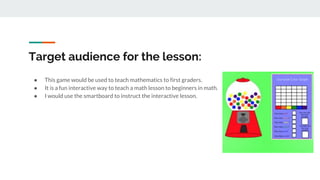
● This game would be used to teach mathematics to first graders.
● It is a fun interactive way to teach a math lesson to beginners in math.
● I would use the smartboard to instruct the interactive lesson.
Why this lesson would be effective:
● This lesson will teach beginners in math in a visual representation.
● Math can be very hard to comprehend for younger kids so by instructing the students on a SMART
board they would be able to fully engage in the lesson plan.
● Compared to just doing standard math problems, students would be more willing to participate
and learn because it is a competitive game.
Basic math with the gumball game:
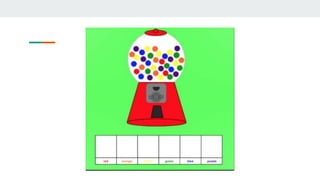
● I would start the game by instructing the students to look at the gumball machine and ask how
many of each color are in the machine.
● I would individually ask students to come up to the SMART board and count the gumball of a
certain color. That same student would then write the correct color section the number of
gumballs for that color
● This would not onluy teach students how to do simple addition, but it would also give them a
lesson on how to identify colors.
Using the gumball machine with advanced math:
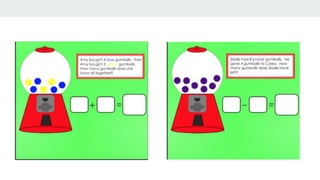
● Next I would try to make the simple lesson more advanced by adding addition and subraction
problems.
● This woud challenge the students to think harder and expand their knowledge.
● I will individually call on students to ask them a vairety of questions where they are asked to add
and subract the number of gumballs.
● I will use real life names and examples so they can relate the math to realistic situations they will
come across on a daily basis.
Testing the gumball lesson:
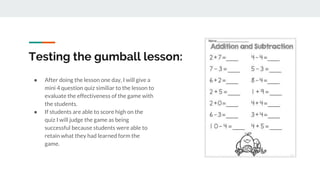
● After doing the lesson one day, I will give a
mini 4 question quiz similiar to the lesson to
evaluate the effectiveness of the game with
the students.
● If students are able to score high on the
quiz I will judge the game as being
successful because students were able to
retain what they had learned form the
game.
How this lesson supports universal design:
● This game engages students visually and
interactively.
● The game supports universal design
because it allows students to
work/participate actively together.
● Students learn more from being involved
and this board allows them to do that.
Sources:
http://exchange.smarttech.com/details.html?id=dd26d41d-fa67-484f-acd1-56b1e991a5f5

Gumball math

  • 1.
  • 2.
    Target audience forthe lesson: ● This game would be used to teach mathematics to first graders. ● It is a fun interactive way to teach a math lesson to beginners in math. ● I would use the smartboard to instruct the interactive lesson.
  • 3.
    Why this lessonwould be effective: ● This lesson will teach beginners in math in a visual representation. ● Math can be very hard to comprehend for younger kids so by instructing the students on a SMART board they would be able to fully engage in the lesson plan. ● Compared to just doing standard math problems, students would be more willing to participate and learn because it is a competitive game.
  • 4.
    Basic math withthe gumball game: ● I would start the game by instructing the students to look at the gumball machine and ask how many of each color are in the machine. ● I would individually ask students to come up to the SMART board and count the gumball of a certain color. That same student would then write the correct color section the number of gumballs for that color ● This would not onluy teach students how to do simple addition, but it would also give them a lesson on how to identify colors.
  • 6.
    Using the gumballmachine with advanced math: ● Next I would try to make the simple lesson more advanced by adding addition and subraction problems. ● This woud challenge the students to think harder and expand their knowledge. ● I will individually call on students to ask them a vairety of questions where they are asked to add and subract the number of gumballs. ● I will use real life names and examples so they can relate the math to realistic situations they will come across on a daily basis.
  • 8.
    Testing the gumballlesson: ● After doing the lesson one day, I will give a mini 4 question quiz similiar to the lesson to evaluate the effectiveness of the game with the students. ● If students are able to score high on the quiz I will judge the game as being successful because students were able to retain what they had learned form the game.
  • 9.
    How this lessonsupports universal design: ● This game engages students visually and interactively. ● The game supports universal design because it allows students to work/participate actively together. ● Students learn more from being involved and this board allows them to do that.
  • 10.