New Simplified Returns
1
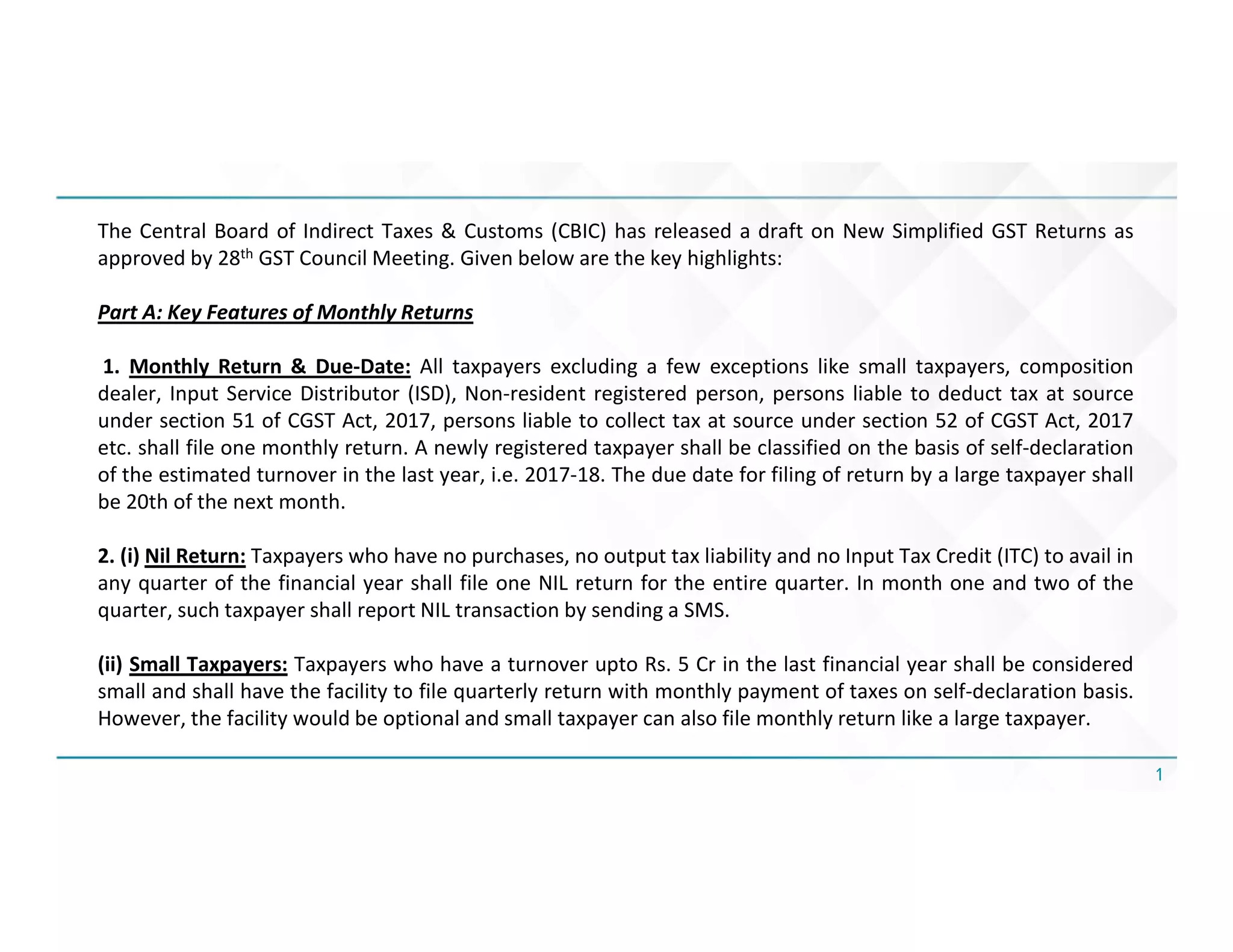
The Central Board of Indirect Taxes & Customs (CBIC) has released a draft on New Simplified GST Returns as
approved by 28th GST Council Meeting. Given below are the key highlights:
Part A: Key Features of Monthly Returns
1. Monthly Return & Due-Date: All taxpayers excluding a few exceptions like small taxpayers, composition
dealer, Input Service Distributor (ISD), Non-resident registered person, persons liable to deduct tax at source
under section 51 of CGST Act, 2017, persons liable to collect tax at source under section 52 of CGST Act, 2017
etc. shall file one monthly return. A newly registered taxpayer shall be classified on the basis of self-declaration
of the estimated turnover in the last year, i.e. 2017-18. The due date for filing of return by a large taxpayer shall
be 20th of the next month.
2. (i) Nil Return: Taxpayers who have no purchases, no output tax liability and no Input Tax Credit (ITC) to avail in
any quarter of the financial year shall file one NIL return for the entire quarter. In month one and two of the
quarter, such taxpayer shall report NIL transaction by sending a SMS.
(ii) Small Taxpayers: Taxpayers who have a turnover upto Rs. 5 Cr in the last financial year shall be considered
small and shall have the facility to file quarterly return with monthly payment of taxes on self-declaration basis.
However, the facility would be optional and small taxpayer can also file monthly return like a large taxpayer.
2
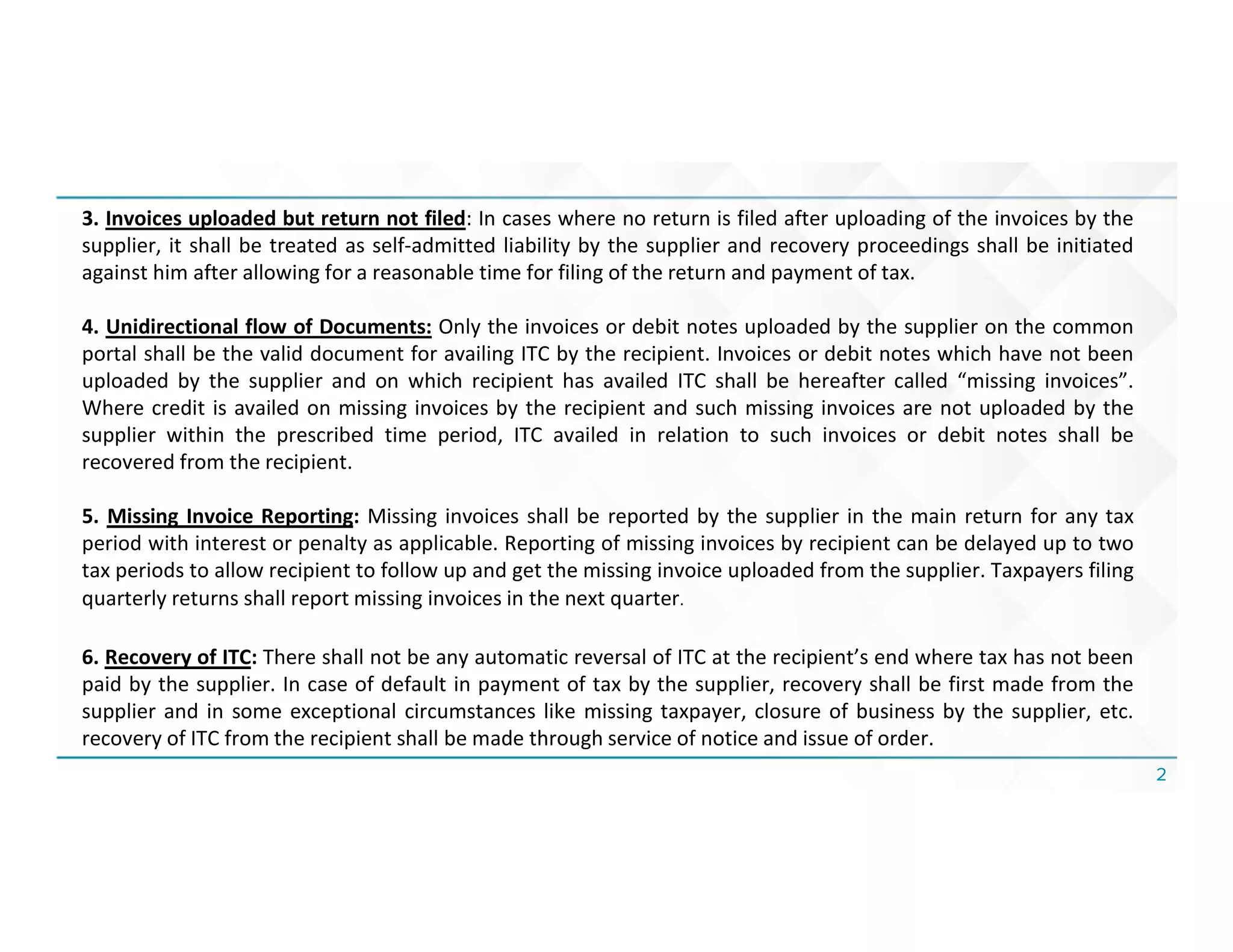
3. Invoices uploaded but return not filed: In cases where no return is filed after uploading of the invoices by the
supplier, it shall be treated as self-admitted liability by the supplier and recovery proceedings shall be initiated
against him after allowing for a reasonable time for filing of the return and payment of tax.
4. Unidirectional flow of Documents: Only the invoices or debit notes uploaded by the supplier on the common
portal shall be the valid document for availing ITC by the recipient. Invoices or debit notes which have not been
uploaded by the supplier and on which recipient has availed ITC shall be hereafter called “missing invoices”.
Where credit is availed on missing invoices by the recipient and such missing invoices are not uploaded by the
supplier within the prescribed time period, ITC availed in relation to such invoices or debit notes shall be
recovered from the recipient.
5. Missing Invoice Reporting: Missing invoices shall be reported by the supplier in the main return for any tax
period with interest or penalty as applicable. Reporting of missing invoices by recipient can be delayed up to two
tax periods to allow recipient to follow up and get the missing invoice uploaded from the supplier. Taxpayers filing
quarterly returns shall report missing invoices in the next quarter.
6. Recovery of ITC: There shall not be any automatic reversal of ITC at the recipient’s end where tax has not been
paid by the supplier. In case of default in payment of tax by the supplier, recovery shall be first made from the
supplier and in some exceptional circumstances like missing taxpayer, closure of business by the supplier, etc.
recovery of ITC from the recipient shall be made through service of notice and issue of order.
3
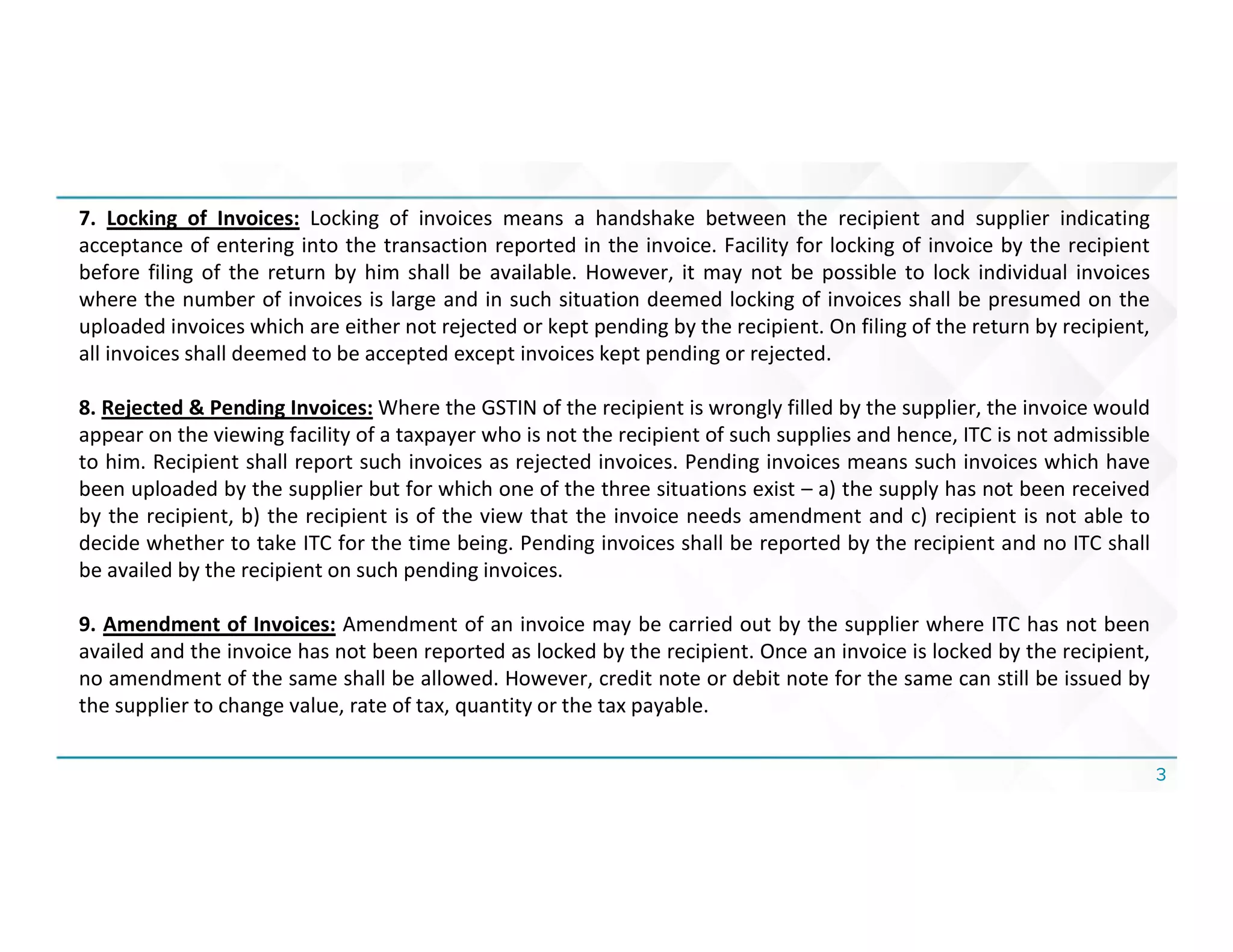
7. Locking of Invoices: Locking of invoices means a handshake between the recipient and supplier indicating
acceptance of entering into the transaction reported in the invoice. Facility for locking of invoice by the recipient
before filing of the return by him shall be available. However, it may not be possible to lock individual invoices
where the number of invoices is large and in such situation deemed locking of invoices shall be presumed on the
uploaded invoices which are either not rejected or kept pending by the recipient. On filing of the return by recipient,
all invoices shall deemed to be accepted except invoices kept pending or rejected.
8. Rejected & Pending Invoices: Where the GSTIN of the recipient is wrongly filled by the supplier, the invoice would
appear on the viewing facility of a taxpayer who is not the recipient of such supplies and hence, ITC is not admissible
to him. Recipient shall report such invoices as rejected invoices. Pending invoices means such invoices which have
been uploaded by the supplier but for which one of the three situations exist – a) the supply has not been received
by the recipient, b) the recipient is of the view that the invoice needs amendment and c) recipient is not able to
decide whether to take ITC for the time being. Pending invoices shall be reported by the recipient and no ITC shall
be availed by the recipient on such pending invoices.
9. Amendment of Invoices: Amendment of an invoice may be carried out by the supplier where ITC has not been
availed and the invoice has not been reported as locked by the recipient. Once an invoice is locked by the recipient,
no amendment of the same shall be allowed. However, credit note or debit note for the same can still be issued by
the supplier to change value, rate of tax, quantity or the tax payable.
4
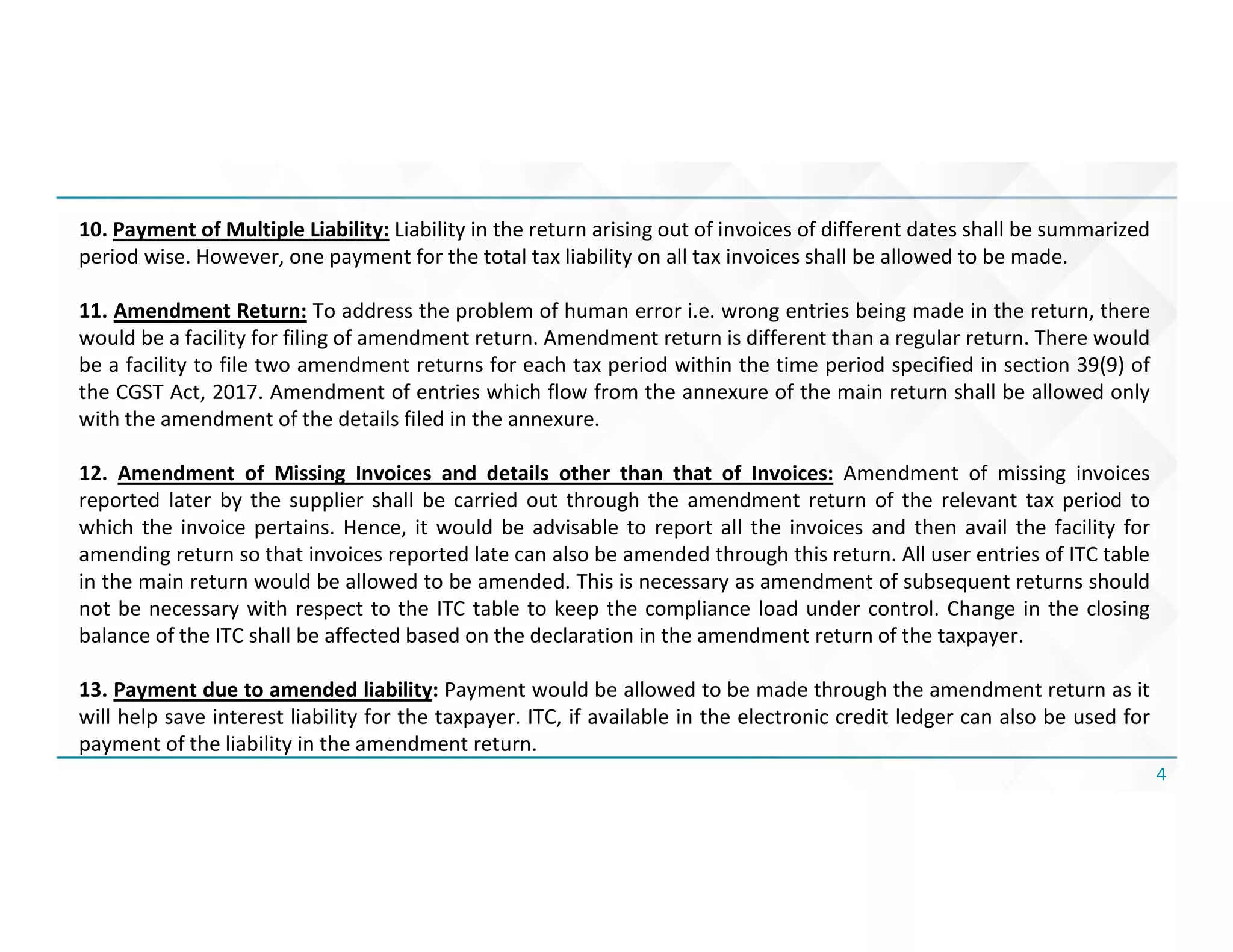
10. Payment of Multiple Liability: Liability in the return arising out of invoices of different dates shall be summarized
period wise. However, one payment for the total tax liability on all tax invoices shall be allowed to be made.
11. Amendment Return: To address the problem of human error i.e. wrong entries being made in the return, there
would be a facility for filing of amendment return. Amendment return is different than a regular return. There would
be a facility to file two amendment returns for each tax period within the time period specified in section 39(9) of
the CGST Act, 2017. Amendment of entries which flow from the annexure of the main return shall be allowed only
with the amendment of the details filed in the annexure.
12. Amendment of Missing Invoices and details other than that of Invoices: Amendment of missing invoices
reported later by the supplier shall be carried out through the amendment return of the relevant tax period to
which the invoice pertains. Hence, it would be advisable to report all the invoices and then avail the facility for
amending return so that invoices reported late can also be amended through this return. All user entries of ITC table
in the main return would be allowed to be amended. This is necessary as amendment of subsequent returns should
not be necessary with respect to the ITC table to keep the compliance load under control. Change in the closing
balance of the ITC shall be affected based on the declaration in the amendment return of the taxpayer.
13. Payment due to amended liability: Payment would be allowed to be made through the amendment return as it
will help save interest liability for the taxpayer. ITC, if available in the electronic credit ledger can also be used for
payment of the liability in the amendment return.
5
14. Higher late fee for amended return: For change in liability of more than 10% through an amendment return, a
higher late fee may be prescribed to ensure that reporting is appropriate in the regular return.
15. Exports: The table for export of goods in return would contain details of the Shipping Bill also. The registered
person can either fill this information at the time of filing the return or after filing the return at his option. Filing the
details of the Shipping bill in the return at a later date shall not be considered as filing of an amendment return.
16. Supply side control: For a newly registered taxpayer and a taxpayer who has defaulted in payment of tax beyond
a time period and/or above a threshold, uploading of invoices shall be allowed only upto a threshold amount or only
after the default in payment of tax is made good respectively. This would lead to the recipient getting protected
against the actions of the supplier and also the interest of public money (revenue) adequately protected.
17. Purchase information in Annual Return: Invoices/ Supplies on which the recipient does not intend to take ITC
but are kept pending or rejected will have to be reported separately in the Annual return.
18. Suspension of Registration: Concept of suspension of registration would be introduced when a registered
person has applied for cancellation of registration or when the conditions in law for cancellation of registration are
satisfied. From the date of suspension to the date of cancellation of registration, return would not be required to be
filed and also invoice uploading shall not be allowed for the period beyond the date of suspension.
6
Part B: Key Features of Quarterly Returns
1. Quarterly filing & monthly payments: It is proposed to provide facility for filing of quarterly return to small
taxpayers, who had a turnover upto Rs. 5 Cr. in the last financial year.
2. Quarterly or monthly return: Option for filing monthly or quarterly return shall be taken from these small
taxpayers at the beginning of the year and generally thereafter they would continue to file the return during the
year as per the option selected. During the course of the year option to change from monthly to quarterly or vice-
versa shall be allowed only once and at the beginning of any quarter.
3. Sahaj & Sugam returns: Small taxpayers often have purchases only from the domestic market and sales in the
domestic market i.e. B2B purchases locally and supplies either as B2C or B2B+B2C. They constitute a very large part
of the tax base and therefore two simplified quarterly returns are proposed for them respectively. They have been
named as “Sahaj” (only B2C outward supplies) and “Sugam” (both B2B and B2C outward supplies).
4. Payment declaration form for payment of monthly taxes: Taxpayers would use a payment declaration form to
make the payment. In the payment declaration form, self-assessed liability and input tax credit on self-declared
basis shall be declared.
7
5. Pending & Missing Invoices: Small businesses have only a few supplies to receive and therefore they track their
purchases well and may not need credit on missing invoices. As the inventory size of these businesses is small they
also do not need to keep invoices pending and generally avail credit forthwith. Therefore quarterly return shall not
have the compliance requirement of missing and pending invoices as small businesses do not use these procedures
in their inventory management.
PRACTICE HEAD
Uday S Gandhi
usg@usgandhigroup.com
+91-22-26601159
+91-9821025835
ENGAGEMENT LEADER
Kunal Gandhi
kunal.gandhi@usgandhigroup.com
+91-22-26601159
+91-9821458072
U. S. Gandhi & Co.
www.usgandhigroup.com
114, Sundervilla, 19, S.V.Road, Santacruz (West),
Mumbai-400054, Maharashtra, India.

Gst Update - Draft New Simplified GST returns

  • 1.
  • 2.
    1 The Central Boardof Indirect Taxes & Customs (CBIC) has released a draft on New Simplified GST Returns as approved by 28th GST Council Meeting. Given below are the key highlights: Part A: Key Features of Monthly Returns 1. Monthly Return & Due-Date: All taxpayers excluding a few exceptions like small taxpayers, composition dealer, Input Service Distributor (ISD), Non-resident registered person, persons liable to deduct tax at source under section 51 of CGST Act, 2017, persons liable to collect tax at source under section 52 of CGST Act, 2017 etc. shall file one monthly return. A newly registered taxpayer shall be classified on the basis of self-declaration of the estimated turnover in the last year, i.e. 2017-18. The due date for filing of return by a large taxpayer shall be 20th of the next month. 2. (i) Nil Return: Taxpayers who have no purchases, no output tax liability and no Input Tax Credit (ITC) to avail in any quarter of the financial year shall file one NIL return for the entire quarter. In month one and two of the quarter, such taxpayer shall report NIL transaction by sending a SMS. (ii) Small Taxpayers: Taxpayers who have a turnover upto Rs. 5 Cr in the last financial year shall be considered small and shall have the facility to file quarterly return with monthly payment of taxes on self-declaration basis. However, the facility would be optional and small taxpayer can also file monthly return like a large taxpayer.
  • 3.
    2 3. Invoices uploadedbut return not filed: In cases where no return is filed after uploading of the invoices by the supplier, it shall be treated as self-admitted liability by the supplier and recovery proceedings shall be initiated against him after allowing for a reasonable time for filing of the return and payment of tax. 4. Unidirectional flow of Documents: Only the invoices or debit notes uploaded by the supplier on the common portal shall be the valid document for availing ITC by the recipient. Invoices or debit notes which have not been uploaded by the supplier and on which recipient has availed ITC shall be hereafter called “missing invoices”. Where credit is availed on missing invoices by the recipient and such missing invoices are not uploaded by the supplier within the prescribed time period, ITC availed in relation to such invoices or debit notes shall be recovered from the recipient. 5. Missing Invoice Reporting: Missing invoices shall be reported by the supplier in the main return for any tax period with interest or penalty as applicable. Reporting of missing invoices by recipient can be delayed up to two tax periods to allow recipient to follow up and get the missing invoice uploaded from the supplier. Taxpayers filing quarterly returns shall report missing invoices in the next quarter. 6. Recovery of ITC: There shall not be any automatic reversal of ITC at the recipient’s end where tax has not been paid by the supplier. In case of default in payment of tax by the supplier, recovery shall be first made from the supplier and in some exceptional circumstances like missing taxpayer, closure of business by the supplier, etc. recovery of ITC from the recipient shall be made through service of notice and issue of order.
  • 4.
    3 7. Locking ofInvoices: Locking of invoices means a handshake between the recipient and supplier indicating acceptance of entering into the transaction reported in the invoice. Facility for locking of invoice by the recipient before filing of the return by him shall be available. However, it may not be possible to lock individual invoices where the number of invoices is large and in such situation deemed locking of invoices shall be presumed on the uploaded invoices which are either not rejected or kept pending by the recipient. On filing of the return by recipient, all invoices shall deemed to be accepted except invoices kept pending or rejected. 8. Rejected & Pending Invoices: Where the GSTIN of the recipient is wrongly filled by the supplier, the invoice would appear on the viewing facility of a taxpayer who is not the recipient of such supplies and hence, ITC is not admissible to him. Recipient shall report such invoices as rejected invoices. Pending invoices means such invoices which have been uploaded by the supplier but for which one of the three situations exist – a) the supply has not been received by the recipient, b) the recipient is of the view that the invoice needs amendment and c) recipient is not able to decide whether to take ITC for the time being. Pending invoices shall be reported by the recipient and no ITC shall be availed by the recipient on such pending invoices. 9. Amendment of Invoices: Amendment of an invoice may be carried out by the supplier where ITC has not been availed and the invoice has not been reported as locked by the recipient. Once an invoice is locked by the recipient, no amendment of the same shall be allowed. However, credit note or debit note for the same can still be issued by the supplier to change value, rate of tax, quantity or the tax payable.
  • 5.
    4 10. Payment ofMultiple Liability: Liability in the return arising out of invoices of different dates shall be summarized period wise. However, one payment for the total tax liability on all tax invoices shall be allowed to be made. 11. Amendment Return: To address the problem of human error i.e. wrong entries being made in the return, there would be a facility for filing of amendment return. Amendment return is different than a regular return. There would be a facility to file two amendment returns for each tax period within the time period specified in section 39(9) of the CGST Act, 2017. Amendment of entries which flow from the annexure of the main return shall be allowed only with the amendment of the details filed in the annexure. 12. Amendment of Missing Invoices and details other than that of Invoices: Amendment of missing invoices reported later by the supplier shall be carried out through the amendment return of the relevant tax period to which the invoice pertains. Hence, it would be advisable to report all the invoices and then avail the facility for amending return so that invoices reported late can also be amended through this return. All user entries of ITC table in the main return would be allowed to be amended. This is necessary as amendment of subsequent returns should not be necessary with respect to the ITC table to keep the compliance load under control. Change in the closing balance of the ITC shall be affected based on the declaration in the amendment return of the taxpayer. 13. Payment due to amended liability: Payment would be allowed to be made through the amendment return as it will help save interest liability for the taxpayer. ITC, if available in the electronic credit ledger can also be used for payment of the liability in the amendment return.
  • 6.
    5 14. Higher latefee for amended return: For change in liability of more than 10% through an amendment return, a higher late fee may be prescribed to ensure that reporting is appropriate in the regular return. 15. Exports: The table for export of goods in return would contain details of the Shipping Bill also. The registered person can either fill this information at the time of filing the return or after filing the return at his option. Filing the details of the Shipping bill in the return at a later date shall not be considered as filing of an amendment return. 16. Supply side control: For a newly registered taxpayer and a taxpayer who has defaulted in payment of tax beyond a time period and/or above a threshold, uploading of invoices shall be allowed only upto a threshold amount or only after the default in payment of tax is made good respectively. This would lead to the recipient getting protected against the actions of the supplier and also the interest of public money (revenue) adequately protected. 17. Purchase information in Annual Return: Invoices/ Supplies on which the recipient does not intend to take ITC but are kept pending or rejected will have to be reported separately in the Annual return. 18. Suspension of Registration: Concept of suspension of registration would be introduced when a registered person has applied for cancellation of registration or when the conditions in law for cancellation of registration are satisfied. From the date of suspension to the date of cancellation of registration, return would not be required to be filed and also invoice uploading shall not be allowed for the period beyond the date of suspension.
  • 7.
    6 Part B: KeyFeatures of Quarterly Returns 1. Quarterly filing & monthly payments: It is proposed to provide facility for filing of quarterly return to small taxpayers, who had a turnover upto Rs. 5 Cr. in the last financial year. 2. Quarterly or monthly return: Option for filing monthly or quarterly return shall be taken from these small taxpayers at the beginning of the year and generally thereafter they would continue to file the return during the year as per the option selected. During the course of the year option to change from monthly to quarterly or vice- versa shall be allowed only once and at the beginning of any quarter. 3. Sahaj & Sugam returns: Small taxpayers often have purchases only from the domestic market and sales in the domestic market i.e. B2B purchases locally and supplies either as B2C or B2B+B2C. They constitute a very large part of the tax base and therefore two simplified quarterly returns are proposed for them respectively. They have been named as “Sahaj” (only B2C outward supplies) and “Sugam” (both B2B and B2C outward supplies). 4. Payment declaration form for payment of monthly taxes: Taxpayers would use a payment declaration form to make the payment. In the payment declaration form, self-assessed liability and input tax credit on self-declared basis shall be declared.
  • 8.
    7 5. Pending &Missing Invoices: Small businesses have only a few supplies to receive and therefore they track their purchases well and may not need credit on missing invoices. As the inventory size of these businesses is small they also do not need to keep invoices pending and generally avail credit forthwith. Therefore quarterly return shall not have the compliance requirement of missing and pending invoices as small businesses do not use these procedures in their inventory management.
  • 9.
    PRACTICE HEAD Uday SGandhi usg@usgandhigroup.com +91-22-26601159 +91-9821025835 ENGAGEMENT LEADER Kunal Gandhi kunal.gandhi@usgandhigroup.com +91-22-26601159 +91-9821458072 U. S. Gandhi & Co. www.usgandhigroup.com 114, Sundervilla, 19, S.V.Road, Santacruz (West), Mumbai-400054, Maharashtra, India.