SAP GST Implementation Road Map
By
1
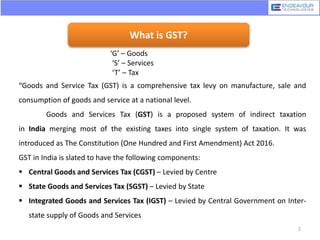
‘G’ – Goods
‘S’ – Services
‘T’ – Tax
“Goods and Service Tax (GST) is a comprehensive tax levy on manufacture, sale and
consumption of goods and service at a national level.
Goods and Services Tax (GST) is a proposed system of indirect taxation
in India merging most of the existing taxes into single system of taxation. It was
introduced as The Constitution (One Hundred and First Amendment) Act 2016.
GST in India is slated to have the following components:
 Central Goods and Services Tax (CGST) – Levied by Centre
 State Goods and Services Tax (SGST) – Levied by State
 Integrated Goods and Services Tax (IGST) – Levied by Central Government on Inter-
state supply of Goods and Services
What is GST?
2
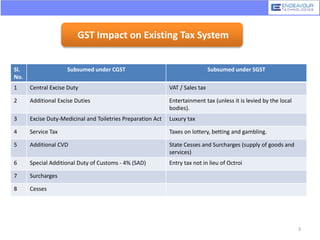
GST Impact on Existing Tax System
Sl.
No.
Subsumed under CGST Subsumed under SGST
1 Central Excise Duty VAT / Sales tax
2 Additional Excise Duties Entertainment tax (unless it is levied by the local
bodies).
3 Excise Duty-Medicinal and Toiletries Preparation Act Luxury tax
4 Service Tax Taxes on lottery, betting and gambling.
5 Additional CVD State Cesses and Surcharges (supply of goods and
services)
6 Special Additional Duty of Customs - 4% (SAD) Entry tax not in lieu of Octroi
7 Surcharges
8 Cesses
3
Proposed
Solution on
SAP GST
Implementation
4
Mandatory Pre-Requisites for SAP GST
• Tax Procedure should be on TAXINN, if not migrate from TAXINJ to
TAXINN
• Recommendation to move to the latest support pack (SAP Note
1175384 for GST)
SAP_APPL_Release Support Pack
• SAP ERP 6.0 (600) SP 26
• EHP2 for SAP ERP 6.0 (602) SP 16
• EHP3 for SAP ERP 6.0 (603) SP 15
• EHP4 for SAP ERP 6.0 (604) SP 16
• EHP5 for SAP ERP 6.0 (605) SP 13
• EHP6 for SAP ERP 6.0 (606) SP 14
• EHP6 for SAP ERP 6.0 for HANA (616 – SAP HANA) SP 08
• EHP7 for SAP ERP 6.0 (607) SP 07
5
Road Map for Migration TAXINJ to TAXINN
• The following notes should be implemented before the migration procedure.
SAP Note 2167294 - Activate a update programed
SAP Note 2153807- Improvements in updated program
SAP Note 2161911- Solution for TAXINJ document reversal/cancellation
• For TAXINN need to create own separate access sequence.
• Users can use the same condition type from TAXINJ in TAXINN. If there are any new
condition types which the client requires it can be added in TAXINN.
• We can maintain the tax rate at FV11 based on condition types and also maintain at
FTXP however both data will be updated in same tables.
• GL determination can be same as TAXINJ.
• The tax conditions and accounting keys used in TAXINJ can be utilized as same in
TAXINN.
• Assign tax codes to company codes.
• Assign GL Accounts to new tax codes and create existing tax codes of TAXINJ in TAXINN
• All your open PO”s ,GRs need to migrate to TAXINN.
6
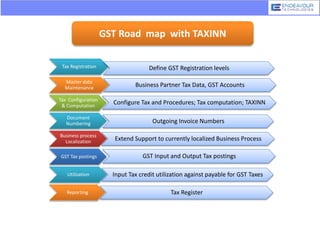
Tax Registration Define GST Registration levels
Master data
Maintenance Business Partner Tax Data, GST Accounts
Tax Configuration
& Computation
Configure Tax and Procedures; Tax computation; TAXINN
Document
Numbering Outgoing Invoice Numbers
Business process
Localization Extend Support to currently localized Business Process
GST Tax postings GST Input and Output Tax postings
Utilization Input Tax credit utilization against payable for GST Taxes
Reporting Tax Register
GST Road map with TAXINN
8
Resources
Resources in Number Place of work
1 - FICO Consultant ONSITE
1 - MM Consultant ONSITE
1 - SD Consultant ONSITE
3 - ABAP Consultants OFFSHORE
1 - BASIS Consultant OFFSHORE
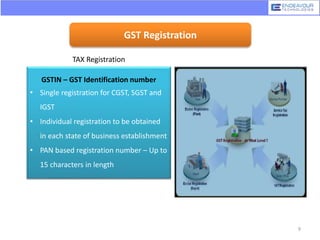
GST Registration
GSTIN – GST Identification number
• Single registration for CGST, SGST and
IGST
• Individual registration to be obtained
in each state of business establishment
• PAN based registration number – Up to
15 characters in length
TAX Registration
9
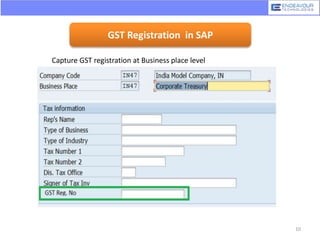
GST Registration in SAP
Capture GST registration at Business place level
level
10
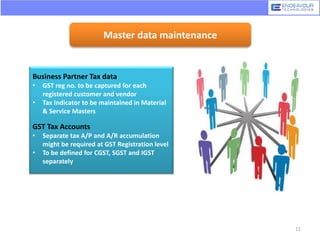
Master data maintenance
Business Partner Tax data
• GST reg no. to be captured for each
registered customer and vendor
• Tax Indicator to be maintained in Material
& Service Masters
GST Tax Accounts
• Separate tax A/P and A/R accumulation
might be required at GST Registration level
• To be defined for CGST, SGST and IGST
separately
11
12
Master Data Changes with GST
• HSN code field will be added newly in Material Master
• SAC code field will be added newly in Service Master
• New GST Tax accounts will exist
• Customer GST registration numbers will be maintained at
customer masters
• Vendor GST registration numbers will be maintained at vendor
masters
Customer/Vendor GST Reg in SAP
13
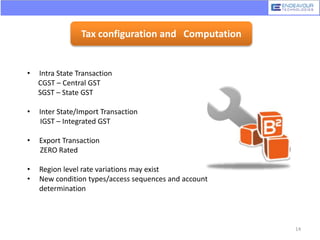
Tax configuration and Computation
• Intra State Transaction
CGST – Central GST
SGST – State GST
• Inter State/Import Transaction
IGST – Integrated GST
• Export Transaction
ZERO Rated
• Region level rate variations may exist
• New condition types/access sequences and account
determination
14
GST Tax /Pricing procedure
Tax Procedure – New Condition Types
15
GST Document Numbering
Unique sequential numbering for outgoing GST invoices
• Criteria for legal numbering may be
specified by govt.
• It could be for example:
Registration level
Document type (Invoice / Credit Memo)
A combination of above
Assign Number Range to Business Place
16
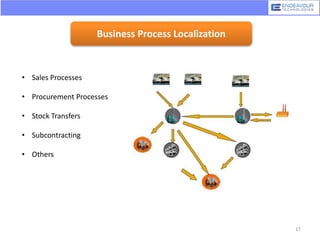
Business Process Localization
• Sales Processes
• Procurement Processes
• Stock Transfers
• Subcontracting
• Others
17
SD Pricing procedure
18
SD Pricing Procedure - New condition Types
Sales Process
Sales Order
19
Sales Process
Billing Document A/R
20
Procurement Process
Purchase Order
21
Procurement Process
Vendor Invoice (A/P)
22
GST Tax Postings
• Separate accumulation of credit and payables
for CGST,SGST and IGST
• Separate accumulation at Registration level
• Automatic Tax posting to respective accounts
from business processes
23
GST Tax Postings at A/R & A/P
Billing (A/R) Accounting Document
Vendor Invoice (A/P) Accounting Document
24
GST Utilization
Utilization of Input tax credit would be as under
• Input CGST to be utilized against output CGST and IGST
• Input SGST to be utilized against output SGST and IGST
• Input IGST to be utilized against output IGST, CGST and SGST in the
order of IGST, CGST and SGST
25
Reporting
• Tax register
 CGST
 SGST
 IGST
• Registration level segregation
26
GST Digital India
27
GST Network
• Goods and Services Tax Network (GSTN) is a Section 8 (under new
companies Act, not for profit companies are governed under section 8)
• GSTN primary purpose is to provide IT infrastructure and services to central
and state governments
• Infosys, which a few months ago won a landmark Rs 1,380-crore contract
from the government to develop a state of-the-art technology platform for
the proposed goods and services tax (GST), is going ahead with the project
despite the delay in the GST Bill getting passed, according to ministers and
executives directly familiar with the matter.
GST Suvidha Provider
• In the evolving environment of the new GST regime it is envisioned that the
GST Suvidha Providers (GSP) concept is going to play a very important and
strategic role. It is the endeavour of GSTN to build the GSP eco system,
ensure its success by putting in place an open, transparent and participative
framework for capable and motivated enterprises and entrepreneurs.
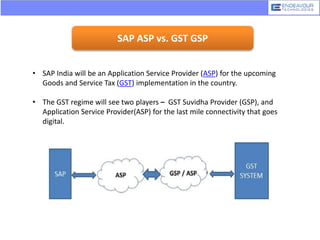
SAP ASP vs. GST GSP
• SAP India will be an Application Service Provider (ASP) for the upcoming
Goods and Service Tax (GST) implementation in the country.
• The GST regime will see two players – GST Suvidha Provider (GSP), and
Application Service Provider(ASP) for the last mile connectivity that goes
digital.
GST Return Forms
• GSTR-1 Outward Supply(Sales)
• GSTR-2 Inward Supplies(Purchases)
• GSTR-3 GST Returns
• GSTR-4 Quarterly Returns
• GSTR-5 Returns for non resident
• GSTR-6 Returns for input service
• GSTR-7 TDS Returns
• GSTR-8 Annual Returns
32

Gst implementation road map by endeavour technologies

  • 1.
  • 2.
    ‘G’ – Goods ‘S’– Services ‘T’ – Tax “Goods and Service Tax (GST) is a comprehensive tax levy on manufacture, sale and consumption of goods and service at a national level. Goods and Services Tax (GST) is a proposed system of indirect taxation in India merging most of the existing taxes into single system of taxation. It was introduced as The Constitution (One Hundred and First Amendment) Act 2016. GST in India is slated to have the following components:  Central Goods and Services Tax (CGST) – Levied by Centre  State Goods and Services Tax (SGST) – Levied by State  Integrated Goods and Services Tax (IGST) – Levied by Central Government on Inter- state supply of Goods and Services What is GST? 2
  • 3.
    GST Impact onExisting Tax System Sl. No. Subsumed under CGST Subsumed under SGST 1 Central Excise Duty VAT / Sales tax 2 Additional Excise Duties Entertainment tax (unless it is levied by the local bodies). 3 Excise Duty-Medicinal and Toiletries Preparation Act Luxury tax 4 Service Tax Taxes on lottery, betting and gambling. 5 Additional CVD State Cesses and Surcharges (supply of goods and services) 6 Special Additional Duty of Customs - 4% (SAD) Entry tax not in lieu of Octroi 7 Surcharges 8 Cesses 3
  • 4.
  • 5.
    Mandatory Pre-Requisites forSAP GST • Tax Procedure should be on TAXINN, if not migrate from TAXINJ to TAXINN • Recommendation to move to the latest support pack (SAP Note 1175384 for GST) SAP_APPL_Release Support Pack • SAP ERP 6.0 (600) SP 26 • EHP2 for SAP ERP 6.0 (602) SP 16 • EHP3 for SAP ERP 6.0 (603) SP 15 • EHP4 for SAP ERP 6.0 (604) SP 16 • EHP5 for SAP ERP 6.0 (605) SP 13 • EHP6 for SAP ERP 6.0 (606) SP 14 • EHP6 for SAP ERP 6.0 for HANA (616 – SAP HANA) SP 08 • EHP7 for SAP ERP 6.0 (607) SP 07 5
  • 6.
    Road Map forMigration TAXINJ to TAXINN • The following notes should be implemented before the migration procedure. SAP Note 2167294 - Activate a update programed SAP Note 2153807- Improvements in updated program SAP Note 2161911- Solution for TAXINJ document reversal/cancellation • For TAXINN need to create own separate access sequence. • Users can use the same condition type from TAXINJ in TAXINN. If there are any new condition types which the client requires it can be added in TAXINN. • We can maintain the tax rate at FV11 based on condition types and also maintain at FTXP however both data will be updated in same tables. • GL determination can be same as TAXINJ. • The tax conditions and accounting keys used in TAXINJ can be utilized as same in TAXINN. • Assign tax codes to company codes. • Assign GL Accounts to new tax codes and create existing tax codes of TAXINJ in TAXINN • All your open PO”s ,GRs need to migrate to TAXINN. 6
  • 7.
    Tax Registration DefineGST Registration levels Master data Maintenance Business Partner Tax Data, GST Accounts Tax Configuration & Computation Configure Tax and Procedures; Tax computation; TAXINN Document Numbering Outgoing Invoice Numbers Business process Localization Extend Support to currently localized Business Process GST Tax postings GST Input and Output Tax postings Utilization Input Tax credit utilization against payable for GST Taxes Reporting Tax Register GST Road map with TAXINN
  • 8.
    8 Resources Resources in NumberPlace of work 1 - FICO Consultant ONSITE 1 - MM Consultant ONSITE 1 - SD Consultant ONSITE 3 - ABAP Consultants OFFSHORE 1 - BASIS Consultant OFFSHORE
  • 9.
    GST Registration GSTIN –GST Identification number • Single registration for CGST, SGST and IGST • Individual registration to be obtained in each state of business establishment • PAN based registration number – Up to 15 characters in length TAX Registration 9
  • 10.
    GST Registration inSAP Capture GST registration at Business place level level 10
  • 11.
    Master data maintenance BusinessPartner Tax data • GST reg no. to be captured for each registered customer and vendor • Tax Indicator to be maintained in Material & Service Masters GST Tax Accounts • Separate tax A/P and A/R accumulation might be required at GST Registration level • To be defined for CGST, SGST and IGST separately 11
  • 12.
    12 Master Data Changeswith GST • HSN code field will be added newly in Material Master • SAC code field will be added newly in Service Master • New GST Tax accounts will exist • Customer GST registration numbers will be maintained at customer masters • Vendor GST registration numbers will be maintained at vendor masters
  • 13.
  • 14.
    Tax configuration andComputation • Intra State Transaction CGST – Central GST SGST – State GST • Inter State/Import Transaction IGST – Integrated GST • Export Transaction ZERO Rated • Region level rate variations may exist • New condition types/access sequences and account determination 14
  • 15.
    GST Tax /Pricingprocedure Tax Procedure – New Condition Types 15
  • 16.
    GST Document Numbering Uniquesequential numbering for outgoing GST invoices • Criteria for legal numbering may be specified by govt. • It could be for example: Registration level Document type (Invoice / Credit Memo) A combination of above Assign Number Range to Business Place 16
  • 17.
    Business Process Localization •Sales Processes • Procurement Processes • Stock Transfers • Subcontracting • Others 17
  • 18.
    SD Pricing procedure 18 SDPricing Procedure - New condition Types
  • 19.
  • 20.
  • 21.
  • 22.
  • 23.
    GST Tax Postings •Separate accumulation of credit and payables for CGST,SGST and IGST • Separate accumulation at Registration level • Automatic Tax posting to respective accounts from business processes 23
  • 24.
    GST Tax Postingsat A/R & A/P Billing (A/R) Accounting Document Vendor Invoice (A/P) Accounting Document 24
  • 25.
    GST Utilization Utilization ofInput tax credit would be as under • Input CGST to be utilized against output CGST and IGST • Input SGST to be utilized against output SGST and IGST • Input IGST to be utilized against output IGST, CGST and SGST in the order of IGST, CGST and SGST 25
  • 26.
    Reporting • Tax register CGST  SGST  IGST • Registration level segregation 26
  • 27.
  • 28.
    GST Network • Goodsand Services Tax Network (GSTN) is a Section 8 (under new companies Act, not for profit companies are governed under section 8) • GSTN primary purpose is to provide IT infrastructure and services to central and state governments • Infosys, which a few months ago won a landmark Rs 1,380-crore contract from the government to develop a state of-the-art technology platform for the proposed goods and services tax (GST), is going ahead with the project despite the delay in the GST Bill getting passed, according to ministers and executives directly familiar with the matter.
  • 29.
    GST Suvidha Provider •In the evolving environment of the new GST regime it is envisioned that the GST Suvidha Providers (GSP) concept is going to play a very important and strategic role. It is the endeavour of GSTN to build the GSP eco system, ensure its success by putting in place an open, transparent and participative framework for capable and motivated enterprises and entrepreneurs.
  • 30.
    SAP ASP vs.GST GSP • SAP India will be an Application Service Provider (ASP) for the upcoming Goods and Service Tax (GST) implementation in the country. • The GST regime will see two players – GST Suvidha Provider (GSP), and Application Service Provider(ASP) for the last mile connectivity that goes digital.
  • 31.
    GST Return Forms •GSTR-1 Outward Supply(Sales) • GSTR-2 Inward Supplies(Purchases) • GSTR-3 GST Returns • GSTR-4 Quarterly Returns • GSTR-5 Returns for non resident • GSTR-6 Returns for input service • GSTR-7 TDS Returns • GSTR-8 Annual Returns
  • 32.