Venture Fast Track
October 24, 2013
Overview	
  of	
  a	
  Term	
  Sheet	
  
•  Two	
  most	
  common	
  early-­‐stage	
  securi8es:	
  
–  1)	
  Conver8ble	
  Debt	
  
–  2)	
  Preferred	
  Stock	
  
•  Conver8ble	
  preferred	
  stock	
  
•  Redeemable	
  preferred	
  stock	
  

2	
  
What	
  is	
  Preferred	
  Stock?	
  
•  Fairly	
  standard	
  in	
  early-­‐stage	
  investment	
  
•  Has	
  certain	
  preferences:	
  
–  Liquida8on	
  preference	
  
–  Dividends	
  (maybe)	
  
–  Board	
  representa8on	
  and	
  blocking	
  rights	
  
–  An8-­‐dilu8on	
  protec8on	
  
–  Redemp8on	
  rights	
  

3	
  
Preferred	
  Stock	
  Term	
  Sheet	
  

•  What	
  is	
  a	
  term	
  sheet?	
  
–  Agree	
  on	
  fundamentals	
  before	
  legal	
  draOing	
  

•  A	
  term	
  sheet	
  is	
  generally	
  non-­‐binding,	
  but...	
  
–  Confiden8ality	
  
–  No-­‐shops	
  
–  Expense	
  provisions	
  
4	
  
Overview	
  of	
  Economics:	
  Equity	
  
•  Price	
  Terms	
  
–  Pre-­‐money	
  valua8on?	


–  Op8on	
  Pool	
  –	
  size	
  and	
  8ming	
  of	
  addi8on	
  
•  Treatment	
  of	
  Dividends	
  
–  Cumula8ve	
  dividends	
  
•  Liquida8on	
  Preferences	
  
–  Par8cipa8ng	
  vs.	
  Non-­‐Par8cipa8ng;	
  dollar-­‐capped	
  
–  The	
  effect	
  on	
  “Ownership	
  Percentage”	
  
•  Price	
  Protec8on	
  –	
  An8-­‐Dilu8on	
  
–  Full	
  vs.	
  weighted	
  average	
  
•  Redemp8on	
  Features	
  
–  Timing	
  and	
  consequences	
  
5	
  
Equity	
  Pricing:	
  Terms	
  to	
  
Understand	
  
•  Pre-­‐Money	
  	
  
–  What	
  the	
  investor	
  believes	
  the	
  company	
  is	
  worth	
  
prior	
  to	
  their	
  investment	
  

•  Post	
  Money	
  
–  Simply	
  the	
  pre-­‐money	
  valua8on	
  plus	
  the	
  
investment	
  amount	
  
6	
  
Equity	
  Pricing:	
  Terms	
  to	
  
Understand	
  
•  Op8on	
  Pool	
  
–  Given	
  to	
  incen8vize	
  employees	
  
–  Feel	
  ownership	
  in	
  company	
  
–  How	
  does	
  it	
  impact	
  Founder	
  economics/ownership?	
  	
  
–  Who	
  benefits?	
  
•  Considera8ons	
  
–  When	
  does	
  it	
  get	
  added?	
  
–  How	
  big	
  should	
  it	
  be?	
  
–  What	
  is	
  the	
  ves8ng	
  schedule?	
  	
  
–  Is	
  there	
  accelera8on	
  on	
  a	
  liquidity	
  event?	
  
7	
  
Equity	
  :	
  Liquida8on	
  Preferences	
  
•  Preferred	
  –	
  First	
  out	
  in	
  “liquida8on	
  event”	
  
–  Liquida8on	
  event:	
  
•  Merger,	
  acquisi8on,	
  change	
  of	
  control,	
  true	
  liquida8on	
  

–  Return	
  of	
  investment	
  before	
  common	
  stock	
  then...	
  
–  Is	
  it	
  Par8cipa8ng	
  Preferred	
  or	
  Non-­‐Par8cipa8ng?	
  
•  With	
  Par8cipa8ng	
  Preferred,	
  the	
  investor	
  gets	
  its	
  
liquida8on	
  preference	
  and	
  then	
  par8cipates	
  in	
  all	
  
residual	
  distribu8ons	
  on	
  an	
  as	
  converted	
  basis	
  
•  With	
  Non-­‐Par8cipa8ng	
  Preferred,	
  the	
  investor	
  is	
  only	
  
en8tled	
  to	
  its	
  liquida8on	
  preference	
  
8	
  
Equity:	
  Par8cipa8ng	
  Preferred	
  vs.	
  
Non	
  
•  An	
  example:	
  
•  10M	
  shares	
  of	
  common	
  stock	
  outstanding	
  
(assuming	
  exercise	
  of	
  all	
  op8ons	
  in	
  pool)	
  
•  Investors	
  hold	
  10M	
  shares	
  of	
  preferred	
  
purchased	
  for	
  $1.00	
  per	
  share	
  	
  
•  Preferred	
  convert	
  to	
  common	
  on	
  a	
  1-­‐for-­‐1	
  
basis	
  
•  Preferred	
  has	
  a	
  1X	
  liquida8on	
  preference	
  
9	
  
Equity:	
  Par8cipa8ng	
  Preferred	
  vs.	
  Non	
  
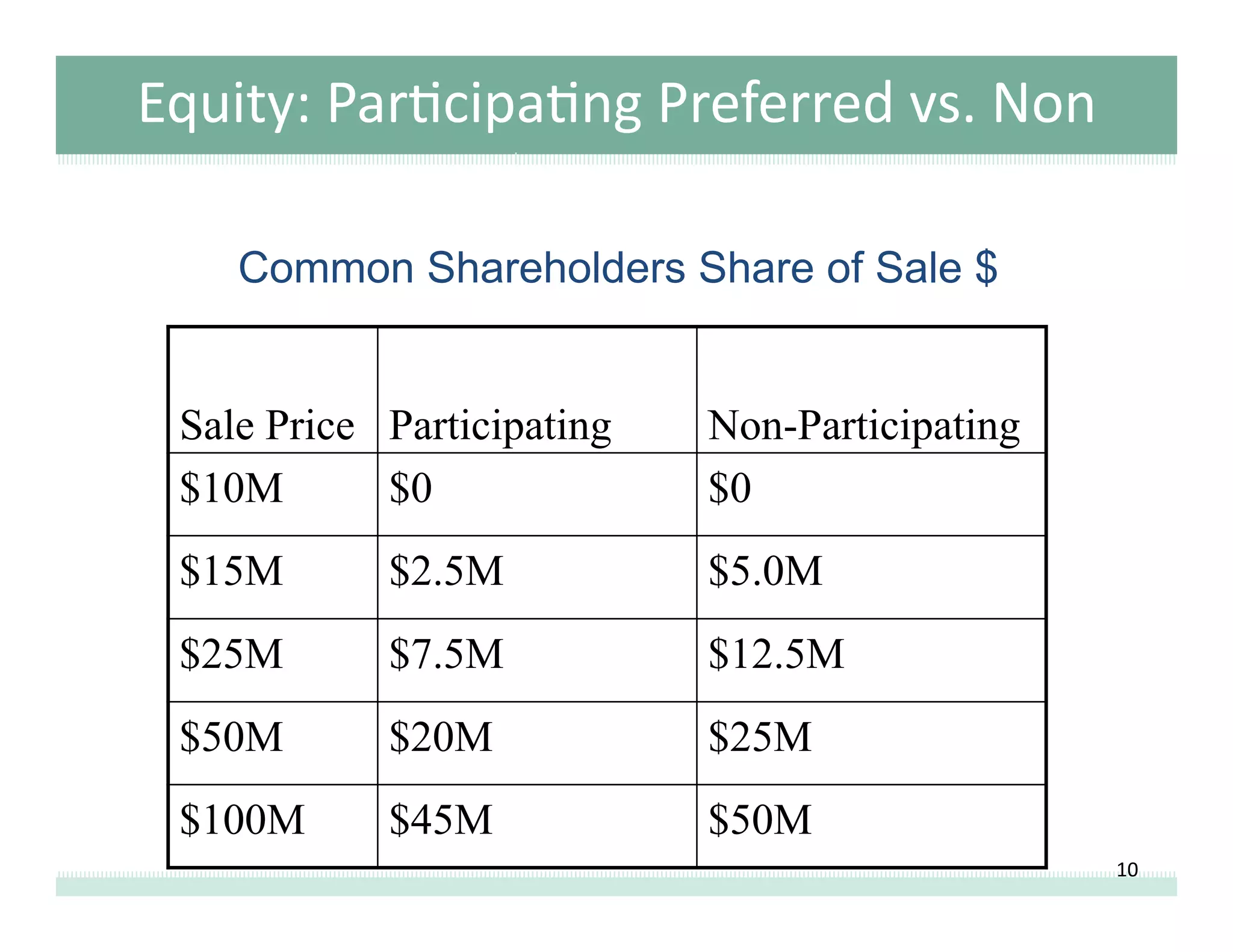
Common Shareholders Share of Sale $
Sale Price Participating
$10M
$0

Non-Participating
$0

$15M

$2.5M

$5.0M

$25M

$7.5M

$12.5M

$50M

$20M

$25M

$100M

$45M

$50M
10	
  
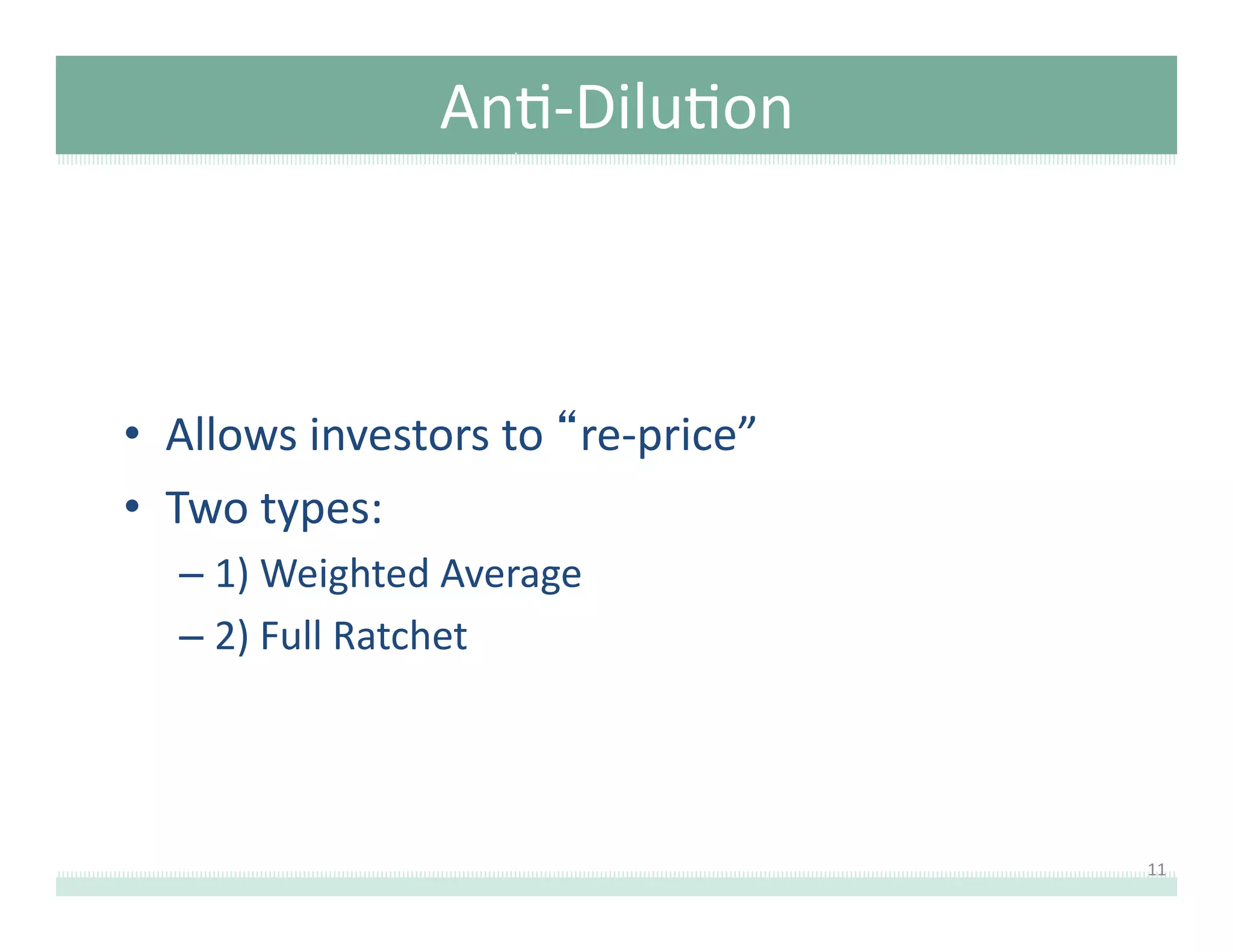
An8-­‐Dilu8on 	


•  Allows	
  investors	
  to	
  “re-­‐price”	
  
•  Two	
  types:	
  
–  1)	
  Weighted	
  Average	
  
–  2)	
  Full	
  Ratchet	
  

11	
  
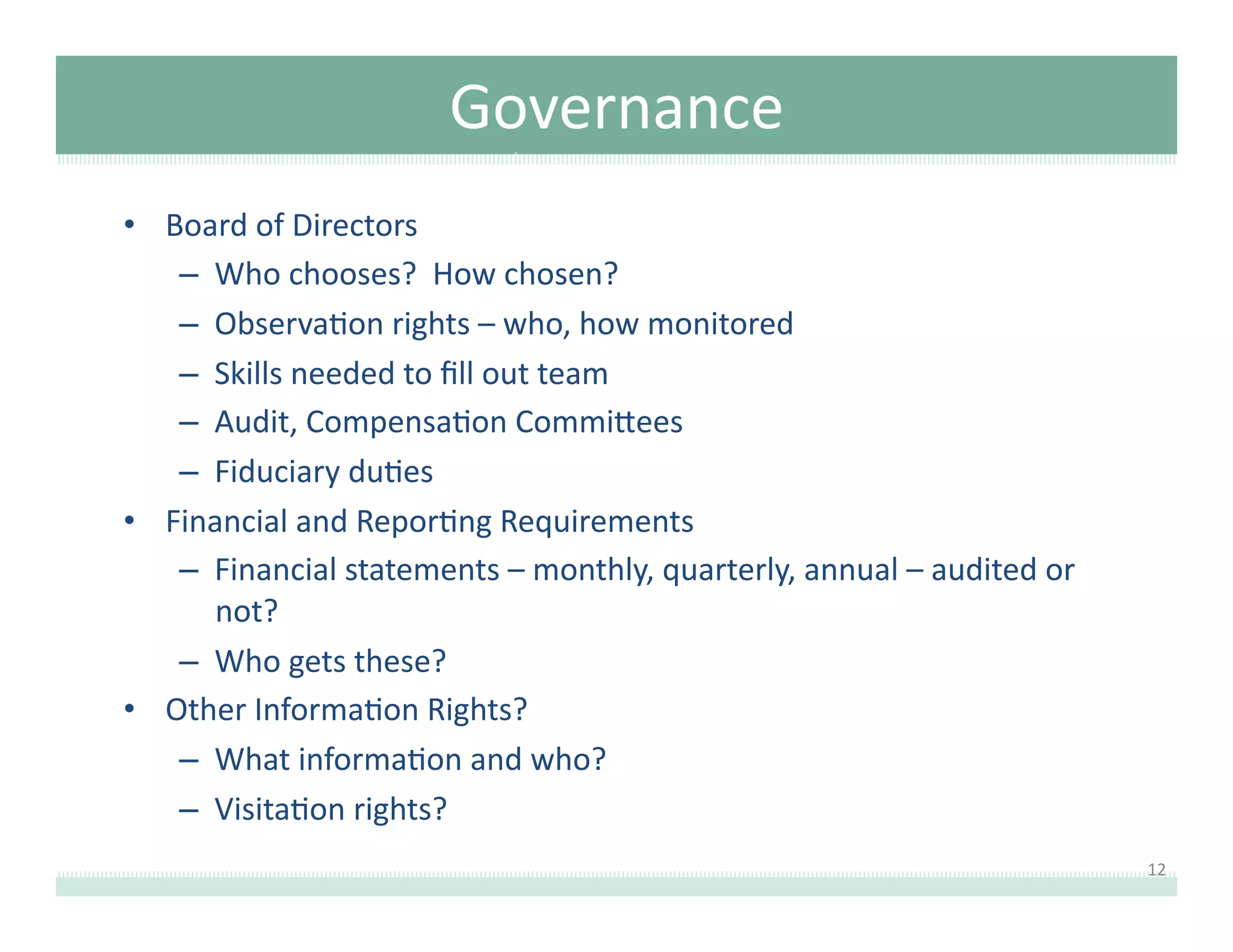
Governance	
  
•  Board	
  of	
  Directors	
  
–  Who	
  chooses?	
  	
  How	
  chosen?	
  
–  Observa8on	
  rights	
  –	
  who,	
  how	
  monitored	
  
–  Skills	
  needed	
  to	
  fill	
  out	
  team	
  	
  
–  Audit,	
  Compensa8on	
  Commiiees	
  
–  Fiduciary	
  du8es	
  	
  
•  Financial	
  and	
  Repor8ng	
  Requirements	
  
–  Financial	
  statements	
  –	
  monthly,	
  quarterly,	
  annual	
  –	
  audited	
  or	
  
not?	
  
–  Who	
  gets	
  these?	
  
•  Other	
  Informa8on	
  Rights?	
  	
  
–  What	
  informa8on	
  and	
  who?	
  
–  Visita8on	
  rights?	
  
12	
  
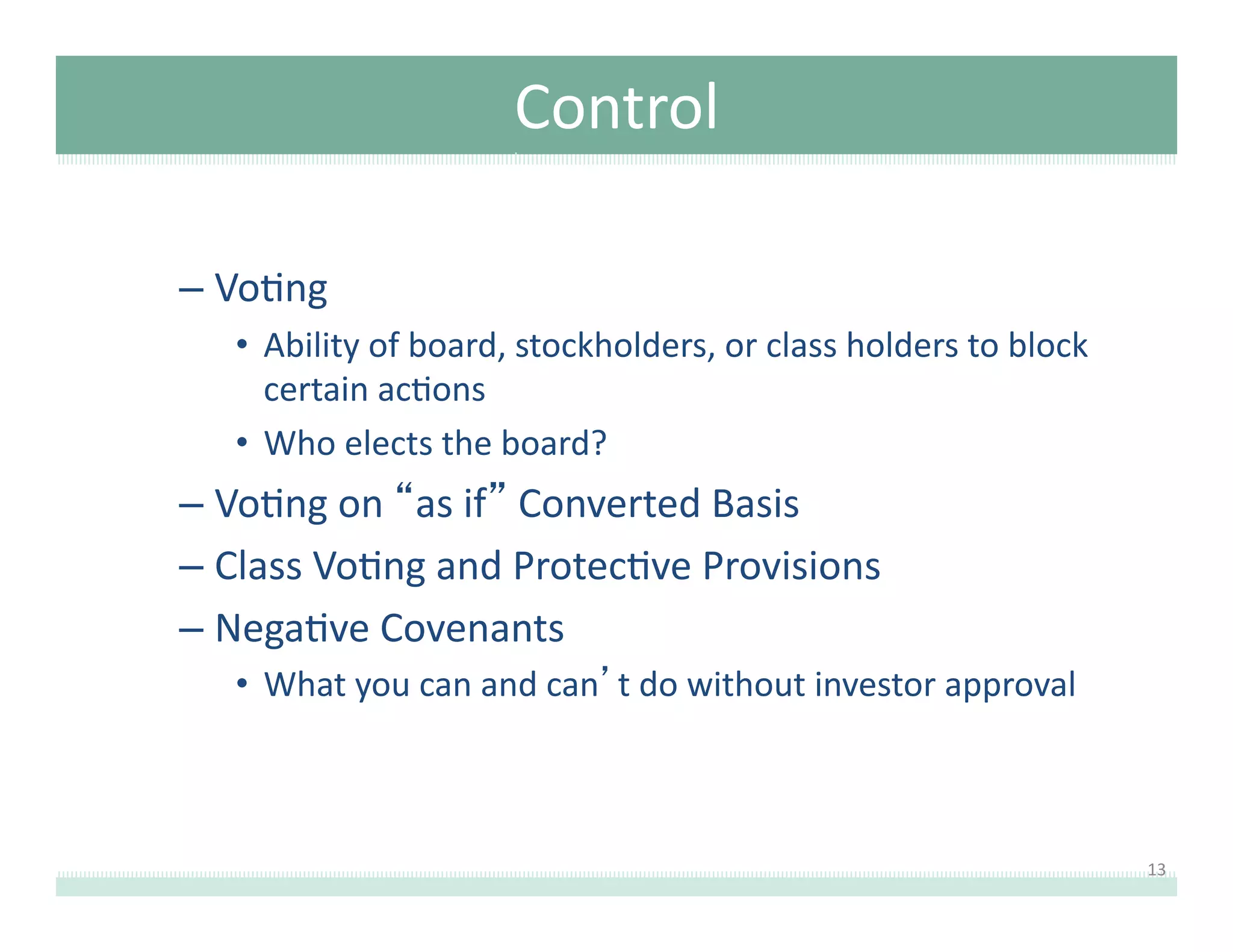
Control	
  
–  Vo8ng	
  	
  
•  Ability	
  of	
  board,	
  stockholders,	
  or	
  class	
  holders	
  to	
  block	
  
certain	
  ac8ons	
  
•  Who	
  elects	
  the	
  board?	
  

–  Vo8ng	
  on	
  “as	
  if”	
  Converted	
  Basis	
  	
  
–  Class	
  Vo8ng	
  and	
  Protec8ve	
  Provisions	
  
–  Nega8ve	
  Covenants	
  
•  What	
  you	
  can	
  and	
  can’t	
  do	
  without	
  investor	
  approval	
  

13	
  
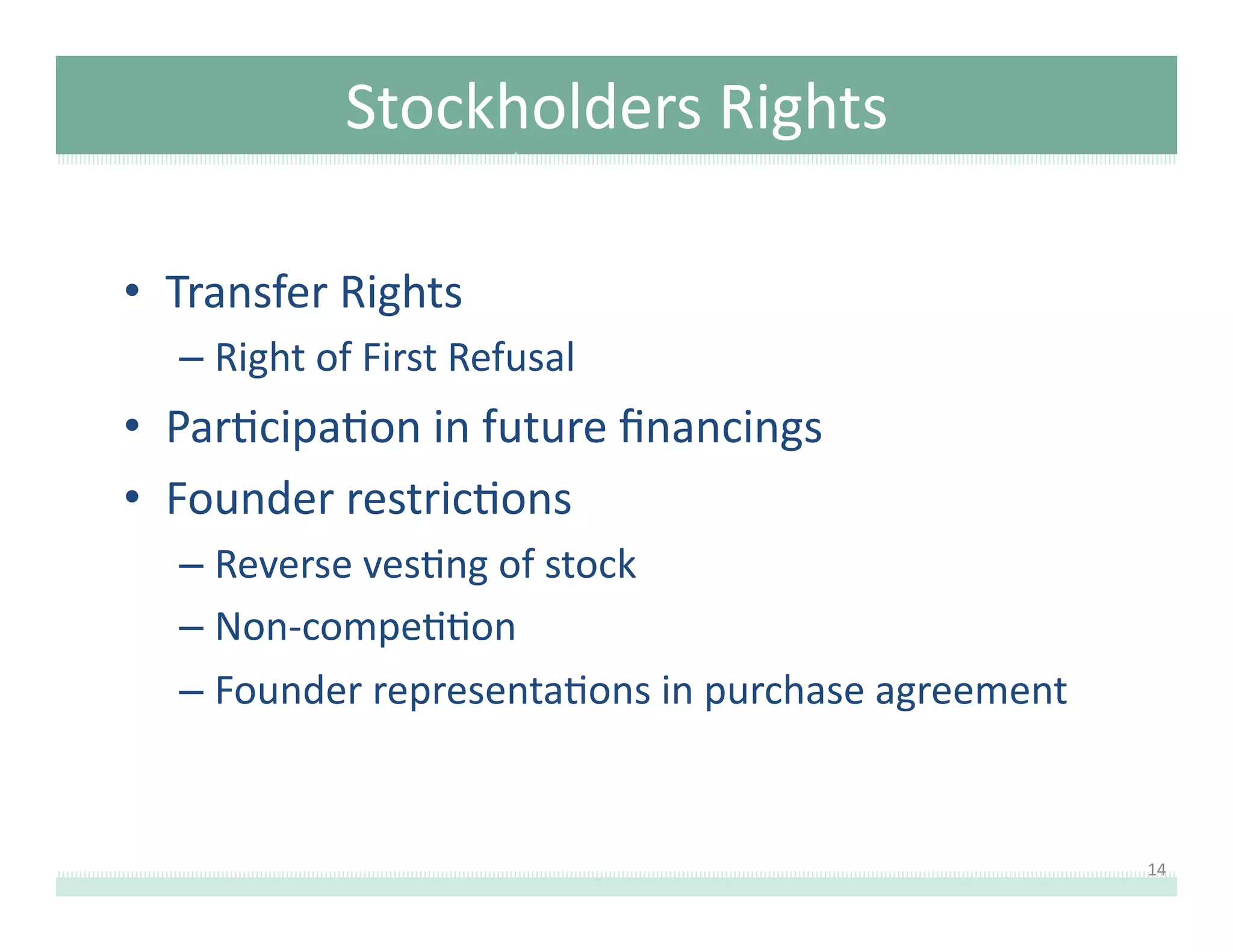
Stockholders	
  Rights	
  	
  
•  Transfer	
  Rights	
  	
  
–  Right	
  of	
  First	
  Refusal	
  

•  Par8cipa8on	
  in	
  future	
  financings	
  
•  Founder	
  restric8ons	
  
–  Reverse	
  ves8ng	
  of	
  stock	
  
–  Non-­‐compe88on	
  
–  Founder	
  representa8ons	
  in	
  purchase	
  agreement	
  

14	
  
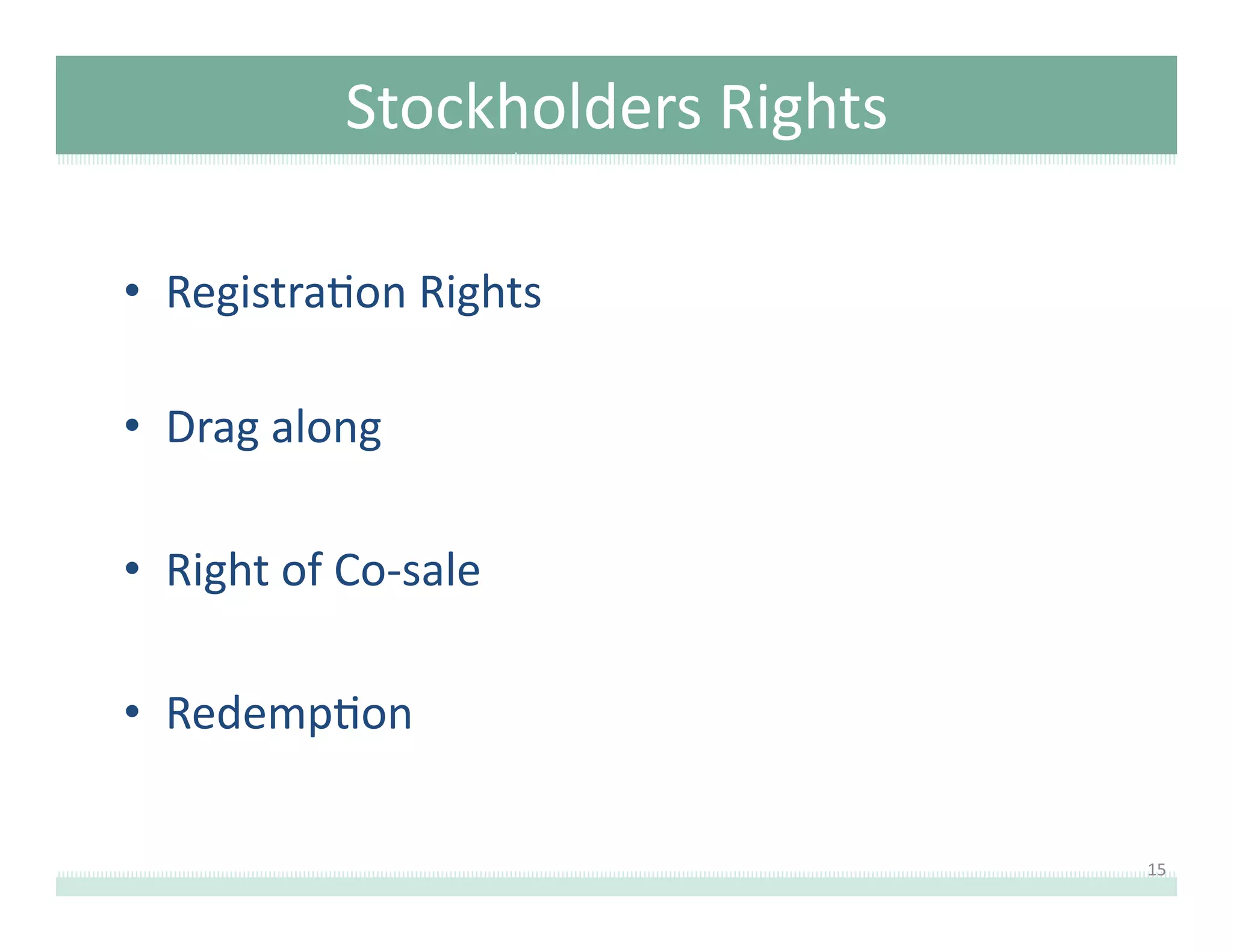
Stockholders	
  Rights	
  
•  Registra8on	
  Rights	
  
•  Drag	
  along	
  
•  Right	
  of	
  Co-­‐sale	
  
•  Redemp8on	
  	
  
15	
  

Negotiating Term sheets (Venture Fast Track)

  • 1.
  • 2.
    Overview  of  a  Term  Sheet   •  Two  most  common  early-­‐stage  securi8es:   –  1)  Conver8ble  Debt   –  2)  Preferred  Stock   •  Conver8ble  preferred  stock   •  Redeemable  preferred  stock   2  
  • 3.
    What  is  Preferred  Stock?   •  Fairly  standard  in  early-­‐stage  investment   •  Has  certain  preferences:   –  Liquida8on  preference   –  Dividends  (maybe)   –  Board  representa8on  and  blocking  rights   –  An8-­‐dilu8on  protec8on   –  Redemp8on  rights   3  
  • 4.
    Preferred  Stock  Term  Sheet   •  What  is  a  term  sheet?   –  Agree  on  fundamentals  before  legal  draOing   •  A  term  sheet  is  generally  non-­‐binding,  but...   –  Confiden8ality   –  No-­‐shops   –  Expense  provisions   4  
  • 5.
    Overview  of  Economics:  Equity   •  Price  Terms   –  Pre-­‐money  valua8on?       –  Op8on  Pool  –  size  and  8ming  of  addi8on   •  Treatment  of  Dividends   –  Cumula8ve  dividends   •  Liquida8on  Preferences   –  Par8cipa8ng  vs.  Non-­‐Par8cipa8ng;  dollar-­‐capped   –  The  effect  on  “Ownership  Percentage”   •  Price  Protec8on  –  An8-­‐Dilu8on   –  Full  vs.  weighted  average   •  Redemp8on  Features   –  Timing  and  consequences   5  
  • 6.
    Equity  Pricing:  Terms  to   Understand   •  Pre-­‐Money     –  What  the  investor  believes  the  company  is  worth   prior  to  their  investment   •  Post  Money   –  Simply  the  pre-­‐money  valua8on  plus  the   investment  amount   6  
  • 7.
    Equity  Pricing:  Terms  to   Understand   •  Op8on  Pool   –  Given  to  incen8vize  employees   –  Feel  ownership  in  company   –  How  does  it  impact  Founder  economics/ownership?     –  Who  benefits?   •  Considera8ons   –  When  does  it  get  added?   –  How  big  should  it  be?   –  What  is  the  ves8ng  schedule?     –  Is  there  accelera8on  on  a  liquidity  event?   7  
  • 8.
    Equity  :  Liquida8on  Preferences   •  Preferred  –  First  out  in  “liquida8on  event”   –  Liquida8on  event:   •  Merger,  acquisi8on,  change  of  control,  true  liquida8on   –  Return  of  investment  before  common  stock  then...   –  Is  it  Par8cipa8ng  Preferred  or  Non-­‐Par8cipa8ng?   •  With  Par8cipa8ng  Preferred,  the  investor  gets  its   liquida8on  preference  and  then  par8cipates  in  all   residual  distribu8ons  on  an  as  converted  basis   •  With  Non-­‐Par8cipa8ng  Preferred,  the  investor  is  only   en8tled  to  its  liquida8on  preference   8  
  • 9.
    Equity:  Par8cipa8ng  Preferred  vs.   Non   •  An  example:   •  10M  shares  of  common  stock  outstanding   (assuming  exercise  of  all  op8ons  in  pool)   •  Investors  hold  10M  shares  of  preferred   purchased  for  $1.00  per  share     •  Preferred  convert  to  common  on  a  1-­‐for-­‐1   basis   •  Preferred  has  a  1X  liquida8on  preference   9  
  • 10.
    Equity:  Par8cipa8ng  Preferred  vs.  Non   Common Shareholders Share of Sale $ Sale Price Participating $10M $0 Non-Participating $0 $15M $2.5M $5.0M $25M $7.5M $12.5M $50M $20M $25M $100M $45M $50M 10  
  • 11.
    An8-­‐Dilu8on     •  Allows  investors  to  “re-­‐price”   •  Two  types:   –  1)  Weighted  Average   –  2)  Full  Ratchet   11  
  • 12.
    Governance   •  Board  of  Directors   –  Who  chooses?    How  chosen?   –  Observa8on  rights  –  who,  how  monitored   –  Skills  needed  to  fill  out  team     –  Audit,  Compensa8on  Commiiees   –  Fiduciary  du8es     •  Financial  and  Repor8ng  Requirements   –  Financial  statements  –  monthly,  quarterly,  annual  –  audited  or   not?   –  Who  gets  these?   •  Other  Informa8on  Rights?     –  What  informa8on  and  who?   –  Visita8on  rights?   12  
  • 13.
    Control   –  Vo8ng     •  Ability  of  board,  stockholders,  or  class  holders  to  block   certain  ac8ons   •  Who  elects  the  board?   –  Vo8ng  on  “as  if”  Converted  Basis     –  Class  Vo8ng  and  Protec8ve  Provisions   –  Nega8ve  Covenants   •  What  you  can  and  can’t  do  without  investor  approval   13  
  • 14.
    Stockholders  Rights     •  Transfer  Rights     –  Right  of  First  Refusal   •  Par8cipa8on  in  future  financings   •  Founder  restric8ons   –  Reverse  ves8ng  of  stock   –  Non-­‐compe88on   –  Founder  representa8ons  in  purchase  agreement   14  
  • 15.
    Stockholders  Rights   • Registra8on  Rights   •  Drag  along   •  Right  of  Co-­‐sale   •  Redemp8on     15