www.sofos.nl


ISAGA - International Simulation and Gaming Association
42nd Annual Conference, 11-15 July 2011, Jachranka, Poland


Pieter van der Hijden MSc
Sofos Consultancy


GS4D - GAMING/SIMULATION FOR DEVELOPMENT
BUILDING AND APPLYING GAMES FOR DEVELOPING COUNTRIES


                                                                1
www.sofos.nl


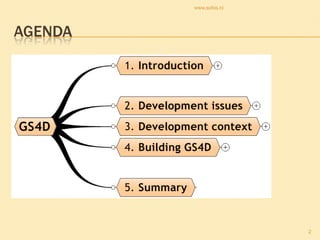
AGENDA


                        2
www.sofos.nl


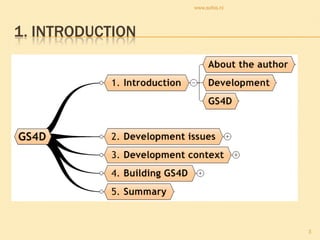
1. INTRODUCTION


                                 3
www.sofos.nl


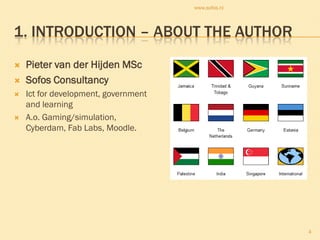
1. INTRODUCTION – ABOUT THE AUTHOR
   Pieter van der Hijden MSc
   Sofos Consultancy
   Ict for development, government
    and learning
   A.o. Gaming/simulation,
    Cyberdam, Fab Labs, Moodle.


                                                     4
www.sofos.nl


1. INTRODUCTION - ABOUT THE AUTHOR


Titles of assignments as WordleTM cloud


                                                         5
www.sofos.nl


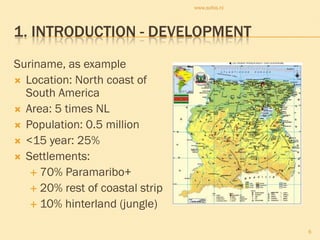
1. INTRODUCTION - DEVELOPMENT
Suriname, as example
 Location: North coast of
  South America
 Area: 5 times NL
 Population: 0.5 million
 <15 year: 25%
 Settlements:
    70% Paramaribo+
    20% rest of coastal strip
    10% hinterland (jungle)


                                                6
www.sofos.nl


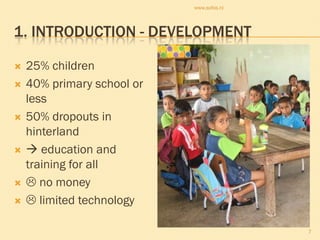
1. INTRODUCTION - DEVELOPMENT

   25% children
   40% primary school or
    less
   50% dropouts in
    hinterland
    education and
    training for all
    no money
    limited technology

                                           7
www.sofos.nl


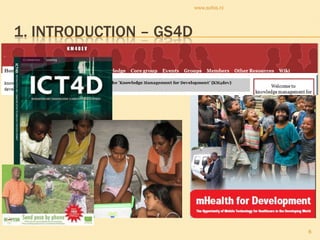
1. INTRODUCTION – GS4D


                                        8
www.sofos.nl


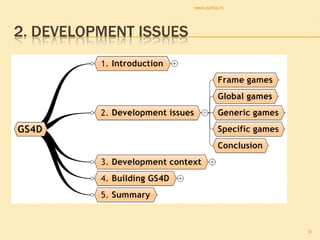
2. DEVELOPMENT ISSUES


                                       9
www.sofos.nl


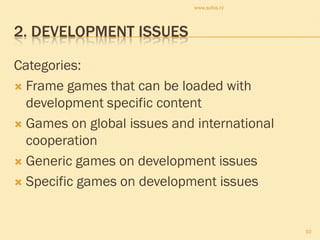
2. DEVELOPMENT ISSUES

Categories:
 Frame games that can be loaded with
  development specific content
 Games on global issues and international
  cooperation
 Generic games on development issues

 Specific games on development issues


                                             10
www.sofos.nl


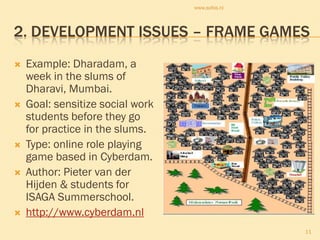
2. DEVELOPMENT ISSUES – FRAME GAMES
   Example: Dharadam, a
    week in the slums of
    Dharavi, Mumbai.
   Goal: sensitize social work
    students before they go
    for practice in the slums.
   Type: online role playing
    game based in Cyberdam.
   Author: Pieter van der
    Hijden & students for
    ISAGA Summerschool.
   http://www.cyberdam.nl
                                                 11
www.sofos.nl


2. DEVELOPMENT ISSUES – GLOBAL ISSUES

   Example: Evoke, a 10-
    week “crash course in
    saving the world.”
   Goal: to help empower
    people all over the
    world to come up with
    creative solutions to
    our most urgent social
    problems.
   Type: social network
    game.
   Author: Natron Baxter
    Applied Gaming
   http://www.urgentevok
    e.com/

                                            12
www.sofos.nl


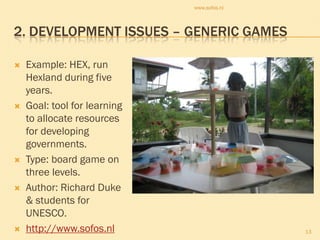
2. DEVELOPMENT ISSUES – GENERIC GAMES

   Example: HEX, run
    Hexland during five
    years.
   Goal: tool for learning
    to allocate resources
    for developing
    governments.
   Type: board game on
    three levels.
   Author: Richard Duke
    & students for
    UNESCO.
   http://www.sofos.nl                      13
www.sofos.nl


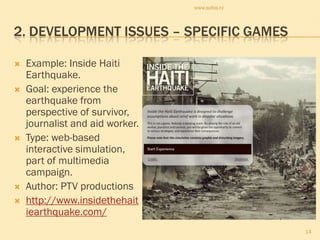
2. DEVELOPMENT ISSUES – SPECIFIC GAMES

   Example: Inside Haiti
    Earthquake.
   Goal: experience the
    earthquake from
    perspective of survivor,
    journalist and aid worker.
   Type: web-based
    interactive simulation,
    part of multimedia
    campaign.
   Author: PTV productions
   http://www.insidethehait
    iearthquake.com/
                                                14
www.sofos.nl


2. DEVELOPMENT ISSUES – CONCLUSION

The examples show:
 A variety of development issues can be
  addressed via a variety of gaming technologies
 Game producers need expertise in both
  domains, so there is a field like GS4D.


                                               15
www.sofos.nl


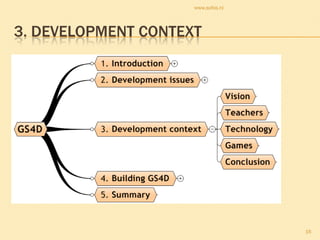
3. DEVELOPMENT CONTEXT


                                    16
www.sofos.nl


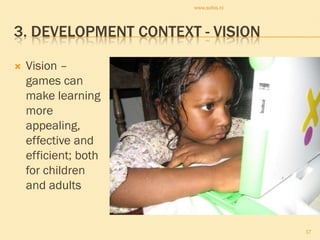
3. DEVELOPMENT CONTEXT - VISION

   Vision –
    games can
    make learning
    more
    appealing,
    effective and
    efficient; both
    for children
    and adults


                                     17
www.sofos.nl


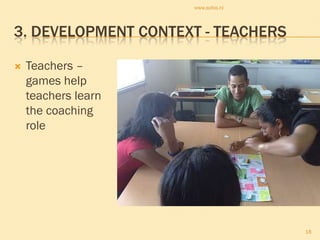
3. DEVELOPMENT CONTEXT - TEACHERS

   Teachers –
    games help
    teachers learn
    the coaching
    role


                                    18
www.sofos.nl


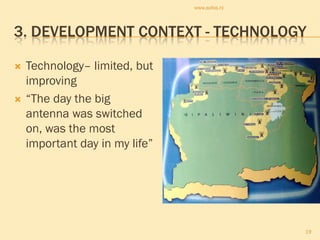
3. DEVELOPMENT CONTEXT - TECHNOLOGY

   Technology– limited, but
    improving
   “The day the big
    antenna was switched
    on, was the most
    important day in my life”


                                               19
www.sofos.nl


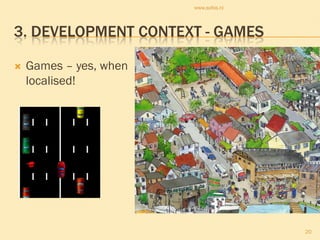
3. DEVELOPMENT CONTEXT - GAMES

   Games – yes, when
    localised!


                                       20
www.sofos.nl


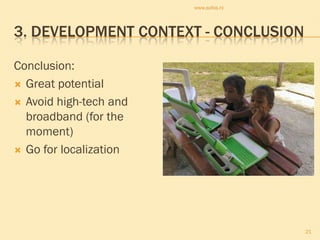
3. DEVELOPMENT CONTEXT - CONCLUSION

Conclusion:
 Great potential

 Avoid high-tech and
  broadband (for the
  moment)
 Go for localization


                                       21
www.sofos.nl


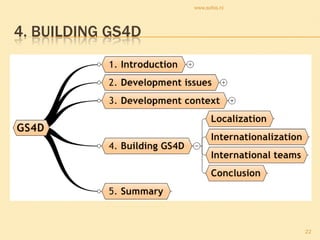
4. BUILDING GS4D


                                  22
www.sofos.nl


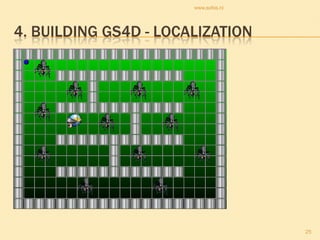
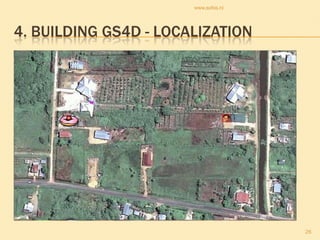
4. BUILDING GS4D - LOCALIZATION

   Localization = preparing
    a game for another
    country, culture or
    language.


                                              23
www.sofos.nl


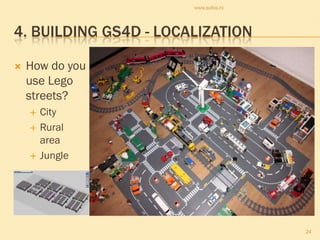
4. BUILDING GS4D - LOCALIZATION

   How do you
    use Lego
    streets?
       City
       Rural
        area
       Jungle


                                      24
www.sofos.nl


4. BUILDING GS4D - LOCALIZATION


                                      25
www.sofos.nl


4. BUILDING GS4D - LOCALIZATION


                                      26
www.sofos.nl


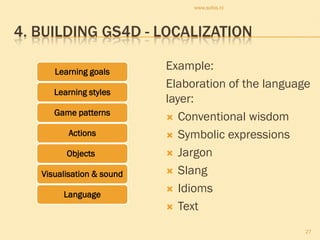
4. BUILDING GS4D - LOCALIZATION

      Learning goals
                           Example:
                           Elaboration of the language
      Learning styles
                           layer:
      Game patterns
                            Conventional wisdom
         Actions            Symbolic expressions

         Objects            Jargon

   Visualisation & sound    Slang

                            Idioms
        Language
                            Text

                                                     27
www.sofos.nl


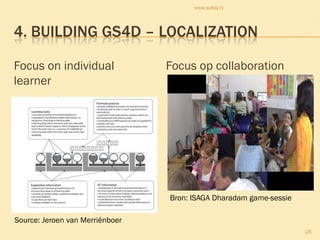
4. BUILDING GS4D – LOCALIZATION

Focus on individual              Focus op collaboration
learner


                                 Bron: ISAGA Dharadam game-sessie

Source: Jeroen van Merriënboer
                                                                    28
www.sofos.nl


4. BUILDING GS4D - INTERNATIONALIZATION

   Internationalization is
    the process of designing
    a game so that it can be
    localized easily.


                                              29
www.sofos.nl


4. BUILDING GS4D – INTERNATIONAL TEAMS

 Multidisciplinary team required
 Local knowledge required

  international team required

Issues:
 Little face-2-face contacts

 Intercultural communication

 Time zones


                                             30
www.sofos.nl


4. BUILDING GS4D - CONCLUSION

 Localization is key success factor
 Localization is more than ICT

 Internationalization and localization are rather
  new for gaming


                                                     31
www.sofos.nl


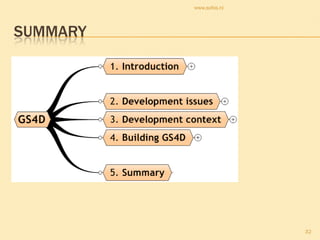
SUMMARY


                         32
www.sofos.nl


SUMMARY
GS4D – Gaming/Simulation for Development
 Development issues
       Interesting and innovative category of games
       Added value for developing countries not always evident
   Development context
       Great potential when localization is OK
       Internationalization will be challenge
   Building GS4D
       Internationalization and localization are rather new for gaming
   GS4D – Gaming/Simulation for Development
       Not a new discipline, but a new specialism
       Local knowledge indispensable
       Internaionalizatiom amd localization become hot

                                                                          33
www.sofos.nl


SOFOS CONSULTANCY


   Thank you for your attention!

   Pieter van der Hijden MSc
   pvdh@sofos.nl


             2011 – Sofos Consultancy / Pieter van der Hijden (pvdh@sofos.nl) - This work is
  licensed under a Creative Commons Attribution- Noncommercial-Share Alike 3.0 Unported
  License.

                                                                                               34

GS4D - Gaming/Simulation for Development building and applying games for developing countries

  • 1.
    www.sofos.nl ISAGA - InternationalSimulation and Gaming Association 42nd Annual Conference, 11-15 July 2011, Jachranka, Poland Pieter van der Hijden MSc Sofos Consultancy GS4D - GAMING/SIMULATION FOR DEVELOPMENT BUILDING AND APPLYING GAMES FOR DEVELOPING COUNTRIES 1
  • 2.
  • 3.
  • 4.
    www.sofos.nl 1. INTRODUCTION –ABOUT THE AUTHOR  Pieter van der Hijden MSc  Sofos Consultancy  Ict for development, government and learning  A.o. Gaming/simulation, Cyberdam, Fab Labs, Moodle. 4
  • 5.
    www.sofos.nl 1. INTRODUCTION -ABOUT THE AUTHOR Titles of assignments as WordleTM cloud 5
  • 6.
    www.sofos.nl 1. INTRODUCTION -DEVELOPMENT Suriname, as example  Location: North coast of South America  Area: 5 times NL  Population: 0.5 million  <15 year: 25%  Settlements:  70% Paramaribo+  20% rest of coastal strip  10% hinterland (jungle) 6
  • 7.
    www.sofos.nl 1. INTRODUCTION -DEVELOPMENT  25% children  40% primary school or less  50% dropouts in hinterland   education and training for all   no money   limited technology 7
  • 8.
  • 9.
  • 10.
    www.sofos.nl 2. DEVELOPMENT ISSUES Categories: Frame games that can be loaded with development specific content  Games on global issues and international cooperation  Generic games on development issues  Specific games on development issues 10
  • 11.
    www.sofos.nl 2. DEVELOPMENT ISSUES– FRAME GAMES  Example: Dharadam, a week in the slums of Dharavi, Mumbai.  Goal: sensitize social work students before they go for practice in the slums.  Type: online role playing game based in Cyberdam.  Author: Pieter van der Hijden & students for ISAGA Summerschool.  http://www.cyberdam.nl 11
  • 12.
    www.sofos.nl 2. DEVELOPMENT ISSUES– GLOBAL ISSUES  Example: Evoke, a 10- week “crash course in saving the world.”  Goal: to help empower people all over the world to come up with creative solutions to our most urgent social problems.  Type: social network game.  Author: Natron Baxter Applied Gaming  http://www.urgentevok e.com/ 12
  • 13.
    www.sofos.nl 2. DEVELOPMENT ISSUES– GENERIC GAMES  Example: HEX, run Hexland during five years.  Goal: tool for learning to allocate resources for developing governments.  Type: board game on three levels.  Author: Richard Duke & students for UNESCO.  http://www.sofos.nl 13
  • 14.
    www.sofos.nl 2. DEVELOPMENT ISSUES– SPECIFIC GAMES  Example: Inside Haiti Earthquake.  Goal: experience the earthquake from perspective of survivor, journalist and aid worker.  Type: web-based interactive simulation, part of multimedia campaign.  Author: PTV productions  http://www.insidethehait iearthquake.com/ 14
  • 15.
    www.sofos.nl 2. DEVELOPMENT ISSUES– CONCLUSION The examples show:  A variety of development issues can be addressed via a variety of gaming technologies  Game producers need expertise in both domains, so there is a field like GS4D. 15
  • 16.
  • 17.
    www.sofos.nl 3. DEVELOPMENT CONTEXT- VISION  Vision – games can make learning more appealing, effective and efficient; both for children and adults 17
  • 18.
    www.sofos.nl 3. DEVELOPMENT CONTEXT- TEACHERS  Teachers – games help teachers learn the coaching role 18
  • 19.
    www.sofos.nl 3. DEVELOPMENT CONTEXT- TECHNOLOGY  Technology– limited, but improving  “The day the big antenna was switched on, was the most important day in my life” 19
  • 20.
    www.sofos.nl 3. DEVELOPMENT CONTEXT- GAMES  Games – yes, when localised! 20
  • 21.
    www.sofos.nl 3. DEVELOPMENT CONTEXT- CONCLUSION Conclusion:  Great potential  Avoid high-tech and broadband (for the moment)  Go for localization 21
  • 22.
  • 23.
    www.sofos.nl 4. BUILDING GS4D- LOCALIZATION  Localization = preparing a game for another country, culture or language. 23
  • 24.
    www.sofos.nl 4. BUILDING GS4D- LOCALIZATION  How do you use Lego streets?  City  Rural area  Jungle 24
  • 25.
  • 26.
  • 27.
    www.sofos.nl 4. BUILDING GS4D- LOCALIZATION Learning goals Example: Elaboration of the language Learning styles layer: Game patterns  Conventional wisdom Actions  Symbolic expressions Objects  Jargon Visualisation & sound  Slang  Idioms Language  Text 27
  • 28.
    www.sofos.nl 4. BUILDING GS4D– LOCALIZATION Focus on individual Focus op collaboration learner Bron: ISAGA Dharadam game-sessie Source: Jeroen van Merriënboer 28
  • 29.
    www.sofos.nl 4. BUILDING GS4D- INTERNATIONALIZATION  Internationalization is the process of designing a game so that it can be localized easily. 29
  • 30.
    www.sofos.nl 4. BUILDING GS4D– INTERNATIONAL TEAMS  Multidisciplinary team required  Local knowledge required   international team required Issues:  Little face-2-face contacts  Intercultural communication  Time zones 30
  • 31.
    www.sofos.nl 4. BUILDING GS4D- CONCLUSION  Localization is key success factor  Localization is more than ICT  Internationalization and localization are rather new for gaming 31
  • 32.
  • 33.
    www.sofos.nl SUMMARY GS4D – Gaming/Simulationfor Development  Development issues  Interesting and innovative category of games  Added value for developing countries not always evident  Development context  Great potential when localization is OK  Internationalization will be challenge  Building GS4D  Internationalization and localization are rather new for gaming  GS4D – Gaming/Simulation for Development  Not a new discipline, but a new specialism  Local knowledge indispensable  Internaionalizatiom amd localization become hot 33
  • 34.
    www.sofos.nl SOFOS CONSULTANCY Thank you for your attention! Pieter van der Hijden MSc pvdh@sofos.nl 2011 – Sofos Consultancy / Pieter van der Hijden (pvdh@sofos.nl) - This work is licensed under a Creative Commons Attribution- Noncommercial-Share Alike 3.0 Unported License. 34