

GROWTH PREDICTIONS

INDIAN DENTAL ACADEMY
Leader in continuing dental education
www.indiandentalacademy.com
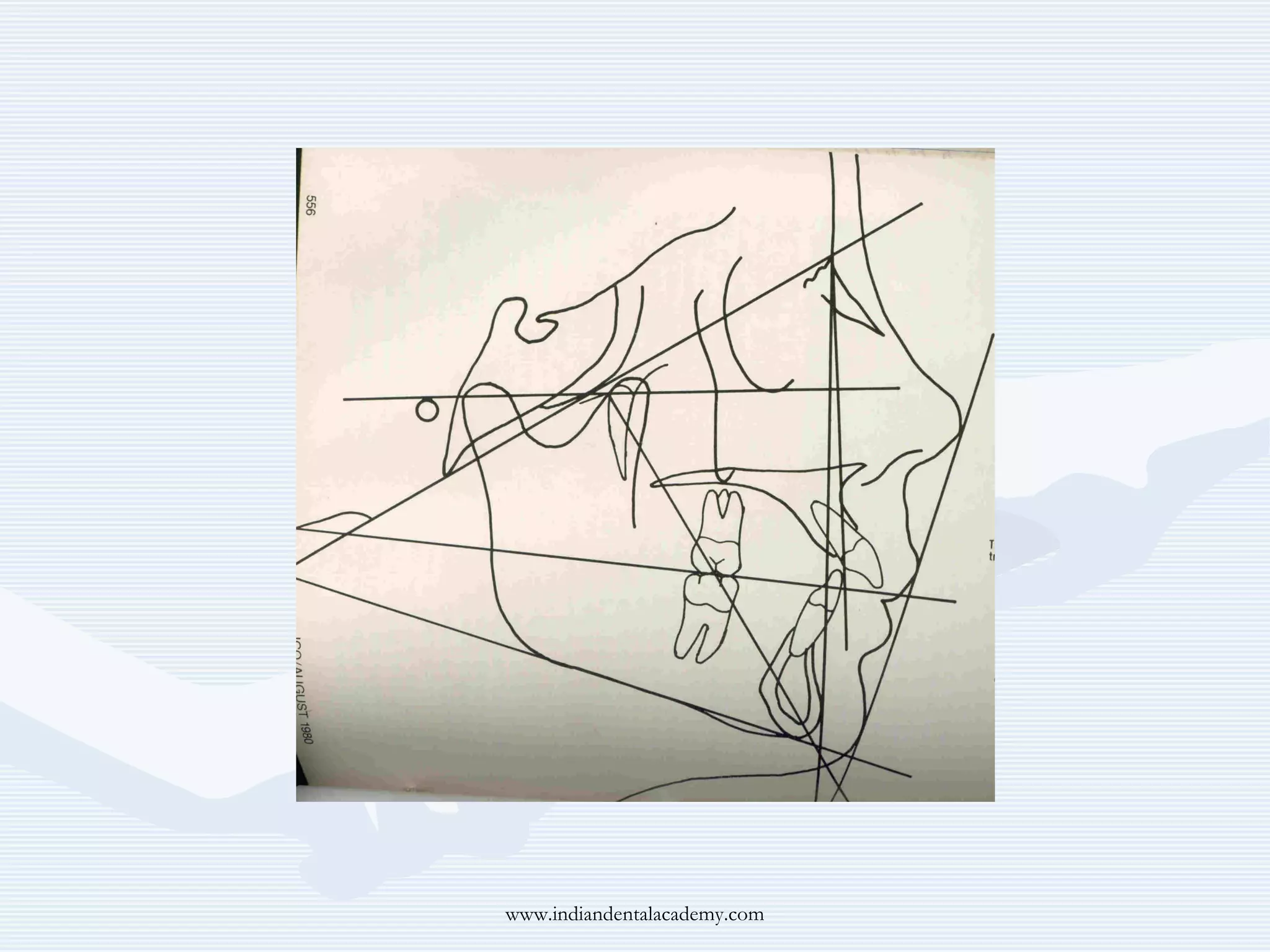
Holdaway’s soft-tissue VTO
• Purpose is to establish a balanced profile and
pleasing facial esthetics and to evaluate the
orthodontic correction necessary to achieve this
goal
• Holdaway VTO emphasizes soft tissue profile
balance

www.indiandentalacademy.com
• Growth of the cranio-facial skeleton is predicted for
the estimated treatment time, and the soft tissue
profile between the nose and the chin arranged to
create an “ideal” facial profile for the individual
patient
• Maxillary and mandibular incisors are repositioned
to eliminate lip strain
• Allowance is made for probable post treatment
“incisor rebound”
• Maxillary teeth are positioned first, and then lower
incisors are repositioned to be in harmony with the
upper incisors
www.indiandentalacademy.com
• Following the repositioning of the mandibular
incisors, the resultant arch length discrepancy
may be calculated to determine whether or not
teeth should be extracted

www.indiandentalacademy.com
• The VTO is thus a dynamic cephalometric
analysis which takes into account both growth
and biomechanics, thus achieving its aim of
being a Visualized Treatment Objective
• It outlines a goal from the inception of
treatment and may be usefully employed in
monitoring growth and treatment progress

www.indiandentalacademy.com
• In sum, therefore the VTO accomplishes :
Predicts growth over an estimated treatment time,
based on the individual morphogenetic pattern
Analyzes the soft tissue facial profile
Graphically plans the best soft tissue facial profile
for the particular patient
Determines favorable incisor repositioning, based on
an “ideal” projected soft tissue facial profile

www.indiandentalacademy.com
Assists in determining total arch length
discrepancy when taking into account
“cephalometric correction”
Aids in determining between extraction and
nonextraction treatment
Aids in deciding which teeth to extract
Assists in planning treatment mechanics
Surgery vs. non-surgery
It provides a visual goal or objective for which to
strive during treatment
www.indiandentalacademy.com
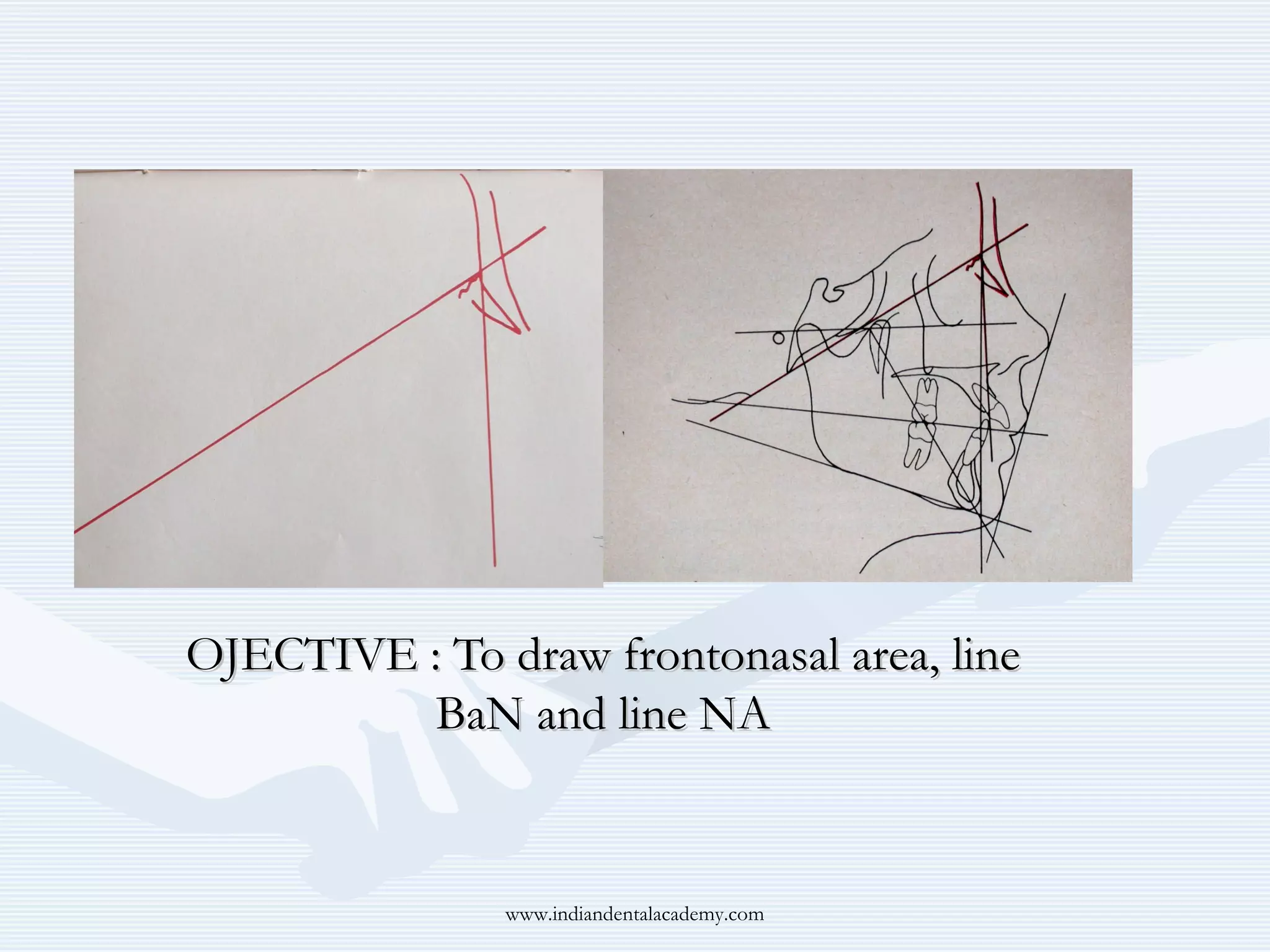
OJECTIVE : To draw frontonasal area, line
BaN and line NA

www.indiandentalacademy.com
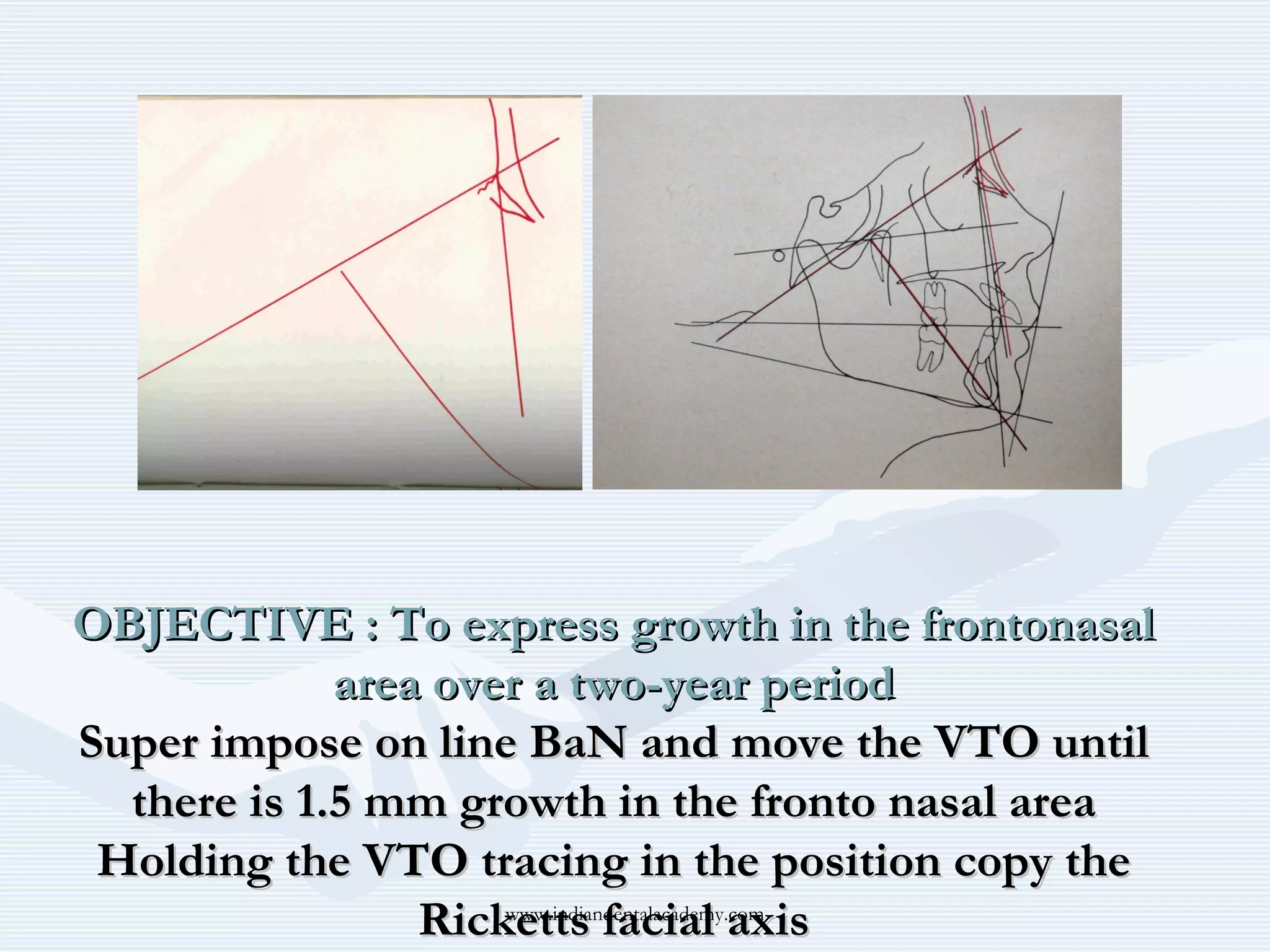
OBJECTIVE : To express growth in the frontonasal
area over a two-year period
Super impose on line BaN and move the VTO until
there is 1.5 mm growth in the fronto nasal area
Holding the VTO tracing in the position copy the
www.indiandentalacademy.com
Ricketts facial axis
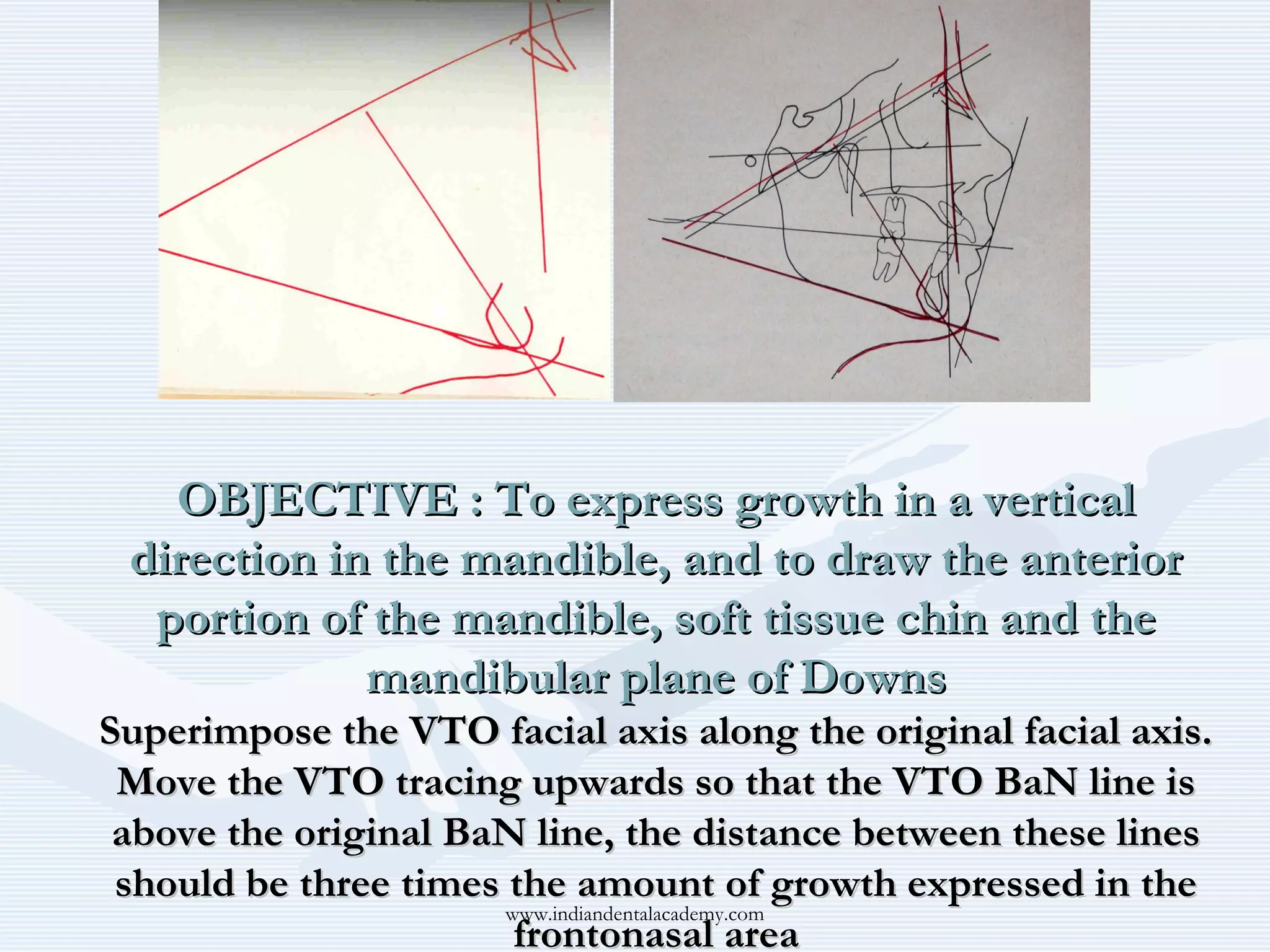
OBJECTIVE : To express growth in a vertical
direction in the mandible, and to draw the anterior
portion of the mandible, soft tissue chin and the
mandibular plane of Downs
Superimpose the VTO facial axis along the original facial axis.
Move the VTO tracing upwards so that the VTO BaN line is
above the original BaN line, the distance between these lines
should be three times the amount of growth expressed in the
www.indiandentalacademy.com
frontonasal area
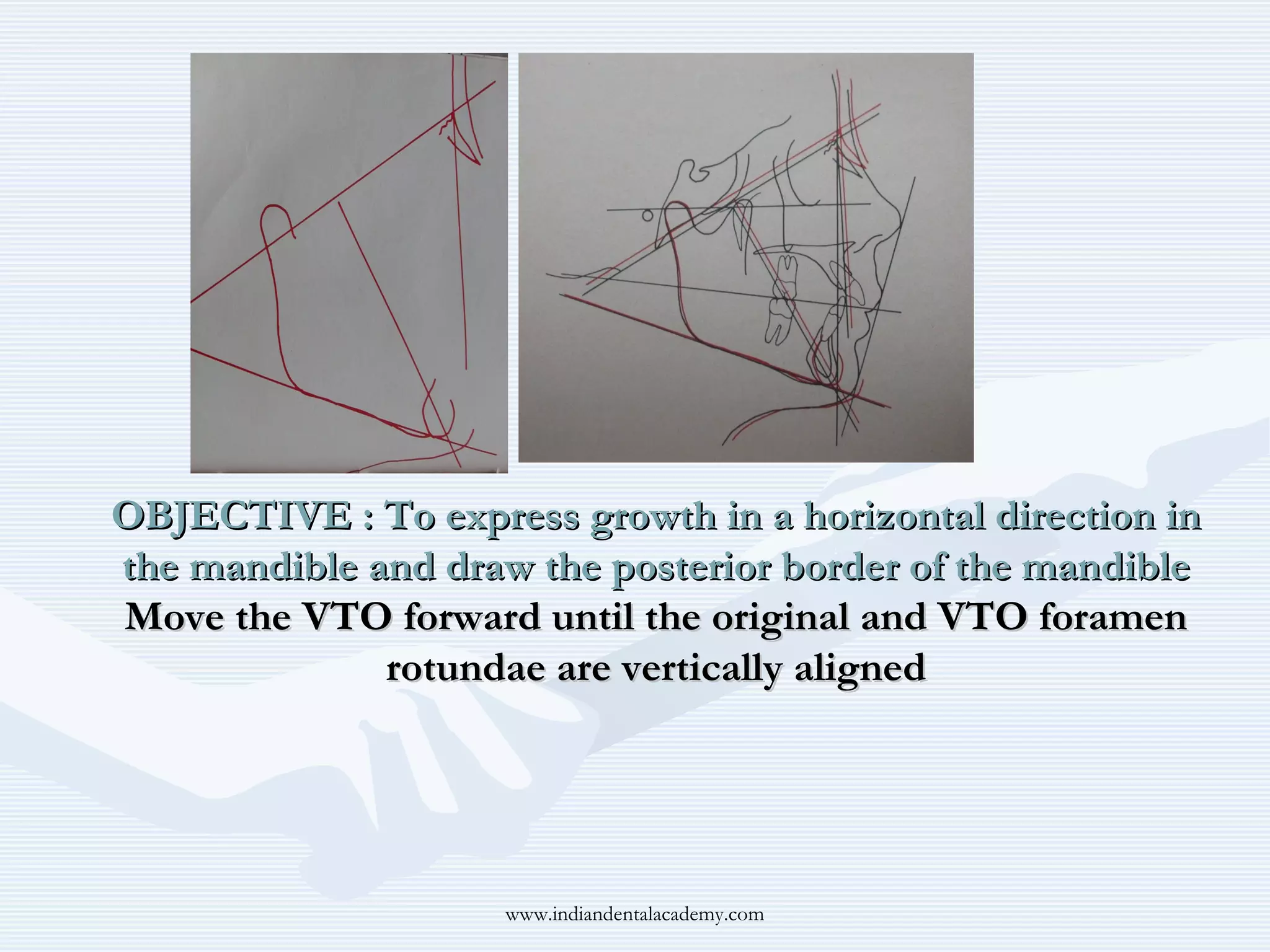
OBJECTIVE : To express growth in a horizontal direction in
the mandible and draw the posterior border of the mandible
Move the VTO forward until the original and VTO foramen
rotundae are vertically aligned

www.indiandentalacademy.com
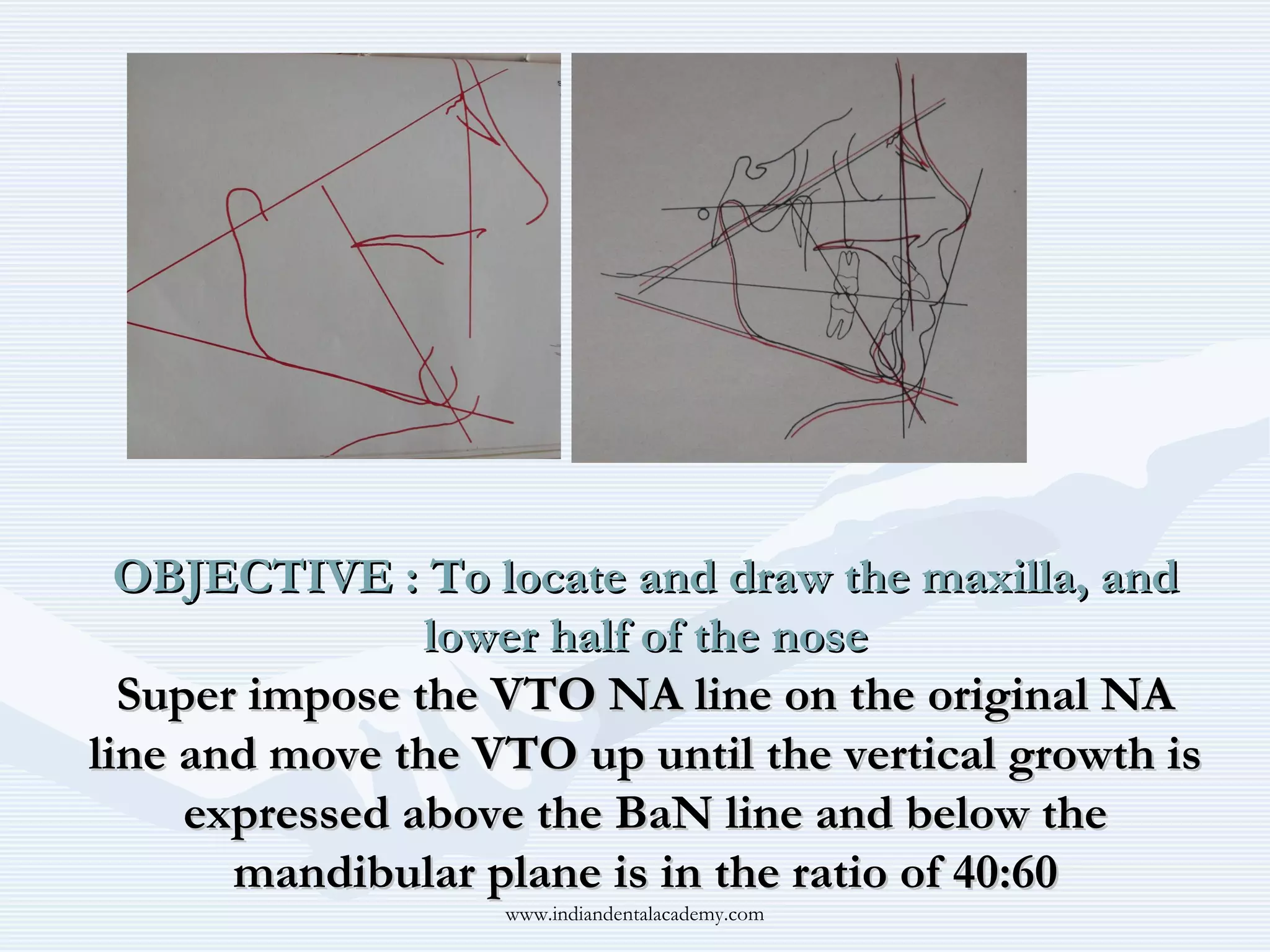
OBJECTIVE : To locate and draw the maxilla, and
lower half of the nose
Super impose the VTO NA line on the original NA
line and move the VTO up until the vertical growth is
expressed above the BaN line and below the
mandibular plane is in the ratio of 40:60
www.indiandentalacademy.com
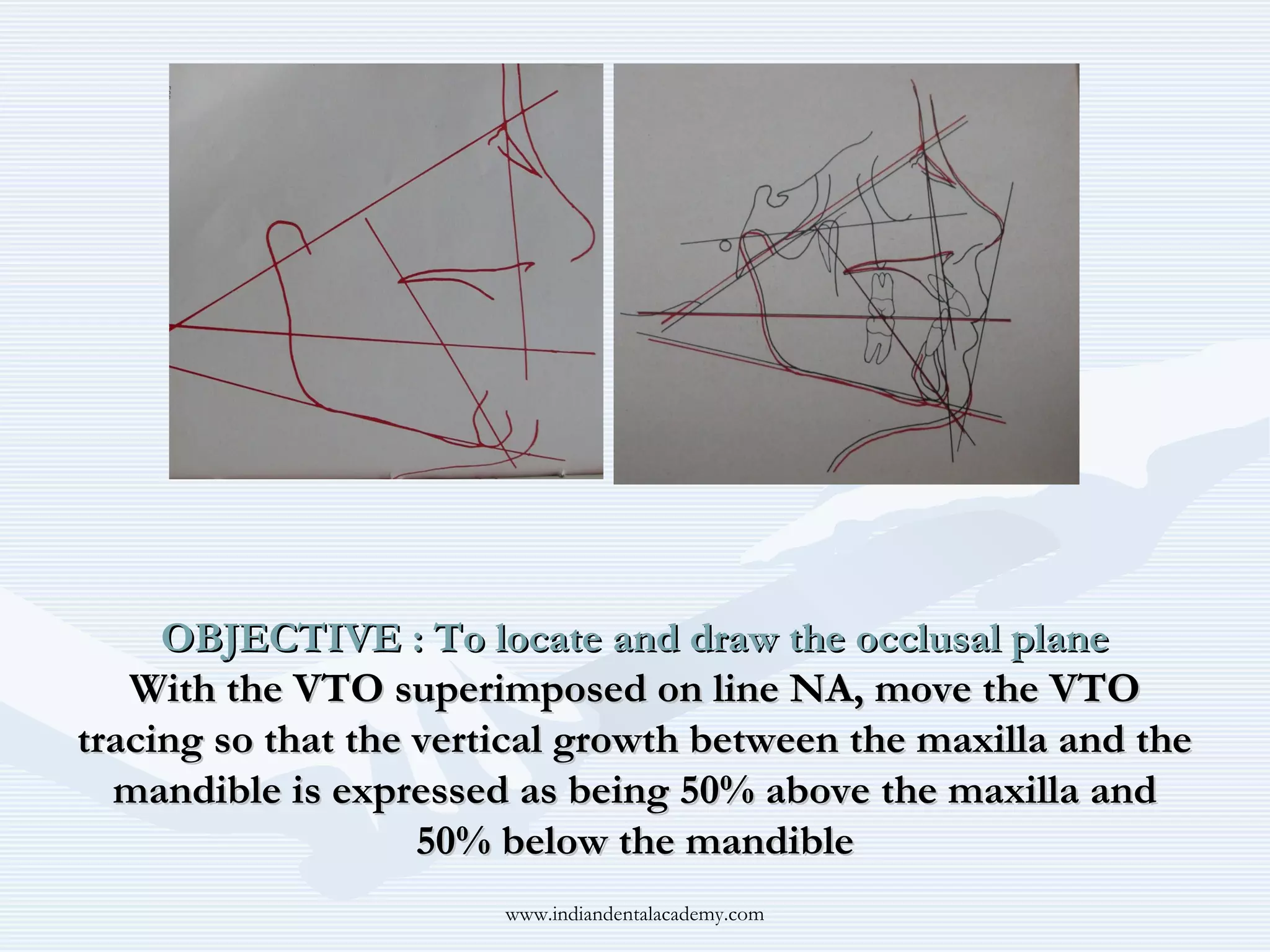
OBJECTIVE : To locate and draw the occlusal plane
With the VTO superimposed on line NA, move the VTO
tracing so that the vertical growth between the maxilla and the
mandible is expressed as being 50% above the maxilla and
50% below the mandible
www.indiandentalacademy.com
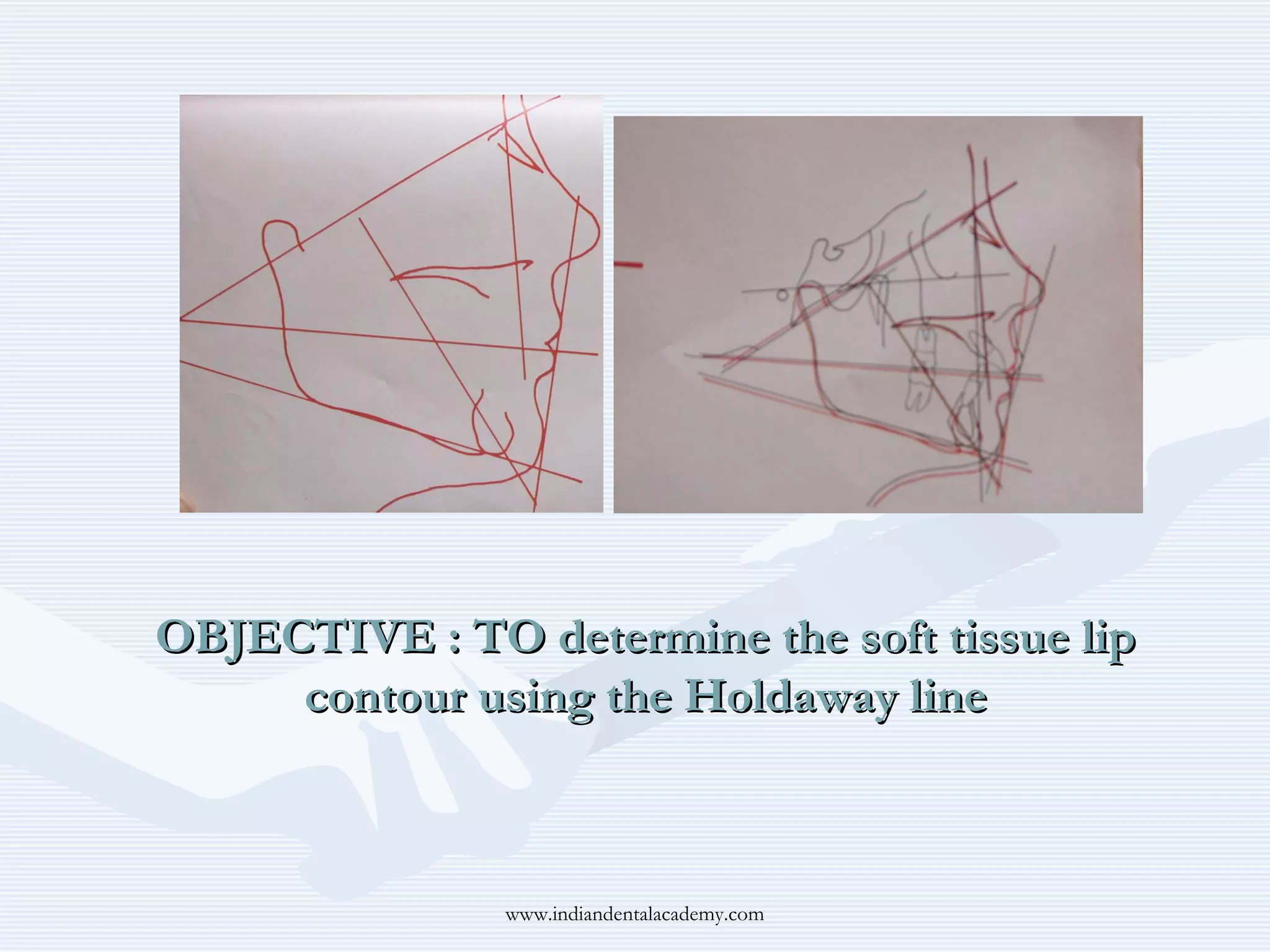
OBJECTIVE : TO determine the soft tissue lip
contour using the Holdaway line

www.indiandentalacademy.com
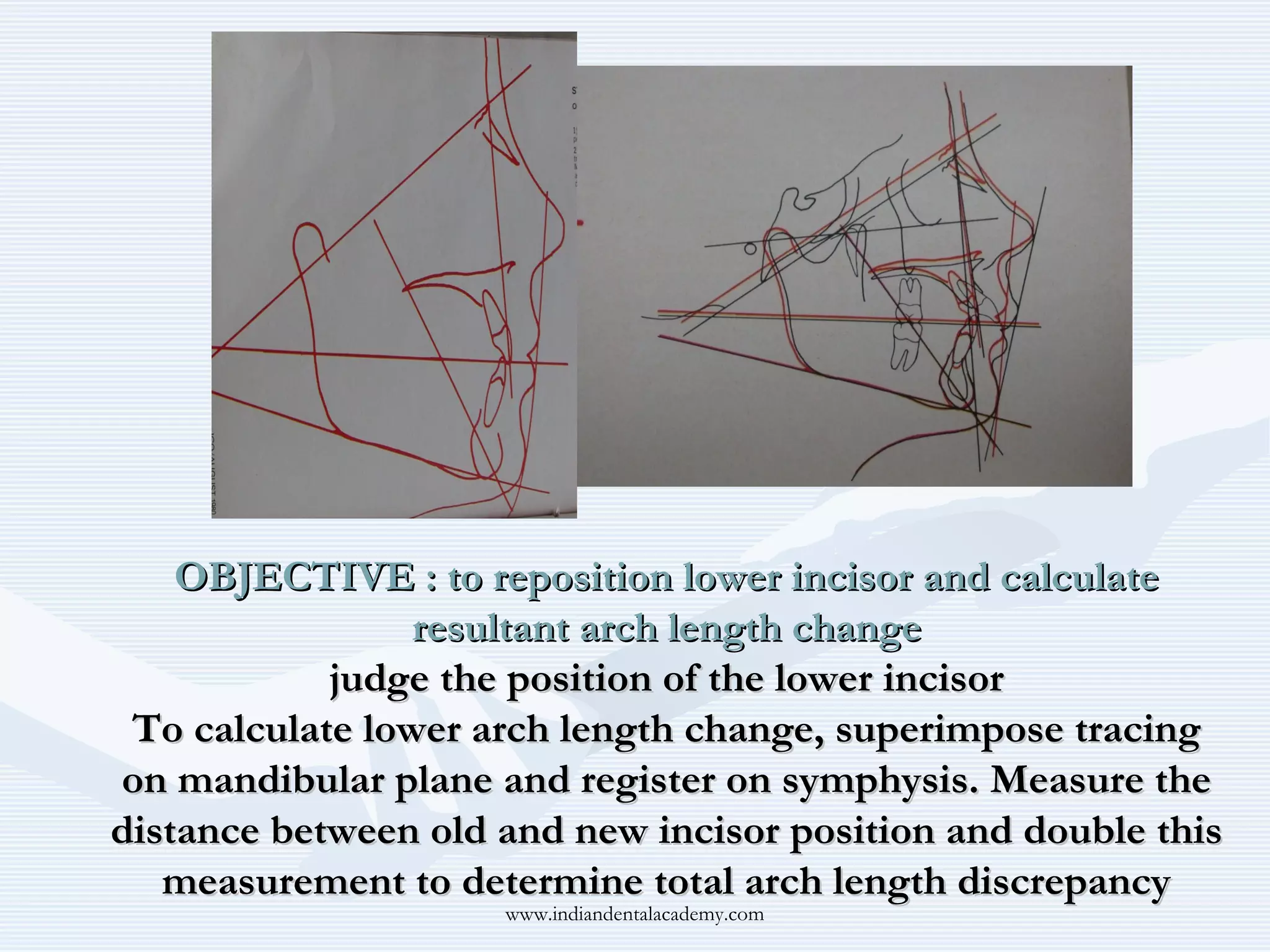
OBJECTIVE : to reposition lower incisor and calculate
resultant arch length change
judge the position of the lower incisor
To calculate lower arch length change, superimpose tracing
on mandibular plane and register on symphysis. Measure the
distance between old and new incisor position and double this
measurement to determine total arch length discrepancy
www.indiandentalacademy.com
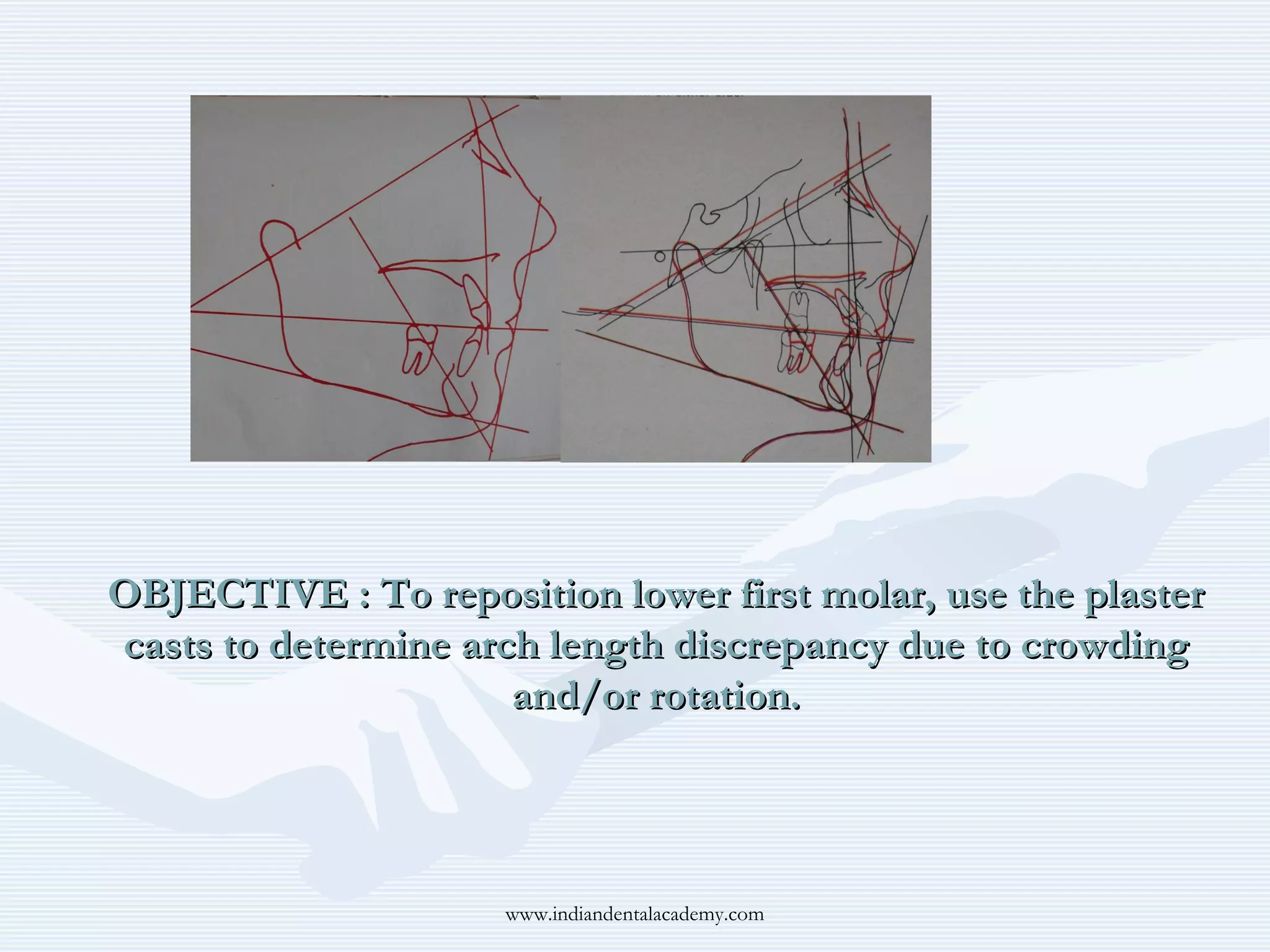
OBJECTIVE : To reposition lower first molar, use the plaster
casts to determine arch length discrepancy due to crowding
and/or rotation.

www.indiandentalacademy.com
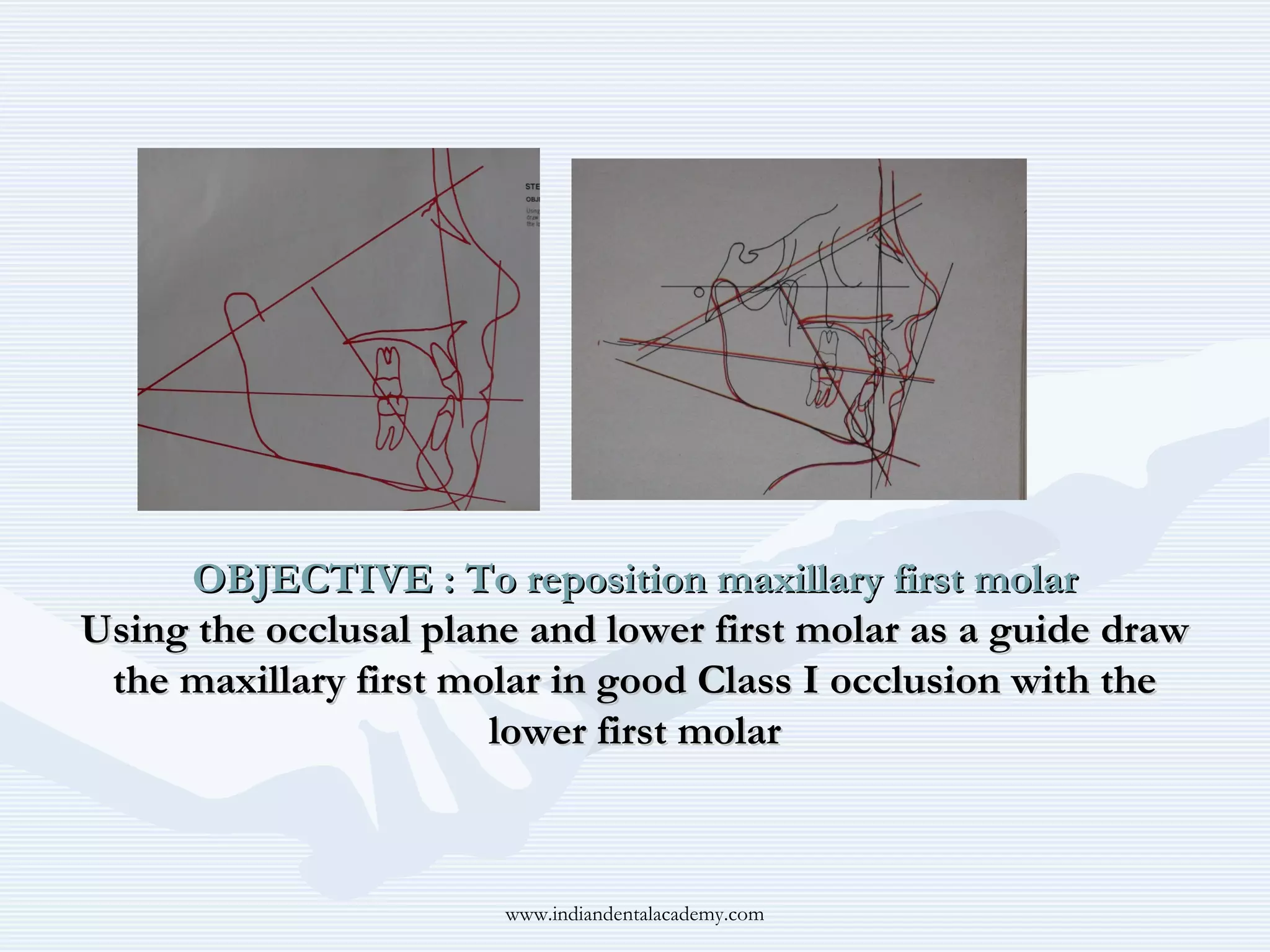
OBJECTIVE : To reposition maxillary first molar
Using the occlusal plane and lower first molar as a guide draw
the maxillary first molar in good Class I occlusion with the
lower first molar

www.indiandentalacademy.com
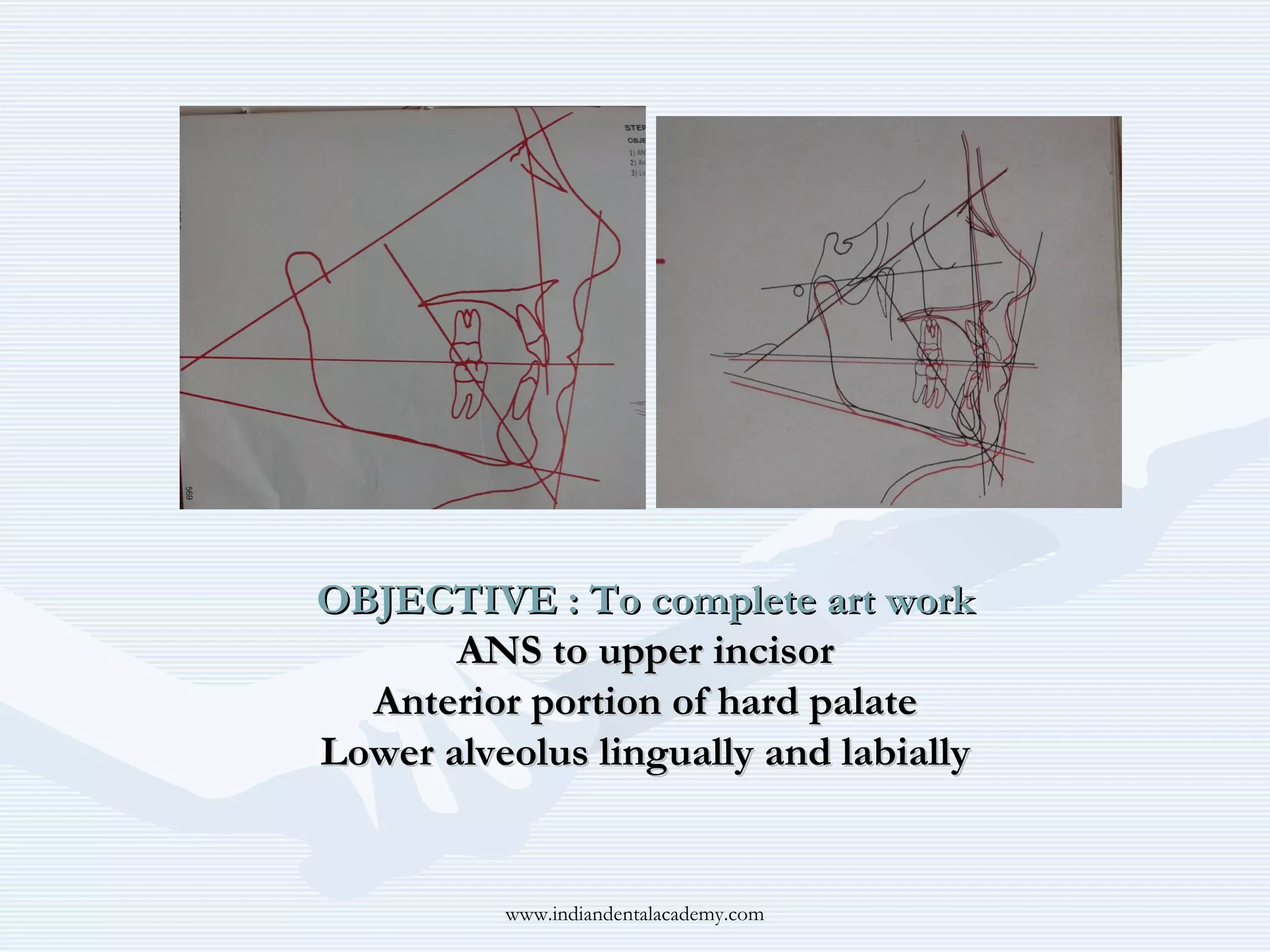
OBJECTIVE : To complete art work
ANS to upper incisor
Anterior portion of hard palate
Lower alveolus lingually and labially

www.indiandentalacademy.com
A statistical evaluation of the
Ricketts and Johnston growthforecasting methods

www.indiandentalacademy.com
• Four methods of growth forecasting were compared
– Johnston forecast grid
– Ave. increments from sella-nasion
– Ricketts short-range prediction
– Computer forecast
• Objective was to predict the final position of the
points A, Pogonion, end of the nose, lower molar
and point Xi with respect to cranial reference lines

www.indiandentalacademy.com
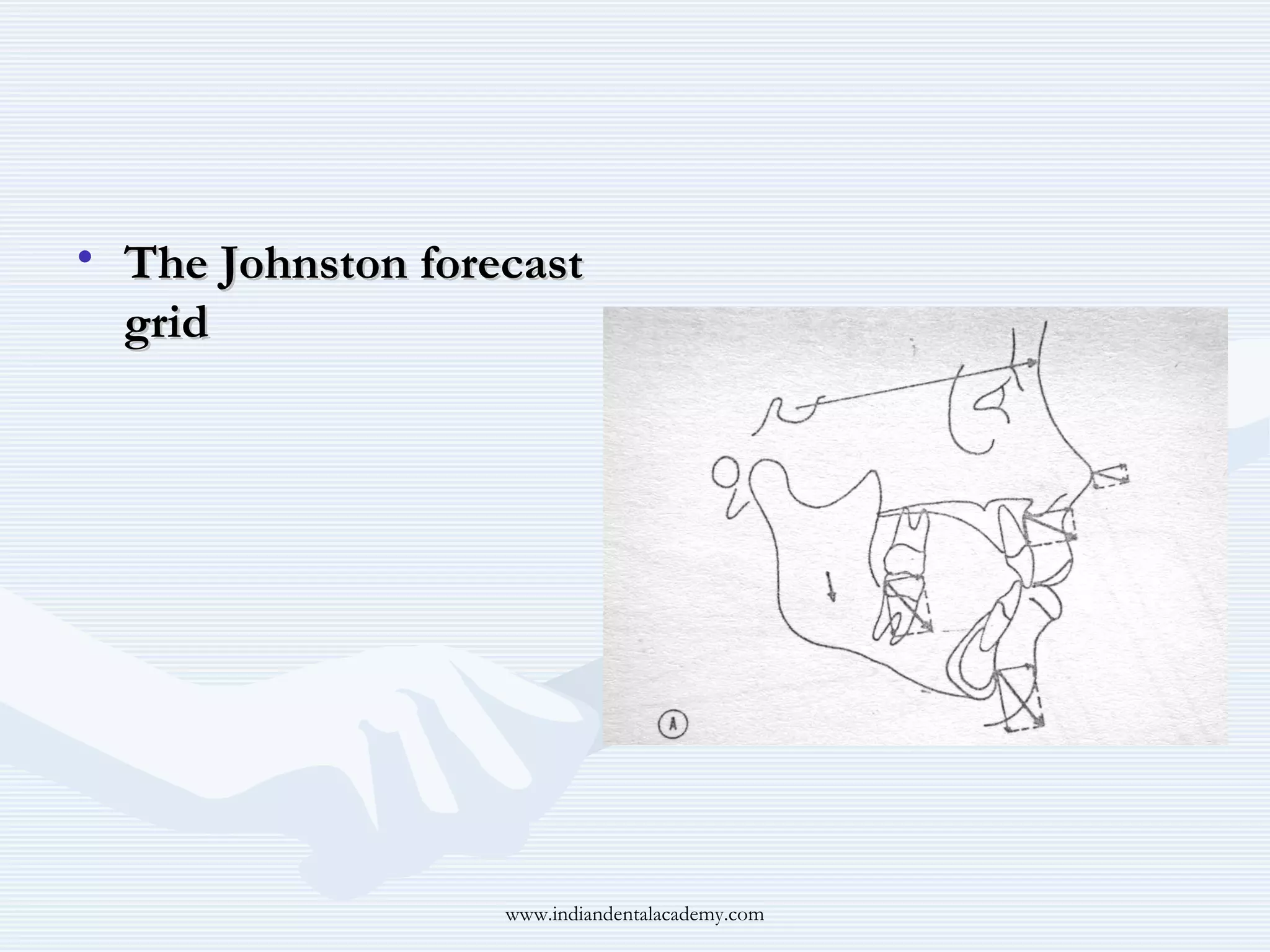
• The Johnston forecast
grid

www.indiandentalacademy.com
• Errors were squared, summed, and divided by
the number in the sample to get the meansquare error. Square root was taken for the rotmean-squared error
• 70% of the predictions will be within ±1 rms
error
• 95 % will be within ±2 rms error

www.indiandentalacademy.com
• Ave. increments from sella-nasion
To study points not included in Johnston
forecast grid, as well as grid’s applicability to a 10year growth period
Average increments for each of the points under
consideration were calculated from SN with S as
the origin, and these increments were then used
in a prediction as follows: Using sella-nasion as a
horizontal axis with sella as its center, ave.
increments per year were added

www.indiandentalacademy.com
• Girls - 15 years
• Boys - 19 years

www.indiandentalacademy.com
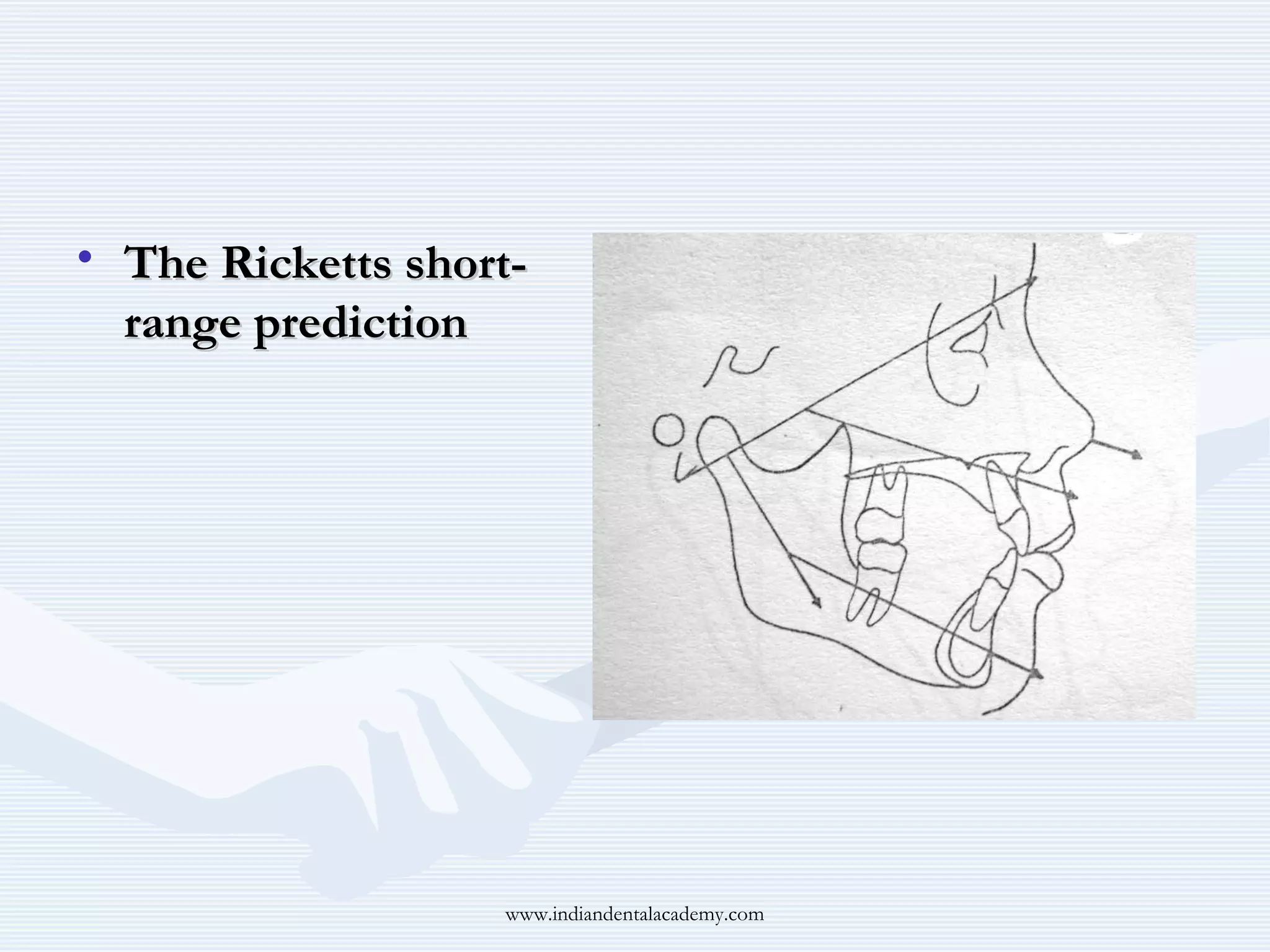
• The Ricketts shortrange prediction

www.indiandentalacademy.com
• Computer forecast
Individual growth curves are used for the mandible,
maxilla, and cranial base rather than using the same
increments for every age group
Abnormal growth with RMDS data bank

www.indiandentalacademy.com
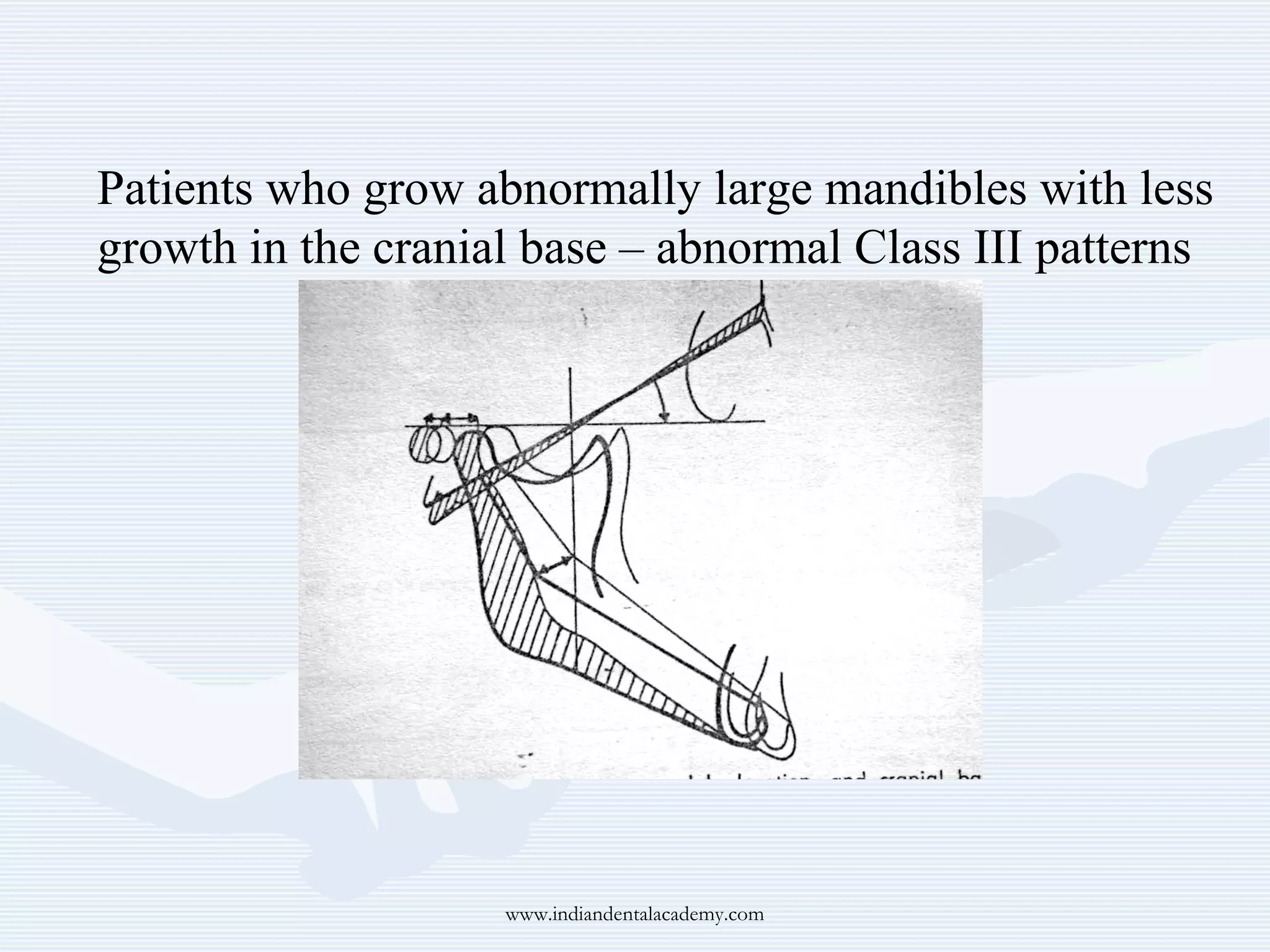
Patients who grow abnormally large mandibles with less
growth in the cranial base – abnormal Class III patterns

www.indiandentalacademy.com
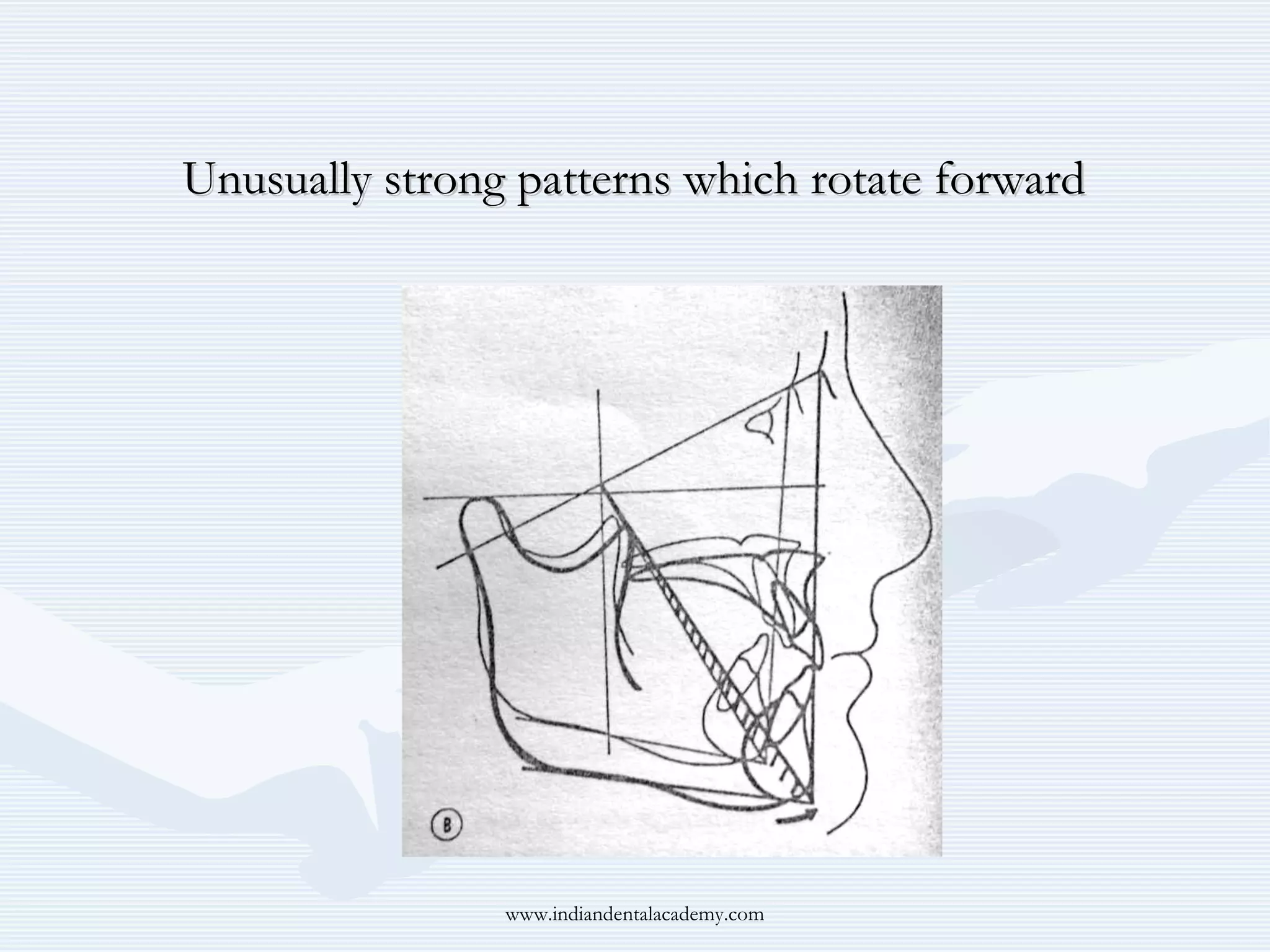
Unusually strong patterns which rotate forward

www.indiandentalacademy.com
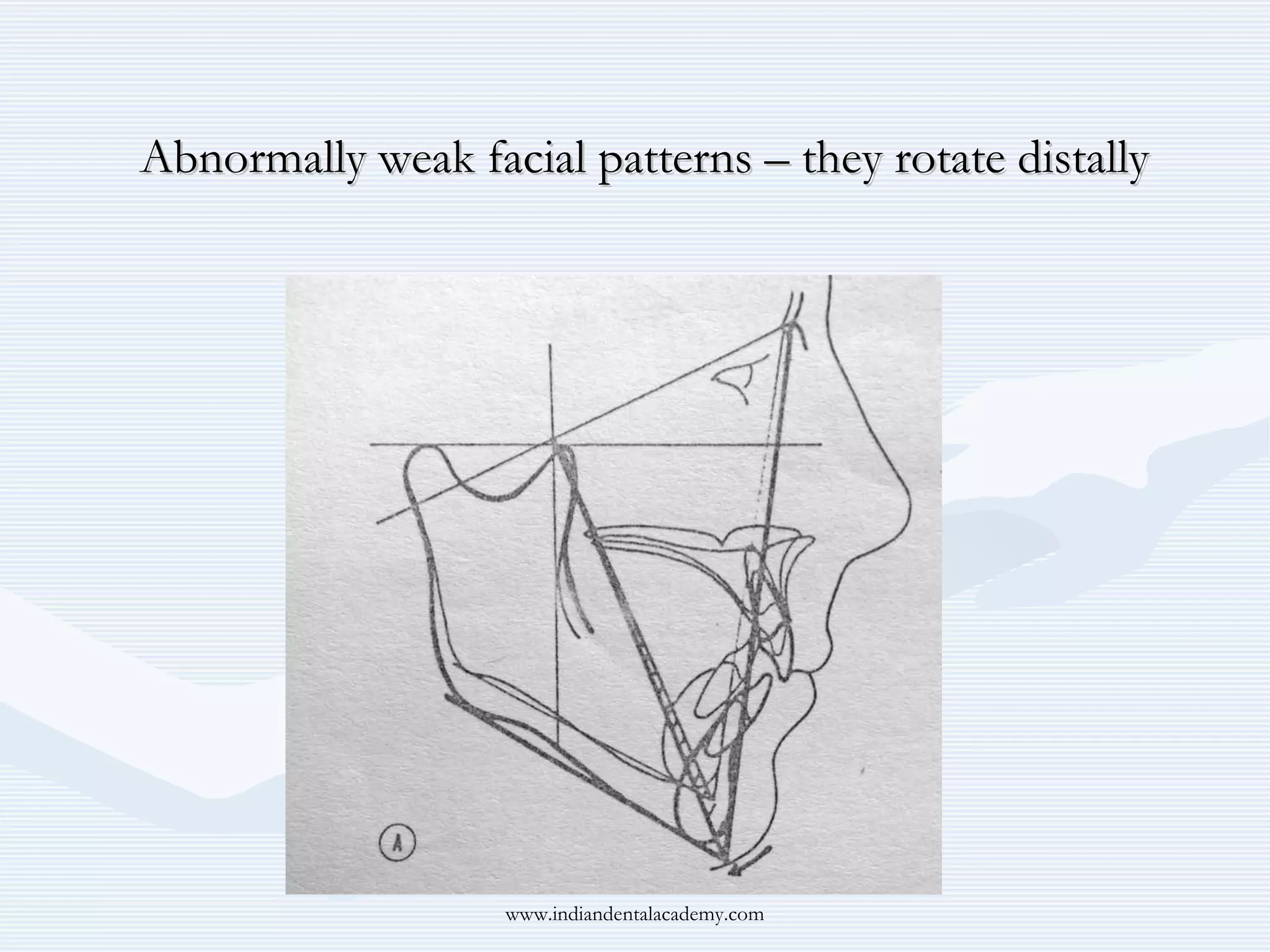
Abnormally weak facial patterns – they rotate distally

www.indiandentalacademy.com
Results
Johnston grid
Least accurate
It was accurate as any for predicting the nose
64 percent accurate for Point A
70 percent accurate on Pogonion

www.indiandentalacademy.com
S-N average increments
Improvement over the Johnston grid at both
Pogonion and point A

www.indiandentalacademy.com
Ricketts short-range prediction method
Less rms error than Johnston grid or SN average increments
Some of the smaller over-all error was due to the fact that
point CC, the origin of this growth prediction, is closer to
Pogonion than to Sella
10 to 20 percent improvement of this method over average
increments

www.indiandentalacademy.com
RMDS computer program
Based on theories of Ricketts
Individualized further by using growth rates variable for the
patient’s age and by recognising unusual facial patterns
Most accurate of the four methods

 21% more accurate than Ricketts
 56% more accurate than Johnston grid

www.indiandentalacademy.com
Prediction of abnormal growth in
Class III malocclusions
If the actual growth was far different from the
predicted growth, the records were often returned to
the laboratory so that a file of “abnormal growth “
could be compiled
A consistent type emerged – one which grew more in
the mandible and less in the cranial base than predicted

www.indiandentalacademy.com
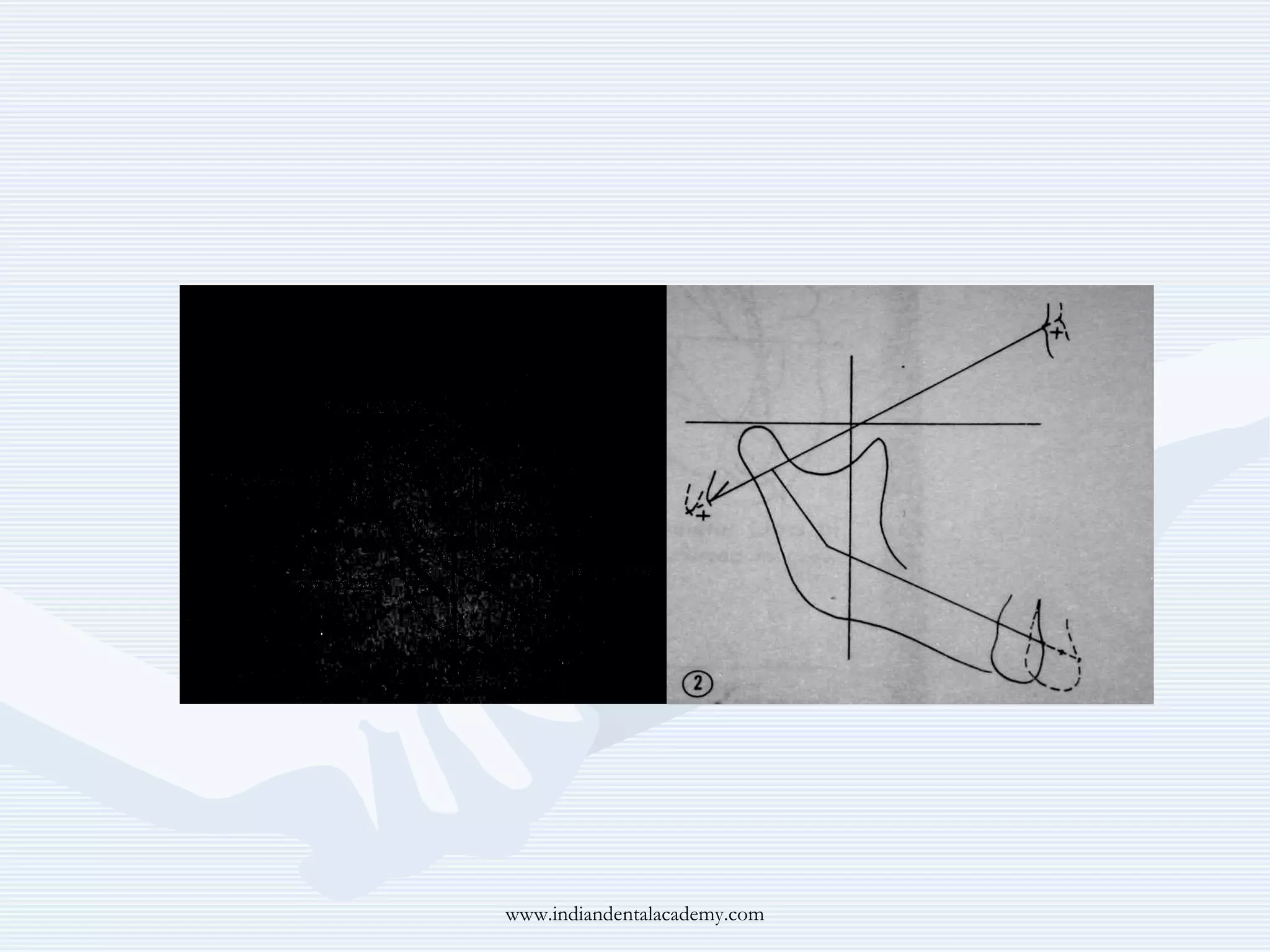
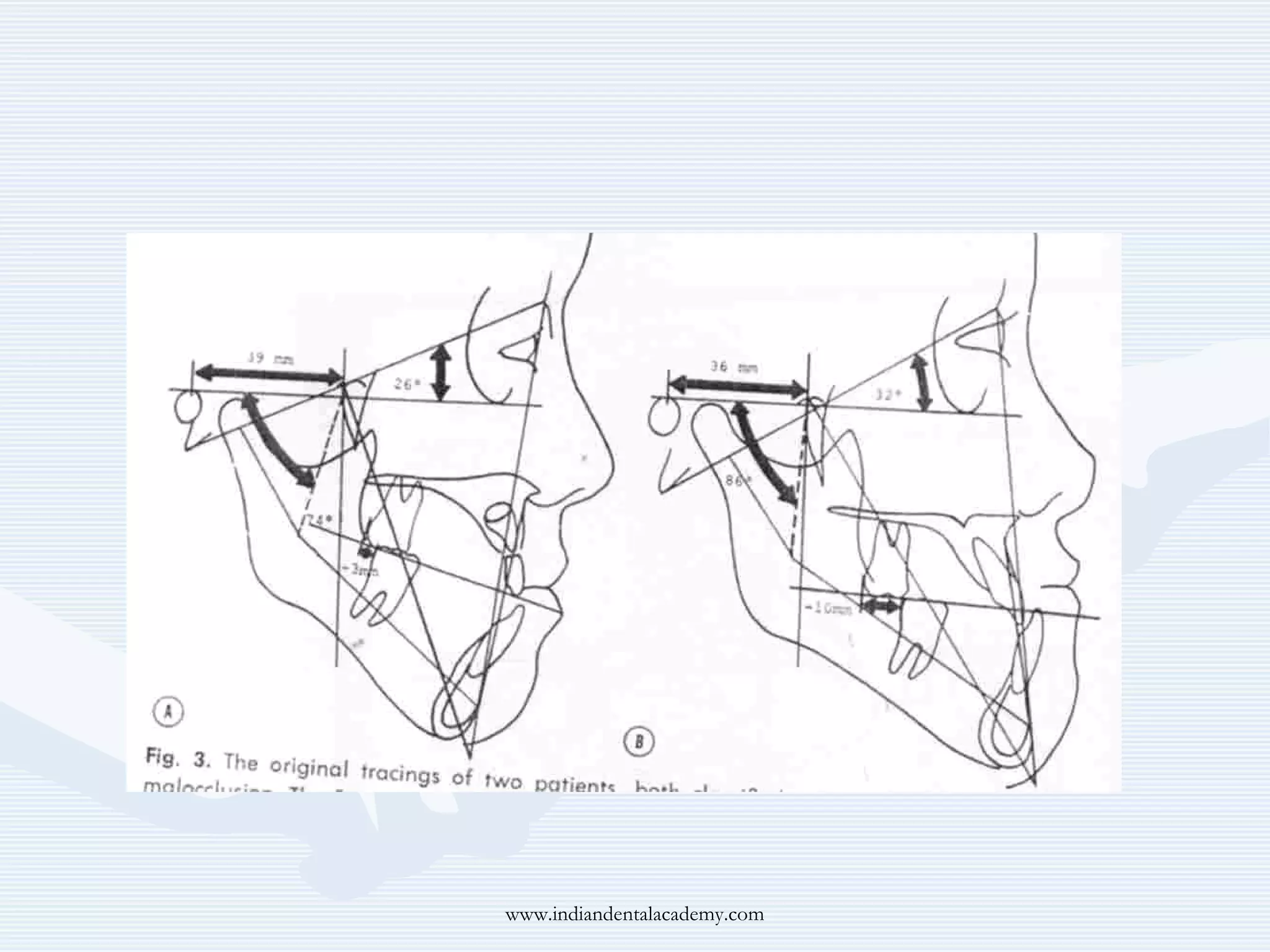
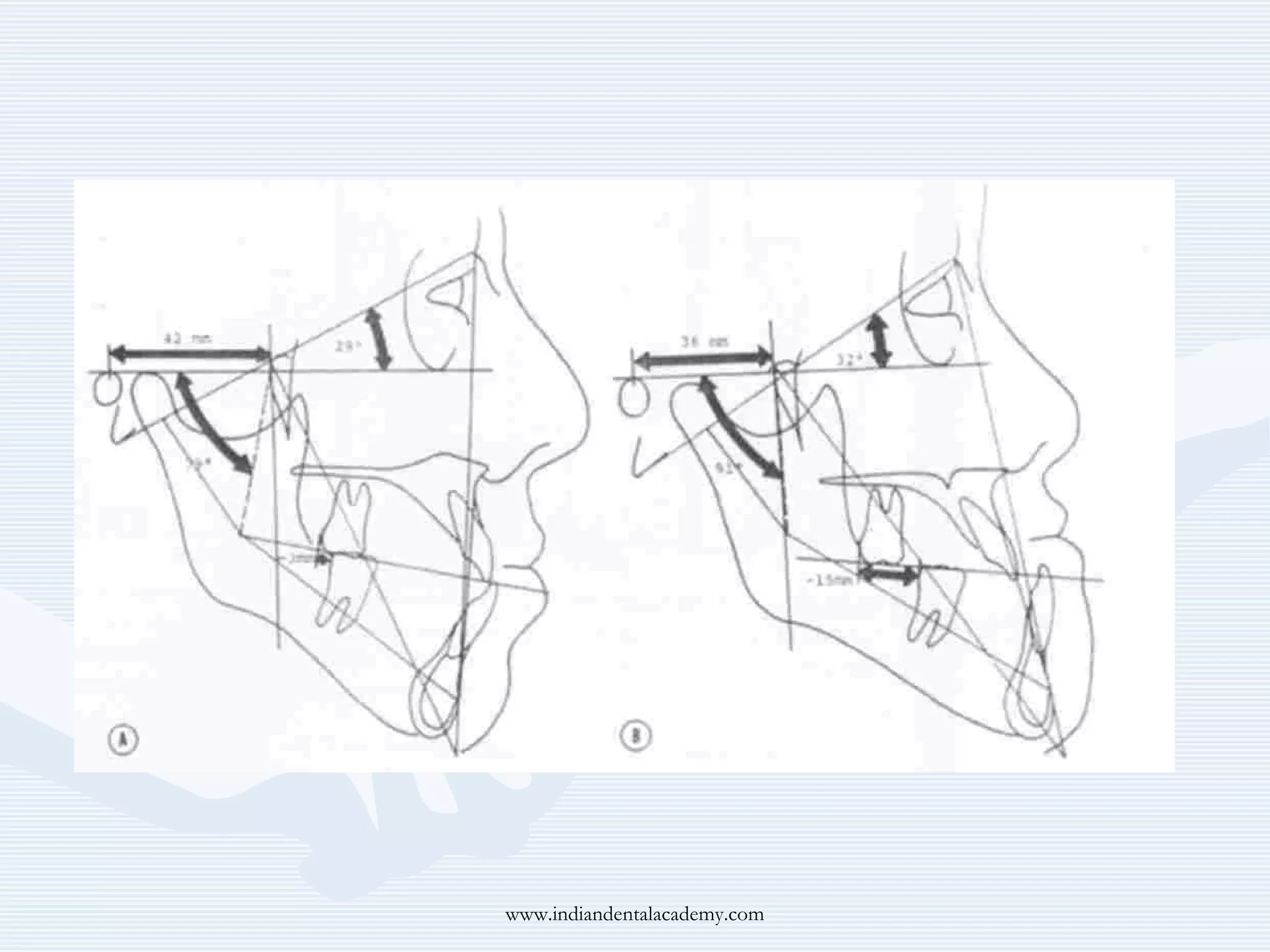
• The three most consistent measurements which
deviated from the normal in these patients were
ramus position, porion location and cranial
deflection
• Predictor measurements
• Hokkaido University Orthodontic Department

www.indiandentalacademy.com
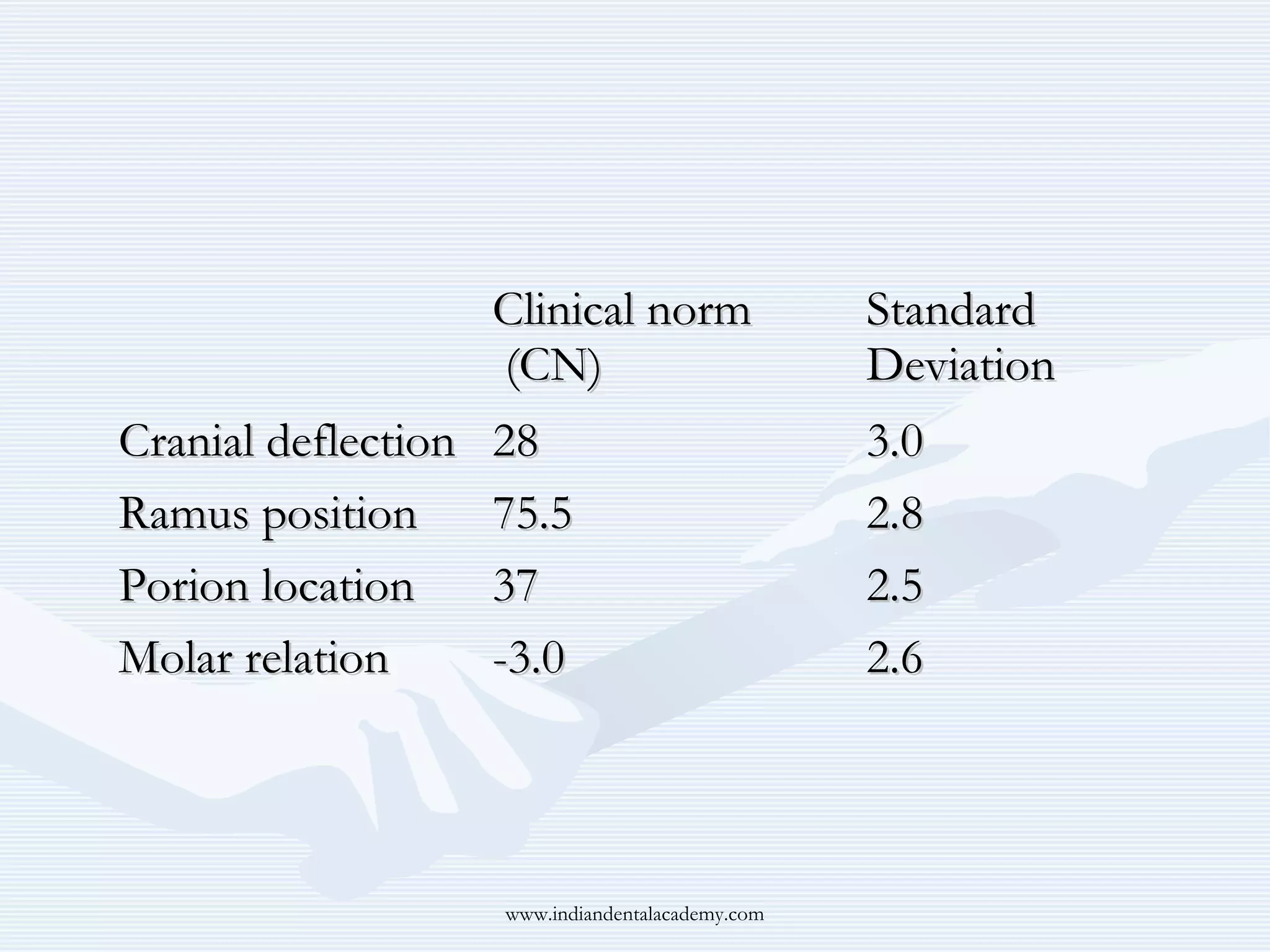
• For cranial deflection, porion location and
ramus position the greater the value, the more
likely the patient is hypothesized to have a Class
III growth pattern
• With molar relation, the lesser the value, the
more likely the patient is to have a Class III
malocclusion

www.indiandentalacademy.com
Clinical norm
(CN)
Cranial deflection 28
Ramus position
75.5
Porion location
37
Molar relation
-3.0

www.indiandentalacademy.com

Standard
Deviation
3.0
2.8
2.5
2.6
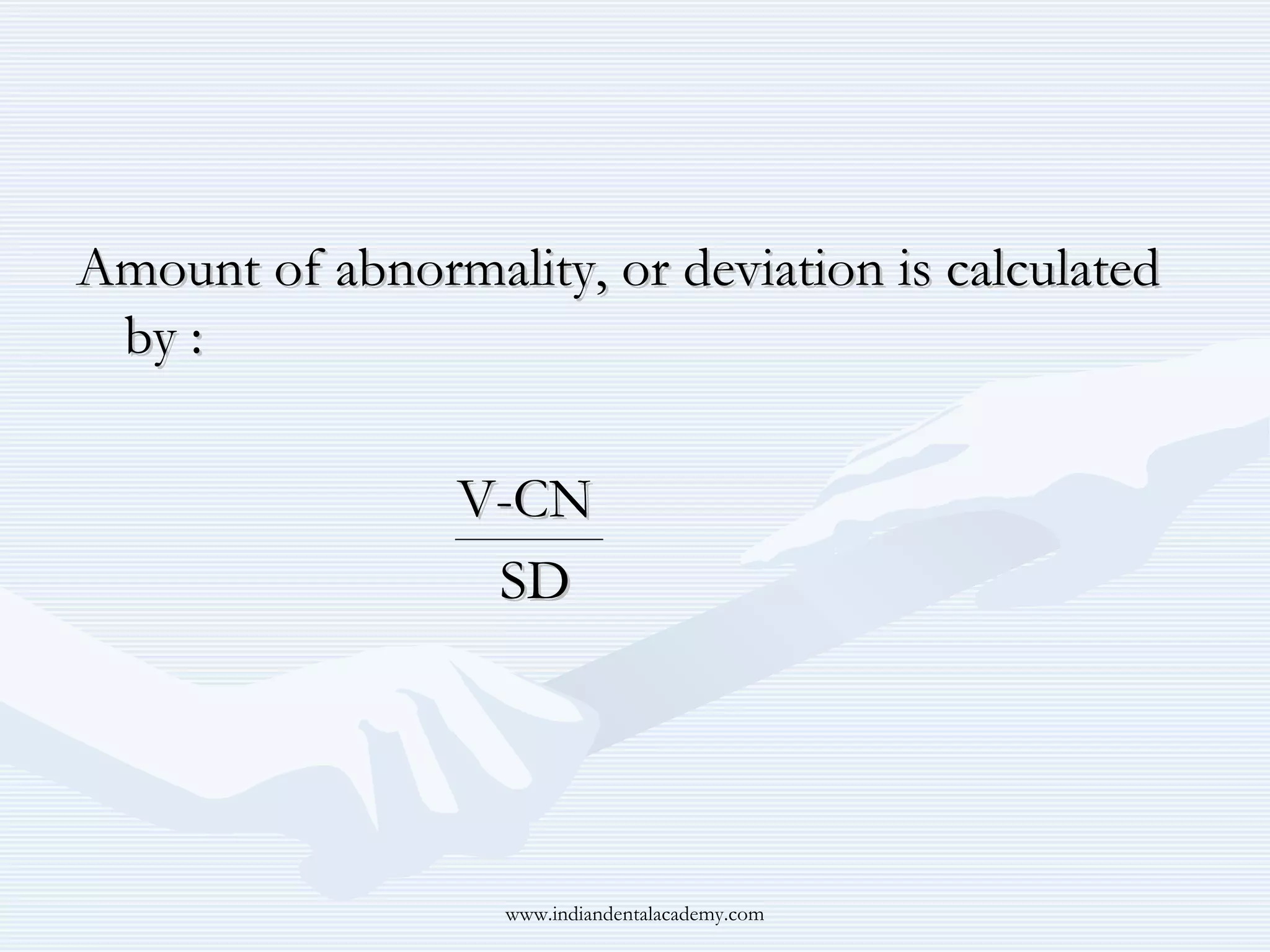
Amount of abnormality, or deviation is calculated
by :
V-CN
SD

www.indiandentalacademy.com
Evaluation of Ricketts’ long-range growth
prediction in Turkish children
• Cephalometric analysis was conducted at baseline and 7
years for 40 children (20 girls, 20 boys) who received no
orthodontic treatment. Ricketts’ long-range prediction
was performed from baseline cephalograms and
compared with actual growth 7 years later. Twenty-one
cephalometric (12 angular and 9 linear) parameters were
measured on actual and predicted tracings. The Pearson
correlation coefficient was used to evaluate
relationships between the “predicted” and “actual”
measurements.
• There was a higher level of correlation for growth
prediction in girls
www.indiandentalacademy.com
• The baseline average age was 9.2 ± 0.82 years for girls
and 9.3 ± 0.92 years for boys
• Linear measurements: 1, Convexity; 2, Condylion-Point
A; 3, Condylion-Gnathion; 4, Lower lip to E plane; 5,
Upper lip length; 6, Cranial length (anterior) (CC-Na);
7, Ramus height (CF-Go); 8, Porion to PTV; 9, Corpus
length (Xi-Pm).
• Angular measurements: 1, Lower face height; 2,
Nasolabial angle; 3, Facial depth; 4, Facial axis; 5,
Maxillary depth; 6, Maxillary height; 7, Palatal plane-FH
plane; 8, Mandibular plane-FH plane; 9, BNA angle; 10,
Cranial deflection; 11, Ramus-Xi position; 12,
Mandibular arc angle.
www.indiandentalacademy.com
Ricketts’ long-range growth prediction applied to
Turkish children showed statistically significantly higher
correlations between predicted and actual
measurements in:
• Convexity, lower face height, condylion, point A, upper
lip length, facial depth, facial axis, palatal plane-FH
plane angle, mandibular plane-FH plane angle, ramus
height, and mandibular arc angle in girls
• Lower face height, nasolabial angle, porion to PTV,
ramus-Xi position, cranial deflection, condylion-point
A, lower lip-E plane, facial axis, BNA angle, and
mandibular arc angle in boys.
www.indiandentalacademy.com
Thank you
www.indiandentalacademy.com
Leader in continuing dental education

www.indiandentalacademy.com

Growth prediction 2 /certified fixed orthodontic courses by Indian dental academy

  • 1.
    GROWTH PREDICTIONS INDIAN DENTALACADEMY Leader in continuing dental education www.indiandentalacademy.com www.indiandentalacademy.com
  • 2.
    Holdaway’s soft-tissue VTO •Purpose is to establish a balanced profile and pleasing facial esthetics and to evaluate the orthodontic correction necessary to achieve this goal • Holdaway VTO emphasizes soft tissue profile balance www.indiandentalacademy.com
  • 3.
    • Growth ofthe cranio-facial skeleton is predicted for the estimated treatment time, and the soft tissue profile between the nose and the chin arranged to create an “ideal” facial profile for the individual patient • Maxillary and mandibular incisors are repositioned to eliminate lip strain • Allowance is made for probable post treatment “incisor rebound” • Maxillary teeth are positioned first, and then lower incisors are repositioned to be in harmony with the upper incisors www.indiandentalacademy.com
  • 4.
    • Following therepositioning of the mandibular incisors, the resultant arch length discrepancy may be calculated to determine whether or not teeth should be extracted www.indiandentalacademy.com
  • 5.
    • The VTOis thus a dynamic cephalometric analysis which takes into account both growth and biomechanics, thus achieving its aim of being a Visualized Treatment Objective • It outlines a goal from the inception of treatment and may be usefully employed in monitoring growth and treatment progress www.indiandentalacademy.com
  • 6.
    • In sum,therefore the VTO accomplishes : Predicts growth over an estimated treatment time, based on the individual morphogenetic pattern Analyzes the soft tissue facial profile Graphically plans the best soft tissue facial profile for the particular patient Determines favorable incisor repositioning, based on an “ideal” projected soft tissue facial profile www.indiandentalacademy.com
  • 7.
    Assists in determiningtotal arch length discrepancy when taking into account “cephalometric correction” Aids in determining between extraction and nonextraction treatment Aids in deciding which teeth to extract Assists in planning treatment mechanics Surgery vs. non-surgery It provides a visual goal or objective for which to strive during treatment www.indiandentalacademy.com
  • 8.
  • 9.
    OJECTIVE : Todraw frontonasal area, line BaN and line NA www.indiandentalacademy.com
  • 10.
    OBJECTIVE : Toexpress growth in the frontonasal area over a two-year period Super impose on line BaN and move the VTO until there is 1.5 mm growth in the fronto nasal area Holding the VTO tracing in the position copy the www.indiandentalacademy.com Ricketts facial axis
  • 11.
    OBJECTIVE : Toexpress growth in a vertical direction in the mandible, and to draw the anterior portion of the mandible, soft tissue chin and the mandibular plane of Downs Superimpose the VTO facial axis along the original facial axis. Move the VTO tracing upwards so that the VTO BaN line is above the original BaN line, the distance between these lines should be three times the amount of growth expressed in the www.indiandentalacademy.com frontonasal area
  • 12.
    OBJECTIVE : Toexpress growth in a horizontal direction in the mandible and draw the posterior border of the mandible Move the VTO forward until the original and VTO foramen rotundae are vertically aligned www.indiandentalacademy.com
  • 13.
    OBJECTIVE : Tolocate and draw the maxilla, and lower half of the nose Super impose the VTO NA line on the original NA line and move the VTO up until the vertical growth is expressed above the BaN line and below the mandibular plane is in the ratio of 40:60 www.indiandentalacademy.com
  • 14.
    OBJECTIVE : Tolocate and draw the occlusal plane With the VTO superimposed on line NA, move the VTO tracing so that the vertical growth between the maxilla and the mandible is expressed as being 50% above the maxilla and 50% below the mandible www.indiandentalacademy.com
  • 15.
    OBJECTIVE : TOdetermine the soft tissue lip contour using the Holdaway line www.indiandentalacademy.com
  • 16.
    OBJECTIVE : toreposition lower incisor and calculate resultant arch length change judge the position of the lower incisor To calculate lower arch length change, superimpose tracing on mandibular plane and register on symphysis. Measure the distance between old and new incisor position and double this measurement to determine total arch length discrepancy www.indiandentalacademy.com
  • 17.
    OBJECTIVE : Toreposition lower first molar, use the plaster casts to determine arch length discrepancy due to crowding and/or rotation. www.indiandentalacademy.com
  • 18.
    OBJECTIVE : Toreposition maxillary first molar Using the occlusal plane and lower first molar as a guide draw the maxillary first molar in good Class I occlusion with the lower first molar www.indiandentalacademy.com
  • 19.
    OBJECTIVE : Tocomplete art work ANS to upper incisor Anterior portion of hard palate Lower alveolus lingually and labially www.indiandentalacademy.com
  • 20.
    A statistical evaluationof the Ricketts and Johnston growthforecasting methods www.indiandentalacademy.com
  • 21.
    • Four methodsof growth forecasting were compared – Johnston forecast grid – Ave. increments from sella-nasion – Ricketts short-range prediction – Computer forecast • Objective was to predict the final position of the points A, Pogonion, end of the nose, lower molar and point Xi with respect to cranial reference lines www.indiandentalacademy.com
  • 22.
    • The Johnstonforecast grid www.indiandentalacademy.com
  • 23.
    • Errors weresquared, summed, and divided by the number in the sample to get the meansquare error. Square root was taken for the rotmean-squared error • 70% of the predictions will be within ±1 rms error • 95 % will be within ±2 rms error www.indiandentalacademy.com
  • 24.
    • Ave. incrementsfrom sella-nasion To study points not included in Johnston forecast grid, as well as grid’s applicability to a 10year growth period Average increments for each of the points under consideration were calculated from SN with S as the origin, and these increments were then used in a prediction as follows: Using sella-nasion as a horizontal axis with sella as its center, ave. increments per year were added www.indiandentalacademy.com
  • 25.
    • Girls -15 years • Boys - 19 years www.indiandentalacademy.com
  • 26.
    • The Rickettsshortrange prediction www.indiandentalacademy.com
  • 27.
    • Computer forecast Individualgrowth curves are used for the mandible, maxilla, and cranial base rather than using the same increments for every age group Abnormal growth with RMDS data bank www.indiandentalacademy.com
  • 28.
    Patients who growabnormally large mandibles with less growth in the cranial base – abnormal Class III patterns www.indiandentalacademy.com
  • 29.
    Unusually strong patternswhich rotate forward www.indiandentalacademy.com
  • 30.
    Abnormally weak facialpatterns – they rotate distally www.indiandentalacademy.com
  • 31.
    Results Johnston grid Least accurate Itwas accurate as any for predicting the nose 64 percent accurate for Point A 70 percent accurate on Pogonion www.indiandentalacademy.com
  • 32.
    S-N average increments Improvementover the Johnston grid at both Pogonion and point A www.indiandentalacademy.com
  • 33.
    Ricketts short-range predictionmethod Less rms error than Johnston grid or SN average increments Some of the smaller over-all error was due to the fact that point CC, the origin of this growth prediction, is closer to Pogonion than to Sella 10 to 20 percent improvement of this method over average increments www.indiandentalacademy.com
  • 34.
    RMDS computer program Basedon theories of Ricketts Individualized further by using growth rates variable for the patient’s age and by recognising unusual facial patterns Most accurate of the four methods  21% more accurate than Ricketts  56% more accurate than Johnston grid www.indiandentalacademy.com
  • 35.
    Prediction of abnormalgrowth in Class III malocclusions If the actual growth was far different from the predicted growth, the records were often returned to the laboratory so that a file of “abnormal growth “ could be compiled A consistent type emerged – one which grew more in the mandible and less in the cranial base than predicted www.indiandentalacademy.com
  • 36.
    • The threemost consistent measurements which deviated from the normal in these patients were ramus position, porion location and cranial deflection • Predictor measurements • Hokkaido University Orthodontic Department www.indiandentalacademy.com
  • 37.
  • 38.
    • For cranialdeflection, porion location and ramus position the greater the value, the more likely the patient is hypothesized to have a Class III growth pattern • With molar relation, the lesser the value, the more likely the patient is to have a Class III malocclusion www.indiandentalacademy.com
  • 39.
  • 40.
  • 41.
    Clinical norm (CN) Cranial deflection28 Ramus position 75.5 Porion location 37 Molar relation -3.0 www.indiandentalacademy.com Standard Deviation 3.0 2.8 2.5 2.6
  • 42.
    Amount of abnormality,or deviation is calculated by : V-CN SD www.indiandentalacademy.com
  • 43.
    Evaluation of Ricketts’long-range growth prediction in Turkish children • Cephalometric analysis was conducted at baseline and 7 years for 40 children (20 girls, 20 boys) who received no orthodontic treatment. Ricketts’ long-range prediction was performed from baseline cephalograms and compared with actual growth 7 years later. Twenty-one cephalometric (12 angular and 9 linear) parameters were measured on actual and predicted tracings. The Pearson correlation coefficient was used to evaluate relationships between the “predicted” and “actual” measurements. • There was a higher level of correlation for growth prediction in girls www.indiandentalacademy.com
  • 44.
    • The baselineaverage age was 9.2 ± 0.82 years for girls and 9.3 ± 0.92 years for boys • Linear measurements: 1, Convexity; 2, Condylion-Point A; 3, Condylion-Gnathion; 4, Lower lip to E plane; 5, Upper lip length; 6, Cranial length (anterior) (CC-Na); 7, Ramus height (CF-Go); 8, Porion to PTV; 9, Corpus length (Xi-Pm). • Angular measurements: 1, Lower face height; 2, Nasolabial angle; 3, Facial depth; 4, Facial axis; 5, Maxillary depth; 6, Maxillary height; 7, Palatal plane-FH plane; 8, Mandibular plane-FH plane; 9, BNA angle; 10, Cranial deflection; 11, Ramus-Xi position; 12, Mandibular arc angle. www.indiandentalacademy.com
  • 45.
    Ricketts’ long-range growthprediction applied to Turkish children showed statistically significantly higher correlations between predicted and actual measurements in: • Convexity, lower face height, condylion, point A, upper lip length, facial depth, facial axis, palatal plane-FH plane angle, mandibular plane-FH plane angle, ramus height, and mandibular arc angle in girls • Lower face height, nasolabial angle, porion to PTV, ramus-Xi position, cranial deflection, condylion-point A, lower lip-E plane, facial axis, BNA angle, and mandibular arc angle in boys. www.indiandentalacademy.com
  • 46.
    Thank you www.indiandentalacademy.com Leader incontinuing dental education www.indiandentalacademy.com