What we’re covering today…
• The USP
• Can your company handle social media?
• Defining your customer
• Finding your content
• Establishing your metrics
• Tips and rules of social media
• Q&A
This is “Growth Hacking”
Performing a marketing strategy, campaign or outreach effort with
minimal resources and maximum results. Key characteristics
include:
• Speed: a time-sensitive focus on only what you need to get a specific
result (traffic, conversions, etc.). Get results as soon as possible.
• Elegance and a cleanly structured (or even automated) approach.
• Performance. Using technology to eliminate complexity or any excess
of manpower.
• Memorability. Understanding each audience segment, and making
content that resonates.
• Attention to detail. Intensive tracking mechanisms that allow you to
know – immediately – as much as possible about your campaign,
audience and progress.
…you must be able to complete
one simple sentence…
Before anything else…
…you must be able to complete
one simple sentence…
“Only we…”
Before anything else…
“Only we…”
Completing this sentence forces you to figure
out:
• Why you’re one-of-a-kind, not just better
• Why prospects should reach out
• Where you fit in the marketplace
“Only we…”
• Offer a certain combination of services
• Provide expertise (certs, etc.) to a specific niche
• Are able to provide certain cost efficiencies
• Own or offer a certain process
• Have bandwidth to quickly execute
“Only we…”
What’s yours?
Companies that communicate a unique
message, or solve a problem no one else
can, thrive on social media.
Take the “Only we…” sentence, then turn it
into an action statement.
What’s your unique message?
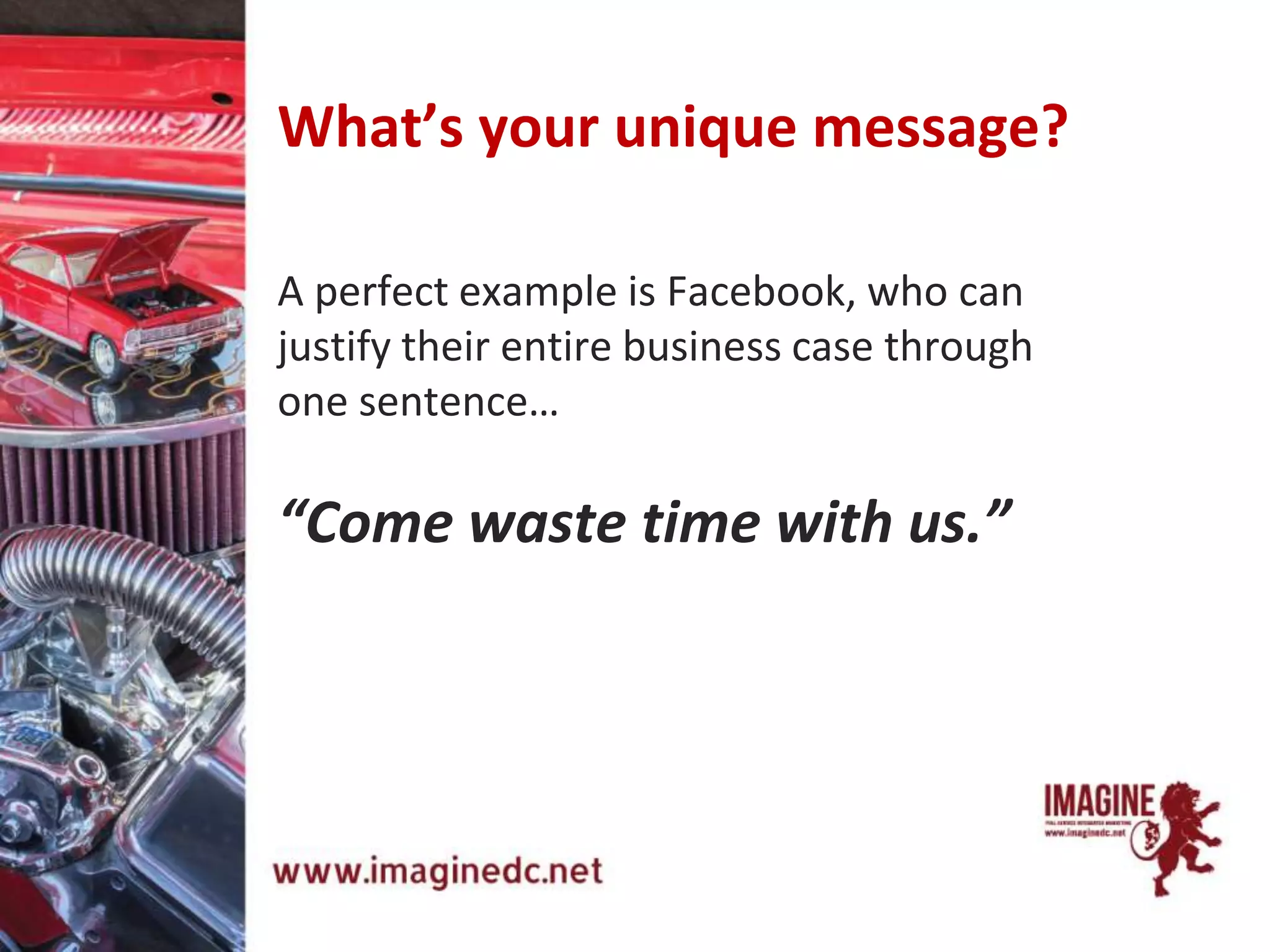
A perfect example is Facebook, who can
justify their entire business case through
one sentence…
“Come waste time with us.”
What’s your unique message?
Figure out why your
audience would pay
attention to you.
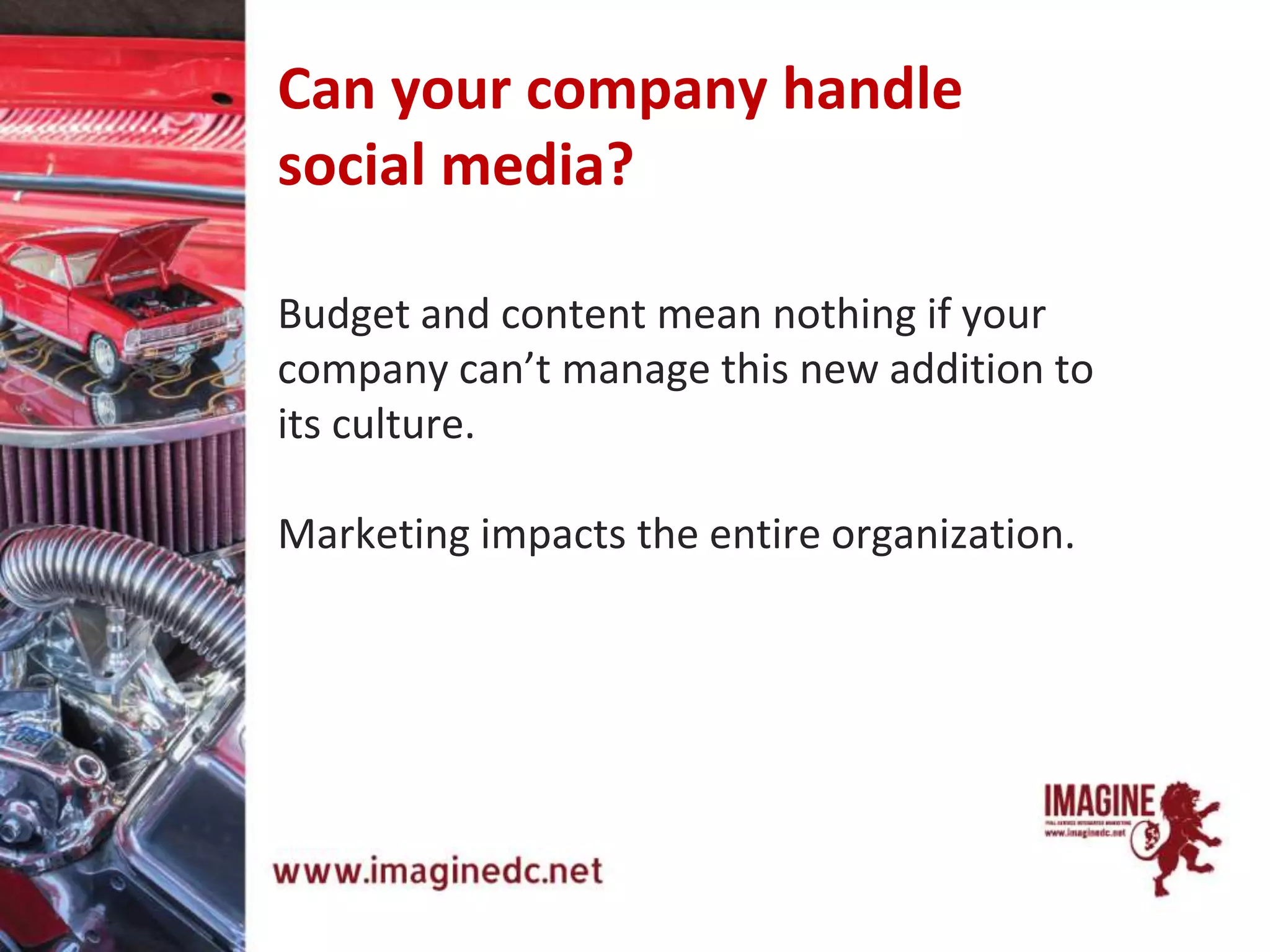
Can your company handle
social media?
Budget and content mean nothing if your
company can’t manage this new addition to
its culture.
Marketing impacts the entire organization.
Can it handle negative comments?
Can it entertain?
Can it inform?
Can it inspire?
Can it handle the workload?
Can it keep a consistent message?
What’s your unique message?
Can your company handle
social media?
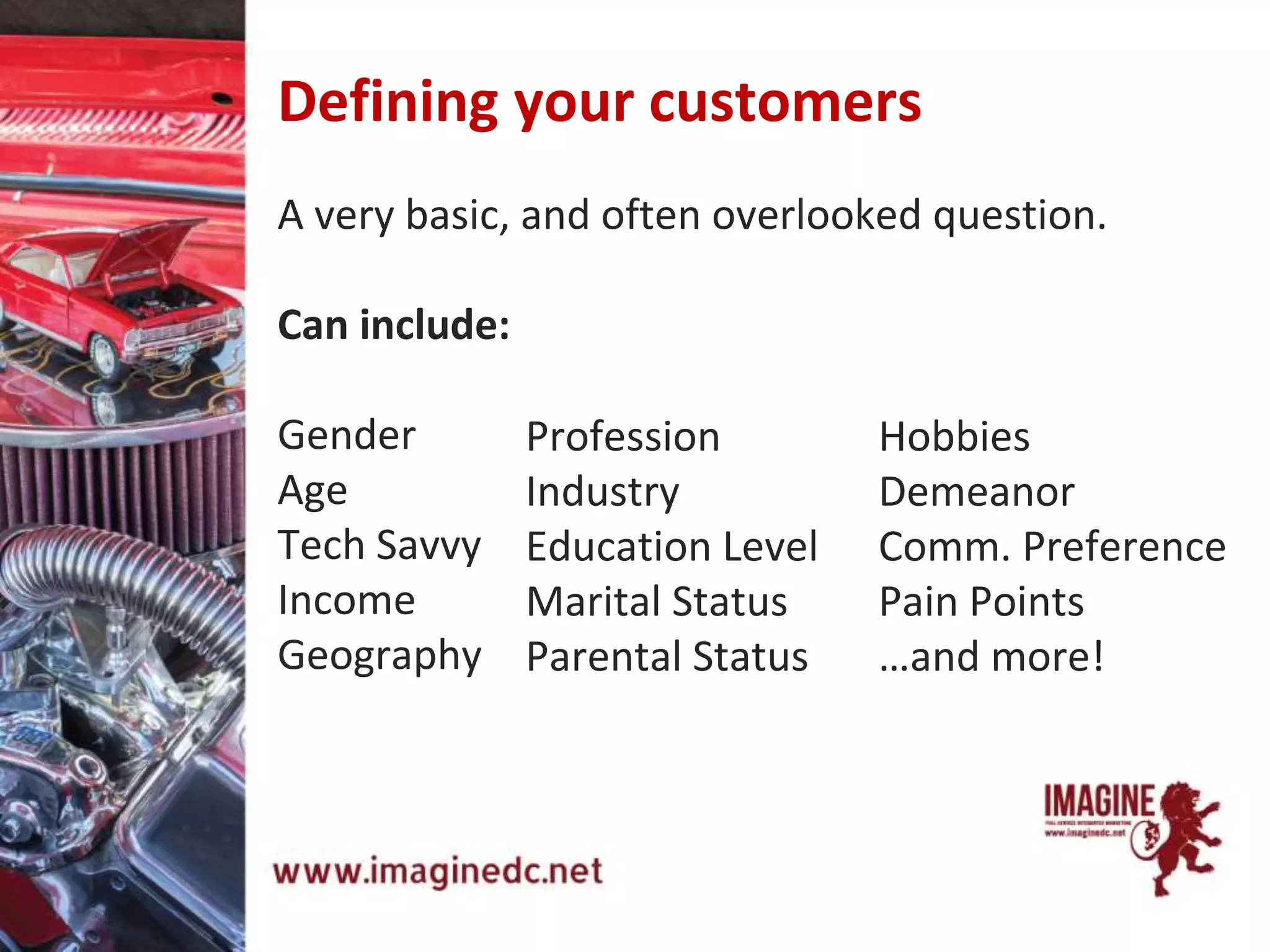
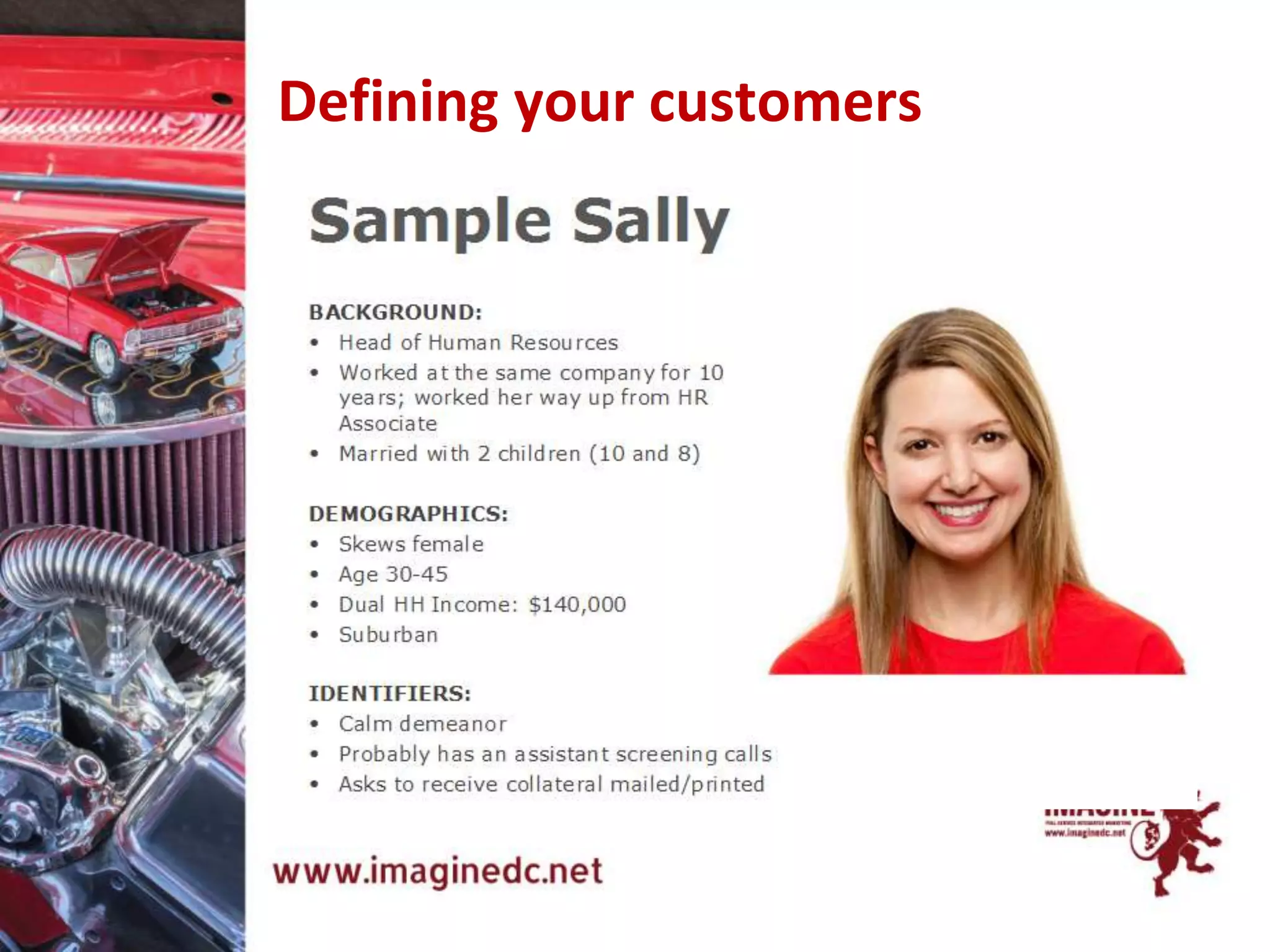
Defining your customers
A very basic, and often overlooked question.
Can include:
Gender
Age
Tech Savvy
Income
Geography
Profession
Industry
Education Level
Marital Status
Parental Status
Hobbies
Demeanor
Comm. Preference
Pain Points
…and more!
Defining your customers
A very basic, and often overlooked question.
Defining your customers
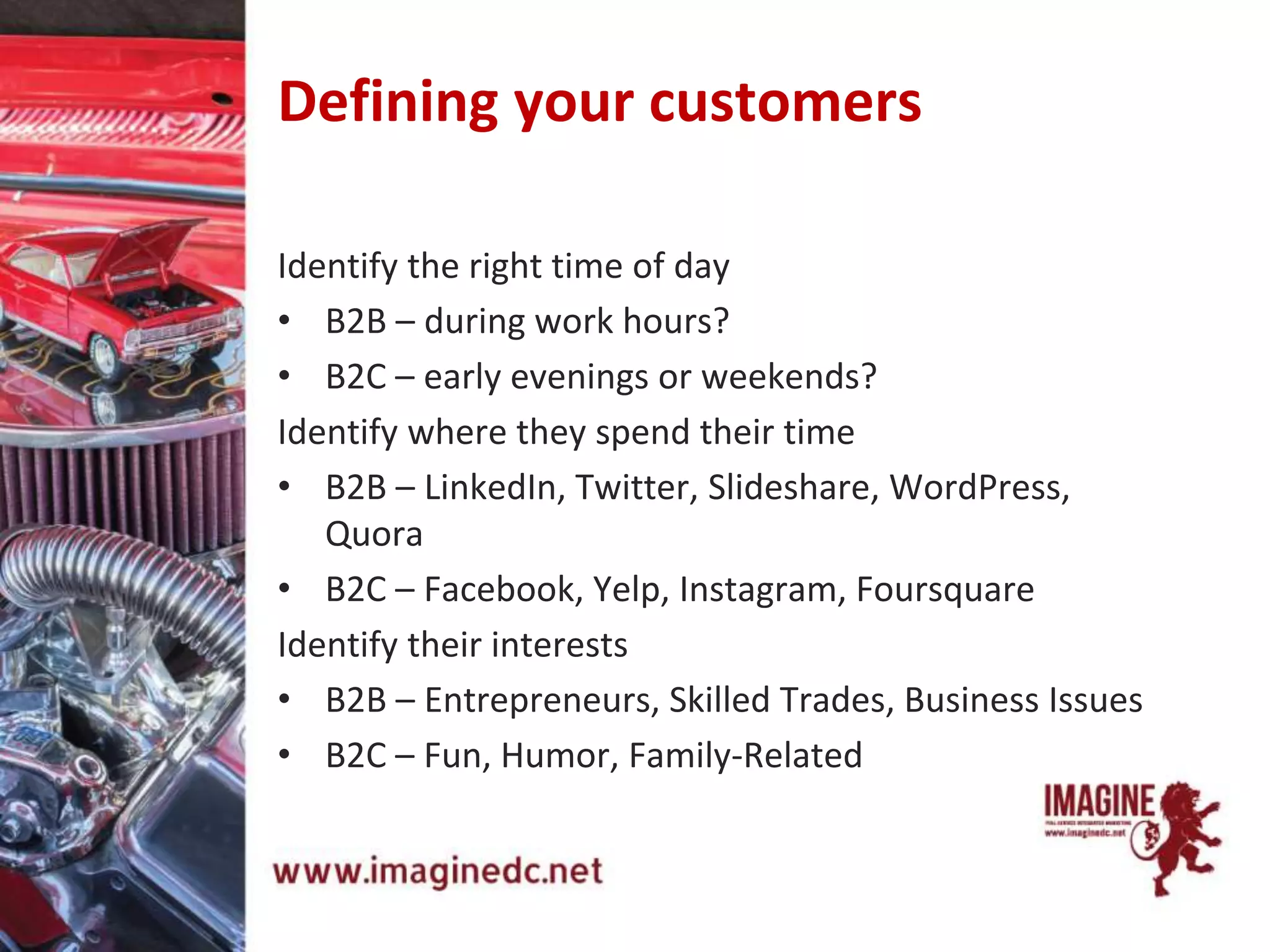
Identify the right time of day
• B2B – during work hours?
• B2C – early evenings or weekends?
Identify where they spend their time
• B2B – LinkedIn, Twitter, Slideshare, WordPress,
Quora
• B2C – Facebook, Yelp, Instagram, Foursquare
Identify their interests
• B2B – Entrepreneurs, Skilled Trades, Business Issues
• B2C – Fun, Humor, Family-Related
Study other companies in your segment or
niche to see how their audience responds to
certain content in certain networks.
Interview/survey some of your favorite
customers.
Then develop the content strategy (topics,
frequency, medium).
Defining your customers
• Complete the sentence “Only we…”
• Can your company handle social media?
• Defining your customer
Any questions?
So far…
Finding your Content
Occasional tweets, emails or random LinkedIn
posts don’t make a strategy.
You need to consistently publish content that
can include articles, blog posts, press releases,
images, graphs, videos, audio, documents,
whitepapers, guides, slideshows, ebooks...
The biggest question we get is:
“That’s great, but how am I
going to find time to do this?”
Fortunately, there’s a good answer.
Finding your Content
The biggest question we get is:
“That’s great, but how am I
going to find time to do this?”
• Comments on existing content.
• Sharing news articles, adding your own perspective.
• Repurposing earlier content (PRs, blogs, etc.).
• Being louder about the work you’re already doing.
Finding your Content
The second biggest question we get is:
“Which networks do you
recommend we use?”
Finding your Content
The second biggest question we get is:
“Which networks do you
recommend we use?”
Instead of worrying about which networks to
use, focus first on the content and let that
dictate the choice of network.
Finding your Content
The toolbox
The toolbox
• Photo-sharing (Instagram, Flickr)
• Document-sharing (Prezi, Slideshare)
• Event-planning (EventBrite, Meetup)
• Reviews/ratings (Yelp, Angie’s List)
• Blogs (WordPress, Website CMS)
• Microblogs (Tumblr, Twitter)
• Wiki (Wikipedia)
• Location-sharing (Foursquare)
• Marketplace (Etsy, Groupon)
• Q&A (Answers.com, Quora)
• Staying in touch (LinkedIn, Facebook)
What type of content are you
sharing?
Personality. Boring online is worse than boring in
person.
Variety. Feel free to deviate from your business
offering. No one wants to read the same stuff
over and over.
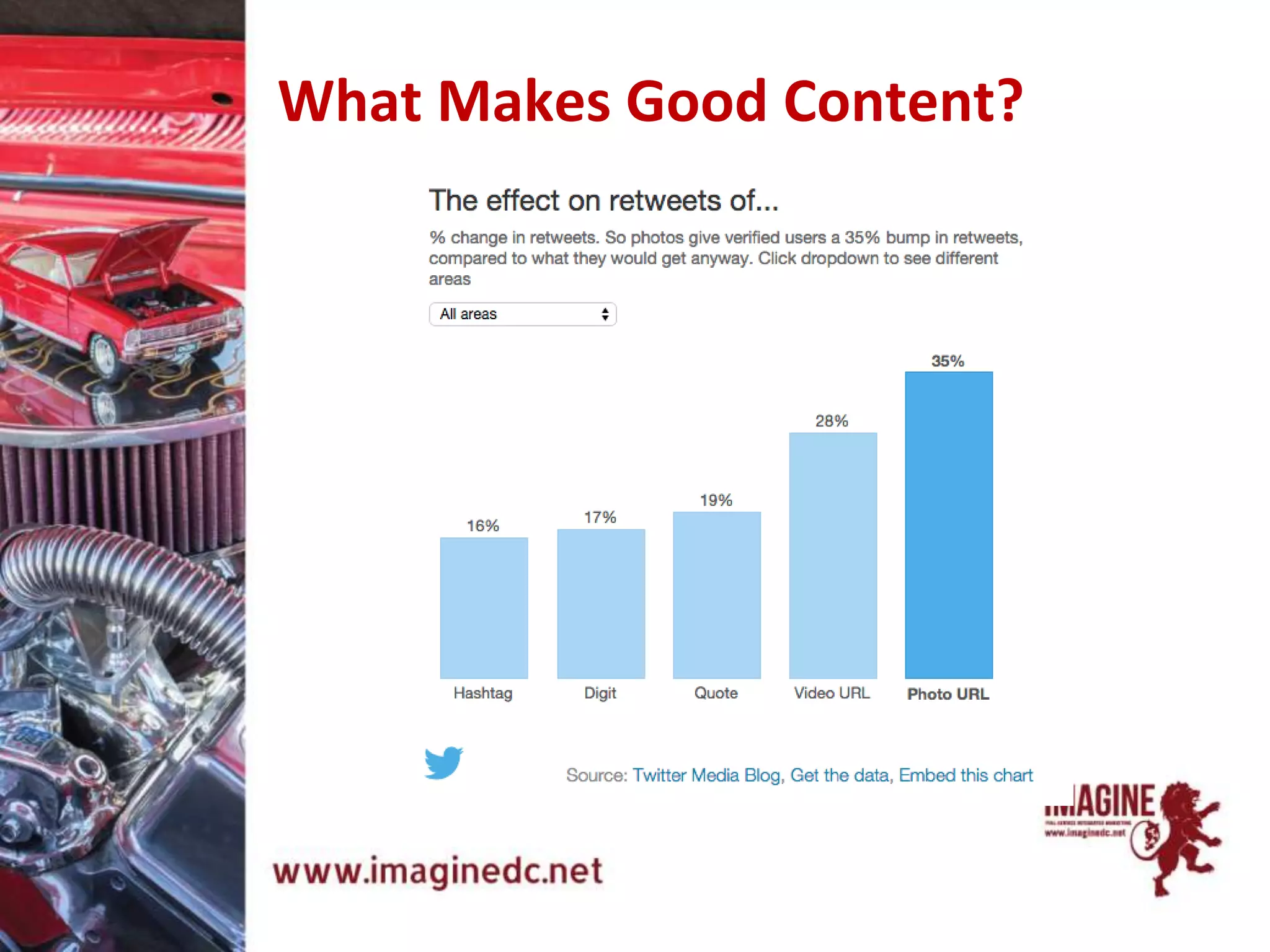
Mobile-friendliness. Simple posts are best
(images get more interaction than text, video or
links).
What Makes Good Content?
46% of marketers say photography is critical
to their current marketing and storytelling
strategies.
http://www.cmocouncil.org/images/uploads/297.pdf
What Makes Good Content?
However,…
http://syndacast.com/video-marketing-statistics-trends-2015/
Establishing Your Metrics
Set expectations and metrics up front, and
adjust as you go. Make sure they’re:
• Realistic within your resources
• Achievable within a defined time period
• Focused on a network and audience
• Related to a business objective (website
traffic, whitepaper downloads, sales)
Establishing Your Metrics
For example: within the next six months,
we would like to see a 10% increase in
website conversions from Pinterest and
Facebook marketing to women aged 25-34,
located in western Prince William County.
Realistic: 10% increase
Achievable: within six months
Focused: defined audience
Related: website conversions
Tips For Saving Time
And Increasing Your
Productivity With Social
Media
1. Automate
Use social media automation tools to help
you manage your social media networks.
Some of the more commonly used tools are
HootSuite and TweetDeck. You can manage
all of your social media accounts through a
single interface, saving you time and energy.
Much of the content out there can be of
tremendous value to your audience. Instead
of feeling like you have to come up with
everything on your own, feel free to share
something you’ve seen or read somewhere
else. Just make sure the creator of the
content gets some credit.
2. Share
With more websites being built on open-
source content management systems
(WordPress, Joomla, Drupal, etc.), business
owners are using plugins on their website to
streamline their social media efforts. Not
only can these plugins automatically publish
to social media, they can also lead website
visitors to your social networks.
3. Plug In
The same content you’re posting on your
blog and social media sites can be re-
purposed into an email newsletter. In many
cases, people don’t catch everything on
social media, and many people prefer to get
emails that catch them up.
4. Repurpose
Facebook, WordPress and many other
services now let you schedule when your
content is published. In many cases,
publishing between 9 to 5 doesn’t work as
well as maybe 8 or 9 at night. Schedule your
posts for when they’ll get the most visibility.
5. Schedule
RULE 1. Add Value
• Give free advice (LifeHacker, Lowe’s “Fix in
Six”)
• Encourage your audience a chance to
speak up (rewards programs, contests)
• Give them the exclusive (discount codes,
exclusive promotions)
RULE 2. Be Human
• Have a conversation, not a sales pitch. No
one likes being sold to…
• Use casual language. Cut the jargon.
• Don’t be afraid of humor, but be sensitive.
• Use it to manage crises, and do so quickly.
• Focus on the brand and the relationship,
not the sale.
RULE 3. Know Your Audience
• When are they active online?
• EEE (enlighten, educate, entertain)
• Women dominate social media
• Targeting men? Go to LinkedIn, G+ and
YouTube (they’re hiding on Digg and
Reddit too)
RULE 4. Stay Active
• Share current experiences (blogs, social
posts, news items)
• Share your personality and culture
• Feature an employee, customer or partner
• Respond to comments and messages
promptly
Growth Hacking Your Social Media

Growth Hacking Your Social Media

  • 2.
    What we’re coveringtoday… • The USP • Can your company handle social media? • Defining your customer • Finding your content • Establishing your metrics • Tips and rules of social media • Q&A
  • 6.
    This is “GrowthHacking” Performing a marketing strategy, campaign or outreach effort with minimal resources and maximum results. Key characteristics include: • Speed: a time-sensitive focus on only what you need to get a specific result (traffic, conversions, etc.). Get results as soon as possible. • Elegance and a cleanly structured (or even automated) approach. • Performance. Using technology to eliminate complexity or any excess of manpower. • Memorability. Understanding each audience segment, and making content that resonates. • Attention to detail. Intensive tracking mechanisms that allow you to know – immediately – as much as possible about your campaign, audience and progress.
  • 8.
    …you must beable to complete one simple sentence… Before anything else…
  • 9.
    …you must beable to complete one simple sentence… “Only we…” Before anything else…
  • 10.
    “Only we…” Completing thissentence forces you to figure out: • Why you’re one-of-a-kind, not just better • Why prospects should reach out • Where you fit in the marketplace
  • 11.
    “Only we…” • Offera certain combination of services • Provide expertise (certs, etc.) to a specific niche • Are able to provide certain cost efficiencies • Own or offer a certain process • Have bandwidth to quickly execute
  • 12.
  • 13.
    Companies that communicatea unique message, or solve a problem no one else can, thrive on social media. Take the “Only we…” sentence, then turn it into an action statement. What’s your unique message?
  • 14.
    A perfect exampleis Facebook, who can justify their entire business case through one sentence… “Come waste time with us.” What’s your unique message?
  • 18.
    Figure out whyyour audience would pay attention to you.
  • 19.
    Can your companyhandle social media? Budget and content mean nothing if your company can’t manage this new addition to its culture. Marketing impacts the entire organization.
  • 20.
    Can it handlenegative comments? Can it entertain? Can it inform? Can it inspire? Can it handle the workload? Can it keep a consistent message? What’s your unique message? Can your company handle social media?
  • 21.
    Defining your customers Avery basic, and often overlooked question. Can include: Gender Age Tech Savvy Income Geography Profession Industry Education Level Marital Status Parental Status Hobbies Demeanor Comm. Preference Pain Points …and more!
  • 22.
    Defining your customers Avery basic, and often overlooked question.
  • 23.
    Defining your customers Identifythe right time of day • B2B – during work hours? • B2C – early evenings or weekends? Identify where they spend their time • B2B – LinkedIn, Twitter, Slideshare, WordPress, Quora • B2C – Facebook, Yelp, Instagram, Foursquare Identify their interests • B2B – Entrepreneurs, Skilled Trades, Business Issues • B2C – Fun, Humor, Family-Related
  • 24.
    Study other companiesin your segment or niche to see how their audience responds to certain content in certain networks. Interview/survey some of your favorite customers. Then develop the content strategy (topics, frequency, medium). Defining your customers
  • 25.
    • Complete thesentence “Only we…” • Can your company handle social media? • Defining your customer Any questions? So far…
  • 26.
    Finding your Content Occasionaltweets, emails or random LinkedIn posts don’t make a strategy. You need to consistently publish content that can include articles, blog posts, press releases, images, graphs, videos, audio, documents, whitepapers, guides, slideshows, ebooks...
  • 28.
    The biggest questionwe get is: “That’s great, but how am I going to find time to do this?” Fortunately, there’s a good answer. Finding your Content
  • 29.
    The biggest questionwe get is: “That’s great, but how am I going to find time to do this?” • Comments on existing content. • Sharing news articles, adding your own perspective. • Repurposing earlier content (PRs, blogs, etc.). • Being louder about the work you’re already doing. Finding your Content
  • 30.
    The second biggestquestion we get is: “Which networks do you recommend we use?” Finding your Content
  • 31.
    The second biggestquestion we get is: “Which networks do you recommend we use?” Instead of worrying about which networks to use, focus first on the content and let that dictate the choice of network. Finding your Content
  • 32.
  • 33.
  • 34.
    • Photo-sharing (Instagram,Flickr) • Document-sharing (Prezi, Slideshare) • Event-planning (EventBrite, Meetup) • Reviews/ratings (Yelp, Angie’s List) • Blogs (WordPress, Website CMS) • Microblogs (Tumblr, Twitter) • Wiki (Wikipedia) • Location-sharing (Foursquare) • Marketplace (Etsy, Groupon) • Q&A (Answers.com, Quora) • Staying in touch (LinkedIn, Facebook) What type of content are you sharing?
  • 35.
    Personality. Boring onlineis worse than boring in person. Variety. Feel free to deviate from your business offering. No one wants to read the same stuff over and over. Mobile-friendliness. Simple posts are best (images get more interaction than text, video or links). What Makes Good Content?
  • 36.
    46% of marketerssay photography is critical to their current marketing and storytelling strategies. http://www.cmocouncil.org/images/uploads/297.pdf
  • 37.
  • 38.
  • 39.
    Establishing Your Metrics Setexpectations and metrics up front, and adjust as you go. Make sure they’re: • Realistic within your resources • Achievable within a defined time period • Focused on a network and audience • Related to a business objective (website traffic, whitepaper downloads, sales)
  • 40.
    Establishing Your Metrics Forexample: within the next six months, we would like to see a 10% increase in website conversions from Pinterest and Facebook marketing to women aged 25-34, located in western Prince William County. Realistic: 10% increase Achievable: within six months Focused: defined audience Related: website conversions
  • 41.
    Tips For SavingTime And Increasing Your Productivity With Social Media
  • 42.
    1. Automate Use socialmedia automation tools to help you manage your social media networks. Some of the more commonly used tools are HootSuite and TweetDeck. You can manage all of your social media accounts through a single interface, saving you time and energy.
  • 43.
    Much of thecontent out there can be of tremendous value to your audience. Instead of feeling like you have to come up with everything on your own, feel free to share something you’ve seen or read somewhere else. Just make sure the creator of the content gets some credit. 2. Share
  • 44.
    With more websitesbeing built on open- source content management systems (WordPress, Joomla, Drupal, etc.), business owners are using plugins on their website to streamline their social media efforts. Not only can these plugins automatically publish to social media, they can also lead website visitors to your social networks. 3. Plug In
  • 45.
    The same contentyou’re posting on your blog and social media sites can be re- purposed into an email newsletter. In many cases, people don’t catch everything on social media, and many people prefer to get emails that catch them up. 4. Repurpose
  • 46.
    Facebook, WordPress andmany other services now let you schedule when your content is published. In many cases, publishing between 9 to 5 doesn’t work as well as maybe 8 or 9 at night. Schedule your posts for when they’ll get the most visibility. 5. Schedule
  • 47.
    RULE 1. AddValue • Give free advice (LifeHacker, Lowe’s “Fix in Six”) • Encourage your audience a chance to speak up (rewards programs, contests) • Give them the exclusive (discount codes, exclusive promotions)
  • 49.
    RULE 2. BeHuman • Have a conversation, not a sales pitch. No one likes being sold to… • Use casual language. Cut the jargon. • Don’t be afraid of humor, but be sensitive. • Use it to manage crises, and do so quickly. • Focus on the brand and the relationship, not the sale.
  • 51.
    RULE 3. KnowYour Audience • When are they active online? • EEE (enlighten, educate, entertain) • Women dominate social media • Targeting men? Go to LinkedIn, G+ and YouTube (they’re hiding on Digg and Reddit too)
  • 52.
    RULE 4. StayActive • Share current experiences (blogs, social posts, news items) • Share your personality and culture • Feature an employee, customer or partner • Respond to comments and messages promptly