GROWTH & DEVELOPMENT
DEFINITIONS AND
TERMINOLOGIES
www.indiandentalacademy.com
Introduction :
• To know the normal growth and how it
occurs.
• Difference between normal and abnormal
growth.
• Timing of growth.
• Working with growth.
www.indiandentalacademy.com
Definition of Growth
• “Growth refers to increase in size” - Todd
• “Growth may be defined as the normal change
in the amount of living substance”- Moyers
• “Growth usually refers to an increase in size
and number” – Profitt
www.indiandentalacademy.com
Definition of Development
“Development is a progress towards maturity” – Todd
“Development refers to all naturally occurring
progressive, unidirectional, sequential changes in the
life of an individual from it’s existence as a single
cell to it’s elaboration as a multifunctional unit
terminating in death” – Moyers
“Development connotes a maturational process
involving progressive differentiation at the cellular
and tissue levels” - Enlowwww.indiandentalacademy.com
Correlation between
Growth & Development
• Growth is basically anatomic phenomenon
and quantitative in nature
• Development is basically physiologic
phenomenon and qualitative in nature
www.indiandentalacademy.com
Definitions
• Morphogenesis – “A biologic process
having an underlying control at the cellular
and tissue levels”
• Differentiation – “It is a change from
generalized cells or tissues to a more
specialized kinds during development”
www.indiandentalacademy.com
Definitions
• Translocation – “It is a change in position”
• Maturation – “The term maturation is
sometimes used to express qualitative
changes which occur with ripening or
ageing”
www.indiandentalacademy.com
Normal features of
Growth & Development
• Differential Growth
• Pattern
• Normality
• Variability
• Timing, rate & direction
www.indiandentalacademy.com
Differential Growth
• Not all tissue systems
of the body grow at
the same rate
• Scammon’s curves
Depicting differential
growth
- Neural tissue growth is
completed by 6
– 7 years
- Lymphoid tissue growth is
completed in late childhood and
growth of genital tissues
accelerates at the same time.
- General Body tissue followswww.indiandentalacademy.com
Pattern
• It is a set of constraints operating to
preserve the integration of parts under
varying conditions or through time
– Changes in overall body proportions
– Changes in proportion of cranio-facial region
www.indiandentalacademy.com
Predictability
• Predictability of growth pattern is a specific
kind of proportionality that exists at a
particular time and progress towards
another at the next time frame with a slight
variations
• In orthodontics
- Morphogenetic
- Developmental
www.indiandentalacademy.com
Normality
• Normality refers to that which is usually
expected is ordinarily seen or typical - Moyers
Mean
Standard
deviation
Two standard deviations
On either side of mean
Is normal
• Misuse of the concept of normality can lead
to many problems in clinical orthodontics &
treatment planning.www.indiandentalacademy.com
Variability
• No two individuals with the exception of
monozygotic twins are like
• Variability quantitatively is categorized in
terms of deviations from the usual pattern,
which is done using standard growth charts
www.indiandentalacademy.com
Timing of Growth
• Largely under genetic control
• Altered by environment
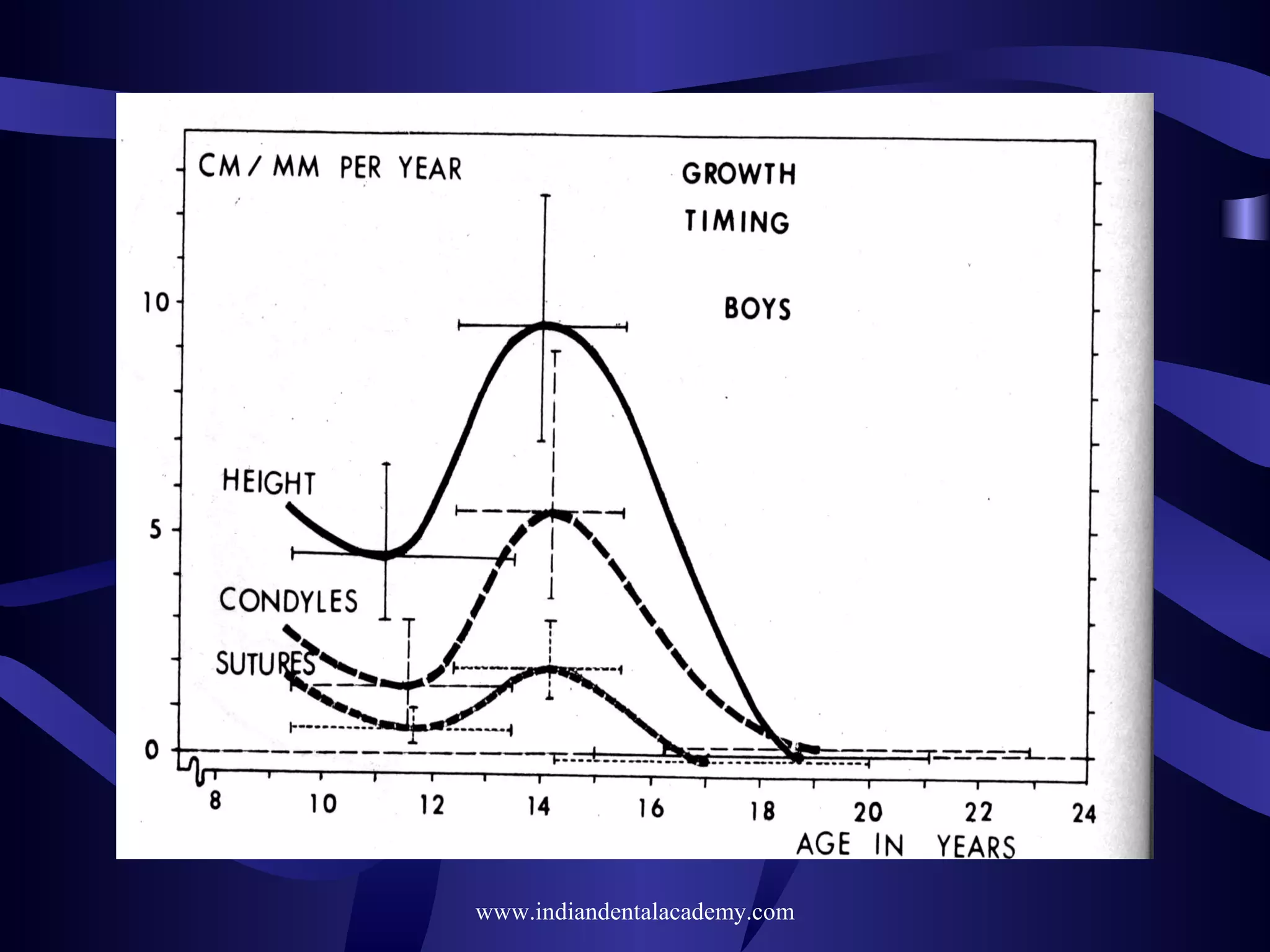
• Sex related difference in timing of events
– Growth spurts
– Dental calcification
– Ossification of carpal bones
www.indiandentalacademy.com
Distance curve
Vs
Velocity curve
Distance
curve
Velocity
curve
Age
Height
Distance Curve : In this curve growth can be plotted in
height or weight recorded at various ages.
Velocity Curve: In this by amount of change in any given
interval that is growth increment is plotted.
www.indiandentalacademy.com
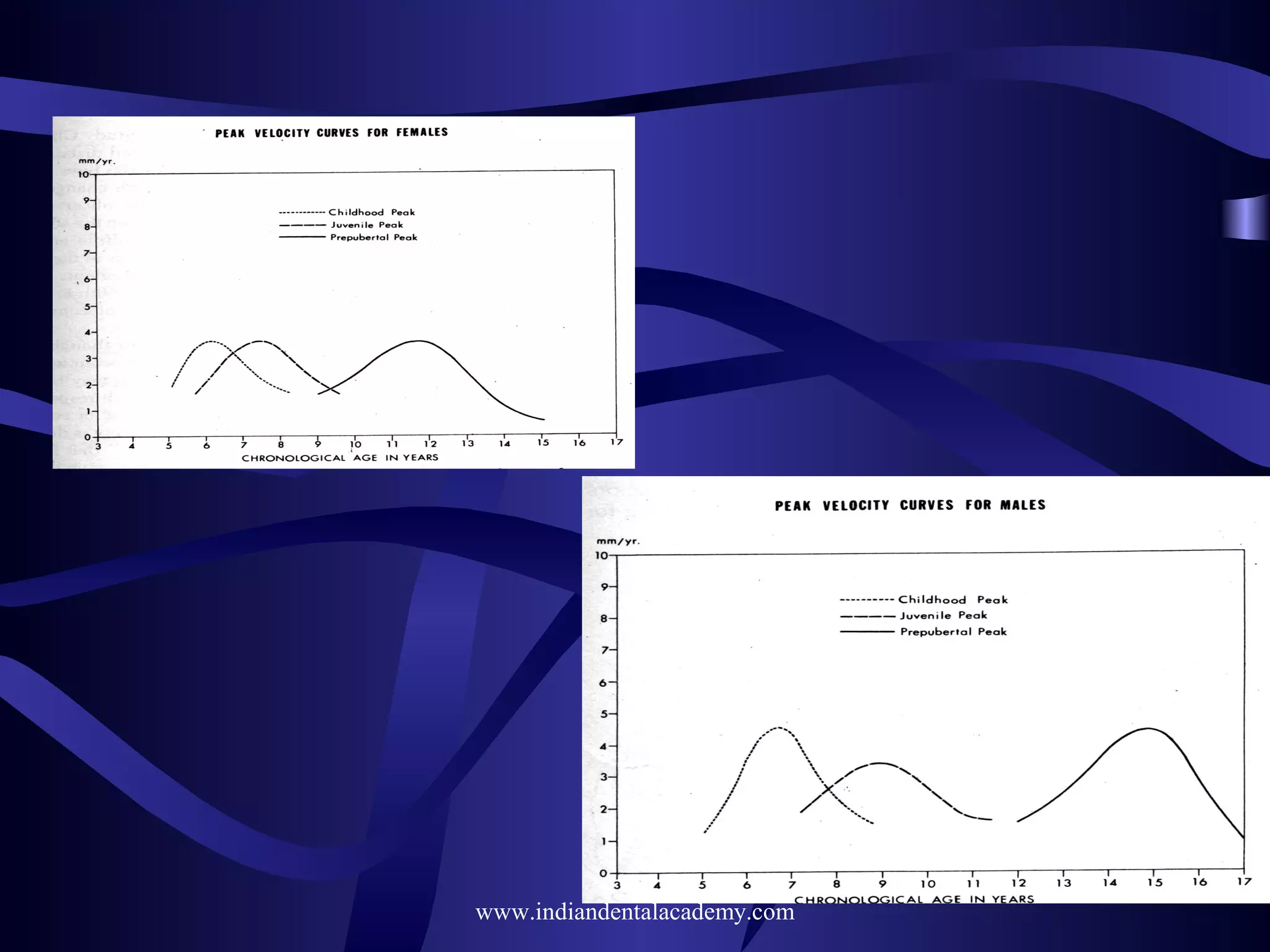
Growth spurts
• Defined as periods of growth acceleration
• Sex-linked
– Normal spurts are
• Infantile spurt – at 3 years age
• Juvenile spurt – 7-8 years (females); 8-10 years (males)
• Pubertal spurt – 10-11 years(females); 18-15 years
(males)
• Growth modulation can be done
www.indiandentalacademy.com
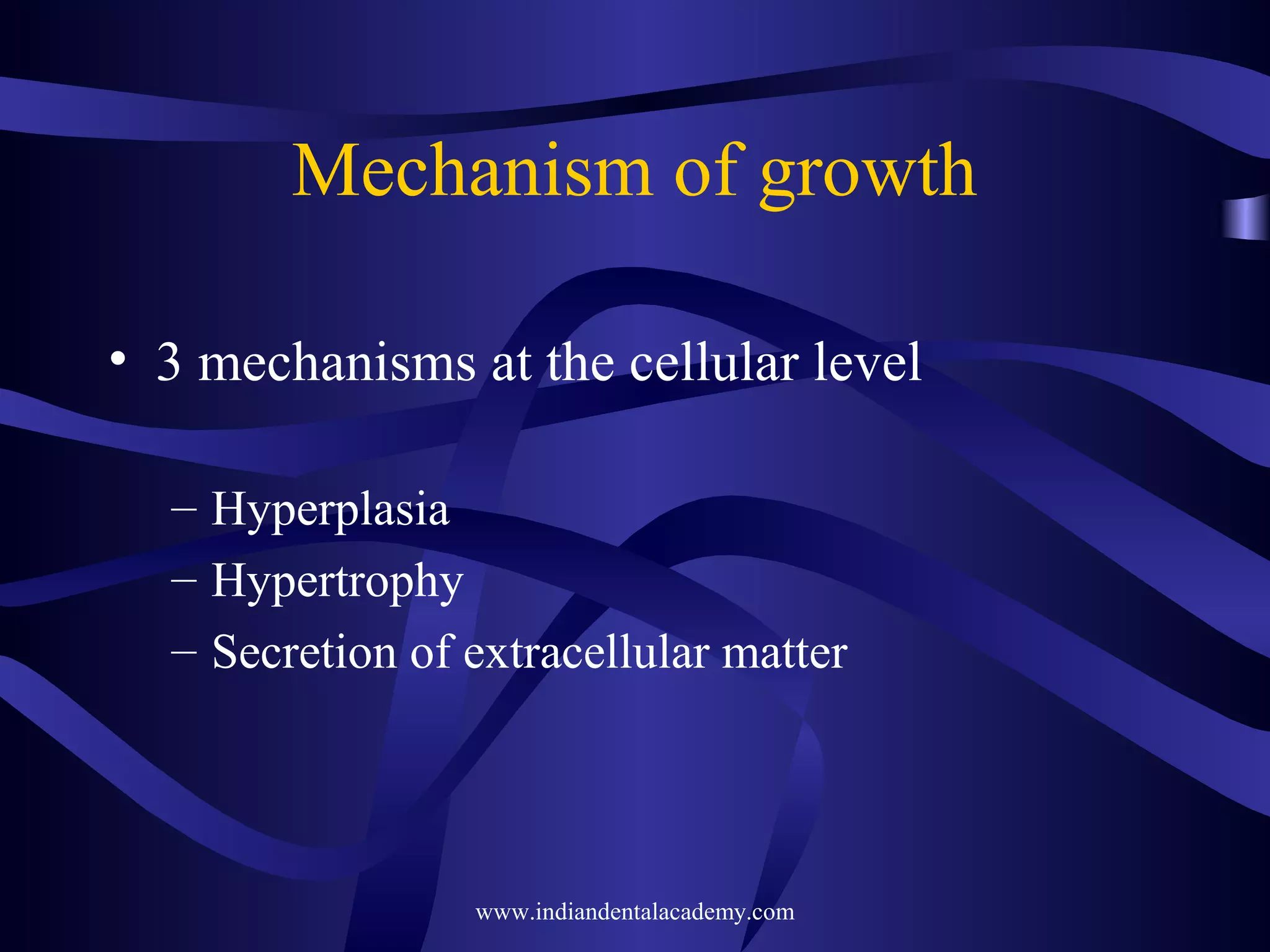
Mechanism of growth
• 3 mechanisms at the cellular level
– Hyperplasia
– Hypertrophy
– Secretion of extracellular matter
www.indiandentalacademy.com
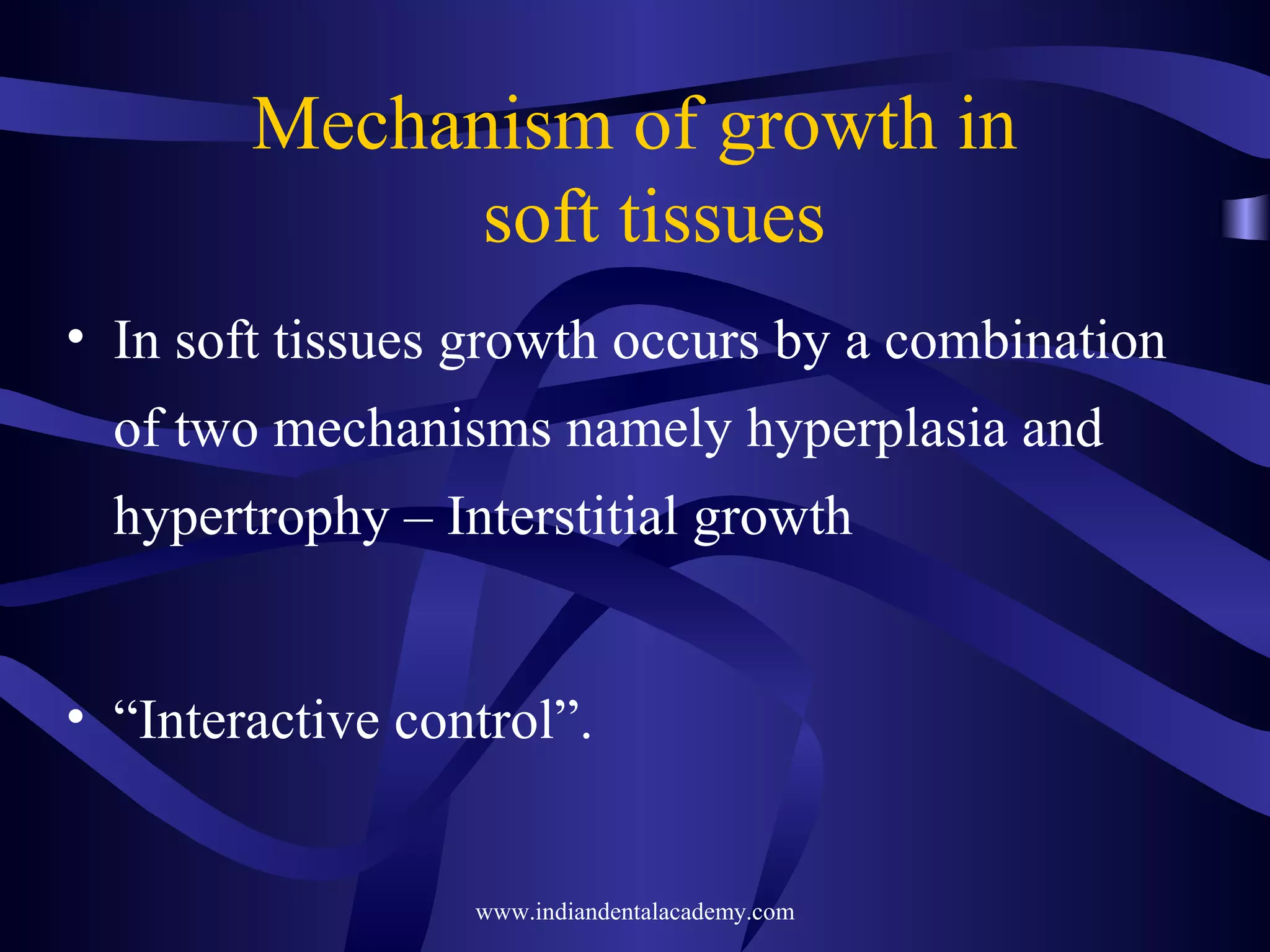
Mechanism of growth in
soft tissues
• In soft tissues growth occurs by a combination
of two mechanisms namely hyperplasia and
hypertrophy – Interstitial growth
• “Interactive control”.
www.indiandentalacademy.com
Mechanism of growth in hard
tissue
It is of two types
Intramembranous Endochondral
Bone formation. Bone formation
www.indiandentalacademy.com
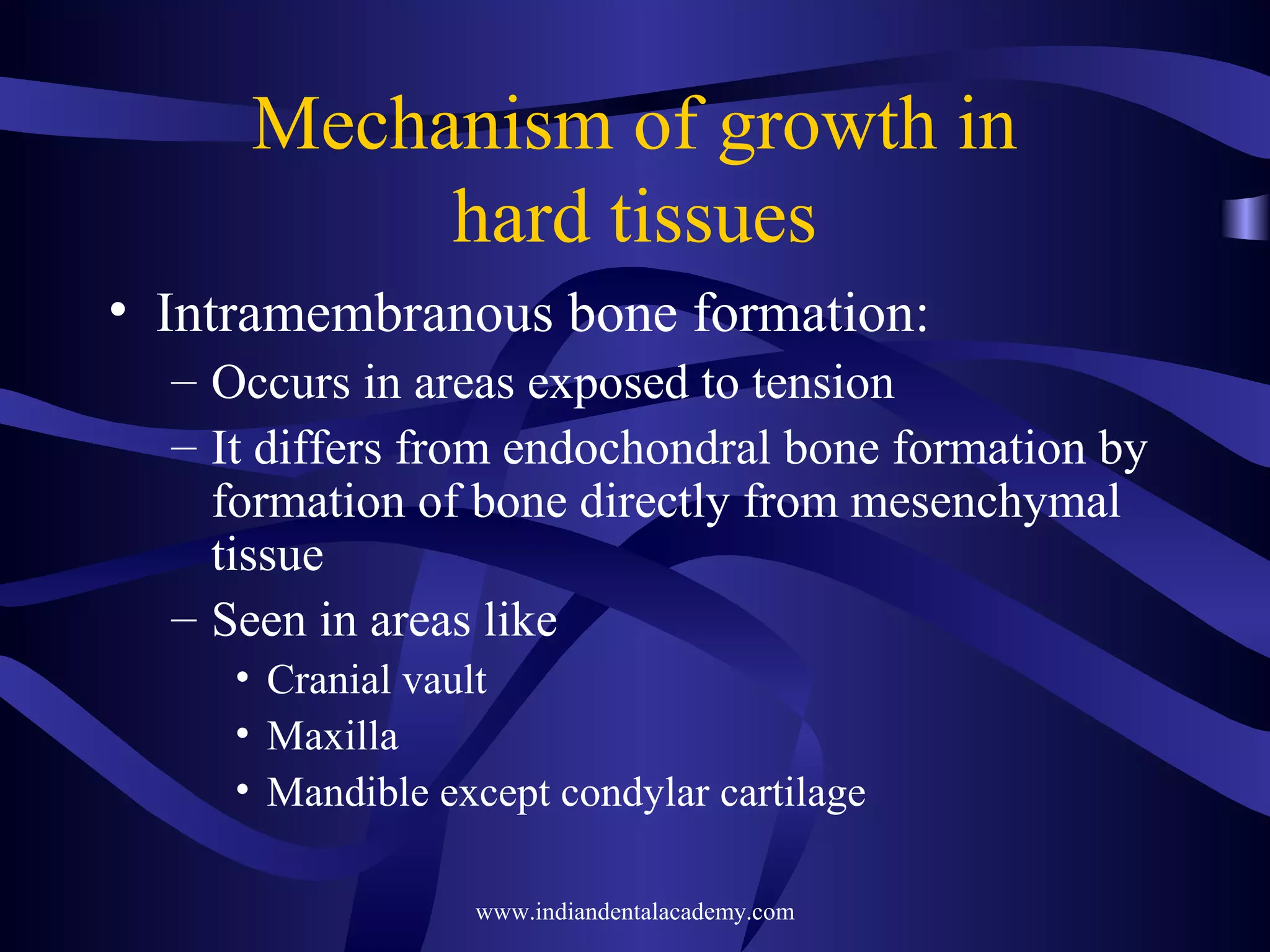
Mechanism of growth in
hard tissues
• Intramembranous bone formation:
– Occurs in areas exposed to tension
– It differs from endochondral bone formation by
formation of bone directly from mesenchymal
tissue
– Seen in areas like
• Cranial vault
• Maxilla
• Mandible except condylar cartilage
www.indiandentalacademy.com
Undifferentiated mesenchymal cells differentiate
Osteoblasts
Osteoid Matrix
Calcification and formation of bone results
www.indiandentalacademy.com
Mechanism of growth in
hard tissues
• Endochondral bone formation:
– Occurs in regions exposed to high levels of
compression
– In craniofacial region it is seen in areas like
• Synchondrosis at the cranial base
• Condylar cartilage
• Nasal septal cartilage
www.indiandentalacademy.com
Cartilage cells undergo hypertrophy
Marix become calcified.
Cells Degenerate
Osteogenic tissues invade disintegrating cartilage and
replace it by formation of bone.
www.indiandentalacademy.com
Bone metabolism
• Bone is the primary calcium reservoir of the body
(99% stored in skeleton)
•Bone structure is sacrificed to maintain the critical
serum calcium levels at 10mg %
www.indiandentalacademy.com
Bone metabolism
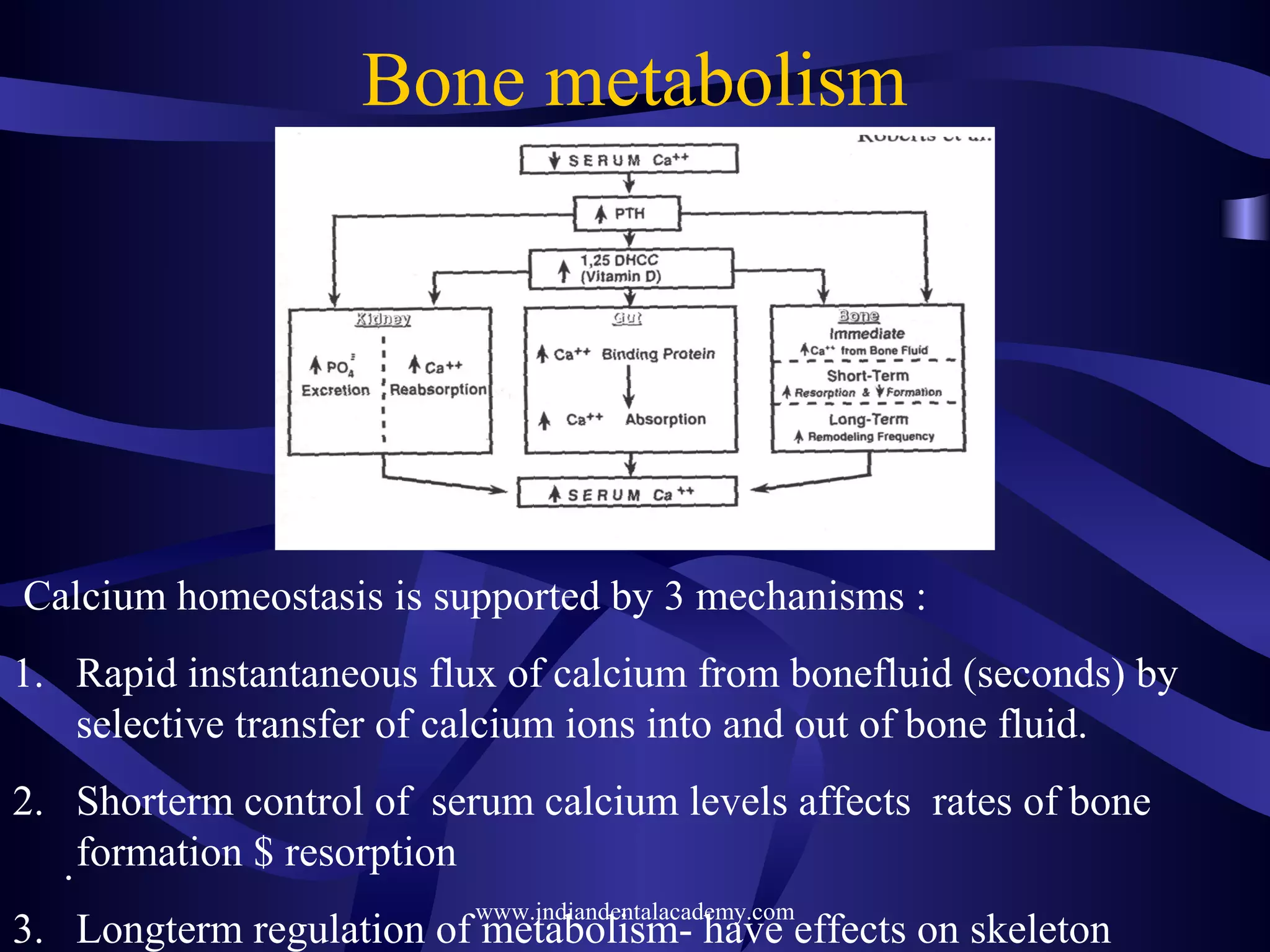
Calcium homeostasis is supported by 3 mechanisms :
1. Rapid instantaneous flux of calcium from bonefluid (seconds) by
selective transfer of calcium ions into and out of bone fluid.
2. Shorterm control of serum calcium levels affects rates of bone
formation $ resorption
3. Longterm regulation of metabolism- have effects on skeleton
.
www.indiandentalacademy.com
Types of Bones
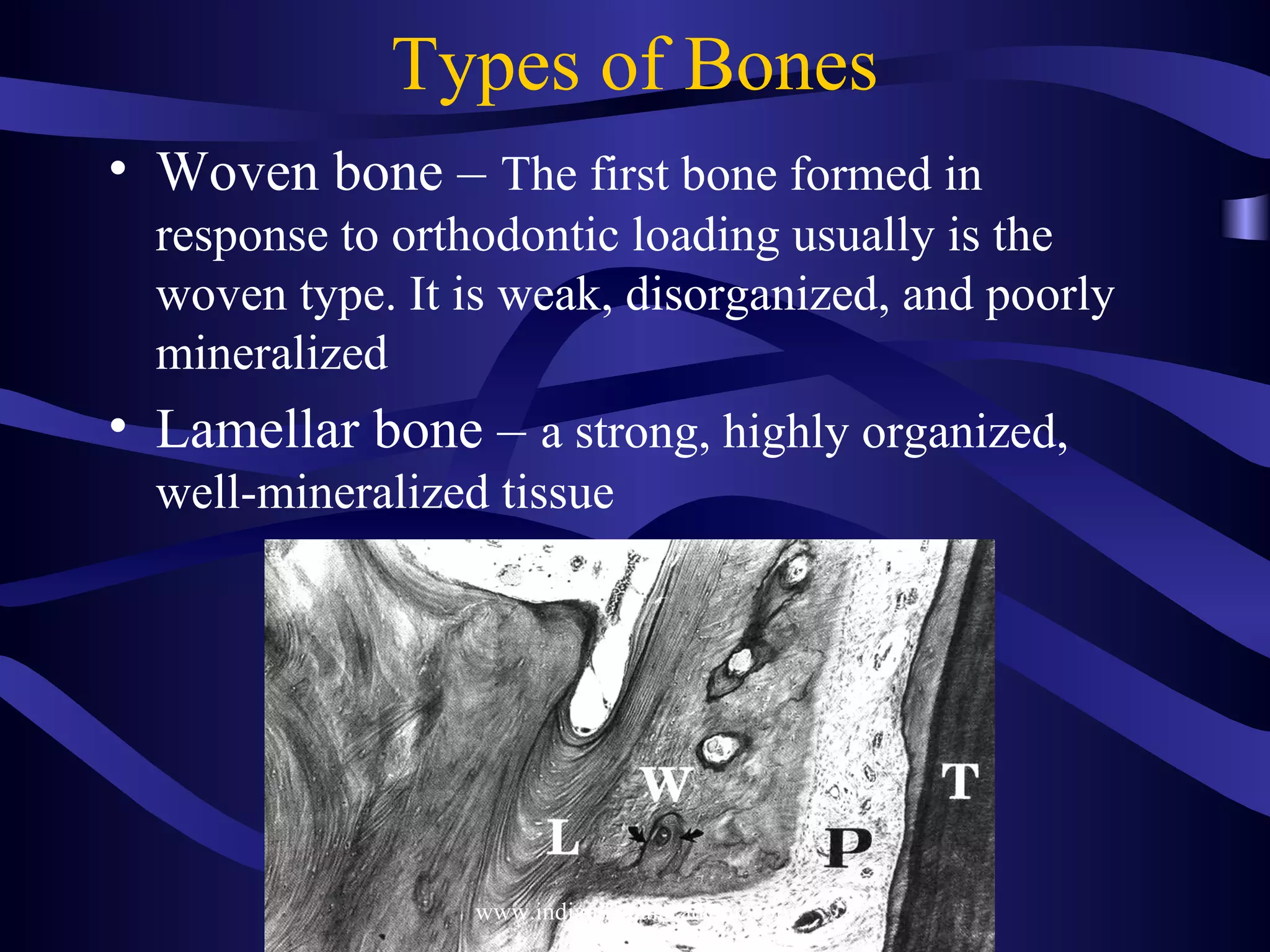
• Woven bone – The first bone formed in
response to orthodontic loading usually is the
woven type. It is weak, disorganized, and poorly
mineralized
• Lamellar bone – a strong, highly organized,
well-mineralized tissue
www.indiandentalacademy.com
Types of bones
• Composite bone – is an osseous tissue formed
by the deposition of lamellar bone within a woven
bone lattice, a process called Cancellous
compaction. This is the quickest means of
producing relatively strong bone
• Bundle bone - is a functional adaptation of
lamellar structure to allow attachment of tendons
and ligaments
www.indiandentalacademy.com
Mechanisms of bone growth
• Modeling
• Remodeling
• Displacement
• Combination of remodeling & displacement
• Rotation
www.indiandentalacademy.com
MODELING
• Bone modeling involves
independent sites of resorption and
formation that change the size and
shape of a bone.
www.indiandentalacademy.com
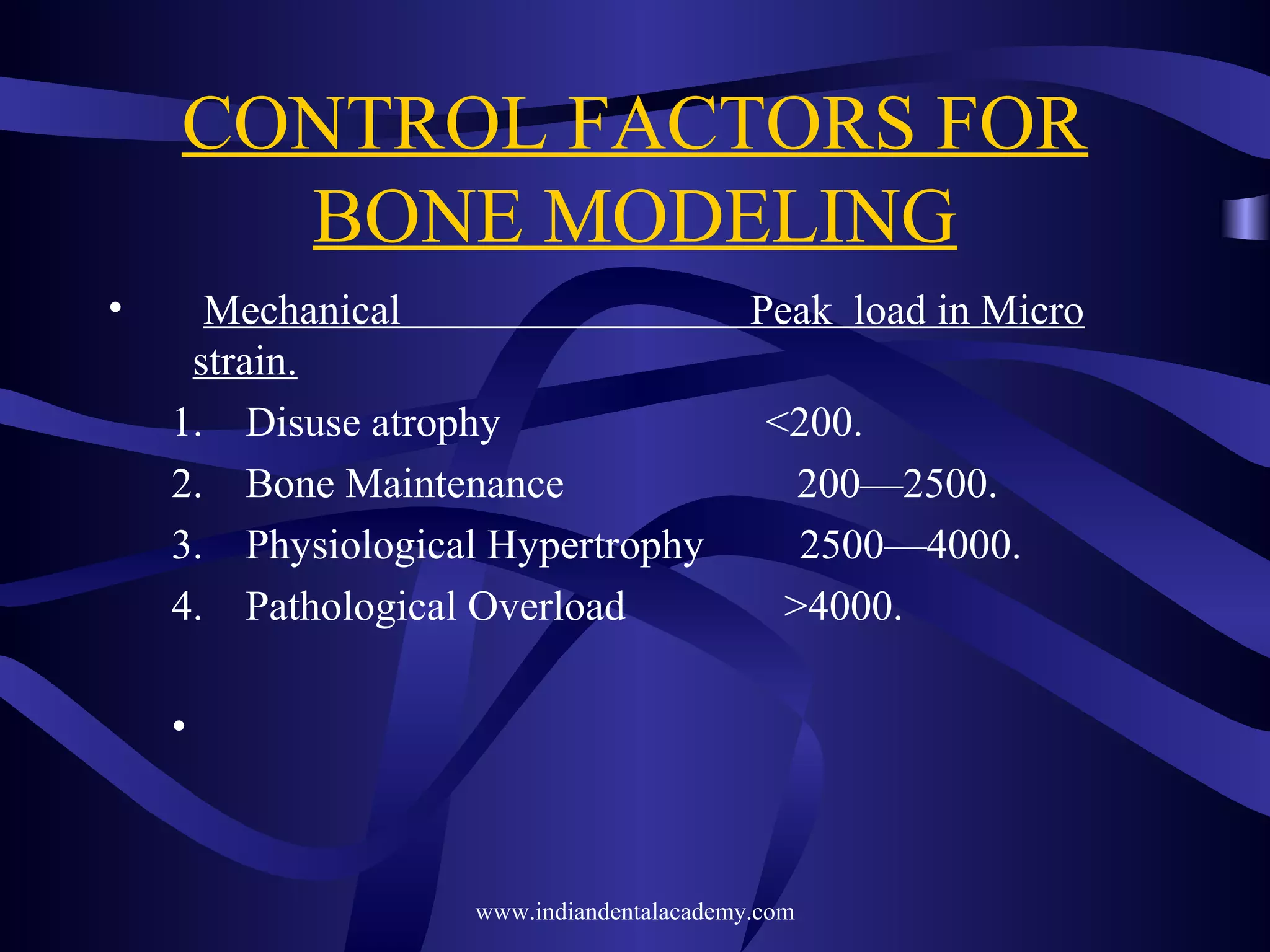
CONTROL FACTORS FOR
BONE MODELING
• Mechanical Peak load in Micro
strain.
1. Disuse atrophy <200.
2. Bone Maintenance 200—2500.
3. Physiological Hypertrophy 2500—4000.
4. Pathological Overload >4000.
•
www.indiandentalacademy.com
• Endocrine.
1.Bone metabolic hormones-PTH,Vit
D,Calcitonin.
2.Growth Hormones-Somatotropin,IGF 1,IGF 2.
3.Sex steroids-Testosterone,Estrogen.
www.indiandentalacademy.com
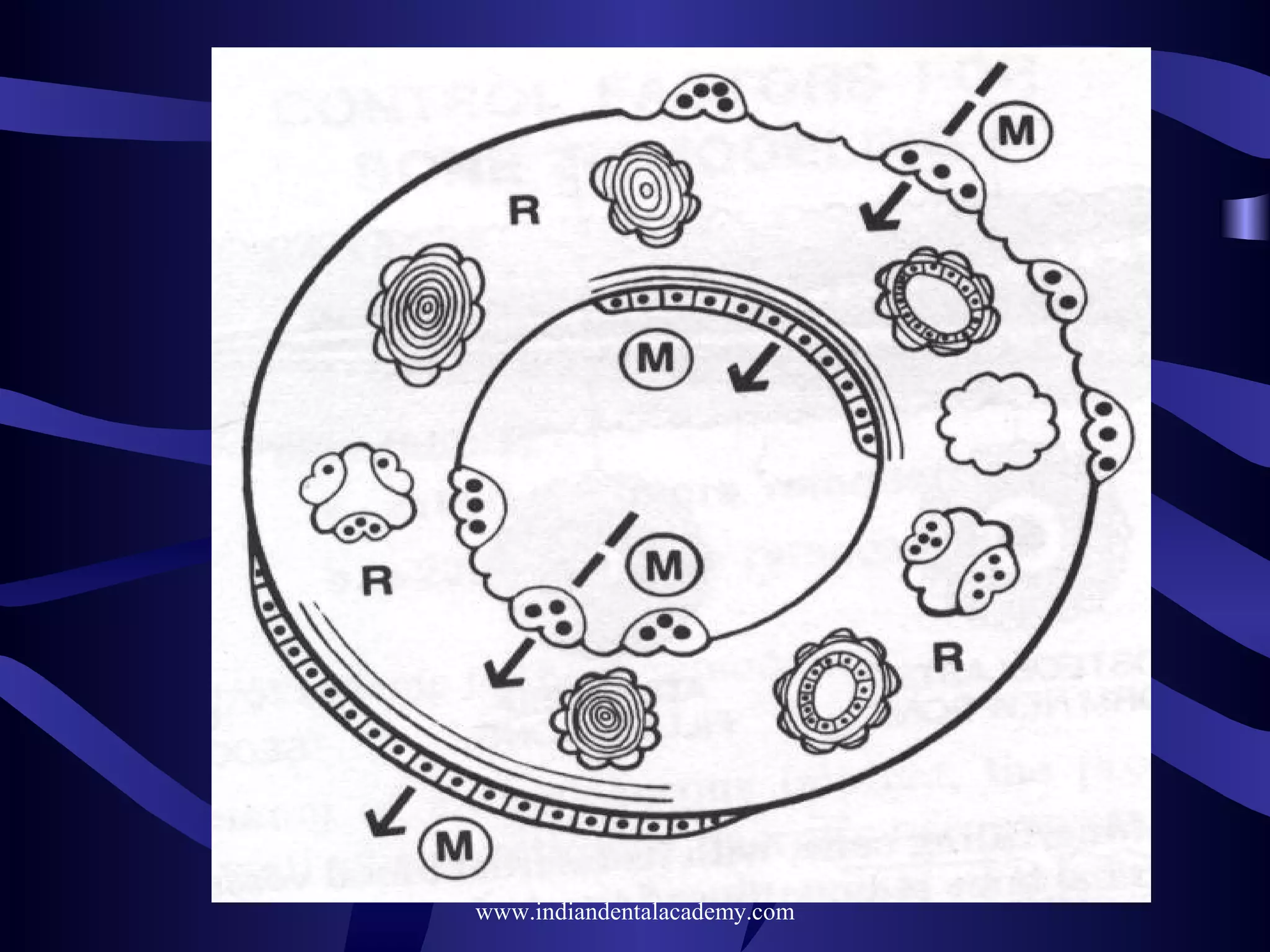
Remodelling
• A process involving deposition and
resorption occuring on opposite ends
• Four types
– Biochemical remodelling
– Haversian remodelling
– Pathologic remodelling
– Growth remodelling
www.indiandentalacademy.com
Functions of Remodelling
1. Progressively change the size of whole bone
2. Sequentially relocate each component of the
whole bone
3. Progressively change the shape of the bone to
accommodate its various functions
www.indiandentalacademy.com
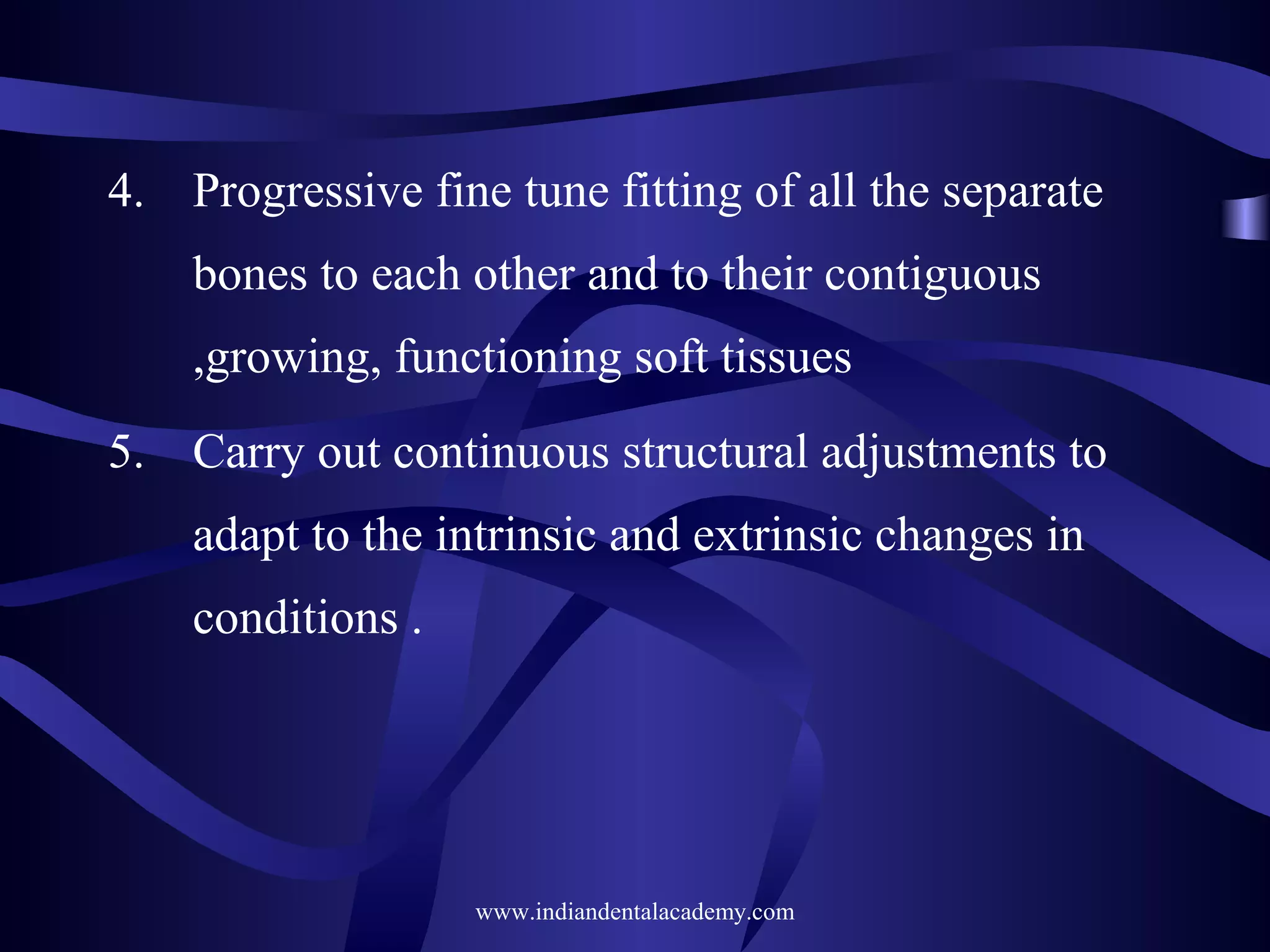
4. Progressive fine tune fitting of all the separate
bones to each other and to their contiguous
,growing, functioning soft tissues
5. Carry out continuous structural adjustments to
adapt to the intrinsic and extrinsic changes in
conditions .
www.indiandentalacademy.com
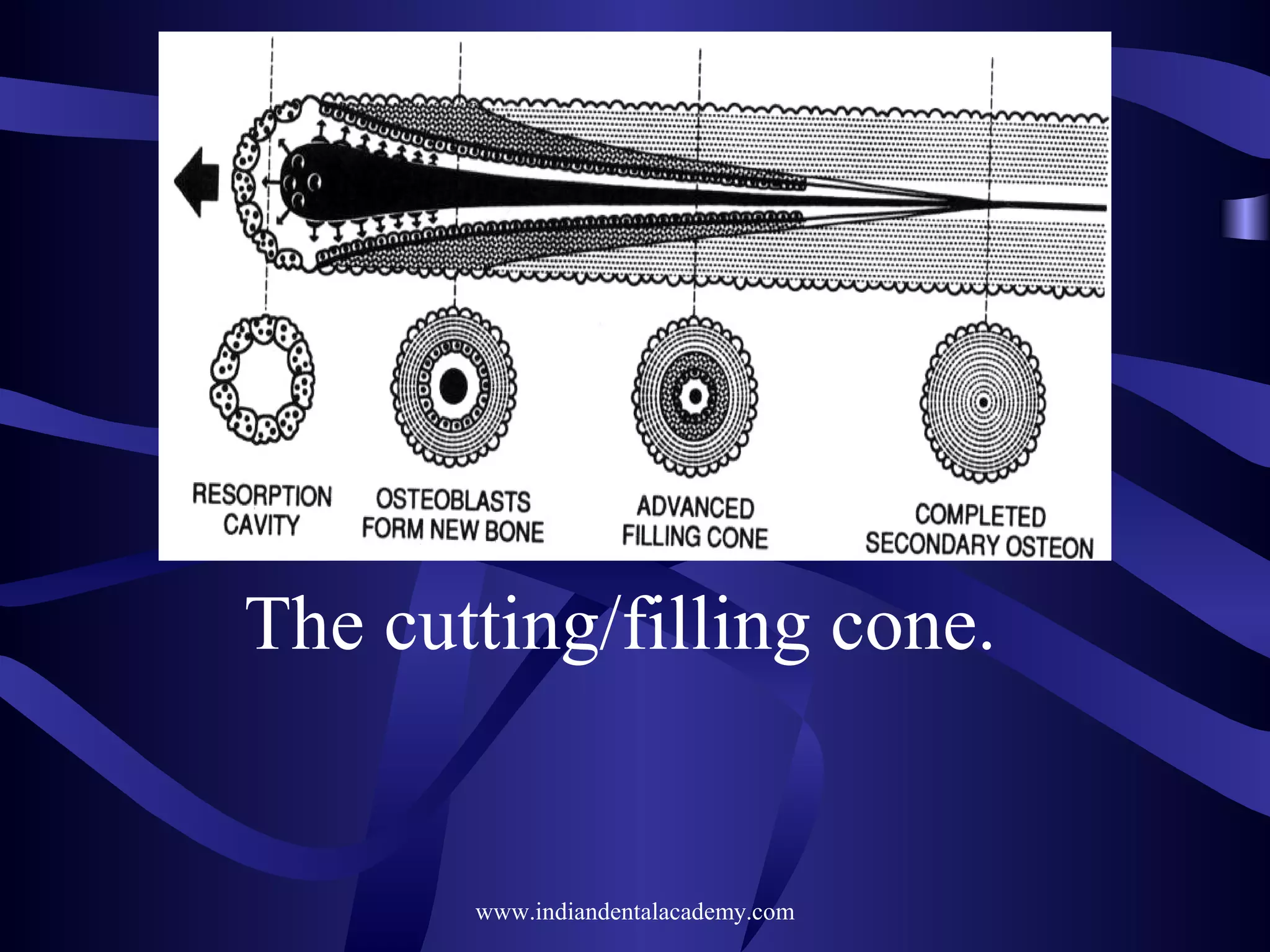
The cutting/filling cone.
www.indiandentalacademy.com
Displacement
• Refers to a shift in the position of the bone
• Two types
– Primary displacement
– Secondary displacement
www.indiandentalacademy.com
Combination of remodelling &
displacement
• Both these mechanisms operate together
and cause enlargement and movement of
the bone
www.indiandentalacademy.com
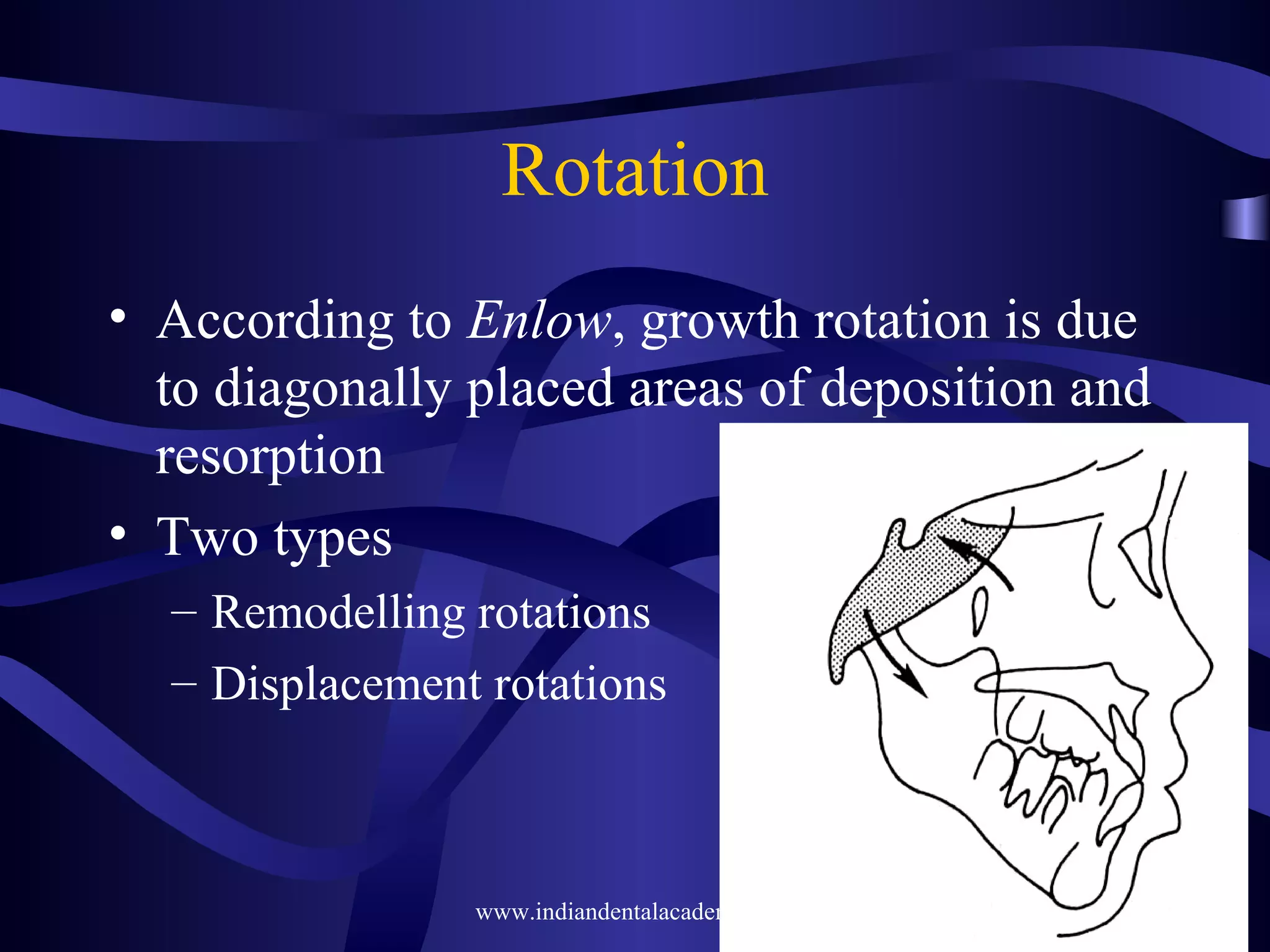
Rotation
• According to Enlow, growth rotation is due
to diagonally placed areas of deposition and
resorption
• Two types
– Remodelling rotations
– Displacement rotations
www.indiandentalacademy.com
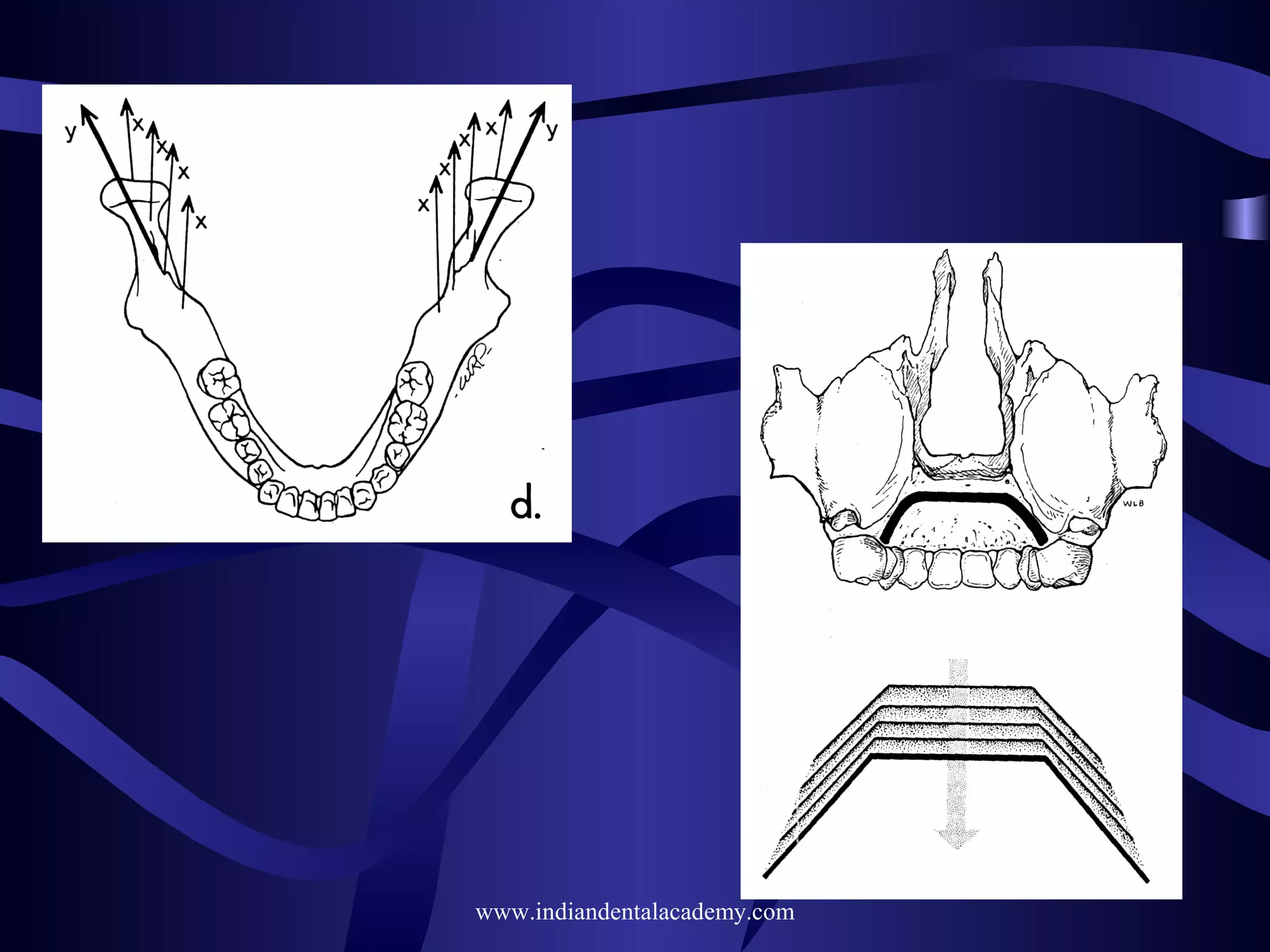
‘V’ - Principle
• Deposition occurs on the inner side and
resorption on the outerside of the bones
causing enlargement and displacement.
• The displacement is towards wide end of
‘V’
• Examples
– Neck of the condyle
– Palatal process of maxilla
www.indiandentalacademy.com
Principle of ‘Area relocation’
Both remodelling and displacement
together cause a shift in the
existing position of a particular
structures with reference to
another.
www.indiandentalacademy.com
Counter part principle
• “Growth of any given facial or cranial part
relates specifically to other structural and
geometric counterparts in the face and
cranium” - Enlow
www.indiandentalacademy.com
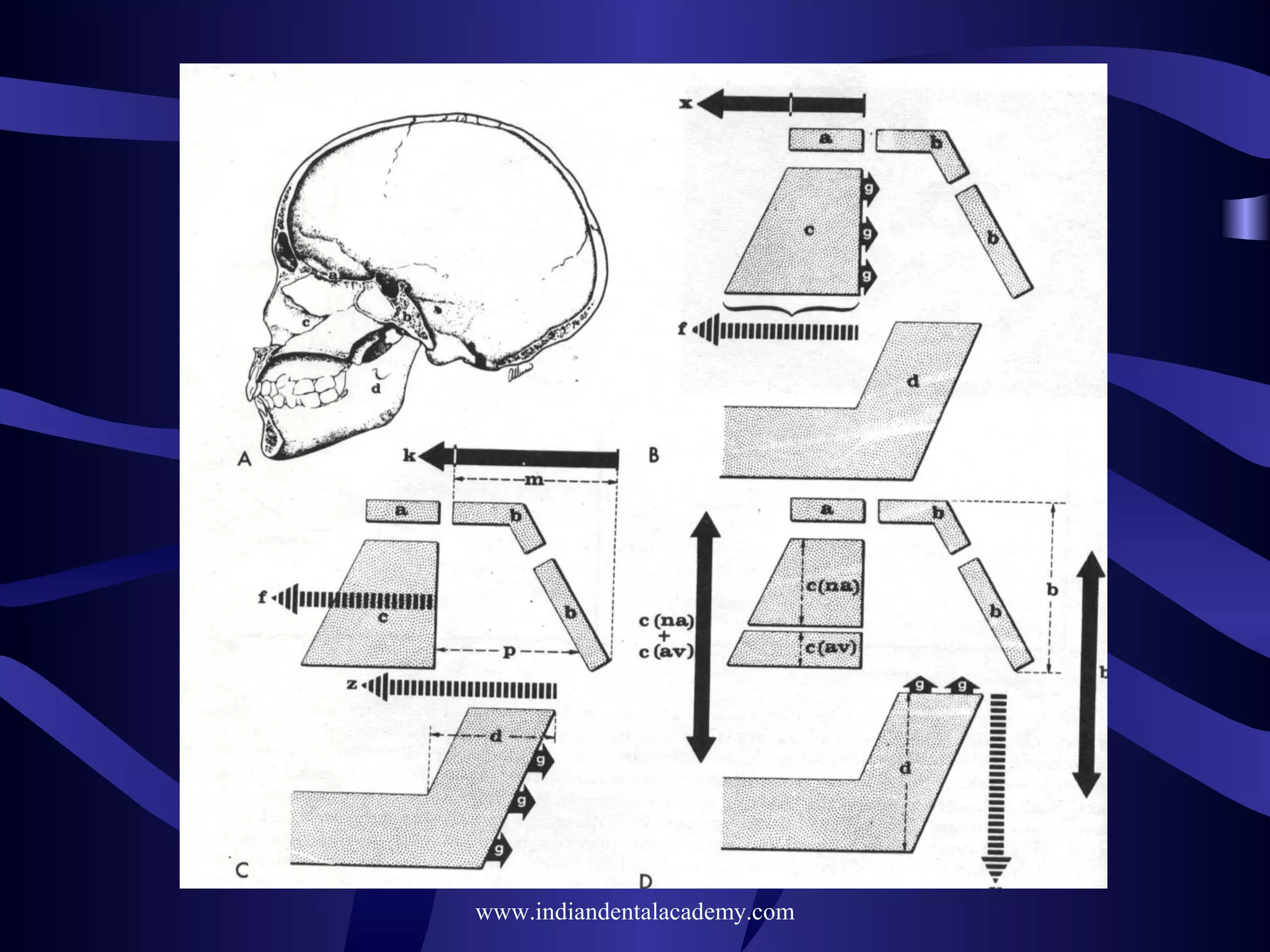
Growth equivalent principle
This principle proposed by Hunter & Enlow
relates the effects of cranial base growth on
the facial bone Growth.
www.indiandentalacademy.com

Growth & development 1

  • 1.
    GROWTH & DEVELOPMENT DEFINITIONSAND TERMINOLOGIES www.indiandentalacademy.com
  • 2.
    Introduction : • Toknow the normal growth and how it occurs. • Difference between normal and abnormal growth. • Timing of growth. • Working with growth. www.indiandentalacademy.com
  • 3.
    Definition of Growth •“Growth refers to increase in size” - Todd • “Growth may be defined as the normal change in the amount of living substance”- Moyers • “Growth usually refers to an increase in size and number” – Profitt www.indiandentalacademy.com
  • 4.
    Definition of Development “Developmentis a progress towards maturity” – Todd “Development refers to all naturally occurring progressive, unidirectional, sequential changes in the life of an individual from it’s existence as a single cell to it’s elaboration as a multifunctional unit terminating in death” – Moyers “Development connotes a maturational process involving progressive differentiation at the cellular and tissue levels” - Enlowwww.indiandentalacademy.com
  • 5.
    Correlation between Growth &Development • Growth is basically anatomic phenomenon and quantitative in nature • Development is basically physiologic phenomenon and qualitative in nature www.indiandentalacademy.com
  • 6.
    Definitions • Morphogenesis –“A biologic process having an underlying control at the cellular and tissue levels” • Differentiation – “It is a change from generalized cells or tissues to a more specialized kinds during development” www.indiandentalacademy.com
  • 7.
    Definitions • Translocation –“It is a change in position” • Maturation – “The term maturation is sometimes used to express qualitative changes which occur with ripening or ageing” www.indiandentalacademy.com
  • 8.
    Normal features of Growth& Development • Differential Growth • Pattern • Normality • Variability • Timing, rate & direction www.indiandentalacademy.com
  • 9.
    Differential Growth • Notall tissue systems of the body grow at the same rate • Scammon’s curves Depicting differential growth - Neural tissue growth is completed by 6 – 7 years - Lymphoid tissue growth is completed in late childhood and growth of genital tissues accelerates at the same time. - General Body tissue followswww.indiandentalacademy.com
  • 10.
    Pattern • It isa set of constraints operating to preserve the integration of parts under varying conditions or through time – Changes in overall body proportions – Changes in proportion of cranio-facial region www.indiandentalacademy.com
  • 11.
    Predictability • Predictability ofgrowth pattern is a specific kind of proportionality that exists at a particular time and progress towards another at the next time frame with a slight variations • In orthodontics - Morphogenetic - Developmental www.indiandentalacademy.com
  • 12.
    Normality • Normality refersto that which is usually expected is ordinarily seen or typical - Moyers Mean Standard deviation Two standard deviations On either side of mean Is normal • Misuse of the concept of normality can lead to many problems in clinical orthodontics & treatment planning.www.indiandentalacademy.com
  • 13.
    Variability • No twoindividuals with the exception of monozygotic twins are like • Variability quantitatively is categorized in terms of deviations from the usual pattern, which is done using standard growth charts www.indiandentalacademy.com
  • 14.
    Timing of Growth •Largely under genetic control • Altered by environment • Sex related difference in timing of events – Growth spurts – Dental calcification – Ossification of carpal bones www.indiandentalacademy.com
  • 15.
    Distance curve Vs Velocity curve Distance curve Velocity curve Age Height DistanceCurve : In this curve growth can be plotted in height or weight recorded at various ages. Velocity Curve: In this by amount of change in any given interval that is growth increment is plotted. www.indiandentalacademy.com
  • 16.
    Growth spurts • Definedas periods of growth acceleration • Sex-linked – Normal spurts are • Infantile spurt – at 3 years age • Juvenile spurt – 7-8 years (females); 8-10 years (males) • Pubertal spurt – 10-11 years(females); 18-15 years (males) • Growth modulation can be done www.indiandentalacademy.com
  • 17.
  • 18.
  • 19.
    Mechanism of growth •3 mechanisms at the cellular level – Hyperplasia – Hypertrophy – Secretion of extracellular matter www.indiandentalacademy.com
  • 20.
    Mechanism of growthin soft tissues • In soft tissues growth occurs by a combination of two mechanisms namely hyperplasia and hypertrophy – Interstitial growth • “Interactive control”. www.indiandentalacademy.com
  • 21.
    Mechanism of growthin hard tissue It is of two types Intramembranous Endochondral Bone formation. Bone formation www.indiandentalacademy.com
  • 22.
    Mechanism of growthin hard tissues • Intramembranous bone formation: – Occurs in areas exposed to tension – It differs from endochondral bone formation by formation of bone directly from mesenchymal tissue – Seen in areas like • Cranial vault • Maxilla • Mandible except condylar cartilage www.indiandentalacademy.com
  • 23.
    Undifferentiated mesenchymal cellsdifferentiate Osteoblasts Osteoid Matrix Calcification and formation of bone results www.indiandentalacademy.com
  • 24.
  • 25.
    Mechanism of growthin hard tissues • Endochondral bone formation: – Occurs in regions exposed to high levels of compression – In craniofacial region it is seen in areas like • Synchondrosis at the cranial base • Condylar cartilage • Nasal septal cartilage www.indiandentalacademy.com
  • 26.
    Cartilage cells undergohypertrophy Marix become calcified. Cells Degenerate Osteogenic tissues invade disintegrating cartilage and replace it by formation of bone. www.indiandentalacademy.com
  • 27.
  • 28.
    Bone metabolism • Boneis the primary calcium reservoir of the body (99% stored in skeleton) •Bone structure is sacrificed to maintain the critical serum calcium levels at 10mg % www.indiandentalacademy.com
  • 29.
    Bone metabolism Calcium homeostasisis supported by 3 mechanisms : 1. Rapid instantaneous flux of calcium from bonefluid (seconds) by selective transfer of calcium ions into and out of bone fluid. 2. Shorterm control of serum calcium levels affects rates of bone formation $ resorption 3. Longterm regulation of metabolism- have effects on skeleton . www.indiandentalacademy.com
  • 30.
    Types of Bones •Woven bone – The first bone formed in response to orthodontic loading usually is the woven type. It is weak, disorganized, and poorly mineralized • Lamellar bone – a strong, highly organized, well-mineralized tissue www.indiandentalacademy.com
  • 31.
    Types of bones •Composite bone – is an osseous tissue formed by the deposition of lamellar bone within a woven bone lattice, a process called Cancellous compaction. This is the quickest means of producing relatively strong bone • Bundle bone - is a functional adaptation of lamellar structure to allow attachment of tendons and ligaments www.indiandentalacademy.com
  • 32.
    Mechanisms of bonegrowth • Modeling • Remodeling • Displacement • Combination of remodeling & displacement • Rotation www.indiandentalacademy.com
  • 33.
    MODELING • Bone modelinginvolves independent sites of resorption and formation that change the size and shape of a bone. www.indiandentalacademy.com
  • 34.
  • 35.
    CONTROL FACTORS FOR BONEMODELING • Mechanical Peak load in Micro strain. 1. Disuse atrophy <200. 2. Bone Maintenance 200—2500. 3. Physiological Hypertrophy 2500—4000. 4. Pathological Overload >4000. • www.indiandentalacademy.com
  • 36.
    • Endocrine. 1.Bone metabolichormones-PTH,Vit D,Calcitonin. 2.Growth Hormones-Somatotropin,IGF 1,IGF 2. 3.Sex steroids-Testosterone,Estrogen. www.indiandentalacademy.com
  • 37.
    Remodelling • A processinvolving deposition and resorption occuring on opposite ends • Four types – Biochemical remodelling – Haversian remodelling – Pathologic remodelling – Growth remodelling www.indiandentalacademy.com
  • 38.
    Functions of Remodelling 1.Progressively change the size of whole bone 2. Sequentially relocate each component of the whole bone 3. Progressively change the shape of the bone to accommodate its various functions www.indiandentalacademy.com
  • 39.
    4. Progressive finetune fitting of all the separate bones to each other and to their contiguous ,growing, functioning soft tissues 5. Carry out continuous structural adjustments to adapt to the intrinsic and extrinsic changes in conditions . www.indiandentalacademy.com
  • 40.
  • 41.
    Displacement • Refers toa shift in the position of the bone • Two types – Primary displacement – Secondary displacement www.indiandentalacademy.com
  • 42.
    Combination of remodelling& displacement • Both these mechanisms operate together and cause enlargement and movement of the bone www.indiandentalacademy.com
  • 43.
    Rotation • According toEnlow, growth rotation is due to diagonally placed areas of deposition and resorption • Two types – Remodelling rotations – Displacement rotations www.indiandentalacademy.com
  • 44.
    ‘V’ - Principle •Deposition occurs on the inner side and resorption on the outerside of the bones causing enlargement and displacement. • The displacement is towards wide end of ‘V’ • Examples – Neck of the condyle – Palatal process of maxilla www.indiandentalacademy.com
  • 45.
  • 46.
    Principle of ‘Arearelocation’ Both remodelling and displacement together cause a shift in the existing position of a particular structures with reference to another. www.indiandentalacademy.com
  • 47.
    Counter part principle •“Growth of any given facial or cranial part relates specifically to other structural and geometric counterparts in the face and cranium” - Enlow www.indiandentalacademy.com
  • 48.
    Growth equivalent principle Thisprinciple proposed by Hunter & Enlow relates the effects of cranial base growth on the facial bone Growth. www.indiandentalacademy.com
  • 49.