Agrarian Reform from the Spanish
Colonial Philippines to the Present
Land Reform
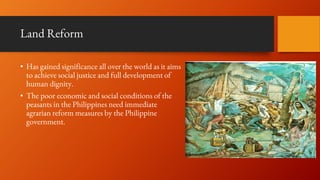
• Has gained significance all over the world as it aims
to achieve social justice and full development of
human dignity.
• The poor economic and social conditions of the
peasants in the Philippines need immediate
agrarian reform measures by the Philippine
government.
Pre-Spanish Period
“This land is Ours God gave this land to us”
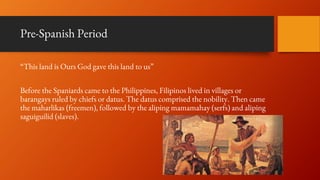
Before the Spaniards came to the Philippines, Filipinos lived in villages or
barangays ruled by chiefs or datus. The datus comprised the nobility. Then came
the maharlikas (freemen), followed by the aliping mamamahay (serfs) and aliping
saguiguilid (slaves).
Spanish Period (1521-1896)
• “United we stand, divided we fall”
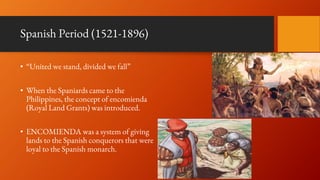
• When the Spaniards came to the
Philippines, the concept of encomienda
(Royal Land Grants) was introduced.
• ENCOMIENDA was a system of giving
lands to the Spanish conquerors that were
loyal to the Spanish monarch.
Encomienda System
Agrarian Uprising (1745-1746)
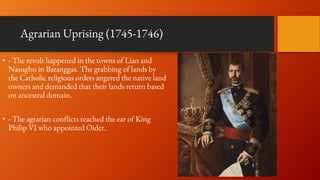
• - The revolt happened in the towns of Lian and
Nasugbu in Batanggas. The grabbing of lands by
the Catholic religious orders angered the native land
owners and demanded that their lands return based
on ancestral domain.
• - The agrarian conflicts reached the ear of King
Philip VI who appointed Oider.
First Philippine Republic
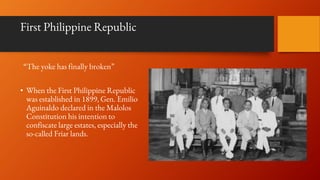
“The yoke has finally broken”
• When the First Philippine Republic
was established in 1899, Gen. Emilio
Aguinaldo declared in the Malolos
Constitution his intention to
confiscate large estates, especially the
so-called Friar lands.
American Period (1898- 1935)
Noteworthy regulations enacted during the American period:
● Philippines Bill of 1902 (AKA Cooper Act) - Which set the ceilings on the
hectarage of private individuals to 16 hectares, and 1, 024 hectares for corporations.
○ The U.S. Congress approved the Philippines Act on July 1, 1902, which provided the
Philippines with limited self-government. Which means that they have rights to which they
can practice during the american period.
○ United States Congressman Henry Allen Cooper sponsored the Philippine Bill of 1902, also
known as the Cooper Act. The bill proposed the creation and administration of a civil
government in the Philippines. President Theodore Roosevelt signed it into law in July 2,
1902.
Land registration act of 1902 (Act No. 496)
● Land registration act of 1902
(Act No. 496) - provided
comprehensive registration of land
titles under Torrens System
● Torrens title is the certificate of
ownership establishing the rights
of ownership of a certain person,
whether natural or juridical, over
the registered parcel of real estate.
However, the land registration act of 1902 did not completely
solve the problem of land registration under the Torrens
system because the lands owners might not have been aware or
the law of that they could not pay survey cost and other fees
required in applying for a Torrens title.
The Public Land of 1933 (Act No. 4054 and 4113)
● The Public Land of 1933 (Act No. 4054 and 4113) -
regulates relationships between landowners and tenants of rice
(50-50 sharing) and sugar cane lands.
Commonwealth Period (1935-1942)
President Manuel L. Quezon
advocated the Social Justice program to block
the increasing social unrest in Central Luzon.
During this period, significant legislations
were enacted.
● The 1935 constitution, which was promulgated for the
promotion of social justice to ensure the well-being and economic
security of all people, should be the concern of the state.
● The commonwealth act no. 178 (An amendment to rice
tenancy act no. 4045) enacted on Nov 13 1936 , provided for
certain controls in the landlord tenant relationships.
● The national rice and corn corporation (NARIC) of
1936 established the price of rice and corn that helped the
poor tenants as well as consumers.
● The commonwealth act no. 461, 1937, specified the
reasons for dismissal of tenants and only with the approval of
the tenancy division of the department of Justice.
● The rural program administration, created on march 2, 1939,
provided the purchase and lease of haciendas and their sale and lease to the
tenants.
● The commonwealth act no. 441 enacted on June 3, 1939, created
the National Settlement Administration with a capital stick of 20,000,000
million pesos.
Japanese Occupation
● during the second world war (that started in Europe
in 1939) and in the pacific (1941) the hukbo ng
bayan laban sa hapon (HUKBALAHAP) controlled
the areas of central luzon.
● The HUKBALAHAP was composed of peasants
and workers who took up arms against the Japanese
Forces. Peasants who supported them earned fixed
rentals, while landowners who supported the
Japanese lost their lands to peasants. But this was
short-lived because it ended with the end of WWII.
The problems of land tenure in the Philippines remained even after
the Philippine independence in 1946. To address the problem, the
Philippines Congress revised the tenancy law.
President Manuel Roxas
● During Roxas’ administration, the
following laws were enacted:
Republic Act No. 34, which
established the 70-30 sharing
arrangements and regulated the share
tenancy contracts.
● Republic Act No. 55, which
provided for a more effective safeguard
against arbitrary ejectment of tenants.
President Elpidio Quirino (1948- 1953)
● Pres. Elpidio Quirino (1948- 1953) issued
Executive Order No. 355 on October 23,
1950, replaced the National Land
Settlement Administration with Land
Settlement Development Corporation
(LASEDECO) that took over the
responsibilities of the Agricultural
Machinery Equipment Corporation and the
Rice and Corn Production Administration.
PRESIDENT FIDEL V.
RAMOS
12TH President of the Republic of the Philippines
Republic Act No. 7881- Amended provisions of R. A. 6657
And exempted fishpond and prawns from CARP coverage.
Republic Act No. 7905- Strengthened the implementation
of CARP ( Comprehensive Agrarian Reform Program ).
Republic Act No. 8435- Agriculture Modernization Act.
Republic Act No. 8532- Strengthened the CARP and
provided a Augmentation Fund a 50 million pesos for CARP
extensions in 10 years.
Executive Order no. 363- Guidelines for Protection of
Areas non-negotiable for conversion and monitoring compliance.
1992-1998
PRESIDENT JOSEPH E.
ESTRADA
13TH PRESIDENT OF THE REPUBLIC OF THE PHILIPPINES
Executive Order no. 151- Farmers Trust Fund
MAGKASAKA- “Magkabalikat para sa Kaunlarang Agraryo”
AGRIKULTURANG MAKAMASA- Achieved an output
growth 6 percent; which lowered the Inflation Rate from 11 to
3 percent in the year 1999.
1998-2000
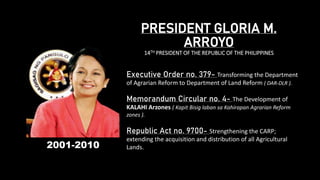
PRESIDENT GLORIA M.
ARROYO
14TH PRESIDENT OF THE REPUBLIC OF THE PHILIPPINES
Executive Order no. 379- Transforming the Department
of Agrarian Reform to Department of Land Reform ( DAR-DLR ).
Memorandum Circular no. 4- The Development of
KALAHI Arzones ( Kapit Bisig laban sa Kahirapan Agrarian Reform
zones ).
Republic Act no. 9700- Strengthening the CARP;
extending the acquisition and distribution of all Agricultural
Lands.
2001-2010
PRESIDENT BENIGNO SIMEON C.
AQUINO III
15TH PRESIDENT OF THE REPUBLIC OF THE PHILIPPINES
CARPER- Farmers, Catholic Bishops, and other Land reforms
advocates a plan for implementation of CARP extensions with
Reforms (CARPER).
Multi-Stakeholders Mechanism- Composed of CARP
implementing agencies of the Government, Church Officials,
Non-Governmental organization, other Farmers and
Federations.
2010-2016
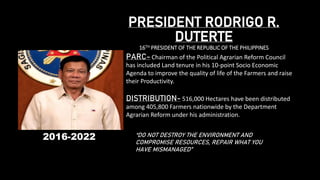
PRESIDENT RODRIGO R.
DUTERTE
16TH PRESIDENT OF THE REPUBLIC OF THE PHILIPPINES
PARC- Chairman of the Political Agrarian Reform Council
has included Land tenure in his 10-point Socio Economic
Agenda to improve the quality of life of the Farmers and raise
their Productivity.
DISTRIBUTION- 516,000 Hectares have been distributed
among 405,800 Farmers nationwide by the Department
Agrarian Reform under his administration.
“DO NOT DESTROY THE ENVIRONMENT AND
COMPROMISE RESOURCES, REPAIR WHAT YOU
HAVE MISMANAGED”
2016-2022
THANKS FOR LISTENING…
GROUP VI :
MARIELLE CLAVANTON
ISA GONZALES
RECANEAL EBOA
JORAMIL HOLLON

GROUP-6-FINAL-REPORT RPH.pptx

  • 1.
    Agrarian Reform fromthe Spanish Colonial Philippines to the Present
  • 2.
    Land Reform • Hasgained significance all over the world as it aims to achieve social justice and full development of human dignity. • The poor economic and social conditions of the peasants in the Philippines need immediate agrarian reform measures by the Philippine government.
  • 3.
    Pre-Spanish Period “This landis Ours God gave this land to us” Before the Spaniards came to the Philippines, Filipinos lived in villages or barangays ruled by chiefs or datus. The datus comprised the nobility. Then came the maharlikas (freemen), followed by the aliping mamamahay (serfs) and aliping saguiguilid (slaves).
  • 4.
    Spanish Period (1521-1896) •“United we stand, divided we fall” • When the Spaniards came to the Philippines, the concept of encomienda (Royal Land Grants) was introduced. • ENCOMIENDA was a system of giving lands to the Spanish conquerors that were loyal to the Spanish monarch.
  • 5.
  • 6.
    Agrarian Uprising (1745-1746) •- The revolt happened in the towns of Lian and Nasugbu in Batanggas. The grabbing of lands by the Catholic religious orders angered the native land owners and demanded that their lands return based on ancestral domain. • - The agrarian conflicts reached the ear of King Philip VI who appointed Oider.
  • 7.
    First Philippine Republic “Theyoke has finally broken” • When the First Philippine Republic was established in 1899, Gen. Emilio Aguinaldo declared in the Malolos Constitution his intention to confiscate large estates, especially the so-called Friar lands.
  • 8.
    American Period (1898-1935) Noteworthy regulations enacted during the American period: ● Philippines Bill of 1902 (AKA Cooper Act) - Which set the ceilings on the hectarage of private individuals to 16 hectares, and 1, 024 hectares for corporations. ○ The U.S. Congress approved the Philippines Act on July 1, 1902, which provided the Philippines with limited self-government. Which means that they have rights to which they can practice during the american period. ○ United States Congressman Henry Allen Cooper sponsored the Philippine Bill of 1902, also known as the Cooper Act. The bill proposed the creation and administration of a civil government in the Philippines. President Theodore Roosevelt signed it into law in July 2, 1902.
  • 9.
    Land registration actof 1902 (Act No. 496) ● Land registration act of 1902 (Act No. 496) - provided comprehensive registration of land titles under Torrens System ● Torrens title is the certificate of ownership establishing the rights of ownership of a certain person, whether natural or juridical, over the registered parcel of real estate.
  • 10.
    However, the landregistration act of 1902 did not completely solve the problem of land registration under the Torrens system because the lands owners might not have been aware or the law of that they could not pay survey cost and other fees required in applying for a Torrens title.
  • 11.
    The Public Landof 1933 (Act No. 4054 and 4113) ● The Public Land of 1933 (Act No. 4054 and 4113) - regulates relationships between landowners and tenants of rice (50-50 sharing) and sugar cane lands.
  • 12.
    Commonwealth Period (1935-1942) PresidentManuel L. Quezon advocated the Social Justice program to block the increasing social unrest in Central Luzon. During this period, significant legislations were enacted.
  • 13.
    ● The 1935constitution, which was promulgated for the promotion of social justice to ensure the well-being and economic security of all people, should be the concern of the state. ● The commonwealth act no. 178 (An amendment to rice tenancy act no. 4045) enacted on Nov 13 1936 , provided for certain controls in the landlord tenant relationships.
  • 14.
    ● The nationalrice and corn corporation (NARIC) of 1936 established the price of rice and corn that helped the poor tenants as well as consumers. ● The commonwealth act no. 461, 1937, specified the reasons for dismissal of tenants and only with the approval of the tenancy division of the department of Justice.
  • 15.
    ● The ruralprogram administration, created on march 2, 1939, provided the purchase and lease of haciendas and their sale and lease to the tenants. ● The commonwealth act no. 441 enacted on June 3, 1939, created the National Settlement Administration with a capital stick of 20,000,000 million pesos.
  • 16.
    Japanese Occupation ● duringthe second world war (that started in Europe in 1939) and in the pacific (1941) the hukbo ng bayan laban sa hapon (HUKBALAHAP) controlled the areas of central luzon. ● The HUKBALAHAP was composed of peasants and workers who took up arms against the Japanese Forces. Peasants who supported them earned fixed rentals, while landowners who supported the Japanese lost their lands to peasants. But this was short-lived because it ended with the end of WWII.
  • 17.
    The problems ofland tenure in the Philippines remained even after the Philippine independence in 1946. To address the problem, the Philippines Congress revised the tenancy law.
  • 18.
    President Manuel Roxas ●During Roxas’ administration, the following laws were enacted: Republic Act No. 34, which established the 70-30 sharing arrangements and regulated the share tenancy contracts. ● Republic Act No. 55, which provided for a more effective safeguard against arbitrary ejectment of tenants. President Elpidio Quirino (1948- 1953) ● Pres. Elpidio Quirino (1948- 1953) issued Executive Order No. 355 on October 23, 1950, replaced the National Land Settlement Administration with Land Settlement Development Corporation (LASEDECO) that took over the responsibilities of the Agricultural Machinery Equipment Corporation and the Rice and Corn Production Administration.
  • 28.
    PRESIDENT FIDEL V. RAMOS 12THPresident of the Republic of the Philippines Republic Act No. 7881- Amended provisions of R. A. 6657 And exempted fishpond and prawns from CARP coverage. Republic Act No. 7905- Strengthened the implementation of CARP ( Comprehensive Agrarian Reform Program ). Republic Act No. 8435- Agriculture Modernization Act. Republic Act No. 8532- Strengthened the CARP and provided a Augmentation Fund a 50 million pesos for CARP extensions in 10 years. Executive Order no. 363- Guidelines for Protection of Areas non-negotiable for conversion and monitoring compliance. 1992-1998
  • 29.
    PRESIDENT JOSEPH E. ESTRADA 13THPRESIDENT OF THE REPUBLIC OF THE PHILIPPINES Executive Order no. 151- Farmers Trust Fund MAGKASAKA- “Magkabalikat para sa Kaunlarang Agraryo” AGRIKULTURANG MAKAMASA- Achieved an output growth 6 percent; which lowered the Inflation Rate from 11 to 3 percent in the year 1999. 1998-2000
  • 30.
    PRESIDENT GLORIA M. ARROYO 14THPRESIDENT OF THE REPUBLIC OF THE PHILIPPINES Executive Order no. 379- Transforming the Department of Agrarian Reform to Department of Land Reform ( DAR-DLR ). Memorandum Circular no. 4- The Development of KALAHI Arzones ( Kapit Bisig laban sa Kahirapan Agrarian Reform zones ). Republic Act no. 9700- Strengthening the CARP; extending the acquisition and distribution of all Agricultural Lands. 2001-2010
  • 31.
    PRESIDENT BENIGNO SIMEONC. AQUINO III 15TH PRESIDENT OF THE REPUBLIC OF THE PHILIPPINES CARPER- Farmers, Catholic Bishops, and other Land reforms advocates a plan for implementation of CARP extensions with Reforms (CARPER). Multi-Stakeholders Mechanism- Composed of CARP implementing agencies of the Government, Church Officials, Non-Governmental organization, other Farmers and Federations. 2010-2016
  • 32.
    PRESIDENT RODRIGO R. DUTERTE 16THPRESIDENT OF THE REPUBLIC OF THE PHILIPPINES PARC- Chairman of the Political Agrarian Reform Council has included Land tenure in his 10-point Socio Economic Agenda to improve the quality of life of the Farmers and raise their Productivity. DISTRIBUTION- 516,000 Hectares have been distributed among 405,800 Farmers nationwide by the Department Agrarian Reform under his administration. “DO NOT DESTROY THE ENVIRONMENT AND COMPROMISE RESOURCES, REPAIR WHAT YOU HAVE MISMANAGED” 2016-2022
  • 33.
    THANKS FOR LISTENING… GROUPVI : MARIELLE CLAVANTON ISA GONZALES RECANEAL EBOA JORAMIL HOLLON