____________________________________________________________
Student ID –
Unit Title - BUSINESS COMMUNICATION 1
Unit Code - LNG015-6
Assignment Title - The Briefing Paper
Tutor Feedback Grade : B+
Executive Summary
As a consultant to our client a Travel Company, we have been asked to prepare a
report on their venture into Home travel business. Accordingly, we have been asked to
prepare a business plan for the new venture. In the present briefing paper we will be
analyzing and presenting our team that will be working on the project. It is very
important that our client is aware of our team and our strengths and weaknesses so that
they are assured of receiving quality outcomes from our side that will satisfy their needs.
Table of Contents
1. Terms of Reference..............................................................................................................1
2. Overview of the Situation.....................................................................................................1
3. SWOT Analysis of our Team...............................................................................................1
4. Solutions and Recommendations.......................................................................................2
5. Formation of our team and team Life cycle ......................................................................2
6. Leadership Activities at Different Group Formation Stages ...........................................4
7. Team contracts......................................................................................................................5
7.1. Belbin roles.....................................................................................................................6
7.2. Balanced teams .............................................................................................................9
7.3. Team Leader ..................................................................................................................9
8. Team Leadership Model ....................................................................................................10
The Four Layers or Steps in the Team Leadership Model ..............................................10
9. Team Culture .......................................................................................................................12
References ..................................................................................................................................15
1
1. Terms of Reference
As a consultant to our client a Travel company, we have been asked to prepare a report
on their venture into Home Travel business. Accordingly, we have been asked to
prepare a business plan for the new venture.
2. Overview of the Situation
What problems do you envisage will need to be addressed?
In the present briefing paper we will be analyzing and presenting our team that will be
working on the project. It is very important that our client is aware of our team and our
strengths and weaknesses so that they are assured of receiving quality outcomes from
our side that will satisfy their needs.
3. SWOT Analysis of our Team
Strengths
Theoretical understanding is strong and fresh in
mind since all our members are still studying
management
Our zeal to perform better so as improve our
own learning
Weaknesses
Lack of practical experience
Lack of exposure to external industry
conditions
Opportunities
To learn about team work dynamics
Threats
Internal disputes arising due to
differences in culture and background
of members
2
4. Solutions and Recommendations
In the present era efficient teamwork is extremely important, the team one has
participated or become leader that it cannot be anticipated that a new team would work
in exceptional manner from the very beginning. Forming a team consumes lots of time
and generally pursues few simply identifiable phases because the team formation starts
as an association of strangers and become a combined team with a shared objective.
The team may work efficiently in case one is able to understand the type of teams which
may be any one of following:
 Temporary working association
 Newly-formed association
 Permanent team
5. Formation of our team and team Life cycle
In 1965 psychologist Bruce Tuckman stated an outstanding expression -: "forming,
storming, norming, and performing". He utilized it for describing it as a way that may be
followed by teams for being successful. Afterwards, he stated the 5th phase which is
known as fifth stage that adjourning which is also commonly known as mourning
because it rhymes nicely with the previous phrase. First phase of the team may be
termed forming phase in which members are optimistic and gracious. Few participants
in our team were nervous because they are not aware about the tasks of team. Others
were merely eager about the forth coming assignment. Leader plays a dominating role
at this phase because others are not aware about their duties & obligations. The
duration of this phase is not very long and might be up to a sole gathering at the time of
introduction of members. During this phase a meeting was conducted regarding the way
team has to work, this was a little irritating for the members as they were straight away
interested in tasks. After this, storming stage came into existence. The ability of the
leader was questioned because others strived for place and their roles were clear. The
procedure of conducting jobs was explained as being a leader one has to consider that
few participants might experience inundated due to the amount of work which has to be
3
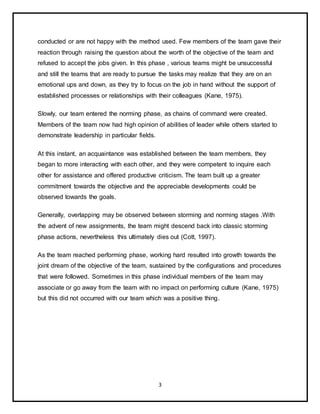
conducted or are not happy with the method used. Few members of the team gave their
reaction through raising the question about the worth of the objective of the team and
refused to accept the jobs given. In this phase , various teams might be unsuccessful
and still the teams that are ready to pursue the tasks may realize that they are on an
emotional ups and down, as they try to focus on the job in hand without the support of
established processes or relationships with their colleagues (Kane, 1975).
Slowly, our team entered the norming phase, as chains of command were created.
Members of the team now had high opinion of abilities of leader while others started to
demonstrate leadership in particular fields.
At this instant, an acquaintance was established between the team members, they
began to more interacting with each other, and they were competent to inquire each
other for assistance and offered productive criticism. The team built up a greater
commitment towards the objective and the appreciable developments could be
observed towards the goals.
Generally, overlapping may be observed between storming and norming stages .With
the advent of new assignments, the team might descend back into classic storming
phase actions, nevertheless this ultimately dies out (Cott, 1997).
As the team reached performing phase, working hard resulted into growth towards the
joint dream of the objective of the team, sustained by the configurations and procedures
that were followed. Sometimes in this phase individual members of the team may
associate or go away from the team with no impact on performing culture (Kane, 1975)
but this did not occurred with our team which was a positive thing.
4
6. Leadership Activities at Different Group Formation Stages
Phase Tasks
Forming The team must be directed in positive manner and the goals
of team are stated in clear manner.
Storming In this phase procedures & structures are stated. Focus is
given on smooth working for resolving conflicts and
establishing good relationships within the team .Usually, it
offers support, particularly to members with insecurity. Facing
the issues with optimistic approach. Creating awareness
regarding the idea of forming, storming, norming, and
performing for explaining the reasons of conflicts and realize
that things would be improved in the future. And following
assertive and conflict resolution skills as & when required.
Norming Stepping back and assisting the team to move for
achievement of team’s objective. This is appropriate time for
arranging a social, or a team-building occasion
Performing The responsibility should be delegated as much as possible.
As the team has come up to improved level of performance,
leader must try not to interfere much. Leader will begin to
focus on other objectives and fields.
Adjourning As the team is coming to an end its achievements must be
celebrated. Because, in future once again team may be
formed with these individuals who would be simple in case
people consider earlier experiences in positive manner.
5
7. Team contracts
Analyzing its abilities & strengths is significant for any team which would offer the basis
for a plan in for increasing the efficiency of the team for efficiently achieving the goal
(Horwitz, 1970).
Team contracts are suppose to relate to the team. Leader of the team must state clearly
that what is desirable in the team and what is not desirable.
The contract comprised of the following:
 Following a proactive approach. Team was required to predict potential issues.
They were required to pursue activities while preventing the future problems with
proactive approach.
 The team members should be well aware as communication is important for
achieving the objective of the team. Communication helps in accomplishing trust
among the members of the team. Working in isolation is not possible in team &
its success is attained through joint support and understanding.
 Focusing on the betterment of the team. The team is required to be bigger in
comparison to individual team player. Team’s interests should get foremost
preference. Moreover, attention has to be paid that there exist a synergy
between the objectives of the team & individual objectives.
Following basic policies should be listed by every team contract and were included in
our team contract as well:
 Team members must be sincere & extrovert which is extremely important for
pursuing the goals of the team.
 Promote diverse opinions on each and every topic. A team comprises of
individuals with diverse viewpoints which may result into conflicts. Though,
opinion of every member should be respected in a team so each and every each
idea is taken and noted for future reference.
 Each member should equally participate in the team as members form the team.
Equal involvement along with equal inputs from each and every team member
should help the team to pursue its aims.
6
Policies were also laid for Communication Patterns which were as follows.
 First understand, and then be understood to apply to all team members
 One must be lucid and brief which not only saves time but also results in
increased understanding within members of team.
 Every conversation should be on right path.
 Visual means of communication should be used such as drawings, charts, tables
for facilitating discussion. It is extremely significant for all the members of team to
be on the same page
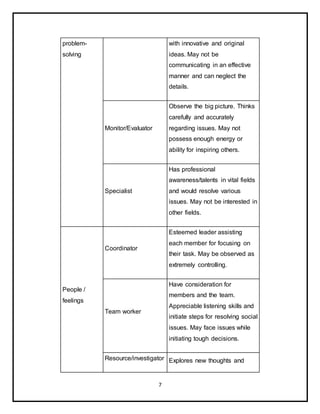
Following roles were stated by Dr. R. Meredith Belbin (Ducanis & Golin 1999):
7.1. Belbin roles
Overall Belbin roles Description
Pursuing
activities
Implementer
Disciplined and knowable.
Takes fundamental ideas and
implement them practically.
May be slow.
Shaper
Immense energy and deed,
challenging others to move
forwards but may be insensible.
Completer/Finisher
Consistently observes things
through to the end, resolving
the issues and assure the
smooth working of team. May
be too worried and not having
faith on others.
views / Plant Resolve complicated issues
7
problem-
solving
with innovative and original
ideas. May not be
communicating in an effective
manner and can neglect the
details.
Monitor/Evaluator
Observe the big picture. Thinks
carefully and accurately
regarding issues. May not
possess enough energy or
ability for inspiring others.
Specialist
Has professional
awareness/talents in vital fields
and would resolve various
issues. May not be interested in
other fields.
People /
feelings
Coordinator
Esteemed leader assisting
each member for focusing on
their task. May be observed as
extremely controlling.
Team worker
Have consideration for
members and the team.
Appreciable listening skills and
initiate steps for resolving social
issues. May face issues while
initiating tough decisions.
Resource/investigator Explores new thoughts and
8
opportunities with energy and
with others. Creates good
network. Can be excessively
positive and drop energy
subsequent to the initial flush.
Alternately, they may be divided as follows:
Overall Belbin role
Leading
Coordinator
Shaper
Doing
Implementer
Completer/finisher
Thinking
Monitor/Evaluator
Plant
Specialist
Socializing
Resource/investigator
Team Worker
9
7.2. Balanced teams
Teams are successful only if they establish balance between its primary roles and when
team members are aware about their roles, work with their full capabilities and efficiently
consider their shortcomings. For achieving the best balance, there has to be:
 Coordinator or Shaper (but just one ) for assisting the leader
 A Plant to stimulate ideas
 A Monitor/evaluator for maintaining truthfulness and simplicity
 Implementer (one or more), Team worker, Resource investigator or
Completer/finisher for initiating the roles in the team.
7.3. Team Leader
Team‘s success may be affected due to lack of leadership. Stewart and Manz (1995)
stated that more particularly, work team management or supervision is generally
recognized as a chief cause of failure of teams for proper development and improving
efficiency, quality, and quality of life for workers of America.
Instead of emphasizing on unproductive teams, alternately Larson and LaFasto (1989)
interviewed outstanding teams for recognizing better approach for achieving objective.
The concluding comments are mentioned below:
 A obvious inspiring objective, they possess a vision
 Structure supporting the success of teams , visions have a trade objective
 capable team members with accurate number and mix
 There should be unified commitment that they are not group but not team
 A joint climate that is driven towards a shared goal
 Achieving high standards of brilliance & they must possess group norms
 Principled leadership — the central driver of excellence
 They must be having good external support & sufficient resources
10
8. Team Leadership Model
Northouse stated that there are many Team Leadership models but Hill's Team model is
one of the renown model which offers the leader or a elected team member with a
mental road map assisting in recognizing various issues concerning teams & initiating
steps for the correction of the issues (Pearce & Ravlin 1997). This Team Leadership
depends on various research projects:
Hill's Team Leadership Model
Figure: http://www.nwlink.com/~donclark/leader/team_leadership.html
The Four Layers or Steps in the Team Leadership Model
 Top layer: The efficient team performance starts with leader’s mental model of
the state of affairs and then recognizing the needs of situation which may be
actions or monitoring.
 Second Layer: It focuses on whether leadership is internal or external.
11
 Third layer: It has to be determined that whether it is Task, Relational, or an
Environmental intervention. Function should be chosen as per the kind of
intervention. See the next section for explanation of Function Interventions.
 Bottom layer: In case the above mentioned steps are initiated in appropriate
manner then high level of performance is achieved through the Development and
Maintenance functions.
Based upon the framework we created a code of conduct for our leader
 The emphasis should be laid on objectives by instructive and/or receiving
agreement
 Polices of Restructuring, procedures, roles, etc. for achieving the anticipated
aims.
 Guiding the decision-making procedure so as to get good knowledge, improved
coordination, focusing on various problems, etc.
 Training should be conducted by formal and informal means
 Performance should be analyzed every now and then.
Internal Relationship Functions
 Coaching the members of the team
 Using more mutual procedures for involving each and every member of the team
 Conflict has to be managed
 Encouraging commitment and esprit de corps while utilizing of ethos leadership
 Fulfilling the requirements of members of the team
 Anticipations from each team member should be clearly stated
External Environmental Functions
 Networking approach should be followed for increasing influence and gathering
data
 Advocate by representing your team so that it shows them at their best
12
 Gaining support for the team through the collection of resources and recognition
for team
 safeguard the team from various environmental issues
 Evaluate the environment by conducting surveys and other performance
indicators for determining its influence on the team
 Information must be shared appropriately with the team members.
9. Team Culture
The homogenous team is what we have to work on this project. Our team comprises of
individuals from diverse nations and so they face diverse cultures, languages, thoughts,
behaviors and procedures for pursuing tasks. Researchers have argued that the global
language of trade wipe out communication problems within a team with members
comprising of various cultures, though those with practical experience of such teams
would not agree (Barczak, 1996).
In our case where there are individuals with diverse cultural background, there would be
always few problems when they interact. This is due to the fact that they possess their
own perceptions of ways of conducting tasks and their expectations are also different.
Cross-cultural problems would not be an obstruction all the time, actually at various
instances they may encourage creativity, but with the issues of culture they may be
negative outcomes particularly in case of teams.
Through the introduction of the idea of cross-cultural communication within an
international team, the 3 main problems have been discussed below along with the way
we handled them:
a) Language
Even though English is mostly the language of the team but all were not well versed.
Further some members did not consider the language of same significance as their
native language. Steps that were initiated for resolving these issues are as follows:
13
 Offering further opportunities for all members of the team for contributing in a
simple manner. For instance, providing individuals opportunity to pen down
issues prior to a meeting or for follow-up.
 Keeping language easy with the avoidance of idioms, slang, irony, etc.
 Non-verbal communication is significant. Team members must be familiar with
the procedures through which individuals might communicate pessimistic
responses or concepts. For instance, silence might be a technique which may be
wrongly recognized as agreement in diverse cultures.
b) Conflict Resolution
Diverse cultures resolves conflicts in diverse ways. Few cultures believe that
conflict occurs in the usual order of things and that when it happens, it must be
resolved in by direct and upfront procedures. Other cultures though don’t favor
open disagreement and would take initiatives for avoiding it in order to
safeguards individuals from uncomfortable situations (Barczak, 1996). They
might support or hold back their view in case someone strongly disagrees
instead of confronting another person.
Hence we stated the procedures for resolving the conflicts and disagreement.
Though, even subsequent to stating the procedure for resolving g conflicts, it is
significant to keep in mind that cultural values are hard to modify. Individuals who
belong to culture where synchronization is extremely significant will still be
somewhat uncomfortable to deal with conflict and confrontation. The important
point that we considered was that all individuals are conscious about such
dissimilarities and sensitive to the procedures of resolving conflicts.
c) Gender
Diverse culture or societies have diverse perspective of gender relations and acts as
per them. The things suitable in one culture may not be in other. This might have little
influence on team, particularly when two ends of the ranges are presented in a team.
14
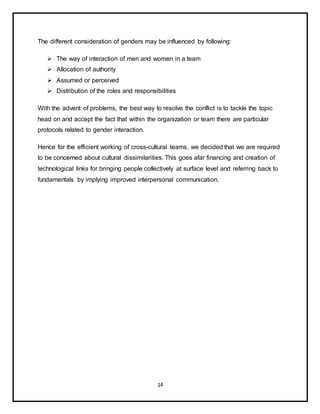
The different consideration of genders may be influenced by following:
 The way of interaction of men and women in a team
 Allocation of authority
 Assumed or perceived
 Distribution of the roles and responsibilities
With the advent of problems, the best way to resolve the conflict is to tackle the topic
head on and accept the fact that within the organization or team there are particular
protocols related to gender interaction.
Hence for the efficient working of cross-cultural teams, we decided that we are required
to be concerned about cultural dissimilarities. This goes afar financing and creation of
technological links for bringing people collectively at surface level and referring back to
fundamentals by implying improved interpersonal communication.
15
References
 Barczak NL. (1996). How to lead effective teams. Critical Care Nursing Quarterly.
pp 73-83.
 Cott C. (1997). We Decide, You carry it out. A Social Network Analysis of
Multidisciplinary Long-term Care Teams. pp 1411-1421.
 Ducanis AJ & Golin AK. (1999). The Interdisciplinary Health Care Team. Aspen
Systems Corporation. Germantown, Maryland.
 Horwitz JJ. (1970). Team Practice and the Specialist. Springfield, Illinios.
 Kane R A. (1975). Interprofessional Teamwork. Syracuse University, New York.
 Pearce JA & Ravlin EC. (1987). The Design and Activation of Self-Regulating
Work Groups. International Journal of Human Relations. pp 751-782.
 http://www.nwlink.com/~donclark/leader/team_leadership.html

B+ bussiness communication

  • 1.
    ____________________________________________________________ Student ID – UnitTitle - BUSINESS COMMUNICATION 1 Unit Code - LNG015-6 Assignment Title - The Briefing Paper Tutor Feedback Grade : B+
  • 3.
    Executive Summary As aconsultant to our client a Travel Company, we have been asked to prepare a report on their venture into Home travel business. Accordingly, we have been asked to prepare a business plan for the new venture. In the present briefing paper we will be analyzing and presenting our team that will be working on the project. It is very important that our client is aware of our team and our strengths and weaknesses so that they are assured of receiving quality outcomes from our side that will satisfy their needs. Table of Contents 1. Terms of Reference..............................................................................................................1 2. Overview of the Situation.....................................................................................................1 3. SWOT Analysis of our Team...............................................................................................1 4. Solutions and Recommendations.......................................................................................2 5. Formation of our team and team Life cycle ......................................................................2 6. Leadership Activities at Different Group Formation Stages ...........................................4 7. Team contracts......................................................................................................................5 7.1. Belbin roles.....................................................................................................................6 7.2. Balanced teams .............................................................................................................9 7.3. Team Leader ..................................................................................................................9 8. Team Leadership Model ....................................................................................................10 The Four Layers or Steps in the Team Leadership Model ..............................................10
  • 4.
    9. Team Culture.......................................................................................................................12 References ..................................................................................................................................15
  • 5.
    1 1. Terms ofReference As a consultant to our client a Travel company, we have been asked to prepare a report on their venture into Home Travel business. Accordingly, we have been asked to prepare a business plan for the new venture. 2. Overview of the Situation What problems do you envisage will need to be addressed? In the present briefing paper we will be analyzing and presenting our team that will be working on the project. It is very important that our client is aware of our team and our strengths and weaknesses so that they are assured of receiving quality outcomes from our side that will satisfy their needs. 3. SWOT Analysis of our Team Strengths Theoretical understanding is strong and fresh in mind since all our members are still studying management Our zeal to perform better so as improve our own learning Weaknesses Lack of practical experience Lack of exposure to external industry conditions Opportunities To learn about team work dynamics Threats Internal disputes arising due to differences in culture and background of members
  • 6.
    2 4. Solutions andRecommendations In the present era efficient teamwork is extremely important, the team one has participated or become leader that it cannot be anticipated that a new team would work in exceptional manner from the very beginning. Forming a team consumes lots of time and generally pursues few simply identifiable phases because the team formation starts as an association of strangers and become a combined team with a shared objective. The team may work efficiently in case one is able to understand the type of teams which may be any one of following:  Temporary working association  Newly-formed association  Permanent team 5. Formation of our team and team Life cycle In 1965 psychologist Bruce Tuckman stated an outstanding expression -: "forming, storming, norming, and performing". He utilized it for describing it as a way that may be followed by teams for being successful. Afterwards, he stated the 5th phase which is known as fifth stage that adjourning which is also commonly known as mourning because it rhymes nicely with the previous phrase. First phase of the team may be termed forming phase in which members are optimistic and gracious. Few participants in our team were nervous because they are not aware about the tasks of team. Others were merely eager about the forth coming assignment. Leader plays a dominating role at this phase because others are not aware about their duties & obligations. The duration of this phase is not very long and might be up to a sole gathering at the time of introduction of members. During this phase a meeting was conducted regarding the way team has to work, this was a little irritating for the members as they were straight away interested in tasks. After this, storming stage came into existence. The ability of the leader was questioned because others strived for place and their roles were clear. The procedure of conducting jobs was explained as being a leader one has to consider that few participants might experience inundated due to the amount of work which has to be
  • 7.
    3 conducted or arenot happy with the method used. Few members of the team gave their reaction through raising the question about the worth of the objective of the team and refused to accept the jobs given. In this phase , various teams might be unsuccessful and still the teams that are ready to pursue the tasks may realize that they are on an emotional ups and down, as they try to focus on the job in hand without the support of established processes or relationships with their colleagues (Kane, 1975). Slowly, our team entered the norming phase, as chains of command were created. Members of the team now had high opinion of abilities of leader while others started to demonstrate leadership in particular fields. At this instant, an acquaintance was established between the team members, they began to more interacting with each other, and they were competent to inquire each other for assistance and offered productive criticism. The team built up a greater commitment towards the objective and the appreciable developments could be observed towards the goals. Generally, overlapping may be observed between storming and norming stages .With the advent of new assignments, the team might descend back into classic storming phase actions, nevertheless this ultimately dies out (Cott, 1997). As the team reached performing phase, working hard resulted into growth towards the joint dream of the objective of the team, sustained by the configurations and procedures that were followed. Sometimes in this phase individual members of the team may associate or go away from the team with no impact on performing culture (Kane, 1975) but this did not occurred with our team which was a positive thing.
  • 8.
    4 6. Leadership Activitiesat Different Group Formation Stages Phase Tasks Forming The team must be directed in positive manner and the goals of team are stated in clear manner. Storming In this phase procedures & structures are stated. Focus is given on smooth working for resolving conflicts and establishing good relationships within the team .Usually, it offers support, particularly to members with insecurity. Facing the issues with optimistic approach. Creating awareness regarding the idea of forming, storming, norming, and performing for explaining the reasons of conflicts and realize that things would be improved in the future. And following assertive and conflict resolution skills as & when required. Norming Stepping back and assisting the team to move for achievement of team’s objective. This is appropriate time for arranging a social, or a team-building occasion Performing The responsibility should be delegated as much as possible. As the team has come up to improved level of performance, leader must try not to interfere much. Leader will begin to focus on other objectives and fields. Adjourning As the team is coming to an end its achievements must be celebrated. Because, in future once again team may be formed with these individuals who would be simple in case people consider earlier experiences in positive manner.
  • 9.
    5 7. Team contracts Analyzingits abilities & strengths is significant for any team which would offer the basis for a plan in for increasing the efficiency of the team for efficiently achieving the goal (Horwitz, 1970). Team contracts are suppose to relate to the team. Leader of the team must state clearly that what is desirable in the team and what is not desirable. The contract comprised of the following:  Following a proactive approach. Team was required to predict potential issues. They were required to pursue activities while preventing the future problems with proactive approach.  The team members should be well aware as communication is important for achieving the objective of the team. Communication helps in accomplishing trust among the members of the team. Working in isolation is not possible in team & its success is attained through joint support and understanding.  Focusing on the betterment of the team. The team is required to be bigger in comparison to individual team player. Team’s interests should get foremost preference. Moreover, attention has to be paid that there exist a synergy between the objectives of the team & individual objectives. Following basic policies should be listed by every team contract and were included in our team contract as well:  Team members must be sincere & extrovert which is extremely important for pursuing the goals of the team.  Promote diverse opinions on each and every topic. A team comprises of individuals with diverse viewpoints which may result into conflicts. Though, opinion of every member should be respected in a team so each and every each idea is taken and noted for future reference.  Each member should equally participate in the team as members form the team. Equal involvement along with equal inputs from each and every team member should help the team to pursue its aims.
  • 10.
    6 Policies were alsolaid for Communication Patterns which were as follows.  First understand, and then be understood to apply to all team members  One must be lucid and brief which not only saves time but also results in increased understanding within members of team.  Every conversation should be on right path.  Visual means of communication should be used such as drawings, charts, tables for facilitating discussion. It is extremely significant for all the members of team to be on the same page Following roles were stated by Dr. R. Meredith Belbin (Ducanis & Golin 1999): 7.1. Belbin roles Overall Belbin roles Description Pursuing activities Implementer Disciplined and knowable. Takes fundamental ideas and implement them practically. May be slow. Shaper Immense energy and deed, challenging others to move forwards but may be insensible. Completer/Finisher Consistently observes things through to the end, resolving the issues and assure the smooth working of team. May be too worried and not having faith on others. views / Plant Resolve complicated issues
  • 11.
    7 problem- solving with innovative andoriginal ideas. May not be communicating in an effective manner and can neglect the details. Monitor/Evaluator Observe the big picture. Thinks carefully and accurately regarding issues. May not possess enough energy or ability for inspiring others. Specialist Has professional awareness/talents in vital fields and would resolve various issues. May not be interested in other fields. People / feelings Coordinator Esteemed leader assisting each member for focusing on their task. May be observed as extremely controlling. Team worker Have consideration for members and the team. Appreciable listening skills and initiate steps for resolving social issues. May face issues while initiating tough decisions. Resource/investigator Explores new thoughts and
  • 12.
    8 opportunities with energyand with others. Creates good network. Can be excessively positive and drop energy subsequent to the initial flush. Alternately, they may be divided as follows: Overall Belbin role Leading Coordinator Shaper Doing Implementer Completer/finisher Thinking Monitor/Evaluator Plant Specialist Socializing Resource/investigator Team Worker
  • 13.
    9 7.2. Balanced teams Teamsare successful only if they establish balance between its primary roles and when team members are aware about their roles, work with their full capabilities and efficiently consider their shortcomings. For achieving the best balance, there has to be:  Coordinator or Shaper (but just one ) for assisting the leader  A Plant to stimulate ideas  A Monitor/evaluator for maintaining truthfulness and simplicity  Implementer (one or more), Team worker, Resource investigator or Completer/finisher for initiating the roles in the team. 7.3. Team Leader Team‘s success may be affected due to lack of leadership. Stewart and Manz (1995) stated that more particularly, work team management or supervision is generally recognized as a chief cause of failure of teams for proper development and improving efficiency, quality, and quality of life for workers of America. Instead of emphasizing on unproductive teams, alternately Larson and LaFasto (1989) interviewed outstanding teams for recognizing better approach for achieving objective. The concluding comments are mentioned below:  A obvious inspiring objective, they possess a vision  Structure supporting the success of teams , visions have a trade objective  capable team members with accurate number and mix  There should be unified commitment that they are not group but not team  A joint climate that is driven towards a shared goal  Achieving high standards of brilliance & they must possess group norms  Principled leadership — the central driver of excellence  They must be having good external support & sufficient resources
  • 14.
    10 8. Team LeadershipModel Northouse stated that there are many Team Leadership models but Hill's Team model is one of the renown model which offers the leader or a elected team member with a mental road map assisting in recognizing various issues concerning teams & initiating steps for the correction of the issues (Pearce & Ravlin 1997). This Team Leadership depends on various research projects: Hill's Team Leadership Model Figure: http://www.nwlink.com/~donclark/leader/team_leadership.html The Four Layers or Steps in the Team Leadership Model  Top layer: The efficient team performance starts with leader’s mental model of the state of affairs and then recognizing the needs of situation which may be actions or monitoring.  Second Layer: It focuses on whether leadership is internal or external.
  • 15.
    11  Third layer:It has to be determined that whether it is Task, Relational, or an Environmental intervention. Function should be chosen as per the kind of intervention. See the next section for explanation of Function Interventions.  Bottom layer: In case the above mentioned steps are initiated in appropriate manner then high level of performance is achieved through the Development and Maintenance functions. Based upon the framework we created a code of conduct for our leader  The emphasis should be laid on objectives by instructive and/or receiving agreement  Polices of Restructuring, procedures, roles, etc. for achieving the anticipated aims.  Guiding the decision-making procedure so as to get good knowledge, improved coordination, focusing on various problems, etc.  Training should be conducted by formal and informal means  Performance should be analyzed every now and then. Internal Relationship Functions  Coaching the members of the team  Using more mutual procedures for involving each and every member of the team  Conflict has to be managed  Encouraging commitment and esprit de corps while utilizing of ethos leadership  Fulfilling the requirements of members of the team  Anticipations from each team member should be clearly stated External Environmental Functions  Networking approach should be followed for increasing influence and gathering data  Advocate by representing your team so that it shows them at their best
  • 16.
    12  Gaining supportfor the team through the collection of resources and recognition for team  safeguard the team from various environmental issues  Evaluate the environment by conducting surveys and other performance indicators for determining its influence on the team  Information must be shared appropriately with the team members. 9. Team Culture The homogenous team is what we have to work on this project. Our team comprises of individuals from diverse nations and so they face diverse cultures, languages, thoughts, behaviors and procedures for pursuing tasks. Researchers have argued that the global language of trade wipe out communication problems within a team with members comprising of various cultures, though those with practical experience of such teams would not agree (Barczak, 1996). In our case where there are individuals with diverse cultural background, there would be always few problems when they interact. This is due to the fact that they possess their own perceptions of ways of conducting tasks and their expectations are also different. Cross-cultural problems would not be an obstruction all the time, actually at various instances they may encourage creativity, but with the issues of culture they may be negative outcomes particularly in case of teams. Through the introduction of the idea of cross-cultural communication within an international team, the 3 main problems have been discussed below along with the way we handled them: a) Language Even though English is mostly the language of the team but all were not well versed. Further some members did not consider the language of same significance as their native language. Steps that were initiated for resolving these issues are as follows:
  • 17.
    13  Offering furtheropportunities for all members of the team for contributing in a simple manner. For instance, providing individuals opportunity to pen down issues prior to a meeting or for follow-up.  Keeping language easy with the avoidance of idioms, slang, irony, etc.  Non-verbal communication is significant. Team members must be familiar with the procedures through which individuals might communicate pessimistic responses or concepts. For instance, silence might be a technique which may be wrongly recognized as agreement in diverse cultures. b) Conflict Resolution Diverse cultures resolves conflicts in diverse ways. Few cultures believe that conflict occurs in the usual order of things and that when it happens, it must be resolved in by direct and upfront procedures. Other cultures though don’t favor open disagreement and would take initiatives for avoiding it in order to safeguards individuals from uncomfortable situations (Barczak, 1996). They might support or hold back their view in case someone strongly disagrees instead of confronting another person. Hence we stated the procedures for resolving the conflicts and disagreement. Though, even subsequent to stating the procedure for resolving g conflicts, it is significant to keep in mind that cultural values are hard to modify. Individuals who belong to culture where synchronization is extremely significant will still be somewhat uncomfortable to deal with conflict and confrontation. The important point that we considered was that all individuals are conscious about such dissimilarities and sensitive to the procedures of resolving conflicts. c) Gender Diverse culture or societies have diverse perspective of gender relations and acts as per them. The things suitable in one culture may not be in other. This might have little influence on team, particularly when two ends of the ranges are presented in a team.
  • 18.
    14 The different considerationof genders may be influenced by following:  The way of interaction of men and women in a team  Allocation of authority  Assumed or perceived  Distribution of the roles and responsibilities With the advent of problems, the best way to resolve the conflict is to tackle the topic head on and accept the fact that within the organization or team there are particular protocols related to gender interaction. Hence for the efficient working of cross-cultural teams, we decided that we are required to be concerned about cultural dissimilarities. This goes afar financing and creation of technological links for bringing people collectively at surface level and referring back to fundamentals by implying improved interpersonal communication.
  • 19.
    15 References  Barczak NL.(1996). How to lead effective teams. Critical Care Nursing Quarterly. pp 73-83.  Cott C. (1997). We Decide, You carry it out. A Social Network Analysis of Multidisciplinary Long-term Care Teams. pp 1411-1421.  Ducanis AJ & Golin AK. (1999). The Interdisciplinary Health Care Team. Aspen Systems Corporation. Germantown, Maryland.  Horwitz JJ. (1970). Team Practice and the Specialist. Springfield, Illinios.  Kane R A. (1975). Interprofessional Teamwork. Syracuse University, New York.  Pearce JA & Ravlin EC. (1987). The Design and Activation of Self-Regulating Work Groups. International Journal of Human Relations. pp 751-782.  http://www.nwlink.com/~donclark/leader/team_leadership.html