• What is learning?
An individual's learning may involve changes in
any of three areas:
• Manner of perceiving and thinking.
• Physical behavior (motor skills).
• Emotional reactions or attitudes.
CHARACTERISTICS
OF THE
LEARNING PROCESS
• Purposeful Process
• Internal Experience
• Active Process
• Multidimensional
• Individual Process
LEARNING PROCESS
• This is the process of picking up new information, skills,
values, attitudes, and preferences is known as learning.
Human, animals, and some robots all have the capacity
to learn, and there is evidence that some plants also
have this capacity.
PURPOSE OF LEARNING PROCESS
• A growing movement called "purpose learning" unifies
the current educational reform into a straightforward,
double framework. The emphasis on learning in the past
has been on helping pupils memorize materials and
advance their critical thinking abilities.
THREE CATEGORIES
OF PROCESS
• Cognitive domain
• Emotional domain
• Psychomotor domain
• Edward L. Thorndike in the early 1900's
postulated several "Laws of Learning," that
seemed generally applicable to the learning
process.
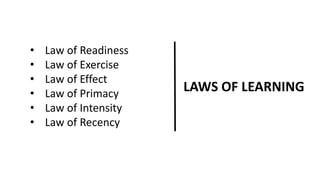
• Law of Readiness
• Law of Exercise
• Law of Effect
• Law of Primacy
• Law of Intensity
• Law of Recency
LAWS OF LEARNING
Learning Styles
• The term learning styles is widely used to describe how
learners gather, sift through, interpret, organize, come to
conclusions about, and “store” information for further use.
Learning styles are cognitive, affective, and physiological
behaviors that serve as indicators of how learners perceive,
interact with, and respond to the learning environment.
THE DIFFERENT
TYPES OF
LEARNING STYLES
• Visual
• Auditory
• Kinesthetic
• Reading/Writing
• Logical/Analytical learning style
• Social/Linguistic learning style
• Solitary learning style
• Nature learning style
GROUP 8
Mendiola Honey
Manguilimotan Ma-Flor
Naque Rojas Sharmaine
Ordaneza Jezzah
Ople Hannah

GROUP 8_PHTeach.pptx

  • 2.
    • What islearning? An individual's learning may involve changes in any of three areas: • Manner of perceiving and thinking. • Physical behavior (motor skills). • Emotional reactions or attitudes.
  • 3.
    CHARACTERISTICS OF THE LEARNING PROCESS •Purposeful Process • Internal Experience • Active Process • Multidimensional • Individual Process
  • 4.
    LEARNING PROCESS • Thisis the process of picking up new information, skills, values, attitudes, and preferences is known as learning. Human, animals, and some robots all have the capacity to learn, and there is evidence that some plants also have this capacity.
  • 5.
    PURPOSE OF LEARNINGPROCESS • A growing movement called "purpose learning" unifies the current educational reform into a straightforward, double framework. The emphasis on learning in the past has been on helping pupils memorize materials and advance their critical thinking abilities.
  • 6.
    THREE CATEGORIES OF PROCESS •Cognitive domain • Emotional domain • Psychomotor domain
  • 7.
    • Edward L.Thorndike in the early 1900's postulated several "Laws of Learning," that seemed generally applicable to the learning process.
  • 8.
    • Law ofReadiness • Law of Exercise • Law of Effect • Law of Primacy • Law of Intensity • Law of Recency LAWS OF LEARNING
  • 9.
    Learning Styles • Theterm learning styles is widely used to describe how learners gather, sift through, interpret, organize, come to conclusions about, and “store” information for further use. Learning styles are cognitive, affective, and physiological behaviors that serve as indicators of how learners perceive, interact with, and respond to the learning environment.
  • 10.
    THE DIFFERENT TYPES OF LEARNINGSTYLES • Visual • Auditory • Kinesthetic • Reading/Writing • Logical/Analytical learning style • Social/Linguistic learning style • Solitary learning style • Nature learning style
  • 11.
    GROUP 8 Mendiola Honey ManguilimotanMa-Flor Naque Rojas Sharmaine Ordaneza Jezzah Ople Hannah