CHARACTERZATIONS
By: Kristen Crites, Emily Simpson, Miroslaba Paxton
Getting to know the Characters of
Why I Live at the P.O.
By: Eudora Welty
∙ Characterization is when the author places fictional characters in a story.
∙ Characterization is important because it allows us to get to know the
characters and relate to them. We become invested in the story and desire to
read what the plot is in the story, and what role these characters we are
coming to know will play in it.
The Characters Can Be:
∙ The characters in the story can be: flat, round, static, dynamic, major, or
minor.
∙ One of these characteristics, or qualities of a character doesn’t make one
better then the other, they just all play a part of the story.
∙ Indirect or Direct
• Flat character- Is a two dimensional character and are typically uncomplicated,
or as some would say BORING…
• Round Character- Isn’t referring to “plump” character. It is referring to a
character who is changing or compels, and often keeps the reader interested.
• Static- Characters are the same person from the beginning of the story to
the end of they story. Typical these characters have drawing personality such as:
confidence, intelligence, humor, or likability.
• Dynamic- These characters experience changes throughout the story. They can
be sudden changes that occur during the plot, or gradual changes throughout the
story.
• Indirect- The author shows the characters personality via speech and emotions.
• Direct- The author direct tells the reader the personality of the characters.
Examples of Direct Character Examples of Indirect Characters
-Sister from Why I Live at the P.O -Stella-Rondo, Pappa-Daddy,
Uncle Rondo, and Shirley-T. from Why -Roberta from Recitatif
I live at the P.O.
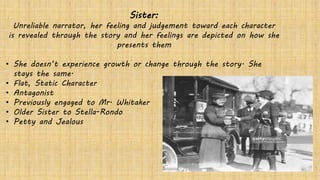
Sister:
Unreliable narrator, her feeling and judgement toward each character
is revealed through the story and her feelings are depicted on how she
presents them
• She doesn’t experience growth or change through the story. She
stays the same.
• Flat, Static Character
• Antagonist
• Previously engaged to Mr. Whitaker
• Older Sister to Stella-Rondo
• Petty and Jealous
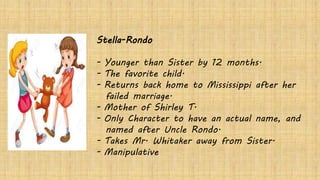
Stella-Rondo
- Younger than Sister by 12 months.
- The favorite child.
- Returns back home to Mississippi after her
failed marriage.
- Mother of Shirley T.
- Only Character to have an actual name, and
named after Uncle Rondo.
- Takes Mr. Whitaker away from Sister.
- Manipulative
Mama
-Gullible, believes whatever she is told from
Stella-Rondo
-Enables sibling rivalry
Papa-Daddy
-Head of household
-Helped Sister get the job at the Post
Office
-Grumpy
-Takes pride in his beard he had been
growing since a teenager
Uncle Rondo
-Mentally unstable after World War
-Mean Spirited
-Wears Stella-Rondo’s night gown
-Take Prescriptions drugs and passes out
Shirley-T.
-Stella-Rondo’s claimed adopted
daughter
-Rarely speaks, but sings Popeye the
Sailor Man
-Refers to Uncle Rondo as Papa
Mr. Whitaker
-Never appears in story, but source of hard feelings
between Sister and Stella-Rondo
-Stella-Rondo’s estranged husband
-Formerly had a relationship with Sister, prior
to Stella
-According to Stella has a drinking problem
-Photographer
Getting to Know the Characters
of Recitatif
By Toni Morrison
Roberta: Roberta is also a round
character. Clearly buys into the racial
situations at the time- “it was black-
white”. Goes through a stage of being
popular, and having money (allowing
the smokes and concerts and her
clothes, like the fur jacket). More
socially, or culturally, aware than her
childhood friend. More secure with
herself, doesn’t doubt her past
actions.
Recitatif, Toni Morrison Continued:
Recitatif, Toni Morrison
Maggie: Maggie, “the kitchen woman” could be representative of the outsider,
as the person whose voice is marginalized, the voice of unheard suffering,
because she is bullied by all of the girls and “couldn’t tell” on any of them.
The big girls pick on Maggie, and when they turn to Twyla and Roberta, the
two girls pick on Maggie themselves which shows the social organization. While
Twyla and Roberta can turn to one another when they are picked on, Maggie
has nobody, she has nothing, and also represents solidarity. Maggie may not be
directly involved, but she does make multiple appearances through the story as
the girls age. This is a significant detail because when the girls are married,
they take solace in their man or marriage and realize that sometimes people
do not always get to be involved within their community- furthering the
“outsider” concept- and serves to remind them that pain and suffering still
exists, even if they were able to escape it. Maggie is a static character.

ZXCV

  • 1.
    CHARACTERZATIONS By: Kristen Crites,Emily Simpson, Miroslaba Paxton
  • 2.
    Getting to knowthe Characters of Why I Live at the P.O. By: Eudora Welty
  • 3.
    ∙ Characterization iswhen the author places fictional characters in a story. ∙ Characterization is important because it allows us to get to know the characters and relate to them. We become invested in the story and desire to read what the plot is in the story, and what role these characters we are coming to know will play in it. The Characters Can Be: ∙ The characters in the story can be: flat, round, static, dynamic, major, or minor. ∙ One of these characteristics, or qualities of a character doesn’t make one better then the other, they just all play a part of the story. ∙ Indirect or Direct
  • 4.
    • Flat character-Is a two dimensional character and are typically uncomplicated, or as some would say BORING… • Round Character- Isn’t referring to “plump” character. It is referring to a character who is changing or compels, and often keeps the reader interested. • Static- Characters are the same person from the beginning of the story to the end of they story. Typical these characters have drawing personality such as: confidence, intelligence, humor, or likability. • Dynamic- These characters experience changes throughout the story. They can be sudden changes that occur during the plot, or gradual changes throughout the story. • Indirect- The author shows the characters personality via speech and emotions. • Direct- The author direct tells the reader the personality of the characters.
  • 5.
    Examples of DirectCharacter Examples of Indirect Characters -Sister from Why I Live at the P.O -Stella-Rondo, Pappa-Daddy, Uncle Rondo, and Shirley-T. from Why -Roberta from Recitatif I live at the P.O.
  • 6.
    Sister: Unreliable narrator, herfeeling and judgement toward each character is revealed through the story and her feelings are depicted on how she presents them • She doesn’t experience growth or change through the story. She stays the same. • Flat, Static Character • Antagonist • Previously engaged to Mr. Whitaker • Older Sister to Stella-Rondo • Petty and Jealous
  • 7.
    Stella-Rondo - Younger thanSister by 12 months. - The favorite child. - Returns back home to Mississippi after her failed marriage. - Mother of Shirley T. - Only Character to have an actual name, and named after Uncle Rondo. - Takes Mr. Whitaker away from Sister. - Manipulative
  • 8.
    Mama -Gullible, believes whatevershe is told from Stella-Rondo -Enables sibling rivalry Papa-Daddy -Head of household -Helped Sister get the job at the Post Office -Grumpy -Takes pride in his beard he had been growing since a teenager
  • 9.
    Uncle Rondo -Mentally unstableafter World War -Mean Spirited -Wears Stella-Rondo’s night gown -Take Prescriptions drugs and passes out Shirley-T. -Stella-Rondo’s claimed adopted daughter -Rarely speaks, but sings Popeye the Sailor Man -Refers to Uncle Rondo as Papa
  • 10.
    Mr. Whitaker -Never appearsin story, but source of hard feelings between Sister and Stella-Rondo -Stella-Rondo’s estranged husband -Formerly had a relationship with Sister, prior to Stella -According to Stella has a drinking problem -Photographer
  • 11.
    Getting to Knowthe Characters of Recitatif By Toni Morrison
  • 12.
    Roberta: Roberta isalso a round character. Clearly buys into the racial situations at the time- “it was black- white”. Goes through a stage of being popular, and having money (allowing the smokes and concerts and her clothes, like the fur jacket). More socially, or culturally, aware than her childhood friend. More secure with herself, doesn’t doubt her past actions. Recitatif, Toni Morrison Continued:
  • 13.
    Recitatif, Toni Morrison Maggie:Maggie, “the kitchen woman” could be representative of the outsider, as the person whose voice is marginalized, the voice of unheard suffering, because she is bullied by all of the girls and “couldn’t tell” on any of them. The big girls pick on Maggie, and when they turn to Twyla and Roberta, the two girls pick on Maggie themselves which shows the social organization. While Twyla and Roberta can turn to one another when they are picked on, Maggie has nobody, she has nothing, and also represents solidarity. Maggie may not be directly involved, but she does make multiple appearances through the story as the girls age. This is a significant detail because when the girls are married, they take solace in their man or marriage and realize that sometimes people do not always get to be involved within their community- furthering the “outsider” concept- and serves to remind them that pain and suffering still exists, even if they were able to escape it. Maggie is a static character.