A
seminar
on
WATER POLLUTION
1
Prepared byPrepared by
MD TANZIL ALAMMD TANZIL ALAM
INTRODUCTION 2
• Water pollution is the contamination of water bodies
(e.g. lakes, rivers, oceans and groundwater). Water
pollution occurs when pollutants are discharged
directly or indirectly into water bodies without
adequate treatment to remove harmful compounds.
• Water pollution affects plants and organisms living in
these bodies of water; and, in almost all cases the
effect is damaging not only to individual species and
populations, but also to the natural biological
communities.
KEY CONCEPT
3
 Types, sources, and effects of water pollutantsTypes, sources, and effects of water pollutants
 Major pollution problems of surface waterMajor pollution problems of surface water
 Major pollution problems of groundwaterMajor pollution problems of groundwater
 Reduction and prevention of water pollutionReduction and prevention of water pollution
Types, Effects, and Sources of Water
Pollution
 Water is polluted by infectious bacteria, inorganic and
organic chemicals, and excess heat.
 Water pollution is any chemical, biological, or physical
change in water quality that has a harmful effect on living
organisms.
 The WHO estimates that 3.4 million people die prematurely
each year from waterborne diseases.
 In the U.S., an estimated 1.5 million people a year become ill
from infectious agents.
4
Types of water pollution
 Nutrients Pollution
 Surface water pollution
 Oxygen Depleting
 Ground water pollution
  Microbiological
 Suspended Matter
 Chemical Water Pollution
 Oil Spillage
5
Sources of Water Pollution 6
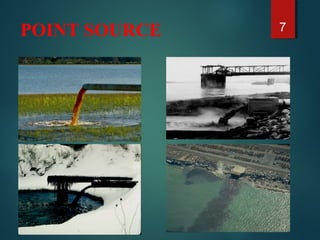
POINT SOURCEPOINT SOURCE
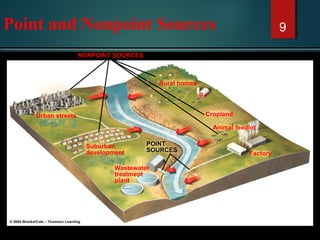
 pollution flowing from a single and identifiablepollution flowing from a single and identifiable
source such as discharge pipe from a factory,source such as discharge pipe from a factory,
roadway, or leaking underground storage tankroadway, or leaking underground storage tank
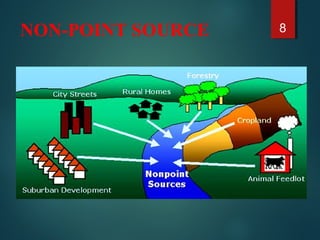
NON-POINT SOURCENON-POINT SOURCE
 pollution collected by rain falling over a largerpollution collected by rain falling over a larger
watershed which is then carried by runoff to awatershed which is then carried by runoff to a
nearby lake or stream, or by infiltration intonearby lake or stream, or by infiltration into
the groundwaterthe groundwater
POINT SOURCE 7
NON-POINT SOURCE 8
Point and Nonpoint Sources 9
NONPOINT SOURCES
Urban streets
Suburban
development
Wastewater
treatment
plant
Rural homes
Cropland
Factory
Animal feedlot
POINT
SOURCES
Sources of water pollution
The leading sources of water pollution are
agriculture, industries, and mining.
1. Agricultural activities - are the leading cause of
water pollution from erosion, overgrazing,
fertilizers and pesticides, and excess salt from
irrigated soils.
2. Industrial facilities - are another large source of
water pollution, and mining is a third source.
10
Pollution of Freshwater Streams
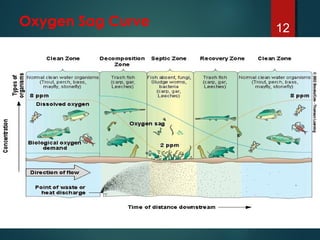
Streams can recover from moderate levels of degradable
water pollutants if the flows are not reduced.
1. A combination of dilution and biodegradation can allow
recovery of stream pollution
2. The breakdown of pollutants by bacteria creates an oxygen
sag curve. Organisms that have a high oxygen demand
can’t survive in the curve.
3. Volume of the stream, volume of wastes entering, flow
rate, temperature, and pH levels all affect how great a sag
curve is produced.
11
Oxygen Sag Curve 12
Water Pollution: Now
• Most developed countries have reduced point source
pollution, but toxic chemicals and pollution from non-point
sources are still problems.
• Stream pollution in most developing countries is a serious
and growing problem. Half of the world’s 500 major rivers
are heavily polluted, and most of them run through
developing countries where waste treatment is minimal or
nonexistent.
• For example: Religious beliefs, cultural traditions, poverty,
little economic development, and a large population interact
to cause severe pollution of the Ganges River in India.
13
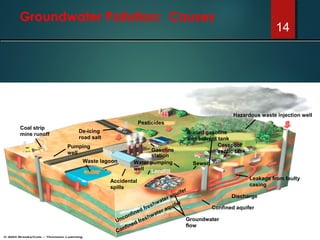
Groundwater Pollution: Causes
14
Coal strip
mine runoff
Pumping
well
Waste lagoon
Accidental
spills
Groundwater
flow
Confined aquifer
Discharge
Leakage from faulty
casing
Hazardous waste injection well
Pesticides
Gasoline
station
Buried gasoline
and solvent tank
Sewer
Cesspool
septic tank
De-icing
road salt
Unconfined freshwater aquifer
Confined freshwater aquifer
Water pumping
well Landfill
Pollution of Groundwater
 Experts rate groundwater pollution as a low-risk ecological
problem; it is rated as a high-risk health problem.
 The extent of groundwater contamination is generally
unknown
 Prevention is the most effective and affordable way to
protect groundwater from pollutants.
15
Solutions: Preventing and
Reducing Surface Water Pollution
16
Nonpoint SourcesNonpoint Sources Point SourcesPoint Sources
• Reduce runoffReduce runoff
• Buffer zone vegetationBuffer zone vegetation
• Reduce soil erosionReduce soil erosion
• Clean Water ActClean Water Act
• Water Quality ActWater Quality Act
How can we stop water pollution 17
Education
Governments, local councils and laws
Economics
Our clean future
Conclusion 18
Clearly, the problems associated with water pollution have the
capabilities to disrupt life on our planet to a great extent.
Congress has passed laws to try to combat water pollution thus
acknowledging the fact that water pollution is, indeed, a serious
issue. But the government alone cannot solve the entire problem.
It is ultimately up to us, to be informed, responsible and involved
when it comes to the problems we face with our water. We must
become familiar with our local water resources and learn about
ways for disposing harmful household wastes so they don't end
up in sewage treatment plants that can't handle them or landfills
not designed to receive hazardous materials
References 19
1. Gannon, RW; Osmond, DL; Humenik, FJ; Gale, JA; Spooner, J
Agricultural Water Quality WATER RESOUR BULL, vol. 32, no. 3, pp.
437-450, 1996
2. U.S. ENVIRONMENTAL PROTECTION AGENCY, WASHINGTON,
DC (USA), 1996, 253 pp
3. MacKenzie, SH The Ecosystem ISLAND PRESS, CA (USA), 1996, 240
20
THE END!
21
THANK
YOU!

Ppt by md tanzil alam.ppt

  • 1.
  • 2.
    INTRODUCTION 2 • Waterpollution is the contamination of water bodies (e.g. lakes, rivers, oceans and groundwater). Water pollution occurs when pollutants are discharged directly or indirectly into water bodies without adequate treatment to remove harmful compounds. • Water pollution affects plants and organisms living in these bodies of water; and, in almost all cases the effect is damaging not only to individual species and populations, but also to the natural biological communities.
  • 3.
    KEY CONCEPT 3  Types,sources, and effects of water pollutantsTypes, sources, and effects of water pollutants  Major pollution problems of surface waterMajor pollution problems of surface water  Major pollution problems of groundwaterMajor pollution problems of groundwater  Reduction and prevention of water pollutionReduction and prevention of water pollution
  • 4.
    Types, Effects, andSources of Water Pollution  Water is polluted by infectious bacteria, inorganic and organic chemicals, and excess heat.  Water pollution is any chemical, biological, or physical change in water quality that has a harmful effect on living organisms.  The WHO estimates that 3.4 million people die prematurely each year from waterborne diseases.  In the U.S., an estimated 1.5 million people a year become ill from infectious agents. 4
  • 5.
    Types of waterpollution  Nutrients Pollution  Surface water pollution  Oxygen Depleting  Ground water pollution   Microbiological  Suspended Matter  Chemical Water Pollution  Oil Spillage 5
  • 6.
    Sources of WaterPollution 6 POINT SOURCEPOINT SOURCE  pollution flowing from a single and identifiablepollution flowing from a single and identifiable source such as discharge pipe from a factory,source such as discharge pipe from a factory, roadway, or leaking underground storage tankroadway, or leaking underground storage tank NON-POINT SOURCENON-POINT SOURCE  pollution collected by rain falling over a largerpollution collected by rain falling over a larger watershed which is then carried by runoff to awatershed which is then carried by runoff to a nearby lake or stream, or by infiltration intonearby lake or stream, or by infiltration into the groundwaterthe groundwater
  • 7.
  • 8.
  • 9.
    Point and NonpointSources 9 NONPOINT SOURCES Urban streets Suburban development Wastewater treatment plant Rural homes Cropland Factory Animal feedlot POINT SOURCES
  • 10.
    Sources of waterpollution The leading sources of water pollution are agriculture, industries, and mining. 1. Agricultural activities - are the leading cause of water pollution from erosion, overgrazing, fertilizers and pesticides, and excess salt from irrigated soils. 2. Industrial facilities - are another large source of water pollution, and mining is a third source. 10
  • 11.
    Pollution of FreshwaterStreams Streams can recover from moderate levels of degradable water pollutants if the flows are not reduced. 1. A combination of dilution and biodegradation can allow recovery of stream pollution 2. The breakdown of pollutants by bacteria creates an oxygen sag curve. Organisms that have a high oxygen demand can’t survive in the curve. 3. Volume of the stream, volume of wastes entering, flow rate, temperature, and pH levels all affect how great a sag curve is produced. 11
  • 12.
  • 13.
    Water Pollution: Now •Most developed countries have reduced point source pollution, but toxic chemicals and pollution from non-point sources are still problems. • Stream pollution in most developing countries is a serious and growing problem. Half of the world’s 500 major rivers are heavily polluted, and most of them run through developing countries where waste treatment is minimal or nonexistent. • For example: Religious beliefs, cultural traditions, poverty, little economic development, and a large population interact to cause severe pollution of the Ganges River in India. 13
  • 14.
    Groundwater Pollution: Causes 14 Coalstrip mine runoff Pumping well Waste lagoon Accidental spills Groundwater flow Confined aquifer Discharge Leakage from faulty casing Hazardous waste injection well Pesticides Gasoline station Buried gasoline and solvent tank Sewer Cesspool septic tank De-icing road salt Unconfined freshwater aquifer Confined freshwater aquifer Water pumping well Landfill
  • 15.
    Pollution of Groundwater Experts rate groundwater pollution as a low-risk ecological problem; it is rated as a high-risk health problem.  The extent of groundwater contamination is generally unknown  Prevention is the most effective and affordable way to protect groundwater from pollutants. 15
  • 16.
    Solutions: Preventing and ReducingSurface Water Pollution 16 Nonpoint SourcesNonpoint Sources Point SourcesPoint Sources • Reduce runoffReduce runoff • Buffer zone vegetationBuffer zone vegetation • Reduce soil erosionReduce soil erosion • Clean Water ActClean Water Act • Water Quality ActWater Quality Act
  • 17.
    How can westop water pollution 17 Education Governments, local councils and laws Economics Our clean future
  • 18.
    Conclusion 18 Clearly, theproblems associated with water pollution have the capabilities to disrupt life on our planet to a great extent. Congress has passed laws to try to combat water pollution thus acknowledging the fact that water pollution is, indeed, a serious issue. But the government alone cannot solve the entire problem. It is ultimately up to us, to be informed, responsible and involved when it comes to the problems we face with our water. We must become familiar with our local water resources and learn about ways for disposing harmful household wastes so they don't end up in sewage treatment plants that can't handle them or landfills not designed to receive hazardous materials
  • 19.
    References 19 1. Gannon,RW; Osmond, DL; Humenik, FJ; Gale, JA; Spooner, J Agricultural Water Quality WATER RESOUR BULL, vol. 32, no. 3, pp. 437-450, 1996 2. U.S. ENVIRONMENTAL PROTECTION AGENCY, WASHINGTON, DC (USA), 1996, 253 pp 3. MacKenzie, SH The Ecosystem ISLAND PRESS, CA (USA), 1996, 240
  • 20.
  • 21.