Undergraduate Team Members
Jin young Kim
Keaton Aktay
Kory Aktay
Faculty Advisor
Timothy D. Ropp
Purdue University
ANTS – Automated NextGen Taxi System
2
Executive Summary
This design packet addresses the Airport Management and Planning Challenge of the
FAA Design Competition for Universities in the 2009-2010 academic year. Through our
extensive research, examination of similar design literature, and communications with many
distinguished industry experts, we have developed a full proof automated aircraft towing system
called Automated NextGen Taxi System (ANTS). ANTS is designed to fill a gap between the
conventional, engine-propelled taxiing and a more fuel and operations efficient taxiing system.
ANTS incorporates a system of automated tractors, termed Towing Support Vehicles (TSV), a
precise GPS navigation system (LAAS), and a monitoring data management system that allows
for safe and efficient airport ground operations synced to future NextGen technologies. The
ANTS design’s benefits are demonstrated through several cost and safety risk assessments,
models, and diagrams. Our ANTS design delivers a significant impact to the industry in the
following categories: monetary savings to airlines and airports, environmental/carbon footprint,
and noise pollution.
3
Table of Contents
Executive Summary ....................................................................................................................2
Problem Statement and Background............................................................................................5
Literature Review........................................................................................................................7
Problem Solving Approach .......................................................................................................10
Safety Risk Assessment.............................................................................................................11
Design.......................................................................................................................................15
Design Specifications............................................................................................................16
Data Management System (DMS) .........................................................................................19
Departure Procedure..............................................................................................................20
Arrival Procedure..................................................................................................................24
Airport Configuration............................................................................................................26
Industry Interaction...................................................................................................................27
Project Impact...........................................................................................................................30
Airport Example....................................................................................................................31
Airline Example ....................................................................................................................32
Environmental Impact ...........................................................................................................33
Noise Impact and Other Uses ................................................................................................33
Summary...............................................................................................................................34
Appendix A...............................................................................................................................36
Appendix B...............................................................................................................................37
Appendix C...............................................................................................................................38
Appendix D...............................................................................................................................39
4
Appendix E...............................................................................................................................40
Appendix F ...............................................................................................................................45
5
Problem Statement and Background
The airline industry has many factors to manage when operating in a high-risk, and
extremely competitive market. One of the more critical factors is fuel costs, which constitute
anywhere from 10% to 15% of total operating costs by convention (ATA, 2008). However, in
the last quarter of 2009, domestic airlines spent an average 23.7% of their operating expenses on
jet fuel (BTS, 2009). In addition, volatility of the fuel market exacerbates most departments’
prediction capabilities. A quick analysis of spot prices of crude oil from 2000 to 2010 shows an
average of $3.82 per barrel monthly fluctuation. Such a low margin appears to be frivolous to
mention, but this monthly vicissitude multiplied by millions (airline) or billions (nationwide) of
gallons creates a serious dent in a budget. Larger monthly differences in price per barrel in the
past decade were $12.82 in May of 2008 and $27.50 in October of 2008 (USEIA, 2010). As an
example, a $21 change in average price of oil resulted in a $1.5 billion difference in a fuel bill
for American Airlines (Bansal, 2006). These stark variances demonstrate fuel price volatility,
proving the difficulties in hedging appropriately to save capital. Overall, this has caused much
anxiety amongst airlines trying to budget their costs each year and climb out of debt. To solve
the problem of rising fuel costs, companies have even implemented procedures to tow aircraft
from the gate to runway. This is especially important because of the current economic crisis
which has caused many airlines to file for bankruptcy.
The rudiments of fuel conservation can be found during the 1973 oil crisis, which
precipitated a need for an efficiency plan for operations. As a result, airport managers and the
airlines, as recommended by the FAA, implemented gate-hold procedures in order to combat the
mounting fuel expense figures. Under this program, aircraft are to hold at the gate if a delay for
take-off exceeds 5 minutes (Aviation Week & Space Technology, 1977). While this saved fuel
6
costs caused by delays and engine idling on taxiways, there was still a need for fuel conservation.
In an experimental effort in the early 80’s, Air France designed a 35 mph tow tractor that would
tug airplanes to runways to combat excessive fuel burn. Even the FAA and Seattle-Tacoma
International Airport wrestled the idea but had concerns of low taxiing speeds causing costly
delays (Mouat, 1981). However, over the next decade, oil prices dropped, putting such
innovative concepts on hold. Nonetheless, not many airline fuel management departments
predicted the price escalation that occurred in recent years, such as oil surpassing $120 per barrel
(USEIA, 2010). Consequently, airlines began executing towing procedures for especially high
fuel-burning aircraft in various taxi operations. For example, American Airlines purchased high-
speed tugs with minimal fuel consumption, to transfer empty airplanes to maintenance facilities
(Hilkevitch, 2008). Virgin Atlantic also suggested, in 2006, the idea of towing all of its airplanes
to a designated holding area to reduce fleet fuel burn and decrease contribution to global CO2
emissions (Johnson, 2006). In conjunction with the late 2000s recession, oil prices stabilized,
but airlines had other concerns to manage, such as their survival through challenging economic
times. This again put fuel conservation on the backburner, perhaps until prices were expected to
rise in the near future. Nonetheless, given this background of information, a problem continues
to exist that is in need of addressing. The current airport operations fail to effectively recognize
and alleviate existing congestion issues, which ultimately results in a considerable amount of
financial loss for airline operators due to excess fuel burn and increased engine wear.
Even with gate-to-runway towing systems, there are several challenges inherent in design
and implementation. An initial problem system engineers found back in the 80s, which is still
applicable today, is efficiency and speed of towing tractors. Aircraft sequencing proves to be
very difficult, when managing more than 75 airplanes an hour at a typical busy airfield (FAA,
7
ASPM, 2010). In addition, conventional tow tractors haul at a very minimal speed, provoking
further counterproductive delays, costing airlines more money. Other considerations include
stress on the landing gear, during prolonged periods of taxiing (Correspondent, 2008). If such a
system were automated, there would need to be safety countermeasures implemented such as
pilot control and ATC oversight. Pilot checklists would have to be modified to allow for taxi
towing and delayed engine startup. Lastly, acquiescence with NextGen and airport authorities
would be needed to ensure proper incorporation of future ground operation programs with a gate-
to-runway taxiing system.
Literature Review
When researching designs relevant to aircraft towing systems comparable to our initial
concept, we found three similar models. These three systems are automated to some degree, but
shortcomings in their designs were believed to exist that could be addressed by our eventual
innovations on an automated aircraft towing system. The three patent holders identified were
Airborne Holding, an individual named Edward Leblanc, and Ricardo Engineering.
In 2001, Airborne Holding developed an aircraft towing system concept labeled airport
ground navigation system. This design’s model used aircraft tugs to transport aircraft around the
airport. In the patent, designers illustrated the benefits of using these tugs, such as fuel costs and
engine wear reduction. Although this design was beneficial, it did not provide specifications of
the tug nor did it present estimated costs of the tug. Also, the patent was very vague in how the
system would operate and be implemented at airports and with aircraft. Overall, the Airborne
Holding design illustrates key design principles, but did not articulate a particular management
system, perhaps a paramount factor for successful implementation (Dow, 1998).
8
The next aircraft towing system was designed in 2003 by Edward Leblanc of Ontario,
Canada. Leblanc also patented the design and developed several detailed diagrams and models.
The patent discussed the benefits of the design, which included fuel savings, reduction of
environmental pollution, and decrease of engine maintenance, without mentioning specific
monetary savings. The basics of this design were the automation and control of the aircraft
towing vehicle through a remote, located within the aircraft itself, with another mode of control
still possible through LORAN or GPS. However, the towing vehicle must be attached and
detached from the aircraft manually, and the towing vehicle utilizes a towing bar to couple to the
aircraft, which increases time spent on connecting the towing vehicle to the aircraft. Also, this
aircraft towing system would solely be used to taxi aircraft from gate to runway and not during
the post-landing phase. As in the previously discussed aircraft towing system by Airborne
Holding, there is no description of the specifications of the design of the aircraft towing vehicle
or the rest of the system (Leblanc, 2003).
The third design partially embodied within our design was by Ricardo Engineering.
Their design, called Taxibot, uses a pilot-controlled towing vehicle to tug the aircraft to its
destination. It is powered by twin, 500 horsepower V8 diesel engines which have the capability
to tow both wide and narrow bodied commercial aircraft. It attaches to the aircraft by using arms
that surround and grasp the nosewheel. The Taxibot requires no modifications to aircraft,
taxiways, or runways, therefore making it very versatile in the aviation industry. The other
benefits of the Ricardo Taxibot, that are standard to most aircraft towing systems, are the
curtailment of fuel costs to aircraft, CO2 emissions and noise pollution.
In Ricardo’s Taxibot design there were definitive benefits, but also technical and
automation areas in question, impacting Taxibot’s feasibility. First, the Taxibot is only
9
automated in the engagement of the towing arms to the aircraft. It requires an operator to drive
and position the Taxibot, having only plans to possibly develop an automated driving system
(Ricardo, 2009). Another disadvantage of the Taxibot is that if it were to be implemented at
airports, it would be necessary to modify the airport’s infrastructure. This could delay and add
significant costs to the implementation of the Taxibot. Lastly, by using diesel engines to power
Taxibots, contribution to aviation’s carbon footprint still occurs.
After our design team reviewed these patents and models, we collaborated to form a
practical system that could be used at any airport and on nearly any aircraft. From Leblanc’s
design, we found that there were certain aspects that could be used and improved upon. These
entailed the automation of the towing vehicles through some type of positioning system, like
Local Area Augmentation System (LAAS), benefits of taxiing aircraft, and using towing vehicles
for both takeoffs and landings. After researching Ricardo’s Taxibot design, we concluded that a
number of elements from their system could be enhanced. Taxibot’s use of twin diesel engines
influenced our towing vehicle’s design to be powered by batteries, therefore increasing the
reduction of the environmental footprint of aircraft. Taxibot’s use of arms to clamp onto the
nosewheel for towing was similar to our initial design concept. Finally, Taxibot and Leblanc’s
designs both use some type of personnel to either operate the towing vehicle or manually
attach/detach the tug from the aircraft. Using workers to drive or attach the towing vehicle is
believed to increase costs of using an aircraft towing system and increase the amount of injury
potential to ground crew (Dell, 1994). This notion encouraged our team to incorporate less
manual labor into our design. Eventually, these designs led to our concept of a fully automated
towing vehicle synced with emerging NextGen and ATC technologies and networks, assisted by
an innovative data management system. In conclusion, evaluation of the similarities and
10
differences of each of the aircraft towing systems helped shape our eventual design, Automated
NextGen Taxi System (ANTS).
Problem Solving Approach
After review of the competition topics, our approach began with listing known challenges
to airports, airlines, and aviation as a global system. After due diligence and narrowing down a
few candidates, we decided it would be beneficial to examine the FAA’s Next Generation Air
Transportation System (NextGen) as it related to fuel/energy savings and airport ground
operations congestion. A gap analysis of airport congestion/operations programs was performed,
and it was concluded that airport ground operations efficiency would be our design challenge to
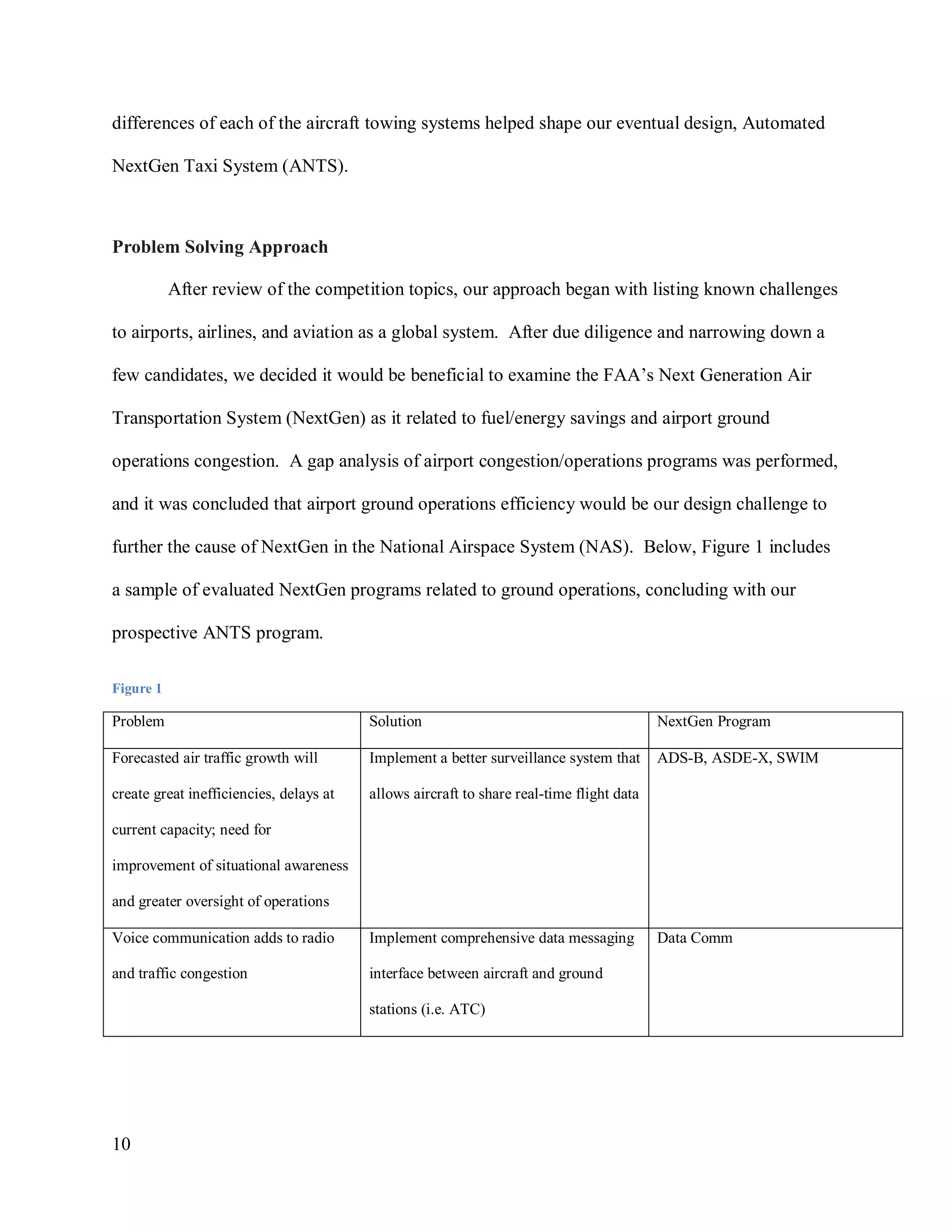
further the cause of NextGen in the National Airspace System (NAS). Below, Figure 1 includes
a sample of evaluated NextGen programs related to ground operations, concluding with our
prospective ANTS program.
Figure 1
Problem Solution NextGen Program
Forecasted air traffic growth will
create great inefficiencies, delays at
current capacity; need for
improvement of situational awareness
and greater oversight of operations
Implement a better surveillance system that
allows aircraft to share real-time flight data
ADS-B, ASDE-X, SWIM
Voice communication adds to radio
and traffic congestion
Implement comprehensive data messaging
interface between aircraft and ground
stations (i.e. ATC)
Data Comm
11
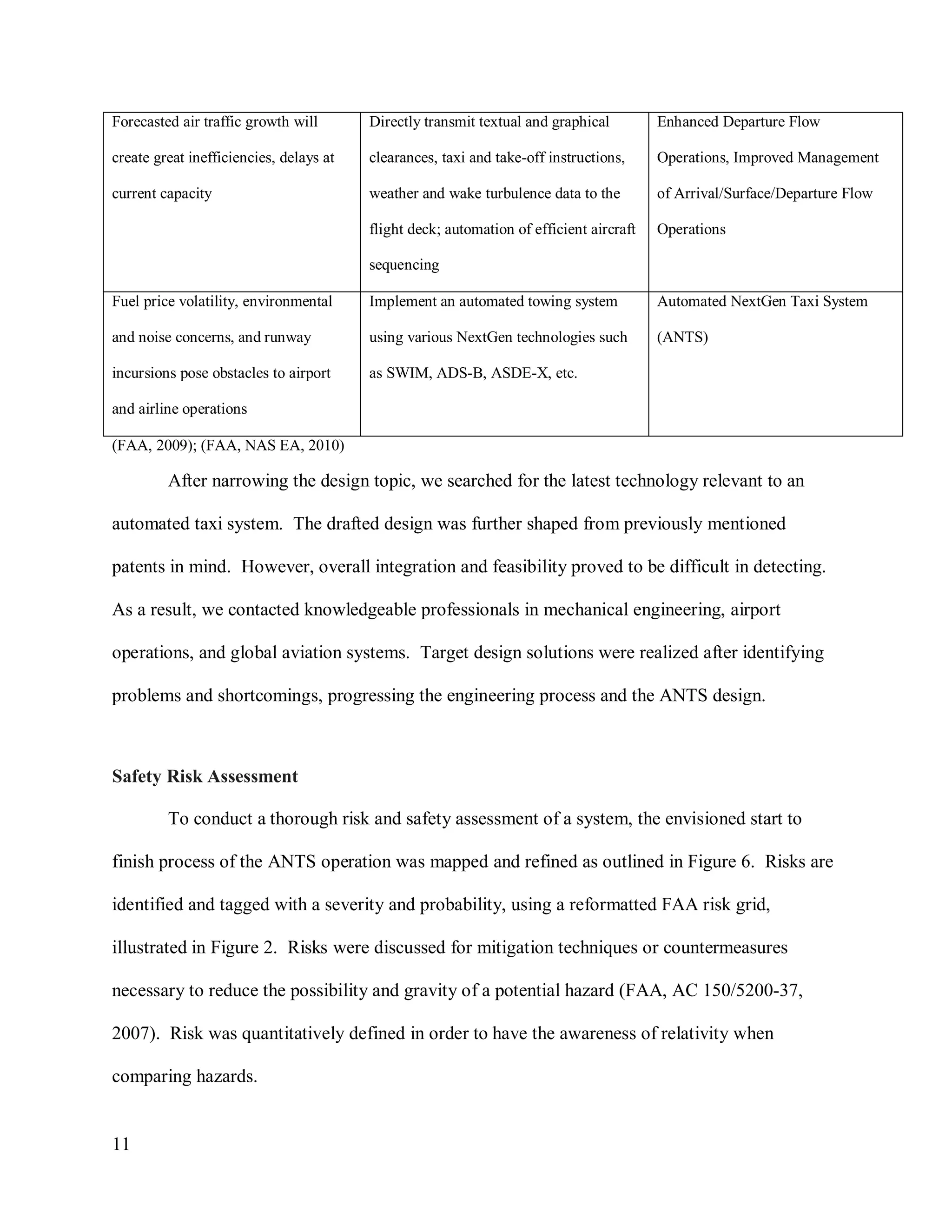
Forecasted air traffic growth will
create great inefficiencies, delays at
current capacity
Directly transmit textual and graphical
clearances, taxi and take-off instructions,
weather and wake turbulence data to the
flight deck; automation of efficient aircraft
sequencing
Enhanced Departure Flow
Operations, Improved Management
of Arrival/Surface/Departure Flow
Operations
Fuel price volatility, environmental
and noise concerns, and runway
incursions pose obstacles to airport
and airline operations
Implement an automated towing system
using various NextGen technologies such
as SWIM, ADS-B, ASDE-X, etc.
Automated NextGen Taxi System
(ANTS)
(FAA, 2009); (FAA, NAS EA, 2010)
After narrowing the design topic, we searched for the latest technology relevant to an
automated taxi system. The drafted design was further shaped from previously mentioned
patents in mind. However, overall integration and feasibility proved to be difficult in detecting.
As a result, we contacted knowledgeable professionals in mechanical engineering, airport
operations, and global aviation systems. Target design solutions were realized after identifying
problems and shortcomings, progressing the engineering process and the ANTS design.
Safety Risk Assessment
To conduct a thorough risk and safety assessment of a system, the envisioned start to
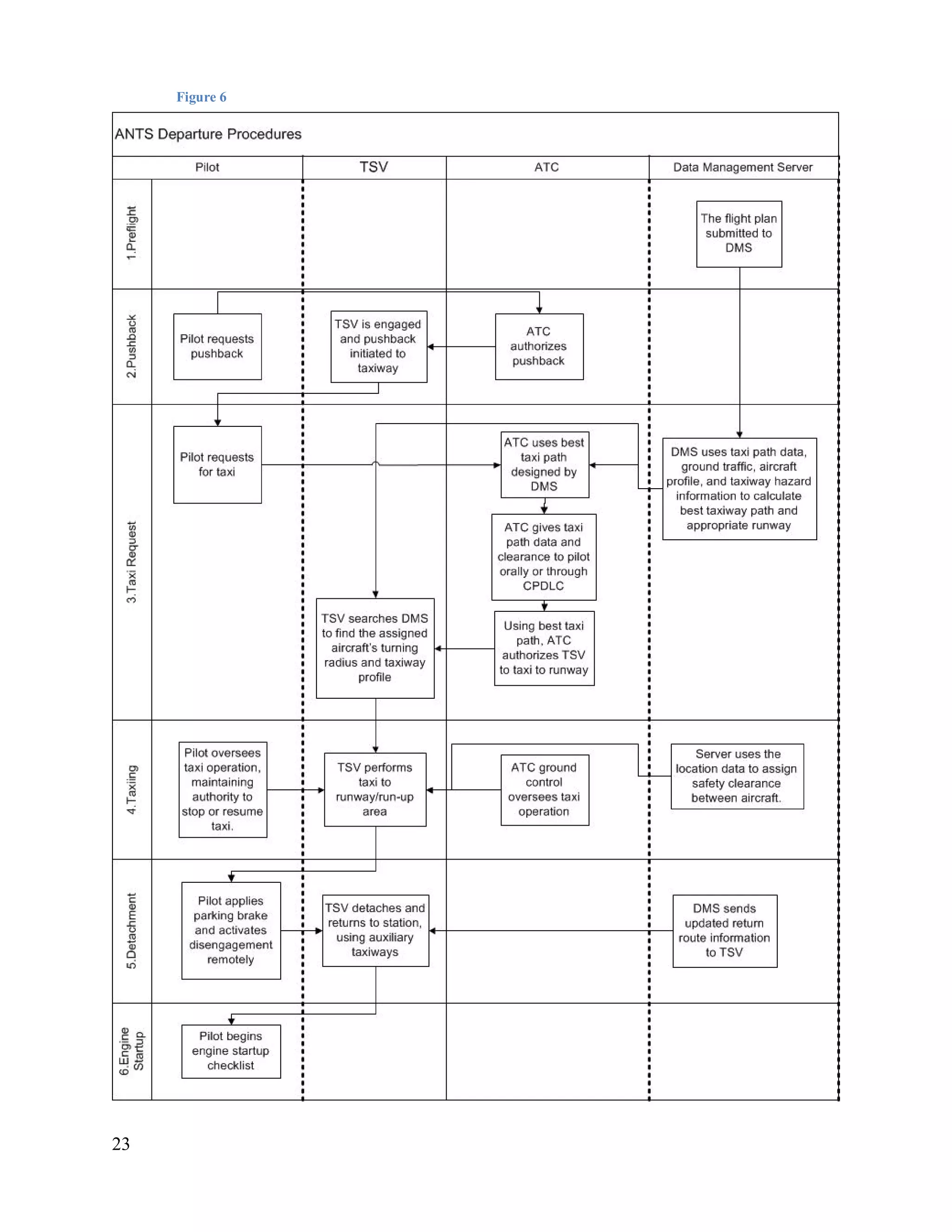
finish process of the ANTS operation was mapped and refined as outlined in Figure 6. Risks are
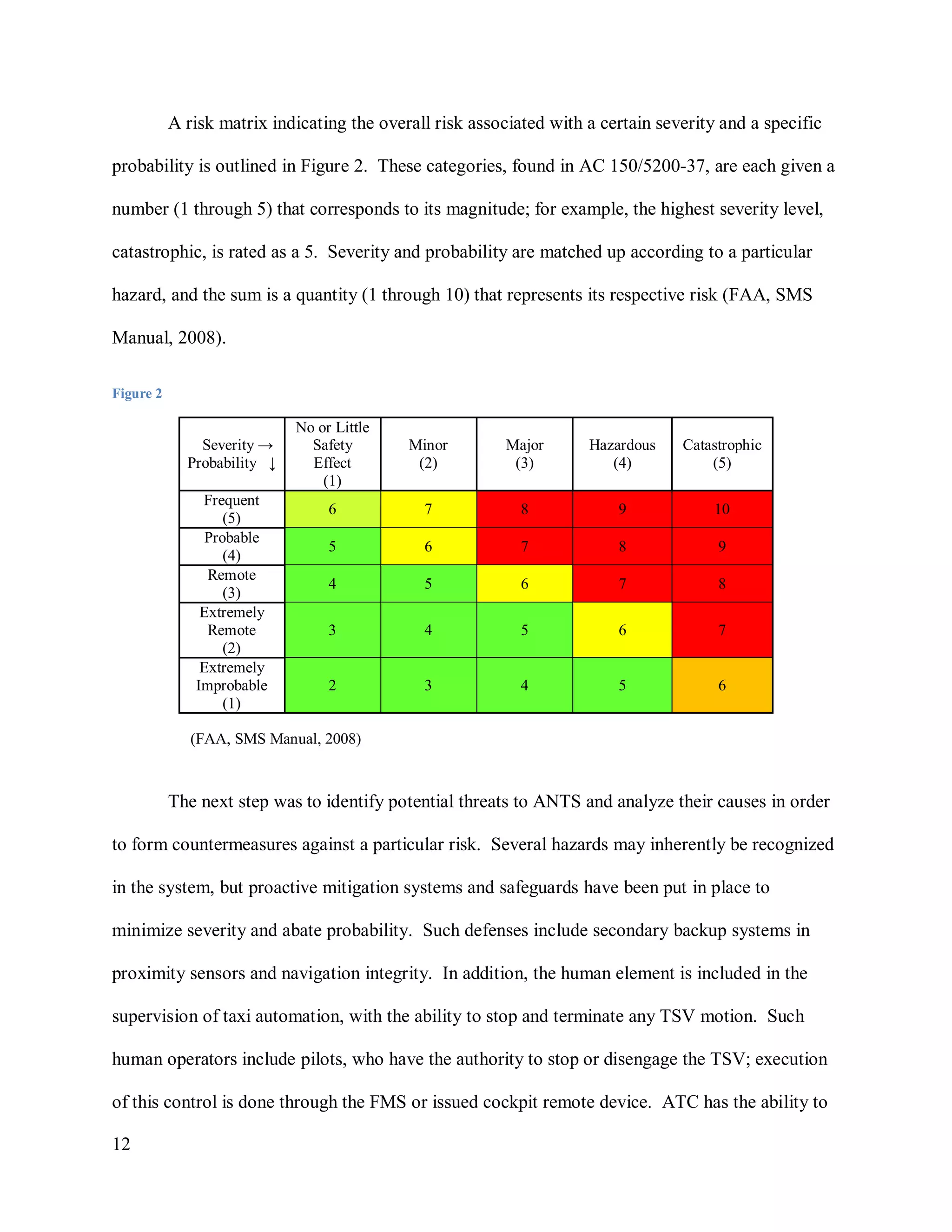
identified and tagged with a severity and probability, using a reformatted FAA risk grid,
illustrated in Figure 2. Risks were discussed for mitigation techniques or countermeasures
necessary to reduce the possibility and gravity of a potential hazard (FAA, AC 150/5200-37,
2007). Risk was quantitatively defined in order to have the awareness of relativity when
comparing hazards.
12
A risk matrix indicating the overall risk associated with a certain severity and a specific
probability is outlined in Figure 2. These categories, found in AC 150/5200-37, are each given a
number (1 through 5) that corresponds to its magnitude; for example, the highest severity level,
catastrophic, is rated as a 5. Severity and probability are matched up according to a particular
hazard, and the sum is a quantity (1 through 10) that represents its respective risk (FAA, SMS
Manual, 2008).
Figure 2
Severity →
Probability ↓
No or Little
Safety
Effect
(1)
Minor
(2)
Major
(3)
Hazardous
(4)
Catastrophic
(5)
Frequent
(5)
6 7 8 9 10
Probable
(4)
5 6 7 8 9
Remote
(3)
4 5 6 7 8
Extremely
Remote
(2)
3 4 5 6 7
Extremely
Improbable
(1)
2 3 4 5 6
The next step was to identify potential threats to ANTS and analyze their causes in order
to form countermeasures against a particular risk. Several hazards may inherently be recognized
in the system, but proactive mitigation systems and safeguards have been put in place to
minimize severity and abate probability. Such defenses include secondary backup systems in
proximity sensors and navigation integrity. In addition, the human element is included in the
supervision of taxi automation, with the ability to stop and terminate any TSV motion. Such
human operators include pilots, who have the authority to stop or disengage the TSV; execution
of this control is done through the FMS or issued cockpit remote device. ATC has the ability to
(FAA, SMS Manual, 2008)
13
cease operations in the event of an emergency or imminent runway incursion, should primary
and secondary systems fail. As a final deterrent to hazards, initial training of ANTS educate
airport personnel standard operating procedures and continual techniques on how to mitigate
risk. Another consideration to note is the ironies that occur in engineering automation.
Automated tasks, such as FMS, autopilot, or even ANTS, are highly complex and require little
operator-machine interaction, thus making monitoring of a system more difficult and less
engaging. This poses serious risks when an unexpected, very infrequent emergency occurs and
an operator, who has become deskilled through continuous and monotonous monitoring, fails to
respond appropriately to the situation (Reason, 1997). In order to combat any loss of skills and
better prepare personnel operating ANTS, recurrent operational training would provide an
invaluable, additional defense to risks.
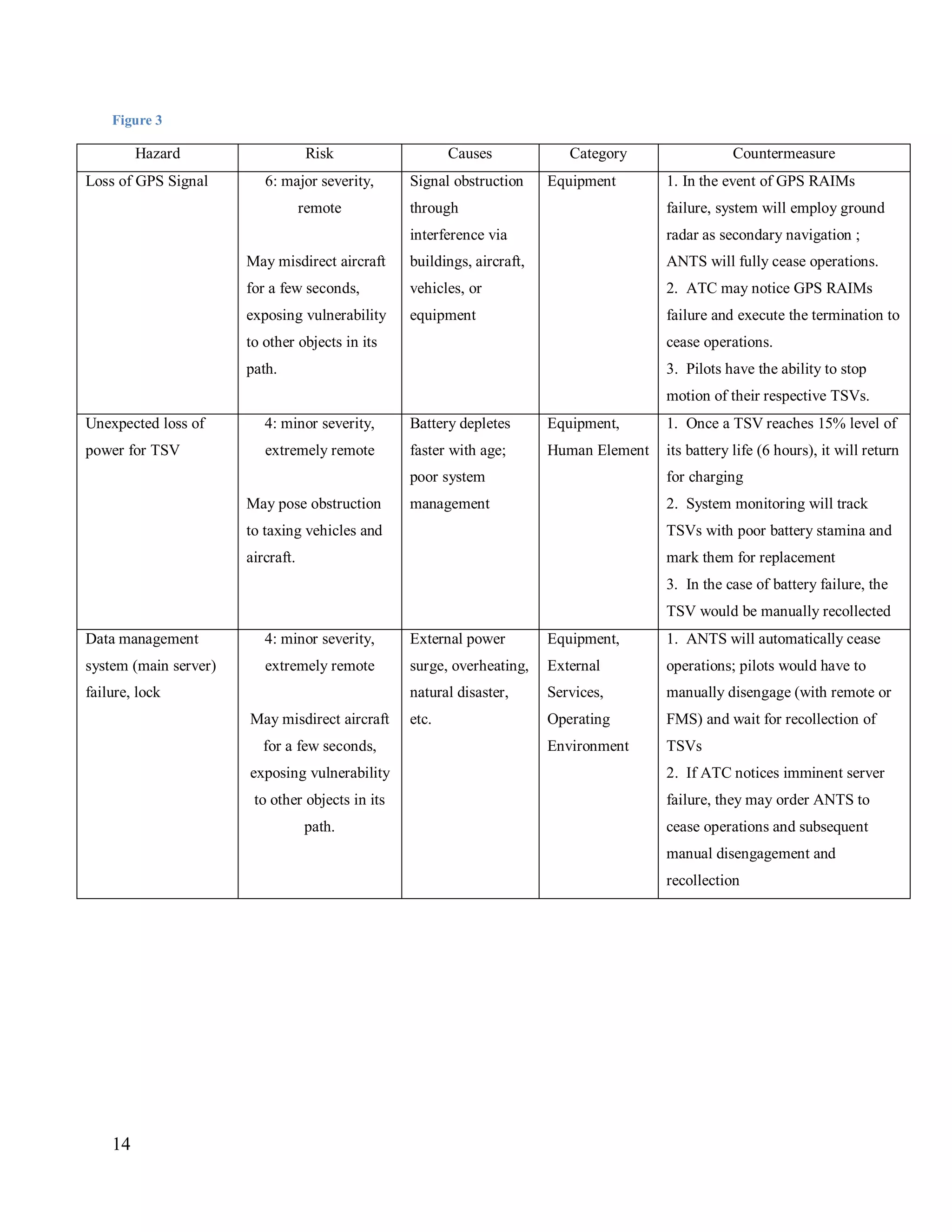
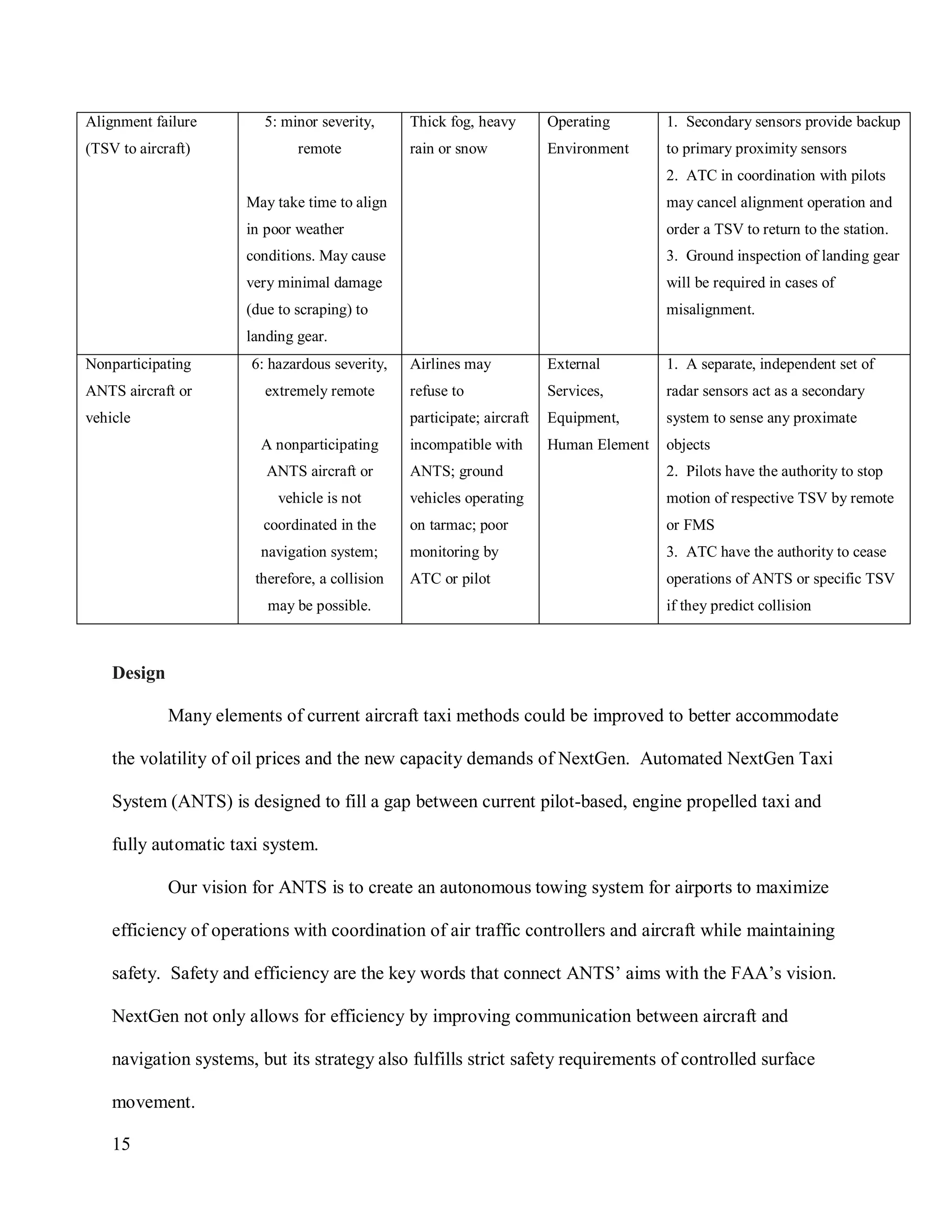
Figure 3 below exemplifies the preliminary hazard analysis, classifying the foremost
hazards and defenses of ANTS. The table illustrates the possible hazard and risk, ranked by
Figure 2’s risk matrix, and the causes of a particular hazard. The hazards are then classified into
categories of error, indicating which area of operation the root cause originated. Lastly,
mitigation of risk occurs through various countermeasures applied to a particular hazard.
14
Figure 3
Hazard Risk Causes Category Countermeasure
Loss of GPS Signal 6: major severity,
remote
May misdirect aircraft
for a few seconds,
exposing vulnerability
to other objects in its
path.
Signal obstruction
through
interference via
buildings, aircraft,
vehicles, or
equipment
Equipment 1. In the event of GPS RAIMs
failure, system will employ ground
radar as secondary navigation ;
ANTS will fully cease operations.
2. ATC may notice GPS RAIMs
failure and execute the termination to
cease operations.
3. Pilots have the ability to stop
motion of their respective TSVs.
Unexpected loss of
power for TSV
4: minor severity,
extremely remote
May pose obstruction
to taxing vehicles and
aircraft.
Battery depletes
faster with age;
poor system
management
Equipment,
Human Element
1. Once a TSV reaches 15% level of
its battery life (6 hours), it will return
for charging
2. System monitoring will track
TSVs with poor battery stamina and
mark them for replacement
3. In the case of battery failure, the
TSV would be manually recollected
Data management
system (main server)
failure, lock
4: minor severity,
extremely remote
May misdirect aircraft
for a few seconds,
exposing vulnerability
to other objects in its
path.
External power
surge, overheating,
natural disaster,
etc.
Equipment,
External
Services,
Operating
Environment
1. ANTS will automatically cease
operations; pilots would have to
manually disengage (with remote or
FMS) and wait for recollection of
TSVs
2. If ATC notices imminent server
failure, they may order ANTS to
cease operations and subsequent
manual disengagement and
recollection
15
Alignment failure
(TSV to aircraft)
5: minor severity,
remote
May take time to align
in poor weather
conditions. May cause
very minimal damage
(due to scraping) to
landing gear.
Thick fog, heavy
rain or snow
Operating
Environment
1. Secondary sensors provide backup
to primary proximity sensors
2. ATC in coordination with pilots
may cancel alignment operation and
order a TSV to return to the station.
3. Ground inspection of landing gear
will be required in cases of
misalignment.
Nonparticipating
ANTS aircraft or
vehicle
6: hazardous severity,
extremely remote
A nonparticipating
ANTS aircraft or
vehicle is not
coordinated in the
navigation system;
therefore, a collision
may be possible.
Airlines may
refuse to
participate; aircraft
incompatible with
ANTS; ground
vehicles operating
on tarmac; poor
monitoring by
ATC or pilot
External
Services,
Equipment,
Human Element
1. A separate, independent set of
radar sensors act as a secondary
system to sense any proximate
objects
2. Pilots have the authority to stop
motion of respective TSV by remote
or FMS
3. ATC have the authority to cease
operations of ANTS or specific TSV
if they predict collision
Design
Many elements of current aircraft taxi methods could be improved to better accommodate
the volatility of oil prices and the new capacity demands of NextGen. Automated NextGen Taxi
System (ANTS) is designed to fill a gap between current pilot-based, engine propelled taxi and
fully automatic taxi system.
Our vision for ANTS is to create an autonomous towing system for airports to maximize
efficiency of operations with coordination of air traffic controllers and aircraft while maintaining
safety. Safety and efficiency are the key words that connect ANTS’ aims with the FAA’s vision.
NextGen not only allows for efficiency by improving communication between aircraft and
navigation systems, but its strategy also fulfills strict safety requirements of controlled surface
movement.
16
ANTS is composed of two designs: the ANTS data management system (DMS) and the
robotic tractors, or Towing Support Vehicles (TSVs). DMS controls the TSVs by using
NextGen communication methods and system management. In addition, DMS also combines all
the information to create the best taxiway routes for each TSV. The TSVs are designed to
autonomously attach and detach to aircraft, delivering aircraft to requested areas, without
compromising safety.
Design Specifications
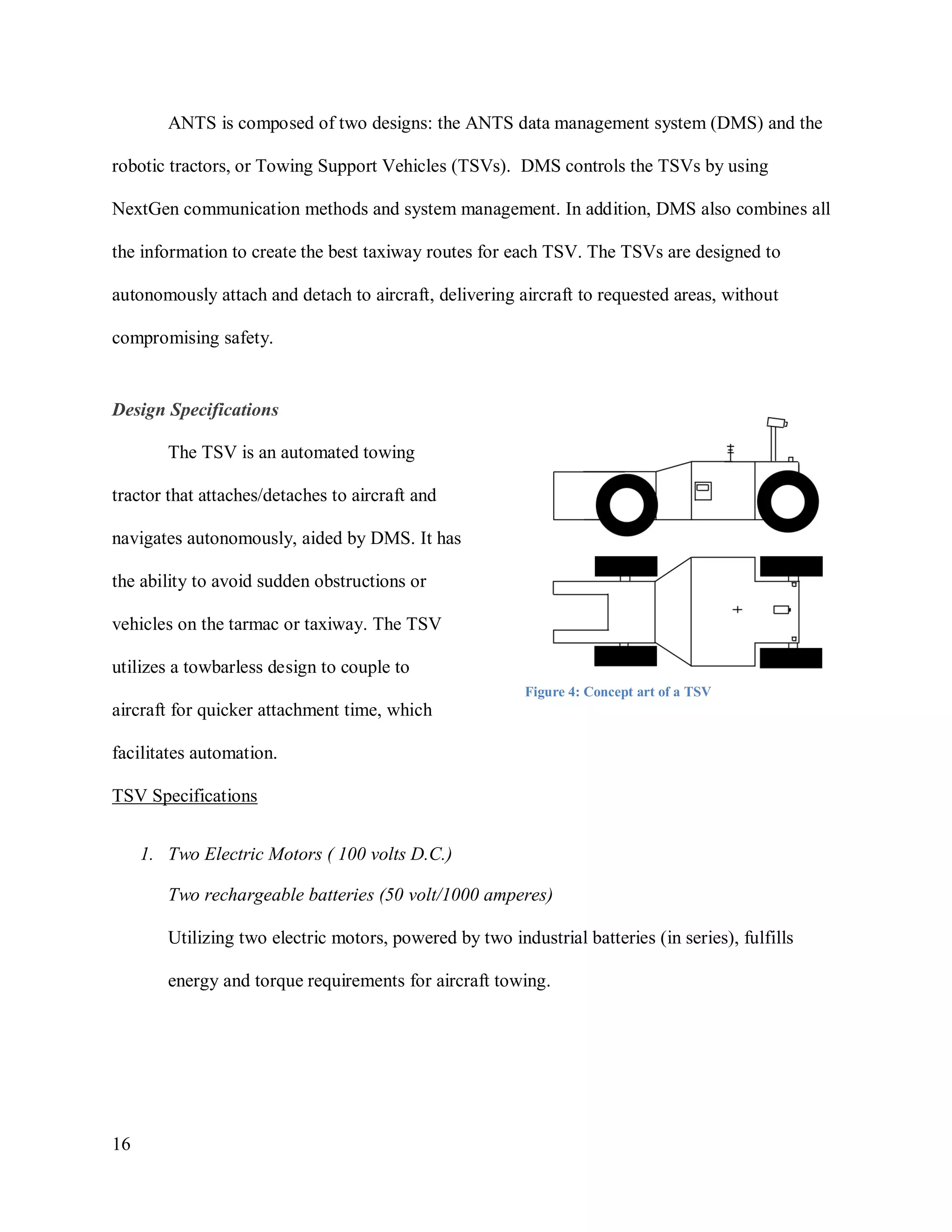
The TSV is an automated towing
tractor that attaches/detaches to aircraft and
navigates autonomously, aided by DMS. It has
the ability to avoid sudden obstructions or
vehicles on the tarmac or taxiway. The TSV
utilizes a towbarless design to couple to
aircraft for quicker attachment time, which
facilitates automation.
TSV Specifications
1. Two Electric Motors ( 100 volts D.C.)
Two rechargeable batteries (50 volt/1000 amperes)
Utilizing two electric motors, powered by two industrial batteries (in series), fulfills
energy and torque requirements for aircraft towing.
Figure 4: Concept art of a TSV
17
2. GPS transponder (Local Area Augmentation System)
The Local Area Augmentation System (LAAS) is used for positioning of TSVs. Accurate
positioning is critical for safety and efficient operations; LAAS fulfills this requirement
with precision and reliability, having an allowance of less than one meter. LAAS aids in
cost minimization since it is a GPS system already in place (FAA, LAAS Quick Facts,
2009).
3. Eight Microwave radar sensors: range- 160m, width- 4m
Radar sensors are used for two purposes: obstacle avoidance and nose gear alignment.
There are two sets of four radar sensors, acting independently as primary and secondary
systems. Each set includes two rear sensors for landing gear alignment and two front
sensors for obstacle avoidance (Smartmicro, 2008).
4. Night vision camera
A high-resolution, pivoted camera is attached to provide better situational awareness and
other potential auxiliary uses. Additionally, the night vision mode allows for operations
in dark settings.
18
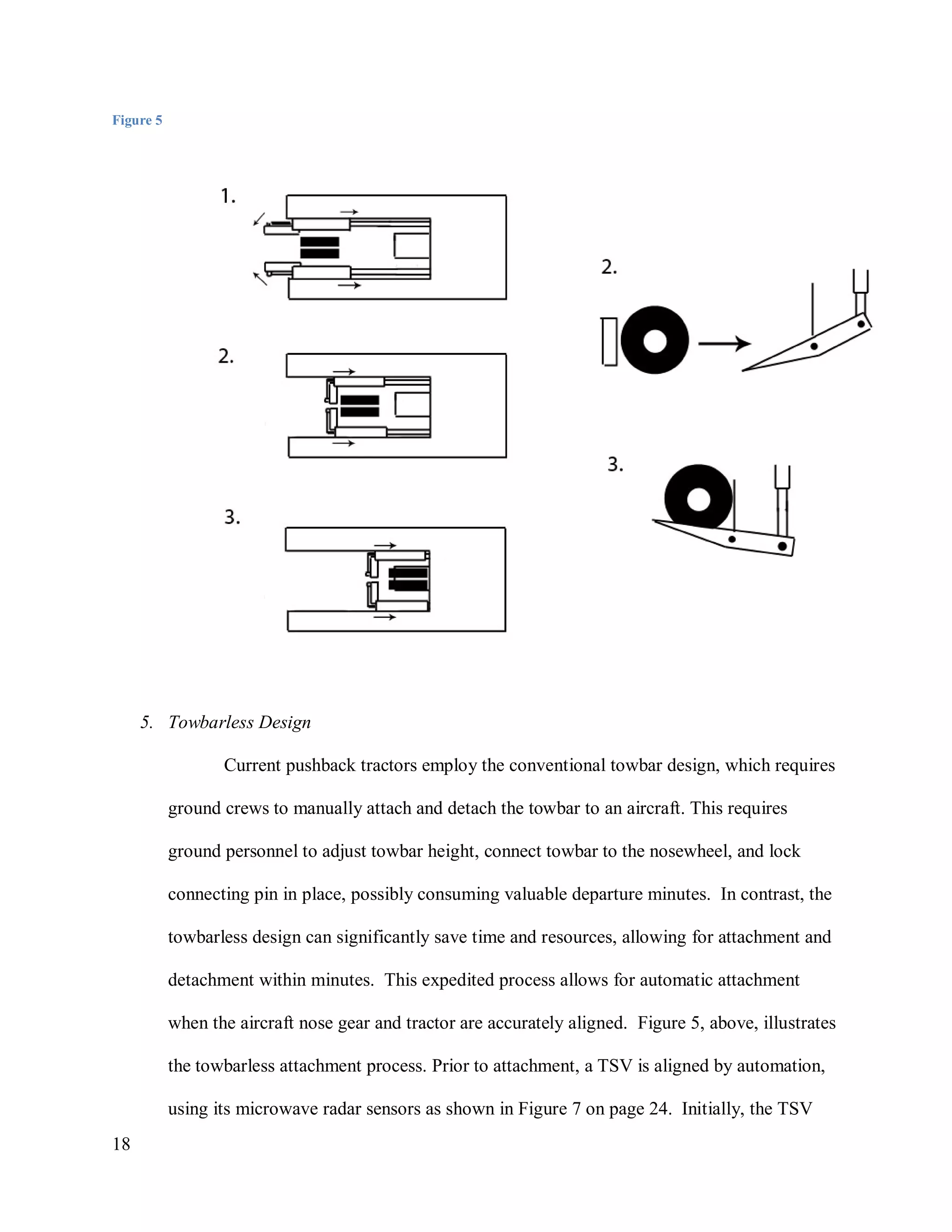
Figure 5
5. Towbarless Design
Current pushback tractors employ the conventional towbar design, which requires
ground crews to manually attach and detach the towbar to an aircraft. This requires
ground personnel to adjust towbar height, connect towbar to the nosewheel, and lock
connecting pin in place, possibly consuming valuable departure minutes. In contrast, the
towbarless design can significantly save time and resources, allowing for attachment and
detachment within minutes. This expedited process allows for automatic attachment
when the aircraft nose gear and tractor are accurately aligned. Figure 5, above, illustrates
the towbarless attachment process. Prior to attachment, a TSV is aligned by automation,
using its microwave radar sensors as shown in Figure 7 on page 24. Initially, the TSV
19
actuates its grappling arms to an open position in order to clasp the nosewheel. The TSV
then closes its grappling arms and pulls aircraft toward a platform wedge as shown in the
second step of Figure 5. Finally, when the front wheels are completely on the platform,
the grappling arms and platform locks the front gear firmly in preparation for towing
(Hammonds, 2007).
Data Management System (DMS)
ANTS data management system (DMS) is a system of servers that combines all the
information to control TSVs efficiently and safely. DMS would prospectively be integrated with
the FAA’s SWIM (System Wide Information Management) technology to ensure the
interoperability among different systems and industry standards. In its entirety, DMS requires a
main central server and a computer interface for ATC, incorporating NEXCOM technology and
Controller Pilot Data Link Communications (CPDLC).
DMS capabilities:
1. Integrating different data for decision making
ANTS combines flight plans, aircraft specifications, weather and runway/taxiway
information to accurately calculate decisions in traffic routing. DMS has the ability to
configure the best runway to use, accompanied by the most efficient route. To do this,
aircraft profiles are analyzed, which include wing span, turning radius, weight, and other
dimensions, which DMS takes into account before assigning taxi routing. Furthermore,
DMS also considers real-time weather information and runway/taxiway NOTAMS or
fixed obstructions, using updated airport taxiway layouts.
20
2. Sending the information to ATC, pilot and TSVs via CPDLC and DataComm
DMS acts as an information exchange between ATC, pilots, and TSVs, disseminating
taxiing instructions, clearances, and runway routing. Under approval of ATC, DMS
sends all runway/taxiway information and clearance via CPDLC.
3. Managing movement of each TSV
DMS oversees the locations of each TSV and regulates safe distances between aircraft.
4. Creating immediate emergency ground traffic control procedures
DMS modifies the traffic flow depending on the emergency scenario. Imminent runway
incursions or traffic hazards are identified and mitigated through dynamic rerouting.
Departure Procedure
One of the most challenging obstacles for ANTS is fitting DMS and TSVs into current air
traffic control and pilot procedures, such as checklists. Figure 6 shows the departure procedure
using ANTS DMS and TSVs to tow aircraft from gate to runway.
1. Preflight
When the IFR flight plan is submitted, DMS checks aircraft type and appropriate gate
assignment. DMS then searches for the best runway for the aircraft by gathering weather
information and taking into account the aircraft’s minimum take-off distance. After
deciding the best runway, DMS calculates the most appropriate taxiway for the aircraft
by searching taxiway profiles and the traffic load of each taxiway in use.
2. Pushback
While the aircraft is preparing for departure at the gate, the ground crew orders TSV
attachment to the aircraft. The ground crew then supervises this process, checking for
GPS or alignment errors. With ATC approval, the TSV starts auto pushback once the
21
pilot advises ATC orally or through CPDLC. The entire pushback process is overseen by
the ground crew and wing walkers.
3. Taxi Request
When the pilot requests for pushback, ATC provides clearance data and taxi routing
information, with the assistance of DMS. Upon clearance acceptance, ATC approves of
the taxi through DMS. DMS then gives taxiing information to the TSV, and the towing
process is initiated.
4. Taxiing
While TSV is taxiing to the engine run-up area, the flight crew, ATC and DMS oversee
the operation:
- When there is an unexpected emergency, the pilot can stop the TSV by using an
emergency stop button on flight management system (FMS) that is linked to DMS via
NEXCOM and CPDLC. Alternatively, aircraft without an FMS are issued remotes
for this oversight process. If a pilot utilizes the stop button, DMS warns ATC and
ceases the traffic of the TSVs that follow.
- If ATC detects a possible runway or taxiway incursion, they can stop the entire
taxiing system or specific operating area. ATC can also adjust distances between
aircraft through DMS, allowing for amendable safety margins.
- DMS constantly gets location feedback from each TSV. If there is an error between
GPS data and ground radar data of a TSV, DMS stops the particular TSV and notifies
ATC. When there is a traffic conflict, DMS also has the ability to modify the
acceleration or velocity of TSVs.
22
5. Detachment
When a TSV reaches the engine run-up area, the pilot applies the parking brake and
requests for engine start to ATC and TSV detachment. Subsequently, the TSV
disengages and returns to the base station. After checking that the TSV is within a safe
distance, the pilot begins the engine start-up checklist.
23
Figure 6
24
Arrival Procedure
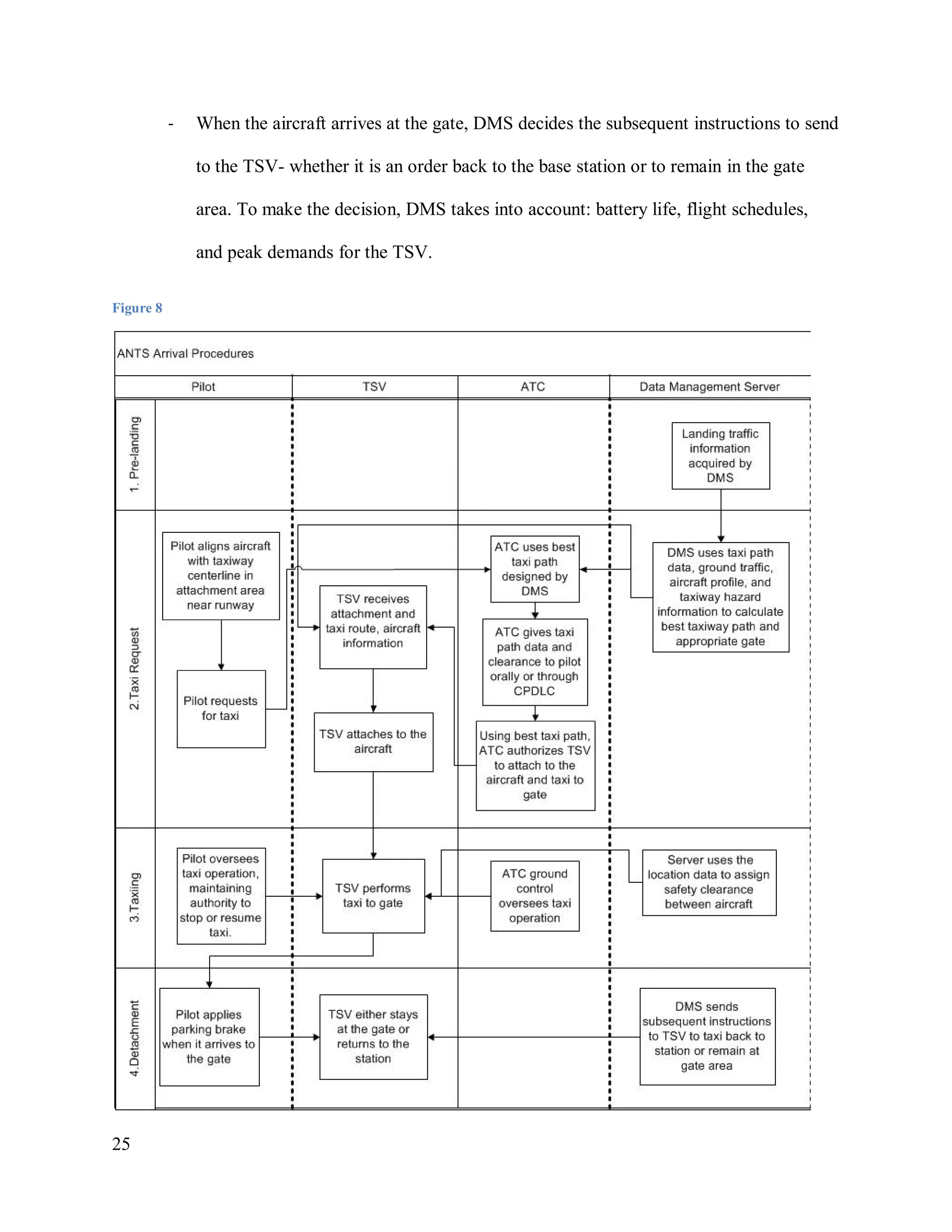
The ANTS arrival procedure, illustrated in Figure 8, is similar to the departure process
map with the exception of the following:
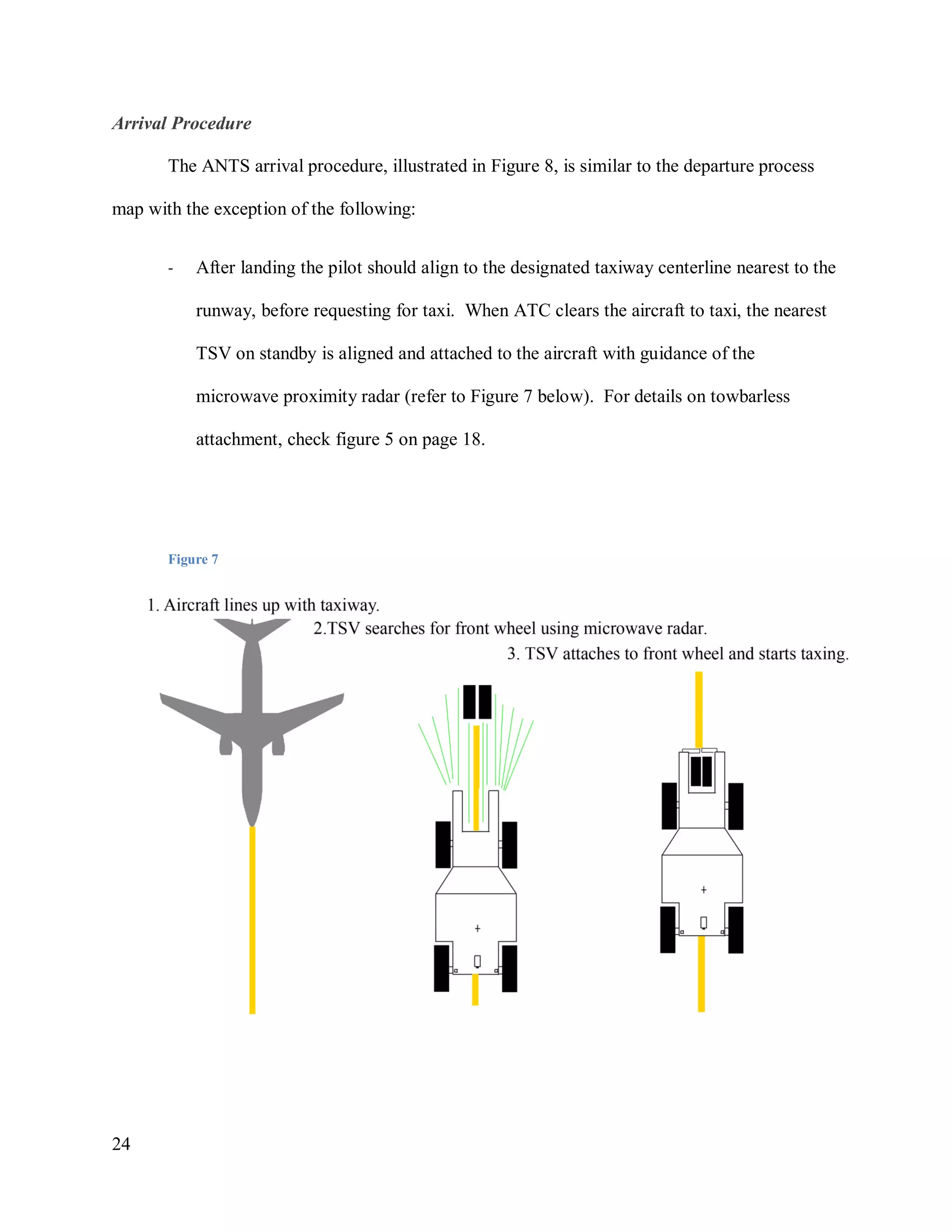
- After landing the pilot should align to the designated taxiway centerline nearest to the
runway, before requesting for taxi. When ATC clears the aircraft to taxi, the nearest
TSV on standby is aligned and attached to the aircraft with guidance of the
microwave proximity radar (refer to Figure 7 below). For details on towbarless
attachment, check figure 5 on page 18.
Figure 7
25
- When the aircraft arrives at the gate, DMS decides the subsequent instructions to send
to the TSV- whether it is an order back to the base station or to remain in the gate
area. To make the decision, DMS takes into account: battery life, flight schedules,
and peak demands for the TSV.
Figure 8
26
Figure 9
Airport Configuration
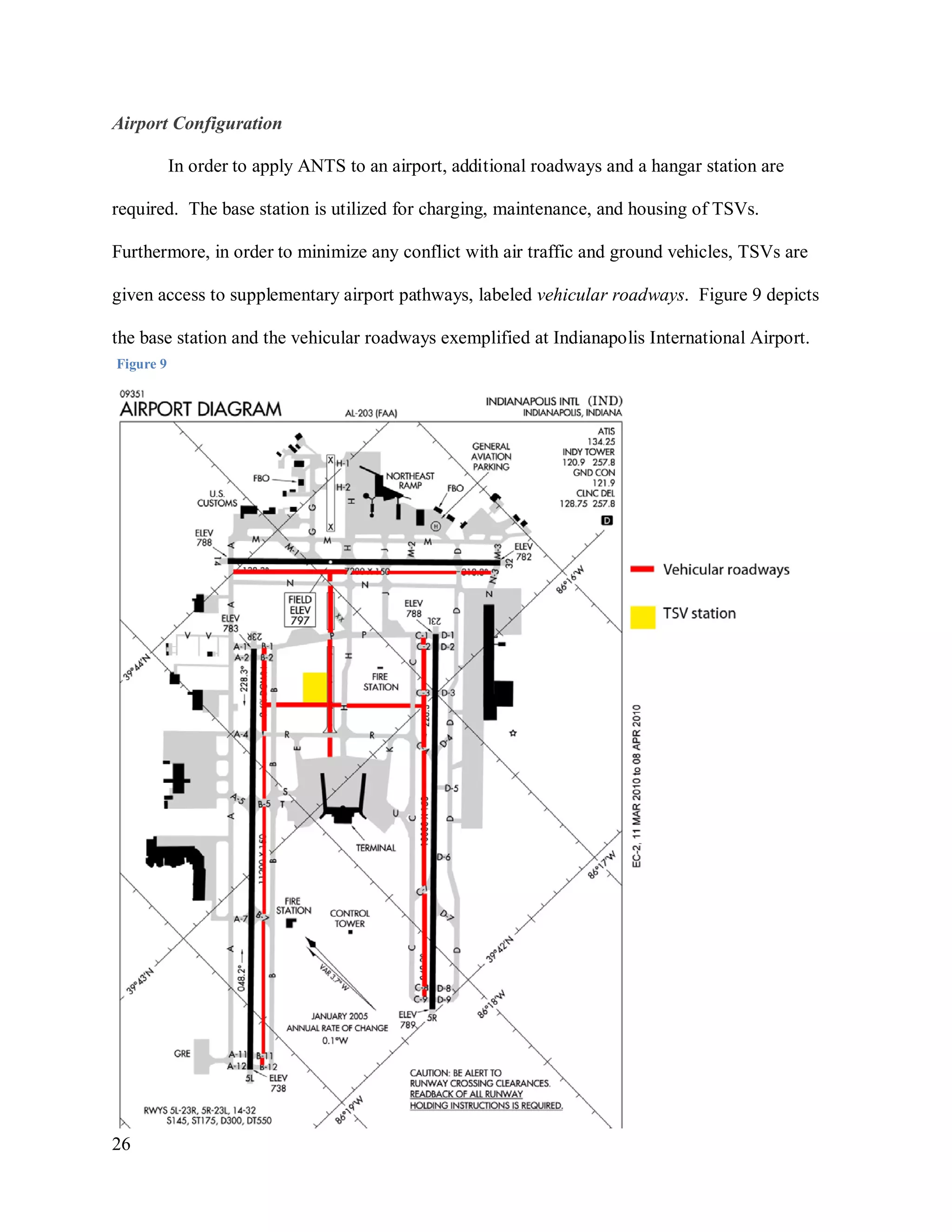
In order to apply ANTS to an airport, additional roadways and a hangar station are
required. The base station is utilized for charging, maintenance, and housing of TSVs.
Furthermore, in order to minimize any conflict with air traffic and ground vehicles, TSVs are
given access to supplementary airport pathways, labeled vehicular roadways. Figure 9 depicts
the base station and the vehicular roadways exemplified at Indianapolis International Airport.
27
Industry Interaction
After we designed our Automated NextGen Taxiing System (ANTS) we consulted
multiple engineering professors, an aviation expert, and one airport operator. First, to combat
our overall problems of interacting with the airport’s environment and uses of our design, we
contacted Professor Stewart Schreckengast, a professor of aviation technology at Purdue
University and former ICAO airport consultant. Next, we asked engineering professors for
advice on the technical aspect of ANTS. These professors were Dr. K.M. Li and Dr. George
Chiu, both associate professors of mechanical engineering at Purdue University. Our additional
contact was an airport operator by the name of Betty Stansbury, A.A.E. and current airport
director/manager of Purdue University Airport. All of these contacts provided vital input and
feedback to our ANTS project and design, and without them, the project would have not
succeeded.
When we met with Professor Schreckengast, he supplied us with useful feedback and
criticism that greatly influenced our project. Our original concept for ANTS was to utilize
ground radar, which is located at many large, busy airports such as O’Hare International Airport,
to coordinate and track the towing support vehicles (TSV) as it drives around the aerodrome. He
informed us that ground radar had too great of a margin of error (100-200 feet) to be used to
coordinate the TSVs precise maneuvers near aircraft. He instead suggested we use the Local
Area Augmentation System (LAAS), which has a margin of error of about 2-3 inches. This is a
much smaller margin compared to ground radar, so it was clear that we had to change our
positioning system for TSVs.
In order for the TSVs to reach aircraft safely and efficiently, we decided to build to
additional roadways used solely by ground vehicles and TSVs. These new vehicular roadways
28
would be adjacent to current runways and taxiways and would be narrow enough so only these
TSVs could drive on them, since the utilization of current taxiways and runways would become a
hazard to aircraft. Professor Schreckengast thought that these additional roadways should be
expanded so other airport vehicles, like fire trucks and snowplows, could use them for additional
uses such as runway inspections or wildlife scatter. An additional point he brought up was to
differentiate these additional roadways by placing distinct marks on them such as large red and
yellow lines. This would prevent pilots from mistaking it as a taxiway or runway used for the
landing, takeoff, and taxiing of aircraft.
As for the airlines appeal to this new system, Professor Schreckengast commented that
airlines would approve of ANTS because of the many benefits, but there were some
indifferences that he thought the airlines might have. His suggestions were the fact that airlines
and the pilots would want an override system to be in place, in case the TSV goes astray or
malfunctions. This override system would allow pilots and air traffic controllers to take over
control of the TSV.
His last suggestion to our ANTS design was the implementation of the system. He
advised us to use an example airline that has a fleet of identical aircraft, and an airport, that is in
the top 50 busiest airports with good climate. Having an airport with good weather would ease
the process of implementing ANTS because there would be no risk of weather delays, such as
snow, to the preliminary implementation. As for the airlines, a common fleet would be easier to
analyze and calculate savings costs of switching to ANTS.
Our next contact was Dr. Li, who in the past worked with Purdue University Airport to
help reduce and prevent airport noise. He advised us on the design of the motors of TSVs along
with the noise reduction part of our design. He recommended that we use a track system that
29
would be directly on top of the runways and taxiways. The TSV would be hooked up to and
would then tug the aircraft. This would eliminate the need for a GPS or positioning system, but
after our design team contemplated Dr. Li’s idea, we concluded to not use this track system
because a track system directly on top of the runways and taxiways would be hazardous to other
aircraft. When we discussed the noise abatement part of our design, he approved of the entire
noise reduction plan. He said that the noise reducing attributes of the ANTS design would be a
major selling point to airports because of the recent government pressure to reduce noise.
The other mechanical engineering professor, that we consulted, was Dr. George Chiu.
His research activities that pertained to our ANTS design were signal processing, mechatronics,
and dynamic systems and control. His first suggestion to our ANTS design was to use TSVs only
for taxiing the aircraft from the gate to runway. His reasoning was that most of time an aircraft
spends on the ground is during its taxiing from the gate to runway and not after it lands. Our
ANTS design team concluded that when we initially implement our system, we will only use it
for takeoffs which will reduce the complexity of the initial implementation of ANTS. As for the
specifications of the TSVs, he recommended that we use the specifications of previous research
done on towing robots in past. His other advice on ANTS was to integrate the controls with the
flight management system (FMS) and the Controller Pilot Data Link Communication (CPDLC).
This would provide additional oversight and control in the case of pilots noticing a problem or
verge of a collision/incursion; they would be able to cease TSV operations and prevent an
accident. His last suggestion was to use radar as a proximity sensor and use LAAS for
positioning and locating the TSVs. He concluded that, overall, the ANTS design is realistic and
its attractive benefits could be immediately seen at many airports.
30
Our last contact was Betty Stansbury, A.A.E. and airport director of Purdue University
Airport. When we presented our ANTS design, her first thoughts were how the TSVs were
going to communicate with ATC, aircraft, and other TSVs. We solved this issue by having ATC
communicate with pilots and TSVs via DMS and DataComm.
Project Impact
ANTS offers several benefits to the industry. One of the principal reasons for its
existence is to replace the conventions of engine-powered taxiing; therefore, it is paramount to
calculate potential fuel savings without the current taxi status quo. Using blunt figures and
limiting use to a popular narrow body aircraft model, it is possible to estimate the total fuel usage
during pre-takeoff and post-landing taxis. Using the Boeing 737-800 as an example, the fuel
consumption of one of the most popular Boeing 737 models, 800 series, comes out to be 334
pounds of jet fuel per minute with both engines at idle (Boeing, 2000). Utilizing this figure from
the 800 series allows for a mathematical buffer since, undoubtedly this is the most efficient of
the Boeing 737 models. Taking this burn rate in combination with the average total taxi time of
23.6 minutes, we can calculate an estimated amount of fuel usage between the gate and runway
(Goldberg & Chesser, 2008). That equates to 1534 pounds of fuel consumed for every flight an
airline operates. Using the most recent mean Jet A price in North America of 701.9 US cents per
metric ton, a total of $488 is spent during taxi operations on an average flight (ATA, 2010).
Taking the country’s third busiest airport by air traffic movements, Dallas/Fort Worth
International Airport and its annual take off and landing operations, a sum of 328,155 flights per
year can be computed. Multiplying this number with average taxiing costs, a preliminary
estimate of $160,139,640 is figured to be a potential saving (ACI, 2010). Applying this concept
across the nation with 9,552,929 flights in 2009, total costs of airline taxiing equates to nearly
31
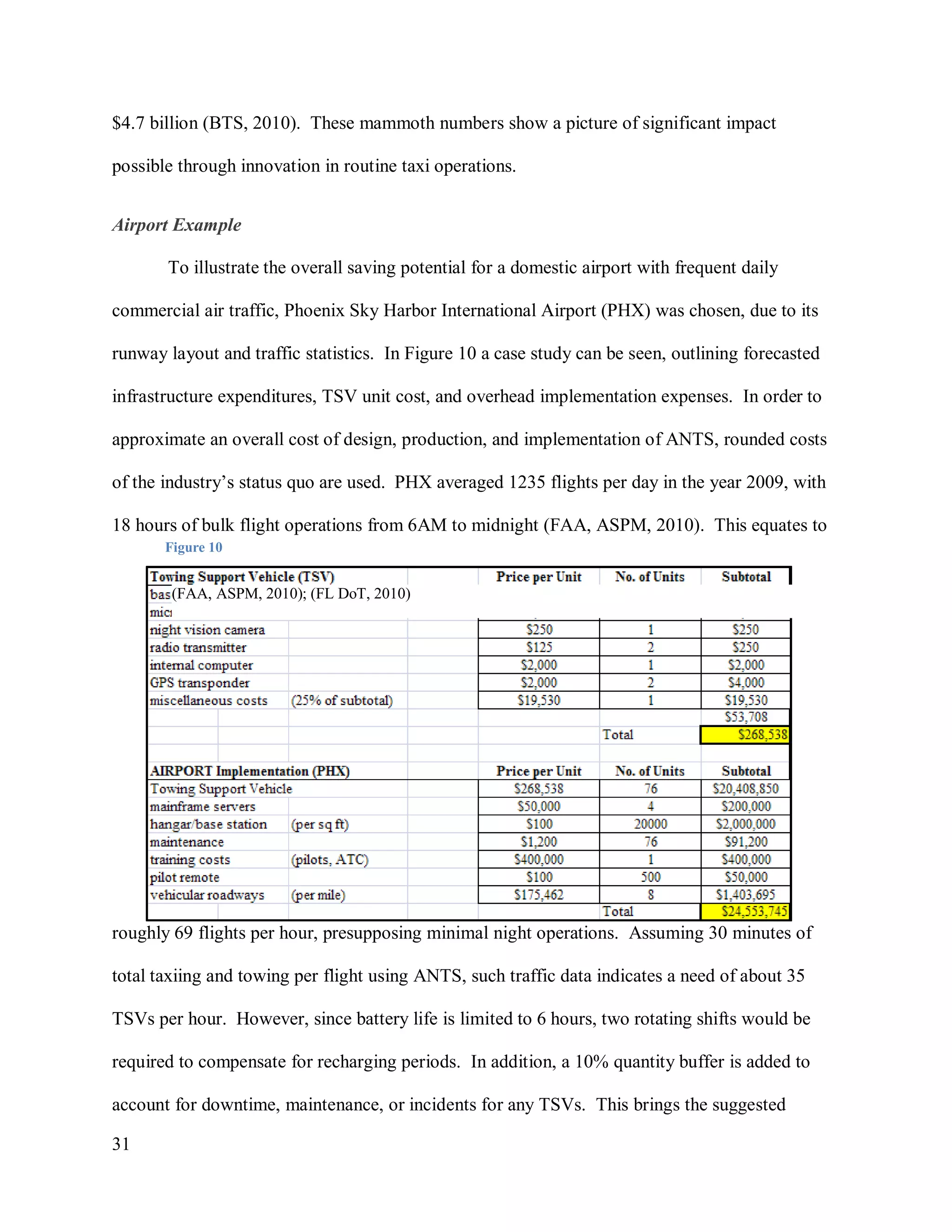
Figure 10
(FAA, ASPM, 2010); (FL DoT, 2010)
$4.7 billion (BTS, 2010). These mammoth numbers show a picture of significant impact
possible through innovation in routine taxi operations.
Airport Example
To illustrate the overall saving potential for a domestic airport with frequent daily
commercial air traffic, Phoenix Sky Harbor International Airport (PHX) was chosen, due to its
runway layout and traffic statistics. In Figure 10 a case study can be seen, outlining forecasted
infrastructure expenditures, TSV unit cost, and overhead implementation expenses. In order to
approximate an overall cost of design, production, and implementation of ANTS, rounded costs
of the industry’s status quo are used. PHX averaged 1235 flights per day in the year 2009, with
18 hours of bulk flight operations from 6AM to midnight (FAA, ASPM, 2010). This equates to
roughly 69 flights per hour, presupposing minimal night operations. Assuming 30 minutes of
total taxiing and towing per flight using ANTS, such traffic data indicates a need of about 35
TSVs per hour. However, since battery life is limited to 6 hours, two rotating shifts would be
required to compensate for recharging periods. In addition, a 10% quantity buffer is added to
account for downtime, maintenance, or incidents for any TSVs. This brings the suggested
32
needed amount to approximately 76 TSVs for this particular airport. Other costs to be noted
include maintenance costs estimated for one year, initial training for pilots, ATC, and airport
personnel, and the recommended annual recurrent training. Further infrastructure costs include
mainframe servers for the DMS, auxiliary taxiways for ANTS routing, and the multi-level station
base for hangaring TSVs. As a result, the preliminary cost estimate for ANTS implementation
amounts to about $25 million at PHX. However, in a very short period of time, the return on
investment proves its merit by repaying initial costs after only a couple of months, taking into
account fuel expenses during taxi and assuming every aircraft uses the system. After the first
two months, fuel savings were calculated to an average of $18 million a month on more than
38,000 flights (ACI, 2010). Therefore, implementing ANTS to PHX gives the airport a great
cost advantage, saving nearly $200 million for its air operators in the first year of operation.
Airline Example
ANTS operations have the potential for also providing enormous savings for airlines, as
outlined previously. Using Southwest Airlines as an airline case study, a cost-benefit analysis
can be conjured to demonstrate reasons for ANTS adoption. Southwest proves to be an
appropriate illustration due to its fleet commonality of B737-700s and history of good fuel
management techniques. Taking the idle fuel consumption for a more efficient model (B737-
800) in the very first example, a calculation of daily operation savings can be made. Southwest,
operating about 3,200 flights a day, has the option of reducing its fuel budget by about $1.5
million a day. Annually, this results in overall savings of $570 million a year, not including the
reduced maintenance costs since there is more wear on the engine during traditional taxiing
operations. Realistically, ANTS implementation would only occur airport by airport; thus, if Las
Vegas McCarran International Airport was used initially, operating 220 Southwest flights daily,
33
the airline would have annual gross savings of about $39 million (Southwest, 2010). While a
significant fiscal amount can be saved, adoption of ANTS for airlines has one potential
drawback: the initial capital required to support implementation at airport hubs.
Environmental Impact
ANTS also has other positive elements that may make it attractive to airport operators.
One chief aspect is the impact on carbon emissions and overall reduction of environmental
impact. As previously mentioned, ANTS dramatically cuts CO2 emissions by reducing engine
idling, reducing aviation’s current 2% contribution to global emissions (Milmo, 2008). One
study suggested that emissions could be cut by 50%, or 150 million tons of CO2 annually by
towing a particular airline’s fleet to runways (Johnson, 2006). Other recent research claims that
even if fuel-powered towing systems were in place, emissions would be reduced from 18 billion
tons to 2 million tons per year (Suslik, 2009). Additionally, carbon credits could potentially be
used, since ANTS operations would reduce ground-level emissions in an already highly-
concentrated pollutant zone. Essentially, a towing system not only provides a reduction of
aviation’s carbon footprint, but it boosts an operator’s public image, moving toward a greener
perspective of social responsibility.
Noise Impact and Other Uses
ANTS has further potential in the measurement of decibels; in that, it facilitates airport
noise abatement initiatives. Rather than running the engines at idle during taxi, multiplied by the
number of aircraft in ground transit at any moment, a towing system would allow for only APU
operation, which is considerably quieter. While the bulk of engine noise is heard during take-off
and landing, the high decibel taxiing operations could be dramatically reduced or omitted to
provide at least, an incremental noise reduction.
34
The implementation of ANTS could also provide crossover use for other daily airport
tasks. The attached camera could be used for foreign object debris/damage (FOD) detection at
night, runway and taxiway inspection, significantly reducing the occurrences of foreign object
damages. This supplementary camera can simply be incorporated into any FOD prevention
program at an airport. Currently, Boeing estimates that $4 billion in FOD damage occur every
year (Batchel, 1999). Other studies indicate $1-2 billion in direct damage and as much as $12
billion in subsequent, indirect costs (FAA, AC 150/5220, 2009). Supplementary items could
include additional radar sensors or electro-optical sensors to aid in further FOD detection. The
vehicular roadways provide additional waypoints for fire trucks during emergencies, facilitating
any rescue efforts. Such roadways can also be employed for traditional airport inspection runs
by ground vehicles. Lastly, using these additional roadways through use of cameras could
facilitate wildlife prevention efforts. Devices could be attached to TSVs to purge the runway
environment of any hazardous fauna. Furthermore, in colder climates, TSVs with attached plows
could aid in snow removal.
Summary
An outline of the general cost advantages of ANTS was examined, illustrating the large
potential savings if implemented nationwide. Economic potential was also analyzed for a few of
the busiest domestic airports. Further evaluation was emphasized using Phoenix Sky Harbor
International Airport, as a model due to its traffic capacity and climate. Taking a typical high-
volume aerodrome, an estimated of $25 million was proposed as preliminary start-up cost,
paying for itself in fuel savings after two months. However, a more realistic implementation
would involve a gradual introduction of the system, starting with support of a particular terminal
or gate area and an airline with an identical fleet, such as Southwest. This airline was selected
35
for its aircraft uniformity and reputation for adopting innovative strategies for minimizing fuel
expenses. Concept or beta testing with an air carrier such as from Southwest, or comparable
airline, and a sizeable airport could accelerate an implementation process. Financial support,
mostly from the participating airline, consenting airport, and other public agencies would be
required for the initial investment. Although the airlines would collect the majority of the
monetary gains, the involved airports would also benefit from the aforementioned immeasurable
advantages like the reduction in local carbon emission, lessening of noise pollution, and
additional resource equipment for daily airport operations (i.e. inspection, snowplowing).
Furthermore, ANTS promotes safety by relieving ground navigation for pilots, abating the
probability of runway incursions with additional oversight by ATS and Data Management Server
(DMS). Taken as a whole, ANTS has a great potential for airlines, airports, and other aviation
operations through reduced impact of fuel usage environmentally and fiscally, while enabling
safe ground handling/movement operations.
36
Appendix A
Professor Timothy Ropp
Phone: 765-494-9957
Fax: 765-494-2305
E-mail: tropp@purdue.edu
Kory Aktay
Phone: 219-801-0902
E-mail: kaktay@purdue.edu
Address:
9213 Birch Ave
Munster, IN 46321
Keaton Aktay
Phone: 219-644-6117
E-mail: khaktay@purdue.edu
Address:
9213 Birch Ave
Munster, IN 46321
Jin Young-Kim
Phone : 765-532-0014
E-mail : kim543@purdue.edu
Address:
114-1202 The Sharp Centumpark Apt
Jae-song 1 Dong, Haeundae-gu, Busan Republic of Korea
612-712
37
Appendix B
Purdue University is a coeducational, state-assisted system in Indiana. Founded in 1869
and named after benefactor John Purdue, Purdue is one of the nation's leading research
institutions with a reputation for excellent and affordable education. Purdue University is
accredited by the Higher Learning Commission of the North Central Association of Colleges and
Schools. The West Lafayette campus offers more than 200 majors for undergraduates, over 70
master’s and doctoral programs, and professional degrees in pharmacy and veterinary medicine.
Purdue University’s College of Technology is one of the largest and most renowned
technology schools in the nation with more than 34,000 living alumni. More than 5,500 Purdue
students are currently pursuing their education in the College of Technology. The College of
Technology consists of eight academic departments, and resides in ten Indiana communities in
addition to the West Lafayette campus. The Aviation Technology department is one of the eight
departments within the College of Technology. Three undergraduate programs are offered within
the department: Aeronautical Engineering Technology, Aviation Management, and Professional
Flight. Graduate studies in Aviation Technology are also offered. In addition, the department
pursues signature research areas that embrace tenets of the emerging Next Generation Air
Transportation System, which include Hangar of the Future aircraft maintenance technology
innovation, National Test Facility for Fuels and Propulsion, and Safety Management Systems.
38
Appendix C
Our non-university partner was Betty Stansbury, airport director of Purdue University
Airport. While she is affiliated with Purdue, she is a member of the American Association of
Airport Executives and provided a vital airport director’s perspective on our design.
Contact Information:
Betty Stansbury
Terminal Building, Room 201
1501 Aviation Drive
West Lafayette, IN 47907
765-743-3442
bmstansbury@purdue.edu
39
Appendix D
40
Appendix E
For Student Team:
1. Did the FAA Design Competition provide a meaningful learning experience for you? Why or
why not?
As we collaborated and developed a design solution to a problem, we gained valuable
experience in not only the aviation industry but also experience with teamwork, organization,
and communication. As we balanced chaotic college lives and differing ideas, we learned to
collaborate and organize as one to manage conflict and accomplish a goal. We were able to
improve our communication skills technically and graphically because of the long length of the
design package. We designed multiple diagrams and models along with writing from a technical
perspective on the description of our design.
2. What challenges did you and/or your team encounter in undertaking the Competition? How
did you overcome them?
Throughout the duration of project, we encountered many problems which
complicated and lengthened our design schedule. Our major problems were time management,
the fact that we commenced the project late, and overall design challenges. The first two
problems were solved by meeting multiple times each week to combat our issues of meeting
together and starting in January on our design. The design challenges we encountered
throughout our design process were both internal and external. Internally, we could not decide
what problem to address and how, and then externally, we faced the problem of finding useful
industry contacts. This problem was solved through the use of our resourceful faculty advisor,
Professor Tim Ropp. He helped us in exactly defining the problem and pointing in the correct
41
direction to find industry experts. We also researched alike designs, which helped narrow what
problem to address.
3. Describe the process you or your team used for developing your hypothesis.
After defining our problem through research, we first performed a gap analysis on the
topic. We found the status quo of our problem, and then looked at where current approaches
should be. This perfect gap was assessed on what needs to be implemented to bring the problem
to the correct level. This was done through not only looking at comparable designs, but also
contacting industry experts and working through the engineering process.
4. Was participation by industry in the project appropriate, meaningful and useful? Why or why
not?
Attending a prominent, large university allowed us to be exposed to many innovative
industry leaders and experts. Our industry contacts gave us direction towards our ultimate
design and without them we would have not succeeded as well as we did. By having not only
aviation experts but engineers, we were able to gain not just an aviation view on the design but
also a technical perspective on it.
5. What did you learn? Did this project help you with skills and knowledge you need to be
successful for entry in the workforce or to pursue further study? Why or why not?
We learned many valuable skills that can easily be applied to our future aviation careers.
First, we learned how to effectively coordinate a team to accomplish a common goal. We
achieved this through collaboration, diligence, and managing our time efficiently. We also
42
gained extensive knowledge on taxiing and towing at airports along with current and future
grounds systems through the design process. Lastly, we were able to acquire a basic
understanding of engineering mechanics because of our towing vehicle design. All of these
skills and knowledge we acquired through this experience will undoubtedly be applied to our
future careers in aviation.
For Faculty Members:
l. Describe the value of the educational experience for your student(s) participating in this
Competition submission.
I believe the most immediate value of this project realized by the student team was the
amount of follow up and tenacity required for a design project of this type; especially for a project so
heavily based upon innovation. Although the team is comprised of aviation students relatively
familiar with the industry from an entry level perspective, they quickly found that skills in project
planning and re-planning, due diligence reviews and both verbal and graphical communication are
sometimes more important than core technical skills. It has been an awakening experience for them
to see the extensive collaborative effort required across many industries to achieve even small
breakthroughs in technology-based systems. This became especially evident as they evaluated their
initial design assumptions against a system comprised of highly regulated, hazardous or risk-sensitive
technologies like air transportation.
2. Was the learning experience appropriate to the course level or context in which the
competition was undertaken?
The student team’s experience was very appropriate for the type of research encouraged
within the aviation department’s research initiatives and as pursued within the Hangar of the Future
43
Research Laboratory which is largely NextGen centric. Students from freshmen through graduate
are introduced to elements of research and problem solving, especially in upper level courses within
the Aviation Technology program. This was an excellent opportunity for them to connect to a real
world problem, transfer and practice their emerging research skills.
3. What challenges did the students face and overcome?
The first challenge was the students’ ability to come to consensus on the problem to address,
narrow down and lay it out visually and descriptively enough to relay a intended solution path clearly
to others. They were forced to transform their ideas from merely a mental model based on discussion
and general intuition, to more concrete visual design. In doing so, they discovered there were
assumptions they were making (or duplication of an existing design) requiring them to seek out
expertise to validate their assumptions and re-design certain concepts. This in turn resulted in
retracting or altering originally assumed solution paths. Second, as undergraduates they did not
always have the savvy of gaining access to higher level industry contacts for expertise and guidance
in a timely fashion (i.e., airport directors, former ICAO members), then explaining their project
succinctly.
4. Would you use this Competition as an educational vehicle in the future? Why or why not?
This was my first experience in the FAA competition and the team was a volunteer group of
undergraduate students from various disciplines. As an educator I have learned a lot myself and
gained insight into how I can use this much more effectively within my courses. Learning from the
challenges to the team and myself this round, I have ideas for improvements and use in the future as
part of my structured classroom approach.
44
5. Are there changes to the Competition that you would suggest for future years?
The competition is an excellent platform for students new to research and development to
explore the realities of doing so in a controlled and structured manner, while connecting to an agency
with real global influence. The field of topics is somewhat restrictive; students found it difficult to
come up with an idea that had not already been pursued or produced. However, this did lead to good
discussion on innovation, building upon previous ideas, the importance of patent/copyright law and
searches and the like. Our largest concern is that which has been shared by previous submission
teams: that the team’s idea presented is not already in existence somewhere which was not
discovered in the literature and technology reviews.
45
Appendix F
Airline fuel conservation effort hit in GAO report. (1977, September 12). Aviation Week &
Space Technology. Air Transport. p. 36.
Airports Council International, (2010). Year to date aircraft movements. Retrieved from
http://www.airports.org/cda/aci_common/display/main/aci_content07_c.jsp?zn=aci&cp=
1-5-212-231_666_2__
ATA. (2010, March). Energy/fuel. Retrieved from http://www.airlines.org/economics/energy/
Bansal, P. (2006, December 7). U.S. airlines adjust to high fuel costs. Reuters. Retrieved from
http://www.reuters.com/article/idUSN0721187320061208
Batchel, B. (1999). Foreign object debris and damage prevention. AERO Magazine, 1(1),
Retrieved from
http://www.boeing.com/commercial/aeromagazine/aero_01/textonly/s01txt.html
Boeing Commercial Airplane Company. (2000). B737 operating manual. D6-27370-3K9, 3.
Seattle, Washington.
Dell, Geoff. (1994). Pushback accidents reviewed to identify causes and prevention. Flight
Safety Foundation, 20. Retrieved from http://flightsafety.org/ao/ao_may_aug94.pdf
Correspondent, B. W. T. (2008, March 10). Virgin's green idea loses its pulling power. The
Times (London), p. 23.
Department of Transportation, BTS. (2009). 3rd-quarter 2009 airline financial data: airlines
report improved operating margins Research and Innovative Technology Administration.
Retrieved from http://www.bts.gov/press_releases/2009/bts059_09/html/bts059_09.html
46
Department of Transportation, BTS. (2010). Air carrier traffic statistics Research and Innovative
Technology Administration. Retrieved from
http://www.bts.gov/xml/air_traffic/src/index.xml#CustomizeTable
Department of Transportation, FAA. (2007). Introduction to safety management systems (sms)
for airport operators (AC 150/5200-37). AAS-300. Retrieved from
http://www.faa.gov/documentLibrary/media/advisory_circular/150-5200-
37/150_5200_37.pdf
Department of Transportation, FAA. (2008). Safety management system manual Air Traffic
Organization. Retrieved from
http://platinum.ts.odu.edu/Apps/FAAUDCA.nsf/SMSManual.pdf
Department of Transportation, FAA. (2009). Airport foreign object debris/damage (fod)
detection equipment (AC 150/5220). AAS-100. Retrieved from
http://www.faa.gov/documentLibrary/media/Advisory_Circular/draft_150_5220_xx.pdf
Department of Transportation, FAA. (2009). Nextgen taxi, push back, departure Retrieved from
http://www.faa.gov/about/initiatives/nextgen/2018/taxi_pushback_departure/
Department of Transportation, FAA. (2010). Air traffic activity system (ATADS) Aviation
System Performance Metrics (ASPM). Retrieved from
http://aspm.faa.gov/opsnet/sys/Airport.asp
Department of Transportation, FAA. (2010). NAS EA portal Retrieved from
https://nasea.faa.gov/system/main/display/141
Department of Transportation, FAA. (2009, August 20). LAAS: Quick Facts. Retrieved from
http://www.faa.gov/about/office_org/headquarters_offices/ato/service_units/techops/navs
ervices/gnss/library/factsheets/media/09972_LAAS_QFact_PRINT.pdf
47
Dow J. H. (2001). U.S. Patent No. 6,600,992. Washington, DC: U.S. Patent and Trademark
Office.
Florida Department of Transportation. (2010). Generic cost per mile models Tallahassee,
Florida: DoT of Florida Public Information Office. Retrieved from
ftp://ftp.dot.state.fl.us/LTS/CO/Estimates/CPM/summary.pdf
Goldberg, B, & Chesser, D. Department of Transportation, BTS. (2008). Sitting on the runway:
current aircraft taxi times now exceed pre-9/11 experience Research and Innovative
Technology Administration. Retrieved from
http://www.bts.gov/publications/bts_special_report/2008_008/pdf/entire.pdf
Hammonds C. L. (2007). U.S. Patent Application No. 20,080,089,766. Washington, DC: U.S.
Patent and Trademark Office.
Hilkevitch, J. (2008, September 19). Fuel-saving idea puts airliners in tow. Chicago Tribune,
Retrieved from http://articles.chicagotribune.com/2008-09-19/news/0809180849_1_
american-airlines-jet-fuel-mary-frances-fagan
IATA. (2010, March). Jet fuel price monitor. IATA Economics, Retrieved from
http://www.iata.org/whatwedo/economics/fuel_monitor/Pages/index.aspx
Johnson, J. (2006, October 23). Tow that jet; virgin atlantic airways chief proposes emissions-
cutting ways. Waste News.
Leblanc, E. (2003). US Patent 6,305,484. Washington DC: US Patent and Trademark Office.
Milmo, C. (2008, May 6). Airline emissions 'far higher than previous estimates'. The
Independent, Retrieved from http://www.independent.co.uk/environment/climate-
change/airline-emissions-far-higher-than-previous-estimates-821598.html
48
Mouat, Lucia. (1981, January 8). Towing airplanes: Will it save fuel? Christian Science Monitor
Boston, MA. pp. 9.
Perry, A., Braier R. (2006). U.S. Patent Application No. 20,080,099,600. Washington, DC: U.S.
Patent and Trademark Office.
Reason, J. (1997). Managing the risks of organizational accidents. Aldershot, England: Ashgate.
Ricardo Media Office, Ricardo PLC. (2009, November 18). Ricardo engineered vehicle concept
aims to reduce aircraft fuel costs, CO2 emissions – and noise [Press release].
Smartmicro. (2008). ACC. Retrieved from
http://smartmicro.de/content/index.php?option=com_content&task=view&id=6&Itemid=
5
Southwest Airlines Co. (2010, March 14). Southwest airlines fact sheet. Retrieved from
http://www.southwest.com/about_swa/press/factsheet.html
Suslik, D. (2009, June 17). IAI and airbus to develop environmentally conscious taxiing system.
Israel Aerospace Industries News, Retrieved from http://www.iai.co.il/32981-39694-
EN/default.aspx
U.S. Energy Information Administration (USEIA). (2010). [Graph and chart April 10, 2010].
Petroleum navigator. Retrieved from
http://tonto.eia.doe.gov/dnav/pet/hist/LeafHandler.ashx?n=PET&s=RWTC&f=M

Automated Nextgen Taxi System

  • 1.
    Undergraduate Team Members Jinyoung Kim Keaton Aktay Kory Aktay Faculty Advisor Timothy D. Ropp Purdue University ANTS – Automated NextGen Taxi System
  • 2.
    2 Executive Summary This designpacket addresses the Airport Management and Planning Challenge of the FAA Design Competition for Universities in the 2009-2010 academic year. Through our extensive research, examination of similar design literature, and communications with many distinguished industry experts, we have developed a full proof automated aircraft towing system called Automated NextGen Taxi System (ANTS). ANTS is designed to fill a gap between the conventional, engine-propelled taxiing and a more fuel and operations efficient taxiing system. ANTS incorporates a system of automated tractors, termed Towing Support Vehicles (TSV), a precise GPS navigation system (LAAS), and a monitoring data management system that allows for safe and efficient airport ground operations synced to future NextGen technologies. The ANTS design’s benefits are demonstrated through several cost and safety risk assessments, models, and diagrams. Our ANTS design delivers a significant impact to the industry in the following categories: monetary savings to airlines and airports, environmental/carbon footprint, and noise pollution.
  • 3.
    3 Table of Contents ExecutiveSummary ....................................................................................................................2 Problem Statement and Background............................................................................................5 Literature Review........................................................................................................................7 Problem Solving Approach .......................................................................................................10 Safety Risk Assessment.............................................................................................................11 Design.......................................................................................................................................15 Design Specifications............................................................................................................16 Data Management System (DMS) .........................................................................................19 Departure Procedure..............................................................................................................20 Arrival Procedure..................................................................................................................24 Airport Configuration............................................................................................................26 Industry Interaction...................................................................................................................27 Project Impact...........................................................................................................................30 Airport Example....................................................................................................................31 Airline Example ....................................................................................................................32 Environmental Impact ...........................................................................................................33 Noise Impact and Other Uses ................................................................................................33 Summary...............................................................................................................................34 Appendix A...............................................................................................................................36 Appendix B...............................................................................................................................37 Appendix C...............................................................................................................................38 Appendix D...............................................................................................................................39
  • 4.
    4 Appendix E...............................................................................................................................40 Appendix F...............................................................................................................................45
  • 5.
    5 Problem Statement andBackground The airline industry has many factors to manage when operating in a high-risk, and extremely competitive market. One of the more critical factors is fuel costs, which constitute anywhere from 10% to 15% of total operating costs by convention (ATA, 2008). However, in the last quarter of 2009, domestic airlines spent an average 23.7% of their operating expenses on jet fuel (BTS, 2009). In addition, volatility of the fuel market exacerbates most departments’ prediction capabilities. A quick analysis of spot prices of crude oil from 2000 to 2010 shows an average of $3.82 per barrel monthly fluctuation. Such a low margin appears to be frivolous to mention, but this monthly vicissitude multiplied by millions (airline) or billions (nationwide) of gallons creates a serious dent in a budget. Larger monthly differences in price per barrel in the past decade were $12.82 in May of 2008 and $27.50 in October of 2008 (USEIA, 2010). As an example, a $21 change in average price of oil resulted in a $1.5 billion difference in a fuel bill for American Airlines (Bansal, 2006). These stark variances demonstrate fuel price volatility, proving the difficulties in hedging appropriately to save capital. Overall, this has caused much anxiety amongst airlines trying to budget their costs each year and climb out of debt. To solve the problem of rising fuel costs, companies have even implemented procedures to tow aircraft from the gate to runway. This is especially important because of the current economic crisis which has caused many airlines to file for bankruptcy. The rudiments of fuel conservation can be found during the 1973 oil crisis, which precipitated a need for an efficiency plan for operations. As a result, airport managers and the airlines, as recommended by the FAA, implemented gate-hold procedures in order to combat the mounting fuel expense figures. Under this program, aircraft are to hold at the gate if a delay for take-off exceeds 5 minutes (Aviation Week & Space Technology, 1977). While this saved fuel
  • 6.
    6 costs caused bydelays and engine idling on taxiways, there was still a need for fuel conservation. In an experimental effort in the early 80’s, Air France designed a 35 mph tow tractor that would tug airplanes to runways to combat excessive fuel burn. Even the FAA and Seattle-Tacoma International Airport wrestled the idea but had concerns of low taxiing speeds causing costly delays (Mouat, 1981). However, over the next decade, oil prices dropped, putting such innovative concepts on hold. Nonetheless, not many airline fuel management departments predicted the price escalation that occurred in recent years, such as oil surpassing $120 per barrel (USEIA, 2010). Consequently, airlines began executing towing procedures for especially high fuel-burning aircraft in various taxi operations. For example, American Airlines purchased high- speed tugs with minimal fuel consumption, to transfer empty airplanes to maintenance facilities (Hilkevitch, 2008). Virgin Atlantic also suggested, in 2006, the idea of towing all of its airplanes to a designated holding area to reduce fleet fuel burn and decrease contribution to global CO2 emissions (Johnson, 2006). In conjunction with the late 2000s recession, oil prices stabilized, but airlines had other concerns to manage, such as their survival through challenging economic times. This again put fuel conservation on the backburner, perhaps until prices were expected to rise in the near future. Nonetheless, given this background of information, a problem continues to exist that is in need of addressing. The current airport operations fail to effectively recognize and alleviate existing congestion issues, which ultimately results in a considerable amount of financial loss for airline operators due to excess fuel burn and increased engine wear. Even with gate-to-runway towing systems, there are several challenges inherent in design and implementation. An initial problem system engineers found back in the 80s, which is still applicable today, is efficiency and speed of towing tractors. Aircraft sequencing proves to be very difficult, when managing more than 75 airplanes an hour at a typical busy airfield (FAA,
  • 7.
    7 ASPM, 2010). Inaddition, conventional tow tractors haul at a very minimal speed, provoking further counterproductive delays, costing airlines more money. Other considerations include stress on the landing gear, during prolonged periods of taxiing (Correspondent, 2008). If such a system were automated, there would need to be safety countermeasures implemented such as pilot control and ATC oversight. Pilot checklists would have to be modified to allow for taxi towing and delayed engine startup. Lastly, acquiescence with NextGen and airport authorities would be needed to ensure proper incorporation of future ground operation programs with a gate- to-runway taxiing system. Literature Review When researching designs relevant to aircraft towing systems comparable to our initial concept, we found three similar models. These three systems are automated to some degree, but shortcomings in their designs were believed to exist that could be addressed by our eventual innovations on an automated aircraft towing system. The three patent holders identified were Airborne Holding, an individual named Edward Leblanc, and Ricardo Engineering. In 2001, Airborne Holding developed an aircraft towing system concept labeled airport ground navigation system. This design’s model used aircraft tugs to transport aircraft around the airport. In the patent, designers illustrated the benefits of using these tugs, such as fuel costs and engine wear reduction. Although this design was beneficial, it did not provide specifications of the tug nor did it present estimated costs of the tug. Also, the patent was very vague in how the system would operate and be implemented at airports and with aircraft. Overall, the Airborne Holding design illustrates key design principles, but did not articulate a particular management system, perhaps a paramount factor for successful implementation (Dow, 1998).
  • 8.
    8 The next aircrafttowing system was designed in 2003 by Edward Leblanc of Ontario, Canada. Leblanc also patented the design and developed several detailed diagrams and models. The patent discussed the benefits of the design, which included fuel savings, reduction of environmental pollution, and decrease of engine maintenance, without mentioning specific monetary savings. The basics of this design were the automation and control of the aircraft towing vehicle through a remote, located within the aircraft itself, with another mode of control still possible through LORAN or GPS. However, the towing vehicle must be attached and detached from the aircraft manually, and the towing vehicle utilizes a towing bar to couple to the aircraft, which increases time spent on connecting the towing vehicle to the aircraft. Also, this aircraft towing system would solely be used to taxi aircraft from gate to runway and not during the post-landing phase. As in the previously discussed aircraft towing system by Airborne Holding, there is no description of the specifications of the design of the aircraft towing vehicle or the rest of the system (Leblanc, 2003). The third design partially embodied within our design was by Ricardo Engineering. Their design, called Taxibot, uses a pilot-controlled towing vehicle to tug the aircraft to its destination. It is powered by twin, 500 horsepower V8 diesel engines which have the capability to tow both wide and narrow bodied commercial aircraft. It attaches to the aircraft by using arms that surround and grasp the nosewheel. The Taxibot requires no modifications to aircraft, taxiways, or runways, therefore making it very versatile in the aviation industry. The other benefits of the Ricardo Taxibot, that are standard to most aircraft towing systems, are the curtailment of fuel costs to aircraft, CO2 emissions and noise pollution. In Ricardo’s Taxibot design there were definitive benefits, but also technical and automation areas in question, impacting Taxibot’s feasibility. First, the Taxibot is only
  • 9.
    9 automated in theengagement of the towing arms to the aircraft. It requires an operator to drive and position the Taxibot, having only plans to possibly develop an automated driving system (Ricardo, 2009). Another disadvantage of the Taxibot is that if it were to be implemented at airports, it would be necessary to modify the airport’s infrastructure. This could delay and add significant costs to the implementation of the Taxibot. Lastly, by using diesel engines to power Taxibots, contribution to aviation’s carbon footprint still occurs. After our design team reviewed these patents and models, we collaborated to form a practical system that could be used at any airport and on nearly any aircraft. From Leblanc’s design, we found that there were certain aspects that could be used and improved upon. These entailed the automation of the towing vehicles through some type of positioning system, like Local Area Augmentation System (LAAS), benefits of taxiing aircraft, and using towing vehicles for both takeoffs and landings. After researching Ricardo’s Taxibot design, we concluded that a number of elements from their system could be enhanced. Taxibot’s use of twin diesel engines influenced our towing vehicle’s design to be powered by batteries, therefore increasing the reduction of the environmental footprint of aircraft. Taxibot’s use of arms to clamp onto the nosewheel for towing was similar to our initial design concept. Finally, Taxibot and Leblanc’s designs both use some type of personnel to either operate the towing vehicle or manually attach/detach the tug from the aircraft. Using workers to drive or attach the towing vehicle is believed to increase costs of using an aircraft towing system and increase the amount of injury potential to ground crew (Dell, 1994). This notion encouraged our team to incorporate less manual labor into our design. Eventually, these designs led to our concept of a fully automated towing vehicle synced with emerging NextGen and ATC technologies and networks, assisted by an innovative data management system. In conclusion, evaluation of the similarities and
  • 10.
    10 differences of eachof the aircraft towing systems helped shape our eventual design, Automated NextGen Taxi System (ANTS). Problem Solving Approach After review of the competition topics, our approach began with listing known challenges to airports, airlines, and aviation as a global system. After due diligence and narrowing down a few candidates, we decided it would be beneficial to examine the FAA’s Next Generation Air Transportation System (NextGen) as it related to fuel/energy savings and airport ground operations congestion. A gap analysis of airport congestion/operations programs was performed, and it was concluded that airport ground operations efficiency would be our design challenge to further the cause of NextGen in the National Airspace System (NAS). Below, Figure 1 includes a sample of evaluated NextGen programs related to ground operations, concluding with our prospective ANTS program. Figure 1 Problem Solution NextGen Program Forecasted air traffic growth will create great inefficiencies, delays at current capacity; need for improvement of situational awareness and greater oversight of operations Implement a better surveillance system that allows aircraft to share real-time flight data ADS-B, ASDE-X, SWIM Voice communication adds to radio and traffic congestion Implement comprehensive data messaging interface between aircraft and ground stations (i.e. ATC) Data Comm
  • 11.
    11 Forecasted air trafficgrowth will create great inefficiencies, delays at current capacity Directly transmit textual and graphical clearances, taxi and take-off instructions, weather and wake turbulence data to the flight deck; automation of efficient aircraft sequencing Enhanced Departure Flow Operations, Improved Management of Arrival/Surface/Departure Flow Operations Fuel price volatility, environmental and noise concerns, and runway incursions pose obstacles to airport and airline operations Implement an automated towing system using various NextGen technologies such as SWIM, ADS-B, ASDE-X, etc. Automated NextGen Taxi System (ANTS) (FAA, 2009); (FAA, NAS EA, 2010) After narrowing the design topic, we searched for the latest technology relevant to an automated taxi system. The drafted design was further shaped from previously mentioned patents in mind. However, overall integration and feasibility proved to be difficult in detecting. As a result, we contacted knowledgeable professionals in mechanical engineering, airport operations, and global aviation systems. Target design solutions were realized after identifying problems and shortcomings, progressing the engineering process and the ANTS design. Safety Risk Assessment To conduct a thorough risk and safety assessment of a system, the envisioned start to finish process of the ANTS operation was mapped and refined as outlined in Figure 6. Risks are identified and tagged with a severity and probability, using a reformatted FAA risk grid, illustrated in Figure 2. Risks were discussed for mitigation techniques or countermeasures necessary to reduce the possibility and gravity of a potential hazard (FAA, AC 150/5200-37, 2007). Risk was quantitatively defined in order to have the awareness of relativity when comparing hazards.
  • 12.
    12 A risk matrixindicating the overall risk associated with a certain severity and a specific probability is outlined in Figure 2. These categories, found in AC 150/5200-37, are each given a number (1 through 5) that corresponds to its magnitude; for example, the highest severity level, catastrophic, is rated as a 5. Severity and probability are matched up according to a particular hazard, and the sum is a quantity (1 through 10) that represents its respective risk (FAA, SMS Manual, 2008). Figure 2 Severity → Probability ↓ No or Little Safety Effect (1) Minor (2) Major (3) Hazardous (4) Catastrophic (5) Frequent (5) 6 7 8 9 10 Probable (4) 5 6 7 8 9 Remote (3) 4 5 6 7 8 Extremely Remote (2) 3 4 5 6 7 Extremely Improbable (1) 2 3 4 5 6 The next step was to identify potential threats to ANTS and analyze their causes in order to form countermeasures against a particular risk. Several hazards may inherently be recognized in the system, but proactive mitigation systems and safeguards have been put in place to minimize severity and abate probability. Such defenses include secondary backup systems in proximity sensors and navigation integrity. In addition, the human element is included in the supervision of taxi automation, with the ability to stop and terminate any TSV motion. Such human operators include pilots, who have the authority to stop or disengage the TSV; execution of this control is done through the FMS or issued cockpit remote device. ATC has the ability to (FAA, SMS Manual, 2008)
  • 13.
    13 cease operations inthe event of an emergency or imminent runway incursion, should primary and secondary systems fail. As a final deterrent to hazards, initial training of ANTS educate airport personnel standard operating procedures and continual techniques on how to mitigate risk. Another consideration to note is the ironies that occur in engineering automation. Automated tasks, such as FMS, autopilot, or even ANTS, are highly complex and require little operator-machine interaction, thus making monitoring of a system more difficult and less engaging. This poses serious risks when an unexpected, very infrequent emergency occurs and an operator, who has become deskilled through continuous and monotonous monitoring, fails to respond appropriately to the situation (Reason, 1997). In order to combat any loss of skills and better prepare personnel operating ANTS, recurrent operational training would provide an invaluable, additional defense to risks. Figure 3 below exemplifies the preliminary hazard analysis, classifying the foremost hazards and defenses of ANTS. The table illustrates the possible hazard and risk, ranked by Figure 2’s risk matrix, and the causes of a particular hazard. The hazards are then classified into categories of error, indicating which area of operation the root cause originated. Lastly, mitigation of risk occurs through various countermeasures applied to a particular hazard.
  • 14.
    14 Figure 3 Hazard RiskCauses Category Countermeasure Loss of GPS Signal 6: major severity, remote May misdirect aircraft for a few seconds, exposing vulnerability to other objects in its path. Signal obstruction through interference via buildings, aircraft, vehicles, or equipment Equipment 1. In the event of GPS RAIMs failure, system will employ ground radar as secondary navigation ; ANTS will fully cease operations. 2. ATC may notice GPS RAIMs failure and execute the termination to cease operations. 3. Pilots have the ability to stop motion of their respective TSVs. Unexpected loss of power for TSV 4: minor severity, extremely remote May pose obstruction to taxing vehicles and aircraft. Battery depletes faster with age; poor system management Equipment, Human Element 1. Once a TSV reaches 15% level of its battery life (6 hours), it will return for charging 2. System monitoring will track TSVs with poor battery stamina and mark them for replacement 3. In the case of battery failure, the TSV would be manually recollected Data management system (main server) failure, lock 4: minor severity, extremely remote May misdirect aircraft for a few seconds, exposing vulnerability to other objects in its path. External power surge, overheating, natural disaster, etc. Equipment, External Services, Operating Environment 1. ANTS will automatically cease operations; pilots would have to manually disengage (with remote or FMS) and wait for recollection of TSVs 2. If ATC notices imminent server failure, they may order ANTS to cease operations and subsequent manual disengagement and recollection
  • 15.
    15 Alignment failure (TSV toaircraft) 5: minor severity, remote May take time to align in poor weather conditions. May cause very minimal damage (due to scraping) to landing gear. Thick fog, heavy rain or snow Operating Environment 1. Secondary sensors provide backup to primary proximity sensors 2. ATC in coordination with pilots may cancel alignment operation and order a TSV to return to the station. 3. Ground inspection of landing gear will be required in cases of misalignment. Nonparticipating ANTS aircraft or vehicle 6: hazardous severity, extremely remote A nonparticipating ANTS aircraft or vehicle is not coordinated in the navigation system; therefore, a collision may be possible. Airlines may refuse to participate; aircraft incompatible with ANTS; ground vehicles operating on tarmac; poor monitoring by ATC or pilot External Services, Equipment, Human Element 1. A separate, independent set of radar sensors act as a secondary system to sense any proximate objects 2. Pilots have the authority to stop motion of respective TSV by remote or FMS 3. ATC have the authority to cease operations of ANTS or specific TSV if they predict collision Design Many elements of current aircraft taxi methods could be improved to better accommodate the volatility of oil prices and the new capacity demands of NextGen. Automated NextGen Taxi System (ANTS) is designed to fill a gap between current pilot-based, engine propelled taxi and fully automatic taxi system. Our vision for ANTS is to create an autonomous towing system for airports to maximize efficiency of operations with coordination of air traffic controllers and aircraft while maintaining safety. Safety and efficiency are the key words that connect ANTS’ aims with the FAA’s vision. NextGen not only allows for efficiency by improving communication between aircraft and navigation systems, but its strategy also fulfills strict safety requirements of controlled surface movement.
  • 16.
    16 ANTS is composedof two designs: the ANTS data management system (DMS) and the robotic tractors, or Towing Support Vehicles (TSVs). DMS controls the TSVs by using NextGen communication methods and system management. In addition, DMS also combines all the information to create the best taxiway routes for each TSV. The TSVs are designed to autonomously attach and detach to aircraft, delivering aircraft to requested areas, without compromising safety. Design Specifications The TSV is an automated towing tractor that attaches/detaches to aircraft and navigates autonomously, aided by DMS. It has the ability to avoid sudden obstructions or vehicles on the tarmac or taxiway. The TSV utilizes a towbarless design to couple to aircraft for quicker attachment time, which facilitates automation. TSV Specifications 1. Two Electric Motors ( 100 volts D.C.) Two rechargeable batteries (50 volt/1000 amperes) Utilizing two electric motors, powered by two industrial batteries (in series), fulfills energy and torque requirements for aircraft towing. Figure 4: Concept art of a TSV
  • 17.
    17 2. GPS transponder(Local Area Augmentation System) The Local Area Augmentation System (LAAS) is used for positioning of TSVs. Accurate positioning is critical for safety and efficient operations; LAAS fulfills this requirement with precision and reliability, having an allowance of less than one meter. LAAS aids in cost minimization since it is a GPS system already in place (FAA, LAAS Quick Facts, 2009). 3. Eight Microwave radar sensors: range- 160m, width- 4m Radar sensors are used for two purposes: obstacle avoidance and nose gear alignment. There are two sets of four radar sensors, acting independently as primary and secondary systems. Each set includes two rear sensors for landing gear alignment and two front sensors for obstacle avoidance (Smartmicro, 2008). 4. Night vision camera A high-resolution, pivoted camera is attached to provide better situational awareness and other potential auxiliary uses. Additionally, the night vision mode allows for operations in dark settings.
  • 18.
    18 Figure 5 5. TowbarlessDesign Current pushback tractors employ the conventional towbar design, which requires ground crews to manually attach and detach the towbar to an aircraft. This requires ground personnel to adjust towbar height, connect towbar to the nosewheel, and lock connecting pin in place, possibly consuming valuable departure minutes. In contrast, the towbarless design can significantly save time and resources, allowing for attachment and detachment within minutes. This expedited process allows for automatic attachment when the aircraft nose gear and tractor are accurately aligned. Figure 5, above, illustrates the towbarless attachment process. Prior to attachment, a TSV is aligned by automation, using its microwave radar sensors as shown in Figure 7 on page 24. Initially, the TSV
  • 19.
    19 actuates its grapplingarms to an open position in order to clasp the nosewheel. The TSV then closes its grappling arms and pulls aircraft toward a platform wedge as shown in the second step of Figure 5. Finally, when the front wheels are completely on the platform, the grappling arms and platform locks the front gear firmly in preparation for towing (Hammonds, 2007). Data Management System (DMS) ANTS data management system (DMS) is a system of servers that combines all the information to control TSVs efficiently and safely. DMS would prospectively be integrated with the FAA’s SWIM (System Wide Information Management) technology to ensure the interoperability among different systems and industry standards. In its entirety, DMS requires a main central server and a computer interface for ATC, incorporating NEXCOM technology and Controller Pilot Data Link Communications (CPDLC). DMS capabilities: 1. Integrating different data for decision making ANTS combines flight plans, aircraft specifications, weather and runway/taxiway information to accurately calculate decisions in traffic routing. DMS has the ability to configure the best runway to use, accompanied by the most efficient route. To do this, aircraft profiles are analyzed, which include wing span, turning radius, weight, and other dimensions, which DMS takes into account before assigning taxi routing. Furthermore, DMS also considers real-time weather information and runway/taxiway NOTAMS or fixed obstructions, using updated airport taxiway layouts.
  • 20.
    20 2. Sending theinformation to ATC, pilot and TSVs via CPDLC and DataComm DMS acts as an information exchange between ATC, pilots, and TSVs, disseminating taxiing instructions, clearances, and runway routing. Under approval of ATC, DMS sends all runway/taxiway information and clearance via CPDLC. 3. Managing movement of each TSV DMS oversees the locations of each TSV and regulates safe distances between aircraft. 4. Creating immediate emergency ground traffic control procedures DMS modifies the traffic flow depending on the emergency scenario. Imminent runway incursions or traffic hazards are identified and mitigated through dynamic rerouting. Departure Procedure One of the most challenging obstacles for ANTS is fitting DMS and TSVs into current air traffic control and pilot procedures, such as checklists. Figure 6 shows the departure procedure using ANTS DMS and TSVs to tow aircraft from gate to runway. 1. Preflight When the IFR flight plan is submitted, DMS checks aircraft type and appropriate gate assignment. DMS then searches for the best runway for the aircraft by gathering weather information and taking into account the aircraft’s minimum take-off distance. After deciding the best runway, DMS calculates the most appropriate taxiway for the aircraft by searching taxiway profiles and the traffic load of each taxiway in use. 2. Pushback While the aircraft is preparing for departure at the gate, the ground crew orders TSV attachment to the aircraft. The ground crew then supervises this process, checking for GPS or alignment errors. With ATC approval, the TSV starts auto pushback once the
  • 21.
    21 pilot advises ATCorally or through CPDLC. The entire pushback process is overseen by the ground crew and wing walkers. 3. Taxi Request When the pilot requests for pushback, ATC provides clearance data and taxi routing information, with the assistance of DMS. Upon clearance acceptance, ATC approves of the taxi through DMS. DMS then gives taxiing information to the TSV, and the towing process is initiated. 4. Taxiing While TSV is taxiing to the engine run-up area, the flight crew, ATC and DMS oversee the operation: - When there is an unexpected emergency, the pilot can stop the TSV by using an emergency stop button on flight management system (FMS) that is linked to DMS via NEXCOM and CPDLC. Alternatively, aircraft without an FMS are issued remotes for this oversight process. If a pilot utilizes the stop button, DMS warns ATC and ceases the traffic of the TSVs that follow. - If ATC detects a possible runway or taxiway incursion, they can stop the entire taxiing system or specific operating area. ATC can also adjust distances between aircraft through DMS, allowing for amendable safety margins. - DMS constantly gets location feedback from each TSV. If there is an error between GPS data and ground radar data of a TSV, DMS stops the particular TSV and notifies ATC. When there is a traffic conflict, DMS also has the ability to modify the acceleration or velocity of TSVs.
  • 22.
    22 5. Detachment When aTSV reaches the engine run-up area, the pilot applies the parking brake and requests for engine start to ATC and TSV detachment. Subsequently, the TSV disengages and returns to the base station. After checking that the TSV is within a safe distance, the pilot begins the engine start-up checklist.
  • 23.
  • 24.
    24 Arrival Procedure The ANTSarrival procedure, illustrated in Figure 8, is similar to the departure process map with the exception of the following: - After landing the pilot should align to the designated taxiway centerline nearest to the runway, before requesting for taxi. When ATC clears the aircraft to taxi, the nearest TSV on standby is aligned and attached to the aircraft with guidance of the microwave proximity radar (refer to Figure 7 below). For details on towbarless attachment, check figure 5 on page 18. Figure 7
  • 25.
    25 - When theaircraft arrives at the gate, DMS decides the subsequent instructions to send to the TSV- whether it is an order back to the base station or to remain in the gate area. To make the decision, DMS takes into account: battery life, flight schedules, and peak demands for the TSV. Figure 8
  • 26.
    26 Figure 9 Airport Configuration Inorder to apply ANTS to an airport, additional roadways and a hangar station are required. The base station is utilized for charging, maintenance, and housing of TSVs. Furthermore, in order to minimize any conflict with air traffic and ground vehicles, TSVs are given access to supplementary airport pathways, labeled vehicular roadways. Figure 9 depicts the base station and the vehicular roadways exemplified at Indianapolis International Airport.
  • 27.
    27 Industry Interaction After wedesigned our Automated NextGen Taxiing System (ANTS) we consulted multiple engineering professors, an aviation expert, and one airport operator. First, to combat our overall problems of interacting with the airport’s environment and uses of our design, we contacted Professor Stewart Schreckengast, a professor of aviation technology at Purdue University and former ICAO airport consultant. Next, we asked engineering professors for advice on the technical aspect of ANTS. These professors were Dr. K.M. Li and Dr. George Chiu, both associate professors of mechanical engineering at Purdue University. Our additional contact was an airport operator by the name of Betty Stansbury, A.A.E. and current airport director/manager of Purdue University Airport. All of these contacts provided vital input and feedback to our ANTS project and design, and without them, the project would have not succeeded. When we met with Professor Schreckengast, he supplied us with useful feedback and criticism that greatly influenced our project. Our original concept for ANTS was to utilize ground radar, which is located at many large, busy airports such as O’Hare International Airport, to coordinate and track the towing support vehicles (TSV) as it drives around the aerodrome. He informed us that ground radar had too great of a margin of error (100-200 feet) to be used to coordinate the TSVs precise maneuvers near aircraft. He instead suggested we use the Local Area Augmentation System (LAAS), which has a margin of error of about 2-3 inches. This is a much smaller margin compared to ground radar, so it was clear that we had to change our positioning system for TSVs. In order for the TSVs to reach aircraft safely and efficiently, we decided to build to additional roadways used solely by ground vehicles and TSVs. These new vehicular roadways
  • 28.
    28 would be adjacentto current runways and taxiways and would be narrow enough so only these TSVs could drive on them, since the utilization of current taxiways and runways would become a hazard to aircraft. Professor Schreckengast thought that these additional roadways should be expanded so other airport vehicles, like fire trucks and snowplows, could use them for additional uses such as runway inspections or wildlife scatter. An additional point he brought up was to differentiate these additional roadways by placing distinct marks on them such as large red and yellow lines. This would prevent pilots from mistaking it as a taxiway or runway used for the landing, takeoff, and taxiing of aircraft. As for the airlines appeal to this new system, Professor Schreckengast commented that airlines would approve of ANTS because of the many benefits, but there were some indifferences that he thought the airlines might have. His suggestions were the fact that airlines and the pilots would want an override system to be in place, in case the TSV goes astray or malfunctions. This override system would allow pilots and air traffic controllers to take over control of the TSV. His last suggestion to our ANTS design was the implementation of the system. He advised us to use an example airline that has a fleet of identical aircraft, and an airport, that is in the top 50 busiest airports with good climate. Having an airport with good weather would ease the process of implementing ANTS because there would be no risk of weather delays, such as snow, to the preliminary implementation. As for the airlines, a common fleet would be easier to analyze and calculate savings costs of switching to ANTS. Our next contact was Dr. Li, who in the past worked with Purdue University Airport to help reduce and prevent airport noise. He advised us on the design of the motors of TSVs along with the noise reduction part of our design. He recommended that we use a track system that
  • 29.
    29 would be directlyon top of the runways and taxiways. The TSV would be hooked up to and would then tug the aircraft. This would eliminate the need for a GPS or positioning system, but after our design team contemplated Dr. Li’s idea, we concluded to not use this track system because a track system directly on top of the runways and taxiways would be hazardous to other aircraft. When we discussed the noise abatement part of our design, he approved of the entire noise reduction plan. He said that the noise reducing attributes of the ANTS design would be a major selling point to airports because of the recent government pressure to reduce noise. The other mechanical engineering professor, that we consulted, was Dr. George Chiu. His research activities that pertained to our ANTS design were signal processing, mechatronics, and dynamic systems and control. His first suggestion to our ANTS design was to use TSVs only for taxiing the aircraft from the gate to runway. His reasoning was that most of time an aircraft spends on the ground is during its taxiing from the gate to runway and not after it lands. Our ANTS design team concluded that when we initially implement our system, we will only use it for takeoffs which will reduce the complexity of the initial implementation of ANTS. As for the specifications of the TSVs, he recommended that we use the specifications of previous research done on towing robots in past. His other advice on ANTS was to integrate the controls with the flight management system (FMS) and the Controller Pilot Data Link Communication (CPDLC). This would provide additional oversight and control in the case of pilots noticing a problem or verge of a collision/incursion; they would be able to cease TSV operations and prevent an accident. His last suggestion was to use radar as a proximity sensor and use LAAS for positioning and locating the TSVs. He concluded that, overall, the ANTS design is realistic and its attractive benefits could be immediately seen at many airports.
  • 30.
    30 Our last contactwas Betty Stansbury, A.A.E. and airport director of Purdue University Airport. When we presented our ANTS design, her first thoughts were how the TSVs were going to communicate with ATC, aircraft, and other TSVs. We solved this issue by having ATC communicate with pilots and TSVs via DMS and DataComm. Project Impact ANTS offers several benefits to the industry. One of the principal reasons for its existence is to replace the conventions of engine-powered taxiing; therefore, it is paramount to calculate potential fuel savings without the current taxi status quo. Using blunt figures and limiting use to a popular narrow body aircraft model, it is possible to estimate the total fuel usage during pre-takeoff and post-landing taxis. Using the Boeing 737-800 as an example, the fuel consumption of one of the most popular Boeing 737 models, 800 series, comes out to be 334 pounds of jet fuel per minute with both engines at idle (Boeing, 2000). Utilizing this figure from the 800 series allows for a mathematical buffer since, undoubtedly this is the most efficient of the Boeing 737 models. Taking this burn rate in combination with the average total taxi time of 23.6 minutes, we can calculate an estimated amount of fuel usage between the gate and runway (Goldberg & Chesser, 2008). That equates to 1534 pounds of fuel consumed for every flight an airline operates. Using the most recent mean Jet A price in North America of 701.9 US cents per metric ton, a total of $488 is spent during taxi operations on an average flight (ATA, 2010). Taking the country’s third busiest airport by air traffic movements, Dallas/Fort Worth International Airport and its annual take off and landing operations, a sum of 328,155 flights per year can be computed. Multiplying this number with average taxiing costs, a preliminary estimate of $160,139,640 is figured to be a potential saving (ACI, 2010). Applying this concept across the nation with 9,552,929 flights in 2009, total costs of airline taxiing equates to nearly
  • 31.
    31 Figure 10 (FAA, ASPM,2010); (FL DoT, 2010) $4.7 billion (BTS, 2010). These mammoth numbers show a picture of significant impact possible through innovation in routine taxi operations. Airport Example To illustrate the overall saving potential for a domestic airport with frequent daily commercial air traffic, Phoenix Sky Harbor International Airport (PHX) was chosen, due to its runway layout and traffic statistics. In Figure 10 a case study can be seen, outlining forecasted infrastructure expenditures, TSV unit cost, and overhead implementation expenses. In order to approximate an overall cost of design, production, and implementation of ANTS, rounded costs of the industry’s status quo are used. PHX averaged 1235 flights per day in the year 2009, with 18 hours of bulk flight operations from 6AM to midnight (FAA, ASPM, 2010). This equates to roughly 69 flights per hour, presupposing minimal night operations. Assuming 30 minutes of total taxiing and towing per flight using ANTS, such traffic data indicates a need of about 35 TSVs per hour. However, since battery life is limited to 6 hours, two rotating shifts would be required to compensate for recharging periods. In addition, a 10% quantity buffer is added to account for downtime, maintenance, or incidents for any TSVs. This brings the suggested
  • 32.
    32 needed amount toapproximately 76 TSVs for this particular airport. Other costs to be noted include maintenance costs estimated for one year, initial training for pilots, ATC, and airport personnel, and the recommended annual recurrent training. Further infrastructure costs include mainframe servers for the DMS, auxiliary taxiways for ANTS routing, and the multi-level station base for hangaring TSVs. As a result, the preliminary cost estimate for ANTS implementation amounts to about $25 million at PHX. However, in a very short period of time, the return on investment proves its merit by repaying initial costs after only a couple of months, taking into account fuel expenses during taxi and assuming every aircraft uses the system. After the first two months, fuel savings were calculated to an average of $18 million a month on more than 38,000 flights (ACI, 2010). Therefore, implementing ANTS to PHX gives the airport a great cost advantage, saving nearly $200 million for its air operators in the first year of operation. Airline Example ANTS operations have the potential for also providing enormous savings for airlines, as outlined previously. Using Southwest Airlines as an airline case study, a cost-benefit analysis can be conjured to demonstrate reasons for ANTS adoption. Southwest proves to be an appropriate illustration due to its fleet commonality of B737-700s and history of good fuel management techniques. Taking the idle fuel consumption for a more efficient model (B737- 800) in the very first example, a calculation of daily operation savings can be made. Southwest, operating about 3,200 flights a day, has the option of reducing its fuel budget by about $1.5 million a day. Annually, this results in overall savings of $570 million a year, not including the reduced maintenance costs since there is more wear on the engine during traditional taxiing operations. Realistically, ANTS implementation would only occur airport by airport; thus, if Las Vegas McCarran International Airport was used initially, operating 220 Southwest flights daily,
  • 33.
    33 the airline wouldhave annual gross savings of about $39 million (Southwest, 2010). While a significant fiscal amount can be saved, adoption of ANTS for airlines has one potential drawback: the initial capital required to support implementation at airport hubs. Environmental Impact ANTS also has other positive elements that may make it attractive to airport operators. One chief aspect is the impact on carbon emissions and overall reduction of environmental impact. As previously mentioned, ANTS dramatically cuts CO2 emissions by reducing engine idling, reducing aviation’s current 2% contribution to global emissions (Milmo, 2008). One study suggested that emissions could be cut by 50%, or 150 million tons of CO2 annually by towing a particular airline’s fleet to runways (Johnson, 2006). Other recent research claims that even if fuel-powered towing systems were in place, emissions would be reduced from 18 billion tons to 2 million tons per year (Suslik, 2009). Additionally, carbon credits could potentially be used, since ANTS operations would reduce ground-level emissions in an already highly- concentrated pollutant zone. Essentially, a towing system not only provides a reduction of aviation’s carbon footprint, but it boosts an operator’s public image, moving toward a greener perspective of social responsibility. Noise Impact and Other Uses ANTS has further potential in the measurement of decibels; in that, it facilitates airport noise abatement initiatives. Rather than running the engines at idle during taxi, multiplied by the number of aircraft in ground transit at any moment, a towing system would allow for only APU operation, which is considerably quieter. While the bulk of engine noise is heard during take-off and landing, the high decibel taxiing operations could be dramatically reduced or omitted to provide at least, an incremental noise reduction.
  • 34.
    34 The implementation ofANTS could also provide crossover use for other daily airport tasks. The attached camera could be used for foreign object debris/damage (FOD) detection at night, runway and taxiway inspection, significantly reducing the occurrences of foreign object damages. This supplementary camera can simply be incorporated into any FOD prevention program at an airport. Currently, Boeing estimates that $4 billion in FOD damage occur every year (Batchel, 1999). Other studies indicate $1-2 billion in direct damage and as much as $12 billion in subsequent, indirect costs (FAA, AC 150/5220, 2009). Supplementary items could include additional radar sensors or electro-optical sensors to aid in further FOD detection. The vehicular roadways provide additional waypoints for fire trucks during emergencies, facilitating any rescue efforts. Such roadways can also be employed for traditional airport inspection runs by ground vehicles. Lastly, using these additional roadways through use of cameras could facilitate wildlife prevention efforts. Devices could be attached to TSVs to purge the runway environment of any hazardous fauna. Furthermore, in colder climates, TSVs with attached plows could aid in snow removal. Summary An outline of the general cost advantages of ANTS was examined, illustrating the large potential savings if implemented nationwide. Economic potential was also analyzed for a few of the busiest domestic airports. Further evaluation was emphasized using Phoenix Sky Harbor International Airport, as a model due to its traffic capacity and climate. Taking a typical high- volume aerodrome, an estimated of $25 million was proposed as preliminary start-up cost, paying for itself in fuel savings after two months. However, a more realistic implementation would involve a gradual introduction of the system, starting with support of a particular terminal or gate area and an airline with an identical fleet, such as Southwest. This airline was selected
  • 35.
    35 for its aircraftuniformity and reputation for adopting innovative strategies for minimizing fuel expenses. Concept or beta testing with an air carrier such as from Southwest, or comparable airline, and a sizeable airport could accelerate an implementation process. Financial support, mostly from the participating airline, consenting airport, and other public agencies would be required for the initial investment. Although the airlines would collect the majority of the monetary gains, the involved airports would also benefit from the aforementioned immeasurable advantages like the reduction in local carbon emission, lessening of noise pollution, and additional resource equipment for daily airport operations (i.e. inspection, snowplowing). Furthermore, ANTS promotes safety by relieving ground navigation for pilots, abating the probability of runway incursions with additional oversight by ATS and Data Management Server (DMS). Taken as a whole, ANTS has a great potential for airlines, airports, and other aviation operations through reduced impact of fuel usage environmentally and fiscally, while enabling safe ground handling/movement operations.
  • 36.
    36 Appendix A Professor TimothyRopp Phone: 765-494-9957 Fax: 765-494-2305 E-mail: tropp@purdue.edu Kory Aktay Phone: 219-801-0902 E-mail: kaktay@purdue.edu Address: 9213 Birch Ave Munster, IN 46321 Keaton Aktay Phone: 219-644-6117 E-mail: khaktay@purdue.edu Address: 9213 Birch Ave Munster, IN 46321 Jin Young-Kim Phone : 765-532-0014 E-mail : kim543@purdue.edu Address: 114-1202 The Sharp Centumpark Apt Jae-song 1 Dong, Haeundae-gu, Busan Republic of Korea 612-712
  • 37.
    37 Appendix B Purdue Universityis a coeducational, state-assisted system in Indiana. Founded in 1869 and named after benefactor John Purdue, Purdue is one of the nation's leading research institutions with a reputation for excellent and affordable education. Purdue University is accredited by the Higher Learning Commission of the North Central Association of Colleges and Schools. The West Lafayette campus offers more than 200 majors for undergraduates, over 70 master’s and doctoral programs, and professional degrees in pharmacy and veterinary medicine. Purdue University’s College of Technology is one of the largest and most renowned technology schools in the nation with more than 34,000 living alumni. More than 5,500 Purdue students are currently pursuing their education in the College of Technology. The College of Technology consists of eight academic departments, and resides in ten Indiana communities in addition to the West Lafayette campus. The Aviation Technology department is one of the eight departments within the College of Technology. Three undergraduate programs are offered within the department: Aeronautical Engineering Technology, Aviation Management, and Professional Flight. Graduate studies in Aviation Technology are also offered. In addition, the department pursues signature research areas that embrace tenets of the emerging Next Generation Air Transportation System, which include Hangar of the Future aircraft maintenance technology innovation, National Test Facility for Fuels and Propulsion, and Safety Management Systems.
  • 38.
    38 Appendix C Our non-universitypartner was Betty Stansbury, airport director of Purdue University Airport. While she is affiliated with Purdue, she is a member of the American Association of Airport Executives and provided a vital airport director’s perspective on our design. Contact Information: Betty Stansbury Terminal Building, Room 201 1501 Aviation Drive West Lafayette, IN 47907 765-743-3442 bmstansbury@purdue.edu
  • 39.
  • 40.
    40 Appendix E For StudentTeam: 1. Did the FAA Design Competition provide a meaningful learning experience for you? Why or why not? As we collaborated and developed a design solution to a problem, we gained valuable experience in not only the aviation industry but also experience with teamwork, organization, and communication. As we balanced chaotic college lives and differing ideas, we learned to collaborate and organize as one to manage conflict and accomplish a goal. We were able to improve our communication skills technically and graphically because of the long length of the design package. We designed multiple diagrams and models along with writing from a technical perspective on the description of our design. 2. What challenges did you and/or your team encounter in undertaking the Competition? How did you overcome them? Throughout the duration of project, we encountered many problems which complicated and lengthened our design schedule. Our major problems were time management, the fact that we commenced the project late, and overall design challenges. The first two problems were solved by meeting multiple times each week to combat our issues of meeting together and starting in January on our design. The design challenges we encountered throughout our design process were both internal and external. Internally, we could not decide what problem to address and how, and then externally, we faced the problem of finding useful industry contacts. This problem was solved through the use of our resourceful faculty advisor, Professor Tim Ropp. He helped us in exactly defining the problem and pointing in the correct
  • 41.
    41 direction to findindustry experts. We also researched alike designs, which helped narrow what problem to address. 3. Describe the process you or your team used for developing your hypothesis. After defining our problem through research, we first performed a gap analysis on the topic. We found the status quo of our problem, and then looked at where current approaches should be. This perfect gap was assessed on what needs to be implemented to bring the problem to the correct level. This was done through not only looking at comparable designs, but also contacting industry experts and working through the engineering process. 4. Was participation by industry in the project appropriate, meaningful and useful? Why or why not? Attending a prominent, large university allowed us to be exposed to many innovative industry leaders and experts. Our industry contacts gave us direction towards our ultimate design and without them we would have not succeeded as well as we did. By having not only aviation experts but engineers, we were able to gain not just an aviation view on the design but also a technical perspective on it. 5. What did you learn? Did this project help you with skills and knowledge you need to be successful for entry in the workforce or to pursue further study? Why or why not? We learned many valuable skills that can easily be applied to our future aviation careers. First, we learned how to effectively coordinate a team to accomplish a common goal. We achieved this through collaboration, diligence, and managing our time efficiently. We also
  • 42.
    42 gained extensive knowledgeon taxiing and towing at airports along with current and future grounds systems through the design process. Lastly, we were able to acquire a basic understanding of engineering mechanics because of our towing vehicle design. All of these skills and knowledge we acquired through this experience will undoubtedly be applied to our future careers in aviation. For Faculty Members: l. Describe the value of the educational experience for your student(s) participating in this Competition submission. I believe the most immediate value of this project realized by the student team was the amount of follow up and tenacity required for a design project of this type; especially for a project so heavily based upon innovation. Although the team is comprised of aviation students relatively familiar with the industry from an entry level perspective, they quickly found that skills in project planning and re-planning, due diligence reviews and both verbal and graphical communication are sometimes more important than core technical skills. It has been an awakening experience for them to see the extensive collaborative effort required across many industries to achieve even small breakthroughs in technology-based systems. This became especially evident as they evaluated their initial design assumptions against a system comprised of highly regulated, hazardous or risk-sensitive technologies like air transportation. 2. Was the learning experience appropriate to the course level or context in which the competition was undertaken? The student team’s experience was very appropriate for the type of research encouraged within the aviation department’s research initiatives and as pursued within the Hangar of the Future
  • 43.
    43 Research Laboratory whichis largely NextGen centric. Students from freshmen through graduate are introduced to elements of research and problem solving, especially in upper level courses within the Aviation Technology program. This was an excellent opportunity for them to connect to a real world problem, transfer and practice their emerging research skills. 3. What challenges did the students face and overcome? The first challenge was the students’ ability to come to consensus on the problem to address, narrow down and lay it out visually and descriptively enough to relay a intended solution path clearly to others. They were forced to transform their ideas from merely a mental model based on discussion and general intuition, to more concrete visual design. In doing so, they discovered there were assumptions they were making (or duplication of an existing design) requiring them to seek out expertise to validate their assumptions and re-design certain concepts. This in turn resulted in retracting or altering originally assumed solution paths. Second, as undergraduates they did not always have the savvy of gaining access to higher level industry contacts for expertise and guidance in a timely fashion (i.e., airport directors, former ICAO members), then explaining their project succinctly. 4. Would you use this Competition as an educational vehicle in the future? Why or why not? This was my first experience in the FAA competition and the team was a volunteer group of undergraduate students from various disciplines. As an educator I have learned a lot myself and gained insight into how I can use this much more effectively within my courses. Learning from the challenges to the team and myself this round, I have ideas for improvements and use in the future as part of my structured classroom approach.
  • 44.
    44 5. Are therechanges to the Competition that you would suggest for future years? The competition is an excellent platform for students new to research and development to explore the realities of doing so in a controlled and structured manner, while connecting to an agency with real global influence. The field of topics is somewhat restrictive; students found it difficult to come up with an idea that had not already been pursued or produced. However, this did lead to good discussion on innovation, building upon previous ideas, the importance of patent/copyright law and searches and the like. Our largest concern is that which has been shared by previous submission teams: that the team’s idea presented is not already in existence somewhere which was not discovered in the literature and technology reviews.
  • 45.
    45 Appendix F Airline fuelconservation effort hit in GAO report. (1977, September 12). Aviation Week & Space Technology. Air Transport. p. 36. Airports Council International, (2010). Year to date aircraft movements. Retrieved from http://www.airports.org/cda/aci_common/display/main/aci_content07_c.jsp?zn=aci&cp= 1-5-212-231_666_2__ ATA. (2010, March). Energy/fuel. Retrieved from http://www.airlines.org/economics/energy/ Bansal, P. (2006, December 7). U.S. airlines adjust to high fuel costs. Reuters. Retrieved from http://www.reuters.com/article/idUSN0721187320061208 Batchel, B. (1999). Foreign object debris and damage prevention. AERO Magazine, 1(1), Retrieved from http://www.boeing.com/commercial/aeromagazine/aero_01/textonly/s01txt.html Boeing Commercial Airplane Company. (2000). B737 operating manual. D6-27370-3K9, 3. Seattle, Washington. Dell, Geoff. (1994). Pushback accidents reviewed to identify causes and prevention. Flight Safety Foundation, 20. Retrieved from http://flightsafety.org/ao/ao_may_aug94.pdf Correspondent, B. W. T. (2008, March 10). Virgin's green idea loses its pulling power. The Times (London), p. 23. Department of Transportation, BTS. (2009). 3rd-quarter 2009 airline financial data: airlines report improved operating margins Research and Innovative Technology Administration. Retrieved from http://www.bts.gov/press_releases/2009/bts059_09/html/bts059_09.html
  • 46.
    46 Department of Transportation,BTS. (2010). Air carrier traffic statistics Research and Innovative Technology Administration. Retrieved from http://www.bts.gov/xml/air_traffic/src/index.xml#CustomizeTable Department of Transportation, FAA. (2007). Introduction to safety management systems (sms) for airport operators (AC 150/5200-37). AAS-300. Retrieved from http://www.faa.gov/documentLibrary/media/advisory_circular/150-5200- 37/150_5200_37.pdf Department of Transportation, FAA. (2008). Safety management system manual Air Traffic Organization. Retrieved from http://platinum.ts.odu.edu/Apps/FAAUDCA.nsf/SMSManual.pdf Department of Transportation, FAA. (2009). Airport foreign object debris/damage (fod) detection equipment (AC 150/5220). AAS-100. Retrieved from http://www.faa.gov/documentLibrary/media/Advisory_Circular/draft_150_5220_xx.pdf Department of Transportation, FAA. (2009). Nextgen taxi, push back, departure Retrieved from http://www.faa.gov/about/initiatives/nextgen/2018/taxi_pushback_departure/ Department of Transportation, FAA. (2010). Air traffic activity system (ATADS) Aviation System Performance Metrics (ASPM). Retrieved from http://aspm.faa.gov/opsnet/sys/Airport.asp Department of Transportation, FAA. (2010). NAS EA portal Retrieved from https://nasea.faa.gov/system/main/display/141 Department of Transportation, FAA. (2009, August 20). LAAS: Quick Facts. Retrieved from http://www.faa.gov/about/office_org/headquarters_offices/ato/service_units/techops/navs ervices/gnss/library/factsheets/media/09972_LAAS_QFact_PRINT.pdf
  • 47.
    47 Dow J. H.(2001). U.S. Patent No. 6,600,992. Washington, DC: U.S. Patent and Trademark Office. Florida Department of Transportation. (2010). Generic cost per mile models Tallahassee, Florida: DoT of Florida Public Information Office. Retrieved from ftp://ftp.dot.state.fl.us/LTS/CO/Estimates/CPM/summary.pdf Goldberg, B, & Chesser, D. Department of Transportation, BTS. (2008). Sitting on the runway: current aircraft taxi times now exceed pre-9/11 experience Research and Innovative Technology Administration. Retrieved from http://www.bts.gov/publications/bts_special_report/2008_008/pdf/entire.pdf Hammonds C. L. (2007). U.S. Patent Application No. 20,080,089,766. Washington, DC: U.S. Patent and Trademark Office. Hilkevitch, J. (2008, September 19). Fuel-saving idea puts airliners in tow. Chicago Tribune, Retrieved from http://articles.chicagotribune.com/2008-09-19/news/0809180849_1_ american-airlines-jet-fuel-mary-frances-fagan IATA. (2010, March). Jet fuel price monitor. IATA Economics, Retrieved from http://www.iata.org/whatwedo/economics/fuel_monitor/Pages/index.aspx Johnson, J. (2006, October 23). Tow that jet; virgin atlantic airways chief proposes emissions- cutting ways. Waste News. Leblanc, E. (2003). US Patent 6,305,484. Washington DC: US Patent and Trademark Office. Milmo, C. (2008, May 6). Airline emissions 'far higher than previous estimates'. The Independent, Retrieved from http://www.independent.co.uk/environment/climate- change/airline-emissions-far-higher-than-previous-estimates-821598.html
  • 48.
    48 Mouat, Lucia. (1981,January 8). Towing airplanes: Will it save fuel? Christian Science Monitor Boston, MA. pp. 9. Perry, A., Braier R. (2006). U.S. Patent Application No. 20,080,099,600. Washington, DC: U.S. Patent and Trademark Office. Reason, J. (1997). Managing the risks of organizational accidents. Aldershot, England: Ashgate. Ricardo Media Office, Ricardo PLC. (2009, November 18). Ricardo engineered vehicle concept aims to reduce aircraft fuel costs, CO2 emissions – and noise [Press release]. Smartmicro. (2008). ACC. Retrieved from http://smartmicro.de/content/index.php?option=com_content&task=view&id=6&Itemid= 5 Southwest Airlines Co. (2010, March 14). Southwest airlines fact sheet. Retrieved from http://www.southwest.com/about_swa/press/factsheet.html Suslik, D. (2009, June 17). IAI and airbus to develop environmentally conscious taxiing system. Israel Aerospace Industries News, Retrieved from http://www.iai.co.il/32981-39694- EN/default.aspx U.S. Energy Information Administration (USEIA). (2010). [Graph and chart April 10, 2010]. Petroleum navigator. Retrieved from http://tonto.eia.doe.gov/dnav/pet/hist/LeafHandler.ashx?n=PET&s=RWTC&f=M