Grizzly Bear’s
By: John Petersen
Description
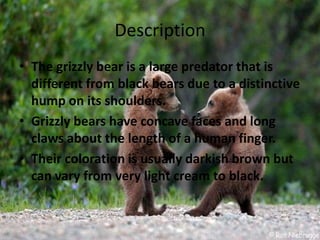
• The grizzly bear is a large predator that is
different from black bears due to a distinctive
hump on its shoulders.
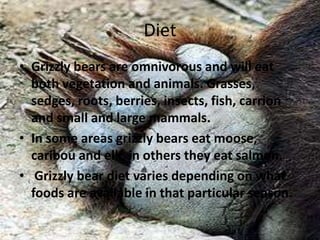
• Grizzly bears have concave faces and long
claws about the length of a human finger.
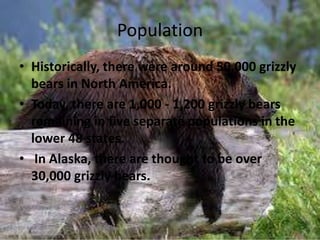
• Their coloration is usually darkish brown but
can vary from very light cream to black.
Diet
• Grizzly bears are omnivorous and will eat
both vegetation and animals. Grasses,
sedges, roots, berries, insects, fish, carrion
and small and large mammals.
• In some areas grizzly bears eat moose,
caribou and elk, in others they eat salmon.
• Grizzly bear diet varies depending on what
foods are available in that particular season.
Population
• Historically, there were around 50,000 grizzly
bears in North America.
• Today, there are 1,000 - 1,200 grizzly bears
remaining in five separate populations in the
lower 48 states.
• In Alaska, there are thought to be over
30,000 grizzly bears.
Range
• Grizzly bears are found in a variety of
habitats, from dense forests, to subalpine
meadows and arctic tundra.
• In North America, grizzly bears are found in
western Canada, Alaska, Wyoming, Montana,
Idaho, and Washington.
• Historically, they could be found from Alaska
to Mexico, California to Ohio.
Behavior
• Bears live solitary lives except during breeding, cub
rearing, and in areas with a super-abundant food supply
such as salmon streams.
• Grizzly bears hibernate during the winter for 5-8 months,
and usually dig their dens on north-facing slopes to ensure
good snow cover.
• Grizzly bears need to eat a lot in the summer and fall in
order to build up sufficient fat reserves for surviving the
denning period.
• This is particularly true for pregnant females who give
birth to one pound cubs and then nurse them to about 20
pounds before emerging from the den in April-May.
Reproduction
• Mating Season: Early May through mid-July
• Gestation: Anywhere from 180-270 days,
including delayed implantation.
• Litter Size: 1-3 cubs
The young are born in January or February
while the mothers are hibernating in a den.
Cubs will remain with their mothers for at
least 2 - 4 years.

Grizzly bear’s

  • 1.
  • 2.
    Description • The grizzlybear is a large predator that is different from black bears due to a distinctive hump on its shoulders. • Grizzly bears have concave faces and long claws about the length of a human finger. • Their coloration is usually darkish brown but can vary from very light cream to black.
  • 3.
    Diet • Grizzly bearsare omnivorous and will eat both vegetation and animals. Grasses, sedges, roots, berries, insects, fish, carrion and small and large mammals. • In some areas grizzly bears eat moose, caribou and elk, in others they eat salmon. • Grizzly bear diet varies depending on what foods are available in that particular season.
  • 4.
    Population • Historically, therewere around 50,000 grizzly bears in North America. • Today, there are 1,000 - 1,200 grizzly bears remaining in five separate populations in the lower 48 states. • In Alaska, there are thought to be over 30,000 grizzly bears.
  • 5.
    Range • Grizzly bearsare found in a variety of habitats, from dense forests, to subalpine meadows and arctic tundra. • In North America, grizzly bears are found in western Canada, Alaska, Wyoming, Montana, Idaho, and Washington. • Historically, they could be found from Alaska to Mexico, California to Ohio.
  • 6.
    Behavior • Bears livesolitary lives except during breeding, cub rearing, and in areas with a super-abundant food supply such as salmon streams. • Grizzly bears hibernate during the winter for 5-8 months, and usually dig their dens on north-facing slopes to ensure good snow cover. • Grizzly bears need to eat a lot in the summer and fall in order to build up sufficient fat reserves for surviving the denning period. • This is particularly true for pregnant females who give birth to one pound cubs and then nurse them to about 20 pounds before emerging from the den in April-May.
  • 7.
    Reproduction • Mating Season:Early May through mid-July • Gestation: Anywhere from 180-270 days, including delayed implantation. • Litter Size: 1-3 cubs The young are born in January or February while the mothers are hibernating in a den. Cubs will remain with their mothers for at least 2 - 4 years.