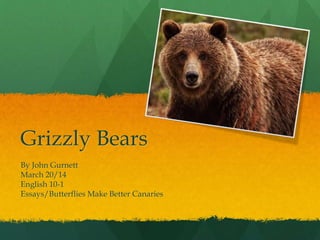
Grizzly Bears
By John Gurnett
March 20/14
English 10-1
Essays/Butterflies Make Better Canaries
Grizzly Types and Habitat
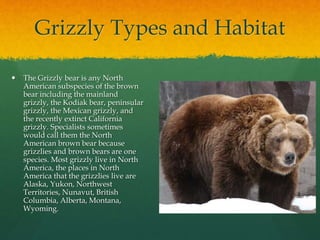
 The Grizzly bear is any North
American subspecies of the brown
bear including the mainland
grizzly, the Kodiak bear, peninsular
grizzly, the Mexican grizzly, and
the recently extinct California
grizzly. Specialists sometimes
would call them the North
American brown bear because
grizzlies and brown bears are one
species. Most grizzly live in North
America, the places in North
America that the grizzlies live are
Alaska, Yukon, Northwest
Territories, Nunavut, British
Columbia, Alberta, Montana,
Wyoming.
A Grizzlies Diet
Grizzly bears are omnivores but they are
usually carnivores: The Grizzly bears diet has
plants and animals. They are known to hunt
many members of the dear family. They are
also known to eat black bears, bison and big
horned sheep. Grizzlies are also scavengers
they eat birds and their eggs for the protein.
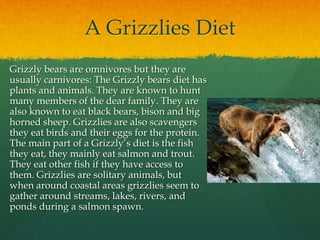
The main part of a Grizzly’s diet is the fish
they eat, they mainly eat salmon and trout.
They eat other fish if they have access to
them. Grizzlies are solitary animals, but
when around coastal areas grizzlies seem to
gather around streams, lakes, rivers, and
ponds during a salmon spawn.
Grizzly Appearance and
Hibernation
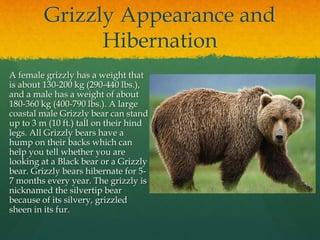
A female grizzly has a weight that
is about 130-200 kg (290-440 lbs.),
and a male has a weight of about
180-360 kg (400-790 lbs.). A large
coastal male Grizzly bear can stand
up to 3 m (10 ft.) tall on their hind
legs. All Grizzly bears have a
hump on their backs which can
help you tell whether you are
looking at a Black bear or a Grizzly
bear. Grizzly bears hibernate for 5-
7 months every year. The grizzly is
nicknamed the silvertip bear
because of its silvery, grizzled
sheen in its fur.
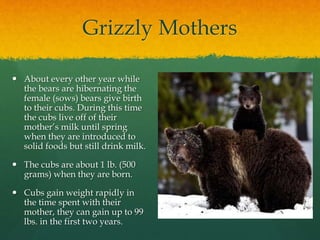
Grizzly Mothers
 About every other year while
the bears are hibernating the
female (sows) bears give birth
to their cubs. During this time
the cubs live off of their
mother’s milk until spring
when they are introduced to
solid foods but still drink milk.
 The cubs are about 1 lb. (500
grams) when they are born.
 Cubs gain weight rapidly in
the time spent with their
mother, they can gain up to 99
lbs. in the first two years.
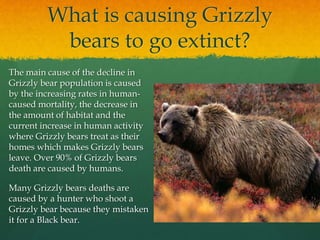
What is causing Grizzly
bears to go extinct?
The main cause of the decline in
Grizzly bear population is caused
by the increasing rates in human-
caused mortality, the decrease in
the amount of habitat and the
current increase in human activity
where Grizzly bears treat as their
homes which makes Grizzly bears
leave. Over 90% of Grizzly bears
death are caused by humans.
Many Grizzly bears deaths are
caused by a hunter who shoot a
Grizzly bear because they mistaken
it for a Black bear.
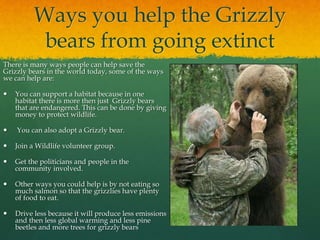
Ways you help the Grizzly
bears from going extinct
There is many ways people can help save the
Grizzly bears in the world today, some of the ways
we can help are:
 You can support a habitat because in one
habitat there is more then just Grizzly bears
that are endangered. This can be done by giving
money to protect wildlife.
 You can also adopt a Grizzly bear.
 Join a Wildlife volunteer group.
 Get the politicians and people in the
community involved.
 Other ways you could help is by not eating so
much salmon so that the grizzlies have plenty
of food to eat.
 Drive less because it will produce less emissions
and then less global warming and less pine
beetles and more trees for grizzly bears
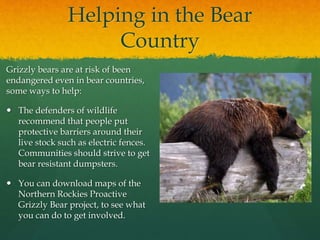
Helping in the Bear
Country
Grizzly bears are at risk of been
endangered even in bear countries,
some ways to help:
 The defenders of wildlife
recommend that people put
protective barriers around their
live stock such as electric fences.
Communities should strive to get
bear resistant dumpsters.
 You can download maps of the
Northern Rockies Proactive
Grizzly Bear project, to see what
you can do to get involved.
Bibliography
 http://en.wikipedia.org/wiki/Grizzly_bear
 http://www.brownbear.org/endangeredbears.htm
 http://www.sierraclub.ca/en/action-grizzly-bear/our-
threatened-grizzly
 http://animal.discovery.com/endangered-
species/grizzly-bears-need-help.htm
 http://www.defenders.org/grizzly-bear/how-you-can-
help
 Google images: Grizzly bears

Butterflies Make Better Canaries

  • 1.
    Grizzly Bears By JohnGurnett March 20/14 English 10-1 Essays/Butterflies Make Better Canaries
  • 2.
    Grizzly Types andHabitat  The Grizzly bear is any North American subspecies of the brown bear including the mainland grizzly, the Kodiak bear, peninsular grizzly, the Mexican grizzly, and the recently extinct California grizzly. Specialists sometimes would call them the North American brown bear because grizzlies and brown bears are one species. Most grizzly live in North America, the places in North America that the grizzlies live are Alaska, Yukon, Northwest Territories, Nunavut, British Columbia, Alberta, Montana, Wyoming.
  • 3.
    A Grizzlies Diet Grizzlybears are omnivores but they are usually carnivores: The Grizzly bears diet has plants and animals. They are known to hunt many members of the dear family. They are also known to eat black bears, bison and big horned sheep. Grizzlies are also scavengers they eat birds and their eggs for the protein. The main part of a Grizzly’s diet is the fish they eat, they mainly eat salmon and trout. They eat other fish if they have access to them. Grizzlies are solitary animals, but when around coastal areas grizzlies seem to gather around streams, lakes, rivers, and ponds during a salmon spawn.
  • 4.
    Grizzly Appearance and Hibernation Afemale grizzly has a weight that is about 130-200 kg (290-440 lbs.), and a male has a weight of about 180-360 kg (400-790 lbs.). A large coastal male Grizzly bear can stand up to 3 m (10 ft.) tall on their hind legs. All Grizzly bears have a hump on their backs which can help you tell whether you are looking at a Black bear or a Grizzly bear. Grizzly bears hibernate for 5- 7 months every year. The grizzly is nicknamed the silvertip bear because of its silvery, grizzled sheen in its fur.
  • 5.
    Grizzly Mothers  Aboutevery other year while the bears are hibernating the female (sows) bears give birth to their cubs. During this time the cubs live off of their mother’s milk until spring when they are introduced to solid foods but still drink milk.  The cubs are about 1 lb. (500 grams) when they are born.  Cubs gain weight rapidly in the time spent with their mother, they can gain up to 99 lbs. in the first two years.
  • 6.
    What is causingGrizzly bears to go extinct? The main cause of the decline in Grizzly bear population is caused by the increasing rates in human- caused mortality, the decrease in the amount of habitat and the current increase in human activity where Grizzly bears treat as their homes which makes Grizzly bears leave. Over 90% of Grizzly bears death are caused by humans. Many Grizzly bears deaths are caused by a hunter who shoot a Grizzly bear because they mistaken it for a Black bear.
  • 7.
    Ways you helpthe Grizzly bears from going extinct There is many ways people can help save the Grizzly bears in the world today, some of the ways we can help are:  You can support a habitat because in one habitat there is more then just Grizzly bears that are endangered. This can be done by giving money to protect wildlife.  You can also adopt a Grizzly bear.  Join a Wildlife volunteer group.  Get the politicians and people in the community involved.  Other ways you could help is by not eating so much salmon so that the grizzlies have plenty of food to eat.  Drive less because it will produce less emissions and then less global warming and less pine beetles and more trees for grizzly bears
  • 8.
    Helping in theBear Country Grizzly bears are at risk of been endangered even in bear countries, some ways to help:  The defenders of wildlife recommend that people put protective barriers around their live stock such as electric fences. Communities should strive to get bear resistant dumpsters.  You can download maps of the Northern Rockies Proactive Grizzly Bear project, to see what you can do to get involved.
  • 9.
    Bibliography  http://en.wikipedia.org/wiki/Grizzly_bear  http://www.brownbear.org/endangeredbears.htm http://www.sierraclub.ca/en/action-grizzly-bear/our- threatened-grizzly  http://animal.discovery.com/endangered- species/grizzly-bears-need-help.htm  http://www.defenders.org/grizzly-bear/how-you-can- help  Google images: Grizzly bears