MODULE 2:
Solar Energy
and the
Atmosphere
By: Rachel M. Tacubao
Our planet receives
an abundant supply
of life-giving energy
from the SUN
The heat of the sun or
SOLAR ENERGY also
propels atmospheric
phenomena.
Greenhouse
Effect and
Global
Warming
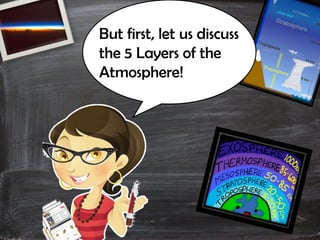
But first, let us discuss
the 5 Layers of the
Atmosphere!
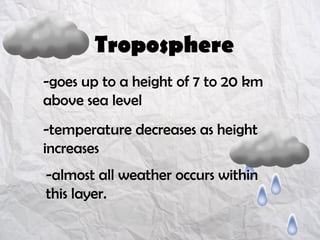
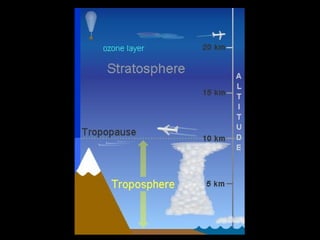
Troposphere
-temperature decreases as height
increases
-almost all weather occurs within
this layer.
-goes up to a height of 7 to 20 km
above sea level
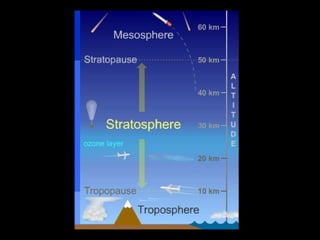
Stratosphere
The top of the stratosphere
occurs at 50 km altitude.
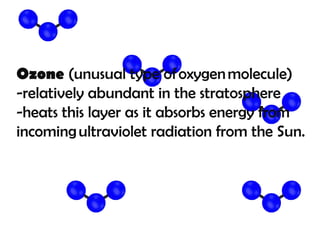
Ozone (unusual type of oxygen molecule)
-relatively abundant in the stratosphere
-heats this layer as it absorbs energy from
incoming ultraviolet radiation from the Sun.
Mesosphere
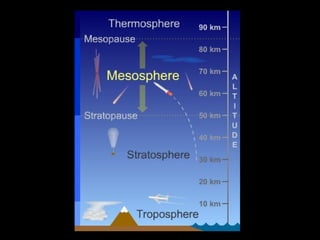
The mesosphere starts at 50 km
above Earth's surface and goes up to
85 km high.
As you get higher up in the mesosphere,
the temperature gets colder. The top of
the mesosphere is the coldest part of
Earth's atmosphere. The temperature
there is around -90° C (-130° F)!
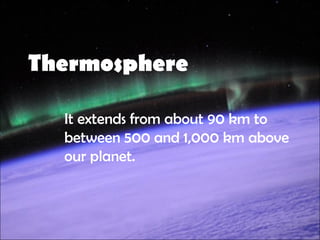
Thermosphere
It extends from about 90 km to
between 500 and 1,000 km above
our planet.
Temperatures climb sharply in the lower
thermosphere (below 200 to 300 km
altitude), then level off and hold fairly
steady with increasing altitude above that
height.
Solar activity strongly
influences temperature in the
thermosphere.

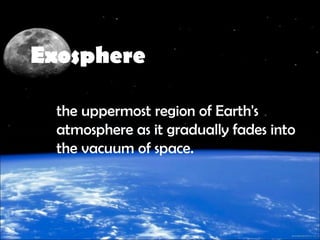
Exosphere
the uppermost region of Earth's
atmosphere as it gradually fades into
the vacuum of space. 
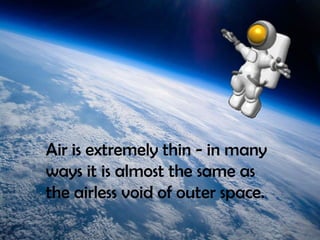
Air is extremely thin - in many
ways it is almost the same as
the airless void of outer space.
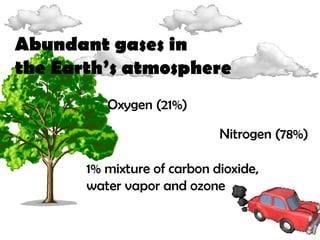
Abundant gases in
the Earth’s atmosphere
Nitrogen (78%)
Oxygen (21%)
1% mixture of carbon dioxide,
water vapor and ozone
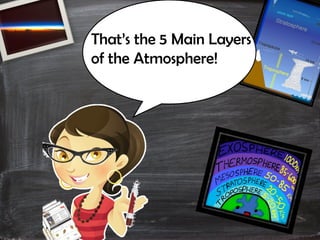
That’s the 5 Main Layers
of the Atmosphere!
Now, let’s discuss about...
and
The greenhouse effect is a
warming of Earth's surface and
the air above it
It is caused by gases in the air that
trap energy from the sun.
The most
common greenhouse
gases are water vapor,
carbon dioxide, and
methane.
Ozone Depletion
When CFCs and HCFCs reach the
stratosphere, the ultraviolet radiation from
the sun causes them to break apart and
release chlorine atoms which react
with ozone, starting chemical cycles
of ozone destruction
that deplete the ozone layer.
One chlorine atom can break
apart more than
100,000 ozone molecules.
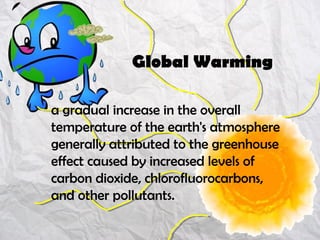
a gradual increase in the overall
temperature of the earth's atmosphere
generally attributed to the greenhouse
effect caused by increased levels of
carbon dioxide, chlorofluorocarbons,
and other pollutants.
Global Warming
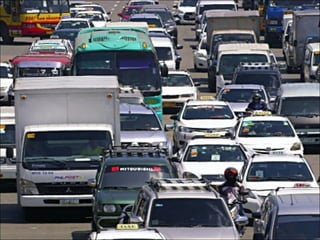
burning fossil fuels
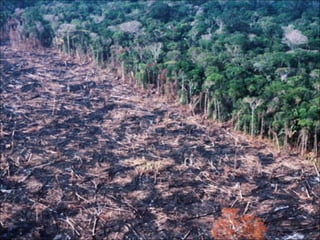
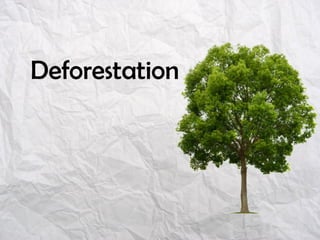
Deforestation
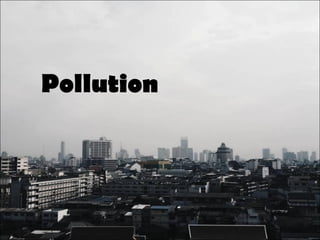
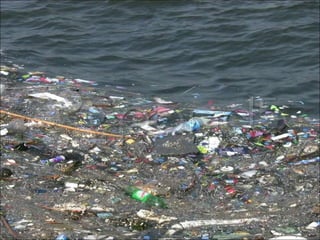
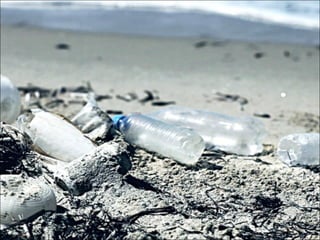
Pollution
http://www.windows2universe.org/earth/Atmos
phere/troposphere.html
http://www.windows2universe.org/earth/Atmosphere
/stratosphere.html
http://www.windows2universe.org/earth/Atmos
phere/thermosphere.html
kids.britannica.com/elementary/article-
403919/greenhouse-effect?
http://www.windows2universe.org/earth/Atmosp
here/exosphere.html
http://www.windows2universe.org/earth/Atmosphere/
mesosphere.html
http://scied.ucar.edu/shortcontent/exosphere-overview
https://dirt.asla.org/2010/04/06/six-ways-that-
human-activity-is-changing-the-planet/
http://education.seattlepi.com/effect-human-
activities-environment-3653.html
https://www.edf.org/climate/human-
activity-is-causing-global-warming

Greenhouse Effect and Global Warming

Editor's Notes

  • #26 These heat-trapping gases are called greenhouse gases.