Exploring the
Earth’s
Atmosphere
Johanna F. Ilao
Sample Footer Text 2
Tuesday, February 2, 20XX
The Earth’s Atmosphere
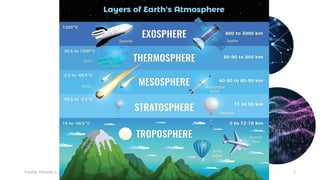
1. TROPOSPHERE
•This layer is the closest to the Earth’s
surface. The temperature just above the
ground is hotter than the temperature high
above.
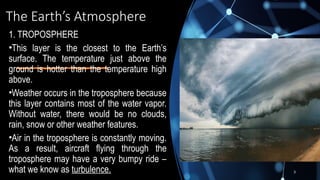
•Weather occurs in the troposphere because
this layer contains most of the water vapor.
Without water, there would be no clouds,
rain, snow or other weather features.
•Air in the troposphere is constantly moving.
As a result, aircraft flying through the
troposphere may have a very bumpy ride –
what we know as turbulence. 3
2. STRATOSPHERE
•This layer of air extends to about 50 km
from Earth’s surface.
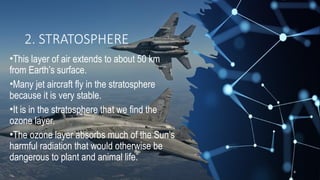
•Many jet aircraft fly in the stratosphere
because it is very stable.
•It is in the stratosphere that we find the
ozone layer.
•The ozone layer absorbs much of the Sun’s
harmful radiation that would otherwise be
dangerous to plant and animal life.
4
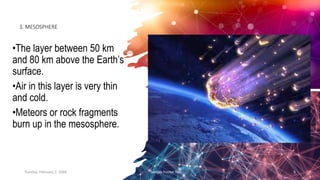
3. MESOSPHERE
•The layer between 50 km
and 80 km above the Earth’s
surface.
•Air in this layer is very thin
and cold.
•Meteors or rock fragments
burn up in the mesosphere.
Tuesday, February 2, 20XX Sample Footer Text 5
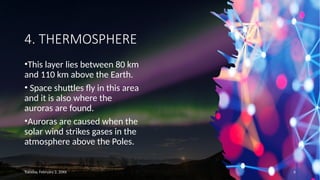
4. THERMOSPHERE
•This layer lies between 80 km
and 110 km above the Earth.
• Space shuttles fly in this area
and it is also where the
auroras are found.
•Auroras are caused when the
solar wind strikes gases in the
atmosphere above the Poles.
Tuesday, February 2, 20XX 6
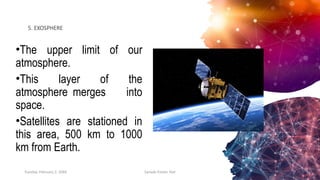
5. EXOSPHERE
•The upper limit of our
atmosphere.
•This layer of the
atmosphere merges into
space.
•Satellites are stationed in
this area, 500 km to 1000
km from Earth.
Tuesday, February 2, 20XX Sample Footer Text 7
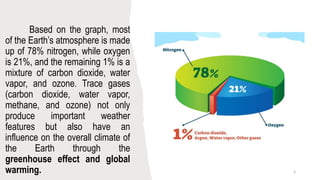
Based on the graph, most
of the Earth’s atmosphere is made
up of 78% nitrogen, while oxygen
is 21%, and the remaining 1% is a
mixture of carbon dioxide, water
vapor, and ozone. Trace gases
(carbon dioxide, water vapor,
methane, and ozone) not only
produce important weather
features but also have an
influence on the overall climate of
the Earth through the
greenhouse effect and global
warming. 8
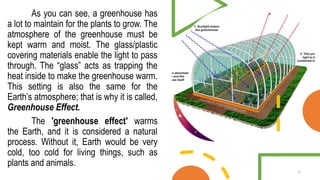
As you can see, a greenhouse has
a lot to maintain for the plants to grow. The
atmosphere of the greenhouse must be
kept warm and moist. The glass/plastic
covering materials enable the light to pass
through. The “glass” acts as trapping the
heat inside to make the greenhouse warm.
This setting is also the same for the
Earth’s atmosphere; that is why it is called,
Greenhouse Effect.
The 'greenhouse effect' warms
the Earth, and it is considered a natural
process. Without it, Earth would be very
cold, too cold for living things, such as
plants and animals.
9
Sources of Greenhouse gases
(Trace Gases):
Living things like plants and trees
take in and use carbon dioxide to produce
their food. Carbon dioxide was also
produced by volcanoes. Methane comes
from grazing animals as they digest their
food and from decaying matter in wet rice
fields. Ozone is also naturally present in
the stratosphere.
10
Sources of Greenhouse gases (Trace
Gases):
But human activities emit a lot of greenhouse gases
into the atmosphere.
Carbon dioxide (CO2) comes from:
burning of fossil fuels such as coal, crude oil, and
natural gas.
cutting down and burning trees release carbon
dioxide into the air.
Methane comes from:
buried waste such as left-over food, garden waste,
and animal waste collected from our houses are thrown into
dumpsite; when lots of wastes are compressed and packed
together, they produce methane.
Coal mining also produces methane. 11
Sources of Greenhouse gases (Trace
Gases):
And another group of greenhouse gases includes:
CFCs (chlorofluorocarbons) which found in
spray cans as propellants, refrigerators as
refrigerants, making foam plastics as foaming
agents. When those were released into the
atmosphere, it would be dangerous. Thus, depleting
the ozone layer. Their use has been banned around
the world.
More carbon dioxide means that more heat is
trapped in the Earth’s atmosphere. More heat
cannot return into space. More heat trapped by
carbon dioxide means a warmer Earth. 12
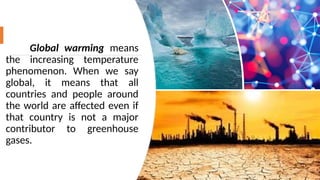
Global warming means
the increasing temperature
phenomenon. When we say
global, it means that all
countries and people around
the world are affected even if
that country is not a major
contributor to greenhouse
gases.
13
Activity 1: Fact or Bluff?
Directions: Write the word “Fact” if the statement is true and “Bluff” if the
statement is false.
____________1. Meteors burn up in the mesosphere.
____________2. Exosphere is the upper limit of our atmosphere.
____________3. Satellites are stationed in the troposphere.
____________4. Aircraft flying through the stratosphere may have a
bumpy ride as what we knew as turbulence.
____________5. Troposphere contains most of the water vapor.
____________6. It is in the stratosphere where we can find the ozone
layer.
____________7. Space shuttles fly in stratosphere.
____________8. Air in troposphere is very thin and cold.
____________9. Exosphere merges into space.
____________10. Auroras can be found in thermosphere.
Assessment
1. Which layer of the atmosphere has very thin and cold air?
A. mesosphere B. thermosphere C. exosphere D. troposphere
2. What do you mean by trace gases?
A. They are not harmful
B. They are naturally occurring on Earth
C.They are emitted by trees
D.They are present in very small amounts.
3. Where can we find Auroras?
A. stratosphere B. exosphere C. mesosphere D. thermosphere
4. Which layer does the airplane experience “turbulence”?
A. thermosphere B. troposphere C. mesosphere D. exosphere
5. How many percent of trace gases does the atmosphere contains?
A. 78 % B. 6 % C. 1% D. 21%
6. The following are the common sources of methane, EXCEPT:
A. trees B. garden waste C. cloth D. volcanoes
7. Which of the following element is the most abundant in the Earth's
atmosphere?
A. Argon B. Carbon dioxide C. Nitrogen D. Oxygen
8. Why is ozone above the troposphere essential?
A. It warms Earth’s surface.
B. It helps in cloud formation.
C. It makes jet flying more comfortable.
D. It offers protection from harmful UV rays.
9. Why was the use of chlorofluorocarbons banned all over the world?
A. It depletes the stratosphere. C. It depletes the ozone layer.
B. The atmosphere is unstable. D. The atmosphere will be too cold.
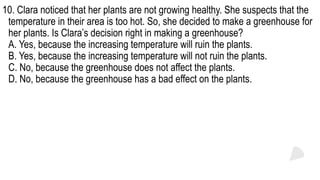
10. Clara noticed that her plants are not growing healthy. She suspects that the
temperature in their area is too hot. So, she decided to make a greenhouse for
her plants. Is Clara’s decision right in making a greenhouse?
A. Yes, because the increasing temperature will ruin the plants.
B. Yes, because the increasing temperature will not ruin the plants.
C. No, because the greenhouse does not affect the plants.
D. No, because the greenhouse has a bad effect on the plants.

Q4 Exploring the Earth’s Atmosphere.pptx

  • 1.
  • 2.
    Sample Footer Text2 Tuesday, February 2, 20XX
  • 3.
    The Earth’s Atmosphere 1.TROPOSPHERE •This layer is the closest to the Earth’s surface. The temperature just above the ground is hotter than the temperature high above. •Weather occurs in the troposphere because this layer contains most of the water vapor. Without water, there would be no clouds, rain, snow or other weather features. •Air in the troposphere is constantly moving. As a result, aircraft flying through the troposphere may have a very bumpy ride – what we know as turbulence. 3
  • 4.
    2. STRATOSPHERE •This layerof air extends to about 50 km from Earth’s surface. •Many jet aircraft fly in the stratosphere because it is very stable. •It is in the stratosphere that we find the ozone layer. •The ozone layer absorbs much of the Sun’s harmful radiation that would otherwise be dangerous to plant and animal life. 4
  • 5.
    3. MESOSPHERE •The layerbetween 50 km and 80 km above the Earth’s surface. •Air in this layer is very thin and cold. •Meteors or rock fragments burn up in the mesosphere. Tuesday, February 2, 20XX Sample Footer Text 5
  • 6.
    4. THERMOSPHERE •This layerlies between 80 km and 110 km above the Earth. • Space shuttles fly in this area and it is also where the auroras are found. •Auroras are caused when the solar wind strikes gases in the atmosphere above the Poles. Tuesday, February 2, 20XX 6
  • 7.
    5. EXOSPHERE •The upperlimit of our atmosphere. •This layer of the atmosphere merges into space. •Satellites are stationed in this area, 500 km to 1000 km from Earth. Tuesday, February 2, 20XX Sample Footer Text 7
  • 8.
    Based on thegraph, most of the Earth’s atmosphere is made up of 78% nitrogen, while oxygen is 21%, and the remaining 1% is a mixture of carbon dioxide, water vapor, and ozone. Trace gases (carbon dioxide, water vapor, methane, and ozone) not only produce important weather features but also have an influence on the overall climate of the Earth through the greenhouse effect and global warming. 8
  • 9.
    As you cansee, a greenhouse has a lot to maintain for the plants to grow. The atmosphere of the greenhouse must be kept warm and moist. The glass/plastic covering materials enable the light to pass through. The “glass” acts as trapping the heat inside to make the greenhouse warm. This setting is also the same for the Earth’s atmosphere; that is why it is called, Greenhouse Effect. The 'greenhouse effect' warms the Earth, and it is considered a natural process. Without it, Earth would be very cold, too cold for living things, such as plants and animals. 9
  • 10.
    Sources of Greenhousegases (Trace Gases): Living things like plants and trees take in and use carbon dioxide to produce their food. Carbon dioxide was also produced by volcanoes. Methane comes from grazing animals as they digest their food and from decaying matter in wet rice fields. Ozone is also naturally present in the stratosphere. 10
  • 11.
    Sources of Greenhousegases (Trace Gases): But human activities emit a lot of greenhouse gases into the atmosphere. Carbon dioxide (CO2) comes from: burning of fossil fuels such as coal, crude oil, and natural gas. cutting down and burning trees release carbon dioxide into the air. Methane comes from: buried waste such as left-over food, garden waste, and animal waste collected from our houses are thrown into dumpsite; when lots of wastes are compressed and packed together, they produce methane. Coal mining also produces methane. 11
  • 12.
    Sources of Greenhousegases (Trace Gases): And another group of greenhouse gases includes: CFCs (chlorofluorocarbons) which found in spray cans as propellants, refrigerators as refrigerants, making foam plastics as foaming agents. When those were released into the atmosphere, it would be dangerous. Thus, depleting the ozone layer. Their use has been banned around the world. More carbon dioxide means that more heat is trapped in the Earth’s atmosphere. More heat cannot return into space. More heat trapped by carbon dioxide means a warmer Earth. 12
  • 13.
    Global warming means theincreasing temperature phenomenon. When we say global, it means that all countries and people around the world are affected even if that country is not a major contributor to greenhouse gases. 13
  • 14.
    Activity 1: Factor Bluff? Directions: Write the word “Fact” if the statement is true and “Bluff” if the statement is false. ____________1. Meteors burn up in the mesosphere. ____________2. Exosphere is the upper limit of our atmosphere. ____________3. Satellites are stationed in the troposphere. ____________4. Aircraft flying through the stratosphere may have a bumpy ride as what we knew as turbulence. ____________5. Troposphere contains most of the water vapor. ____________6. It is in the stratosphere where we can find the ozone layer. ____________7. Space shuttles fly in stratosphere. ____________8. Air in troposphere is very thin and cold. ____________9. Exosphere merges into space. ____________10. Auroras can be found in thermosphere.
  • 15.
    Assessment 1. Which layerof the atmosphere has very thin and cold air? A. mesosphere B. thermosphere C. exosphere D. troposphere 2. What do you mean by trace gases? A. They are not harmful B. They are naturally occurring on Earth C.They are emitted by trees D.They are present in very small amounts. 3. Where can we find Auroras? A. stratosphere B. exosphere C. mesosphere D. thermosphere 4. Which layer does the airplane experience “turbulence”? A. thermosphere B. troposphere C. mesosphere D. exosphere 5. How many percent of trace gases does the atmosphere contains? A. 78 % B. 6 % C. 1% D. 21%
  • 16.
    6. The followingare the common sources of methane, EXCEPT: A. trees B. garden waste C. cloth D. volcanoes 7. Which of the following element is the most abundant in the Earth's atmosphere? A. Argon B. Carbon dioxide C. Nitrogen D. Oxygen 8. Why is ozone above the troposphere essential? A. It warms Earth’s surface. B. It helps in cloud formation. C. It makes jet flying more comfortable. D. It offers protection from harmful UV rays. 9. Why was the use of chlorofluorocarbons banned all over the world? A. It depletes the stratosphere. C. It depletes the ozone layer. B. The atmosphere is unstable. D. The atmosphere will be too cold.
  • 17.
    10. Clara noticedthat her plants are not growing healthy. She suspects that the temperature in their area is too hot. So, she decided to make a greenhouse for her plants. Is Clara’s decision right in making a greenhouse? A. Yes, because the increasing temperature will ruin the plants. B. Yes, because the increasing temperature will not ruin the plants. C. No, because the greenhouse does not affect the plants. D. No, because the greenhouse has a bad effect on the plants.