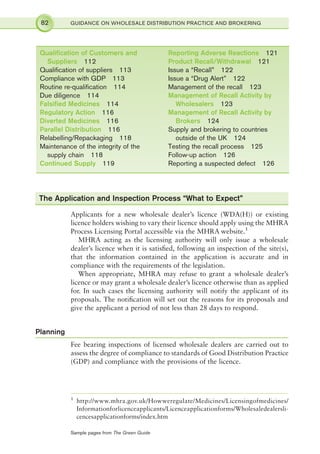
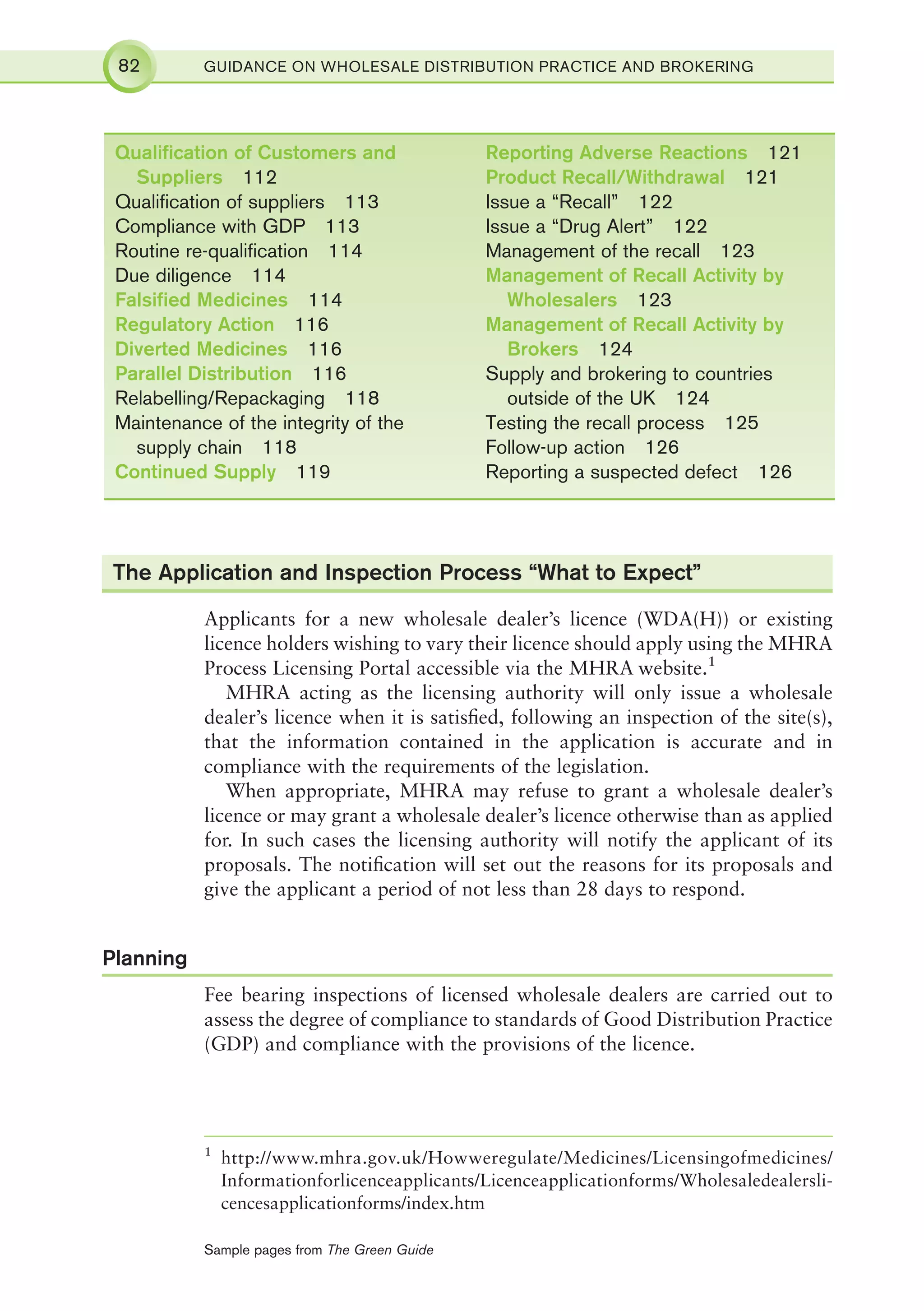
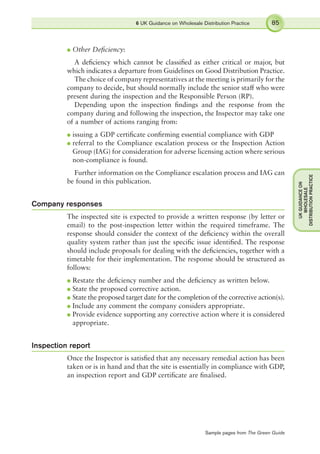
The Application and Inspection Process “What to Expect”
Applicants for a new wholesale dealer’s licence (WDA(H)) or existing
licence holders wishing to vary their licence should apply using the MHRA
Process Licensing Portal accessible via the MHRA website.1
MHRA acting as the licensing authority will only issue a wholesale
dealer’s licence when it is satisfied, following an inspection of the site(s),
that the information contained in the application is accurate and in
compliance with the requirements of the legislation.
When appropriate, MHRA may refuse to grant a wholesale dealer’s
licence or may grant a wholesale dealer’s licence otherwise than as applied
for. In such cases the licensing authority will notify the applicant of its
proposals. The notification will set out the reasons for its proposals and
give the applicant a period of not less than 28 days to respond.
Planning
Fee bearing inspections of licensed wholesale dealers are carried out to
assess the degree of compliance to standards of Good Distribution Practice
(GDP) and compliance with the provisions of the licence.
Qualification of Customers and
Suppliers 112
Qualification of suppliers 113
Compliance with GDP 113
Routine re-qualification 114
Due diligence 114
Falsified Medicines 114
Regulatory Action 116
Diverted Medicines 116
Parallel Distribution 116
Relabelling/Repackaging 118
Maintenance of the integrity of the
supply chain 118
Continued Supply 119
Reporting Adverse Reactions 121
Product Recall/Withdrawal 121
Issue a “Recall” 122
Issue a “Drug Alert” 122
Management of the recall 123
Management of Recall Activity by
Wholesalers 123
Management of Recall Activity by
Brokers 124
Supply and brokering to countries
outside of the UK 124
Testing the recall process 125
Follow-up action 126
Reporting a suspected defect 126
1
http://www.mhra.gov.uk/Howweregulate/Medicines/Licensingofmedicines/
Informationforlicenceapplicants/Licenceapplicationforms/Wholesaledealersli-
cencesapplicationforms/index.htm
82 GUIDANCE ON WHOLESALE DISTRIBUTION PRACTICE AND BROKERING
Sample pages from The Green Guide
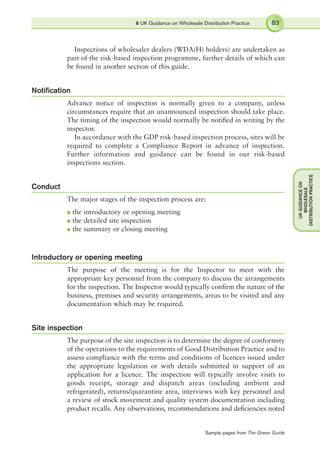
Inspections of wholesaler dealers (WDA(H) holders) are undertaken as
part of the risk-based inspection programme, further details of which can
be found in another section of this guide.
Notification
Advance notice of inspection is normally given to a company, unless
circumstances require that an unannounced inspection should take place.
The timing of the inspection would normally be notified in writing by the
inspector.
In accordance with the GDP risk-based inspection process, sites will be
required to complete a Compliance Report in advance of inspection.
Further information and guidance can be found in our risk-based
inspections section.
Conduct
The major stages of the inspection process are:
l the introductory or opening meeting
l the detailed site inspection
l the summary or closing meeting
Introductory or opening meeting
The purpose of the meeting is for the Inspector to meet with the
appropriate key personnel from the company to discuss the arrangements
for the inspection. The Inspector would typically confirm the nature of the
business, premises and security arrangements, areas to be visited and any
documentation which may be required.
Site inspection
The purpose of the site inspection is to determine the degree of conformity
of the operations to the requirements of Good Distribution Practice and to
assess compliance with the terms and conditions of licences issued under
the appropriate legislation or with details submitted in support of an
application for a licence. The inspection will typically involve visits to
goods receipt, storage and dispatch areas (including ambient and
refrigerated), returns/quarantine area, interviews with key personnel and
a review of stock movement and quality system documentation including
product recalls. Any observations, recommendations and deficiencies noted
6 UK Guidance on Wholesale Distribution Practice 83
UKGUIDANCEON
WHOLESALE
DISTRIBUTIONPRACTICE
Sample pages from The Green Guide
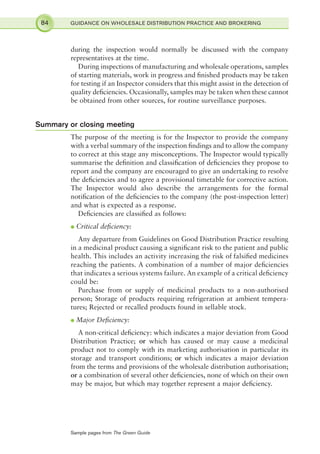
during the inspection would normally be discussed with the company
representatives at the time.
During inspections of manufacturing and wholesale operations, samples
of starting materials, work in progress and finished products may be taken
for testing if an Inspector considers that this might assist in the detection of
quality deficiencies. Occasionally, samples may be taken when these cannot
be obtained from other sources, for routine surveillance purposes.
Summary or closing meeting
The purpose of the meeting is for the Inspector to provide the company
with a verbal summary of the inspection findings and to allow the company
to correct at this stage any misconceptions. The Inspector would typically
summarise the definition and classification of deficiencies they propose to
report and the company are encouraged to give an undertaking to resolve
the deficiencies and to agree a provisional timetable for corrective action.
The Inspector would also describe the arrangements for the formal
notification of the deficiencies to the company (the post-inspection letter)
and what is expected as a response.
Deficiencies are classified as follows:
l Critical deficiency:
Any departure from Guidelines on Good Distribution Practice resulting
in a medicinal product causing a significant risk to the patient and public
health. This includes an activity increasing the risk of falsified medicines
reaching the patients. A combination of a number of major deficiencies
that indicates a serious systems failure. An example of a critical deficiency
could be:
Purchase from or supply of medicinal products to a non-authorised
person; Storage of products requiring refrigeration at ambient tempera-
tures; Rejected or recalled products found in sellable stock.
l Major Deficiency:
A non-critical deficiency: which indicates a major deviation from Good
Distribution Practice; or which has caused or may cause a medicinal
product not to comply with its marketing authorisation in particular its
storage and transport conditions; or which indicates a major deviation
from the terms and provisions of the wholesale distribution authorisation;
or a combination of several other deficiencies, none of which on their own
may be major, but which may together represent a major deficiency.
84 GUIDANCE ON WHOLESALE DISTRIBUTION PRACTICE AND BROKERING
Sample pages from The Green Guide
l Other Deficiency:
A deficiency which cannot be classified as either critical or major, but
which indicates a departure from Guidelines on Good Distribution Practice.
The choice of company representatives at the meeting is primarily for the
company to decide, but should normally include the senior staff who were
present during the inspection and the Responsible Person (RP).
Depending upon the inspection findings and the response from the
company during and following the inspection, the Inspector may take one
of a number of actions ranging from:
l issuing a GDP certificate confirming essential compliance with GDP
l referral to the Compliance escalation process or the Inspection Action
Group (IAG) for consideration for adverse licensing action where serious
non-compliance is found.
Further information on the Compliance escalation process and IAG can
be found in this publication.
Company responses
The inspected site is expected to provide a written response (by letter or
email) to the post-inspection letter within the required timeframe. The
response should consider the context of the deficiency within the overall
quality system rather than just the specific issue identified. The response
should include proposals for dealing with the deficiencies, together with a
timetable for their implementation. The response should be structured as
follows:
l Restate the deficiency number and the deficiency as written below.
l State the proposed corrective action.
l State the proposed target date for the completion of the corrective action(s).
l Include any comment the company considers appropriate.
l Provide evidence supporting any corrective action where it is considered
appropriate.
Inspection report
Once the Inspector is satisfied that any necessary remedial action has been
taken or is in hand and that the site is essentially in compliance with GDP,
an inspection report and GDP certificate are finalised.
6 UK Guidance on Wholesale Distribution Practice 85
UKGUIDANCEON
WHOLESALE
DISTRIBUTIONPRACTICE
Sample pages from The Green Guide
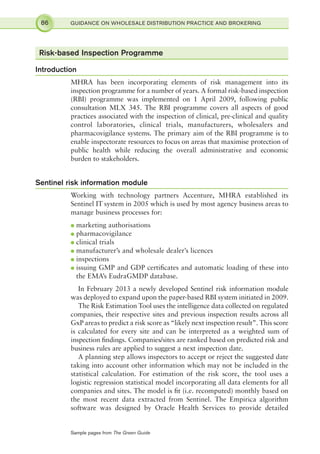
Risk-based Inspection Programme
Introduction
MHRA has been incorporating elements of risk management into its
inspection programme for a number of years. A formal risk-based inspection
(RBI) programme was implemented on 1 April 2009, following public
consultation MLX 345. The RBI programme covers all aspects of good
practices associated with the inspection of clinical, pre-clinical and quality
control laboratories, clinical trials, manufacturers, wholesalers and
pharmacovigilance systems. The primary aim of the RBI programme is to
enable inspectorate resources to focus on areas that maximise protection of
public health while reducing the overall administrative and economic
burden to stakeholders.
Sentinel risk information module
Working with technology partners Accenture, MHRA established its
Sentinel IT system in 2005 which is used by most agency business areas to
manage business processes for:
l marketing authorisations
l pharmacovigilance
l clinical trials
l manufacturer’s and wholesale dealer’s licences
l inspections
l issuing GMP and GDP certificates and automatic loading of these into
the EMA’s EudraGMDP database.
In February 2013 a newly developed Sentinel risk information module
was deployed to expand upon the paper-based RBI system initiated in 2009.
The Risk Estimation Tool uses the intelligence data collected on regulated
companies, their respective sites and previous inspection results across all
GxP areas to predict a risk score as “likely next inspection result”. This score
is calculated for every site and can be interpreted as a weighted sum of
inspection findings. Companies/sites are ranked based on predicted risk and
business rules are applied to suggest a next inspection date.
A planning step allows inspectors to accept or reject the suggested date
taking into account other information which may not be included in the
statistical calculation. For estimation of the risk score, the tool uses a
logistic regression statistical model incorporating all data elements for all
companies and sites. The model is fit (i.e. recomputed) monthly based on
the most recent data extracted from Sentinel. The Empirica algorithm
software was designed by Oracle Health Services to provide detailed
86 GUIDANCE ON WHOLESALE DISTRIBUTION PRACTICE AND BROKERING
Sample pages from The Green Guide
analysis of the risk information. MHRA first used Empirica software in
2006 for pharmacovigilance signal detection and management.
The model estimates the association between inspection findings and
other covariates (events) observed in data. The algorithm makes a global
estimate on how these events affect inspection score within a GxP and then
applies this when these events are recorded in the future. As a result those
factors which are statistically most relevant to risk will receive the highest
weighting and this will be continuously updated as more events are
recorded. The model looks at events over a five year period but applies
greater significance to more recent data.
Current implementation status
A number of aspects of the algorithm are being validated including;
l The risk score
l The weighting of inspection outcomes
l The weighting of the risk events
l The generation of proposed inspection dates from the risk score
l Inclusion of all appropriate risk events
The algorithm is being assessed on an individual GxP basis as well as
across the GxPs. The algorithm output is being compared against the
existing RBI processes within the GxPs. Until the algorithm has been
successfully validated the existing risk-based inspection scheduling
processes will remain in place.
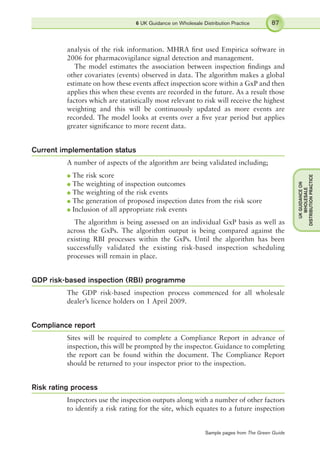
GDP risk-based inspection (RBI) programme
The GDP risk-based inspection process commenced for all wholesale
dealer’s licence holders on 1 April 2009.
Compliance report
Sites will be required to complete a Compliance Report in advance of
inspection, this will be prompted by the inspector. Guidance to completing
the report can be found within the document. The Compliance Report
should be returned to your inspector prior to the inspection.
Risk rating process
Inspectors use the inspection outputs along with a number of other factors
to identify a risk rating for the site, which equates to a future inspection
6 UK Guidance on Wholesale Distribution Practice 87
UKGUIDANCEON
WHOLESALE
DISTRIBUTIONPRACTICE
Sample pages from The Green Guide
frequency. As this process is not concluded until the inspection is closed the
risk ratings will not be discussed at the closing meetings. However a copy
of the full inspection report which includes the full risk rating rationale is
provided to sites once the inspection has been closed.
Issue of a certificate of GDP compliance and/or support of the site on the
relevant licence is indication of meeting the minimum level of GDP
compliance. Risk ratings identify the degree of surveillance required within
the licensing and inspection program. There is no intention that sites be
rated against each other as a result of risk ratings assigned by MHRA. Risk
ratings can change following inspection resulting in either increased or
decreased risk. Inspection risk ratings will not be published by MHRA.
There will be no formal process of appeal against risk ratings and future
inspection frequency. However any rating that results in an increased
inspection frequency from the previous standard will be peer reviewed
before conclusion by a GDP operations manager. MHRA does have a formal
complaints process if sites wish to log an issue, however any concerns
regarding the inspection process should be raised with the inspector.
Conditions of Holding a Wholesale Dealer’s Licence
The holder of a wholesale dealer’s licence must comply with certain
conditions in relation to the wholesale distribution of medicinal products.
These conditions are set out in regulations 43 – 45 of the Human Medicines
Regulations 2012 [SI 2012/1916] (“the Regulations”). They require that
the licence holder shall:
l comply with the guidelines on Good Distribution Practice (GDP);1
l ensure, within the limits of their responsibility as a distributor of medicinal
products, the appropriate and continued supply of such medicinal
products to pharmacies and persons who may lawfully sell such products
by retail or who may lawfully supply them in circumstances corresponding
to retail sale, so that the needs of patients in the UK are met;
l provide and maintain such staff, premises, equipment and facilities for
the handling, storage and distribution of the medicinal products under
the licence as are necessary to maintain the quality of, and ensure proper
distribution of the medicinal products;
l inform the licensing authority of any proposed structural alteration to, or
discontinued use of, premises to which the licence relates or premises
which have been approved by the licensing authority;
l inform the licensing authority of any change to the Responsible Person;
1
Guidelines on Good Distribution Practice of Medicinal Products for Human Use
(2013/C 343/01) http://eur-lex.europa.eu/LexUriServ/LexUriServ.do?uri=OJ:
C:2013:343:0001:0014:EN:PDF.
88 GUIDANCE ON WHOLESALE DISTRIBUTION PRACTICE AND BROKERING
Sample pages from The Green Guide

Rules and Guidance for Pharmaceutical Manufacturers Distributors 2015 - The Green Guide

  • 1.
    The Application andInspection Process “What to Expect” Applicants for a new wholesale dealer’s licence (WDA(H)) or existing licence holders wishing to vary their licence should apply using the MHRA Process Licensing Portal accessible via the MHRA website.1 MHRA acting as the licensing authority will only issue a wholesale dealer’s licence when it is satisfied, following an inspection of the site(s), that the information contained in the application is accurate and in compliance with the requirements of the legislation. When appropriate, MHRA may refuse to grant a wholesale dealer’s licence or may grant a wholesale dealer’s licence otherwise than as applied for. In such cases the licensing authority will notify the applicant of its proposals. The notification will set out the reasons for its proposals and give the applicant a period of not less than 28 days to respond. Planning Fee bearing inspections of licensed wholesale dealers are carried out to assess the degree of compliance to standards of Good Distribution Practice (GDP) and compliance with the provisions of the licence. Qualification of Customers and Suppliers 112 Qualification of suppliers 113 Compliance with GDP 113 Routine re-qualification 114 Due diligence 114 Falsified Medicines 114 Regulatory Action 116 Diverted Medicines 116 Parallel Distribution 116 Relabelling/Repackaging 118 Maintenance of the integrity of the supply chain 118 Continued Supply 119 Reporting Adverse Reactions 121 Product Recall/Withdrawal 121 Issue a “Recall” 122 Issue a “Drug Alert” 122 Management of the recall 123 Management of Recall Activity by Wholesalers 123 Management of Recall Activity by Brokers 124 Supply and brokering to countries outside of the UK 124 Testing the recall process 125 Follow-up action 126 Reporting a suspected defect 126 1 http://www.mhra.gov.uk/Howweregulate/Medicines/Licensingofmedicines/ Informationforlicenceapplicants/Licenceapplicationforms/Wholesaledealersli- cencesapplicationforms/index.htm 82 GUIDANCE ON WHOLESALE DISTRIBUTION PRACTICE AND BROKERING Sample pages from The Green Guide
  • 2.
    Inspections of wholesalerdealers (WDA(H) holders) are undertaken as part of the risk-based inspection programme, further details of which can be found in another section of this guide. Notification Advance notice of inspection is normally given to a company, unless circumstances require that an unannounced inspection should take place. The timing of the inspection would normally be notified in writing by the inspector. In accordance with the GDP risk-based inspection process, sites will be required to complete a Compliance Report in advance of inspection. Further information and guidance can be found in our risk-based inspections section. Conduct The major stages of the inspection process are: l the introductory or opening meeting l the detailed site inspection l the summary or closing meeting Introductory or opening meeting The purpose of the meeting is for the Inspector to meet with the appropriate key personnel from the company to discuss the arrangements for the inspection. The Inspector would typically confirm the nature of the business, premises and security arrangements, areas to be visited and any documentation which may be required. Site inspection The purpose of the site inspection is to determine the degree of conformity of the operations to the requirements of Good Distribution Practice and to assess compliance with the terms and conditions of licences issued under the appropriate legislation or with details submitted in support of an application for a licence. The inspection will typically involve visits to goods receipt, storage and dispatch areas (including ambient and refrigerated), returns/quarantine area, interviews with key personnel and a review of stock movement and quality system documentation including product recalls. Any observations, recommendations and deficiencies noted 6 UK Guidance on Wholesale Distribution Practice 83 UKGUIDANCEON WHOLESALE DISTRIBUTIONPRACTICE Sample pages from The Green Guide
  • 3.
    during the inspectionwould normally be discussed with the company representatives at the time. During inspections of manufacturing and wholesale operations, samples of starting materials, work in progress and finished products may be taken for testing if an Inspector considers that this might assist in the detection of quality deficiencies. Occasionally, samples may be taken when these cannot be obtained from other sources, for routine surveillance purposes. Summary or closing meeting The purpose of the meeting is for the Inspector to provide the company with a verbal summary of the inspection findings and to allow the company to correct at this stage any misconceptions. The Inspector would typically summarise the definition and classification of deficiencies they propose to report and the company are encouraged to give an undertaking to resolve the deficiencies and to agree a provisional timetable for corrective action. The Inspector would also describe the arrangements for the formal notification of the deficiencies to the company (the post-inspection letter) and what is expected as a response. Deficiencies are classified as follows: l Critical deficiency: Any departure from Guidelines on Good Distribution Practice resulting in a medicinal product causing a significant risk to the patient and public health. This includes an activity increasing the risk of falsified medicines reaching the patients. A combination of a number of major deficiencies that indicates a serious systems failure. An example of a critical deficiency could be: Purchase from or supply of medicinal products to a non-authorised person; Storage of products requiring refrigeration at ambient tempera- tures; Rejected or recalled products found in sellable stock. l Major Deficiency: A non-critical deficiency: which indicates a major deviation from Good Distribution Practice; or which has caused or may cause a medicinal product not to comply with its marketing authorisation in particular its storage and transport conditions; or which indicates a major deviation from the terms and provisions of the wholesale distribution authorisation; or a combination of several other deficiencies, none of which on their own may be major, but which may together represent a major deficiency. 84 GUIDANCE ON WHOLESALE DISTRIBUTION PRACTICE AND BROKERING Sample pages from The Green Guide
  • 4.
    l Other Deficiency: Adeficiency which cannot be classified as either critical or major, but which indicates a departure from Guidelines on Good Distribution Practice. The choice of company representatives at the meeting is primarily for the company to decide, but should normally include the senior staff who were present during the inspection and the Responsible Person (RP). Depending upon the inspection findings and the response from the company during and following the inspection, the Inspector may take one of a number of actions ranging from: l issuing a GDP certificate confirming essential compliance with GDP l referral to the Compliance escalation process or the Inspection Action Group (IAG) for consideration for adverse licensing action where serious non-compliance is found. Further information on the Compliance escalation process and IAG can be found in this publication. Company responses The inspected site is expected to provide a written response (by letter or email) to the post-inspection letter within the required timeframe. The response should consider the context of the deficiency within the overall quality system rather than just the specific issue identified. The response should include proposals for dealing with the deficiencies, together with a timetable for their implementation. The response should be structured as follows: l Restate the deficiency number and the deficiency as written below. l State the proposed corrective action. l State the proposed target date for the completion of the corrective action(s). l Include any comment the company considers appropriate. l Provide evidence supporting any corrective action where it is considered appropriate. Inspection report Once the Inspector is satisfied that any necessary remedial action has been taken or is in hand and that the site is essentially in compliance with GDP, an inspection report and GDP certificate are finalised. 6 UK Guidance on Wholesale Distribution Practice 85 UKGUIDANCEON WHOLESALE DISTRIBUTIONPRACTICE Sample pages from The Green Guide
  • 5.
    Risk-based Inspection Programme Introduction MHRAhas been incorporating elements of risk management into its inspection programme for a number of years. A formal risk-based inspection (RBI) programme was implemented on 1 April 2009, following public consultation MLX 345. The RBI programme covers all aspects of good practices associated with the inspection of clinical, pre-clinical and quality control laboratories, clinical trials, manufacturers, wholesalers and pharmacovigilance systems. The primary aim of the RBI programme is to enable inspectorate resources to focus on areas that maximise protection of public health while reducing the overall administrative and economic burden to stakeholders. Sentinel risk information module Working with technology partners Accenture, MHRA established its Sentinel IT system in 2005 which is used by most agency business areas to manage business processes for: l marketing authorisations l pharmacovigilance l clinical trials l manufacturer’s and wholesale dealer’s licences l inspections l issuing GMP and GDP certificates and automatic loading of these into the EMA’s EudraGMDP database. In February 2013 a newly developed Sentinel risk information module was deployed to expand upon the paper-based RBI system initiated in 2009. The Risk Estimation Tool uses the intelligence data collected on regulated companies, their respective sites and previous inspection results across all GxP areas to predict a risk score as “likely next inspection result”. This score is calculated for every site and can be interpreted as a weighted sum of inspection findings. Companies/sites are ranked based on predicted risk and business rules are applied to suggest a next inspection date. A planning step allows inspectors to accept or reject the suggested date taking into account other information which may not be included in the statistical calculation. For estimation of the risk score, the tool uses a logistic regression statistical model incorporating all data elements for all companies and sites. The model is fit (i.e. recomputed) monthly based on the most recent data extracted from Sentinel. The Empirica algorithm software was designed by Oracle Health Services to provide detailed 86 GUIDANCE ON WHOLESALE DISTRIBUTION PRACTICE AND BROKERING Sample pages from The Green Guide
  • 6.
    analysis of therisk information. MHRA first used Empirica software in 2006 for pharmacovigilance signal detection and management. The model estimates the association between inspection findings and other covariates (events) observed in data. The algorithm makes a global estimate on how these events affect inspection score within a GxP and then applies this when these events are recorded in the future. As a result those factors which are statistically most relevant to risk will receive the highest weighting and this will be continuously updated as more events are recorded. The model looks at events over a five year period but applies greater significance to more recent data. Current implementation status A number of aspects of the algorithm are being validated including; l The risk score l The weighting of inspection outcomes l The weighting of the risk events l The generation of proposed inspection dates from the risk score l Inclusion of all appropriate risk events The algorithm is being assessed on an individual GxP basis as well as across the GxPs. The algorithm output is being compared against the existing RBI processes within the GxPs. Until the algorithm has been successfully validated the existing risk-based inspection scheduling processes will remain in place. GDP risk-based inspection (RBI) programme The GDP risk-based inspection process commenced for all wholesale dealer’s licence holders on 1 April 2009. Compliance report Sites will be required to complete a Compliance Report in advance of inspection, this will be prompted by the inspector. Guidance to completing the report can be found within the document. The Compliance Report should be returned to your inspector prior to the inspection. Risk rating process Inspectors use the inspection outputs along with a number of other factors to identify a risk rating for the site, which equates to a future inspection 6 UK Guidance on Wholesale Distribution Practice 87 UKGUIDANCEON WHOLESALE DISTRIBUTIONPRACTICE Sample pages from The Green Guide
  • 7.
    frequency. As thisprocess is not concluded until the inspection is closed the risk ratings will not be discussed at the closing meetings. However a copy of the full inspection report which includes the full risk rating rationale is provided to sites once the inspection has been closed. Issue of a certificate of GDP compliance and/or support of the site on the relevant licence is indication of meeting the minimum level of GDP compliance. Risk ratings identify the degree of surveillance required within the licensing and inspection program. There is no intention that sites be rated against each other as a result of risk ratings assigned by MHRA. Risk ratings can change following inspection resulting in either increased or decreased risk. Inspection risk ratings will not be published by MHRA. There will be no formal process of appeal against risk ratings and future inspection frequency. However any rating that results in an increased inspection frequency from the previous standard will be peer reviewed before conclusion by a GDP operations manager. MHRA does have a formal complaints process if sites wish to log an issue, however any concerns regarding the inspection process should be raised with the inspector. Conditions of Holding a Wholesale Dealer’s Licence The holder of a wholesale dealer’s licence must comply with certain conditions in relation to the wholesale distribution of medicinal products. These conditions are set out in regulations 43 – 45 of the Human Medicines Regulations 2012 [SI 2012/1916] (“the Regulations”). They require that the licence holder shall: l comply with the guidelines on Good Distribution Practice (GDP);1 l ensure, within the limits of their responsibility as a distributor of medicinal products, the appropriate and continued supply of such medicinal products to pharmacies and persons who may lawfully sell such products by retail or who may lawfully supply them in circumstances corresponding to retail sale, so that the needs of patients in the UK are met; l provide and maintain such staff, premises, equipment and facilities for the handling, storage and distribution of the medicinal products under the licence as are necessary to maintain the quality of, and ensure proper distribution of the medicinal products; l inform the licensing authority of any proposed structural alteration to, or discontinued use of, premises to which the licence relates or premises which have been approved by the licensing authority; l inform the licensing authority of any change to the Responsible Person; 1 Guidelines on Good Distribution Practice of Medicinal Products for Human Use (2013/C 343/01) http://eur-lex.europa.eu/LexUriServ/LexUriServ.do?uri=OJ: C:2013:343:0001:0014:EN:PDF. 88 GUIDANCE ON WHOLESALE DISTRIBUTION PRACTICE AND BROKERING Sample pages from The Green Guide