BY
ORDUEKWA SOLOMON
DEPT. OF ENVT. TECHN.(EVT)
FEDERAL UNIVERSITY OF TECH.
OWERRI (FUTO)
OUTLINE
INTRO
• INTRODUCTION
• DEFINITIONS
• ENVIRONMENTAL COMPONENTS
BODY
• ENVIRONMENTAL PROBLEMS
• MEANING OF GOING GREEN
• REASONS FOR GOING GREEN
• HOW TO GO GREEN
SUMMARY
• RECOMMENDATIONS
• CONCLUSION
INTRODUCTION
In today’s world, no individual
operates in a vacuum. Our choices
and behaviors have a ripple effect
that reach across the world and on to
future generations.
What we buy, what we do or do not,
what we “throw away” has an impact
on an evermore interconnected
planet.
If we want our future generations to
continue to have this great wealth of
natural resources, it will take an all-
hands effort to preserve clean air,
water and soil.
DEFINITIONS
 Green is the symbolic color
of environmentalism and
sustainability.
 Anything can be green-from
energy policy to building
design, parenting
techniques, and economic
strategies.
 Green is often used to
describe efforts to reduce
the impact of modern
human life on the rest of the
natural world.
 The surroundings or conditions
in which a person, animal, or
plant lives or operates.
 An environment is all of the
conditions, circumstances, etc.
that surround and influence life
on earth, including atmospheric
conditions, food chains, and the
water cycle.
 Our environment is a
combination of many elements,
both living and non-living that
make up our surroundings.
Some include natural elements
and some are manufactured.
GREEN ENVIRONMENT
COMPONENTS OF THE ENVIRONMENT
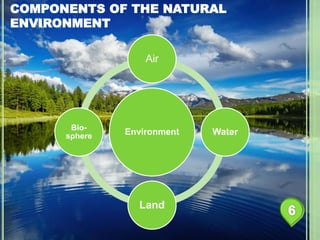
COMPONENTS OF THE NATURAL
ENVIRONMENT
Environment
Air
Water
Land
Bio-
sphere
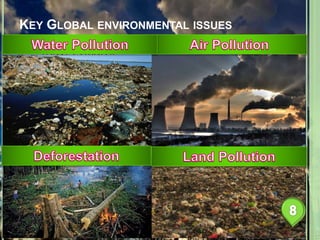
ENVIRONMENTAL PROBLEMS
 Overpopulation
 Natural Resource Depletion
 Loss of Biodiversity
 Waste Disposal
 Pollution
 Urban Sprawl
 Acid Rain
 Ozone Layer Depletion
 Global Warming
KEY GLOBAL ENVIRONMENTAL ISSUES
GLOBAL WARMING
This graph illustrates the change in global
surface temperature relative to 1951-1980
average temperatures. The 10 warmest years
in the 134-year record all have occurred since
2000, with the exception of 1998. The time
series below shows the five-year average
variation of global surface temperatures from
1884 to 2015. Dark blue indicates areas
cooler than average. Dark red indicates areas
warmer than average.
EFFECTS OF GLOBAL WARMING
EFFECTS…
REDUCED PRODUCTIVITY LOSS OF BIODIVERSITY
GOING GREEN
Basically, going green means to live
life, as an individual as well as a
community, in a way that is friendly to
the natural environment and is
sustainable for the earth.
It means contributing towards
maintaining the natural ecological
balance in the environment, and
preserving the planet and it’s systems
& resources.
It means taking steps, whether big or
small, to minimize the harm you do to
the environment.
Reduce pollution
Conserve resources
Conserve energy
Reduce consumption
and waste
Protect the earth’s ecological
balance
Business
• Beat the competition
• Earn and save more
money
Legal
• Avoid Regulatory
burdens
• Meet legal requirements
Environmental
• Save natural resources
• Benefit or protect the
environment
Political
• Achieve Energy
independence
• Effect a political change
• Solve or prevent crisis
Ethical
• Benefit future generation
• Benefit animals
HOW TO GO GREEN
REDUCE
Transportation
• Bicycling, Walking,
• Carpooling, Use public Transport.
Save energy
• Use energy efficient bulbs
• Off bulbs during the day
Conserve water
• Off taps while not in use
• Don’t waste
REUSE
Refillables
• Water bottles
• Cans
Reusable
• Launch box
• Reusable bags
Save papers
• Use the backside of a paper
• Use e-mails
RECYCLE
Plastics
• Polyethynes
• Bottle water
Papers
• News papers,
• Magazines, etc.
Metals
• Aluminums
• Cars
Waste to Energy (WTE)
• Generate Energy from inflammable waste
• Make manuals from compost
 A carbon footprint is
historically defined as "the
total set of greenhouse gas
emissions caused by an
[individual, event,
organization, product]
expressed as CO2e
 Your carbon footprint is the
sum of all emissions of CO2
(carbon dioxide), which were
induced by your activities in a
given time frame. Usually a
carbon footprint is calculated
for the time period of a year.
Fuel type Unit
CO2 emitted per
unit
Petrol
1 gallon (UK) 10.4 kg
Petrol 1 liter 2.3 kg
Gasoline
1 gallon (USA) 8.7 kg
Gasoline
1 liter 2.3 kg
Diesel
1 gallon (UK) 12.2 kg
Diesel
1 gallon (USA)
9.95 kg
Diesel 1 liter 2.7 kg
Oil (heating) 1 gallon (UK) 13.6 kg
Oil (heating)
1 gallon (USA)
11.26 kg
Oil (heating) 1 liter 3 kg
Source: M.J. Bradley & Associates, 2008), p. 4, table 1.1
KNOW YOUR CARBON FOOTPRINT
Average carbon dioxide emissions (grams) per
passenger mile (USA). Based on 'Updated Comparison
of Energy Use & CO2 Emissions From Different
Transportation Modes, October 2008' (Manchester, NH: M.J.
Bradley & Associates, 2008), p. 4, table 1.1
Calculation:
If your car consumes 7.5 liter
diesel per 100 km, then a drive of
300 km distance consumes
3 x 7.5 = 22.5 liter diesel, which
adds 22.5 x 2.7 kg = 60.75 kg
CO2 to your personal carbon
footprint.
WORK PLACE RECOMMENDATION FOR GOING GREEN
PERSONAL RECOMMENDATION ON GOING
GREEN
CONCLUSION
 The green environment means a healthy,
sustainable, conservative, productive and
wealthy environment.
 Go green and be healthy,
 Go green and be rich,
 Go green and save the unborn world.
 Go green, think green, its easy, simple and
life transforming.
Green environment solowise 1

Green environment solowise 1

  • 1.
    BY ORDUEKWA SOLOMON DEPT. OFENVT. TECHN.(EVT) FEDERAL UNIVERSITY OF TECH. OWERRI (FUTO)
  • 2.
    OUTLINE INTRO • INTRODUCTION • DEFINITIONS •ENVIRONMENTAL COMPONENTS BODY • ENVIRONMENTAL PROBLEMS • MEANING OF GOING GREEN • REASONS FOR GOING GREEN • HOW TO GO GREEN SUMMARY • RECOMMENDATIONS • CONCLUSION
  • 3.
    INTRODUCTION In today’s world,no individual operates in a vacuum. Our choices and behaviors have a ripple effect that reach across the world and on to future generations. What we buy, what we do or do not, what we “throw away” has an impact on an evermore interconnected planet. If we want our future generations to continue to have this great wealth of natural resources, it will take an all- hands effort to preserve clean air, water and soil.
  • 4.
    DEFINITIONS  Green isthe symbolic color of environmentalism and sustainability.  Anything can be green-from energy policy to building design, parenting techniques, and economic strategies.  Green is often used to describe efforts to reduce the impact of modern human life on the rest of the natural world.  The surroundings or conditions in which a person, animal, or plant lives or operates.  An environment is all of the conditions, circumstances, etc. that surround and influence life on earth, including atmospheric conditions, food chains, and the water cycle.  Our environment is a combination of many elements, both living and non-living that make up our surroundings. Some include natural elements and some are manufactured. GREEN ENVIRONMENT
  • 5.
    COMPONENTS OF THEENVIRONMENT
  • 6.
    COMPONENTS OF THENATURAL ENVIRONMENT Environment Air Water Land Bio- sphere
  • 7.
    ENVIRONMENTAL PROBLEMS  Overpopulation Natural Resource Depletion  Loss of Biodiversity  Waste Disposal  Pollution  Urban Sprawl  Acid Rain  Ozone Layer Depletion  Global Warming
  • 8.
  • 9.
    GLOBAL WARMING This graphillustrates the change in global surface temperature relative to 1951-1980 average temperatures. The 10 warmest years in the 134-year record all have occurred since 2000, with the exception of 1998. The time series below shows the five-year average variation of global surface temperatures from 1884 to 2015. Dark blue indicates areas cooler than average. Dark red indicates areas warmer than average.
  • 10.
  • 11.
  • 14.
    GOING GREEN Basically, goinggreen means to live life, as an individual as well as a community, in a way that is friendly to the natural environment and is sustainable for the earth. It means contributing towards maintaining the natural ecological balance in the environment, and preserving the planet and it’s systems & resources. It means taking steps, whether big or small, to minimize the harm you do to the environment. Reduce pollution Conserve resources Conserve energy Reduce consumption and waste Protect the earth’s ecological balance
  • 15.
    Business • Beat thecompetition • Earn and save more money Legal • Avoid Regulatory burdens • Meet legal requirements Environmental • Save natural resources • Benefit or protect the environment Political • Achieve Energy independence • Effect a political change • Solve or prevent crisis Ethical • Benefit future generation • Benefit animals
  • 16.
    HOW TO GOGREEN REDUCE Transportation • Bicycling, Walking, • Carpooling, Use public Transport. Save energy • Use energy efficient bulbs • Off bulbs during the day Conserve water • Off taps while not in use • Don’t waste
  • 17.
    REUSE Refillables • Water bottles •Cans Reusable • Launch box • Reusable bags Save papers • Use the backside of a paper • Use e-mails
  • 18.
    RECYCLE Plastics • Polyethynes • Bottlewater Papers • News papers, • Magazines, etc. Metals • Aluminums • Cars Waste to Energy (WTE) • Generate Energy from inflammable waste • Make manuals from compost
  • 19.
     A carbonfootprint is historically defined as "the total set of greenhouse gas emissions caused by an [individual, event, organization, product] expressed as CO2e  Your carbon footprint is the sum of all emissions of CO2 (carbon dioxide), which were induced by your activities in a given time frame. Usually a carbon footprint is calculated for the time period of a year. Fuel type Unit CO2 emitted per unit Petrol 1 gallon (UK) 10.4 kg Petrol 1 liter 2.3 kg Gasoline 1 gallon (USA) 8.7 kg Gasoline 1 liter 2.3 kg Diesel 1 gallon (UK) 12.2 kg Diesel 1 gallon (USA) 9.95 kg Diesel 1 liter 2.7 kg Oil (heating) 1 gallon (UK) 13.6 kg Oil (heating) 1 gallon (USA) 11.26 kg Oil (heating) 1 liter 3 kg Source: M.J. Bradley & Associates, 2008), p. 4, table 1.1
  • 20.
    KNOW YOUR CARBONFOOTPRINT Average carbon dioxide emissions (grams) per passenger mile (USA). Based on 'Updated Comparison of Energy Use & CO2 Emissions From Different Transportation Modes, October 2008' (Manchester, NH: M.J. Bradley & Associates, 2008), p. 4, table 1.1 Calculation: If your car consumes 7.5 liter diesel per 100 km, then a drive of 300 km distance consumes 3 x 7.5 = 22.5 liter diesel, which adds 22.5 x 2.7 kg = 60.75 kg CO2 to your personal carbon footprint.
  • 21.
  • 22.
  • 23.
    CONCLUSION  The greenenvironment means a healthy, sustainable, conservative, productive and wealthy environment.  Go green and be healthy,  Go green and be rich,  Go green and save the unborn world.  Go green, think green, its easy, simple and life transforming.

Editor's Notes

  • #5 In many cultures, green is the color associated with nature and growth. There is no single way to define “being green,” nor is there a limit to the number of efforts that can be made to go green. Therefore the green environment means a healthy environment, a sustainable environment and a wealthy environment. Therefore green environment means a natural, sustainable, environmental friendly, healthy environment.
  • #14 Now the choice is yours, our environment is in our hands weather to go green or not, but I strongly advice we go green.