Green Accounting
Introduction
Dr. Johan van Rooyen
Rationale for conventional
accounting
• Measurement of economic activity - production = GDP
• Often used as indicator of welfare
• Two elements of accounts
• Changes in Stocks of Capital - Investment
• Measurement of production/output – Flows - Consumption
Standard National Accounts
(SNA) framework
• NNP = C + I – D + X – M or GDP= C + I + G + X - M
Where:
NNP = Net National Product GDP= Gross national Product
C = Consumption
I = Investment
D = Depreciation
X = Exports
M = Imports
G = Government spending
Misleadingly used as measure of welfare: welfare not
proportionate to consumption of produced goods
Green accounting – rationale
“The effect of mankind’s activity upon the environment
has been an important policy issue throughout the last
part of the twentieth century….
increasing recognition that continuing economic growth
and human welfare are dependent upon the services
provided by the environment”
Source: The United Nations Handbook of National Accounting -
Integrated Environmental and Economic Accounting
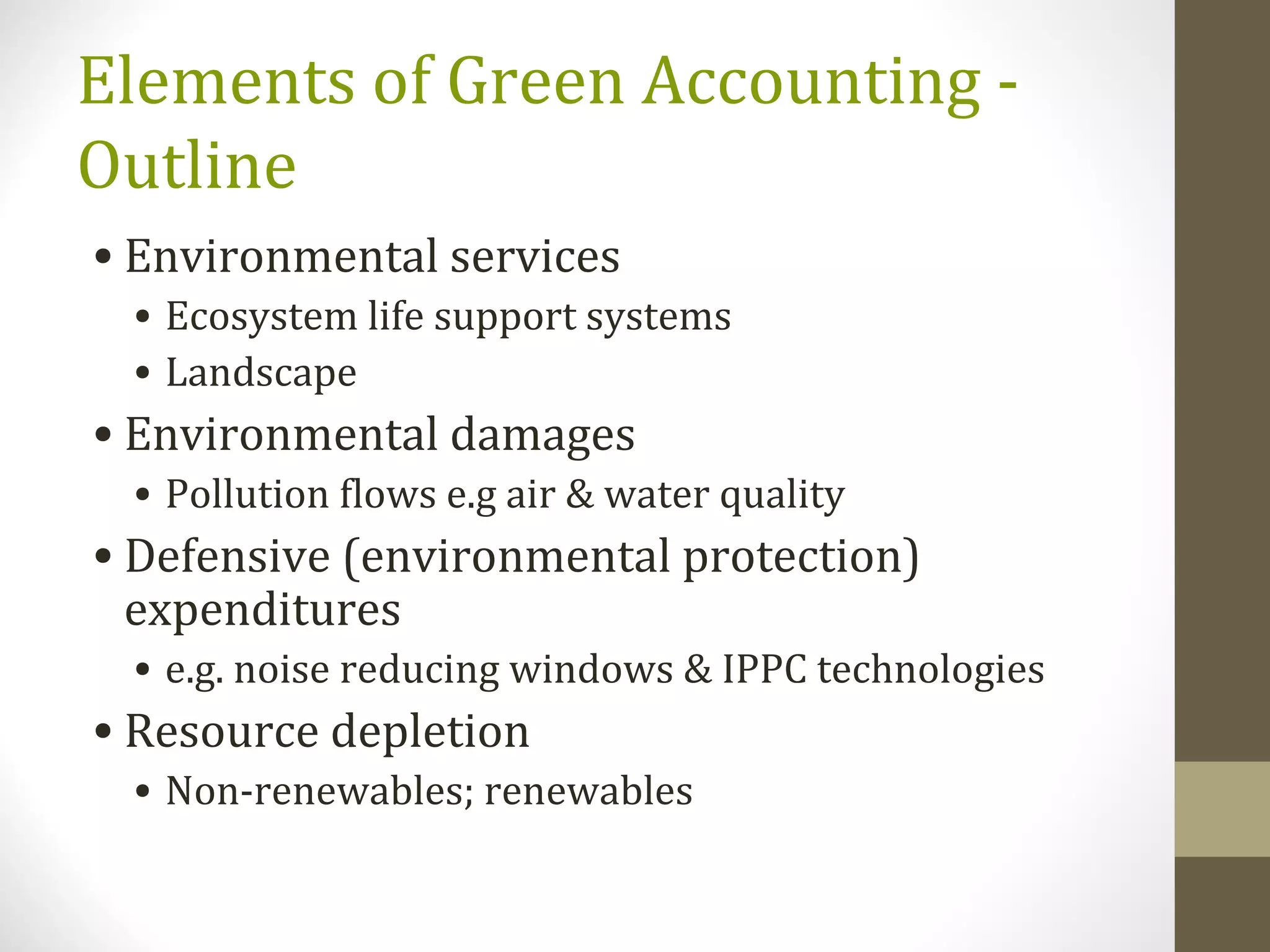
Elements of Green Accounting -
Outline
• Environmental services
• Ecosystem life support systems
• Landscape
• Environmental damages
• Pollution flows e.g air & water quality
• Defensive (environmental protection)
expenditures
• e.g. noise reducing windows & IPPC technologies
• Resource depletion
• Non-renewables; renewables
Empirical progress in
Environmental Accounting in diffe
rent contexts
– some evidence
UN initiative on Green Accounting – UNSEEA
(1993, 2000, 2003)
• System of integrated Environmental and Economic
Accounting (SEEA) – complements SNA method for measur
ing economic activity
• Adds environmental information to existing Input-Output
economic data
• Physical stock and flow tables
• Hybrid (physical & monetary) stock and flow tables
• Methodological guidance on resource depletion,
degradation, defensive expenditures
An indicator of weak
sustainability: genuine savings
• Genuine Savings = monetary savings less the depreciation on
manmade capital less the depletion of natural capital. (From S = Iv id
entity)
• Value of changes in economy’s overall capital stocks.
• Negative genuine saving corresponds to unsustainability, since if
depleting capital stock, can receive lower welfare from it in future
• Genuine Savings rates low or negative for Sub-Saharan Africa and for
Middle East and North Africa.
• Assumes all capital is substitutable
The Index of Sustainable
Economic Welfare (ISEW)
• ISEW
• current welfare should be measured as the current flow of
services from all sources, rather than current output of mar
keted goods
• E.g.
• value for leisure time to correct for the fact that welfare could
increase while NNP decreases if people choose to work less;
• higher incomes of urban residents are compensation for
externalities connected with urbanisation and congestion, ∴ p
roportion of income should not be included as welfare
The Index of Sustainable
Economic Welfare (ISEW)
ISEW =
Consumption + Investment + Extra-Market services + Consumer Durables
Services + Services of Roads + Public Health & Education – Consumer
Durables Expenditure – Private Defensive Expenditure on Health/Education –
Advertising – Commuting costs – Pollution costs – cost of loss of ecosystems –
resource depletion costs – Long term environmental damage

Sustainability targets analysed
under the GREENSENSE project
Environmental
Impact
Weak Sustainability Intermediate sustainability target Strong sustainability target
Air pollution Invest the value of damage to capital
stocks due to air pollution.
Current legislation with Emission Ceilings Medium Ambition GAP Closure +
Emission Ceilings
/ Maximum Technical Feasible Solution
Climate Change Invest the NPV of the cost of current
carbon emissions ($4/tonne current
estimate)
550 ppmv by 2120 450 ppmv by 2120
Biodiversity Invest the value of damage to capital
stocks due to biodiversity loss
Natura 2000 network to be preserved
No further wetland loss or degradation
15% of agricultural area under management
contracts
No further deterioration of natural and semi-
natural forests
20% of all land to be preserved in natural
condition
Natural resources Energy: Invest % of resource rents
Invest value of future price
Increases
Forestry: Invest value of future price
increases
12% energy from renewables by 2010 16-19% energy from renewables by 2010
(current estimate)
Toxic Substances Invest the value of damage to capital
stocks due to Toxic substances
Concentration levels of lead and cadmium
given in EU Directives
Future steady-state concentrations of lead
and cadmium
Urban
Environmental
Problems (Noise)
Not applicable since only current
welfare impacts
Not applicable since only current welfare
impacts
Not applicable since only current welfare
impacts
Waste Invest the value of damage (e.g. land
converted for landfill) due to waste
Landfill max. 35% of household waste;
Recycle 25%
Land space availability
Water Pollution Invest the value of any decline in water
resource stocks.
Satisfaction of the EC Water Framework
Directive
Satisfaction of the EC Water Framework
Directive
Conclusions on Green Accounting
• Recognition of need to address both current welfare and
sustainability issues from macro-perspective
• National and international initiatives (e.g. UN SEEA, 2003)
are developing improved methodologies
• Variety of initiatives reflects lack of consensus on priorities
and methods
• Local applications of methods can reflect regulatory
responsibilities but may be difficult to define sustainability
at this scale?
• Applications very data-hungry and modelling intensive

Green Accounting

  • 1.
  • 2.
    Rationale for conventional accounting •Measurement of economic activity - production = GDP • Often used as indicator of welfare • Two elements of accounts • Changes in Stocks of Capital - Investment • Measurement of production/output – Flows - Consumption
  • 3.
    Standard National Accounts (SNA)framework • NNP = C + I – D + X – M or GDP= C + I + G + X - M Where: NNP = Net National Product GDP= Gross national Product C = Consumption I = Investment D = Depreciation X = Exports M = Imports G = Government spending Misleadingly used as measure of welfare: welfare not proportionate to consumption of produced goods
  • 4.
    Green accounting –rationale “The effect of mankind’s activity upon the environment has been an important policy issue throughout the last part of the twentieth century…. increasing recognition that continuing economic growth and human welfare are dependent upon the services provided by the environment” Source: The United Nations Handbook of National Accounting - Integrated Environmental and Economic Accounting
  • 5.
    Elements of GreenAccounting - Outline • Environmental services • Ecosystem life support systems • Landscape • Environmental damages • Pollution flows e.g air & water quality • Defensive (environmental protection) expenditures • e.g. noise reducing windows & IPPC technologies • Resource depletion • Non-renewables; renewables
  • 6.
    Empirical progress in EnvironmentalAccounting in diffe rent contexts – some evidence
  • 7.
    UN initiative onGreen Accounting – UNSEEA (1993, 2000, 2003) • System of integrated Environmental and Economic Accounting (SEEA) – complements SNA method for measur ing economic activity • Adds environmental information to existing Input-Output economic data • Physical stock and flow tables • Hybrid (physical & monetary) stock and flow tables • Methodological guidance on resource depletion, degradation, defensive expenditures
  • 8.
    An indicator ofweak sustainability: genuine savings • Genuine Savings = monetary savings less the depreciation on manmade capital less the depletion of natural capital. (From S = Iv id entity) • Value of changes in economy’s overall capital stocks. • Negative genuine saving corresponds to unsustainability, since if depleting capital stock, can receive lower welfare from it in future • Genuine Savings rates low or negative for Sub-Saharan Africa and for Middle East and North Africa. • Assumes all capital is substitutable
  • 9.
    The Index ofSustainable Economic Welfare (ISEW) • ISEW • current welfare should be measured as the current flow of services from all sources, rather than current output of mar keted goods • E.g. • value for leisure time to correct for the fact that welfare could increase while NNP decreases if people choose to work less; • higher incomes of urban residents are compensation for externalities connected with urbanisation and congestion, ∴ p roportion of income should not be included as welfare
  • 10.
    The Index ofSustainable Economic Welfare (ISEW) ISEW = Consumption + Investment + Extra-Market services + Consumer Durables Services + Services of Roads + Public Health & Education – Consumer Durables Expenditure – Private Defensive Expenditure on Health/Education – Advertising – Commuting costs – Pollution costs – cost of loss of ecosystems – resource depletion costs – Long term environmental damage 
  • 11.
    Sustainability targets analysed underthe GREENSENSE project Environmental Impact Weak Sustainability Intermediate sustainability target Strong sustainability target Air pollution Invest the value of damage to capital stocks due to air pollution. Current legislation with Emission Ceilings Medium Ambition GAP Closure + Emission Ceilings / Maximum Technical Feasible Solution Climate Change Invest the NPV of the cost of current carbon emissions ($4/tonne current estimate) 550 ppmv by 2120 450 ppmv by 2120 Biodiversity Invest the value of damage to capital stocks due to biodiversity loss Natura 2000 network to be preserved No further wetland loss or degradation 15% of agricultural area under management contracts No further deterioration of natural and semi- natural forests 20% of all land to be preserved in natural condition Natural resources Energy: Invest % of resource rents Invest value of future price Increases Forestry: Invest value of future price increases 12% energy from renewables by 2010 16-19% energy from renewables by 2010 (current estimate) Toxic Substances Invest the value of damage to capital stocks due to Toxic substances Concentration levels of lead and cadmium given in EU Directives Future steady-state concentrations of lead and cadmium Urban Environmental Problems (Noise) Not applicable since only current welfare impacts Not applicable since only current welfare impacts Not applicable since only current welfare impacts Waste Invest the value of damage (e.g. land converted for landfill) due to waste Landfill max. 35% of household waste; Recycle 25% Land space availability Water Pollution Invest the value of any decline in water resource stocks. Satisfaction of the EC Water Framework Directive Satisfaction of the EC Water Framework Directive
  • 12.
    Conclusions on GreenAccounting • Recognition of need to address both current welfare and sustainability issues from macro-perspective • National and international initiatives (e.g. UN SEEA, 2003) are developing improved methodologies • Variety of initiatives reflects lack of consensus on priorities and methods • Local applications of methods can reflect regulatory responsibilities but may be difficult to define sustainability at this scale? • Applications very data-hungry and modelling intensive