GREAT INVENTIONSGREAT INVENTIONS
• TelevisionTelevision
• ElectricityElectricity
• AeroplaneAeroplane
• TelephoneTelephone
• Computer (20th Century)Computer (20th Century)
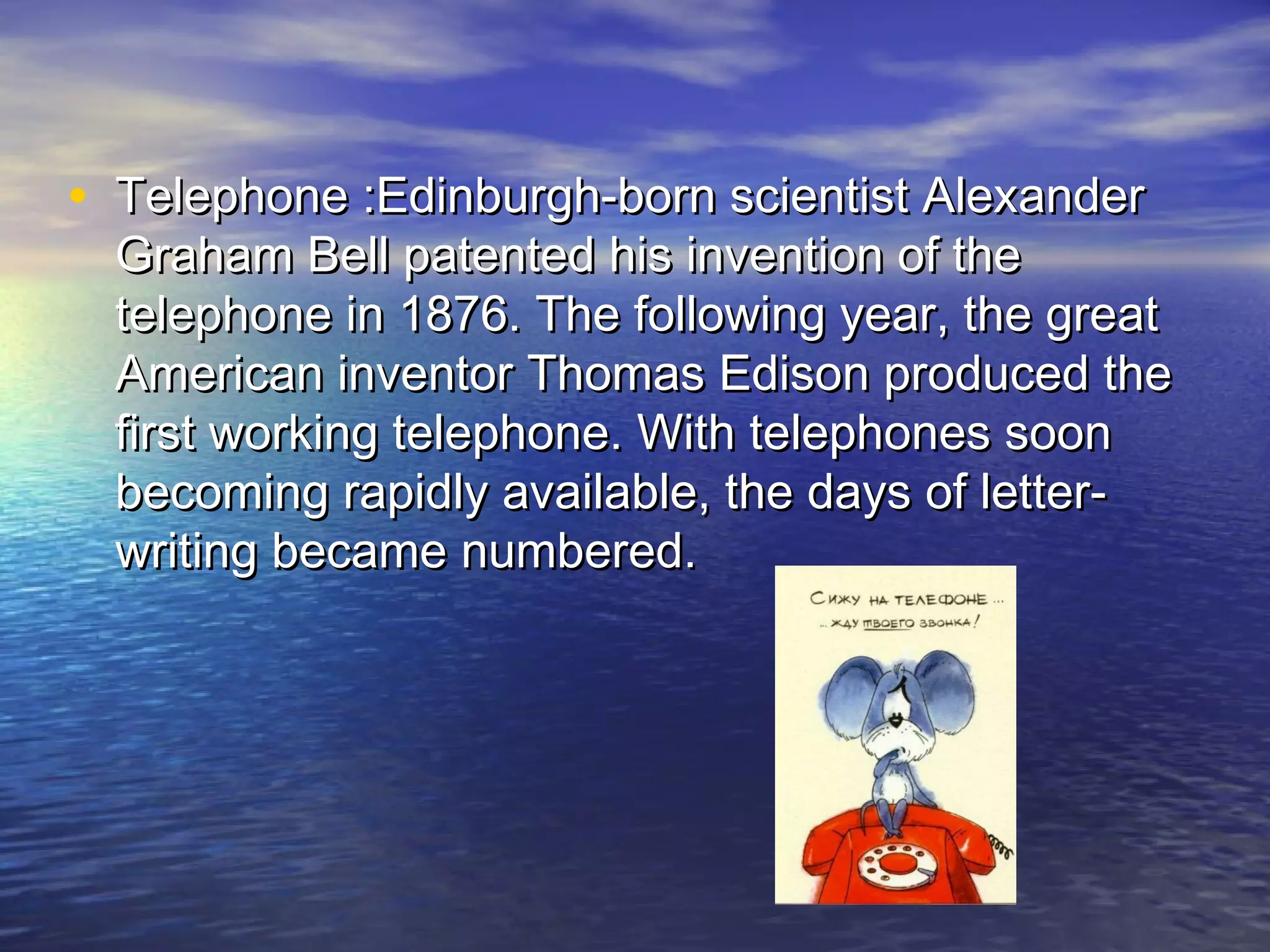
• Telephone :Edinburgh-born scientist AlexanderTelephone :Edinburgh-born scientist Alexander
Graham Bell patented his invention of theGraham Bell patented his invention of the
telephone in 1876. The following year, the greattelephone in 1876. The following year, the great
American inventor Thomas Edison produced theAmerican inventor Thomas Edison produced the
first working telephone. With telephones soonfirst working telephone. With telephones soon
becoming rapidly available, the days of letter-becoming rapidly available, the days of letter-
writing became numbered.writing became numbered.
Computer (20th Century)Computer (20th Century)
• The computer has been another life-The computer has been another life-
transforming invention. British mathematiciantransforming invention. British mathematician
Charles Babbage designed a form of computerCharles Babbage designed a form of computer
in the mid-1830s, but it was not until more than ain the mid-1830s, but it was not until more than a
century later that theory was put into practice.century later that theory was put into practice.
Now, a whole generation has grown up withNow, a whole generation has grown up with
calculators, windows, icons, computer gamescalculators, windows, icons, computer games
and word processors, and the Internet and e-and word processors, and the Internet and e-
mail have transformed communication andmail have transformed communication and
information.information.
TelevisionTelevision
• The invention that swept the world and changedThe invention that swept the world and changed
leisure habits for countless millions wasleisure habits for countless millions was
pioneered by Scottish-bom electrical engineerpioneered by Scottish-bom electrical engineer
John Logie Baird. It had been realised for someJohn Logie Baird. It had been realised for some
time that light could be converted into electricaltime that light could be converted into electrical
impulses, making it possible to transmit suchimpulses, making it possible to transmit such
impulses over a distance and then reconvertimpulses over a distance and then reconvert
them into light.them into light.
TelevisionTelevision
• The invention that swept the world and changedThe invention that swept the world and changed
leisure habits for countless millions wasleisure habits for countless millions was
pioneered by Scottish-bom electrical engineerpioneered by Scottish-bom electrical engineer
John Logie Baird. It had been realised for someJohn Logie Baird. It had been realised for some
time that light could be converted into electricaltime that light could be converted into electrical
impulses, making it possible to transmit suchimpulses, making it possible to transmit such
impulses over a distance and then reconvertimpulses over a distance and then reconvert
them into light.them into light.

Greatinventions

  • 1.
  • 2.
    GREAT INVENTIONSGREAT INVENTIONS •TelevisionTelevision • ElectricityElectricity • AeroplaneAeroplane • TelephoneTelephone • Computer (20th Century)Computer (20th Century)
  • 3.
    • Telephone :Edinburgh-bornscientist AlexanderTelephone :Edinburgh-born scientist Alexander Graham Bell patented his invention of theGraham Bell patented his invention of the telephone in 1876. The following year, the greattelephone in 1876. The following year, the great American inventor Thomas Edison produced theAmerican inventor Thomas Edison produced the first working telephone. With telephones soonfirst working telephone. With telephones soon becoming rapidly available, the days of letter-becoming rapidly available, the days of letter- writing became numbered.writing became numbered.
  • 5.
    Computer (20th Century)Computer(20th Century) • The computer has been another life-The computer has been another life- transforming invention. British mathematiciantransforming invention. British mathematician Charles Babbage designed a form of computerCharles Babbage designed a form of computer in the mid-1830s, but it was not until more than ain the mid-1830s, but it was not until more than a century later that theory was put into practice.century later that theory was put into practice. Now, a whole generation has grown up withNow, a whole generation has grown up with calculators, windows, icons, computer gamescalculators, windows, icons, computer games and word processors, and the Internet and e-and word processors, and the Internet and e- mail have transformed communication andmail have transformed communication and information.information.
  • 6.
    TelevisionTelevision • The inventionthat swept the world and changedThe invention that swept the world and changed leisure habits for countless millions wasleisure habits for countless millions was pioneered by Scottish-bom electrical engineerpioneered by Scottish-bom electrical engineer John Logie Baird. It had been realised for someJohn Logie Baird. It had been realised for some time that light could be converted into electricaltime that light could be converted into electrical impulses, making it possible to transmit suchimpulses, making it possible to transmit such impulses over a distance and then reconvertimpulses over a distance and then reconvert them into light.them into light.
  • 7.
    TelevisionTelevision • The inventionthat swept the world and changedThe invention that swept the world and changed leisure habits for countless millions wasleisure habits for countless millions was pioneered by Scottish-bom electrical engineerpioneered by Scottish-bom electrical engineer John Logie Baird. It had been realised for someJohn Logie Baird. It had been realised for some time that light could be converted into electricaltime that light could be converted into electrical impulses, making it possible to transmit suchimpulses, making it possible to transmit such impulses over a distance and then reconvertimpulses over a distance and then reconvert them into light.them into light.