Presented by:
The ICT AND THE COMPUTER ITS ROLE AND
HISTORY
Motivations.
Presented by:
The ICT AND THE COMPUTER ITS ROLE AND
HISTORY
Presented by:
The ICT AND THE COMPUTER ITS ROLE AND
HISTORY
Motivations.
 Internet has been the most useful technology of the
modern times which helps us not only in our daily lives,
but also our personal and professional lives
developments. The internet helps us achieve this in
several different ways.
 For the students and educational purposes the internet
is widely used to gather information so as to do research
or add to the knowledge of any sort of subject they have.
Even the business personals and the professionals like
doctors, access the internet to filter the necessary
information for their use. The internet is therefore the
largest encyclopedia for everyone, in all age categories.
Uses of Internet
 Advantages
 Everyone is of course very well known that
known that internet advantages than just a
few concerned ones. With the introduction of
the internet the global communication has
become a matter of just the fingertips of the
users.
 The internet has become a matter of just the
fingertips of the users.
Advantages and Disadvantages of
Internet
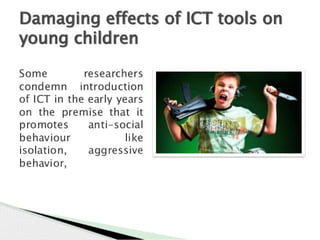
 Everything has the negative aspect to it and so
does the internet, the biggest threat of the
internet is in the pornography and the security
threats.
 Pornography is widespread over the internet
making it inappropriate to be used by the children
below certain age so as to prevent the
psychological damage from the early days. These
sites are easily accessible and attractive for the
teenagers and young kids.
Disadvantages
ICT created an enormous growth over the
past years in the field of education . It has
changed many aspects in the teaching and
Learning process as it affects the
educations system, educational learning
environment , teaching methods and strategies
and the way the students learn.
Let us find out how the development of
ICT had made a great impact in education.
Evolution of ICT in Education
1650- The Horn Book is a teaching
aid consisting of a leaf of paper showing the
alphabet, and often the ten digits and the
Lord's Prayer, mounted on a wooden tablet
and protected by a thin plate of horn.
The Difference Engine, designed in the 1820s by the
English mathematician and inventor Charles Babbage
, was intended to automatically compute
mathematical tables which, until that time, had
been tediously calculated by hand and were prone to
error.
The Analytical Engine was a proposed
mechanical general-purpose computer
designed by English mathematician and
computer pioneer Charles Babbage. ...
Babbage was never able to complete
construction of any of his machines due to
conflicts with his chief engineer and
inadequate funding.
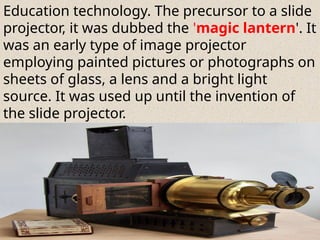
Education technology. The precursor to a slide
projector, it was dubbed the 'magic lantern'. It
was an early type of image projector
employing painted pictures or photographs on
sheets of glass, a lens and a bright light
source. It was used up until the invention of
the slide projector.
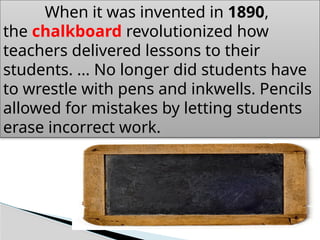
When it was invented in 1890,
the chalkboard revolutionized how
teachers delivered lessons to their
students. ... No longer did students have
to wrestle with pens and inkwells. Pencils
allowed for mistakes by letting students
erase incorrect work.
A stereoscope is a device for viewing
a stereoscopic pair of separate
images, depicting left-eye and right-
eye views of the same scene, as a
single three-dimensional image.
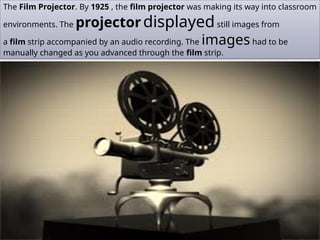
The Film Projector. By 1925 , the film projector was making its way into classroom
environments. The projectordisplayedstill images from
a film strip accompanied by an audio recording. The imageshad to be
manually changed as you advanced through the film strip.
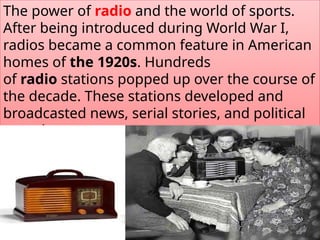
The power of radio and the world of sports.
After being introduced during World War I,
radios became a common feature in American
homes of the 1920s. Hundreds
of radio stations popped up over the course of
the decade. These stations developed and
broadcasted news, serial stories, and political
speeches.
1 Computer
In 1936 The First Computer Ever Made Was
The Z1 Computer By Konrad Zuse Which Was
The First Freely Programmable Computer.
The ballpoint pen was invented by the Biro
brothers. At first the pen relied on gravity for
the ink to be pushed down toward the tip and
having to hold the pen straight up. Soon after
the ball at the tip was able to soak up
the ink and be used without gravity.
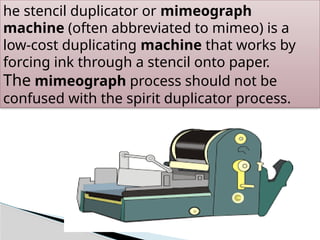
he stencil duplicator or mimeograph
machine (often abbreviated to mimeo) is a
low-cost duplicating machine that works by
forcing ink through a stencil onto paper.
The mimeograph process should not be
confused with the spirit duplicator process.
It's been called the most important invention
of the 20th century. The transistor, aka point-
contact transistor, is a semiconductor device
that can amplify or switch electrical signals. It
was developed to replace vacuum tubes.
Vacuum tubes were bulky, unreliable and
consumed too much power. Inventor: William
Shockley
n 1958, John Koss rewrote the rule book when
he created the first stereo headphones, the
Koss SP-3. Early models were nothing more
than mini speakers covered in cardboard and
sofa foam, but their impact was immense.
The slide rule, also known colloquially in the
United States as a slapstick, is a mechanical
analog computer. ... The slide rule is used
primarily for multiplication and division, and
also for functions such as exponents, roots,
logarithms, and trigonometry, but typically not
for addition or subtraction. Creator William
Oughtred
Educational Television - 1958
These were used in the classroom because of the
many educational programs that were shown on tv.
Mainly used as a supplement to the classroom
teachings, and it was helpful to have a good idea of
what was going on at the time. Mainly the National
Educational Television company was responsible for
programs up until the 1970s, when PBS then
successfully took over.
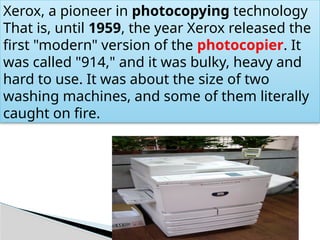
Xerox, a pioneer in photocopying technology
That is, until 1959, the year Xerox released the
first "modern" version of the photocopier. It
was called "914," and it was bulky, heavy and
hard to use. It was about the size of two
washing machines, and some of them literally
caught on fire.
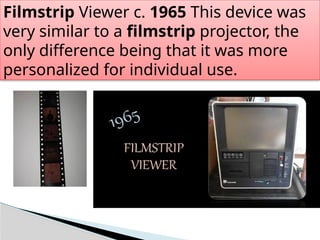
Filmstrip Viewer c. 1965 This device was
very similar to a filmstrip projector, the
only difference being that it was more
personalized for individual use.
ARPANET was the network that became the basis for
the Internet. Based on a concept first published in
1967, ARPANET was developed under the direction of
the U.S. Advanced Research Projects Agency (ARPA).
In 1969, the idea became a modest reality with the
interconnection of four university computers. The
first Internet called ARPANET.
British scientist Tim Berners-Lee invented the World
Wide Web in 1989. He wrote the first web browser
in 1990 while employed at CERN near Geneva,
Switzerland. The browser was released outside CERN
in 1991, first to other research institutions starting in
January 1991 and then to the general public in
August 1991.
Inventor: Tim Berners-Lee
n 1642, the first true “calculator” was
invented: one that performed calculations
through a clockwork-type of mechanism. The
Pascal calculator, invented by French inventor
and mathematician Blaise Pascal, was lauded
for attempting arithmetic calculations
previously thought impossible.
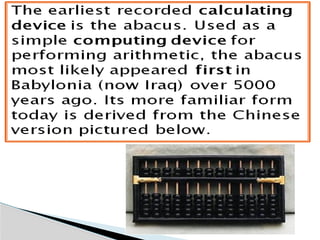
The earliest recorded calculating
device is the abacus. Used as a
simple computing device for
performing arithmetic, the abacus
most likely appeared first in
Babylonia (now Iraq) over 5000
Technology Flashback: Apple PowerBook
100 Laptop (1991) The PowerBook 100,
released in 1991, ushered in a new era
for laptops. In 1991, owning anything by
Apple wasn't really considered as cool as it was
in the 1980s, but Apple's first laptop ended up
influencing a lot of other laptops.
A minicomputer is a type of computer that
possesses most of the features and
capabilities of a large computer but is smaller
in physical size. ... Minicomputers are mainly
used as small or mid-range servers operating
business and scientific applications.
Apple Ipad was launched by Steve
Jobs as a question back in 2010. He
asked the audience whether "there
was room for something in the
middle" of the iPhone and the
MacBook?
Interactive Mobile apps- Amazon Appstore is an
alternative application store for the Android
operating system. It was opened in March 2011 and
as of June 2015, the app store has nearly
334,000 apps. The Amazon Appstore's
Android Apps can also be installed and run on
BlackBerry 10 devices.
Juliet M. Morata
Group Activity.
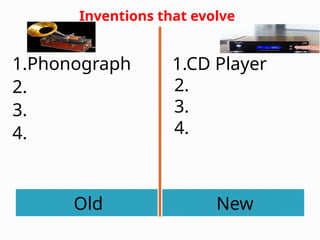
Instructions: Think of any other inventions
that changed the way we work and live.
You trace changes and improvements
in those inventions? An example might
be the sewing machine, which,
originally was mechanical rather than
electric and had to be operated by a
foot pedal. Another the phonograph ,
which evolved into the CD player.
Inventions that evolve
Old New
1.Phonograph
2.
3.
4.
1.CD Player
2.
3.
4.
Directions: Give the best answer of the
following question below.
1. Give the advantages of using Internet.


2. Give the disadvantages of using Internet.

ICT can lead to improved
student learning and better
teaching methods. ICT enhance the
quality of teaching and learning.
Despite what ICT
disadvantages brigs it’s up to us on
how we are going to use our
gadgets into a meaningful ways.
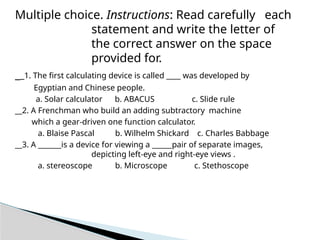
Multiple choice. Instructions: Read carefully each
statement and write the letter of
the correct answer on the space
provided for.
__1. The first calculating device is called ____ was developed by
Egyptian and Chinese people.
a. Solar calculator b. ABACUS c. Slide rule
__2. A Frenchman who build an adding subtractory machine
which a gear-driven one function calculator.
a. Blaise Pascal b. Wilhelm Shickard c. Charles Babbage
__3. A _______is a device for viewing a ______pair of separate images,
depicting left-eye and right-eye views .
a. stereoscope b. Microscope c. Stethoscope
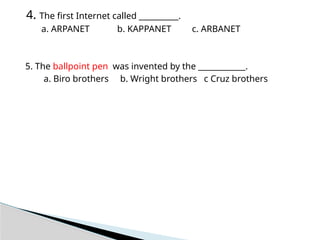
4. The first Internet called __________.
a. ARPANET b. KAPPANET c. ARBANET
5. The ballpoint pen was invented by the ____________.
a. Biro brothers b. Wright brothers c Cruz brothers
Directions: Give the best answer of the
following questions.
1. What is meant by computer generations ?
2. The personal computer that you see today is in
which generation of computer?
Assignment.
Prepared by: Juliet M. Morata
BEED III

ICT role inside Computer Laboratory.pptx

  • 1.
    Presented by: The ICTAND THE COMPUTER ITS ROLE AND HISTORY
  • 2.
  • 3.
    Presented by: The ICTAND THE COMPUTER ITS ROLE AND HISTORY
  • 4.
    Presented by: The ICTAND THE COMPUTER ITS ROLE AND HISTORY
  • 5.
  • 15.
     Internet hasbeen the most useful technology of the modern times which helps us not only in our daily lives, but also our personal and professional lives developments. The internet helps us achieve this in several different ways.  For the students and educational purposes the internet is widely used to gather information so as to do research or add to the knowledge of any sort of subject they have. Even the business personals and the professionals like doctors, access the internet to filter the necessary information for their use. The internet is therefore the largest encyclopedia for everyone, in all age categories. Uses of Internet
  • 16.
     Advantages  Everyoneis of course very well known that known that internet advantages than just a few concerned ones. With the introduction of the internet the global communication has become a matter of just the fingertips of the users.  The internet has become a matter of just the fingertips of the users. Advantages and Disadvantages of Internet
  • 17.
     Everything hasthe negative aspect to it and so does the internet, the biggest threat of the internet is in the pornography and the security threats.  Pornography is widespread over the internet making it inappropriate to be used by the children below certain age so as to prevent the psychological damage from the early days. These sites are easily accessible and attractive for the teenagers and young kids. Disadvantages
  • 26.
    ICT created anenormous growth over the past years in the field of education . It has changed many aspects in the teaching and Learning process as it affects the educations system, educational learning environment , teaching methods and strategies and the way the students learn. Let us find out how the development of ICT had made a great impact in education. Evolution of ICT in Education
  • 27.
    1650- The HornBook is a teaching aid consisting of a leaf of paper showing the alphabet, and often the ten digits and the Lord's Prayer, mounted on a wooden tablet and protected by a thin plate of horn.
  • 28.
    The Difference Engine,designed in the 1820s by the English mathematician and inventor Charles Babbage , was intended to automatically compute mathematical tables which, until that time, had been tediously calculated by hand and were prone to error.
  • 29.
    The Analytical Enginewas a proposed mechanical general-purpose computer designed by English mathematician and computer pioneer Charles Babbage. ... Babbage was never able to complete construction of any of his machines due to conflicts with his chief engineer and inadequate funding.
  • 30.
    Education technology. Theprecursor to a slide projector, it was dubbed the 'magic lantern'. It was an early type of image projector employing painted pictures or photographs on sheets of glass, a lens and a bright light source. It was used up until the invention of the slide projector.
  • 31.
    When it wasinvented in 1890, the chalkboard revolutionized how teachers delivered lessons to their students. ... No longer did students have to wrestle with pens and inkwells. Pencils allowed for mistakes by letting students erase incorrect work.
  • 32.
    A stereoscope isa device for viewing a stereoscopic pair of separate images, depicting left-eye and right- eye views of the same scene, as a single three-dimensional image.
  • 33.
    The Film Projector.By 1925 , the film projector was making its way into classroom environments. The projectordisplayedstill images from a film strip accompanied by an audio recording. The imageshad to be manually changed as you advanced through the film strip.
  • 34.
    The power ofradio and the world of sports. After being introduced during World War I, radios became a common feature in American homes of the 1920s. Hundreds of radio stations popped up over the course of the decade. These stations developed and broadcasted news, serial stories, and political speeches.
  • 35.
    1 Computer In 1936The First Computer Ever Made Was The Z1 Computer By Konrad Zuse Which Was The First Freely Programmable Computer.
  • 36.
    The ballpoint penwas invented by the Biro brothers. At first the pen relied on gravity for the ink to be pushed down toward the tip and having to hold the pen straight up. Soon after the ball at the tip was able to soak up the ink and be used without gravity.
  • 37.
    he stencil duplicatoror mimeograph machine (often abbreviated to mimeo) is a low-cost duplicating machine that works by forcing ink through a stencil onto paper. The mimeograph process should not be confused with the spirit duplicator process.
  • 38.
    It's been calledthe most important invention of the 20th century. The transistor, aka point- contact transistor, is a semiconductor device that can amplify or switch electrical signals. It was developed to replace vacuum tubes. Vacuum tubes were bulky, unreliable and consumed too much power. Inventor: William Shockley
  • 39.
    n 1958, JohnKoss rewrote the rule book when he created the first stereo headphones, the Koss SP-3. Early models were nothing more than mini speakers covered in cardboard and sofa foam, but their impact was immense.
  • 40.
    The slide rule,also known colloquially in the United States as a slapstick, is a mechanical analog computer. ... The slide rule is used primarily for multiplication and division, and also for functions such as exponents, roots, logarithms, and trigonometry, but typically not for addition or subtraction. Creator William Oughtred
  • 41.
    Educational Television -1958 These were used in the classroom because of the many educational programs that were shown on tv. Mainly used as a supplement to the classroom teachings, and it was helpful to have a good idea of what was going on at the time. Mainly the National Educational Television company was responsible for programs up until the 1970s, when PBS then successfully took over.
  • 42.
    Xerox, a pioneerin photocopying technology That is, until 1959, the year Xerox released the first "modern" version of the photocopier. It was called "914," and it was bulky, heavy and hard to use. It was about the size of two washing machines, and some of them literally caught on fire.
  • 43.
    Filmstrip Viewer c.1965 This device was very similar to a filmstrip projector, the only difference being that it was more personalized for individual use.
  • 44.
    ARPANET was thenetwork that became the basis for the Internet. Based on a concept first published in 1967, ARPANET was developed under the direction of the U.S. Advanced Research Projects Agency (ARPA). In 1969, the idea became a modest reality with the interconnection of four university computers. The first Internet called ARPANET.
  • 45.
    British scientist TimBerners-Lee invented the World Wide Web in 1989. He wrote the first web browser in 1990 while employed at CERN near Geneva, Switzerland. The browser was released outside CERN in 1991, first to other research institutions starting in January 1991 and then to the general public in August 1991. Inventor: Tim Berners-Lee
  • 46.
    n 1642, thefirst true “calculator” was invented: one that performed calculations through a clockwork-type of mechanism. The Pascal calculator, invented by French inventor and mathematician Blaise Pascal, was lauded for attempting arithmetic calculations previously thought impossible. The earliest recorded calculating device is the abacus. Used as a simple computing device for performing arithmetic, the abacus most likely appeared first in Babylonia (now Iraq) over 5000
  • 48.
    Technology Flashback: ApplePowerBook 100 Laptop (1991) The PowerBook 100, released in 1991, ushered in a new era for laptops. In 1991, owning anything by Apple wasn't really considered as cool as it was in the 1980s, but Apple's first laptop ended up influencing a lot of other laptops.
  • 49.
    A minicomputer isa type of computer that possesses most of the features and capabilities of a large computer but is smaller in physical size. ... Minicomputers are mainly used as small or mid-range servers operating business and scientific applications.
  • 50.
    Apple Ipad waslaunched by Steve Jobs as a question back in 2010. He asked the audience whether "there was room for something in the middle" of the iPhone and the MacBook?
  • 51.
    Interactive Mobile apps-Amazon Appstore is an alternative application store for the Android operating system. It was opened in March 2011 and as of June 2015, the app store has nearly 334,000 apps. The Amazon Appstore's Android Apps can also be installed and run on BlackBerry 10 devices.
  • 52.
  • 63.
    Group Activity. Instructions: Thinkof any other inventions that changed the way we work and live. You trace changes and improvements in those inventions? An example might be the sewing machine, which, originally was mechanical rather than electric and had to be operated by a foot pedal. Another the phonograph , which evolved into the CD player.
  • 64.
    Inventions that evolve OldNew 1.Phonograph 2. 3. 4. 1.CD Player 2. 3. 4.
  • 65.
    Directions: Give thebest answer of the following question below. 1. Give the advantages of using Internet.   2. Give the disadvantages of using Internet. 
  • 66.
    ICT can leadto improved student learning and better teaching methods. ICT enhance the quality of teaching and learning. Despite what ICT disadvantages brigs it’s up to us on how we are going to use our gadgets into a meaningful ways.
  • 67.
    Multiple choice. Instructions:Read carefully each statement and write the letter of the correct answer on the space provided for. __1. The first calculating device is called ____ was developed by Egyptian and Chinese people. a. Solar calculator b. ABACUS c. Slide rule __2. A Frenchman who build an adding subtractory machine which a gear-driven one function calculator. a. Blaise Pascal b. Wilhelm Shickard c. Charles Babbage __3. A _______is a device for viewing a ______pair of separate images, depicting left-eye and right-eye views . a. stereoscope b. Microscope c. Stethoscope
  • 68.
    4. The firstInternet called __________. a. ARPANET b. KAPPANET c. ARBANET 5. The ballpoint pen was invented by the ____________. a. Biro brothers b. Wright brothers c Cruz brothers
  • 69.
    Directions: Give thebest answer of the following questions. 1. What is meant by computer generations ? 2. The personal computer that you see today is in which generation of computer? Assignment.
  • 70.
    Prepared by: JulietM. Morata BEED III