Graph Community Detection Algorithm for Distributed
Memory Parallel Computing Systems
(Credit: X. Que, F. Checconi, F. Petrini, J. A. Gunnels — IBM Research)
Alexander Pozdneev
Technical Consultant — High Performance Computing, IBM
March 5, 2015 — GraphHPC-2015
Outline
1 Introduction
2 Scalable graph community detection with the Louvain algorithm
3 Conclusion
4 References
2 c 2015 IBM Corporation
Outline
1 Introduction
Big Data challenges
IBM leadership in graph processing
2 Scalable graph community detection with the Louvain algorithm
3 Conclusion
4 References
3 c 2015 IBM Corporation
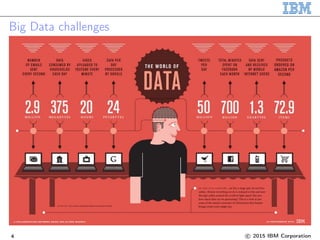
Big Data challenges
4 c 2015 IBM Corporation
IBM leadership in graph processing: Graph500
Date # System Model Nodes Cores Scale GTEPS
Nov’14 1 Sequoia Q 96k 1.5M 41 23751
Jun’14 2 Sequoia Q 64k 1M 40 16599
Nov’13 1 Sequoia Q 64k 1M 40 15363
Jun’13 1 Sequoia Q 64k 1M 40 15363
Nov’12 1 Sequoia Q 64k 1M 40 15363
Jun’12 1 Sequoia/Mira Q 32k 512k 38 3541
Nov’11 1 BG/Q prototype Q 4k 64k 32 253
Jun’11 1 Interpid/Jugene P 32k 128k 38 18
Nov’10 1 Interpid P 8k 32k 36 7
5 c 2015 IBM Corporation
Outline
1 Introduction
2 Scalable graph community detection with the Louvain algorithm
The graph community detection problem
Problem definition
The modularity metric
Sequential Louvain algorithm
Modularity gain
Hash-based data organization
Novel convergence heuristic
Parallel Louvain algorithm
Community state propagation
Community refinement
Graph reconstruction
Scalability analysis
3 Conclusion
4 References
6 c 2015 IBM Corporation
Reference
X. Que, F. Checconi, F. Petrini, J. Gunnels.
“Scalable Community Detection with the Louvain Algorithm”.
29th IEEE International Parallel & Distributed Processing Symposium,
Hyderabad International Convention Centre, Hyderabad, INDIA,
May 25-29, 2015.
http://dx.doi.org/10.1109/IPDPS.2015.59
7 c 2015 IBM Corporation
The graph community detection problem
• Important problem that spans many research areas:
health care
social networks
systems biology
power grid optimization, etc.
• Graph community detection algorithms attempt to identify
modules
their hierarchical organization
• Challenges that limit the overall scalability and performance
fine-grained communication
irregular access pattern to memory and interconnect
• Open research problem
strong scalability
high quality of community detection
8 c 2015 IBM Corporation
Graph community detection: problem definition
• A weighted directed graph G = (V, E):
V — set of vertices
E — set of edges
when u, v ∈ V , an edge e(u, v) ∈ E has weight wu,v
• The goal of community detection is to partition graph G into a set C
of disjoint communities ci:
∪ ci = V, ∀ci ∈ C
ci ∩ cj = ∅, ∀ci, cj ∈ C
• Vertices in the same community are densely connected
• Vertices in different communities are sparsely connected
• The modularity [Newman, 2004] quantifies a community structure
• Empirically, the higher a modularity value, the better a partition quality
9 c 2015 IBM Corporation
Graph community detection: the modularity metric
Modularity Q,
Q =
c∈C
Σc
in
2m
−
Σc
tot
2m
2
Σc
in — the sum of the weights from all internal edges of community c,
Σc
in =
u,v∈c
e(u,v)∈E
wu,v
Σc
tot — the sum of the weights from edges incident to any vertex in c,
Σc
tot =
u∈c or v∈c
e(u,v)∈E
wu,v
m — normalization factor, the sum of the weights across the graph,
m =
e(u,v)∈E
wu,v
10 c 2015 IBM Corporation
Sequential Louvain algorithm
Louvain algorithm [Blondel, 2008] is a popular greedy algorithm for
community detection.
1. Put all vertices into distinct communities (one per vertex)
2. Refine communities
For each vertex i
• Compute ΔQi→c(j) for each neighbor j
• Join the community c(j) that yields the largest gain in ΔQ
Repeat until no movement yields a gain
3. Reconstruct the graph
The partitions become supervertices
The weights of edges between communities are summed
4. Repeat steps 2 and 3 until convergence
11 c 2015 IBM Corporation
Modularity gain
Modularity gain when moving vertex u into community c:
ΔQu→c =
wu→c
2m
−
w(u)Σc
tot
2m2
Σc
tot — the sum of the weights from edges incident to any vertex in c,
Σc
tot =
u∈c or v∈c
e(u,v)∈E
wu,v
w(u) — the sum of the weights of the edges incident to vertex u
wu→c — the sum of the weights of the edges from vertex u to vertices in
community c
wu→c =
v∈c
wu,v
12 c 2015 IBM Corporation
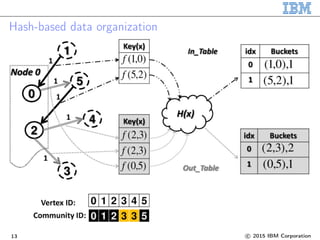
Hash-based data organization
13 c 2015 IBM Corporation
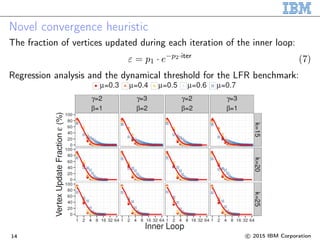
Novel convergence heuristic
The fraction of vertices updated during each iteration of the inner loop:
ε = p1 · e−p2·iter
(7)
Regression analysis and the dynamical threshold for the LFR benchmark:
14 c 2015 IBM Corporation
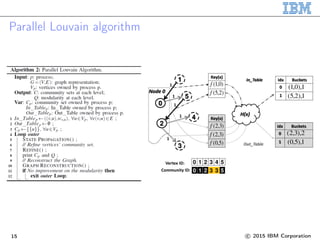
Parallel Louvain algorithm
15 c 2015 IBM Corporation
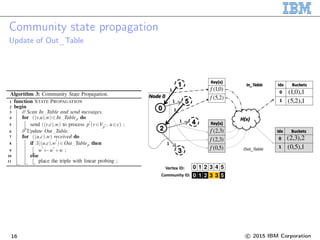
Community state propagation
Update of Out_Table
16 c 2015 IBM Corporation
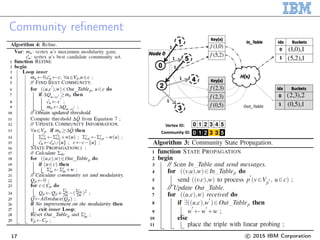
Community refinement
17 c 2015 IBM Corporation
Graph reconstruction
Reconstruction of In_Table
18 c 2015 IBM Corporation
Scalability analysis: weak scaling
P7-IH, BTER: 222 vertices per node, average degree of 32
19 c 2015 IBM Corporation
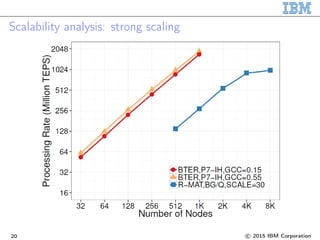
Scalability analysis: strong scaling
20 c 2015 IBM Corporation
Outline
1 Introduction
2 Scalable graph community detection with the Louvain algorithm
3 Conclusion
4 References
21 c 2015 IBM Corporation
Conclusion
• Highly scalable parallel Louvain algorithm for distributed memory
systems
• Preserves/slightly improves
the convergence properties
the overall modularity
the quality of the detected communities
• A novel implementation strategy to store and process dynamic graphs
• Validation on a wide variety of real-world social graphs
• Scalability:
BTER, 4B vertices/138B edges — 1k P7-IH nodes (32k threads)
R-MAT, 8B vertices/138B edges — 8k BG/Q nodes (512k threads)
22 c 2015 IBM Corporation
Outline
1 Introduction
2 Scalable graph community detection with the Louvain algorithm
3 Conclusion
4 References
23 c 2015 IBM Corporation
References
M. E. J. Newman, M. Girvan.
Finding and Evaluating Community Structure in Networks.
Phys. Rev. E, 69(2):026113, Feb. 2004.
V. Blondel et al.
Fast unfolding of communities in large networks.
J. Stat. Mech., P10008, 2008.
X. Que et al.
Scalable Community Detection with the Louvain Algorithm.
Parallel and Distributed Processing Symposium (IPDPS), 2015 IEEE
International, Hyderabad, India, 25-29 May 2015, pp. 28-37.
24 c 2015 IBM Corporation
Outline
5 Modularity maximization techniques
25 c 2015 IBM Corporation
Modularity maximization techniques
• Greedy optimization — applies different approaches to merge vertices
into communities for higher modularity
• Simulated annealing — adopts a probabilistic procedure for global
optimization on modularity
• Extremal optimization — is a heuristic search procedure
• Spectral optimization — uses eigenvalues and eigenvectors of a special
matrix for modularity optimization
26 c 2015 IBM Corporation
Disclaimer
All the information, representations, statements, opinions and proposals in this
document are correct and accurate to the best of our present knowledge but are
not intended (and should not be taken) to be contractually binding unless and
until they become the subject of separate, specific agreement between us.
Any IBM Machines provided are subject to the Statements of Limited Warranty
accompanying the applicable Machine.
Any IBM Program Products provided are subject to their applicable license terms.
Nothing herein, in whole or in part, shall be deemed to constitute a warranty.
IBM products are subject to withdrawal from marketing and or service upon
notice, and changes to product configurations, or follow-on products, may result
in price changes.
Any references in this document to “partner” or “partnership” do not constitute or
imply a partnership in the sense of the Partnership Act 1890.
IBM is not responsible for printing errors in this proposal that result in pricing or
information inaccuracies.
27 c 2015 IBM Corporation
Правовая информация
IBM, логотип IBM, BladeCenter, System Storage и System x являются товарными знаками International Business
Machines Corporation в США и/или других странах. Полный список товарных знаков компании IBM смотрите
на узле Web: www.ibm.com/legal/copytrade.shtml.
Названия других компаний, продуктов и услуг могут являться товарными знаками или знаками обслуживания
других компаний.
(c) 2015 International Business Machines Corporation. Все права защищены.
Упоминание в этой публикации продуктов или услуг корпорации IBM не означает, что IBM предполагает
предоставлять их во всех странах, в которых осуществляет свою деятельность, информация о
предоставлении продуктов или услуг может быть изменена без уведомления. За самой свежей информацией
о продуктах и услугах компании IBM, предоставляемых в Вашем регионе, следует обращаться в ближайшее
торговое представительство IBM или к авторизованным бизнес-партнерам.
Все заявления относительно намерений и перспективных планов IBM могут быть изменены без уведомления.
Информация о продуктах третьих фирм получена от производителей этих продуктов или из опубликованных
анонсов указанных продуктов. IBM не тестировала эти продукты и не может подтвердить
производительность, совместимость, или любые другие заявления относительно продуктов третьих фирм.
Вопросы о возможностях продуктов третьих фирм следует адресовать поставщику этих продуктов.
Информация может содержать технические неточности или типографические ошибки. В представленную в
публикации информацию могут вноситься изменения, эти изменения будут включаться в новые редакции
данной публикации. IBM может вносить изменения в рассматриваемые в данной публикации продукты или
услуги в любое время без уведомления.
Любые ссылки на узлы Web третьих фирм приведены только для удобства и никоим образом не служат
поддержкой этим узлам Web. Материалы на указанных узлах Web не являются частью материалов для
данного продукта IBM.
28 c 2015 IBM Corporation

Graph Community Detection Algorithm for Distributed Memory Parallel Computing Systems

  • 1.
    Graph Community DetectionAlgorithm for Distributed Memory Parallel Computing Systems (Credit: X. Que, F. Checconi, F. Petrini, J. A. Gunnels — IBM Research) Alexander Pozdneev Technical Consultant — High Performance Computing, IBM March 5, 2015 — GraphHPC-2015
  • 2.
    Outline 1 Introduction 2 Scalablegraph community detection with the Louvain algorithm 3 Conclusion 4 References 2 c 2015 IBM Corporation
  • 3.
    Outline 1 Introduction Big Datachallenges IBM leadership in graph processing 2 Scalable graph community detection with the Louvain algorithm 3 Conclusion 4 References 3 c 2015 IBM Corporation
  • 4.
    Big Data challenges 4c 2015 IBM Corporation
  • 5.
    IBM leadership ingraph processing: Graph500 Date # System Model Nodes Cores Scale GTEPS Nov’14 1 Sequoia Q 96k 1.5M 41 23751 Jun’14 2 Sequoia Q 64k 1M 40 16599 Nov’13 1 Sequoia Q 64k 1M 40 15363 Jun’13 1 Sequoia Q 64k 1M 40 15363 Nov’12 1 Sequoia Q 64k 1M 40 15363 Jun’12 1 Sequoia/Mira Q 32k 512k 38 3541 Nov’11 1 BG/Q prototype Q 4k 64k 32 253 Jun’11 1 Interpid/Jugene P 32k 128k 38 18 Nov’10 1 Interpid P 8k 32k 36 7 5 c 2015 IBM Corporation
  • 6.
    Outline 1 Introduction 2 Scalablegraph community detection with the Louvain algorithm The graph community detection problem Problem definition The modularity metric Sequential Louvain algorithm Modularity gain Hash-based data organization Novel convergence heuristic Parallel Louvain algorithm Community state propagation Community refinement Graph reconstruction Scalability analysis 3 Conclusion 4 References 6 c 2015 IBM Corporation
  • 7.
    Reference X. Que, F.Checconi, F. Petrini, J. Gunnels. “Scalable Community Detection with the Louvain Algorithm”. 29th IEEE International Parallel & Distributed Processing Symposium, Hyderabad International Convention Centre, Hyderabad, INDIA, May 25-29, 2015. http://dx.doi.org/10.1109/IPDPS.2015.59 7 c 2015 IBM Corporation
  • 8.
    The graph communitydetection problem • Important problem that spans many research areas: health care social networks systems biology power grid optimization, etc. • Graph community detection algorithms attempt to identify modules their hierarchical organization • Challenges that limit the overall scalability and performance fine-grained communication irregular access pattern to memory and interconnect • Open research problem strong scalability high quality of community detection 8 c 2015 IBM Corporation
  • 9.
    Graph community detection:problem definition • A weighted directed graph G = (V, E): V — set of vertices E — set of edges when u, v ∈ V , an edge e(u, v) ∈ E has weight wu,v • The goal of community detection is to partition graph G into a set C of disjoint communities ci: ∪ ci = V, ∀ci ∈ C ci ∩ cj = ∅, ∀ci, cj ∈ C • Vertices in the same community are densely connected • Vertices in different communities are sparsely connected • The modularity [Newman, 2004] quantifies a community structure • Empirically, the higher a modularity value, the better a partition quality 9 c 2015 IBM Corporation
  • 10.
    Graph community detection:the modularity metric Modularity Q, Q = c∈C Σc in 2m − Σc tot 2m 2 Σc in — the sum of the weights from all internal edges of community c, Σc in = u,v∈c e(u,v)∈E wu,v Σc tot — the sum of the weights from edges incident to any vertex in c, Σc tot = u∈c or v∈c e(u,v)∈E wu,v m — normalization factor, the sum of the weights across the graph, m = e(u,v)∈E wu,v 10 c 2015 IBM Corporation
  • 11.
    Sequential Louvain algorithm Louvainalgorithm [Blondel, 2008] is a popular greedy algorithm for community detection. 1. Put all vertices into distinct communities (one per vertex) 2. Refine communities For each vertex i • Compute ΔQi→c(j) for each neighbor j • Join the community c(j) that yields the largest gain in ΔQ Repeat until no movement yields a gain 3. Reconstruct the graph The partitions become supervertices The weights of edges between communities are summed 4. Repeat steps 2 and 3 until convergence 11 c 2015 IBM Corporation
  • 12.
    Modularity gain Modularity gainwhen moving vertex u into community c: ΔQu→c = wu→c 2m − w(u)Σc tot 2m2 Σc tot — the sum of the weights from edges incident to any vertex in c, Σc tot = u∈c or v∈c e(u,v)∈E wu,v w(u) — the sum of the weights of the edges incident to vertex u wu→c — the sum of the weights of the edges from vertex u to vertices in community c wu→c = v∈c wu,v 12 c 2015 IBM Corporation
  • 13.
    Hash-based data organization 13c 2015 IBM Corporation
  • 14.
    Novel convergence heuristic Thefraction of vertices updated during each iteration of the inner loop: ε = p1 · e−p2·iter (7) Regression analysis and the dynamical threshold for the LFR benchmark: 14 c 2015 IBM Corporation
  • 15.
    Parallel Louvain algorithm 15c 2015 IBM Corporation
  • 16.
    Community state propagation Updateof Out_Table 16 c 2015 IBM Corporation
  • 17.
    Community refinement 17 c2015 IBM Corporation
  • 18.
    Graph reconstruction Reconstruction ofIn_Table 18 c 2015 IBM Corporation
  • 19.
    Scalability analysis: weakscaling P7-IH, BTER: 222 vertices per node, average degree of 32 19 c 2015 IBM Corporation
  • 20.
    Scalability analysis: strongscaling 20 c 2015 IBM Corporation
  • 21.
    Outline 1 Introduction 2 Scalablegraph community detection with the Louvain algorithm 3 Conclusion 4 References 21 c 2015 IBM Corporation
  • 22.
    Conclusion • Highly scalableparallel Louvain algorithm for distributed memory systems • Preserves/slightly improves the convergence properties the overall modularity the quality of the detected communities • A novel implementation strategy to store and process dynamic graphs • Validation on a wide variety of real-world social graphs • Scalability: BTER, 4B vertices/138B edges — 1k P7-IH nodes (32k threads) R-MAT, 8B vertices/138B edges — 8k BG/Q nodes (512k threads) 22 c 2015 IBM Corporation
  • 23.
    Outline 1 Introduction 2 Scalablegraph community detection with the Louvain algorithm 3 Conclusion 4 References 23 c 2015 IBM Corporation
  • 24.
    References M. E. J.Newman, M. Girvan. Finding and Evaluating Community Structure in Networks. Phys. Rev. E, 69(2):026113, Feb. 2004. V. Blondel et al. Fast unfolding of communities in large networks. J. Stat. Mech., P10008, 2008. X. Que et al. Scalable Community Detection with the Louvain Algorithm. Parallel and Distributed Processing Symposium (IPDPS), 2015 IEEE International, Hyderabad, India, 25-29 May 2015, pp. 28-37. 24 c 2015 IBM Corporation
  • 25.
    Outline 5 Modularity maximizationtechniques 25 c 2015 IBM Corporation
  • 26.
    Modularity maximization techniques •Greedy optimization — applies different approaches to merge vertices into communities for higher modularity • Simulated annealing — adopts a probabilistic procedure for global optimization on modularity • Extremal optimization — is a heuristic search procedure • Spectral optimization — uses eigenvalues and eigenvectors of a special matrix for modularity optimization 26 c 2015 IBM Corporation
  • 27.
    Disclaimer All the information,representations, statements, opinions and proposals in this document are correct and accurate to the best of our present knowledge but are not intended (and should not be taken) to be contractually binding unless and until they become the subject of separate, specific agreement between us. Any IBM Machines provided are subject to the Statements of Limited Warranty accompanying the applicable Machine. Any IBM Program Products provided are subject to their applicable license terms. Nothing herein, in whole or in part, shall be deemed to constitute a warranty. IBM products are subject to withdrawal from marketing and or service upon notice, and changes to product configurations, or follow-on products, may result in price changes. Any references in this document to “partner” or “partnership” do not constitute or imply a partnership in the sense of the Partnership Act 1890. IBM is not responsible for printing errors in this proposal that result in pricing or information inaccuracies. 27 c 2015 IBM Corporation
  • 28.
    Правовая информация IBM, логотипIBM, BladeCenter, System Storage и System x являются товарными знаками International Business Machines Corporation в США и/или других странах. Полный список товарных знаков компании IBM смотрите на узле Web: www.ibm.com/legal/copytrade.shtml. Названия других компаний, продуктов и услуг могут являться товарными знаками или знаками обслуживания других компаний. (c) 2015 International Business Machines Corporation. Все права защищены. Упоминание в этой публикации продуктов или услуг корпорации IBM не означает, что IBM предполагает предоставлять их во всех странах, в которых осуществляет свою деятельность, информация о предоставлении продуктов или услуг может быть изменена без уведомления. За самой свежей информацией о продуктах и услугах компании IBM, предоставляемых в Вашем регионе, следует обращаться в ближайшее торговое представительство IBM или к авторизованным бизнес-партнерам. Все заявления относительно намерений и перспективных планов IBM могут быть изменены без уведомления. Информация о продуктах третьих фирм получена от производителей этих продуктов или из опубликованных анонсов указанных продуктов. IBM не тестировала эти продукты и не может подтвердить производительность, совместимость, или любые другие заявления относительно продуктов третьих фирм. Вопросы о возможностях продуктов третьих фирм следует адресовать поставщику этих продуктов. Информация может содержать технические неточности или типографические ошибки. В представленную в публикации информацию могут вноситься изменения, эти изменения будут включаться в новые редакции данной публикации. IBM может вносить изменения в рассматриваемые в данной публикации продукты или услуги в любое время без уведомления. Любые ссылки на узлы Web третьих фирм приведены только для удобства и никоим образом не служат поддержкой этим узлам Web. Материалы на указанных узлах Web не являются частью материалов для данного продукта IBM. 28 c 2015 IBM Corporation