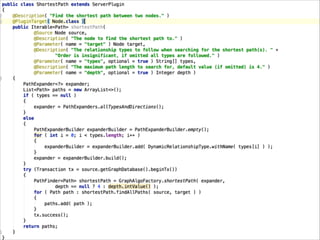
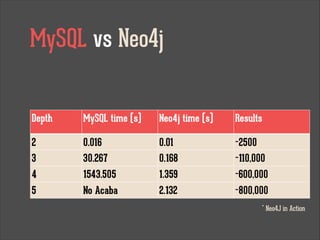
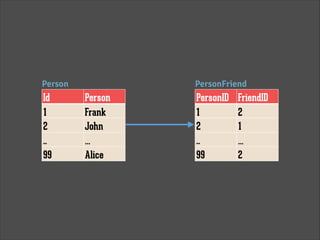
This document provides an introduction to graph databases and Neo4j. It discusses how graph databases are better suited than relational databases for certain types of connected data. It uses social network and movie recommendation examples to demonstrate how to model and query data in a graph database using the Cypher query language.











![Cypher
clapton cream
(clapton)-[:play_in]->(cream)
play_in](https://image.slidesharecdn.com/codemotion-140429095052-phpapp02/85/Graph-Databases-a-little-connected-tour-Codemotion-Rome-38-320.jpg)
![Follow
FollowJohn Jeff
Douglas
Cypher
(john:User)-[:FOLLOW]->(jeff:User)
!
(douglas:User)-[:FOLLOW]->(john:User)](https://image.slidesharecdn.com/codemotion-140429095052-phpapp02/85/Graph-Databases-a-little-connected-tour-Codemotion-Rome-39-320.jpg)
![Cypher
clapton
{name: Eric
Clapton}
cream
(clapton)-[:play_in]->(cream)<-[:labeled]-(blues)
play_in
{date: 1968}
Blues
labeled](https://image.slidesharecdn.com/codemotion-140429095052-phpapp02/85/Graph-Databases-a-little-connected-tour-Codemotion-Rome-40-320.jpg)

![Cypher
MATCH (a)-[:PLAY_IN]—>(b)
RETURN a,b;](https://image.slidesharecdn.com/codemotion-140429095052-phpapp02/85/Graph-Databases-a-little-connected-tour-Codemotion-Rome-42-320.jpg)
![Cypher
MATCH (a)-[:PLAY_IN]—>(g),
(g)<-[:LABELED]-(e)
RETURN a.name,
t.date,
e.name;](https://image.slidesharecdn.com/codemotion-140429095052-phpapp02/85/Graph-Databases-a-little-connected-tour-Codemotion-Rome-43-320.jpg)
![Cypher
MATCH (c {name: ‘clapton’})-[t:PLAY_IN]—>(g),
(g)<-[:LABELED]-(e)
RETURN c.name,
t.date,
e.name;](https://image.slidesharecdn.com/codemotion-140429095052-phpapp02/85/Graph-Databases-a-little-connected-tour-Codemotion-Rome-44-320.jpg)
![Cypher
MATCH (c {name: ‘clapton’})-[t:PLAY_IN]—>(g),
(g)<-[:LABELED]-(e {name: ‘blues’})
RETURN c.name,
e.name
ORDER BY t.date](https://image.slidesharecdn.com/codemotion-140429095052-phpapp02/85/Graph-Databases-a-little-connected-tour-Codemotion-Rome-45-320.jpg)
![Cypher
MATCH (c {name: ‘clapton’})-[r:PLAY_IN | PRODUCE]—>(g),
(g)<-[:LABELED]-(e {name: ‘blues’})
RETURN c.name,
e.name
WHERE r.date > 1968
ORDER BY r.date](https://image.slidesharecdn.com/codemotion-140429095052-phpapp02/85/Graph-Databases-a-little-connected-tour-Codemotion-Rome-46-320.jpg)
![Cypher
MATCH (carlo)-[:KNOW*5]—>(john)](https://image.slidesharecdn.com/codemotion-140429095052-phpapp02/85/Graph-Databases-a-little-connected-tour-Codemotion-Rome-47-320.jpg)
![MATCH p = (startNode:Station {name: ‘Sol’})
-[rels:CONNECTED_TO*]->
(endNode:Station {name: ‘Retiro’})
RETURN p AS shortestPath,
reduce(weight=0, r in rels: weight + r.weight) as tWeight
ORDER BY tWeight ASC
LIMIT 1](https://image.slidesharecdn.com/codemotion-140429095052-phpapp02/85/Graph-Databases-a-little-connected-tour-Codemotion-Rome-48-320.jpg)




![Movies social network
MATCH (fran:User {name: ‘Fran’})
-[or:Rate]->
(pf:Film {title: ‘Pulp Fiction’}),
!
(pf)<-[:Rate]-(other_users)-[:Rate]->(other_films)
!
RETURN distinct other_films.title;](https://image.slidesharecdn.com/codemotion-140429095052-phpapp02/85/Graph-Databases-a-little-connected-tour-Codemotion-Rome-54-320.jpg)

![Movies social network
MATCH (fran:User {name: ‘Fran’})
-[or:Rate]->
(pf:Film {title: ‘Pulp Fiction’}),
!
(pf)<-[:Rate]-(other_users)-[r:Rate]->(other_films)
!
WHERE or.stars = r.stars
!
RETURN distinct other_films.title;](https://image.slidesharecdn.com/codemotion-140429095052-phpapp02/85/Graph-Databases-a-little-connected-tour-Codemotion-Rome-56-320.jpg)
![Movies social network
MATCH (fran:User {name: ‘Fran’})
-[or:Rate]->
(pf:Film {title: ‘Pulp Fiction’}),
!
(pf)<-[:Rate]-(other_users)-[r:Rate]->(other_films),
!
(other_users)-[:FOLLOW]-(fran)
!
WHERE or.stars = r.stars
!
RETURN distinct other_films.title;](https://image.slidesharecdn.com/codemotion-140429095052-phpapp02/85/Graph-Databases-a-little-connected-tour-Codemotion-Rome-57-320.jpg)

![Movies social network
MATCH (tarantino:User {name: ‘Quentin Tarantino’}),
(tarantino)-[:DIRECT]->(movie)<-[:ACT_IN]-(tarantino)
RETURN movie.title](https://image.slidesharecdn.com/codemotion-140429095052-phpapp02/85/Graph-Databases-a-little-connected-tour-Codemotion-Rome-59-320.jpg)


![Movies social network
MATCH (fran:User {name: ‘Fran’})
-[or:Rate]->
(pf:Film {title: ‘Pulp Fiction’}),
!
(pf)<-[:Rate]-(other_users)-[r:Rate]->(other_films),
(film)->[:BELONGS_TO*3]->(genre)<-[:BELONGS_TO]-(other_films),
!
(other_users)-[:FOLLOW]-(fran)
!
WHERE or.stars = r.stars
!
RETURN distinct other_films.title;](https://image.slidesharecdn.com/codemotion-140429095052-phpapp02/85/Graph-Databases-a-little-connected-tour-Codemotion-Rome-63-320.jpg)