Understanding Graph Databases with Neo4j 
and Cypher 
Group Members 
S.S. Niranga MS-14901836 
Nipuna Pannala MS-14902208 
Ruhaim Izmeth MS-14901218
Trends in Data 
Data is getting bigger: 
“Every 2 days we 
create as much 
information as we did 
up to 2003” 
– Eric Schmidt, Google
The History of Graph Theory 
● 1736: Leonard Euler writes a paper on the “Seven Bridges of Konisberg” 
● 1845: Gustav Kirchoff publishes his electrical circuit laws 
● 1852: Francis Guthrie poses the “Four Color Problem” 
● 1878: Sylvester publishes an article in Nature magazine that describes graphs 
● 1936: Dénes Kőnig publishes a textbook on Graph Theory 
● 1941: Ramsey and Turán define Extremal Graph Theory 
● 1959: De Bruijn publishes a paper summarizing Enumerative Graph Theory 
● 1959: Erdos, Renyi and Gilbert define Random Graph Theory 
● 1969: Heinrich Heesch solves the “Four Color” problem 
● 2003: Commercial Graph Database products start appearing on the market
What is Graph database? 
“A traditional relational database may tell you 
the average age of everyone in this room.. 
..but a graph database will tell you who 
is most likely to buy you a beer!”
What does a Graph database look like?
What is a Graph Database? 
● A database with an explicit graph structure 
● Each node knows its adjacent nodes 
● As the number of nodes increases, the cost of a local 
step (or hop) remains the same 
● Plus an Index for lookups
Compared to Relational Databases 
Optimized for aggregation Optimized for connections
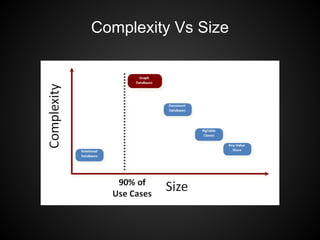
Complexity Vs Size
What to Choose? 
http://db-engines.com/en/ranking/graph+dbms
What is Neo4j? 
● Neo4j is an open-source graph database, implemented in Java. 
● Neo4j version 1.0 was released in February, 2010. 
● Neo4j version 2.0 was released in December, 2013 
● Neo4j was developed by Neo Technology, Inc. 
● Neo Technology board of directors consists of Rod Johnson, 
(founder of the Spring Framework), Magnus Christerson (Vice 
President of Intentional Software Corp), Nikolaj Nyholm (CEO 
of Polar Rose), Sami Ahvenniemi (Partner at Conor Venture 
Partners) and Johan Svensson (CTO of Neo Technology).
Entities in Graph DBs (Neo4j) 
● Nodes 
● Relationships 
● Properties 
● Labels 
● Paths 
● Traversal 
● Schema (index and constraints)
Neo4j Properties 
Ex.
Ex. 
Neo4j Labels
Ex. 
Neo4j Nodes
Neo4j Relationships 
Ex.
Neo4j Paths 
Ex.
Introducing - Cypher 
Query Language for Neo4j
Relational Schema 
Person 
p_id p_name 
Book 
b_id b_title 
p_type 
Wrote 
p_id b_id 
Purchased 
p_id b_id pur_date
Cypher - Few Keywords 
General Clauses 
● Return 
● Order by 
● Limit 
Writing Clauses 
● Create 
● Merge 
● Set 
● Delete 
● Remove 
Reading Clauses 
● Match 
● Optional Match 
● Where 
● Aggregation 
Functions 
● Predicates 
● Scalar functions 
● Collection functions 
● Mathematical functions 
● String functions 
See Full list at Cypher RefCard 
http://neo4j.com/docs/stable/cypher-refcard/
Cypher Demo 
http://console.neo4j.org/ 
or 
if Neo4j is locally installed 
http://localhost:7474
Cypher 
Creating nodes 
CREATE (:Person) 
CREATE (:Person { name:"John Le 
Carre" }) 
CREATE ({ name:"John Le Carre" }) 
CREATE (:Person:Author { name:"John 
Le Carre" }) 
CREATE 
(:Person:Author { name:"Graham 
Greene" }), 
(:Book { title:"Tinker, Tailor, 
Soldier, Spy" }), 
(:Book { title:"Our Man in Havana" 
}), 
(:Person { name:"Ian" }), 
(:Person { name:"Alan" })
Cypher 
Modifying nodes 
MATCH (p:Person { namme:"Alan" }) 
SET p += {name2 : "Alan2"} 
MATCH (p:Person { namme:"Alan" }) 
SET p.name = "Alan" 
MATCH (p:Person { namme:"Alan" }) 
SET p = {name : "Alan"} 
CREATE (:Person { namme:"Alan" }) 
MATCH (p:Person { name2:"Alan2" }) 
DELETE p 
MATCH (p:Person { namme:"Alan" }) 
REMOVE p.namme
Cypher Relationships
Cypher - Creating 
Relationships 
CREATE 
(john:Person:Author { name:"John Le Carre" }), 
(b:Book { title:"Tinker, Tailor, Soldier, Spy" }), 
(john)-[:WROTE]->(b) 
MATCH 
(p:Person { name:"Ian" }), 
(b:Book { title:"Our Man in Havana" }) 
MERGE 
(p)-[:PURCHASED { date:"09-09-2011" }]->(b) 
MATCH 
(graham:Person:Author { name:" 
Graham Greene" }), 
(b:Book { title:"Our Man in 
Havana" }) 
MERGE (graham)-[:WROTE]-> 
(b) 
MATCH (t:Book { title:"Tinker, Tailor, Soldier, Spy" }), 
(i:Person { name:"Ian" }), 
(a:Person { name:"Alan" }) 
MERGE 
(i)-[:PURCHASED { date:"03-02-2011" }]->(t)<-[:PURCHASED { date:"05-07-2011" }]-(a)
Cypher - Modifying Relationships 
MATCH 
(graham:Person:Author { name:"Graham Greene" }), 
(b:Book { title:"Our Man in Havana" }) 
MERGE (graham)-[:WORTE]->(b) 
MATCH 
(graham:Person {name:"Graham Greene"})-[r]->(b:Book {title:"Our Man in Havana" }) 
DELETE r 
MATCH (p:Person { name:"Ian" })-[r]->(b:Book { title:"Our Man in Havana" }) 
SET r.date = "09-09-2012"
Cypher - Querying DBs 
Find All Books 
SQL 
SELECT * FROM Books 
Cypher Query 
MATCH (b:Book) 
RETURN b 
Person (p_id, p_name, p_type) 
Wrote (p_id, b_id) 
Book (b_id, b_title ) 
Purchased (p_id, b_id, 
pur_date) 
Cypher Result 
+-----------------------------------------------+ 
| b | 
+-----------------------------------------------+ 
| Node[2]{title:"Tinker, Tailor, Soldier, Spy"} | 
| Node[3]{title:"Our Man in Havana"} | 
+-----------------------------------------------+ 
2 rows 
2 ms
Cypher - Querying DBs 
Find All Authors 
SQL 
SELECT * FROM Person where p_type=” 
Author” 
Cypher Query 
MATCH (a:Author) 
RETURN a 
Person (p_id, p_name, p_type) 
Wrote (p_id, b_id) 
Book (b_id, b_title ) 
Purchased (p_id, b_id, 
pur_date) 
Cypher Result 
+-------------------------------+ 
| a | 
+-------------------------------+ 
| Node[0]{name:"John Le Carre"} | 
| Node[1]{name:"Graham Greene"} | 
+-------------------------------+ 
2 rows 
8 ms
Cypher - Querying DBs 
Find All Authors and the Books written by them 
SQL 
SELECT p.p_name, b.b_title 
FROM Person p, Wrote w, 
Book b 
where p.p_type=”Author” and 
w.p_id = p.p_id and 
w.b_id = b.b_id 
Cypher Query 
Person (p_id, p_name, p_type) 
Wrote (p_id, b_id) 
Book (b_id, b_title ) 
Purchased (p_id, b_id, 
pur_date) 
MATCH (a:Author)-[:WROTE]->(b: 
Book) 
RETURN a,b 
Cypher Result 
+-------------------------------------------------------------------------------+ 
| a | b | 
+-------------------------------------------------------------------------------+ 
| Node[0]{name:"John Le Carre"} | Node[2]{title:"Tinker, Tailor, Soldier, Spy"} | 
| Node[1]{name:"Graham Greene"} | Node[3]{title:"Our Man in Havana"} | 
+-------------------------------------------------------------------------------+ 
2 rows 
12 ms
Cypher - Querying DBs 
Find Books written by Graham Greene 
SQL 
SELECT b.b_title 
FROM Person p, Wrote w, 
Book b 
where p.p_type=”Author” and 
w.p_id = p.p_id and 
w.b_id = b.b_id and 
p.name = “Graham Greene” 
Person (p_id, p_name, p_type) 
Wrote (p_id, b_id) 
Book (b_id, b_title ) 
Purchased (p_id, b_id, 
pur_date) 
Cypher Query 
MATCH (a:Author)-[:WROTE]->(b: 
Book) 
WHERE a.name = 'Graham Greene' 
RETURN b 
Cypher Result 
+------------------------------------+ 
| b | 
+------------------------------------+ 
| Node[3]{title:"Our Man in Havana"} | 
+------------------------------------+ 
1 row 
13 ms
Cypher - Querying DBs 
Find names of all persons, the books they purchased 
and the date the purchase was made 
SQL 
SELECT p.p_name, pur.pur_date, 
b.b_title 
FROM Person p, Book b, 
Purchased pur 
WHERE pur.p_id=p.p_id and b. 
b_id = pur.b_id 
Person (p_id, p_name, p_type) 
Wrote (p_id, b_id) 
Book (b_id, b_title ) 
Purchased (p_id, b_id, 
pur_date) 
Cypher Query 
MATCH 
(a)-[r:PURCHASED]->(b) 
RETURN a,r.date,b 
Cypher Result 
+-------------------------------------------------------------------------------------+ 
| a | r.date | b | 
+-------------------------------------------------------------------------------------+ 
| Node[4]{name:"Ian"} | "09-09-2011" | Node[3]{title:"Our Man in Havana"} | 
| Node[4]{name:"Ian"} | "03-02-2011" | Node[2]{title:"Tinker, Tailor, Soldier, Spy"} | 
| Node[5]{name:"Alan"} | "05-07-2011" | Node[2]{title:"Tinker, Tailor, Soldier, Spy"} | 
+-------------------------------------------------------------------------------------+ 
3 rows
Cypher - Querying DBs 
Find how Graham Greene is related to Ian 
SQL 
I won’t attempt!!! 
Person (p_id, p_name, p_type) 
Wrote (p_id, b_id) 
Book (b_id, b_title ) 
Purchased (p_id, b_id, 
pur_date) 
Cypher Query 
MATCH 
(a:Author)-[r*]-(p:Person { name:'Ian' }) 
WHERE a.name = 'Graham Greene' 
RETURN a,r,p 
Cypher Result 
+--------------------------------------------------------------------------------------------------------+ 
| a | r | p | 
+--------------------------------------------------------------------------------------------------------+ 
| Node[1]{name:"Graham Greene"} | [:WROTE[1] {},:PURCHASED[0] {date:"09-09-2011"}] | Node[4]{name:"Ian"} | 
+--------------------------------------------------------------------------------------------------------+ 
1 row 
38 ms
Support for Graph Algorithms 
● shortestPath 
● allSimplePaths 
● allPaths 
● dijkstra (optionally with 
cost_property and 
default_cost 
parameters)
Neo4j - Default locking behavior for 
Concurrency 
● When adding, changing or removing a property on a 
node or relationship a write lock will be taken on the 
specific node or relationship. 
● When creating or deleting a node a write lock will be 
taken for the specific node. 
● When creating or deleting a relationship a write lock will 
be taken on the specific relationship and both its nodes.
Neo4j - Performance 
● As JVM runs on a shared environment, the way the 
JVM is configured greatly related to Performance. 
● More optimized for querying than CRUD operations, 
Batch updates are recommended 
● Indexes can be set on nodes, relationships and their 
properties. Can boost query response times 
● Mixed reports on querytimes and performance, 
upcoming releases are optimizing this.
Neo4j Capacity - Data size 
In Neo4j, data size is mainly limited by the address space 
of the primary keys for Nodes, Relationships, Properties 
and Relationship types. Currently, the address space is as 
follows: 
nodes 2^35 (∼ 34 billion) 
relationships 2^35 (∼ 34 billion) 
properties 2^36 to 2^38 depending on property types (maximum ∼ 
274 billion, always at least ∼ 68 billion) 
relationship 
types 
2^15 (∼ 32 000)
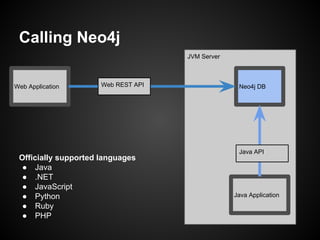
Calling Neo4j 
JVM Server 
Neo4j DB 
Java Application 
Web Application Web REST API 
Java API 
Officially supported languages 
● Java 
● .NET 
● JavaScript 
● Python 
● Ruby 
● PHP
Neo4j Editions 
Enterprise 
Enterprise Lock Manager 
High Performance Cache 
Clustering 
Hot Backups 
Advanced Monitoring 
NOT FREE 
Community 
FREE 
OPEN SOURCE
If you’ve ever 
● Joined more than 7 tables together 
● Modeled a graph in a table 
● Written a recursive CTE (Common Table Expression) 
● Tried to write some crazy stored procedure with multiple 
recursive self and inner joins 
You should use Neo4j
Disadvantages 
● JVM should configured properly to get the 
optimal performance. 
● Neo4j DB cannot be distributed. They should 
replicated. 
● Inappropriate for transactional information 
like accounting and banking.
Who use Neo4j?
Thank you !!!

Understanding Graph Databases with Neo4j and Cypher

  • 1.
    Understanding Graph Databaseswith Neo4j and Cypher Group Members S.S. Niranga MS-14901836 Nipuna Pannala MS-14902208 Ruhaim Izmeth MS-14901218
  • 2.
    Trends in Data Data is getting bigger: “Every 2 days we create as much information as we did up to 2003” – Eric Schmidt, Google
  • 3.
    The History ofGraph Theory ● 1736: Leonard Euler writes a paper on the “Seven Bridges of Konisberg” ● 1845: Gustav Kirchoff publishes his electrical circuit laws ● 1852: Francis Guthrie poses the “Four Color Problem” ● 1878: Sylvester publishes an article in Nature magazine that describes graphs ● 1936: Dénes Kőnig publishes a textbook on Graph Theory ● 1941: Ramsey and Turán define Extremal Graph Theory ● 1959: De Bruijn publishes a paper summarizing Enumerative Graph Theory ● 1959: Erdos, Renyi and Gilbert define Random Graph Theory ● 1969: Heinrich Heesch solves the “Four Color” problem ● 2003: Commercial Graph Database products start appearing on the market
  • 4.
    What is Graphdatabase? “A traditional relational database may tell you the average age of everyone in this room.. ..but a graph database will tell you who is most likely to buy you a beer!”
  • 6.
    What does aGraph database look like?
  • 7.
    What is aGraph Database? ● A database with an explicit graph structure ● Each node knows its adjacent nodes ● As the number of nodes increases, the cost of a local step (or hop) remains the same ● Plus an Index for lookups
  • 8.
    Compared to RelationalDatabases Optimized for aggregation Optimized for connections
  • 9.
  • 10.
    What to Choose? http://db-engines.com/en/ranking/graph+dbms
  • 11.
    What is Neo4j? ● Neo4j is an open-source graph database, implemented in Java. ● Neo4j version 1.0 was released in February, 2010. ● Neo4j version 2.0 was released in December, 2013 ● Neo4j was developed by Neo Technology, Inc. ● Neo Technology board of directors consists of Rod Johnson, (founder of the Spring Framework), Magnus Christerson (Vice President of Intentional Software Corp), Nikolaj Nyholm (CEO of Polar Rose), Sami Ahvenniemi (Partner at Conor Venture Partners) and Johan Svensson (CTO of Neo Technology).
  • 12.
    Entities in GraphDBs (Neo4j) ● Nodes ● Relationships ● Properties ● Labels ● Paths ● Traversal ● Schema (index and constraints)
  • 13.
  • 14.
  • 15.
  • 16.
  • 17.
  • 19.
    Introducing - Cypher Query Language for Neo4j
  • 21.
    Relational Schema Person p_id p_name Book b_id b_title p_type Wrote p_id b_id Purchased p_id b_id pur_date
  • 22.
    Cypher - FewKeywords General Clauses ● Return ● Order by ● Limit Writing Clauses ● Create ● Merge ● Set ● Delete ● Remove Reading Clauses ● Match ● Optional Match ● Where ● Aggregation Functions ● Predicates ● Scalar functions ● Collection functions ● Mathematical functions ● String functions See Full list at Cypher RefCard http://neo4j.com/docs/stable/cypher-refcard/
  • 23.
    Cypher Demo http://console.neo4j.org/ or if Neo4j is locally installed http://localhost:7474
  • 24.
    Cypher Creating nodes CREATE (:Person) CREATE (:Person { name:"John Le Carre" }) CREATE ({ name:"John Le Carre" }) CREATE (:Person:Author { name:"John Le Carre" }) CREATE (:Person:Author { name:"Graham Greene" }), (:Book { title:"Tinker, Tailor, Soldier, Spy" }), (:Book { title:"Our Man in Havana" }), (:Person { name:"Ian" }), (:Person { name:"Alan" })
  • 25.
    Cypher Modifying nodes MATCH (p:Person { namme:"Alan" }) SET p += {name2 : "Alan2"} MATCH (p:Person { namme:"Alan" }) SET p.name = "Alan" MATCH (p:Person { namme:"Alan" }) SET p = {name : "Alan"} CREATE (:Person { namme:"Alan" }) MATCH (p:Person { name2:"Alan2" }) DELETE p MATCH (p:Person { namme:"Alan" }) REMOVE p.namme
  • 26.
  • 27.
    Cypher - Creating Relationships CREATE (john:Person:Author { name:"John Le Carre" }), (b:Book { title:"Tinker, Tailor, Soldier, Spy" }), (john)-[:WROTE]->(b) MATCH (p:Person { name:"Ian" }), (b:Book { title:"Our Man in Havana" }) MERGE (p)-[:PURCHASED { date:"09-09-2011" }]->(b) MATCH (graham:Person:Author { name:" Graham Greene" }), (b:Book { title:"Our Man in Havana" }) MERGE (graham)-[:WROTE]-> (b) MATCH (t:Book { title:"Tinker, Tailor, Soldier, Spy" }), (i:Person { name:"Ian" }), (a:Person { name:"Alan" }) MERGE (i)-[:PURCHASED { date:"03-02-2011" }]->(t)<-[:PURCHASED { date:"05-07-2011" }]-(a)
  • 28.
    Cypher - ModifyingRelationships MATCH (graham:Person:Author { name:"Graham Greene" }), (b:Book { title:"Our Man in Havana" }) MERGE (graham)-[:WORTE]->(b) MATCH (graham:Person {name:"Graham Greene"})-[r]->(b:Book {title:"Our Man in Havana" }) DELETE r MATCH (p:Person { name:"Ian" })-[r]->(b:Book { title:"Our Man in Havana" }) SET r.date = "09-09-2012"
  • 29.
    Cypher - QueryingDBs Find All Books SQL SELECT * FROM Books Cypher Query MATCH (b:Book) RETURN b Person (p_id, p_name, p_type) Wrote (p_id, b_id) Book (b_id, b_title ) Purchased (p_id, b_id, pur_date) Cypher Result +-----------------------------------------------+ | b | +-----------------------------------------------+ | Node[2]{title:"Tinker, Tailor, Soldier, Spy"} | | Node[3]{title:"Our Man in Havana"} | +-----------------------------------------------+ 2 rows 2 ms
  • 30.
    Cypher - QueryingDBs Find All Authors SQL SELECT * FROM Person where p_type=” Author” Cypher Query MATCH (a:Author) RETURN a Person (p_id, p_name, p_type) Wrote (p_id, b_id) Book (b_id, b_title ) Purchased (p_id, b_id, pur_date) Cypher Result +-------------------------------+ | a | +-------------------------------+ | Node[0]{name:"John Le Carre"} | | Node[1]{name:"Graham Greene"} | +-------------------------------+ 2 rows 8 ms
  • 31.
    Cypher - QueryingDBs Find All Authors and the Books written by them SQL SELECT p.p_name, b.b_title FROM Person p, Wrote w, Book b where p.p_type=”Author” and w.p_id = p.p_id and w.b_id = b.b_id Cypher Query Person (p_id, p_name, p_type) Wrote (p_id, b_id) Book (b_id, b_title ) Purchased (p_id, b_id, pur_date) MATCH (a:Author)-[:WROTE]->(b: Book) RETURN a,b Cypher Result +-------------------------------------------------------------------------------+ | a | b | +-------------------------------------------------------------------------------+ | Node[0]{name:"John Le Carre"} | Node[2]{title:"Tinker, Tailor, Soldier, Spy"} | | Node[1]{name:"Graham Greene"} | Node[3]{title:"Our Man in Havana"} | +-------------------------------------------------------------------------------+ 2 rows 12 ms
  • 32.
    Cypher - QueryingDBs Find Books written by Graham Greene SQL SELECT b.b_title FROM Person p, Wrote w, Book b where p.p_type=”Author” and w.p_id = p.p_id and w.b_id = b.b_id and p.name = “Graham Greene” Person (p_id, p_name, p_type) Wrote (p_id, b_id) Book (b_id, b_title ) Purchased (p_id, b_id, pur_date) Cypher Query MATCH (a:Author)-[:WROTE]->(b: Book) WHERE a.name = 'Graham Greene' RETURN b Cypher Result +------------------------------------+ | b | +------------------------------------+ | Node[3]{title:"Our Man in Havana"} | +------------------------------------+ 1 row 13 ms
  • 33.
    Cypher - QueryingDBs Find names of all persons, the books they purchased and the date the purchase was made SQL SELECT p.p_name, pur.pur_date, b.b_title FROM Person p, Book b, Purchased pur WHERE pur.p_id=p.p_id and b. b_id = pur.b_id Person (p_id, p_name, p_type) Wrote (p_id, b_id) Book (b_id, b_title ) Purchased (p_id, b_id, pur_date) Cypher Query MATCH (a)-[r:PURCHASED]->(b) RETURN a,r.date,b Cypher Result +-------------------------------------------------------------------------------------+ | a | r.date | b | +-------------------------------------------------------------------------------------+ | Node[4]{name:"Ian"} | "09-09-2011" | Node[3]{title:"Our Man in Havana"} | | Node[4]{name:"Ian"} | "03-02-2011" | Node[2]{title:"Tinker, Tailor, Soldier, Spy"} | | Node[5]{name:"Alan"} | "05-07-2011" | Node[2]{title:"Tinker, Tailor, Soldier, Spy"} | +-------------------------------------------------------------------------------------+ 3 rows
  • 34.
    Cypher - QueryingDBs Find how Graham Greene is related to Ian SQL I won’t attempt!!! Person (p_id, p_name, p_type) Wrote (p_id, b_id) Book (b_id, b_title ) Purchased (p_id, b_id, pur_date) Cypher Query MATCH (a:Author)-[r*]-(p:Person { name:'Ian' }) WHERE a.name = 'Graham Greene' RETURN a,r,p Cypher Result +--------------------------------------------------------------------------------------------------------+ | a | r | p | +--------------------------------------------------------------------------------------------------------+ | Node[1]{name:"Graham Greene"} | [:WROTE[1] {},:PURCHASED[0] {date:"09-09-2011"}] | Node[4]{name:"Ian"} | +--------------------------------------------------------------------------------------------------------+ 1 row 38 ms
  • 35.
    Support for GraphAlgorithms ● shortestPath ● allSimplePaths ● allPaths ● dijkstra (optionally with cost_property and default_cost parameters)
  • 36.
    Neo4j - Defaultlocking behavior for Concurrency ● When adding, changing or removing a property on a node or relationship a write lock will be taken on the specific node or relationship. ● When creating or deleting a node a write lock will be taken for the specific node. ● When creating or deleting a relationship a write lock will be taken on the specific relationship and both its nodes.
  • 37.
    Neo4j - Performance ● As JVM runs on a shared environment, the way the JVM is configured greatly related to Performance. ● More optimized for querying than CRUD operations, Batch updates are recommended ● Indexes can be set on nodes, relationships and their properties. Can boost query response times ● Mixed reports on querytimes and performance, upcoming releases are optimizing this.
  • 38.
    Neo4j Capacity -Data size In Neo4j, data size is mainly limited by the address space of the primary keys for Nodes, Relationships, Properties and Relationship types. Currently, the address space is as follows: nodes 2^35 (∼ 34 billion) relationships 2^35 (∼ 34 billion) properties 2^36 to 2^38 depending on property types (maximum ∼ 274 billion, always at least ∼ 68 billion) relationship types 2^15 (∼ 32 000)
  • 39.
    Calling Neo4j JVMServer Neo4j DB Java Application Web Application Web REST API Java API Officially supported languages ● Java ● .NET ● JavaScript ● Python ● Ruby ● PHP
  • 40.
    Neo4j Editions Enterprise Enterprise Lock Manager High Performance Cache Clustering Hot Backups Advanced Monitoring NOT FREE Community FREE OPEN SOURCE
  • 41.
    If you’ve ever ● Joined more than 7 tables together ● Modeled a graph in a table ● Written a recursive CTE (Common Table Expression) ● Tried to write some crazy stored procedure with multiple recursive self and inner joins You should use Neo4j
  • 42.
    Disadvantages ● JVMshould configured properly to get the optimal performance. ● Neo4j DB cannot be distributed. They should replicated. ● Inappropriate for transactional information like accounting and banking.
  • 43.
  • 44.