Grammar Wednesday
       Chapter 4
      Section 5,6,7
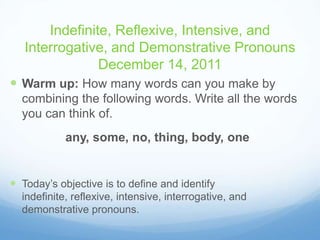
Indefinite, Reflexive, Intensive, and
   Interrogative, and Demonstrative Pronouns
                December 14, 2011
 Warm up: How many words can you make by
  combining the following words. Write all the words
  you can think of.
            any, some, no, thing, body, one


 Today’s objective is to define and identify
  indefinite, reflexive, intensive, interrogative, and
  demonstrative pronouns.
Indefinite Pronouns
 Does not refer to a particular person, place or
  thing.
 Singular—All words made in the warm up
  Plus, another, much, neither, each, and either
 Plural—Both, few, many, others, several
 Depends—All, any, most, none, some
So?
 Subject-Verb Agreement
  Example:
 Everyone eats (his or her, their) lunch.

  Example:
 Many are enjoying (his or her, their) roles
  in the play.
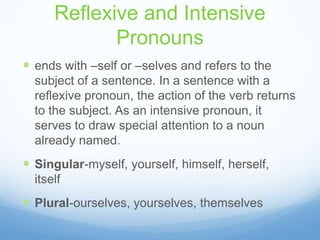
Reflexive and Intensive
             Pronouns
 ends with –self or –selves and refers to the
  subject of a sentence. In a sentence with a
  reflexive pronoun, the action of the verb returns
  to the subject. As an intensive pronoun, it
  serves to draw special attention to a noun
  already named.
 Singular-myself, yourself, himself, herself,
  itself
 Plural-ourselves, yourselves, themselves
So?
 No hisself!
 No theirselves!


 The volunteers were proud of
  (themselves, theirselves).
 Jim repaired the old grandfather clock
  (himself, hisself).
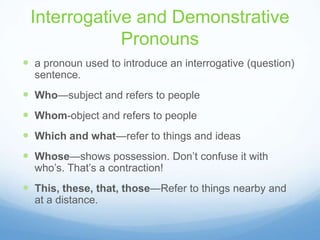
Interrogative and Demonstrative
             Pronouns
 a pronoun used to introduce an interrogative (question)
  sentence.
 Who—subject and refers to people
 Whom-object and refers to people
 Which and what—refer to things and ideas
 Whose—shows possession. Don’t confuse it with
  who’s. That’s a contraction!
 This, these, that, those—Refer to things nearby and
  at a distance.
Practice
 Everyone (wonder, wonders) about the
  accuracy of the story in the newspaper.
 In my opinion, all of the action movies this
  summer (are, is) unrealistic.
 Everyone in John’s class (is, are) grossed out
  by his nose picking habit.
 The engineers (theirselves, themselves)
  examined the bridge.
Practice
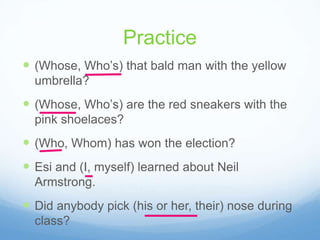
 (Whose, Who’s) that bald man with the yellow
  umbrella?
 (Whose, Who’s) are the red sneakers with the
  pink shoelaces?
 (Who, Whom) has won the election?
 Esi and (I, myself) learned about Neil
  Armstrong.
 Did anybody pick (his or her, their) nose during
  class?
Practice
 Few of the students (have, has) volunteered
  yet.
 All of the sugar (are, is) spilling onto the floor.
 Mr. McFadden bought (himself, hisself) a new
  tractor for his fields.
 This book is (mines, mine’s, mine).
 (It’s, Its) fun in English class.
 The dog chased (it’s, its) ball through the back
  yard.
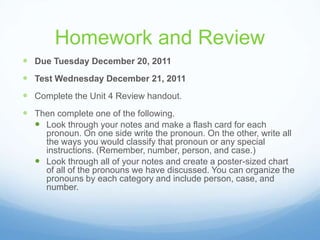
Homework and Review
 Due Tuesday December 20, 2011
 Test Wednesday December 21, 2011
 Complete the Unit 4 Review handout.
 Then complete one of the following.
   Look through your notes and make a flash card for each
    pronoun. On one side write the pronoun. On the other, write all
    the ways you would classify that pronoun or any special
    instructions. (Remember, number, person, and case.)
   Look through all of your notes and create a poster-sized chart
    of all of the pronouns we have discussed. You can organize the
    pronouns by each category and include person, case, and
    number.

Grammar chapter 4 section 5, 6, 7

  • 1.
    Grammar Wednesday Chapter 4 Section 5,6,7
  • 2.
    Indefinite, Reflexive, Intensive,and Interrogative, and Demonstrative Pronouns December 14, 2011  Warm up: How many words can you make by combining the following words. Write all the words you can think of. any, some, no, thing, body, one  Today’s objective is to define and identify indefinite, reflexive, intensive, interrogative, and demonstrative pronouns.
  • 3.
    Indefinite Pronouns  Doesnot refer to a particular person, place or thing.  Singular—All words made in the warm up Plus, another, much, neither, each, and either  Plural—Both, few, many, others, several  Depends—All, any, most, none, some
  • 4.
    So?  Subject-Verb Agreement  Example: Everyone eats (his or her, their) lunch.  Example: Many are enjoying (his or her, their) roles in the play.
  • 5.
    Reflexive and Intensive Pronouns  ends with –self or –selves and refers to the subject of a sentence. In a sentence with a reflexive pronoun, the action of the verb returns to the subject. As an intensive pronoun, it serves to draw special attention to a noun already named.  Singular-myself, yourself, himself, herself, itself  Plural-ourselves, yourselves, themselves
  • 6.
    So?  No hisself! No theirselves!  The volunteers were proud of (themselves, theirselves).  Jim repaired the old grandfather clock (himself, hisself).
  • 7.
    Interrogative and Demonstrative Pronouns  a pronoun used to introduce an interrogative (question) sentence.  Who—subject and refers to people  Whom-object and refers to people  Which and what—refer to things and ideas  Whose—shows possession. Don’t confuse it with who’s. That’s a contraction!  This, these, that, those—Refer to things nearby and at a distance.
  • 8.
    Practice  Everyone (wonder,wonders) about the accuracy of the story in the newspaper.  In my opinion, all of the action movies this summer (are, is) unrealistic.  Everyone in John’s class (is, are) grossed out by his nose picking habit.  The engineers (theirselves, themselves) examined the bridge.
  • 9.
    Practice  (Whose, Who’s)that bald man with the yellow umbrella?  (Whose, Who’s) are the red sneakers with the pink shoelaces?  (Who, Whom) has won the election?  Esi and (I, myself) learned about Neil Armstrong.  Did anybody pick (his or her, their) nose during class?
  • 10.
    Practice  Few ofthe students (have, has) volunteered yet.  All of the sugar (are, is) spilling onto the floor.  Mr. McFadden bought (himself, hisself) a new tractor for his fields.  This book is (mines, mine’s, mine).  (It’s, Its) fun in English class.  The dog chased (it’s, its) ball through the back yard.
  • 11.
    Homework and Review Due Tuesday December 20, 2011  Test Wednesday December 21, 2011  Complete the Unit 4 Review handout.  Then complete one of the following.  Look through your notes and make a flash card for each pronoun. On one side write the pronoun. On the other, write all the ways you would classify that pronoun or any special instructions. (Remember, number, person, and case.)  Look through all of your notes and create a poster-sized chart of all of the pronouns we have discussed. You can organize the pronouns by each category and include person, case, and number.