Using React with Grails 3
Zachary Klein
Software Engineer, OCI
Slides/Sample Code:
http://bit.ly/2fD91Qf
About Me
Grails & web developer for 5 years
Joined OCI Grails team in 2015
Using React since 2015
Author of the React profile/s for Grails 3
@zacharyaklein
On the Grails Team at @ObjectComputing.
Christ-follower, husband (of Elizabeth), dad (of
John & Timmy) programmer, guitarist. Needing
to be more like Jesus.
About you
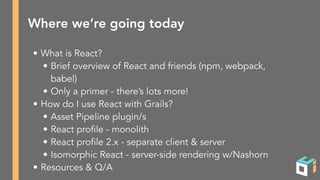
Where we’re going today
• What is React?
• Brief overview of React and friends (npm, webpack,
babel)
• Only a primer - there’s lots more!
• How do I use React with Grails?
• Asset Pipeline plugin/s
• React profile - monolith
• React profile 2.x - separate client & server
• Isomorphic React - server-side rendering w/Nashorn
• Resources & Q/A
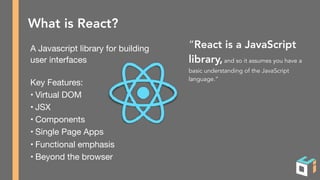
What is React?
A Javascript library for building 

user interfaces

Key Features:

• Virtual DOM

• JSX

• Components

• Single Page Apps

• Functional emphasis

• Beyond the browser
“React is a JavaScript
library,and so it assumes you have a
basic understanding of the JavaScript
language.”
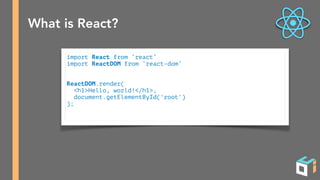
What is React?
import React from ‘react’
import ReactDOM from ‘react-dom’
ReactDOM.render(
<h1>Hello, world!</h1>,
document.getElementById('root')
);
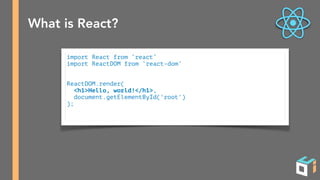
What is React?
import React from ‘react’
import ReactDOM from ‘react-dom’
ReactDOM.render(
<h1>Hello, world!</h1>,
document.getElementById('root')
);
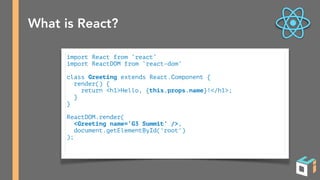
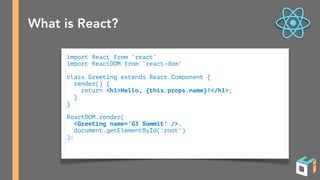
What is React?
import React from ‘react’
import ReactDOM from ‘react-dom’
class Greeting extends React.Component {
render() {
return <h1>Hello, {this.props.name}!</h1>;
}
}
ReactDOM.render(
<Greeting name=‘G3 Summit’ />,
document.getElementById('root')
);
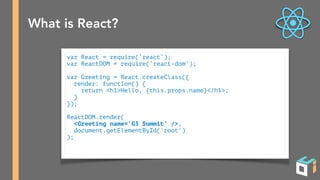
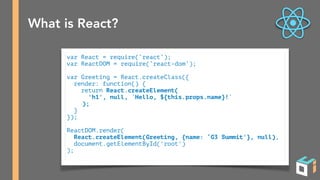
What is React?
var React = require(‘react’);
var ReactDOM = require(‘react-dom’);
var Greeting = React.createClass({
render: function() {
return <h1>Hello, {this.props.name}</h1>;
}
});
ReactDOM.render(
<Greeting name=‘G3 Summit’ />,
document.getElementById('root')
);
What is React?
import React from ‘react’
import ReactDOM from ‘react-dom’
class Greeting extends React.Component {
render() {
return <h1>Hello, {this.props.name}!</h1>;
}
}
ReactDOM.render(
<Greeting name=‘G3 Summit’ />,
document.getElementById('root')
);
What is React?
var React = require(‘react’);
var ReactDOM = require(‘react-dom’);
var Greeting = React.createClass({
render: function() {
return React.createElement(
'h1', null, `Hello, ${this.props.name}!`
);
}
});
ReactDOM.render(
React.createElement(Greeting, {name: ‘G3 Summit'}, null),
document.getElementById('root')
);
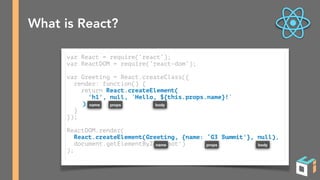
What is React?
var React = require(‘react’);
var ReactDOM = require(‘react-dom’);
var Greeting = React.createClass({
render: function() {
return React.createElement(
'h1', null, `Hello, ${this.props.name}!`
);
}
});
ReactDOM.render(
React.createElement(Greeting, {name: ‘G3 Summit'}, null),
document.getElementById('root')
);
name bodyprops
name bodyprops
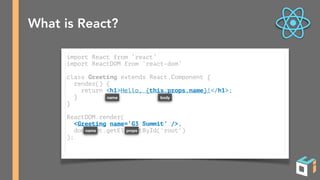
What is React?
import React from ‘react’
import ReactDOM from ‘react-dom’
class Greeting extends React.Component {
render() {
return <h1>Hello, {this.props.name}!</h1>;
}
}
ReactDOM.render(
<Greeting name=‘G3 Summit’ />,
document.getElementById('root')
);
name body
propsname
What is React?
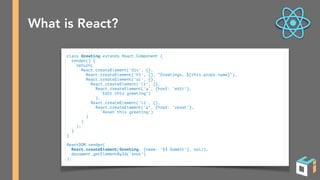
class Greeting extends React.Component {
render() {
return(
React.createElement('div', {},
React.createElement('h1', {}, “Greetings, ${this.props.name}"),
React.createElement('ul', {},
React.createElement('li', {},
React.createElement('a', {href: ‘edit'},
‘Edit this greeting’)
),
React.createElement('li', {},
React.createElement('a', {href: 'reset'},
‘Reset this greeting')
)
)
);
}
}
ReactDOM.render(
React.createElement(Greeting, {name: ‘G3 Summit'}, null),
document.getElementById('root')
);
What is React?
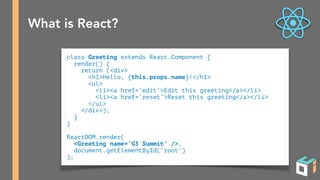
class Greeting extends React.Component {
render() {
return (<div>
<h1>Hello, {this.props.name}!</h1>
<ul>
<li><a href=‘edit’>Edit this greeting</a></li>
<li><a href=‘reset’>Reset this greeting</a></li>
</ul>
</div>);
}
}
ReactDOM.render(
<Greeting name=‘G3 Summit’ />,
document.getElementById('root')
);
What is React?
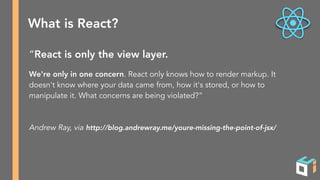
“React is only the view layer.
We're only in one concern. React only knows how to render markup. It
doesn't know where your data came from, how it's stored, or how to
manipulate it. What concerns are being violated?”
Andrew Ray, via http://blog.andrewray.me/youre-missing-the-point-of-jsx/
Component State
class Greeting extends React.Component {
constructor() {
super();
this.state = {
greetings: ['Hello', 'Salutations', 'Ho there’]
}
}
render() {
const greetings = this.state.greetings;
const randomGreeting = greetings[Math.floor(Math.random() * greetings.length];
return(
<h1>{randomGreeting}, {this.props.name}</h1>
);
}
}
ReactDOM.render(
React.createElement(<Greeting name=‘G3 Summit’ />, document.getElementById('root')
);
Component State
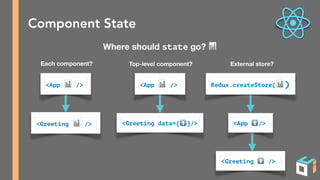
<Greeting 📊 />
<App 📊 />
<Greeting data={⬆ }/>
Redux.createStore( 📊)
<App ⬆ />
<Greeting ⬆ />
<App 📊 />
Each component? Top-level component? External store?
Where should state go? 📊
Component State
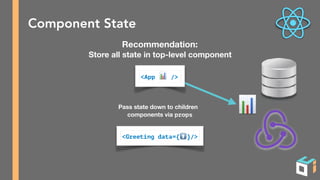
<App 📊 />
<Greeting data={⬆ }/>
Recommendation:
Store all state in top-level component
Pass state down to children
components via props
📊
What is React?
Other features:

• Lifecycle methods

• Event-handling

• State management

• PropType checking

• DOM access via refs
• SPA or partials

“React is, in our
opinion,the premier way to build
big, fast Web apps with JavaScript. It
has scaled very well for us at Facebook
and Instagram.”
What is React?
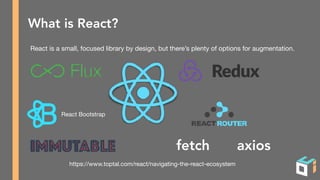
https://www.toptal.com/react/navigating-the-react-ecosystem
React Bootstrap
React is a small, focused library by design, but there’s plenty of options for augmentation.

fetch axios
What is React?
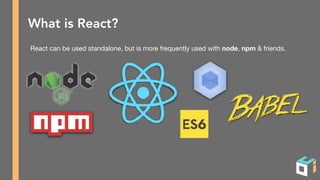
React can be used standalone, but is more frequently used with node, npm & friends.
What is React?
“Node.js is an open-source, cross-platform JavaScipt runtime environment.” (Wikipedia)
What is React?
“npm is the default package manager for… Node.js.” (Wikipedia)
What is React?
The 6th edition of ECMAScript, officially titled ECMAScript 2015.
What is React?
Babel - a Javascript “transpiler”
What is React?
Webpack is an open-source Javascript module bundler. (official website)
Why use React with Grails?
• Rest support
• rest-api profile
• JSON views
• Spring Websockets
• Gradle
+
How do I use React with Grails?
• Most React community resources & documentation
assume a node/Javascript-based environment.
• Typical project structure is not immediately
transferable to a Grails project.
• Use of npm is ubiquitous (but not required) and brings
both advantages & challenges.
• Potential tension between front-end and back-end
developer workflows
• Wild west - the trail is still being blazed!
How do I use React with Grails?
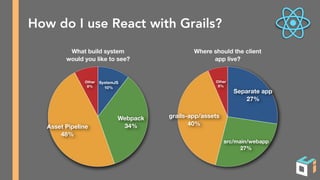
What build system
would you like to see?
Other
6%
grails-app/assets
40%
src/main/webapp
27%
Separate app
27%
Where should the client
app live?
Other
8%
Asset Pipeline
48%
Webpack
34%
SystemJS
10%
React & the Asset Pipeline
• Front-end asset management/processing in Grails is
typically handled via the Asset Pipeline.
• Recently-released plugins now support React with AP.
• React/JSX files in grails-app/assets/javascripts.
• Take advantage of other front-end Grails/Gradle
plugins, such as the excellent client-dependencies
plugin (https://github.com/craigburke/client-
dependencies-gradle)
• Performant, extensible, familiar to Grails developers.
React & the Asset Pipeline
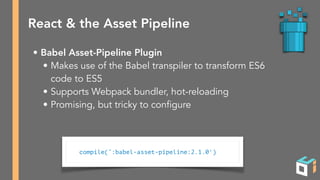
• Babel Asset-Pipeline Plugin
• Makes use of the Babel transpiler to transform ES6
code to ES5
• Supports Webpack bundler, hot-reloading
• Promising, but tricky to configure
compile(‘:babel-asset-pipeline:2.1.0')
React & the Asset Pipeline
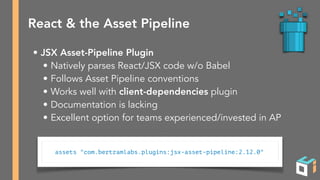
• JSX Asset-Pipeline Plugin
• Natively parses React/JSX code w/o Babel
• Follows Asset Pipeline conventions
• Works well with client-dependencies plugin
• Documentation is lacking
• Excellent option for teams experienced/invested in AP

assets "com.bertramlabs.plugins:jsx-asset-pipeline:2.12.0"
React & the Asset Pipeline
DEMO
React & the Asset Pipeline
• “Asset pipeline” seems to be out of favor among
front-end developers (perhaps unfairly).
• May be difficult to follow along with community
documentation/resources.
• AP support for new asset processing tools tends to lag
behind Node-based tooling.
• Not compatible with popular front-end toolchains.
• Grails-centric - may be confusing/unfamiliar to a
dedicated front-end team.
Webpack
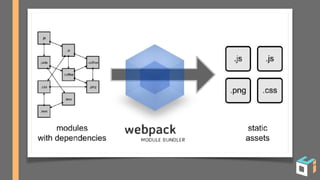
• Webpack is a Module bundler.
• Typically installed via npm, run via scripts in package.json
• Designed for Single Page Apps
• Supports a huge variety of asset types via configurable
“loaders” (processors)
• Supports code-splitting/chunking
• Supports hashed/version assets for cache control
• Outputs a single bundle (by default), containing all
required Javascript/CSS to render the target (i.e, your
React app)
import ‘text-label’
_react2.default.createElement(
_reactBootstrap.Modal.Footer,
null,
_react2.default.createElement(
'span',
{ className: 'copyright' },
'Built with React 15.3.2, webpack
1.13.1, Grails 3'
),
_react2.default.createElement(
_reactBootstrap.Button,
{ onClick: this.toggleModal },
'Close'
)
hello.js
bundle.js
import ‘lodash’
text-label.js
//from node_modules
loadash.js
import ‘hello’
app.js
function hello() {
return <div>Hello world!</div>;
}
"use strict";
function hello() {
return React.createElement(
"div",
null,
"Hello world!"
);
}
hello.js
bundle.js
- loader
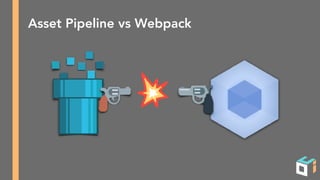
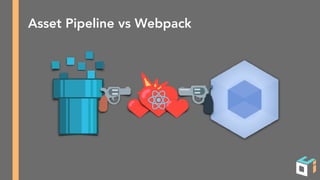
Asset Pipeline vs Webpack
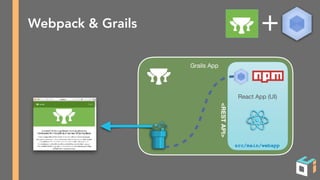
Webpack & Grails +
src/main/webapp
Grails App
React App (UI)
<RESTAPI>
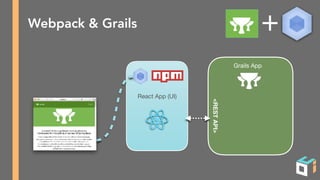
Webpack & Grails +
Grails App
React App (UI)
<RESTAPI>
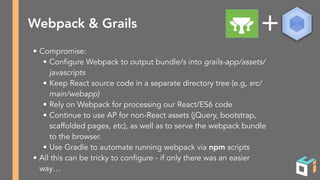
Webpack & Grails
• Compromise:
• Configure Webpack to output bundle/s into grails-app/assets/
javascripts
• Keep React source code in a separate directory tree (e.g, src/
main/webapp)
• Rely on Webpack for processing our React/ES6 code
• Continue to use AP for non-React assets (jQuery, bootstrap,
scaffolded pages, etc), as well as to serve the webpack bundle
to the browser.
• Use Gradle to automate running webpack via npm scripts
• All this can be tricky to configure - if only there was an easier
way…
+
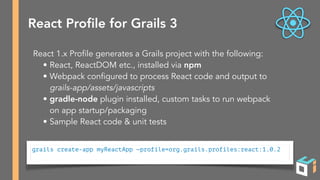
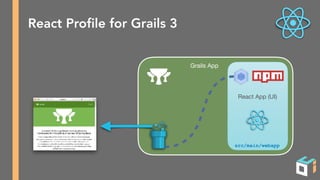
React Profile for Grails 3
grails create-app myReactApp —profile=org.grails.profiles:react:1.0.2
React 1.x Profile generates a Grails project with the following:
• React, ReactDOM etc., installed via npm
• Webpack configured to process React code and output to
grails-app/assets/javascripts
• gradle-node plugin installed, custom tasks to run webpack
on app startup/packaging
• Sample React code & unit tests
React Profile for Grails 3
src/main/webapp
Grails App
React App (UI)
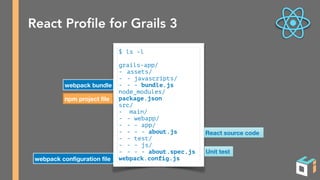
React Profile for Grails 3
$ ls -l
grails-app/
- assets/
- - javascripts/
- - - bundle.js
node_modules/
package.json
src/
- main/
- - webapp/
- - - app/
- - - - about.js
- - test/
- - - js/
- - - - about.spec.js
webpack.config.js
npm project file
webpack configuration file
React source code
webpack bundle
Unit test
React Profile for Grails 3
DEMO
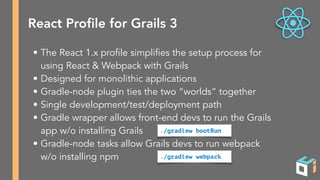
React Profile for Grails 3
• The React 1.x profile simplifies the setup process for
using React & Webpack with Grails
• Designed for monolithic applications
• Gradle-node plugin ties the two “worlds” together
• Single development/test/deployment path
• Gradle wrapper allows front-end devs to run the Grails
app w/o installing Grails
• Gradle-node tasks allow Grails devs to run webpack
w/o installing npm
./gradlew bootRun
./gradlew webpack
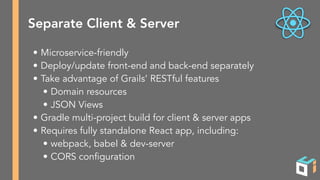
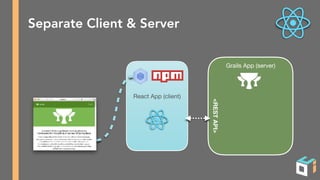
Separate Client & Server
• Microservice-friendly
• Deploy/update front-end and back-end separately
• Take advantage of Grails’ RESTful features
• Domain resources
• JSON Views
• Gradle multi-project build for client & server apps
• Requires fully standalone React app, including:
• webpack, babel & dev-server
• CORS configuration
Separate Client & Server
Grails App (server)
React App (client)
<RESTAPI>
create-react-app
“Create React App is a new officially supported way to
create single-page React applications. It offers a modern
build setup with no configuration.”
https://facebook.github.io/react/blog/2016/07/22/create-apps-with-no-configuration.html
• Generates fully standalone React app
• Provides working webpack & Babel config
• Provides scripts for starting app, building public bundle,
running tests
• Simplified development & an easy “exit strategy”
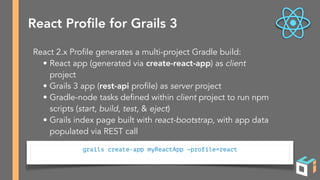
React Profile for Grails 3
grails create-app myReactApp —profile=react
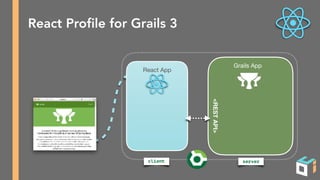
React 2.x Profile generates a multi-project Gradle build:
• React app (generated via create-react-app) as client
project
• Grails 3 app (rest-api profile) as server project
• Gradle-node tasks defined within client project to run npm
scripts (start, build, test, & eject)
• Grails index page built with react-bootstrap, with app data
populated via REST call
React Profile for Grails 3
Grails App
React App
<RESTAPI>
client server
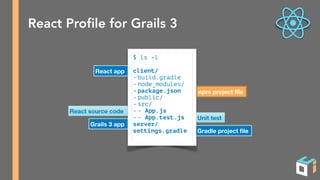
React Profile for Grails 3
$ ls -l
client/
- build.gradle
- node_modules/
- package.json
- public/
- src/
- - App.js
- - App.test.js
server/
settings.gradle
npm project file
Grails 3 app
React source code
React app
Unit test
Gradle project file
React Profile for Grails 3
DEMO
Isomorphic React
• Isomorphic - same code on client & server (aka “universal”)
• React can be rendered server-side
• Can improve initial page load time
• Can improve SEO performance
• Java 8 introduced a new JavaScript engine, Nashorn
Isomorphic React
NashornScriptEngine nashornScriptEngine =
new ScriptEngineManager().getEngineByName("nashorn")
nashornScriptEngine.eval(readResource(“myscript.js”))
nashornScriptEngine.invokeFunction('myFunction',
“${new JsonBuilder([arg:‘some arg’])}”)
function myFunction(data) {
render(“Here’s some data we got from the server: “ + data.arg);
}
Isomorphic React
DEMO
Isomorphic React
• Tightly couples React source code with Grails app
• Adds additional complexity
• Requires polyfill to work with React
• Nashorn's CSS/LESS support is very poor
• Perhaps useful for React scaffolding?
• Performance?
Resources
React Ecosystem
• https://www.toptal.com/react/navigating-the-react-ecosystem
JSX
• http://jamesknelson.com/learned-stop-worrying-love-jsx/
• http://blog.andrewray.me/youre-missing-the-point-of-jsx/
React Architecture
• https://facebook.github.io/react/docs/thinking-in-react.html
• https://discuss.reactjs.org/t/best-practices-for-extending-
subclassing-components/1820
Resources
Grails Plugins & Profiles
• https://grails.org/plugin/babel-asset-pipeline
• https://github.com/bertramdev/asset-pipeline/tree/master/jsx-asset-
pipeline
• https://github.com/ZacharyKlein/grails-isomorphic
• https://github.com/grails-profiles/webpack
• https://github.com/grails-profiles/react
Using React & Grails
• http://grailsblog.objectcomputing.com/posts/2016/05/28/using-react-
with-grails.html
• http://grailsblog.objectcomputing.com/posts/2016/11/14/
introducing-the-react-profile-for-grails.html
• http://guides.grails.org/using-the-react-profile/guide/index.html
Thank you!
twitter: @zacharyaklein
mailto: kleinz@ociweb.com

Using React with Grails 3

  • 1.
    Using React withGrails 3 Zachary Klein Software Engineer, OCI
  • 2.
  • 3.
    About Me Grails &web developer for 5 years Joined OCI Grails team in 2015 Using React since 2015 Author of the React profile/s for Grails 3 @zacharyaklein On the Grails Team at @ObjectComputing. Christ-follower, husband (of Elizabeth), dad (of John & Timmy) programmer, guitarist. Needing to be more like Jesus.
  • 4.
  • 5.
    Where we’re goingtoday • What is React? • Brief overview of React and friends (npm, webpack, babel) • Only a primer - there’s lots more! • How do I use React with Grails? • Asset Pipeline plugin/s • React profile - monolith • React profile 2.x - separate client & server • Isomorphic React - server-side rendering w/Nashorn • Resources & Q/A
  • 6.
    What is React? AJavascript library for building user interfaces Key Features: • Virtual DOM • JSX • Components • Single Page Apps • Functional emphasis • Beyond the browser “React is a JavaScript library,and so it assumes you have a basic understanding of the JavaScript language.”
  • 7.
    What is React? importReact from ‘react’ import ReactDOM from ‘react-dom’ ReactDOM.render( <h1>Hello, world!</h1>, document.getElementById('root') );
  • 8.
    What is React? importReact from ‘react’ import ReactDOM from ‘react-dom’ ReactDOM.render( <h1>Hello, world!</h1>, document.getElementById('root') );
  • 9.
    What is React? importReact from ‘react’ import ReactDOM from ‘react-dom’ class Greeting extends React.Component { render() { return <h1>Hello, {this.props.name}!</h1>; } } ReactDOM.render( <Greeting name=‘G3 Summit’ />, document.getElementById('root') );
  • 10.
    What is React? varReact = require(‘react’); var ReactDOM = require(‘react-dom’); var Greeting = React.createClass({ render: function() { return <h1>Hello, {this.props.name}</h1>; } }); ReactDOM.render( <Greeting name=‘G3 Summit’ />, document.getElementById('root') );
  • 11.
    What is React? importReact from ‘react’ import ReactDOM from ‘react-dom’ class Greeting extends React.Component { render() { return <h1>Hello, {this.props.name}!</h1>; } } ReactDOM.render( <Greeting name=‘G3 Summit’ />, document.getElementById('root') );
  • 12.
    What is React? varReact = require(‘react’); var ReactDOM = require(‘react-dom’); var Greeting = React.createClass({ render: function() { return React.createElement( 'h1', null, `Hello, ${this.props.name}!` ); } }); ReactDOM.render( React.createElement(Greeting, {name: ‘G3 Summit'}, null), document.getElementById('root') );
  • 13.
    What is React? varReact = require(‘react’); var ReactDOM = require(‘react-dom’); var Greeting = React.createClass({ render: function() { return React.createElement( 'h1', null, `Hello, ${this.props.name}!` ); } }); ReactDOM.render( React.createElement(Greeting, {name: ‘G3 Summit'}, null), document.getElementById('root') ); name bodyprops name bodyprops
  • 14.
    What is React? importReact from ‘react’ import ReactDOM from ‘react-dom’ class Greeting extends React.Component { render() { return <h1>Hello, {this.props.name}!</h1>; } } ReactDOM.render( <Greeting name=‘G3 Summit’ />, document.getElementById('root') ); name body propsname
  • 15.
    What is React? classGreeting extends React.Component { render() { return( React.createElement('div', {}, React.createElement('h1', {}, “Greetings, ${this.props.name}"), React.createElement('ul', {}, React.createElement('li', {}, React.createElement('a', {href: ‘edit'}, ‘Edit this greeting’) ), React.createElement('li', {}, React.createElement('a', {href: 'reset'}, ‘Reset this greeting') ) ) ); } } ReactDOM.render( React.createElement(Greeting, {name: ‘G3 Summit'}, null), document.getElementById('root') );
  • 16.
    What is React? classGreeting extends React.Component { render() { return (<div> <h1>Hello, {this.props.name}!</h1> <ul> <li><a href=‘edit’>Edit this greeting</a></li> <li><a href=‘reset’>Reset this greeting</a></li> </ul> </div>); } } ReactDOM.render( <Greeting name=‘G3 Summit’ />, document.getElementById('root') );
  • 17.
    What is React? “Reactis only the view layer. We're only in one concern. React only knows how to render markup. It doesn't know where your data came from, how it's stored, or how to manipulate it. What concerns are being violated?” Andrew Ray, via http://blog.andrewray.me/youre-missing-the-point-of-jsx/
  • 18.
    Component State class Greetingextends React.Component { constructor() { super(); this.state = { greetings: ['Hello', 'Salutations', 'Ho there’] } } render() { const greetings = this.state.greetings; const randomGreeting = greetings[Math.floor(Math.random() * greetings.length]; return( <h1>{randomGreeting}, {this.props.name}</h1> ); } } ReactDOM.render( React.createElement(<Greeting name=‘G3 Summit’ />, document.getElementById('root') );
  • 19.
    Component State <Greeting 📊/> <App 📊 /> <Greeting data={⬆ }/> Redux.createStore( 📊) <App ⬆ /> <Greeting ⬆ /> <App 📊 /> Each component? Top-level component? External store? Where should state go? 📊
  • 20.
    Component State <App 📊/> <Greeting data={⬆ }/> Recommendation: Store all state in top-level component Pass state down to children components via props 📊
  • 21.
    What is React? Otherfeatures: • Lifecycle methods • Event-handling • State management • PropType checking • DOM access via refs • SPA or partials “React is, in our opinion,the premier way to build big, fast Web apps with JavaScript. It has scaled very well for us at Facebook and Instagram.”
  • 22.
    What is React? https://www.toptal.com/react/navigating-the-react-ecosystem ReactBootstrap React is a small, focused library by design, but there’s plenty of options for augmentation. fetch axios
  • 23.
    What is React? Reactcan be used standalone, but is more frequently used with node, npm & friends.
  • 24.
    What is React? “Node.jsis an open-source, cross-platform JavaScipt runtime environment.” (Wikipedia)
  • 25.
    What is React? “npmis the default package manager for… Node.js.” (Wikipedia)
  • 26.
    What is React? The6th edition of ECMAScript, officially titled ECMAScript 2015.
  • 27.
    What is React? Babel- a Javascript “transpiler”
  • 28.
    What is React? Webpackis an open-source Javascript module bundler. (official website)
  • 29.
    Why use Reactwith Grails?
  • 30.
    Why use Reactwith Grails? • Rest support • rest-api profile • JSON views • Spring Websockets • Gradle +
  • 31.
    How do Iuse React with Grails? • Most React community resources & documentation assume a node/Javascript-based environment. • Typical project structure is not immediately transferable to a Grails project. • Use of npm is ubiquitous (but not required) and brings both advantages & challenges. • Potential tension between front-end and back-end developer workflows • Wild west - the trail is still being blazed!
  • 32.
    How do Iuse React with Grails? What build system would you like to see? Other 6% grails-app/assets 40% src/main/webapp 27% Separate app 27% Where should the client app live? Other 8% Asset Pipeline 48% Webpack 34% SystemJS 10%
  • 33.
    React & theAsset Pipeline
  • 34.
    React & theAsset Pipeline • Front-end asset management/processing in Grails is typically handled via the Asset Pipeline. • Recently-released plugins now support React with AP. • React/JSX files in grails-app/assets/javascripts. • Take advantage of other front-end Grails/Gradle plugins, such as the excellent client-dependencies plugin (https://github.com/craigburke/client- dependencies-gradle) • Performant, extensible, familiar to Grails developers.
  • 35.
    React & theAsset Pipeline • Babel Asset-Pipeline Plugin • Makes use of the Babel transpiler to transform ES6 code to ES5 • Supports Webpack bundler, hot-reloading • Promising, but tricky to configure compile(‘:babel-asset-pipeline:2.1.0')
  • 36.
    React & theAsset Pipeline • JSX Asset-Pipeline Plugin • Natively parses React/JSX code w/o Babel • Follows Asset Pipeline conventions • Works well with client-dependencies plugin • Documentation is lacking • Excellent option for teams experienced/invested in AP
 assets "com.bertramlabs.plugins:jsx-asset-pipeline:2.12.0"
  • 37.
    React & theAsset Pipeline DEMO
  • 38.
    React & theAsset Pipeline • “Asset pipeline” seems to be out of favor among front-end developers (perhaps unfairly). • May be difficult to follow along with community documentation/resources. • AP support for new asset processing tools tends to lag behind Node-based tooling. • Not compatible with popular front-end toolchains. • Grails-centric - may be confusing/unfamiliar to a dedicated front-end team.
  • 39.
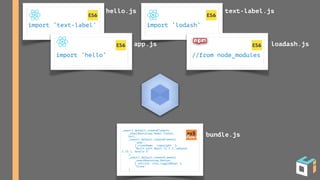
    Webpack • Webpack isa Module bundler. • Typically installed via npm, run via scripts in package.json • Designed for Single Page Apps • Supports a huge variety of asset types via configurable “loaders” (processors) • Supports code-splitting/chunking • Supports hashed/version assets for cache control • Outputs a single bundle (by default), containing all required Javascript/CSS to render the target (i.e, your React app)
  • 41.
    import ‘text-label’ _react2.default.createElement( _reactBootstrap.Modal.Footer, null, _react2.default.createElement( 'span', { className:'copyright' }, 'Built with React 15.3.2, webpack 1.13.1, Grails 3' ), _react2.default.createElement( _reactBootstrap.Button, { onClick: this.toggleModal }, 'Close' ) hello.js bundle.js import ‘lodash’ text-label.js //from node_modules loadash.js import ‘hello’ app.js
  • 42.
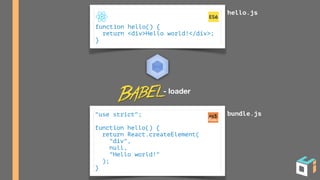
    function hello() { return<div>Hello world!</div>; } "use strict"; function hello() { return React.createElement( "div", null, "Hello world!" ); } hello.js bundle.js - loader
  • 43.
  • 44.
  • 45.
    Webpack & Grails+ src/main/webapp Grails App React App (UI) <RESTAPI>
  • 46.
    Webpack & Grails+ Grails App React App (UI) <RESTAPI>
  • 47.
    Webpack & Grails •Compromise: • Configure Webpack to output bundle/s into grails-app/assets/ javascripts • Keep React source code in a separate directory tree (e.g, src/ main/webapp) • Rely on Webpack for processing our React/ES6 code • Continue to use AP for non-React assets (jQuery, bootstrap, scaffolded pages, etc), as well as to serve the webpack bundle to the browser. • Use Gradle to automate running webpack via npm scripts • All this can be tricky to configure - if only there was an easier way… +
  • 48.
    React Profile forGrails 3 grails create-app myReactApp —profile=org.grails.profiles:react:1.0.2 React 1.x Profile generates a Grails project with the following: • React, ReactDOM etc., installed via npm • Webpack configured to process React code and output to grails-app/assets/javascripts • gradle-node plugin installed, custom tasks to run webpack on app startup/packaging • Sample React code & unit tests
  • 49.
    React Profile forGrails 3 src/main/webapp Grails App React App (UI)
  • 50.
    React Profile forGrails 3 $ ls -l grails-app/ - assets/ - - javascripts/ - - - bundle.js node_modules/ package.json src/ - main/ - - webapp/ - - - app/ - - - - about.js - - test/ - - - js/ - - - - about.spec.js webpack.config.js npm project file webpack configuration file React source code webpack bundle Unit test
  • 51.
    React Profile forGrails 3 DEMO
  • 52.
    React Profile forGrails 3 • The React 1.x profile simplifies the setup process for using React & Webpack with Grails • Designed for monolithic applications • Gradle-node plugin ties the two “worlds” together • Single development/test/deployment path • Gradle wrapper allows front-end devs to run the Grails app w/o installing Grails • Gradle-node tasks allow Grails devs to run webpack w/o installing npm ./gradlew bootRun ./gradlew webpack
  • 53.
    Separate Client &Server • Microservice-friendly • Deploy/update front-end and back-end separately • Take advantage of Grails’ RESTful features • Domain resources • JSON Views • Gradle multi-project build for client & server apps • Requires fully standalone React app, including: • webpack, babel & dev-server • CORS configuration
  • 54.
    Separate Client &Server Grails App (server) React App (client) <RESTAPI>
  • 55.
    create-react-app “Create React Appis a new officially supported way to create single-page React applications. It offers a modern build setup with no configuration.” https://facebook.github.io/react/blog/2016/07/22/create-apps-with-no-configuration.html • Generates fully standalone React app • Provides working webpack & Babel config • Provides scripts for starting app, building public bundle, running tests • Simplified development & an easy “exit strategy”
  • 56.
    React Profile forGrails 3 grails create-app myReactApp —profile=react React 2.x Profile generates a multi-project Gradle build: • React app (generated via create-react-app) as client project • Grails 3 app (rest-api profile) as server project • Gradle-node tasks defined within client project to run npm scripts (start, build, test, & eject) • Grails index page built with react-bootstrap, with app data populated via REST call
  • 57.
    React Profile forGrails 3 Grails App React App <RESTAPI> client server
  • 58.
    React Profile forGrails 3 $ ls -l client/ - build.gradle - node_modules/ - package.json - public/ - src/ - - App.js - - App.test.js server/ settings.gradle npm project file Grails 3 app React source code React app Unit test Gradle project file
  • 59.
    React Profile forGrails 3 DEMO
  • 60.
    Isomorphic React • Isomorphic- same code on client & server (aka “universal”) • React can be rendered server-side • Can improve initial page load time • Can improve SEO performance • Java 8 introduced a new JavaScript engine, Nashorn
  • 61.
    Isomorphic React NashornScriptEngine nashornScriptEngine= new ScriptEngineManager().getEngineByName("nashorn") nashornScriptEngine.eval(readResource(“myscript.js”)) nashornScriptEngine.invokeFunction('myFunction', “${new JsonBuilder([arg:‘some arg’])}”) function myFunction(data) { render(“Here’s some data we got from the server: “ + data.arg); }
  • 62.
  • 63.
    Isomorphic React • Tightlycouples React source code with Grails app • Adds additional complexity • Requires polyfill to work with React • Nashorn's CSS/LESS support is very poor • Perhaps useful for React scaffolding? • Performance?
  • 64.
    Resources React Ecosystem • https://www.toptal.com/react/navigating-the-react-ecosystem JSX •http://jamesknelson.com/learned-stop-worrying-love-jsx/ • http://blog.andrewray.me/youre-missing-the-point-of-jsx/ React Architecture • https://facebook.github.io/react/docs/thinking-in-react.html • https://discuss.reactjs.org/t/best-practices-for-extending- subclassing-components/1820
  • 65.
    Resources Grails Plugins &Profiles • https://grails.org/plugin/babel-asset-pipeline • https://github.com/bertramdev/asset-pipeline/tree/master/jsx-asset- pipeline • https://github.com/ZacharyKlein/grails-isomorphic • https://github.com/grails-profiles/webpack • https://github.com/grails-profiles/react Using React & Grails • http://grailsblog.objectcomputing.com/posts/2016/05/28/using-react- with-grails.html • http://grailsblog.objectcomputing.com/posts/2016/11/14/ introducing-the-react-profile-for-grails.html • http://guides.grails.org/using-the-react-profile/guide/index.html
  • 66.