MySQL/JVM
A Framework for Enabling Java Language Stored Procedures in MySQL
Kevin Tankersley
Sacred Heart University
5151 Park Avenue
Fairfield, CT 06825
tankersleyk@sacredheart.edu
Abstract
Database procedural languages tend to be special-purpose lan-
guages, with constructs and libraries designed to support common
data access methods and flow control. To provide support for tasks
which cannot be solved with such basic data access functional-
ity, many database vendors embed the runtime environment of a
more general-purpose language in the database server, allowing
stored programs to be written in this external language. Such an
approach leverages the work that has already gone into design-
ing, implementing, and testing the runtime library of the external
language, while maintaining a low learning curve for advanced
functionality since many developers will already be fluent in this
external language. This paper presents the design, implementation,
and use of the MySQL/JVM system, a framework for embedding
the Java Virtual Machine runtime environment into the MySQL
database server to allow stored procedures and stored functions
in the MySQL database to be written in the Java programming
language.
Categories and Subject Descriptors H.2.3 [Database Manage-
ment]: Languages—Database (persistent) programming languages;
D.3.4 [Programming Languages]: Processors—Run-time environ-
ments; D.3.3 [Programming Languages]: Language Constructs
and Features—Data types and structures
General Terms Design, Languages, Security
Keywords MySQL, Java Native Interface, JNI, Stored Proce-
dures, SQL/JRT, ISO/IEC 9075-13
1. Introduction
Most relational database systems provide a procedural language,
which allows stored procedures to be hosted in the database to en-
capsulate common business logic, and allows user defined stored
functions to be created to calculate common metrics. The nature
of these languages and the robustness of the library of functions
available to them can vary widely from one vendor to another. For
example, MySQL includes a procedural language which offers ba-
sic control flow and has a fairly small library, Microsoft SQL Server
Permission to make digital or hard copies of all or part of this work for personal or
classroom use is granted without fee provided that copies are not made or distributed
for profit or commercial advantage and that copies bear this notice and the full citation
on the first page. To copy otherwise, to republish, to post on servers or to redistribute
to lists, requires prior specific permission and/or a fee.
offers control flow and basic exception handling with a larger li-
brary, and Oracle includes an object-oriented language with a fairly
robust library.
Given that the majority of the procedures hosted inside a
database system will be primarily intended to execute basic al-
gorithms over data sets and cursors, most of the functionality that
developers will need is present even in the least feature-rich stored
procedure languages. There are tasks, however, for which features
typically found in the libraries of more general purpose languages
may be needed. For example, processing and transmitting XML
documents has become a more common task in many databases
as XML standards have become widely accepted for data transfer.
Security policies for sensitive data may require custom encryption
routines and processes. Access to the file system, or to network
sockets, may be needed to acquire or export data. The degree of
support for these tasks is generally low in most database procedu-
ral languages.
To solve such problems, several database vendors allow stored
procedures to be written in a general purpose programming lan-
guage (in addition to the database native procedural language) in
order to expose the libraries provided by that language to devel-
opers. For example, the Oracle database allows stored procedures
to be written in the Java language, and Microsoft’s SQL Server
allows stored procedures to be written in any of the .NET lan-
guages. Further, all versions of the standard definition of the SQL
language since SQL:2003 [1] have consisted of 14 parts, one of
which (SQL/JRT [2], [5]) is dedicated entirely to defining the be-
havior of Java language stored procedures within a database server.
Currently, however, the MySQL database does not provide support
for Java language stored procedures.
This paper will present the MySQL/JVM system, a project
which integrates the Java Virtual Machine runtime environment
into the MySQL database server process to allow stored procedures
to be written in the Java language. The balance of this section will
present the features and characteristics of stored procedures in the
MySQL database. Section 2 will present the scope of the project,
and Section 3 will discuss the high level design. In section 4, lower
level design issues and noteworthy highlights of the implementa-
tion will be presented.
1.1 Stored Procedures, Functions, and Triggers
Relational databases are ubiquitous in application architecture.
Most of the major information systems used by a typical orga-
nization rely on a relational database server for their data storage
and retrieval needs. The role of the database as the originator of
data and the final destination of data makes it a good candidate to
assume data access control functionality. The centralization of the
database and the use of network protocols for data transfer also
makes it a potential performance bottleneck. The result has been
a migration of some program logic out of the applications making
use of the database and into the database itself, in the form of stored
procedures.
The term stored procedures will be used here to mean subrou-
tines which are stored in a location accessible to a database server
process and which the process may execute in response to an event
or on behalf of a client. Some distinction is typically made between
stored procedures and stored functions (or user-defined functions),
namely that stored functions can return a value to the caller. Further
distinction can be made between stored procedures and triggers on
the basis that triggers are not called explicity by a client but are in-
stead executed on the occurrence of some predefined event. When
such distinctions are important in the following sections, they will
be mentioned explicity; Otherwise the use of the term stored pro-
cedures throughout the rest of this paper will broadly refer to all of
these classes of stored code.
Migrating common business logic out of applications and into
stored procedures can bring several benefits. Stored procedures
may be able to implement logic containing multiple decision points
more efficiently than a client application, since a stored procedure
does not need to make each data request over the network. On many
systems, the statements in the procedure are precompiled, so that
executing a stored procedure will be faster than executing a block
of the same statements. Implementing stored procedures makes the
business logic they encapsulate reusable across applications. Stored
procedures can also be used to create fine-grained access control
policies.
1.2 Stored Procedures in the MySQL Database
MySQL is a relational database management system. Development
on the MySQL project began as early as 1994, and the features of
the server have grown steadily since. MySQL now supports most
of the SQL:1999 standard, and has become extremely popular, with
more than 100 million distributions to date. The MySQL server is
widely used as the underlying data store backing many web appli-
cations. The source code for the MySQL server is freely available
under the terms of the GNU General Public License.
Stored procedures were added to MySQL in its fifth version
in 2005. The syntax for creating and executing stored procedures
loosely adheres to the SQL:2003 Persistent Stored Module stan-
dard [3] (see [11] for full details concerning stored procedure syn-
tax and features). The stored procedure language provides flow
control via such statements as IF, LOOP, and WHILE; a BEGIN ...
END syntax for blocks; a DECLARE statement for variable declara-
tion and a SET statement for variable assignment; OPEN, CLOSE,
and FETCH statements for cursors; a RETURN statement for func-
tions; and a DECLARE ... HANDLER for exception handling. User
defined types, packages, and objects are not supported. The lan-
guage provides about 250 functions and operators for control flow,
string manipulation, mathematics, date and time manipulation, type
casting, XML processing, aggregation, spatial data manipulation,
binary data operations, encryption and compression.
1.3 Limitations of Stored Procedures in MySQL
The procedural statements and function libraries discussed in sec-
tion 1.2 are certainly sufficient for a large number of tasks related
to data processing, but they do not provide much support for more
advanced functionality. Below are several use cases that cannot be
easily achieved by using the existing stored procedure language of
MySQL. Each case could be implemented within individual ap-
plications instead of in the database, of course, but such a solu-
tion would lose all of the benefits discussed in section 1.1. When
databases do provide robust, general purpose libraries, the choice
of whether to implement common business logic in the database
or in each application that uses the data is an important design de-
cision. The following cases would be good candidates for stored
procedures, if MySQL had sufficient support to develop solutions
for them:
1. The database regularly receives and stores XML documents
which are supposed to adhere to a particular XML Schema.
The documents are generated independently by several source
systems, each implemented in different languages and using
different XML platforms. To detect and control errors, it would
be desirable for the database to ensure the validity of each
document and to verify that it does conform to the expected
schema.
2. The database needs to store sensitive information in an en-
crypted form. Symmetric encryption is deemed unsuitable due
to problems in properly protecting the shared encryption key.
A public key encryption protocol is desired to protect the most
sensitive data; Preferably one which does not have to be re-
implemented in each client application.
3. An organization is employing a service-oriented application ar-
chitecture, and valuable data services are available over the net-
work. It would be both costly and undesirable for the function-
ality made available by these services to be re-implemented in
the database. It would be ideal if a procedure could be written
to access such services whenever the database needs them.
2. Scope
Bringing Java language stored procedures to MySQL is a very
high-level goal. Both the Java runtime environment and the MySQL
database are complex systems, which can in fact already interact
independently over network protocols. Further, Java technology
is highly standardized, by way of the Java Community Process.
Expert groups consisting of representatives from multiple product
vendors draft technology specifications in the form of Java Speci-
fication Requests, which in turn become the standards to adhere to
when working with a Java technology area.
The SQL language is also governed by a defining standard (the
most recent version of which is defined by [4]). The standard con-
sists of the nine interrelated parts in Table 1, each of which is iden-
tified by a standard ID (e.g. ISO/IEC 9075-1:2008), a full name
(e.g. Information Technology–Database Language–SQL– Part 1:
Framework), and a short mnemonic identifier (e.g. SQL/Frame-
work).
Official claims of conformance to one of the nine parts of this
standard are verified by a conformance audit. No vendor currently
claims full official conformance to all nine parts of the standard,
and some vendors do not pursue official conformance at all, choos-
ing instead simply to design their products to comply with the stan-
dards as much as possible but to make exceptions or extensions as
needed. The features and behavior of the MySQL database server
comply closely with several of the nine parts of the SQL standard.
In particular, the stored procedure language used by MySQL is one
of the few vendor languages that closely conforms to the language
specified in the SQL/PSM substandard for defining stored routines.
It is noteworthy that part 13 (SQL/JRT) defines a standard for Java
stored procedures that builds on the syntax and standards defined in
ISO/IEC ID Name Mnemonic
9075-1:2008 Framework SQL/Framework
9075-2:2008 Foundation SQL/Foundation
9075-3:2008 Call-Level Interface SQL/CLI
9075-4:2008 Persistent Stored Modules SQL/PSM
9075-9:2008 Management of External Data SQL/MED
9075-10:2008 Object Language Bindings SQL/OLB
9075-11:2008 Information and Definition
Schemas
SQL/Schemata
9075-13:2008 SQL Routines and Types Us-
ing the Java TM Programming
Language
SQL/JRT
9075-14:2008 XML-Related Specifications SQL/XML
Table 1. ISO/IEC 9075:2008 Substandards
Feature Feature Name Compliance
1 J511 Commands In Scope
2 J521 JDBC data types Out of Scope
3 J531 Deployment No Compliance
4 J541 SERIALIZABLE Out of Scope
5 J551 SQLDATA Out of Scope
6 J561 JAR privileges Out of Scope
7 J571 NEW operator Out of Scope
8 J581 Output parameters In Scope
9 J591 Overloading Out of Scope
10 J601 SQL-Java paths No Compliance
11 J611 References Out of Scope
12 J621 External Java routines In Scope
13 J622 External Java types Out of Scope
14 J631 Java signatures In Scope
15 J641 Static fields Out of Scope
16 J651 Information Schema Out of Scope
17 J652 Usage tables Out of Scope
Table 2. SQL/JRT Feature Sets
SQL/PSM. Since the stored routine language in MySQL is already
in close compliance with SQL/PSM, defining what levels of con-
formance this project will have with the elements of the SQL/JRT
standard are the primary scope decisions to be made.
2.1 ISO Standard Compliance
The SQL/JRT ISO standard [4] is a large standard. In fact, it is large
enough that it groups the feature requirements it defines into sev-
enteen feature sets. Table 2 defines whether each of the seventeen
feature sets are in scope, out of scope, or will not be a conformance
target for this project. Features which are in scope for this project
will be implemented in close compliance to the SQL/JRT specifi-
cation. Features which are out of scope will not be implemented,
but the implementation will be structured such that they can be
added in the future. Features which are not compliance targets will
not be implemented, and it is unlikely that they could be added to
the system without a substantial redesign. The presence of such
features does not necessarily preclude a claim of conformance to
the specification, however. An official claim of conformance to
the specification requires, at a minimum, one of the features J621,
J541, or J551 together with one of the features J511 or J531.
The features can be even more broadly classified as those which
support the definition and execution of Java stored routines, those
which support the definition and execution of user defined Java
types, those which define the interaction between the database and
the Java runtime environment, and those which define the tables
and views which should be exposed as database metadata. The pri-
mary scope of this project is to integrate the Java Virtual Machine
into the database engine and to provide an API through which calls
can be made from the Java runtime to the database or vice-versa.
The project will comply closely with the feature sets in Table 2
which fall within that scope.
The SQL/JRT specification devotes roughly half of the features
it defines to defining and invoking Java routines, and devotes the
other half to defining and using Java language user-defined types.
Any feature relating to the creation of user-defined types with the
Java language is out of scope, and left for future development.
Since MySQL does not currently have any support for user-defined
types, even in the host language, such a change would be too large
of a task to complete within the timeframe of the project. Such a
type system could be added later, though, and could easily leverage
the framework which will be built to support routine calls.
For reasons discussed in Section 3, the subsystem for locating
Java classfiles will differ significantly from the recommendations in
SQL/JRT. As a result, the system will not comply with the features
in Table 2 relating to the deployment of Java classfiles and the
resolution of Java paths. Further, it would not be reasonable to bring
the system into compliance with these features without a major re-
write (possibly a total re-write). As mentioned above, this does not
mean that an official claim of compliance could not be made, since
a minimal claim of compliance can be made without either of the
features J531 or J601.
2.2 Other Scope Considerations
Within the features defined in Section 2.1, there are still a num-
ber of scope decisions to be made. The SQL/JRT standard defines
the features that a compliant database server must provide from a
fairly high level, but it does not provide many mandates concerning
the design details related to implementing those features. In partic-
ular, there are several subsystems which the Java runtime and the
MySQL database server have in common. Ideally, a seamless inte-
gration would fully integrate each such subsystem. Since there will
not be sufficient time to provide a full integration of each subsys-
tem, the remainder of this section will discuss the scoping decisions
for each major touch point between the database and the Java run-
time.
2.2.1 Access Control
Security in MySQL is managed in a fairly standard way through
a remote login process and access control lists. The access control
lists control access to resources such as tables, views, and stored
procedures. The access control allows actions such as CREATE,
DROP, SELECT, and EXECUTE against these resources, and these ac-
tions can either be explicitly allowed (GRANT) or denied (REVOKE).
(See [11] for a more complete listing of MySQL access control
commands).
Security in the Java runtime, however, is managed rather differ-
ently. The default security model for the Java runtime assigns per-
missions based on the notion of a CODESOURCE, which is primarily
a combination of a URL identifying where an archive originated
and possibly a cryptographic signature of the code. This policy
essentially allows local Java code to execute with access to the en-
tire runtime, but restricts the access of remotely downloaded code
such as Java Applets. This default policy is difficult to integrate
in a meaningful way with the user-driven access control policy of
MySQL. It should be noted that a custom security policy could be
written by system administrators, and there are Java Specifications
and APIs which allow user-driven access control to be enforced -
see [6] for more details on access control options in Java.
The Java runtime provides access to some very powerful re-
sources (e.g. network sockets and file operations), which is exactly
why it is useful as a language for stored routines. Some of these
might use significant memory or processor resources, however,
which can be a big problem in a database server which is typically
multi-user and performance-sensitive. Ultimately, the database ad-
ministrator is the individual responsible for ensuring that access
control is setup optimally. The database administrator should have
a simple way to control access to the various sensitive resources
in the Java runtime. Ideally this would come in the form of ex-
tending the GRANT and REVOKE actions to include Java resources
(e.g. ‘GRANT OPEN SOCKET TO USER1’ or ‘GRANT WRITE FILE
TO USER2’). The implementation differences between the Java se-
curity model and the MySQL security model currently make this
an unreasonable goal, although it is an interesting area for future
development.
2.2.2 Output
Several database vendors provide a channel across which basic
messages can be sent from a stored procedure. Microsoft SQL
Server, for example, provides a print statement, and the Oracle
database provides the dbms output.put line procedure. In some
cases, the client may even choose whether or not information re-
ceived through this channel will be processed, making it a useful
tool for diagnostics information or debugging information.
The MySQL database, however, does not provide such a chan-
nel. This is more than just a missing feature in the language - the
TCP protocol which the client and server use to communicate does
not even define any structure which could be used to pass such data
(see [10] for a description of the MySQL network protocol).
The scope of this project is certainly limited to the server pro-
cess itself. Even a small change to the communication protocol
would render all existing clients unable to connect to the server. As
such, no diagnostic channel will be created or assumed. The Java
runtime, however, frequently sends output to the user through the
System.out and System.err streams. With no convenient way to
redirect these to the user, they will end up in the MySQL server log
files. This is almost certainly not the ideal place for them, especially
since the MySQL log file conventionally follows a specific format
for its diagnostic messages. A future enhancement could disable
these streams in the most harmless way possible, or might redirect
them to a special Java log file.
2.2.3 Data Type Translation
At the moment when a Java routine is called, the parameters must
be translated from their MySQL data type to the equivalent Java
data type. For stored functions, the same holds for the return value
at the time the Java method completes. Only data type mappings
which can map to and from Java primitive types will be consid-
ered in scope for this project, with the exception of mappings to
and from java.lang.String and mappings to and from one-
dimensional arrays of char and byte. Mappings to and from any
other Java reference type are not in scope. This is an issue of time,
not feasibility, so the design of the parameter translation should
be easily extensible to accomodate future mappings to and from
more complex MySQL types which call for a Java reference type
to properly represent them. Since no straightforward mapping ex-
ists for result sets, there will not be any way in this version of the
system for a Java routine to return a result set. Adding parameter
support for result sets and cursors would be another interesting area
Charset Description Default collation
big5 Big5 Traditional Chinese big5 chinese ci
dec8 DEC West European dec8 swedish ci
cp850 DOS West European cp850 general ci
hp8 HP West European hp8 english ci
koi8r KOI8-R Relcom Russian koi8r general ci
latin1 cp1252 West European latin1 swedish ci
latin2 ISO 8859-2 Central European latin2 general ci
swe7 7bit Swedish swe7 swedish ci
ascii US ASCII ascii general ci
ujis EUC-JP Japanese ujis japanese ci
sjis Shift-JIS Japanese sjis japanese ci
hebrew ISO 8859-8 Hebrew hebrew general ci
tis620 TIS620 Thai tis620 thai ci
euckr EUC-KR Korean euckr korean ci
koi8u KOI8-U Ukrainian koi8u general ci
gb2312 GB2312 Simplified Chinese gb2312 chinese ci
greek ISO 8859-7 Greek greek general ci
cp1250 Windows Central European cp1250 general ci
gbk GBK Simplified Chinese gbk chinese ci
latin5 ISO 8859-9 Turkish latin5 turkish ci
armscii8 ARMSCII-8 Armenian armscii8 general ci
utf8 UTF-8 Unicode utf8 general ci
ucs2 UCS-2 Unicode ucs2 general ci
cp866 DOS Russian cp866 general ci
keybcs2 DOS Kamenicky Czech-Slovak keybcs2 general ci
macce Mac Central European macce general ci
macroman Mac West European macroman general ci
cp852 DOS Central European cp852 general ci
latin7 ISO 8859-13 Baltic latin7 general ci
cp1251 Windows Cyrillic cp1251 general ci
cp1256 Windows Arabic cp1256 general ci
cp1257 Windows Baltic cp1257 general ci
binary Binary pseudo charset binary
geostd8 GEOSTD8 Georgian geostd8 general ci
cp932 SJIS for Windows Japanese cp932 japanese ci
eucjpms UJIS for Windows Japanese eucjpms japanese ci
Table 3. Supported Character Sets
for future development.
With respect to java.lang.String parameters and char[]
parameters, some consideration needs to be given to the character
set encodings that can be used in MySQL and in the Java runtime.
Table 3 lists the character set encodings supported in MySQL 5.1
(see [11] for details). The two-byte UCS2 Unicode character set
will be used as the common encoding to translate all other charac-
ter sets into before being passed into the Java runtime. This means
that any character not in the Unicode Basic Multilingual Plane can-
not be represented, although MySQL provides no support for such
characters at the moment anyway.
2.2.4 Other Server/Runtime Communication
The MySQL database server has an extensible exception handling
mechanism, which includes the DECLARE ... HANDLER stored
procedure instruction for exception catching. The Java language
includes a very powerful exception handling mechanism, although
the behavior of uncaught exceptions which propogate all the way
out of the entry method is necessarily defined by the runtime. In-
tegration of these two exception handling mechanisms will be in
scope, so uncaught Java exceptions should continue to propogate
outward from the Java routine as MySQL exceptions. Further, new
exceptions will be created for errors resulting from incorrect Java
routine definitions or errors in parameter translation.
The Java runtime makes calls into a database using the Java
Database Connectivity API (JDBC, the msot recent version of
which is defined in the Java community process specification JSR-
54). The JDBC API provides a fixed interface for all database ven-
dors, and it is up to each vendor to provide an implementation
of that interface (called a JDBC driver) for their product. These
drivers communicate with the database server by opening a TCP
connection to the server, providing login credentials, sending the
desired command, and receiving the appropriate result. For Java
code which is not running on the same machine as the MySQL
server, this is an effective communication mechanism. Java stored
procedures, however, will be executing not only on the same ma-
chine as the database server, but in the same process. It could po-
tentially be much faster for JDBC calls to make a direct call to
the appropriate function in the MySQL server, rather than send-
ing commands over TCP sockets that require authorization, state-
ment parsing, and result interpretation. Unfortunately, the JDBC
API is prohibitively large, so a general-purpose native driver is
out of scope. However, as a special exception, the custom class-
loader class edu.sacredheart.cs.myjvm.MyClassLoader (see
Section 3.2.3) does make direct calls to native MySQL functions
without routing anything over a TCP connection.
3. Design
The features scoped in Section 2 could be added to the MySQL
server in a number of ways, and the design of additions and modifi-
cations to the server could affect issues like the platform avaiability
of the server, the performance of the Java routines, and the memory
consumption of client threads.
The most pressing design issue is the choice of how to in-
voke the Java Virtual Machine and call class methods within it.
The available design choices differ primarily in how tightly inte-
grated the MySQL server and the JVM become. At one extreme,
the MySQL server could simply make a system() call or similar,
invoking the java binary executable and passing the class name,
path, and arguments as strings. At the other extreme, the source
code for the JVM could be included with that of the MySQL server,
and MySQL could make direct calls into the internal processing
logic of the JVM. Section 3.2 presents the major design decisions
made in this project, and Section 3.2.2 presents the design deci-
sions made specifically to enable the MySQL server to make calls
into the JVM.
Before presenting these design decisions, it will be useful to
summarize the current MySQL server design. The server is actually
quite complex, offering platform-independent support for features
like threads, transactions, locking, logging, and replication. A full
presentation of the server design is beyond the scope of this paper,
but a summary of the design elements which support the use of
stored routines will be presented in Section 3.1.
3.1 MySQL Design
The MySQL server is implemented as a fairly standard client-server
application. When the server is first started, it goes through an ini-
tialization procedure, setting up the structures and parameters that
it will need to properly serve requests (see [10] for a much more
complete description of the server initialization process and many
other details of the server implementation). After initialization, the
server begins listening for network connections (the default port
that it listens on is port 3306, although administrators can change
this). From this point on, the main server thread does very little
other than listen for incoming connections and spawn new threads
:Client :Server :ClientThread :Parser :ParseTree
t
request()
create(thd)
handle one connection(thd)
do command(thd)
dispatch command(thd,packet)
mysql parse(thd,command)
create()
return()
mysql execute command(thd)
Figure 1. MySQL New Thread Prolog
to handle them.
Once a client is authenticated and a thread has been created
for it, the typical flow of events proceeds as in Figure 1. Af-
ter the client makes a request, the server creates a new thread to
handle the request. The thread begins execution by calling the
handle one connection server function. This calls the do command
server function, which calls the dispatch command server func-
tion, which invokes the parser via the mysql parse function. The
parser then parses the input, creating a parse tree class with objects
and structures representing the client request. The parser then calls
the execute server function, after which processing will differ ac-
cording to the type of command which the client requested.
This thread initialization prolog demonstrates a few features of
the design of the server. Firstly, note that the server is not sub-
divided into loosely coupled subsystems or classes. Most of the
core server features are implemented as globally accessible func-
tions. Features added to the server more recently, however, are
more likely to be encapsulated in classes. Secondly, this prolog in-
troduces a few of the elements which will be most important in the
design of Java routines.
After the server creates a new thread in Figure 1, most of the
remaining function calls pass a variable named thd. This variable
is a MySQL thread descriptor, and it is passed as the first argu-
ment to almost every function in the core server library. The thread
descriptor contains basically all data structures that are relevant to
a specific client request. This includes the objects which actually
represent the operating system thread, but also much more, such as
the parse tree, flags and states, references to the protocol handlers
and the table handlers, object caches, and status variables.
One element of the thread initialization prolog which is a sepa-
rate module is the parser. MySQL uses the GNU Bison parser gen-
erator to create a parser for the language understood by MySQL
1 CREATE DEFINER = ’root’@’localhost’ PROCEDURE ‘hello‘(
2 INOUT str VARCHAR(100)
3 )
4 LANGUAGE SQL
5 DETERMINISTIC
6 CONTAINS SQL
7 SQL SECURITY DEFINER
8 COMMENT ’Outputs a greeting.’
9 BEGIN
10 SET str = ’Hello, World!’;
11 END;
Listing 1. A Basic MySQL Stored Routine
from a specification grammar. Bison would normally use the GNU
Flex utility to generate a lexical analyzer to support the parser, but
for performance reasons MySQL uses a custom-built lexical ana-
lyzer. The job of the parser is to create the parse tree, a data struc-
ture which holds the class instances, structures, and flags which
represent the command requested by the client.
3.1.1 Creating Stored Routines
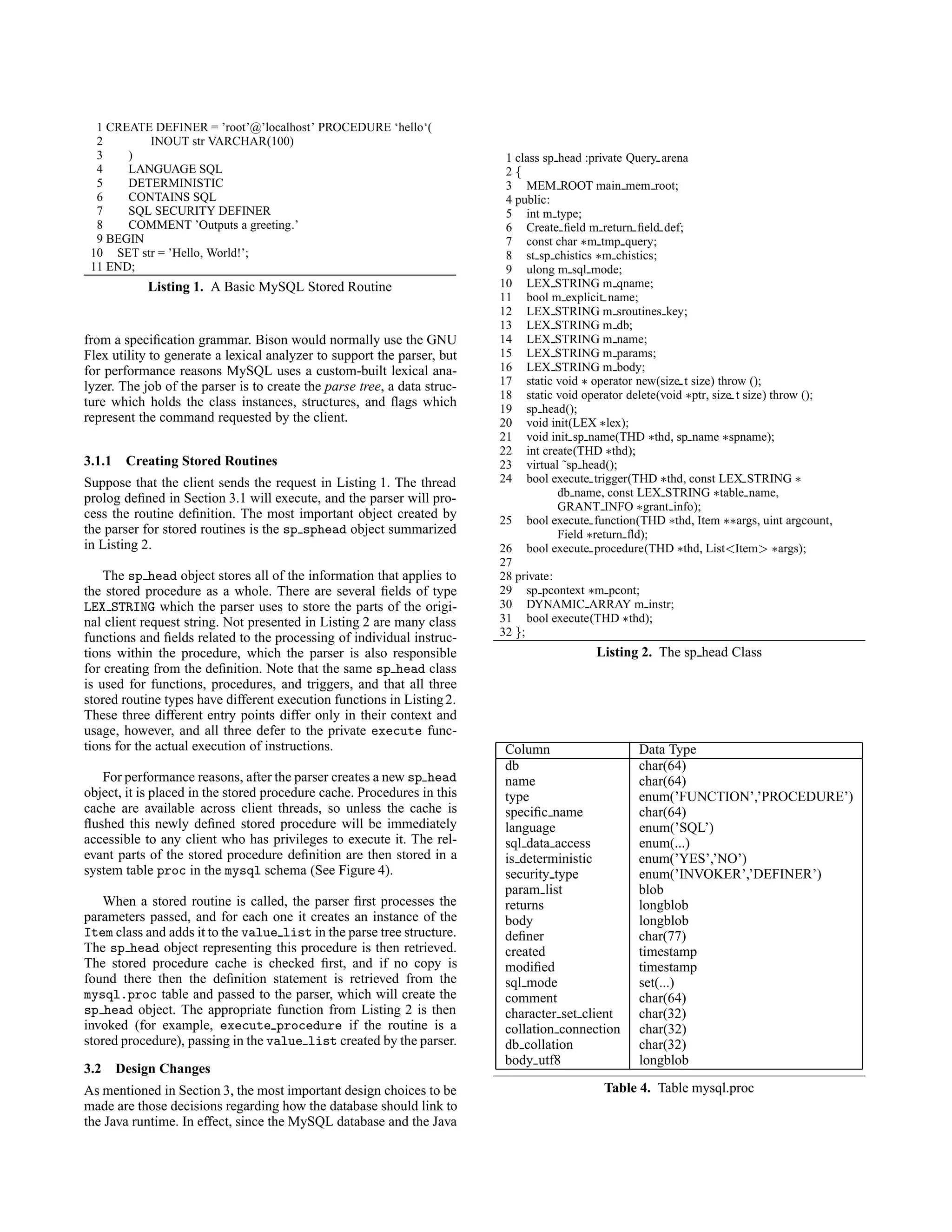
Suppose that the client sends the request in Listing 1. The thread
prolog defined in Section 3.1 will execute, and the parser will pro-
cess the routine definition. The most important object created by
the parser for stored routines is the sp sphead object summarized
in Listing 2.
The sp head object stores all of the information that applies to
the stored procedure as a whole. There are several fields of type
LEX STRING which the parser uses to store the parts of the origi-
nal client request string. Not presented in Listing 2 are many class
functions and fields related to the processing of individual instruc-
tions within the procedure, which the parser is also responsible
for creating from the definition. Note that the same sp head class
is used for functions, procedures, and triggers, and that all three
stored routine types have different execution functions in Listing2.
These three different entry points differ only in their context and
usage, however, and all three defer to the private execute func-
tions for the actual execution of instructions.
For performance reasons, after the parser creates a new sp head
object, it is placed in the stored procedure cache. Procedures in this
cache are available across client threads, so unless the cache is
flushed this newly defined stored procedure will be immediately
accessible to any client who has privileges to execute it. The rel-
evant parts of the stored procedure definition are then stored in a
system table proc in the mysql schema (See Figure 4).
When a stored routine is called, the parser first processes the
parameters passed, and for each one it creates an instance of the
Item class and adds it to the value list in the parse tree structure.
The sp head object representing this procedure is then retrieved.
The stored procedure cache is checked first, and if no copy is
found there then the definition statement is retrieved from the
mysql.proc table and passed to the parser, which will create the
sp head object. The appropriate function from Listing 2 is then
invoked (for example, execute procedure if the routine is a
stored procedure), passing in the value list created by the parser.
3.2 Design Changes
As mentioned in Section 3, the most important design choices to be
made are those decisions regarding how the database should link to
the Java runtime. In effect, since the MySQL database and the Java
1 class sp head :private Query arena
2 {
3 MEM ROOT main mem root;
4 public:
5 int m type;
6 Create field m return field def;
7 const char ∗m tmp query;
8 st sp chistics ∗m chistics;
9 ulong m sql mode;
10 LEX STRING m qname;
11 bool m explicit name;
12 LEX STRING m sroutines key;
13 LEX STRING m db;
14 LEX STRING m name;
15 LEX STRING m params;
16 LEX STRING m body;
17 static void ∗ operator new(size t size) throw ();
18 static void operator delete(void ∗ptr, size t size) throw ();
19 sp head();
20 void init(LEX ∗lex);
21 void init sp name(THD ∗thd, sp name ∗spname);
22 int create(THD ∗thd);
23 virtual ˜sp head();
24 bool execute trigger(THD ∗thd, const LEX STRING ∗
db name, const LEX STRING ∗table name,
GRANT INFO ∗grant info);
25 bool execute function(THD ∗thd, Item ∗∗args, uint argcount,
Field ∗return fld);
26 bool execute procedure(THD ∗thd, List<Item> ∗args);
27
28 private:
29 sp pcontext ∗m pcont;
30 DYNAMIC ARRAY m instr;
31 bool execute(THD ∗thd);
32 };
Listing 2. The sp head Class
Column Data Type
db char(64)
name char(64)
type enum(’FUNCTION’,’PROCEDURE’)
specific name char(64)
language enum(’SQL’)
sql data access enum(...)
is deterministic enum(’YES’,’NO’)
security type enum(’INVOKER’,’DEFINER’)
param list blob
returns longblob
body longblob
definer char(77)
created timestamp
modified timestamp
sql mode set(...)
comment char(64)
character set client char(32)
collation connection char(32)
db collation char(32)
body utf8 longblob
Table 4. Table mysql.proc
runtime are already functional systems separately, this amounts
to saying that the most crucial element of their integration is the
boundary between the two systems.
The primary vehicle for that integration will be the Java Native
Interface (JNI). Section 3.2.1 discusses the JNI in general, and
Section 3.2.2 discusses the design of a subsystem which manages
the JVM linkage using JNI. Section 3.2.3 discusses the choice of
where and how to store compiled Java code so that the database
can find and execute it at runtime, and Sections 3.2.4 and 3.2.5
discuss changes to the objects introduced in Section 3.1.1 to add
Java routine functionality.
3.2.1 The Java Native Interface
The Java Native Interface is an API which provides a powerful bi-
directional communication channel between native code and code
running within the Java Virtual Machine. The JNI can be an ideal
framework with which to integrate C or C++ applications with Java
applications. A brief introduction to the JNI will be presented here,
but the interested reader can find much more detail in [8].
Since the Java Virtual Machine is not a specific software pack-
age, but rather a standard which many vendors have provided im-
plementations for, the features exposed through the JNI treat the
internal structure of the JVM as a black box. This is accomplished
through the use of the JNI environment pointer, defined in the
header file jni.h as type JNIEnv *. The environment pointer pro-
vides an interface through which requests for services can be made
from the JVM without revealing the internal structure of the virtual
machine.
The JNI basically allows running Java methods to call C or C++
(“native”) functions, and it allows running C or C++ code to call
methods of Java classes. Calls from Java to native code are facili-
tated by the native keyword in Java, which informs the compiler
that the definition of a method will be provided by a C or C++ func-
tion from a library which will be linked at runtime. The appropriate
function to call is determined either by following specific naming
conventions and exporting the function from a shared library, or
by explicitly registering the appropriate native function with the
JVM at runtime. Making calls from native code to Java methods
is achived through the JNI invocation interface. The invocation in-
terface allows native code to create an instance of the JVM, then
create class instances within the created JVM and call methods on
those classes.
Since the JVM is multithreaded, the JNI provides a mechanism
for native code to interact with the JVM in a multithreaded way. A
request can be made to attach the current native thread to the JVM,
which creates a new instance of java.lang.Thread to represent
the native thread in the JVM and provides an environment pointer
to the native thread through which it can request JVM services.
Since the Java language allows method overloading, it is neces-
sary to identify methods with both their name and their signature.
The signature of a method is formatted using the internal signa-
ture format defined in the JVM specification (see [9]). In this for-
mat, primitive types are represented with a single character, and
reference types have a form similar to Ljava/lang/String; in
which the type name begins with L and ends with ; and consists
of the fully-qualified name in between, with packages separated
by slashes. Arrays of any type are represented by prepending a
number of [ characters equal to the depth of the array to the type
name, so that a three-dimensional array of strings would be iden-
tified as [[[Ljava/lang/String;. This type format is important
1 #include ”jni.h”
2
3 class MyJVM {
4 // Using latest version of JNI, version 1.4
5 static const jint vm version = JNI VERSION 1 4;
6 // Singleton instance of this class
7 static class MyJVM ∗myjvm;
8 // The pointer to the JNI jvm descriptor
9 JavaVM ∗jvm;
10 // Environment descriptor for main thread
11 JNIEnv ∗env;
12 public:
13 static MyJVM ∗getMyJVM();
14 int startMyJVM();
15 int restartMyJVM();
16 int shutdownMyJVM();
17 ˜MyJVM();
18 JNIEnv ∗attachThread();
19 int detachThread();
20 static const unsigned char sigmap[NUM STATES] [
NUM CHARS];
21 static const unsigned char chmap[NUM ASCII CHARS];
22 private:
23 MyJVM();
24 };
Listing 3. The MyJVM Class
to understand when working with the JVM, as many calls need to
specify either a variable type or a method signature in this way.
3.2.2 Linking to the Java Virtual Machine
Linking to the JVM will be acomplished by the class MyJVM, pre-
sented in Listing 3. The class will encapsulate all of the JNI-related
processing that needs to be done to create and attach to the virtual
machine, so that other parts of the server do not have to make JNI
calls or even include JNI headers.
The MyJVM class is implemented as a singleton. During the
server intialization process described in Section3.1, the getMyJVM()
function will be called for the first time, which will in turn call the
private constructor to create the static instance myjvm. Subsequent
calls to the getMyJVM() function by native client threads will re-
turn this static instance. This design guarantees that there will never
be more than one JVM defined in a single database instance. Native
client threads can also call the attachThread() function to attach
the current native thread to this JVM.
The arrays sigmap and chmap implement the finite state ma-
chine in Figure 2 which parses the language of method signatures
mentioned in Section 3.2.1. They are defined at the JVM level in
part because the internal method signature format is defined by
the JVM and in part because this ensures that the arrays will not
be defined more than once in the application. In Figure 2, transi-
tions labelled with α represent the character set [a-zA-Z0-9$ ]
(which are defined in [9] to be legal to use as part of a Java class
name), and the transitions labelled β represent the character class
[ZBCSIJFD] (the JNI single character representations of the Java
primitive types).
3.2.3 Locating Java Class Files
After linking to the JVM, the next most pressing decision to make
is where and how to store the Java code. The simplest solution
would be to store the Java classes on the file system of the same
0 1
2
3 4 5
6 7
8
9 10 11
12
13
(
β
[
β
[
L
L
α
α
/
α
;
)
V
β
[
L
β
[
L α
α ;
/
α
Figure 2. Method Signature Parser
physical or virtual machine that the database instance is running
on. This is, in fact, the solution which the ISO specifications [2, 5]
assume systems will use. There are a number of potential problems
with this solution, however. The most pressing concern is that this
solution requires that all developers who will be allowed to write
Java routines be given access to the file system that the database
resides on. The database is a very sensitive resource, and access
to the file system of a server is a very powerful privilege to grant
on such a sensitive resource. Further, this increases the surface
area which must be reliably secured. Security concerns aside, stor-
ing Java code locally also makes administration more difficult, as
database administrators would then have to work partly with the
file system and partly with the database to properly manage privi-
leges and resolve issues.
Given these drawbacks, this project will not assume that Java
code is stored in individual class files on the database server.
Rather, the Java code will be stored in a table in the mysql schema.
Of course, this means that ultimately the Java code is stored on the
file system used by the database, but this code will be stored in files
which are already secured and managed by the database itself, and
administrative tasks related to this code can be carried out using
only the features of the database. Table 5 describes the jclass
table which Java code will be stored in.
The biggest drawback to storing java code in the database itself
is that the runtime environment will not know how to find it. Java
code is located by the runtime with the use of Classloaders, and the
default Classloader searches the file system directories specified by
a classpath variable to find class bytecode representations when
resolving new class references. However, for flexibility, custom
Classloaders can be created which locate Java bytecode by other
means, and in fact these Classloaders can be arranged hierarchi-
cally such that a Classloader delegates the task of locating a class
first to its parent, and then employs its own techniques if the parent
Classloader is unable to find the requested class (see [7] for a more
thorough treatment of the subject).
To locate the Java class files stored in the jproc table, the cus-
tom Classloader MyClassLoader (see Listing 4) will be added to
the Classloader chain of the first class defined as part of executing
a Java routine. For performance reasons, the work of actually re-
trieving the class definition from the database is done by the native
method findClass0, which makes a direct call into the MySQL
Field Type Description
class name varchar(200) The fully-qualified name
of the class
package name varchar(100) The package which the
class resides in
internal name varchar(200) The fully qualified name
of the class, in JVM inter-
nal format
library name char(50) The name of the JAR
archive which this class
was loaded from
short name varchar(100) The unqualified name of
the class
major version tinyint(3) The major class version
number
minor version tinyint(3) The minor class version
number
platform version enum(...) The java platform version
which this class was com-
piled under
is interface enum(...) Indicates whether or not
this class is an interface
modifiers set(...) Indicates what modifiers
were listed for this class
size int(10) The size of the bytecode
for this class, in bytes
created timestamp The date this class was
loaded into the database
bytecode longblob The binary definition of
this class
Table 5. The mysql.jclass Table
1 package edu.sacredheart.cs.myjvm.launcher;
2
3 public final class MyClassLoader extends ClassLoader {
4 @Override
5 protected Class<?> findClass(String name) throws
ClassNotFoundException { ... };
6 private native byte[] findClass0(String className);
7 }
Listing 4. The MyClassLoader Class
table handler for the jclass table and retrieves the bytecode. A
similar set of native calls for more general features such as exe-
cuting queries, opening and iterating over cursors, and managing
transaction could be the basis for a fully native JDBC Driver.
In addition to locating class files, the decision to store Java
code in the database also raises the question of how to catalog
methods and resources. As for methods, to simplify the design,
only static class methods will be permissible as Java routines. Any
attempt to allow instance methods to be used as Java routines
would necessarily imply that the database has to have a means of
creating class instances. Further, restricting routines defintions to
statically defined methods imposes no loss of generality, since a
static wrapper method could be written to perform any instantiation
which the database itself could be expected to perform. To keep
a catalog of which methods are available in which classes, the
tool which loads classes into the mysql.jclass table should also
populate the mysql.jmethod table described in Table 6. This table
tracks which static methods are available in which classes, and
provides method level details for summary and analysis.
Field Type Description
signature varchar(1000) The fully-qualified class
name and parameter list
for the method
class name varchar(200) The fully-qualified class
name for the method
method name varchar(100) The name of the method
method descriptor varchar(500) The JNI method descrip-
tor for the method
num args int(11) The number of parame-
ters the method accepts
has return enum(...) Indicates whether or not
this method has a return
value
return type varchar(100) If the method has a return
value, this is the fully-
qualified type which is re-
turned
modifiers set(...) The list of modifiers
which the method was
defined with
throws exceptions enum(...) Indicates whether or not
this method throws any
checked exceptions
exceptions varchar(300) A list of the exceptions
thrown by this method, if
any
Table 6. The mysql.jmethod Table
Field Type Description
resource name varchar(200) The file name (minus the
path)
file name varchar(300) The file name, with the
patch included
package name varchar(100) The name of the java
pacakge which this re-
source is contained in
library name char(50) The name of the JAR file
which this resource was
loaded from
size int(10) unsigned The size of this resource,
in bytes
contents longblob The resource, represented
in raw binary form
Table 7. The mysql.jresource Table
It is also necessary to track class resources in the database.
Resources are file system objects which would be stored with the
Java class file definitions and accessible at runtime. Frequently,
this includes objects like property configuration files, XML-based
configuration files, or documents like XSD Schemas. As with
class files, resource files will be stored in the database, in the
mysql.jresource table defined in Table 7.
3.2.4 Creating Java Stored Routines
A primary goal of this project is that calling Java routines should
be as similar as possible to calling native routines. From a design
perspective, that means that the classes and tables presented in Sec-
tion 3.1.1 should also be used to represent Java routines. Making all
changes internally within the functions which are already defined
in these classes will ensure that calling and executing Java routines
1 CREATE DEFINER = ’root’@’localhost’ PROCEDURE ‘hello‘(
2 IN str VARCHAR(100)
3 )
4 LANGUAGE JAVA PARAMETER STYLE JAVA
5 EXTERNAL NAME ’edu.sacredheart.cs.myjvm.hello.Hello(
java.lang.String)’;
6 DETERMINISTIC
7 CONTAINS SQL
8 SQL SECURITY DEFINER
9 COMMENT ’Outputs a greeting.’;
Listing 5. A Basic Java Stored Routine
Column Data Type Change
external name varchar(1000) Column added
language enum(’SQL’,’JAVA’) Column can now store ei-
ther SQL or JAVA
is external enum(’YES’,’NO’) Column added
body longblob Can now be null, since
the ‘body’ of external
routines is stored else-
where
body utf8 longblob Can now be null, since
the ‘body’ of external
routines is stored else-
where
Table 8. Changes to the mysql.proc table
is as seamless as possible.
Changes will obviously have to be made to the grammar itself,
to accomodate the slightly different syntax required for defining
Java routines. Note that there are directives in Listing 1 between
the end of the parameter list and the beginning of the body of
the routine. These directives are referred to as the characteristics
of the routine. The ISO standard [5] distinguishes Java routines
from native ones using a new set of options for these character-
istics, as in Listing 5. Specifically, the LANGUAGE characteristic
may now specify JAVA, and an optional PARAMETER STYLE JAVA
characteristic may now appear. Routines defined in languages other
than the database native language are referred to as external lan-
guages in the specifications, so the characteristic EXTERNAL NAME
is followed by a string which tells the database where to find the
code for the routine. For example, in Listing 5, the bytecode for
the class edu.sacredheart.cs.myjvm.hello should be in the
mysql.jclass table, and this class should have a static method
named Hello described in the mysql.jmethod table which takes
a single String argument.
As mentioned in Section 3.1.1, the most important data struc-
tures in the creation of a stored procedure are the table mysql.proc
and the class sp head. The mysql.proc table will be modified
as summarized in Table 8. The design of the sp head class will
not change very much (of course the implementation of some of
the functions in it will need modification), but a single new pri-
vate class variable of type MyJThread will be added. See Listing 7
in Section 3.2.5 for a description of the MyJThreadClass class.
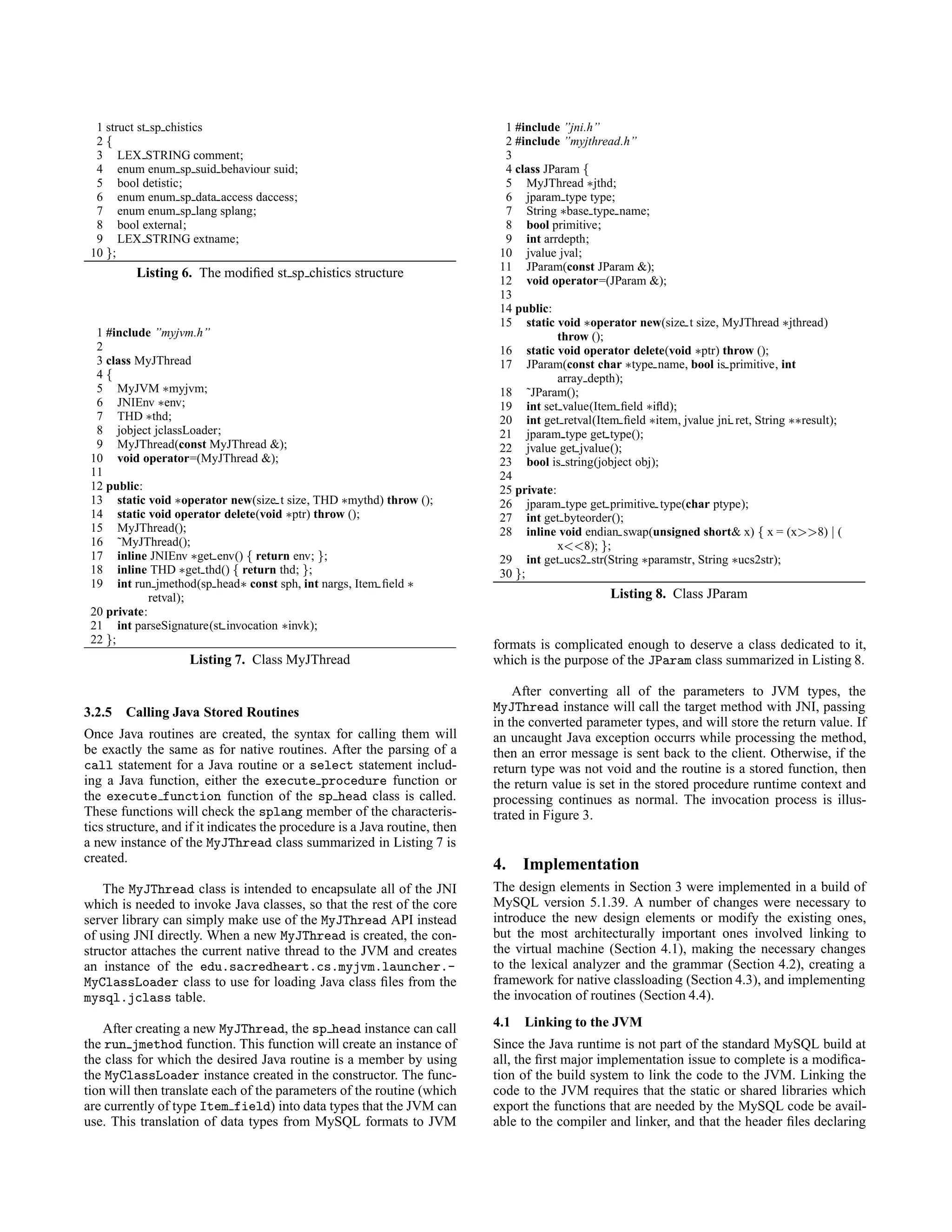
Note that the sp head class in Listing 2 has a member variable of
pointer type st sp chistics. This structure defines the charac-
teristics of the routine, and the definition of this structure with the
needed changes for Java routines is presented in Listing 6.
1 struct st sp chistics
2 {
3 LEX STRING comment;
4 enum enum sp suid behaviour suid;
5 bool detistic;
6 enum enum sp data access daccess;
7 enum enum sp lang splang;
8 bool external;
9 LEX STRING extname;
10 };
Listing 6. The modified st sp chistics structure
1 #include ”myjvm.h”
2
3 class MyJThread
4 {
5 MyJVM ∗myjvm;
6 JNIEnv ∗env;
7 THD ∗thd;
8 jobject jclassLoader;
9 MyJThread(const MyJThread &);
10 void operator=(MyJThread &);
11
12 public:
13 static void ∗operator new(size t size, THD ∗mythd) throw ();
14 static void operator delete(void ∗ptr) throw ();
15 MyJThread();
16 ˜MyJThread();
17 inline JNIEnv ∗get env() { return env; };
18 inline THD ∗get thd() { return thd; };
19 int run jmethod(sp head∗ const sph, int nargs, Item field ∗
retval);
20 private:
21 int parseSignature(st invocation ∗invk);
22 };
Listing 7. Class MyJThread
3.2.5 Calling Java Stored Routines
Once Java routines are created, the syntax for calling them will
be exactly the same as for native routines. After the parsing of a
call statement for a Java routine or a select statement includ-
ing a Java function, either the execute procedure function or
the execute function function of the sp head class is called.
These functions will check the splang member of the characteris-
tics structure, and if it indicates the procedure is a Java routine, then
a new instance of the MyJThread class summarized in Listing 7 is
created.
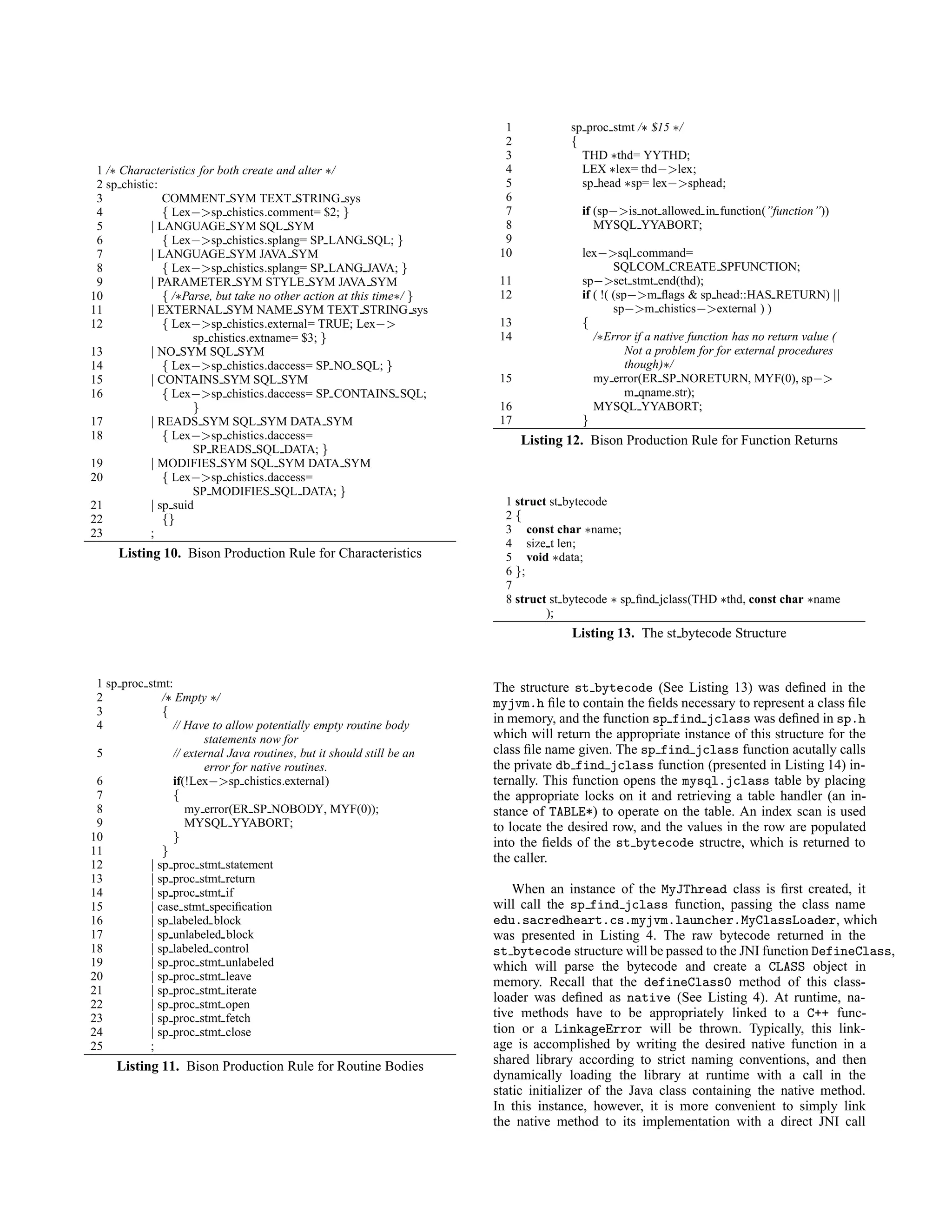
The MyJThread class is intended to encapsulate all of the JNI
which is needed to invoke Java classes, so that the rest of the core
server library can simply make use of the MyJThread API instead
of using JNI directly. When a new MyJThread is created, the con-
structor attaches the current native thread to the JVM and creates
an instance of the edu.sacredheart.cs.myjvm.launcher.-
MyClassLoader class to use for loading Java class files from the
mysql.jclass table.
After creating a new MyJThread, the sp head instance can call
the run jmethod function. This function will create an instance of
the class for which the desired Java routine is a member by using
the MyClassLoader instance created in the constructor. The func-
tion will then translate each of the parameters of the routine (which
are currently of type Item field) into data types that the JVM can
use. This translation of data types from MySQL formats to JVM
1 #include ”jni.h”
2 #include ”myjthread.h”
3
4 class JParam {
5 MyJThread ∗jthd;
6 jparam type type;
7 String ∗base type name;
8 bool primitive;
9 int arrdepth;
10 jvalue jval;
11 JParam(const JParam &);
12 void operator=(JParam &);
13
14 public:
15 static void ∗operator new(size t size, MyJThread ∗jthread)
throw ();
16 static void operator delete(void ∗ptr) throw ();
17 JParam(const char ∗type name, bool is primitive, int
array depth);
18 ˜JParam();
19 int set value(Item field ∗ifld);
20 int get retval(Item field ∗item, jvalue jni ret, String ∗∗result);
21 jparam type get type();
22 jvalue get jvalue();
23 bool is string(jobject obj);
24
25 private:
26 jparam type get primitive type(char ptype);
27 int get byteorder();
28 inline void endian swap(unsigned short& x) { x = (x>>8) | (
x<<8); };
29 int get ucs2 str(String ∗paramstr, String ∗ucs2str);
30 };
Listing 8. Class JParam
formats is complicated enough to deserve a class dedicated to it,
which is the purpose of the JParam class summarized in Listing 8.
After converting all of the parameters to JVM types, the
MyJThread instance will call the target method with JNI, passing
in the converted parameter types, and will store the return value. If
an uncaught Java exception occurrs while processing the method,
then an error message is sent back to the client. Otherwise, if the
return type was not void and the routine is a stored function, then
the return value is set in the stored procedure runtime context and
processing continues as normal. The invocation process is illus-
trated in Figure 3.
4. Implementation
The design elements in Section 3 were implemented in a build of
MySQL version 5.1.39. A number of changes were necessary to
introduce the new design elements or modify the existing ones,
but the most architecturally important ones involved linking to
the virtual machine (Section 4.1), making the necessary changes
to the lexical analyzer and the grammar (Section 4.2), creating a
framework for native classloading (Section 4.3), and implementing
the invocation of routines (Section 4.4).
4.1 Linking to the JVM
Since the Java runtime is not part of the standard MySQL build at
all, the first major implementation issue to complete is a modifica-
tion of the build system to link the code to the JVM. Linking the
code to the JVM requires that the static or shared libraries which
export the functions that are needed by the MySQL code be avail-
able to the compiler and linker, and that the header files declaring
:Server :Parser :SpHead :MyJThread :Loader :JParam :JVM
t
parse()
create()
call()
create()
attach()
create()
run jmethod(sp head *sph, Item field *params)
loadClass()
jparams = create(params)
invoke(jparams)
return()
return()
return()
Figure 3. Java Routine Invocation
any needed prototypes are available to the compiler. To meet these
requirements, the shared library jvm.dll and the import library
jvm.lib (for Windows platforms) were copied to the sql/lib
source code directory, and the header file jni.h was copied to the
sql/include source code directory. These files are available from
any standard Java Development Kit.
MySQL uses a cross-platform build system named CMake1
to manage the build process. CMake allows the developer to de-
fine abstract libraries, which be sets of code files from the current
project, code files from other project, or shared native libraries.
The CMake buils system is rather interesting in that it does not ac-
tually build the project. Rather, it generates a configuration file for
the development file or build system of your choice. For instance,
on Windows platforms, CMake can generate Visual Studio solution
files, and on Linux platforms it can generate makefiles. The CMake
system maintains a set of properties for each library that the user
defines, and allows these libraries to be linked, and when it is run
the appropriate commands or syntax will be generated in the target
build system to effectively carry out the declared directive. The
major changes made to the CMake configuration file are presented
in Listing 9.
Although making the shared JVM library, the imported JVM
library (on Windows), and the jni.h header file available to the
build system is enough to compile and link the application, the full
Java Runtime Environment is required when executing the applica-
tion in order for the application to operate successfully. Further, the
JRE must be compatible with the shared JVM library linked by the
build system. Compiling the application under a Java 6 JVM and
then running the application under a Java 5 JRE will likely lead to
crashes.
1 http://www.cmake.org
1 SET (JVM HOME ${PROJECT SOURCE DIR}/sql/lib )
2 SET (JNI HOME ${PROJECT SOURCE DIR}/sql/include )
3
4 INCLUDE DIRECTORIES( ${JNI HOME}/include )
5
6 ADD LIBRARY(jvm SHARED IMPORTED)
7
8 SET TARGET PROPERTIES(jvm PROPERTIES
9 IMPORTED IMPLIB ${JVM HOME}/lib/jvm.lib
10 IMPORTED LOCATION ${JVM HOME}/lib/jvm.dll
11 IMPORT PREFIX ””
12 IMPORT SUFFIX .dll
13 )
14
15 SET (MYSQLD CORE LIBS mysys zlib dbug strings yassl
taocrypt vio regex sql jvm)
16 TARGET LINK LIBRARIES(mysqld ${
MYSQLD CORE LIBS} ${
MYSQLD STATIC ENGINE LIBS})
Listing 9. CMakeList.txt
4.2 Modifying the Grammar
Fortunately, since the MySQL language for routines is already
strongly compliant with the ISO standard [1], only a fairly small
set of changes had to be made to the language processing subsys-
tem. Since new keywords need to be added to the grammar, the
first changes to make are in the lexical analyzer. MySQL uses a
custom lexical analyzer which relies on constructing a perfect hash
of symbols at compile time. The symbols are defined in lex.h,
and the keywords JAVA, PARAMETER, STYLE, EXTERNAL, and NAME
were added to the definition of syntactic symbols.
For parsing, MySQL uses the GNU Bison parser generator.
Bison creates the parser from a language specification grammar,
which for MySQL is defined in the file sql yacc.yy. For each
symbol added to lex.h, a corresponding %token was added to
the header of the grammar. The production rule for stored routine
characteristics (See Section 3.1.1 for a discussion and examples of
routine characteristics) was then modified as in Listing 10. Note
the presence of the LANGUAGE SYM JAVA SYM rule, which allows
a routine to be declared as a Java routine, and the EXTERNAL SYM
NAME SYM TEXT STRING sys rule which sets the external prop-
erty of the sp chistics object in the parse tree and stores the fully
qualified name of the Java method in the extname field.
Beyond this, only two other changes to the grammar are nec-
essary. A stored routine is normally ended with an sp proc stmt
production rule, which can be a single statment or a BEGIN...END
block. External routines will not have such a statement, however,
as the “body” of external routines is defined in a separate code file.
Listing 11 relaxes the condition that a stored procedure statement
cannot be empty for external routines. Additionally, stored func-
tions must include a RETURN statement as one of the statements in
the sp proc stmt body. However, external functions will not have
such a RETURN statement, as the return value will be managed sep-
arately by the language runtime. Listing 12 shows modifications to
the sf tail production rule which relax this constraint for exter-
nal functions.
4.3 Classloading
Implementing native classloading was one of the most interesting
challenges of this project. The design ideas were discussed in Sec-
tion 3.2.3, but a number of choices remain for implementation.
1 /∗ Characteristics for both create and alter ∗/
2 sp chistic:
3 COMMENT SYM TEXT STRING sys
4 { Lex−>sp chistics.comment= $2; }
5 | LANGUAGE SYM SQL SYM
6 { Lex−>sp chistics.splang= SP LANG SQL; }
7 | LANGUAGE SYM JAVA SYM
8 { Lex−>sp chistics.splang= SP LANG JAVA; }
9 | PARAMETER SYM STYLE SYM JAVA SYM
10 { /∗Parse, but take no other action at this time∗/ }
11 | EXTERNAL SYM NAME SYM TEXT STRING sys
12 { Lex−>sp chistics.external= TRUE; Lex−>
sp chistics.extname= $3; }
13 | NO SYM SQL SYM
14 { Lex−>sp chistics.daccess= SP NO SQL; }
15 | CONTAINS SYM SQL SYM
16 { Lex−>sp chistics.daccess= SP CONTAINS SQL;
}
17 | READS SYM SQL SYM DATA SYM
18 { Lex−>sp chistics.daccess=
SP READS SQL DATA; }
19 | MODIFIES SYM SQL SYM DATA SYM
20 { Lex−>sp chistics.daccess=
SP MODIFIES SQL DATA; }
21 | sp suid
22 {}
23 ;
Listing 10. Bison Production Rule for Characteristics
1 sp proc stmt:
2 /∗ Empty ∗/
3 {
4 // Have to allow potentially empty routine body
statements now for
5 // external Java routines, but it should still be an
error for native routines.
6 if(!Lex−>sp chistics.external)
7 {
8 my error(ER SP NOBODY, MYF(0));
9 MYSQL YYABORT;
10 }
11 }
12 | sp proc stmt statement
13 | sp proc stmt return
14 | sp proc stmt if
15 | case stmt specification
16 | sp labeled block
17 | sp unlabeled block
18 | sp labeled control
19 | sp proc stmt unlabeled
20 | sp proc stmt leave
21 | sp proc stmt iterate
22 | sp proc stmt open
23 | sp proc stmt fetch
24 | sp proc stmt close
25 ;
Listing 11. Bison Production Rule for Routine Bodies
1 sp proc stmt /∗ $15 ∗/
2 {
3 THD ∗thd= YYTHD;
4 LEX ∗lex= thd−>lex;
5 sp head ∗sp= lex−>sphead;
6
7 if (sp−>is not allowed in function(”function”))
8 MYSQL YYABORT;
9
10 lex−>sql command=
SQLCOM CREATE SPFUNCTION;
11 sp−>set stmt end(thd);
12 if ( !( (sp−>m flags & sp head::HAS RETURN) ||
sp−>m chistics−>external ) )
13 {
14 /∗Error if a native function has no return value (
Not a problem for for external procedures
though)∗/
15 my error(ER SP NORETURN, MYF(0), sp−>
m qname.str);
16 MYSQL YYABORT;
17 }
Listing 12. Bison Production Rule for Function Returns
1 struct st bytecode
2 {
3 const char ∗name;
4 size t len;
5 void ∗data;
6 };
7
8 struct st bytecode ∗ sp find jclass(THD ∗thd, const char ∗name
);
Listing 13. The st bytecode Structure
The structure st bytecode (See Listing 13) was defined in the
myjvm.h file to contain the fields necessary to represent a class file
in memory, and the function sp find jclass was defined in sp.h
which will return the appropriate instance of this structure for the
class file name given. The sp find jclass function acutally calls
the private db find jclass function (presented in Listing 14) in-
ternally. This function opens the mysql.jclass table by placing
the appropriate locks on it and retrieving a table handler (an in-
stance of TABLE*) to operate on the table. An index scan is used
to locate the desired row, and the values in the row are populated
into the fields of the st bytecode structre, which is returned to
the caller.
When an instance of the MyJThread class is first created, it
will call the sp find jclass function, passing the class name
edu.sacredheart.cs.myjvm.launcher.MyClassLoader, which
was presented in Listing 4. The raw bytecode returned in the
st bytecode structure will be passed to the JNI function DefineClass,
which will parse the bytecode and create a CLASS object in
memory. Recall that the defineClass0 method of this class-
loader was defined as native (See Listing 4). At runtime, na-
tive methods have to be appropriately linked to a C++ func-
tion or a LinkageError will be thrown. Typically, this link-
age is accomplished by writing the desired native function in a
shared library according to strict naming conventions, and then
dynamically loading the library at runtime with a call in the
static initializer of the Java class containing the native method.
In this instance, however, it is more convenient to simply link
the native method to its implementation with a direct JNI call
1 static int
2 db find jclass(THD ∗thd, const char ∗name, st bytecode ∗∗clazz
)
3 {
4 TABLE ∗table;
5 int ret;
6 char ∗ptr;
7
8 ∗clazz= 0; // In case of errors
9 if (!(table= open jclass table for read(thd, &
open tables state backup)))
10 DBUG RETURN(SP OPEN TABLE FAILED);
11
12 st bytecode ∗tmp= (st bytecode ∗) alloc root( thd−>mem root
, sizeof(st bytecode) );
13 if ((ptr= get field(thd−>mem root,
14 table−>field[
15 MYSQL JCLASS FIELD INTERNAL NAME
16 ])) == NULL)
17 {
18 ret= SP GET FIELD FAILED;
19 goto done;
20 }
21 tmp−>name= ptr;
22 tmp−>len= table−>field[MYSQL JCLASS FIELD SIZE
]−>val int();
23
24 if ((ptr= get field(thd−>mem root,
25 table−>field[
26 MYSQL JCLASS FIELD BYTECODE
27 ])) == NULL)
28 {
29 ret= SP GET FIELD FAILED;
30 goto done;
31 }
32
33 tmp−>data= ptr;
34 (∗clazz)= tmp;
35
36 close system tables(thd, &open tables state backup);
37 table= 0;
38
39 ret= SP OK;
40 ...
41 DBUG RETURN(ret);
42 }
Listing 14. The db find jclass Function
named RegisterNatives. The MyJThread constructor will reg-
ister the findClass0 method of the MyClassLoader class to a
function named get jclass bytes, which is presented in List-
ing 16. The MyJThread constructor then creates an instance of the
MyClassLoader class, which will be used as the defining class-
loader for the class which is called when the MyJThread object is
executed. See Listing 15 for the full MyJThread constructor (with
some exception handling elided).
At this point, native classloading is now setup. If the Java class
invoked when the MyJThread instance runs encounters a class def-
inition which is not yet defined in the runtime, the defining class-
loader for that class (namely, the MyClassLoader instance which
was created in the MyJThread constructor) will first delegate to
its parent classloader (which would be the bootstrap classloader,
in this instance). The bootstrap classloader will be unable to find
the class definitions, since they exist in database tables and not
on the file system, so it will indicate failure. The MyClassLoader
instance will then call the native method defineClass0, which
1 MyJThread::MyJThread() {
2 myjvm= MyJVM::getMyJVM();
3 env= myjvm−>attachThread();
4 ...
5 // Thread Bootstrapping: Natively define the
MyClassLoader loader
6 st bytecode ∗my cls loader cd= sp find jclass(thd, ”edu
.sacredheart.cs.myjvm.launcher.MyClassLoader”)
;
7
8 jclass myClassLoaderClass= env−>DefineClass(
my cls loader cd−>name, NULL, (jbyte ∗)
my cls loader cd−>data, my cls loader cd−>
len);
9 ...
10 jclass launchClassLoader = env−>FindClass(
MY JAVA ENTRY CLASSLOADER);
11 // Linkage: Native method registration
12 JNINativeMethod nm;
13 nm.name= ”findClass0”;
14 nm.signature= ”(Ljava/lang/String;)[B”;
15 nm.fnPtr= &get jclass bytes;
16 env−>RegisterNatives(launchClassLoader, &nm, 1);
17 ...
18 // Create classloader instance
19 jmethodID myClassLoaderCtor= env−>GetMethodID(
myClassLoaderClass, ”<init>”, ”()V”);
20 ...
21 jclassLoader= env−>NewObject(myClassLoaderClass,
myClassLoaderCtor);
22 ...
23 }
Listing 15. MyJThread Constructor
1 #include ”myjthread.h”
2
3 jbyteArray JNICALL get jclass bytes(JNIEnv ∗env, jobject obj,
jstring lkp class nm)
4 {
5 // Get the THD∗ for this pthread
6 THD ∗thd= my pthread getspecific ptr(THD∗, THR THD);
7 const char ∗class name = env−>GetStringUTFChars(
lkp class nm, false);
8 st bytecode ∗clazz= sp find jclass(thd, class name);
9 env−>ReleaseStringUTFChars(lkp class nm, class name);
10 jbyteArray data= env−>NewByteArray(clazz−>len);
11 env−>SetByteArrayRegion(data, 0, clazz−>len, (jbyte ∗)
clazz−>data );
12 return data;
13 }
Listing 16. MyClassLoader Callback
has been linked to the function get jclass bytes. Note that
code running inside the JVM is making a direct call to the
get jclass bytes function, which is running in the same process
space, rather than opening a new Socket and making a database re-
quest over JDBC. This is a strong advantage to the tight coupling
that JNI provides for an integration project like this, and it is easy
to see how a similar set of linked functions could be created to
construct a fully native JDBC driver.
4.4 Invocation
With classloading setup and working, all that remains is to create
the functions which invoke the target methods of Java routines.
This responsibility belongs to the run jmethod function, which
is presented in Listings 17 and 18. The first half of the function
deals with finding and loading the correct Java class file, finding
the method details from the mysql.jmethod table, parsing the
method signature, and using the JParam class to translate the rou-
tine parameters from MySQL data types to Java data types. The
second half of the function makes JNI calls to execute the method,
passing in the correctly translated parameters, and saves the return
value (if the return type is not void), which is then set as the return
value of the routine.
The run jmethod function starts by calling the sp find jmethod
function. This function similar to the sp find jclass function
in that it accesses the mysql.jmethod table with native table
handlers and stores the information for the desired method in a
structure in memory. The parser in Figure 2 is then called on this
structure, and it will parse the method signature and create an ar-
ray of parameter and return types appropriate for this method. The
sp find jclass method is then called to get the bytecode for
the class which defines the target method. This class is then de-
fined using a JNI DefineClass call. Note that the instance of the
MyClassLoader class created in the constructor is passed in this
call to DefineClass. This makes the jClassLoader instance of
the MyClassLoader class the defining classloader for this class,
which means that the jClassLoader instance will be called upon
when any other unknown class is encountered in this method call
(as described in Section 4.3). The JNI ID of the target method is
then retrieved with a JNI call to GetStaticMethodID. The reason
for requiring methods which implement Java routines to be static
is evident here - if instance methods were allowed, what instance
would be used to get the JNI Method ID? No instance of the target
class is readily available, although the class itself is, which makes
retrieving static methods straightforward.
The final loop in Listing 17 translates the routine parameters
from their MySQL data type (an instance of the Item field class)
to their associated Java data type. This is done primarily with the
get jvalue function in the JParam class, which is dedicated
solely to translating data between MySQL types and Java types.
All MySQL integer types are allowed to translate to some Java nu-
meric type, and the MySQL float and double types will translate
as well. The exact precision numeric type cannot be translated to
any Java primitive, although in the future it could be translated to
a Java object type. It is worth noting that MySQL allows integer
data types to be either signed or unsigned, whereas Java allows
only signed types. This means that an incompatibility may arise
at runtime if the value passed in an unsigned mysql type is too
large to fit into the corresponding Java signed type. For example,
the TINYINT type in MySQL is a one-byte value, so its unsigned
variant can store numbers from 0 to 255. The Java byte primitive
is also a one-byte value, but it is always signed so it can only accept
values from −128 to 127. If an unsigned TINYINT with a value of
250 is passed to a method where a byte is accepted, an exception
will be raised and the caller will be notified.
Some special consideration is given to character types during
data type translation. The MySQL CHAR and VARCHAR data types
will map to the Java types byte[], char[], or java.lang.String.
The implementation of this mapping needs careful treatment, how-
ever, since MySQL and Java use different character set encodings
for strings. MySQL allows character data to be stored in many
encodings, as listed in Table 3. Java, on the other hand, stores all
string and character data internally using the UTF-16 encoding.
MySQL does not currently have support for UTF-16, although it
does support the older UCS2 encoding, and UTF-16 is backwards-
1 int MyJThread::run jmethod(sp head∗ const sph, int nargs,
Item field ∗retval)
2 {
3 st invocation ∗invk= sp find jmethod(thd, sph−>
m chistics−>extname.str);
4
5 int sig parse ret= this−>parseSignature(invk);
6 ...
7 st bytecode ∗target def= sp find jclass(thd, invk−>
className);
8 ...
9 jclass target class= env−>DefineClass(target def−>
name, jclassLoader, (jbyte ∗) target def−>data,
target def−>len);
10 ...
11 jmethodID target method= env−>GetStaticMethodID(
target class, invk−>methodName, invk−>
internalSignature);
12 ...
13 sp rcontext ∗rctx= thd−>spcont;
14 jvalue ∗target method params= (jvalue ∗) alloc root(thd−>
mem root, nargs ∗ sizeof(jvalue) );
15 if(nargs)
16 {
17 for(int k= 0; k < nargs; k++)
18 {
19 Item field ∗nxt arg= (Item field ∗) rctx−>get item(k);
20 int cast failed= invk−>jparams[k]−>set value(nxt arg);
21 if(cast failed)
22 {
23 my error(ER JPARAM CAST, MYF(0), k+1, invk−>
fullSignature);
24 return ER JPARAM CAST;
25 }
26 target method params[k]= invk−>jparams[k]−>
get jvalue();
27 }
28 }
Listing 17. Invoking Java Routines (Part 1)
compatible with UCS2. The general procedure, then, will be to
convert MySQL strings from whatever encoding they are currently
in to UCS2, and the create Java strings or characters using this UCS2
data. There is one more implementation issue here, though, and
that is the fact that UCS2 is a multi-byte data format (each character
is represented by two bytes). This means that big-endian and little-
endian systems may have different expectation as to the layout of
this data in memory. The JParam class therefore has functions to
detect the endian-ness of the platform and swap the bytes in each
UCS2 character if the translation is not in the correct endian mode
for the platform. The allowed data type translations are listed in
Table 9, in which square brackets indicate the MySQL type can
map to a one-dimensional array of the Java type, ‘Y’ indicates that
the two types can map, and ‘S’ indicates that the two types can map
but that unsigned values could potentially overflow.
The rest of the run jmethod function is presented in List-
ing 18. After translating the routine parameters to Java types, the
target method is invoked. If the return type is void, the function
returns, otherwise the return value is stored in the jni ret vari-
able. The JParam class is then used to translate this value back
into a MySQL type, which is stored in the return value field. At this
point the Java routine has been called successfully, and the MySQL
server completes via its usual path and returns results to the caller
over the network connection.
1 jvalue jni ret;
2
3 switch(invk−>jreturn−>get type())
4 {
5 case JPARAM TYPE VOID :
6 env−>CallStaticVoidMethodA(target class, target method
, target method params);
7 ...
8 break;
9 case JPARAM TYPE BOOLEAN :
10 jni ret.z= env−>CallStaticBooleanMethodA(target class,
target method, target method params);
11 break;
12 case JPARAM TYPE BYTE :
13 jni ret.b= env−>CallStaticByteMethodA(target class,
target method, target method params);
14 break;
15 case JPARAM TYPE CHAR :
16 jni ret.c= env−>CallStaticCharMethodA(target class,
target method, target method params);
17 break;
18 case JPARAM TYPE SHORT :
19 jni ret.s= env−>CallStaticShortMethodA(target class,
target method, target method params);
20 break;
21 case JPARAM TYPE INT :
22 jni ret.i= env−>CallStaticIntMethodA(target class,
target method, target method params);
23 break;
24 case JPARAM TYPE LONG :
25 jni ret.j= env−>CallStaticLongMethodA(target class,
target method, target method params);
26 break;
27 case JPARAM TYPE FLOAT :
28 jni ret.f= env−>CallStaticFloatMethodA(target class,
target method, target method params);
29 break;
30 case JPARAM TYPE DOUBLE :
31 jni ret.d= env−>CallStaticDoubleMethodA(target class,
target method, target method params);
32 break;
33 case JPARAM TYPE OBJECT :
34 jni ret.l= env−>CallStaticObjectMethodA(target class,
target method, target method params);
35 break;
36 case JPARAM TYPE UNKNOWN :
37 // Fall−through
38 default :
39 return 1;
40 }
41 ...
42 String ∗ret bytes;
43 if(invk−>jreturn−>get retval(retval, jni ret, &ret bytes))
44 {
45 return 1;
46 }
47 retval−>save str value in field(retval−>field, ret bytes);
48 return 0;
49 }
Listing 18. Invoking Java Routines (Part 2)
Java Types
B S I J F D Z C Str
M CHAR [] [] Y
y BINARY []
S TEXT [] [] Y
Q BLOB
L ENUM
SET
T BIT S Y
y TINYINT S Y Y Y Y
p BOOLEAN S Y Y Y Y
e SMALLINT S Y Y
s MEDIUMINT S Y
INT S Y
BIGINT S
FLOAT Y
DOUBLE Y
DECIMAL
DATE
DATETIME
TIMESTAMP
TIME
YEAR S Y Y
Table 9. Allowed data type translations
5. Summary and Future Work
The design of the project’s major architectural elements leaves
room for the addition of several new features in the future. Several
optimization features could improve the performance or memory
profile of Java routines, and a number of additional features could
be added which would considerably extend the flexibility or usabil-
ity of Java routines in the server.
For performance optimization and administration purposes, it
would be interesting to create several new server variables related
to Java routines. MySQL server variables control many aspects of
the system, such as the size of certain object caches and memory
pools. Modifying these configuration variables is an important part
of performance optimization, and it could be important to manage
JVM variables in the same way. For instance, such variables could
control the amount of memory allocated to the JVM, or the size of
the stack allocated for each thread.
To further optimize performance, a caching structure could be
implemented for the Java bytecode lookups and the Java routine
definitions. MySQL makes use of caches for many other database
objects, including stored procedure definitions, statements, and
some result sets, all to good effect.
It would be interesting to integrate the Java Authentication and
Authorization Services into the system, so that user-based access
control could be seamlessly integrated. Such a security solution
would ideally also involve extending the set of available GRANT
and REVOKE targets, so that database administrators could manage
access to sensitive Java resources the same way they manage access
to sensitive database resources.
The most interesting additional feature that could be added to
this framework would be support for a fully native JDBC driver. A
native driver would give much better performance for JDBC calls
than routing requests and responses over TCP, even if the packets
are travelling over the loopback interface on the server. A native
JDBC driver would take full advantage of the fact that the JVM
and the database are running in the same process space, and the
native classloader described in Section 4.3 demonstrates that the
framework would support such a driver.
An even more ambitious goal would be to implement the
other half of the ISO specification and bring user defined types
to MySQL using the Java language. This would require a much
more extensive change to the grammar than that which was imple-
mented here, but the payoff could be worth the effort, as MySQL
does not support any form of user-defined types at the present time.
Finally, the data type translation layer could be extended. This
layer currently support translations for basic interger and floating
point types, as well as character and string types. Support could be
added for date and time types, exact numeric types, and even more
exotic types like ENUM, SET, or GEOMETRY types.
The primary goal of this project, however, which was to build a
robust and extensible framework for linking the MySQL database
server to the Java runtime environment, has been very successful.
The MySQL/JVM framework provides a fully functional environ-
ment for loading, creating, and calling Java routines; a manage-
able framework for storing and locating class files; and a well-
encapsulated API for invoking Java methods and translating data
types. Further optimizations could be applied, and more features
could be added, but the system as it stands even now can bring the
power of the Java language and its class library to MySQL stored
routines.
References
[1] I. O. for Standardization (ISO). Information technology–database
language–sql, standard no. iso/iec 9075:2003, 2003.
[2] I. O. for Standardization (ISO). Information technology–database
language–sql– part 13: Sql routines and types using the java program-
ming language (sql/jrt), standard no. iso/iec 9075-13:2003, 2003.
[3] I. O. for Standardization (ISO). Information technology–database
language–sql– part 4: Persistent stored modules (sql/psm), standard
no. iso/iec 9075-4:2003, 2003.
[4] I. O. for Standardization (ISO). Information technology–database
language–sql, standard no. iso/iec 9075:2008, 2008.
[5] I. O. for Standardization (ISO). Information technology–database
language–sql– part 13: Sql routines and types using the java program-
ming language (sql/jrt), standard no. iso/iec 9075-13:2008, 2008.
[6] L. Gong and G. Ellison. Inside Java(TM) 2 Platform Security: Archi-
tecture, API Design, and Implementation. Pearson Education, 2003.
ISBN 0201787911.
[7] J. Gosling, B. Joy, G. Steele, and G. Bracha. Java Language Specifi-
cation, Second Edition: The Java Series. Addison-Wesley Longman
Publishing Co., Inc., Boston, MA, USA, 2000. ISBN 0201310082.
[8] S. Liang. Java Native Interface: Programmer’s Guide and Reference.
Addison-Wesley Longman Publishing Co., Inc., Boston, MA, USA,
1999. ISBN 0201325772.
[9] T. Lindholm and F. Yellin. Java Virtual Machine Specification.
Addison-Wesley Longman Publishing Co., Inc., Boston, MA, USA,
1999. ISBN 0201432943.
[10] S. Pachev. Understanding MySQL Internals. O’Reilly Media, Inc.,
2007. ISBN 0596009577.
[11] M. Widenius and D. Axmark. Mysql Reference Manual. O’Reilly &
Associates, Inc., Sebastopol, CA, USA, 2002. ISBN 0596002653.
A. Tables, Figures, and Listings
List of Tables
1 ISO/IEC 9075:2008 Substandards . . . . . . . . . 3
2 SQL/JRT Feature Sets . . . . . . . . . . . . . . . 3
3 Supported Character Sets . . . . . . . . . . . . . 4
4 Table mysql.proc . . . . . . . . . . . . . . . . . 6
5 The mysql.jclass Table . . . . . . . . . . . . . . . 8
6 The mysql.jmethod Table . . . . . . . . . . . . . 9
7 The mysql.jresource Table . . . . . . . . . . . . . 9
8 Changes to the mysql.proc table . . . . . . . . . . 9
9 Allowed data type translations . . . . . . . . . . . 15
List of Figures
1 MySQL New Thread Prolog . . . . . . . . . . . . 5
2 Method Signature Parser . . . . . . . . . . . . . . 8
3 Java Routine Invocation . . . . . . . . . . . . . . 11
List of Listings
1 A Basic MySQL Stored Routine . . . . . . . . . . 6
2 The sp head Class . . . . . . . . . . . . . . . . . 6
3 The MyJVM Class . . . . . . . . . . . . . . . . . 7
4 The MyClassLoader Class . . . . . . . . . . . . . 8
5 A Basic Java Stored Routine . . . . . . . . . . . . 9
6 The modified st sp chistics structure . . . . . . . 10
7 Class MyJThread . . . . . . . . . . . . . . . . . 10
8 Class JParam . . . . . . . . . . . . . . . . . . . . 10
9 CMakeList.txt . . . . . . . . . . . . . . . . . . . 11
10 Bison Production Rule for Characteristics . . . . . 12
11 Bison Production Rule for Routine Bodies . . . . 12
12 Bison Production Rule for Function Returns . . . 12
13 The st bytecode Structure . . . . . . . . . . . . . 12
14 The db find jclass Function . . . . . . . . . . . . 13
15 MyJThread Constructor . . . . . . . . . . . . . . 13
16 MyClassLoader Callback . . . . . . . . . . . . . 13
17 Invoking Java Routines (Part 1) . . . . . . . . . . 14
18 Invoking Java Routines (Part 2) . . . . . . . . . . 15

Graduate Project Summary

  • 1.
    MySQL/JVM A Framework forEnabling Java Language Stored Procedures in MySQL Kevin Tankersley Sacred Heart University 5151 Park Avenue Fairfield, CT 06825 tankersleyk@sacredheart.edu Abstract Database procedural languages tend to be special-purpose lan- guages, with constructs and libraries designed to support common data access methods and flow control. To provide support for tasks which cannot be solved with such basic data access functional- ity, many database vendors embed the runtime environment of a more general-purpose language in the database server, allowing stored programs to be written in this external language. Such an approach leverages the work that has already gone into design- ing, implementing, and testing the runtime library of the external language, while maintaining a low learning curve for advanced functionality since many developers will already be fluent in this external language. This paper presents the design, implementation, and use of the MySQL/JVM system, a framework for embedding the Java Virtual Machine runtime environment into the MySQL database server to allow stored procedures and stored functions in the MySQL database to be written in the Java programming language. Categories and Subject Descriptors H.2.3 [Database Manage- ment]: Languages—Database (persistent) programming languages; D.3.4 [Programming Languages]: Processors—Run-time environ- ments; D.3.3 [Programming Languages]: Language Constructs and Features—Data types and structures General Terms Design, Languages, Security Keywords MySQL, Java Native Interface, JNI, Stored Proce- dures, SQL/JRT, ISO/IEC 9075-13 1. Introduction Most relational database systems provide a procedural language, which allows stored procedures to be hosted in the database to en- capsulate common business logic, and allows user defined stored functions to be created to calculate common metrics. The nature of these languages and the robustness of the library of functions available to them can vary widely from one vendor to another. For example, MySQL includes a procedural language which offers ba- sic control flow and has a fairly small library, Microsoft SQL Server Permission to make digital or hard copies of all or part of this work for personal or classroom use is granted without fee provided that copies are not made or distributed for profit or commercial advantage and that copies bear this notice and the full citation on the first page. To copy otherwise, to republish, to post on servers or to redistribute to lists, requires prior specific permission and/or a fee. offers control flow and basic exception handling with a larger li- brary, and Oracle includes an object-oriented language with a fairly robust library. Given that the majority of the procedures hosted inside a database system will be primarily intended to execute basic al- gorithms over data sets and cursors, most of the functionality that developers will need is present even in the least feature-rich stored procedure languages. There are tasks, however, for which features typically found in the libraries of more general purpose languages may be needed. For example, processing and transmitting XML documents has become a more common task in many databases as XML standards have become widely accepted for data transfer. Security policies for sensitive data may require custom encryption routines and processes. Access to the file system, or to network sockets, may be needed to acquire or export data. The degree of support for these tasks is generally low in most database procedu- ral languages. To solve such problems, several database vendors allow stored procedures to be written in a general purpose programming lan- guage (in addition to the database native procedural language) in order to expose the libraries provided by that language to devel- opers. For example, the Oracle database allows stored procedures to be written in the Java language, and Microsoft’s SQL Server allows stored procedures to be written in any of the .NET lan- guages. Further, all versions of the standard definition of the SQL language since SQL:2003 [1] have consisted of 14 parts, one of which (SQL/JRT [2], [5]) is dedicated entirely to defining the be- havior of Java language stored procedures within a database server. Currently, however, the MySQL database does not provide support for Java language stored procedures. This paper will present the MySQL/JVM system, a project which integrates the Java Virtual Machine runtime environment into the MySQL database server process to allow stored procedures to be written in the Java language. The balance of this section will present the features and characteristics of stored procedures in the MySQL database. Section 2 will present the scope of the project, and Section 3 will discuss the high level design. In section 4, lower level design issues and noteworthy highlights of the implementa- tion will be presented. 1.1 Stored Procedures, Functions, and Triggers Relational databases are ubiquitous in application architecture. Most of the major information systems used by a typical orga- nization rely on a relational database server for their data storage and retrieval needs. The role of the database as the originator of
  • 2.
    data and thefinal destination of data makes it a good candidate to assume data access control functionality. The centralization of the database and the use of network protocols for data transfer also makes it a potential performance bottleneck. The result has been a migration of some program logic out of the applications making use of the database and into the database itself, in the form of stored procedures. The term stored procedures will be used here to mean subrou- tines which are stored in a location accessible to a database server process and which the process may execute in response to an event or on behalf of a client. Some distinction is typically made between stored procedures and stored functions (or user-defined functions), namely that stored functions can return a value to the caller. Further distinction can be made between stored procedures and triggers on the basis that triggers are not called explicity by a client but are in- stead executed on the occurrence of some predefined event. When such distinctions are important in the following sections, they will be mentioned explicity; Otherwise the use of the term stored pro- cedures throughout the rest of this paper will broadly refer to all of these classes of stored code. Migrating common business logic out of applications and into stored procedures can bring several benefits. Stored procedures may be able to implement logic containing multiple decision points more efficiently than a client application, since a stored procedure does not need to make each data request over the network. On many systems, the statements in the procedure are precompiled, so that executing a stored procedure will be faster than executing a block of the same statements. Implementing stored procedures makes the business logic they encapsulate reusable across applications. Stored procedures can also be used to create fine-grained access control policies. 1.2 Stored Procedures in the MySQL Database MySQL is a relational database management system. Development on the MySQL project began as early as 1994, and the features of the server have grown steadily since. MySQL now supports most of the SQL:1999 standard, and has become extremely popular, with more than 100 million distributions to date. The MySQL server is widely used as the underlying data store backing many web appli- cations. The source code for the MySQL server is freely available under the terms of the GNU General Public License. Stored procedures were added to MySQL in its fifth version in 2005. The syntax for creating and executing stored procedures loosely adheres to the SQL:2003 Persistent Stored Module stan- dard [3] (see [11] for full details concerning stored procedure syn- tax and features). The stored procedure language provides flow control via such statements as IF, LOOP, and WHILE; a BEGIN ... END syntax for blocks; a DECLARE statement for variable declara- tion and a SET statement for variable assignment; OPEN, CLOSE, and FETCH statements for cursors; a RETURN statement for func- tions; and a DECLARE ... HANDLER for exception handling. User defined types, packages, and objects are not supported. The lan- guage provides about 250 functions and operators for control flow, string manipulation, mathematics, date and time manipulation, type casting, XML processing, aggregation, spatial data manipulation, binary data operations, encryption and compression. 1.3 Limitations of Stored Procedures in MySQL The procedural statements and function libraries discussed in sec- tion 1.2 are certainly sufficient for a large number of tasks related to data processing, but they do not provide much support for more advanced functionality. Below are several use cases that cannot be easily achieved by using the existing stored procedure language of MySQL. Each case could be implemented within individual ap- plications instead of in the database, of course, but such a solu- tion would lose all of the benefits discussed in section 1.1. When databases do provide robust, general purpose libraries, the choice of whether to implement common business logic in the database or in each application that uses the data is an important design de- cision. The following cases would be good candidates for stored procedures, if MySQL had sufficient support to develop solutions for them: 1. The database regularly receives and stores XML documents which are supposed to adhere to a particular XML Schema. The documents are generated independently by several source systems, each implemented in different languages and using different XML platforms. To detect and control errors, it would be desirable for the database to ensure the validity of each document and to verify that it does conform to the expected schema. 2. The database needs to store sensitive information in an en- crypted form. Symmetric encryption is deemed unsuitable due to problems in properly protecting the shared encryption key. A public key encryption protocol is desired to protect the most sensitive data; Preferably one which does not have to be re- implemented in each client application. 3. An organization is employing a service-oriented application ar- chitecture, and valuable data services are available over the net- work. It would be both costly and undesirable for the function- ality made available by these services to be re-implemented in the database. It would be ideal if a procedure could be written to access such services whenever the database needs them. 2. Scope Bringing Java language stored procedures to MySQL is a very high-level goal. Both the Java runtime environment and the MySQL database are complex systems, which can in fact already interact independently over network protocols. Further, Java technology is highly standardized, by way of the Java Community Process. Expert groups consisting of representatives from multiple product vendors draft technology specifications in the form of Java Speci- fication Requests, which in turn become the standards to adhere to when working with a Java technology area. The SQL language is also governed by a defining standard (the most recent version of which is defined by [4]). The standard con- sists of the nine interrelated parts in Table 1, each of which is iden- tified by a standard ID (e.g. ISO/IEC 9075-1:2008), a full name (e.g. Information Technology–Database Language–SQL– Part 1: Framework), and a short mnemonic identifier (e.g. SQL/Frame- work). Official claims of conformance to one of the nine parts of this standard are verified by a conformance audit. No vendor currently claims full official conformance to all nine parts of the standard, and some vendors do not pursue official conformance at all, choos- ing instead simply to design their products to comply with the stan- dards as much as possible but to make exceptions or extensions as needed. The features and behavior of the MySQL database server comply closely with several of the nine parts of the SQL standard. In particular, the stored procedure language used by MySQL is one of the few vendor languages that closely conforms to the language specified in the SQL/PSM substandard for defining stored routines. It is noteworthy that part 13 (SQL/JRT) defines a standard for Java stored procedures that builds on the syntax and standards defined in
  • 3.
    ISO/IEC ID NameMnemonic 9075-1:2008 Framework SQL/Framework 9075-2:2008 Foundation SQL/Foundation 9075-3:2008 Call-Level Interface SQL/CLI 9075-4:2008 Persistent Stored Modules SQL/PSM 9075-9:2008 Management of External Data SQL/MED 9075-10:2008 Object Language Bindings SQL/OLB 9075-11:2008 Information and Definition Schemas SQL/Schemata 9075-13:2008 SQL Routines and Types Us- ing the Java TM Programming Language SQL/JRT 9075-14:2008 XML-Related Specifications SQL/XML Table 1. ISO/IEC 9075:2008 Substandards Feature Feature Name Compliance 1 J511 Commands In Scope 2 J521 JDBC data types Out of Scope 3 J531 Deployment No Compliance 4 J541 SERIALIZABLE Out of Scope 5 J551 SQLDATA Out of Scope 6 J561 JAR privileges Out of Scope 7 J571 NEW operator Out of Scope 8 J581 Output parameters In Scope 9 J591 Overloading Out of Scope 10 J601 SQL-Java paths No Compliance 11 J611 References Out of Scope 12 J621 External Java routines In Scope 13 J622 External Java types Out of Scope 14 J631 Java signatures In Scope 15 J641 Static fields Out of Scope 16 J651 Information Schema Out of Scope 17 J652 Usage tables Out of Scope Table 2. SQL/JRT Feature Sets SQL/PSM. Since the stored routine language in MySQL is already in close compliance with SQL/PSM, defining what levels of con- formance this project will have with the elements of the SQL/JRT standard are the primary scope decisions to be made. 2.1 ISO Standard Compliance The SQL/JRT ISO standard [4] is a large standard. In fact, it is large enough that it groups the feature requirements it defines into sev- enteen feature sets. Table 2 defines whether each of the seventeen feature sets are in scope, out of scope, or will not be a conformance target for this project. Features which are in scope for this project will be implemented in close compliance to the SQL/JRT specifi- cation. Features which are out of scope will not be implemented, but the implementation will be structured such that they can be added in the future. Features which are not compliance targets will not be implemented, and it is unlikely that they could be added to the system without a substantial redesign. The presence of such features does not necessarily preclude a claim of conformance to the specification, however. An official claim of conformance to the specification requires, at a minimum, one of the features J621, J541, or J551 together with one of the features J511 or J531. The features can be even more broadly classified as those which support the definition and execution of Java stored routines, those which support the definition and execution of user defined Java types, those which define the interaction between the database and the Java runtime environment, and those which define the tables and views which should be exposed as database metadata. The pri- mary scope of this project is to integrate the Java Virtual Machine into the database engine and to provide an API through which calls can be made from the Java runtime to the database or vice-versa. The project will comply closely with the feature sets in Table 2 which fall within that scope. The SQL/JRT specification devotes roughly half of the features it defines to defining and invoking Java routines, and devotes the other half to defining and using Java language user-defined types. Any feature relating to the creation of user-defined types with the Java language is out of scope, and left for future development. Since MySQL does not currently have any support for user-defined types, even in the host language, such a change would be too large of a task to complete within the timeframe of the project. Such a type system could be added later, though, and could easily leverage the framework which will be built to support routine calls. For reasons discussed in Section 3, the subsystem for locating Java classfiles will differ significantly from the recommendations in SQL/JRT. As a result, the system will not comply with the features in Table 2 relating to the deployment of Java classfiles and the resolution of Java paths. Further, it would not be reasonable to bring the system into compliance with these features without a major re- write (possibly a total re-write). As mentioned above, this does not mean that an official claim of compliance could not be made, since a minimal claim of compliance can be made without either of the features J531 or J601. 2.2 Other Scope Considerations Within the features defined in Section 2.1, there are still a num- ber of scope decisions to be made. The SQL/JRT standard defines the features that a compliant database server must provide from a fairly high level, but it does not provide many mandates concerning the design details related to implementing those features. In partic- ular, there are several subsystems which the Java runtime and the MySQL database server have in common. Ideally, a seamless inte- gration would fully integrate each such subsystem. Since there will not be sufficient time to provide a full integration of each subsys- tem, the remainder of this section will discuss the scoping decisions for each major touch point between the database and the Java run- time. 2.2.1 Access Control Security in MySQL is managed in a fairly standard way through a remote login process and access control lists. The access control lists control access to resources such as tables, views, and stored procedures. The access control allows actions such as CREATE, DROP, SELECT, and EXECUTE against these resources, and these ac- tions can either be explicitly allowed (GRANT) or denied (REVOKE). (See [11] for a more complete listing of MySQL access control commands). Security in the Java runtime, however, is managed rather differ- ently. The default security model for the Java runtime assigns per- missions based on the notion of a CODESOURCE, which is primarily a combination of a URL identifying where an archive originated and possibly a cryptographic signature of the code. This policy essentially allows local Java code to execute with access to the en- tire runtime, but restricts the access of remotely downloaded code such as Java Applets. This default policy is difficult to integrate in a meaningful way with the user-driven access control policy of MySQL. It should be noted that a custom security policy could be written by system administrators, and there are Java Specifications and APIs which allow user-driven access control to be enforced -
  • 4.
    see [6] formore details on access control options in Java. The Java runtime provides access to some very powerful re- sources (e.g. network sockets and file operations), which is exactly why it is useful as a language for stored routines. Some of these might use significant memory or processor resources, however, which can be a big problem in a database server which is typically multi-user and performance-sensitive. Ultimately, the database ad- ministrator is the individual responsible for ensuring that access control is setup optimally. The database administrator should have a simple way to control access to the various sensitive resources in the Java runtime. Ideally this would come in the form of ex- tending the GRANT and REVOKE actions to include Java resources (e.g. ‘GRANT OPEN SOCKET TO USER1’ or ‘GRANT WRITE FILE TO USER2’). The implementation differences between the Java se- curity model and the MySQL security model currently make this an unreasonable goal, although it is an interesting area for future development. 2.2.2 Output Several database vendors provide a channel across which basic messages can be sent from a stored procedure. Microsoft SQL Server, for example, provides a print statement, and the Oracle database provides the dbms output.put line procedure. In some cases, the client may even choose whether or not information re- ceived through this channel will be processed, making it a useful tool for diagnostics information or debugging information. The MySQL database, however, does not provide such a chan- nel. This is more than just a missing feature in the language - the TCP protocol which the client and server use to communicate does not even define any structure which could be used to pass such data (see [10] for a description of the MySQL network protocol). The scope of this project is certainly limited to the server pro- cess itself. Even a small change to the communication protocol would render all existing clients unable to connect to the server. As such, no diagnostic channel will be created or assumed. The Java runtime, however, frequently sends output to the user through the System.out and System.err streams. With no convenient way to redirect these to the user, they will end up in the MySQL server log files. This is almost certainly not the ideal place for them, especially since the MySQL log file conventionally follows a specific format for its diagnostic messages. A future enhancement could disable these streams in the most harmless way possible, or might redirect them to a special Java log file. 2.2.3 Data Type Translation At the moment when a Java routine is called, the parameters must be translated from their MySQL data type to the equivalent Java data type. For stored functions, the same holds for the return value at the time the Java method completes. Only data type mappings which can map to and from Java primitive types will be consid- ered in scope for this project, with the exception of mappings to and from java.lang.String and mappings to and from one- dimensional arrays of char and byte. Mappings to and from any other Java reference type are not in scope. This is an issue of time, not feasibility, so the design of the parameter translation should be easily extensible to accomodate future mappings to and from more complex MySQL types which call for a Java reference type to properly represent them. Since no straightforward mapping ex- ists for result sets, there will not be any way in this version of the system for a Java routine to return a result set. Adding parameter support for result sets and cursors would be another interesting area Charset Description Default collation big5 Big5 Traditional Chinese big5 chinese ci dec8 DEC West European dec8 swedish ci cp850 DOS West European cp850 general ci hp8 HP West European hp8 english ci koi8r KOI8-R Relcom Russian koi8r general ci latin1 cp1252 West European latin1 swedish ci latin2 ISO 8859-2 Central European latin2 general ci swe7 7bit Swedish swe7 swedish ci ascii US ASCII ascii general ci ujis EUC-JP Japanese ujis japanese ci sjis Shift-JIS Japanese sjis japanese ci hebrew ISO 8859-8 Hebrew hebrew general ci tis620 TIS620 Thai tis620 thai ci euckr EUC-KR Korean euckr korean ci koi8u KOI8-U Ukrainian koi8u general ci gb2312 GB2312 Simplified Chinese gb2312 chinese ci greek ISO 8859-7 Greek greek general ci cp1250 Windows Central European cp1250 general ci gbk GBK Simplified Chinese gbk chinese ci latin5 ISO 8859-9 Turkish latin5 turkish ci armscii8 ARMSCII-8 Armenian armscii8 general ci utf8 UTF-8 Unicode utf8 general ci ucs2 UCS-2 Unicode ucs2 general ci cp866 DOS Russian cp866 general ci keybcs2 DOS Kamenicky Czech-Slovak keybcs2 general ci macce Mac Central European macce general ci macroman Mac West European macroman general ci cp852 DOS Central European cp852 general ci latin7 ISO 8859-13 Baltic latin7 general ci cp1251 Windows Cyrillic cp1251 general ci cp1256 Windows Arabic cp1256 general ci cp1257 Windows Baltic cp1257 general ci binary Binary pseudo charset binary geostd8 GEOSTD8 Georgian geostd8 general ci cp932 SJIS for Windows Japanese cp932 japanese ci eucjpms UJIS for Windows Japanese eucjpms japanese ci Table 3. Supported Character Sets for future development. With respect to java.lang.String parameters and char[] parameters, some consideration needs to be given to the character set encodings that can be used in MySQL and in the Java runtime. Table 3 lists the character set encodings supported in MySQL 5.1 (see [11] for details). The two-byte UCS2 Unicode character set will be used as the common encoding to translate all other charac- ter sets into before being passed into the Java runtime. This means that any character not in the Unicode Basic Multilingual Plane can- not be represented, although MySQL provides no support for such characters at the moment anyway. 2.2.4 Other Server/Runtime Communication The MySQL database server has an extensible exception handling mechanism, which includes the DECLARE ... HANDLER stored procedure instruction for exception catching. The Java language includes a very powerful exception handling mechanism, although the behavior of uncaught exceptions which propogate all the way out of the entry method is necessarily defined by the runtime. In- tegration of these two exception handling mechanisms will be in scope, so uncaught Java exceptions should continue to propogate outward from the Java routine as MySQL exceptions. Further, new exceptions will be created for errors resulting from incorrect Java
  • 5.
    routine definitions orerrors in parameter translation. The Java runtime makes calls into a database using the Java Database Connectivity API (JDBC, the msot recent version of which is defined in the Java community process specification JSR- 54). The JDBC API provides a fixed interface for all database ven- dors, and it is up to each vendor to provide an implementation of that interface (called a JDBC driver) for their product. These drivers communicate with the database server by opening a TCP connection to the server, providing login credentials, sending the desired command, and receiving the appropriate result. For Java code which is not running on the same machine as the MySQL server, this is an effective communication mechanism. Java stored procedures, however, will be executing not only on the same ma- chine as the database server, but in the same process. It could po- tentially be much faster for JDBC calls to make a direct call to the appropriate function in the MySQL server, rather than send- ing commands over TCP sockets that require authorization, state- ment parsing, and result interpretation. Unfortunately, the JDBC API is prohibitively large, so a general-purpose native driver is out of scope. However, as a special exception, the custom class- loader class edu.sacredheart.cs.myjvm.MyClassLoader (see Section 3.2.3) does make direct calls to native MySQL functions without routing anything over a TCP connection. 3. Design The features scoped in Section 2 could be added to the MySQL server in a number of ways, and the design of additions and modifi- cations to the server could affect issues like the platform avaiability of the server, the performance of the Java routines, and the memory consumption of client threads. The most pressing design issue is the choice of how to in- voke the Java Virtual Machine and call class methods within it. The available design choices differ primarily in how tightly inte- grated the MySQL server and the JVM become. At one extreme, the MySQL server could simply make a system() call or similar, invoking the java binary executable and passing the class name, path, and arguments as strings. At the other extreme, the source code for the JVM could be included with that of the MySQL server, and MySQL could make direct calls into the internal processing logic of the JVM. Section 3.2 presents the major design decisions made in this project, and Section 3.2.2 presents the design deci- sions made specifically to enable the MySQL server to make calls into the JVM. Before presenting these design decisions, it will be useful to summarize the current MySQL server design. The server is actually quite complex, offering platform-independent support for features like threads, transactions, locking, logging, and replication. A full presentation of the server design is beyond the scope of this paper, but a summary of the design elements which support the use of stored routines will be presented in Section 3.1. 3.1 MySQL Design The MySQL server is implemented as a fairly standard client-server application. When the server is first started, it goes through an ini- tialization procedure, setting up the structures and parameters that it will need to properly serve requests (see [10] for a much more complete description of the server initialization process and many other details of the server implementation). After initialization, the server begins listening for network connections (the default port that it listens on is port 3306, although administrators can change this). From this point on, the main server thread does very little other than listen for incoming connections and spawn new threads :Client :Server :ClientThread :Parser :ParseTree t request() create(thd) handle one connection(thd) do command(thd) dispatch command(thd,packet) mysql parse(thd,command) create() return() mysql execute command(thd) Figure 1. MySQL New Thread Prolog to handle them. Once a client is authenticated and a thread has been created for it, the typical flow of events proceeds as in Figure 1. Af- ter the client makes a request, the server creates a new thread to handle the request. The thread begins execution by calling the handle one connection server function. This calls the do command server function, which calls the dispatch command server func- tion, which invokes the parser via the mysql parse function. The parser then parses the input, creating a parse tree class with objects and structures representing the client request. The parser then calls the execute server function, after which processing will differ ac- cording to the type of command which the client requested. This thread initialization prolog demonstrates a few features of the design of the server. Firstly, note that the server is not sub- divided into loosely coupled subsystems or classes. Most of the core server features are implemented as globally accessible func- tions. Features added to the server more recently, however, are more likely to be encapsulated in classes. Secondly, this prolog in- troduces a few of the elements which will be most important in the design of Java routines. After the server creates a new thread in Figure 1, most of the remaining function calls pass a variable named thd. This variable is a MySQL thread descriptor, and it is passed as the first argu- ment to almost every function in the core server library. The thread descriptor contains basically all data structures that are relevant to a specific client request. This includes the objects which actually represent the operating system thread, but also much more, such as the parse tree, flags and states, references to the protocol handlers and the table handlers, object caches, and status variables. One element of the thread initialization prolog which is a sepa- rate module is the parser. MySQL uses the GNU Bison parser gen- erator to create a parser for the language understood by MySQL
  • 6.
    1 CREATE DEFINER= ’root’@’localhost’ PROCEDURE ‘hello‘( 2 INOUT str VARCHAR(100) 3 ) 4 LANGUAGE SQL 5 DETERMINISTIC 6 CONTAINS SQL 7 SQL SECURITY DEFINER 8 COMMENT ’Outputs a greeting.’ 9 BEGIN 10 SET str = ’Hello, World!’; 11 END; Listing 1. A Basic MySQL Stored Routine from a specification grammar. Bison would normally use the GNU Flex utility to generate a lexical analyzer to support the parser, but for performance reasons MySQL uses a custom-built lexical ana- lyzer. The job of the parser is to create the parse tree, a data struc- ture which holds the class instances, structures, and flags which represent the command requested by the client. 3.1.1 Creating Stored Routines Suppose that the client sends the request in Listing 1. The thread prolog defined in Section 3.1 will execute, and the parser will pro- cess the routine definition. The most important object created by the parser for stored routines is the sp sphead object summarized in Listing 2. The sp head object stores all of the information that applies to the stored procedure as a whole. There are several fields of type LEX STRING which the parser uses to store the parts of the origi- nal client request string. Not presented in Listing 2 are many class functions and fields related to the processing of individual instruc- tions within the procedure, which the parser is also responsible for creating from the definition. Note that the same sp head class is used for functions, procedures, and triggers, and that all three stored routine types have different execution functions in Listing2. These three different entry points differ only in their context and usage, however, and all three defer to the private execute func- tions for the actual execution of instructions. For performance reasons, after the parser creates a new sp head object, it is placed in the stored procedure cache. Procedures in this cache are available across client threads, so unless the cache is flushed this newly defined stored procedure will be immediately accessible to any client who has privileges to execute it. The rel- evant parts of the stored procedure definition are then stored in a system table proc in the mysql schema (See Figure 4). When a stored routine is called, the parser first processes the parameters passed, and for each one it creates an instance of the Item class and adds it to the value list in the parse tree structure. The sp head object representing this procedure is then retrieved. The stored procedure cache is checked first, and if no copy is found there then the definition statement is retrieved from the mysql.proc table and passed to the parser, which will create the sp head object. The appropriate function from Listing 2 is then invoked (for example, execute procedure if the routine is a stored procedure), passing in the value list created by the parser. 3.2 Design Changes As mentioned in Section 3, the most important design choices to be made are those decisions regarding how the database should link to the Java runtime. In effect, since the MySQL database and the Java 1 class sp head :private Query arena 2 { 3 MEM ROOT main mem root; 4 public: 5 int m type; 6 Create field m return field def; 7 const char ∗m tmp query; 8 st sp chistics ∗m chistics; 9 ulong m sql mode; 10 LEX STRING m qname; 11 bool m explicit name; 12 LEX STRING m sroutines key; 13 LEX STRING m db; 14 LEX STRING m name; 15 LEX STRING m params; 16 LEX STRING m body; 17 static void ∗ operator new(size t size) throw (); 18 static void operator delete(void ∗ptr, size t size) throw (); 19 sp head(); 20 void init(LEX ∗lex); 21 void init sp name(THD ∗thd, sp name ∗spname); 22 int create(THD ∗thd); 23 virtual ˜sp head(); 24 bool execute trigger(THD ∗thd, const LEX STRING ∗ db name, const LEX STRING ∗table name, GRANT INFO ∗grant info); 25 bool execute function(THD ∗thd, Item ∗∗args, uint argcount, Field ∗return fld); 26 bool execute procedure(THD ∗thd, List<Item> ∗args); 27 28 private: 29 sp pcontext ∗m pcont; 30 DYNAMIC ARRAY m instr; 31 bool execute(THD ∗thd); 32 }; Listing 2. The sp head Class Column Data Type db char(64) name char(64) type enum(’FUNCTION’,’PROCEDURE’) specific name char(64) language enum(’SQL’) sql data access enum(...) is deterministic enum(’YES’,’NO’) security type enum(’INVOKER’,’DEFINER’) param list blob returns longblob body longblob definer char(77) created timestamp modified timestamp sql mode set(...) comment char(64) character set client char(32) collation connection char(32) db collation char(32) body utf8 longblob Table 4. Table mysql.proc
  • 7.
    runtime are alreadyfunctional systems separately, this amounts to saying that the most crucial element of their integration is the boundary between the two systems. The primary vehicle for that integration will be the Java Native Interface (JNI). Section 3.2.1 discusses the JNI in general, and Section 3.2.2 discusses the design of a subsystem which manages the JVM linkage using JNI. Section 3.2.3 discusses the choice of where and how to store compiled Java code so that the database can find and execute it at runtime, and Sections 3.2.4 and 3.2.5 discuss changes to the objects introduced in Section 3.1.1 to add Java routine functionality. 3.2.1 The Java Native Interface The Java Native Interface is an API which provides a powerful bi- directional communication channel between native code and code running within the Java Virtual Machine. The JNI can be an ideal framework with which to integrate C or C++ applications with Java applications. A brief introduction to the JNI will be presented here, but the interested reader can find much more detail in [8]. Since the Java Virtual Machine is not a specific software pack- age, but rather a standard which many vendors have provided im- plementations for, the features exposed through the JNI treat the internal structure of the JVM as a black box. This is accomplished through the use of the JNI environment pointer, defined in the header file jni.h as type JNIEnv *. The environment pointer pro- vides an interface through which requests for services can be made from the JVM without revealing the internal structure of the virtual machine. The JNI basically allows running Java methods to call C or C++ (“native”) functions, and it allows running C or C++ code to call methods of Java classes. Calls from Java to native code are facili- tated by the native keyword in Java, which informs the compiler that the definition of a method will be provided by a C or C++ func- tion from a library which will be linked at runtime. The appropriate function to call is determined either by following specific naming conventions and exporting the function from a shared library, or by explicitly registering the appropriate native function with the JVM at runtime. Making calls from native code to Java methods is achived through the JNI invocation interface. The invocation in- terface allows native code to create an instance of the JVM, then create class instances within the created JVM and call methods on those classes. Since the JVM is multithreaded, the JNI provides a mechanism for native code to interact with the JVM in a multithreaded way. A request can be made to attach the current native thread to the JVM, which creates a new instance of java.lang.Thread to represent the native thread in the JVM and provides an environment pointer to the native thread through which it can request JVM services. Since the Java language allows method overloading, it is neces- sary to identify methods with both their name and their signature. The signature of a method is formatted using the internal signa- ture format defined in the JVM specification (see [9]). In this for- mat, primitive types are represented with a single character, and reference types have a form similar to Ljava/lang/String; in which the type name begins with L and ends with ; and consists of the fully-qualified name in between, with packages separated by slashes. Arrays of any type are represented by prepending a number of [ characters equal to the depth of the array to the type name, so that a three-dimensional array of strings would be iden- tified as [[[Ljava/lang/String;. This type format is important 1 #include ”jni.h” 2 3 class MyJVM { 4 // Using latest version of JNI, version 1.4 5 static const jint vm version = JNI VERSION 1 4; 6 // Singleton instance of this class 7 static class MyJVM ∗myjvm; 8 // The pointer to the JNI jvm descriptor 9 JavaVM ∗jvm; 10 // Environment descriptor for main thread 11 JNIEnv ∗env; 12 public: 13 static MyJVM ∗getMyJVM(); 14 int startMyJVM(); 15 int restartMyJVM(); 16 int shutdownMyJVM(); 17 ˜MyJVM(); 18 JNIEnv ∗attachThread(); 19 int detachThread(); 20 static const unsigned char sigmap[NUM STATES] [ NUM CHARS]; 21 static const unsigned char chmap[NUM ASCII CHARS]; 22 private: 23 MyJVM(); 24 }; Listing 3. The MyJVM Class to understand when working with the JVM, as many calls need to specify either a variable type or a method signature in this way. 3.2.2 Linking to the Java Virtual Machine Linking to the JVM will be acomplished by the class MyJVM, pre- sented in Listing 3. The class will encapsulate all of the JNI-related processing that needs to be done to create and attach to the virtual machine, so that other parts of the server do not have to make JNI calls or even include JNI headers. The MyJVM class is implemented as a singleton. During the server intialization process described in Section3.1, the getMyJVM() function will be called for the first time, which will in turn call the private constructor to create the static instance myjvm. Subsequent calls to the getMyJVM() function by native client threads will re- turn this static instance. This design guarantees that there will never be more than one JVM defined in a single database instance. Native client threads can also call the attachThread() function to attach the current native thread to this JVM. The arrays sigmap and chmap implement the finite state ma- chine in Figure 2 which parses the language of method signatures mentioned in Section 3.2.1. They are defined at the JVM level in part because the internal method signature format is defined by the JVM and in part because this ensures that the arrays will not be defined more than once in the application. In Figure 2, transi- tions labelled with α represent the character set [a-zA-Z0-9$ ] (which are defined in [9] to be legal to use as part of a Java class name), and the transitions labelled β represent the character class [ZBCSIJFD] (the JNI single character representations of the Java primitive types). 3.2.3 Locating Java Class Files After linking to the JVM, the next most pressing decision to make is where and how to store the Java code. The simplest solution would be to store the Java classes on the file system of the same
  • 8.
    0 1 2 3 45 6 7 8 9 10 11 12 13 ( β [ β [ L L α α / α ; ) V β [ L β [ L α α ; / α Figure 2. Method Signature Parser physical or virtual machine that the database instance is running on. This is, in fact, the solution which the ISO specifications [2, 5] assume systems will use. There are a number of potential problems with this solution, however. The most pressing concern is that this solution requires that all developers who will be allowed to write Java routines be given access to the file system that the database resides on. The database is a very sensitive resource, and access to the file system of a server is a very powerful privilege to grant on such a sensitive resource. Further, this increases the surface area which must be reliably secured. Security concerns aside, stor- ing Java code locally also makes administration more difficult, as database administrators would then have to work partly with the file system and partly with the database to properly manage privi- leges and resolve issues. Given these drawbacks, this project will not assume that Java code is stored in individual class files on the database server. Rather, the Java code will be stored in a table in the mysql schema. Of course, this means that ultimately the Java code is stored on the file system used by the database, but this code will be stored in files which are already secured and managed by the database itself, and administrative tasks related to this code can be carried out using only the features of the database. Table 5 describes the jclass table which Java code will be stored in. The biggest drawback to storing java code in the database itself is that the runtime environment will not know how to find it. Java code is located by the runtime with the use of Classloaders, and the default Classloader searches the file system directories specified by a classpath variable to find class bytecode representations when resolving new class references. However, for flexibility, custom Classloaders can be created which locate Java bytecode by other means, and in fact these Classloaders can be arranged hierarchi- cally such that a Classloader delegates the task of locating a class first to its parent, and then employs its own techniques if the parent Classloader is unable to find the requested class (see [7] for a more thorough treatment of the subject). To locate the Java class files stored in the jproc table, the cus- tom Classloader MyClassLoader (see Listing 4) will be added to the Classloader chain of the first class defined as part of executing a Java routine. For performance reasons, the work of actually re- trieving the class definition from the database is done by the native method findClass0, which makes a direct call into the MySQL Field Type Description class name varchar(200) The fully-qualified name of the class package name varchar(100) The package which the class resides in internal name varchar(200) The fully qualified name of the class, in JVM inter- nal format library name char(50) The name of the JAR archive which this class was loaded from short name varchar(100) The unqualified name of the class major version tinyint(3) The major class version number minor version tinyint(3) The minor class version number platform version enum(...) The java platform version which this class was com- piled under is interface enum(...) Indicates whether or not this class is an interface modifiers set(...) Indicates what modifiers were listed for this class size int(10) The size of the bytecode for this class, in bytes created timestamp The date this class was loaded into the database bytecode longblob The binary definition of this class Table 5. The mysql.jclass Table 1 package edu.sacredheart.cs.myjvm.launcher; 2 3 public final class MyClassLoader extends ClassLoader { 4 @Override 5 protected Class<?> findClass(String name) throws ClassNotFoundException { ... }; 6 private native byte[] findClass0(String className); 7 } Listing 4. The MyClassLoader Class table handler for the jclass table and retrieves the bytecode. A similar set of native calls for more general features such as exe- cuting queries, opening and iterating over cursors, and managing transaction could be the basis for a fully native JDBC Driver. In addition to locating class files, the decision to store Java code in the database also raises the question of how to catalog methods and resources. As for methods, to simplify the design, only static class methods will be permissible as Java routines. Any attempt to allow instance methods to be used as Java routines would necessarily imply that the database has to have a means of creating class instances. Further, restricting routines defintions to statically defined methods imposes no loss of generality, since a static wrapper method could be written to perform any instantiation which the database itself could be expected to perform. To keep a catalog of which methods are available in which classes, the tool which loads classes into the mysql.jclass table should also populate the mysql.jmethod table described in Table 6. This table tracks which static methods are available in which classes, and provides method level details for summary and analysis.
  • 9.
    Field Type Description signaturevarchar(1000) The fully-qualified class name and parameter list for the method class name varchar(200) The fully-qualified class name for the method method name varchar(100) The name of the method method descriptor varchar(500) The JNI method descrip- tor for the method num args int(11) The number of parame- ters the method accepts has return enum(...) Indicates whether or not this method has a return value return type varchar(100) If the method has a return value, this is the fully- qualified type which is re- turned modifiers set(...) The list of modifiers which the method was defined with throws exceptions enum(...) Indicates whether or not this method throws any checked exceptions exceptions varchar(300) A list of the exceptions thrown by this method, if any Table 6. The mysql.jmethod Table Field Type Description resource name varchar(200) The file name (minus the path) file name varchar(300) The file name, with the patch included package name varchar(100) The name of the java pacakge which this re- source is contained in library name char(50) The name of the JAR file which this resource was loaded from size int(10) unsigned The size of this resource, in bytes contents longblob The resource, represented in raw binary form Table 7. The mysql.jresource Table It is also necessary to track class resources in the database. Resources are file system objects which would be stored with the Java class file definitions and accessible at runtime. Frequently, this includes objects like property configuration files, XML-based configuration files, or documents like XSD Schemas. As with class files, resource files will be stored in the database, in the mysql.jresource table defined in Table 7. 3.2.4 Creating Java Stored Routines A primary goal of this project is that calling Java routines should be as similar as possible to calling native routines. From a design perspective, that means that the classes and tables presented in Sec- tion 3.1.1 should also be used to represent Java routines. Making all changes internally within the functions which are already defined in these classes will ensure that calling and executing Java routines 1 CREATE DEFINER = ’root’@’localhost’ PROCEDURE ‘hello‘( 2 IN str VARCHAR(100) 3 ) 4 LANGUAGE JAVA PARAMETER STYLE JAVA 5 EXTERNAL NAME ’edu.sacredheart.cs.myjvm.hello.Hello( java.lang.String)’; 6 DETERMINISTIC 7 CONTAINS SQL 8 SQL SECURITY DEFINER 9 COMMENT ’Outputs a greeting.’; Listing 5. A Basic Java Stored Routine Column Data Type Change external name varchar(1000) Column added language enum(’SQL’,’JAVA’) Column can now store ei- ther SQL or JAVA is external enum(’YES’,’NO’) Column added body longblob Can now be null, since the ‘body’ of external routines is stored else- where body utf8 longblob Can now be null, since the ‘body’ of external routines is stored else- where Table 8. Changes to the mysql.proc table is as seamless as possible. Changes will obviously have to be made to the grammar itself, to accomodate the slightly different syntax required for defining Java routines. Note that there are directives in Listing 1 between the end of the parameter list and the beginning of the body of the routine. These directives are referred to as the characteristics of the routine. The ISO standard [5] distinguishes Java routines from native ones using a new set of options for these character- istics, as in Listing 5. Specifically, the LANGUAGE characteristic may now specify JAVA, and an optional PARAMETER STYLE JAVA characteristic may now appear. Routines defined in languages other than the database native language are referred to as external lan- guages in the specifications, so the characteristic EXTERNAL NAME is followed by a string which tells the database where to find the code for the routine. For example, in Listing 5, the bytecode for the class edu.sacredheart.cs.myjvm.hello should be in the mysql.jclass table, and this class should have a static method named Hello described in the mysql.jmethod table which takes a single String argument. As mentioned in Section 3.1.1, the most important data struc- tures in the creation of a stored procedure are the table mysql.proc and the class sp head. The mysql.proc table will be modified as summarized in Table 8. The design of the sp head class will not change very much (of course the implementation of some of the functions in it will need modification), but a single new pri- vate class variable of type MyJThread will be added. See Listing 7 in Section 3.2.5 for a description of the MyJThreadClass class. Note that the sp head class in Listing 2 has a member variable of pointer type st sp chistics. This structure defines the charac- teristics of the routine, and the definition of this structure with the needed changes for Java routines is presented in Listing 6.
  • 10.
    1 struct stsp chistics 2 { 3 LEX STRING comment; 4 enum enum sp suid behaviour suid; 5 bool detistic; 6 enum enum sp data access daccess; 7 enum enum sp lang splang; 8 bool external; 9 LEX STRING extname; 10 }; Listing 6. The modified st sp chistics structure 1 #include ”myjvm.h” 2 3 class MyJThread 4 { 5 MyJVM ∗myjvm; 6 JNIEnv ∗env; 7 THD ∗thd; 8 jobject jclassLoader; 9 MyJThread(const MyJThread &); 10 void operator=(MyJThread &); 11 12 public: 13 static void ∗operator new(size t size, THD ∗mythd) throw (); 14 static void operator delete(void ∗ptr) throw (); 15 MyJThread(); 16 ˜MyJThread(); 17 inline JNIEnv ∗get env() { return env; }; 18 inline THD ∗get thd() { return thd; }; 19 int run jmethod(sp head∗ const sph, int nargs, Item field ∗ retval); 20 private: 21 int parseSignature(st invocation ∗invk); 22 }; Listing 7. Class MyJThread 3.2.5 Calling Java Stored Routines Once Java routines are created, the syntax for calling them will be exactly the same as for native routines. After the parsing of a call statement for a Java routine or a select statement includ- ing a Java function, either the execute procedure function or the execute function function of the sp head class is called. These functions will check the splang member of the characteris- tics structure, and if it indicates the procedure is a Java routine, then a new instance of the MyJThread class summarized in Listing 7 is created. The MyJThread class is intended to encapsulate all of the JNI which is needed to invoke Java classes, so that the rest of the core server library can simply make use of the MyJThread API instead of using JNI directly. When a new MyJThread is created, the con- structor attaches the current native thread to the JVM and creates an instance of the edu.sacredheart.cs.myjvm.launcher.- MyClassLoader class to use for loading Java class files from the mysql.jclass table. After creating a new MyJThread, the sp head instance can call the run jmethod function. This function will create an instance of the class for which the desired Java routine is a member by using the MyClassLoader instance created in the constructor. The func- tion will then translate each of the parameters of the routine (which are currently of type Item field) into data types that the JVM can use. This translation of data types from MySQL formats to JVM 1 #include ”jni.h” 2 #include ”myjthread.h” 3 4 class JParam { 5 MyJThread ∗jthd; 6 jparam type type; 7 String ∗base type name; 8 bool primitive; 9 int arrdepth; 10 jvalue jval; 11 JParam(const JParam &); 12 void operator=(JParam &); 13 14 public: 15 static void ∗operator new(size t size, MyJThread ∗jthread) throw (); 16 static void operator delete(void ∗ptr) throw (); 17 JParam(const char ∗type name, bool is primitive, int array depth); 18 ˜JParam(); 19 int set value(Item field ∗ifld); 20 int get retval(Item field ∗item, jvalue jni ret, String ∗∗result); 21 jparam type get type(); 22 jvalue get jvalue(); 23 bool is string(jobject obj); 24 25 private: 26 jparam type get primitive type(char ptype); 27 int get byteorder(); 28 inline void endian swap(unsigned short& x) { x = (x>>8) | ( x<<8); }; 29 int get ucs2 str(String ∗paramstr, String ∗ucs2str); 30 }; Listing 8. Class JParam formats is complicated enough to deserve a class dedicated to it, which is the purpose of the JParam class summarized in Listing 8. After converting all of the parameters to JVM types, the MyJThread instance will call the target method with JNI, passing in the converted parameter types, and will store the return value. If an uncaught Java exception occurrs while processing the method, then an error message is sent back to the client. Otherwise, if the return type was not void and the routine is a stored function, then the return value is set in the stored procedure runtime context and processing continues as normal. The invocation process is illus- trated in Figure 3. 4. Implementation The design elements in Section 3 were implemented in a build of MySQL version 5.1.39. A number of changes were necessary to introduce the new design elements or modify the existing ones, but the most architecturally important ones involved linking to the virtual machine (Section 4.1), making the necessary changes to the lexical analyzer and the grammar (Section 4.2), creating a framework for native classloading (Section 4.3), and implementing the invocation of routines (Section 4.4). 4.1 Linking to the JVM Since the Java runtime is not part of the standard MySQL build at all, the first major implementation issue to complete is a modifica- tion of the build system to link the code to the JVM. Linking the code to the JVM requires that the static or shared libraries which export the functions that are needed by the MySQL code be avail- able to the compiler and linker, and that the header files declaring
  • 11.
    :Server :Parser :SpHead:MyJThread :Loader :JParam :JVM t parse() create() call() create() attach() create() run jmethod(sp head *sph, Item field *params) loadClass() jparams = create(params) invoke(jparams) return() return() return() Figure 3. Java Routine Invocation any needed prototypes are available to the compiler. To meet these requirements, the shared library jvm.dll and the import library jvm.lib (for Windows platforms) were copied to the sql/lib source code directory, and the header file jni.h was copied to the sql/include source code directory. These files are available from any standard Java Development Kit. MySQL uses a cross-platform build system named CMake1 to manage the build process. CMake allows the developer to de- fine abstract libraries, which be sets of code files from the current project, code files from other project, or shared native libraries. The CMake buils system is rather interesting in that it does not ac- tually build the project. Rather, it generates a configuration file for the development file or build system of your choice. For instance, on Windows platforms, CMake can generate Visual Studio solution files, and on Linux platforms it can generate makefiles. The CMake system maintains a set of properties for each library that the user defines, and allows these libraries to be linked, and when it is run the appropriate commands or syntax will be generated in the target build system to effectively carry out the declared directive. The major changes made to the CMake configuration file are presented in Listing 9. Although making the shared JVM library, the imported JVM library (on Windows), and the jni.h header file available to the build system is enough to compile and link the application, the full Java Runtime Environment is required when executing the applica- tion in order for the application to operate successfully. Further, the JRE must be compatible with the shared JVM library linked by the build system. Compiling the application under a Java 6 JVM and then running the application under a Java 5 JRE will likely lead to crashes. 1 http://www.cmake.org 1 SET (JVM HOME ${PROJECT SOURCE DIR}/sql/lib ) 2 SET (JNI HOME ${PROJECT SOURCE DIR}/sql/include ) 3 4 INCLUDE DIRECTORIES( ${JNI HOME}/include ) 5 6 ADD LIBRARY(jvm SHARED IMPORTED) 7 8 SET TARGET PROPERTIES(jvm PROPERTIES 9 IMPORTED IMPLIB ${JVM HOME}/lib/jvm.lib 10 IMPORTED LOCATION ${JVM HOME}/lib/jvm.dll 11 IMPORT PREFIX ”” 12 IMPORT SUFFIX .dll 13 ) 14 15 SET (MYSQLD CORE LIBS mysys zlib dbug strings yassl taocrypt vio regex sql jvm) 16 TARGET LINK LIBRARIES(mysqld ${ MYSQLD CORE LIBS} ${ MYSQLD STATIC ENGINE LIBS}) Listing 9. CMakeList.txt 4.2 Modifying the Grammar Fortunately, since the MySQL language for routines is already strongly compliant with the ISO standard [1], only a fairly small set of changes had to be made to the language processing subsys- tem. Since new keywords need to be added to the grammar, the first changes to make are in the lexical analyzer. MySQL uses a custom lexical analyzer which relies on constructing a perfect hash of symbols at compile time. The symbols are defined in lex.h, and the keywords JAVA, PARAMETER, STYLE, EXTERNAL, and NAME were added to the definition of syntactic symbols. For parsing, MySQL uses the GNU Bison parser generator. Bison creates the parser from a language specification grammar, which for MySQL is defined in the file sql yacc.yy. For each symbol added to lex.h, a corresponding %token was added to the header of the grammar. The production rule for stored routine characteristics (See Section 3.1.1 for a discussion and examples of routine characteristics) was then modified as in Listing 10. Note the presence of the LANGUAGE SYM JAVA SYM rule, which allows a routine to be declared as a Java routine, and the EXTERNAL SYM NAME SYM TEXT STRING sys rule which sets the external prop- erty of the sp chistics object in the parse tree and stores the fully qualified name of the Java method in the extname field. Beyond this, only two other changes to the grammar are nec- essary. A stored routine is normally ended with an sp proc stmt production rule, which can be a single statment or a BEGIN...END block. External routines will not have such a statement, however, as the “body” of external routines is defined in a separate code file. Listing 11 relaxes the condition that a stored procedure statement cannot be empty for external routines. Additionally, stored func- tions must include a RETURN statement as one of the statements in the sp proc stmt body. However, external functions will not have such a RETURN statement, as the return value will be managed sep- arately by the language runtime. Listing 12 shows modifications to the sf tail production rule which relax this constraint for exter- nal functions. 4.3 Classloading Implementing native classloading was one of the most interesting challenges of this project. The design ideas were discussed in Sec- tion 3.2.3, but a number of choices remain for implementation.
  • 12.
    1 /∗ Characteristicsfor both create and alter ∗/ 2 sp chistic: 3 COMMENT SYM TEXT STRING sys 4 { Lex−>sp chistics.comment= $2; } 5 | LANGUAGE SYM SQL SYM 6 { Lex−>sp chistics.splang= SP LANG SQL; } 7 | LANGUAGE SYM JAVA SYM 8 { Lex−>sp chistics.splang= SP LANG JAVA; } 9 | PARAMETER SYM STYLE SYM JAVA SYM 10 { /∗Parse, but take no other action at this time∗/ } 11 | EXTERNAL SYM NAME SYM TEXT STRING sys 12 { Lex−>sp chistics.external= TRUE; Lex−> sp chistics.extname= $3; } 13 | NO SYM SQL SYM 14 { Lex−>sp chistics.daccess= SP NO SQL; } 15 | CONTAINS SYM SQL SYM 16 { Lex−>sp chistics.daccess= SP CONTAINS SQL; } 17 | READS SYM SQL SYM DATA SYM 18 { Lex−>sp chistics.daccess= SP READS SQL DATA; } 19 | MODIFIES SYM SQL SYM DATA SYM 20 { Lex−>sp chistics.daccess= SP MODIFIES SQL DATA; } 21 | sp suid 22 {} 23 ; Listing 10. Bison Production Rule for Characteristics 1 sp proc stmt: 2 /∗ Empty ∗/ 3 { 4 // Have to allow potentially empty routine body statements now for 5 // external Java routines, but it should still be an error for native routines. 6 if(!Lex−>sp chistics.external) 7 { 8 my error(ER SP NOBODY, MYF(0)); 9 MYSQL YYABORT; 10 } 11 } 12 | sp proc stmt statement 13 | sp proc stmt return 14 | sp proc stmt if 15 | case stmt specification 16 | sp labeled block 17 | sp unlabeled block 18 | sp labeled control 19 | sp proc stmt unlabeled 20 | sp proc stmt leave 21 | sp proc stmt iterate 22 | sp proc stmt open 23 | sp proc stmt fetch 24 | sp proc stmt close 25 ; Listing 11. Bison Production Rule for Routine Bodies 1 sp proc stmt /∗ $15 ∗/ 2 { 3 THD ∗thd= YYTHD; 4 LEX ∗lex= thd−>lex; 5 sp head ∗sp= lex−>sphead; 6 7 if (sp−>is not allowed in function(”function”)) 8 MYSQL YYABORT; 9 10 lex−>sql command= SQLCOM CREATE SPFUNCTION; 11 sp−>set stmt end(thd); 12 if ( !( (sp−>m flags & sp head::HAS RETURN) || sp−>m chistics−>external ) ) 13 { 14 /∗Error if a native function has no return value ( Not a problem for for external procedures though)∗/ 15 my error(ER SP NORETURN, MYF(0), sp−> m qname.str); 16 MYSQL YYABORT; 17 } Listing 12. Bison Production Rule for Function Returns 1 struct st bytecode 2 { 3 const char ∗name; 4 size t len; 5 void ∗data; 6 }; 7 8 struct st bytecode ∗ sp find jclass(THD ∗thd, const char ∗name ); Listing 13. The st bytecode Structure The structure st bytecode (See Listing 13) was defined in the myjvm.h file to contain the fields necessary to represent a class file in memory, and the function sp find jclass was defined in sp.h which will return the appropriate instance of this structure for the class file name given. The sp find jclass function acutally calls the private db find jclass function (presented in Listing 14) in- ternally. This function opens the mysql.jclass table by placing the appropriate locks on it and retrieving a table handler (an in- stance of TABLE*) to operate on the table. An index scan is used to locate the desired row, and the values in the row are populated into the fields of the st bytecode structre, which is returned to the caller. When an instance of the MyJThread class is first created, it will call the sp find jclass function, passing the class name edu.sacredheart.cs.myjvm.launcher.MyClassLoader, which was presented in Listing 4. The raw bytecode returned in the st bytecode structure will be passed to the JNI function DefineClass, which will parse the bytecode and create a CLASS object in memory. Recall that the defineClass0 method of this class- loader was defined as native (See Listing 4). At runtime, na- tive methods have to be appropriately linked to a C++ func- tion or a LinkageError will be thrown. Typically, this link- age is accomplished by writing the desired native function in a shared library according to strict naming conventions, and then dynamically loading the library at runtime with a call in the static initializer of the Java class containing the native method. In this instance, however, it is more convenient to simply link the native method to its implementation with a direct JNI call
  • 13.
    1 static int 2db find jclass(THD ∗thd, const char ∗name, st bytecode ∗∗clazz ) 3 { 4 TABLE ∗table; 5 int ret; 6 char ∗ptr; 7 8 ∗clazz= 0; // In case of errors 9 if (!(table= open jclass table for read(thd, & open tables state backup))) 10 DBUG RETURN(SP OPEN TABLE FAILED); 11 12 st bytecode ∗tmp= (st bytecode ∗) alloc root( thd−>mem root , sizeof(st bytecode) ); 13 if ((ptr= get field(thd−>mem root, 14 table−>field[ 15 MYSQL JCLASS FIELD INTERNAL NAME 16 ])) == NULL) 17 { 18 ret= SP GET FIELD FAILED; 19 goto done; 20 } 21 tmp−>name= ptr; 22 tmp−>len= table−>field[MYSQL JCLASS FIELD SIZE ]−>val int(); 23 24 if ((ptr= get field(thd−>mem root, 25 table−>field[ 26 MYSQL JCLASS FIELD BYTECODE 27 ])) == NULL) 28 { 29 ret= SP GET FIELD FAILED; 30 goto done; 31 } 32 33 tmp−>data= ptr; 34 (∗clazz)= tmp; 35 36 close system tables(thd, &open tables state backup); 37 table= 0; 38 39 ret= SP OK; 40 ... 41 DBUG RETURN(ret); 42 } Listing 14. The db find jclass Function named RegisterNatives. The MyJThread constructor will reg- ister the findClass0 method of the MyClassLoader class to a function named get jclass bytes, which is presented in List- ing 16. The MyJThread constructor then creates an instance of the MyClassLoader class, which will be used as the defining class- loader for the class which is called when the MyJThread object is executed. See Listing 15 for the full MyJThread constructor (with some exception handling elided). At this point, native classloading is now setup. If the Java class invoked when the MyJThread instance runs encounters a class def- inition which is not yet defined in the runtime, the defining class- loader for that class (namely, the MyClassLoader instance which was created in the MyJThread constructor) will first delegate to its parent classloader (which would be the bootstrap classloader, in this instance). The bootstrap classloader will be unable to find the class definitions, since they exist in database tables and not on the file system, so it will indicate failure. The MyClassLoader instance will then call the native method defineClass0, which 1 MyJThread::MyJThread() { 2 myjvm= MyJVM::getMyJVM(); 3 env= myjvm−>attachThread(); 4 ... 5 // Thread Bootstrapping: Natively define the MyClassLoader loader 6 st bytecode ∗my cls loader cd= sp find jclass(thd, ”edu .sacredheart.cs.myjvm.launcher.MyClassLoader”) ; 7 8 jclass myClassLoaderClass= env−>DefineClass( my cls loader cd−>name, NULL, (jbyte ∗) my cls loader cd−>data, my cls loader cd−> len); 9 ... 10 jclass launchClassLoader = env−>FindClass( MY JAVA ENTRY CLASSLOADER); 11 // Linkage: Native method registration 12 JNINativeMethod nm; 13 nm.name= ”findClass0”; 14 nm.signature= ”(Ljava/lang/String;)[B”; 15 nm.fnPtr= &get jclass bytes; 16 env−>RegisterNatives(launchClassLoader, &nm, 1); 17 ... 18 // Create classloader instance 19 jmethodID myClassLoaderCtor= env−>GetMethodID( myClassLoaderClass, ”<init>”, ”()V”); 20 ... 21 jclassLoader= env−>NewObject(myClassLoaderClass, myClassLoaderCtor); 22 ... 23 } Listing 15. MyJThread Constructor 1 #include ”myjthread.h” 2 3 jbyteArray JNICALL get jclass bytes(JNIEnv ∗env, jobject obj, jstring lkp class nm) 4 { 5 // Get the THD∗ for this pthread 6 THD ∗thd= my pthread getspecific ptr(THD∗, THR THD); 7 const char ∗class name = env−>GetStringUTFChars( lkp class nm, false); 8 st bytecode ∗clazz= sp find jclass(thd, class name); 9 env−>ReleaseStringUTFChars(lkp class nm, class name); 10 jbyteArray data= env−>NewByteArray(clazz−>len); 11 env−>SetByteArrayRegion(data, 0, clazz−>len, (jbyte ∗) clazz−>data ); 12 return data; 13 } Listing 16. MyClassLoader Callback has been linked to the function get jclass bytes. Note that code running inside the JVM is making a direct call to the get jclass bytes function, which is running in the same process space, rather than opening a new Socket and making a database re- quest over JDBC. This is a strong advantage to the tight coupling that JNI provides for an integration project like this, and it is easy to see how a similar set of linked functions could be created to construct a fully native JDBC driver. 4.4 Invocation With classloading setup and working, all that remains is to create the functions which invoke the target methods of Java routines.
  • 14.
    This responsibility belongsto the run jmethod function, which is presented in Listings 17 and 18. The first half of the function deals with finding and loading the correct Java class file, finding the method details from the mysql.jmethod table, parsing the method signature, and using the JParam class to translate the rou- tine parameters from MySQL data types to Java data types. The second half of the function makes JNI calls to execute the method, passing in the correctly translated parameters, and saves the return value (if the return type is not void), which is then set as the return value of the routine. The run jmethod function starts by calling the sp find jmethod function. This function similar to the sp find jclass function in that it accesses the mysql.jmethod table with native table handlers and stores the information for the desired method in a structure in memory. The parser in Figure 2 is then called on this structure, and it will parse the method signature and create an ar- ray of parameter and return types appropriate for this method. The sp find jclass method is then called to get the bytecode for the class which defines the target method. This class is then de- fined using a JNI DefineClass call. Note that the instance of the MyClassLoader class created in the constructor is passed in this call to DefineClass. This makes the jClassLoader instance of the MyClassLoader class the defining classloader for this class, which means that the jClassLoader instance will be called upon when any other unknown class is encountered in this method call (as described in Section 4.3). The JNI ID of the target method is then retrieved with a JNI call to GetStaticMethodID. The reason for requiring methods which implement Java routines to be static is evident here - if instance methods were allowed, what instance would be used to get the JNI Method ID? No instance of the target class is readily available, although the class itself is, which makes retrieving static methods straightforward. The final loop in Listing 17 translates the routine parameters from their MySQL data type (an instance of the Item field class) to their associated Java data type. This is done primarily with the get jvalue function in the JParam class, which is dedicated solely to translating data between MySQL types and Java types. All MySQL integer types are allowed to translate to some Java nu- meric type, and the MySQL float and double types will translate as well. The exact precision numeric type cannot be translated to any Java primitive, although in the future it could be translated to a Java object type. It is worth noting that MySQL allows integer data types to be either signed or unsigned, whereas Java allows only signed types. This means that an incompatibility may arise at runtime if the value passed in an unsigned mysql type is too large to fit into the corresponding Java signed type. For example, the TINYINT type in MySQL is a one-byte value, so its unsigned variant can store numbers from 0 to 255. The Java byte primitive is also a one-byte value, but it is always signed so it can only accept values from −128 to 127. If an unsigned TINYINT with a value of 250 is passed to a method where a byte is accepted, an exception will be raised and the caller will be notified. Some special consideration is given to character types during data type translation. The MySQL CHAR and VARCHAR data types will map to the Java types byte[], char[], or java.lang.String. The implementation of this mapping needs careful treatment, how- ever, since MySQL and Java use different character set encodings for strings. MySQL allows character data to be stored in many encodings, as listed in Table 3. Java, on the other hand, stores all string and character data internally using the UTF-16 encoding. MySQL does not currently have support for UTF-16, although it does support the older UCS2 encoding, and UTF-16 is backwards- 1 int MyJThread::run jmethod(sp head∗ const sph, int nargs, Item field ∗retval) 2 { 3 st invocation ∗invk= sp find jmethod(thd, sph−> m chistics−>extname.str); 4 5 int sig parse ret= this−>parseSignature(invk); 6 ... 7 st bytecode ∗target def= sp find jclass(thd, invk−> className); 8 ... 9 jclass target class= env−>DefineClass(target def−> name, jclassLoader, (jbyte ∗) target def−>data, target def−>len); 10 ... 11 jmethodID target method= env−>GetStaticMethodID( target class, invk−>methodName, invk−> internalSignature); 12 ... 13 sp rcontext ∗rctx= thd−>spcont; 14 jvalue ∗target method params= (jvalue ∗) alloc root(thd−> mem root, nargs ∗ sizeof(jvalue) ); 15 if(nargs) 16 { 17 for(int k= 0; k < nargs; k++) 18 { 19 Item field ∗nxt arg= (Item field ∗) rctx−>get item(k); 20 int cast failed= invk−>jparams[k]−>set value(nxt arg); 21 if(cast failed) 22 { 23 my error(ER JPARAM CAST, MYF(0), k+1, invk−> fullSignature); 24 return ER JPARAM CAST; 25 } 26 target method params[k]= invk−>jparams[k]−> get jvalue(); 27 } 28 } Listing 17. Invoking Java Routines (Part 1) compatible with UCS2. The general procedure, then, will be to convert MySQL strings from whatever encoding they are currently in to UCS2, and the create Java strings or characters using this UCS2 data. There is one more implementation issue here, though, and that is the fact that UCS2 is a multi-byte data format (each character is represented by two bytes). This means that big-endian and little- endian systems may have different expectation as to the layout of this data in memory. The JParam class therefore has functions to detect the endian-ness of the platform and swap the bytes in each UCS2 character if the translation is not in the correct endian mode for the platform. The allowed data type translations are listed in Table 9, in which square brackets indicate the MySQL type can map to a one-dimensional array of the Java type, ‘Y’ indicates that the two types can map, and ‘S’ indicates that the two types can map but that unsigned values could potentially overflow. The rest of the run jmethod function is presented in List- ing 18. After translating the routine parameters to Java types, the target method is invoked. If the return type is void, the function returns, otherwise the return value is stored in the jni ret vari- able. The JParam class is then used to translate this value back into a MySQL type, which is stored in the return value field. At this point the Java routine has been called successfully, and the MySQL server completes via its usual path and returns results to the caller over the network connection.
  • 15.
    1 jvalue jniret; 2 3 switch(invk−>jreturn−>get type()) 4 { 5 case JPARAM TYPE VOID : 6 env−>CallStaticVoidMethodA(target class, target method , target method params); 7 ... 8 break; 9 case JPARAM TYPE BOOLEAN : 10 jni ret.z= env−>CallStaticBooleanMethodA(target class, target method, target method params); 11 break; 12 case JPARAM TYPE BYTE : 13 jni ret.b= env−>CallStaticByteMethodA(target class, target method, target method params); 14 break; 15 case JPARAM TYPE CHAR : 16 jni ret.c= env−>CallStaticCharMethodA(target class, target method, target method params); 17 break; 18 case JPARAM TYPE SHORT : 19 jni ret.s= env−>CallStaticShortMethodA(target class, target method, target method params); 20 break; 21 case JPARAM TYPE INT : 22 jni ret.i= env−>CallStaticIntMethodA(target class, target method, target method params); 23 break; 24 case JPARAM TYPE LONG : 25 jni ret.j= env−>CallStaticLongMethodA(target class, target method, target method params); 26 break; 27 case JPARAM TYPE FLOAT : 28 jni ret.f= env−>CallStaticFloatMethodA(target class, target method, target method params); 29 break; 30 case JPARAM TYPE DOUBLE : 31 jni ret.d= env−>CallStaticDoubleMethodA(target class, target method, target method params); 32 break; 33 case JPARAM TYPE OBJECT : 34 jni ret.l= env−>CallStaticObjectMethodA(target class, target method, target method params); 35 break; 36 case JPARAM TYPE UNKNOWN : 37 // Fall−through 38 default : 39 return 1; 40 } 41 ... 42 String ∗ret bytes; 43 if(invk−>jreturn−>get retval(retval, jni ret, &ret bytes)) 44 { 45 return 1; 46 } 47 retval−>save str value in field(retval−>field, ret bytes); 48 return 0; 49 } Listing 18. Invoking Java Routines (Part 2) Java Types B S I J F D Z C Str M CHAR [] [] Y y BINARY [] S TEXT [] [] Y Q BLOB L ENUM SET T BIT S Y y TINYINT S Y Y Y Y p BOOLEAN S Y Y Y Y e SMALLINT S Y Y s MEDIUMINT S Y INT S Y BIGINT S FLOAT Y DOUBLE Y DECIMAL DATE DATETIME TIMESTAMP TIME YEAR S Y Y Table 9. Allowed data type translations 5. Summary and Future Work The design of the project’s major architectural elements leaves room for the addition of several new features in the future. Several optimization features could improve the performance or memory profile of Java routines, and a number of additional features could be added which would considerably extend the flexibility or usabil- ity of Java routines in the server. For performance optimization and administration purposes, it would be interesting to create several new server variables related to Java routines. MySQL server variables control many aspects of the system, such as the size of certain object caches and memory pools. Modifying these configuration variables is an important part of performance optimization, and it could be important to manage JVM variables in the same way. For instance, such variables could control the amount of memory allocated to the JVM, or the size of the stack allocated for each thread. To further optimize performance, a caching structure could be implemented for the Java bytecode lookups and the Java routine definitions. MySQL makes use of caches for many other database objects, including stored procedure definitions, statements, and some result sets, all to good effect. It would be interesting to integrate the Java Authentication and Authorization Services into the system, so that user-based access control could be seamlessly integrated. Such a security solution would ideally also involve extending the set of available GRANT and REVOKE targets, so that database administrators could manage access to sensitive Java resources the same way they manage access to sensitive database resources. The most interesting additional feature that could be added to this framework would be support for a fully native JDBC driver. A native driver would give much better performance for JDBC calls than routing requests and responses over TCP, even if the packets are travelling over the loopback interface on the server. A native JDBC driver would take full advantage of the fact that the JVM and the database are running in the same process space, and the native classloader described in Section 4.3 demonstrates that the
  • 16.
    framework would supportsuch a driver. An even more ambitious goal would be to implement the other half of the ISO specification and bring user defined types to MySQL using the Java language. This would require a much more extensive change to the grammar than that which was imple- mented here, but the payoff could be worth the effort, as MySQL does not support any form of user-defined types at the present time. Finally, the data type translation layer could be extended. This layer currently support translations for basic interger and floating point types, as well as character and string types. Support could be added for date and time types, exact numeric types, and even more exotic types like ENUM, SET, or GEOMETRY types. The primary goal of this project, however, which was to build a robust and extensible framework for linking the MySQL database server to the Java runtime environment, has been very successful. The MySQL/JVM framework provides a fully functional environ- ment for loading, creating, and calling Java routines; a manage- able framework for storing and locating class files; and a well- encapsulated API for invoking Java methods and translating data types. Further optimizations could be applied, and more features could be added, but the system as it stands even now can bring the power of the Java language and its class library to MySQL stored routines. References [1] I. O. for Standardization (ISO). Information technology–database language–sql, standard no. iso/iec 9075:2003, 2003. [2] I. O. for Standardization (ISO). Information technology–database language–sql– part 13: Sql routines and types using the java program- ming language (sql/jrt), standard no. iso/iec 9075-13:2003, 2003. [3] I. O. for Standardization (ISO). Information technology–database language–sql– part 4: Persistent stored modules (sql/psm), standard no. iso/iec 9075-4:2003, 2003. [4] I. O. for Standardization (ISO). Information technology–database language–sql, standard no. iso/iec 9075:2008, 2008. [5] I. O. for Standardization (ISO). Information technology–database language–sql– part 13: Sql routines and types using the java program- ming language (sql/jrt), standard no. iso/iec 9075-13:2008, 2008. [6] L. Gong and G. Ellison. Inside Java(TM) 2 Platform Security: Archi- tecture, API Design, and Implementation. Pearson Education, 2003. ISBN 0201787911. [7] J. Gosling, B. Joy, G. Steele, and G. Bracha. Java Language Specifi- cation, Second Edition: The Java Series. Addison-Wesley Longman Publishing Co., Inc., Boston, MA, USA, 2000. ISBN 0201310082. [8] S. Liang. Java Native Interface: Programmer’s Guide and Reference. Addison-Wesley Longman Publishing Co., Inc., Boston, MA, USA, 1999. ISBN 0201325772. [9] T. Lindholm and F. Yellin. Java Virtual Machine Specification. Addison-Wesley Longman Publishing Co., Inc., Boston, MA, USA, 1999. ISBN 0201432943. [10] S. Pachev. Understanding MySQL Internals. O’Reilly Media, Inc., 2007. ISBN 0596009577. [11] M. Widenius and D. Axmark. Mysql Reference Manual. O’Reilly & Associates, Inc., Sebastopol, CA, USA, 2002. ISBN 0596002653. A. Tables, Figures, and Listings List of Tables 1 ISO/IEC 9075:2008 Substandards . . . . . . . . . 3 2 SQL/JRT Feature Sets . . . . . . . . . . . . . . . 3 3 Supported Character Sets . . . . . . . . . . . . . 4 4 Table mysql.proc . . . . . . . . . . . . . . . . . 6 5 The mysql.jclass Table . . . . . . . . . . . . . . . 8 6 The mysql.jmethod Table . . . . . . . . . . . . . 9 7 The mysql.jresource Table . . . . . . . . . . . . . 9 8 Changes to the mysql.proc table . . . . . . . . . . 9 9 Allowed data type translations . . . . . . . . . . . 15 List of Figures 1 MySQL New Thread Prolog . . . . . . . . . . . . 5 2 Method Signature Parser . . . . . . . . . . . . . . 8 3 Java Routine Invocation . . . . . . . . . . . . . . 11 List of Listings 1 A Basic MySQL Stored Routine . . . . . . . . . . 6 2 The sp head Class . . . . . . . . . . . . . . . . . 6 3 The MyJVM Class . . . . . . . . . . . . . . . . . 7 4 The MyClassLoader Class . . . . . . . . . . . . . 8 5 A Basic Java Stored Routine . . . . . . . . . . . . 9 6 The modified st sp chistics structure . . . . . . . 10 7 Class MyJThread . . . . . . . . . . . . . . . . . 10 8 Class JParam . . . . . . . . . . . . . . . . . . . . 10 9 CMakeList.txt . . . . . . . . . . . . . . . . . . . 11 10 Bison Production Rule for Characteristics . . . . . 12 11 Bison Production Rule for Routine Bodies . . . . 12 12 Bison Production Rule for Function Returns . . . 12 13 The st bytecode Structure . . . . . . . . . . . . . 12 14 The db find jclass Function . . . . . . . . . . . . 13 15 MyJThread Constructor . . . . . . . . . . . . . . 13 16 MyClassLoader Callback . . . . . . . . . . . . . 13 17 Invoking Java Routines (Part 1) . . . . . . . . . . 14 18 Invoking Java Routines (Part 2) . . . . . . . . . . 15