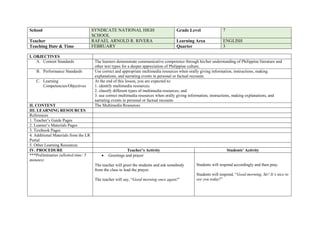
School SYNDICATE NATIONAL HIGH
SCHOOL
Grade Level 7
Teacher RAFAEL ARNOLD R. RIVERA Learning Area ENGLISH
Teaching Date & Time FEBRUARY Quarter 3
I. OBJECTIVES
A. Content Standards The learners demonstrate communicative competence through his/her understanding of Philippine literature and
other text types for a deeper appreciation of Philippine culture.
B. Performance Standards Use correct and appropriate multimedia resources when orally giving information, instructions, making
explanations, and narrating events in personal or factual recounts.
C. Learning
Competencies/Objectives
At the end of this lesson, you are expected to:
1. identify multimedia resources;
2. classify different types of multimedia resources; and
3. use correct multimedia resources when orally giving information, instructions, making explanations, and
narrating events in personal or factual recounts
II. CONTENT The Multimedia Resources
III. LEARNING RESOURCES
References
1. Teacher’s Guide Pages
2. Learner’s Materials Pages
3. Textbook Pages
4. Additional Materials from the LR
Portal
5. Other Learning Resources
IV. PROCEDURE Teacher’s Activity Students’ Activity
***Preliminaries (allotted time: 5
minutes)
 Greetings and prayer
The teacher will greet the students and ask somebody
from the class to lead the prayer.
The teacher will say, “Good morning once again!”
Students will respond accordingly and then pray.
Students will respond, “Good morning, Sir! It’s nice to
see you today!”
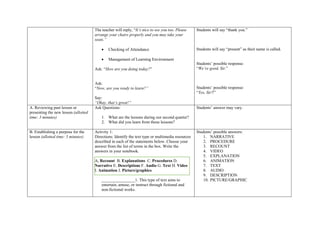
The teacher will reply, “It’s nice to see you too. Please
arrange your chairs properly and you may take your
seats.”
 Checking of Attendance
 Management of Learning Environment
Ask: “How are you doing today?”
Ask:
“Now, are you ready to learn?”
Say:
“Okay, that’s great!”
Students will say “thank you.”
Students will say “present” as their name is called.
Students’ possible response:
“We’re good, Sir.”
Students’ possible response:
“Yes, Sir!!”
A. Reviewing past lesson or
presenting the new lesson (allotted
time: 3 minutes)
Ask Questions:
1. What are the lessons during our second quarter?
2. What did you learn from those lessons?
Students’ answer may vary.
B. Establishing a purpose for the
lesson (allotted time: 5 minutes)
Activity 1:
Directions: Identify the text type or multimedia resources
described in each of the statements below. Choose your
answer from the list of terms in the box. Write the
answers in your notebook.
A. Recount B. Explanations C. Procedures D.
Narrative E. Descriptions F. Audio G. Text H. Video
I. Animation J. Picture/graphics
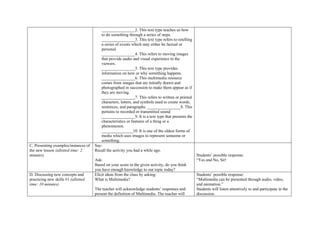
________________1. This type of text aims to
entertain, amuse, or instruct through fictional and
non-fictional works.
Students’ possible answers:
1. NARRATIVE
2. PROCEDURE
3. RECOUNT
4. VIDEO
5. EXPLANATION
6. ANIMATION
7. TEXT
8. AUDIO
9. DESCRIPTION
10. PICTURE/GRAPHIC
________________2. This text type teaches us how
to do something through a series of steps.
________________3. This text type refers to retelling
a series of events which may either be factual or
personal.
________________4. This refers to moving images
that provide audio and visual experience to the
viewers.
________________5. This text type provides
information on how or why something happens.
________________6. This multimedia resource
comes from images that are initially drawn and
photographed in succession to make them appear as if
they are moving.
________________7. This refers to written or printed
characters, letters, and symbols used to create words,
sentences, and paragraphs. ________________8. This
pertains to recorded or transmitted sound
________________9. It is a text type that presents the
characteristics or features of a thing or a
phenomenon.
_______________10. It is one of the oldest forms of
media which uses images to represent someone or
something.
C. Presenting examples/instances of
the new lesson (allotted time: 2
minutes)
Say:
Recall the activity you had a while ago.
Ask:
Based on your score in the given activity, do you think
you have enough knowledge to our topic today?
Students’ possible response:
“Yes and No, Sir!
D. Discussing new concepts and
practicing new skills #1 (allotted
time: 10 minutes)
Elicit ideas from the class by asking:
What is Multimedia?
The teacher will acknowledge students’ responses and
present the definition of Multimedia. The teacher will
Students’ possible response:
“Multimedia can be presented through audio, video,
and animation.”
Students will listen attentively to and participate in the
discussion.
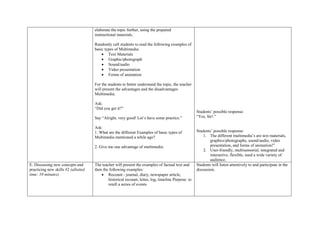
elaborate the topic further, using the prepared
instructional materials.
Randomly call students to read the following examples of
basic types of Multimedia:
 Text Materials
 Graphic/photograph
 Sound/audio
 Video presentation
 Forms of animation
For the students to better understand the topic, the teacher
will present the advantages and the disadvantages
Multimedia.
Ask:
“Did you get it?”
Say “Alright, very good! Let’s have some practice.”
Ask:
1. What are the different Examples of basic types of
Multimedia mentioned a while ago?
2. Give me one advantage of multimedia.
Students’ possible response:
“Yes, Sir!.”
Students’ possible response:
1. The different multimedia’s are text materials,
graphics/photographs, sound/audio, video
presentation, and forms of animation!”
2. User-friendly, multisensorial, integrated and
interactive, flexible, used a wide variety of
audience.
E. Discussing new concepts and
practicing new skills #2 (allotted
time: 10 minutes)
The teacher will present the examples of factual text and
then the following examples:
 Recount - journal, diary, newspaper article,
historical recount, letter, log, timeline Purpose: to
retell a series of events
Students will listen attentively to and participate in the
discussion.
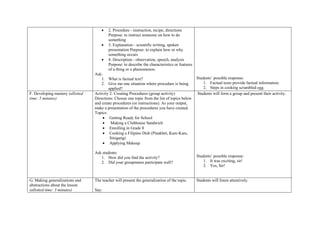
 2. Procedure - instruction, recipe, directions
Purpose: to instruct someone on how to do
something
 3. Explanation - scientific writing, spoken
presentation Purpose: to explain how or why
something occurs
 4. Description - observation, speech, analysis
Purpose: to describe the characteristics or features
of a thing or a phenomenon.
Ask:
1. What is factual text?
2. Give me one situation where procedure is being
applied?
Students’ possible response:
1. Factual texts provide factual information.
2. Steps in cooking scrambled egg.
F. Developing mastery (allotted
time: 5 minutes)
Activity 2: Creating Procedures (group activity)
Directions: Choose one topic from the list of topics below
and create procedures (or instructions). As your output,
make a presentation of the procedures you have created.
Topics:
 Getting Ready for School
 Making a Clubhouse Sandwich
 Enrolling in Grade 8
 Cooking a Filipino Dish (Pinakbet, Kare-Kare,
Sinigang)
 Applying Makeup
Ask students:
1. How did you find the activity?
2. Did your groupmates participate well?
Students will form a group and present their activity.
Students’ possible response:
1. It was exciting, sir!
2. Yes, Sir!
G. Making generalizations and
abstractions about the lesson
(allotted time: 3 minutes)
The teacher will present the generalization of the topic.
Say:
Students will listen attentively.
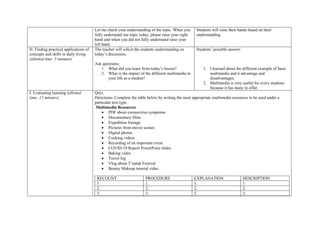
Let me check your understanding of the topic. When you
fully understand our topic today, please raise your right
hand and when you did not fully understand raise your
left hand.
Students will raise their hands based on their
understanding.
H. Finding practical applications of
concepts and skills in daily living
(allotted time: 5 minutes)
The teacher will solicit the students understanding on
today’s discussion.
Ask questions;
1. What did you learn from today’s lesson?
2. What is the impact of the different multimedia in
your life as a student?
Students’ possible answer:
1. I learned about the different example of basic
multimedia and it advantage and
disadvantages.
2. Multimedia is very useful for every students
because it has many to offer.
I. Evaluating learning (allotted
time: 12 minutes)
Quiz:
Directions: Complete the table below by writing the most appropriate multimedia resources to be used under a
particular text type.
Multimedia Resources
 PDF about coronavirus symptoms
 Documentary films
 Expedition footage
 Pictures from movie scenes
 Digital photos
 Cooking videos
 Recording of an important event
 COVID-19 Report PowerPoint slides
 Baking video
 Travel log
 Vlog about T’nalak Festival
 Beauty Makeup tutorial vides.
RECOUNT PROCEDURE EXPLANATION DESCRIPTION
1. 1. 1. 1.
2. 2. 2. 2.
3. 3. 3. 3.
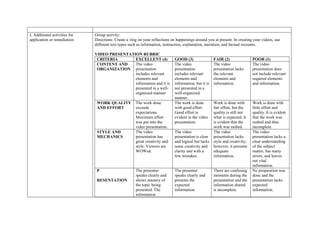
J. Additional activities for
application or remediation
Group activity:
Directions: Create a vlog on your reflections on happenings around you at present. In creating your videos, use
different text types such as information, instruction, explanation, narration, and factual recounts.
VIDEO PRESENTATION RUBRIC
CRITERIA EXCELLENT (4) GOOD (3) FAIR (2) POOR (1)
CONTENT AND
ORGANIZATION
The video
presentation
includes relevant
elements and
information and it is
presented in a well-
organized manner
The video
presentation
includes relevant
elements and
information, but it is
not presented in a
well-organized
manner.
The video
presentation lacks
the relevant
elements and
information.
The video
presentation does
not include relevant
required elements
and information.
WORK QUALITY
AND EFFORT
The work done
exceeds
expectations.
Maximum effort
was put into the
video presentation.
The work is done
with good effort.
Good effort is
evident in the video
presentation.
Work is done with
fair effort, but the
quality is still not
what is expected. It
is evident that the
work was rushed.
Work is done with
little effort and
quality. It is evident
that the work was
rushed and thus
incomplete.
STYLE AND
MECHANICS
The video
presentation has
great creativity and
style. Viewers are
WOWed.
The video
presentation is clear
and logical but lacks
some creativity and
clarity and with a
few mistakes.
The video
presentation lacks
style and creativity;
however, it presents
adequate
information.
The video
presentation lacks a
clear understanding
of the subject
matter, has many
errors, and leaves
out vital
information.
P
RESENTATION
The presenter
speaks clearly and
shows mastery of
the topic being
presented. The
information
The presenter
speaks clearly and
presents the
expected
information.
There are confusing
moments during the
presentation and the
information shared
is incomplete.
No preparation was
done and the
presentation lacks
expected
information.
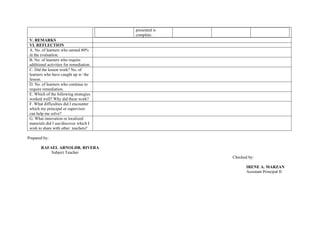
presented is
complete.
V. REMARKS
VI. REFLECTION
A. No. of learners who earned 80%
in the evaluation.
B. No. of learners who require
additional activities for remediation.
C. Did the lesson work? No. of
learners who have caught up w/ the
lesson.
D. No. of learners who continue to
require remediation.
E. Which of the following strategies
worked well? Why did these work?
F. What difficulties did I encounter
which my principal or supervisor
can help me solve?
G. What innovation or localized
materials did I use/discover which I
wish to share with other teachers?
Prepared by:
RAFAEL ARNOLDR. RIVERA
Subject Teacher
Checked by:
IRENE A. MARZAN
Assistant Principal II

Grade-Seven -third Quarter lesson plan-Final-Demo.docx

  • 1.
    School SYNDICATE NATIONALHIGH SCHOOL Grade Level 7 Teacher RAFAEL ARNOLD R. RIVERA Learning Area ENGLISH Teaching Date & Time FEBRUARY Quarter 3 I. OBJECTIVES A. Content Standards The learners demonstrate communicative competence through his/her understanding of Philippine literature and other text types for a deeper appreciation of Philippine culture. B. Performance Standards Use correct and appropriate multimedia resources when orally giving information, instructions, making explanations, and narrating events in personal or factual recounts. C. Learning Competencies/Objectives At the end of this lesson, you are expected to: 1. identify multimedia resources; 2. classify different types of multimedia resources; and 3. use correct multimedia resources when orally giving information, instructions, making explanations, and narrating events in personal or factual recounts II. CONTENT The Multimedia Resources III. LEARNING RESOURCES References 1. Teacher’s Guide Pages 2. Learner’s Materials Pages 3. Textbook Pages 4. Additional Materials from the LR Portal 5. Other Learning Resources IV. PROCEDURE Teacher’s Activity Students’ Activity ***Preliminaries (allotted time: 5 minutes)  Greetings and prayer The teacher will greet the students and ask somebody from the class to lead the prayer. The teacher will say, “Good morning once again!” Students will respond accordingly and then pray. Students will respond, “Good morning, Sir! It’s nice to see you today!”
  • 2.
    The teacher willreply, “It’s nice to see you too. Please arrange your chairs properly and you may take your seats.”  Checking of Attendance  Management of Learning Environment Ask: “How are you doing today?” Ask: “Now, are you ready to learn?” Say: “Okay, that’s great!” Students will say “thank you.” Students will say “present” as their name is called. Students’ possible response: “We’re good, Sir.” Students’ possible response: “Yes, Sir!!” A. Reviewing past lesson or presenting the new lesson (allotted time: 3 minutes) Ask Questions: 1. What are the lessons during our second quarter? 2. What did you learn from those lessons? Students’ answer may vary. B. Establishing a purpose for the lesson (allotted time: 5 minutes) Activity 1: Directions: Identify the text type or multimedia resources described in each of the statements below. Choose your answer from the list of terms in the box. Write the answers in your notebook. A. Recount B. Explanations C. Procedures D. Narrative E. Descriptions F. Audio G. Text H. Video I. Animation J. Picture/graphics ________________1. This type of text aims to entertain, amuse, or instruct through fictional and non-fictional works. Students’ possible answers: 1. NARRATIVE 2. PROCEDURE 3. RECOUNT 4. VIDEO 5. EXPLANATION 6. ANIMATION 7. TEXT 8. AUDIO 9. DESCRIPTION 10. PICTURE/GRAPHIC
  • 3.
    ________________2. This texttype teaches us how to do something through a series of steps. ________________3. This text type refers to retelling a series of events which may either be factual or personal. ________________4. This refers to moving images that provide audio and visual experience to the viewers. ________________5. This text type provides information on how or why something happens. ________________6. This multimedia resource comes from images that are initially drawn and photographed in succession to make them appear as if they are moving. ________________7. This refers to written or printed characters, letters, and symbols used to create words, sentences, and paragraphs. ________________8. This pertains to recorded or transmitted sound ________________9. It is a text type that presents the characteristics or features of a thing or a phenomenon. _______________10. It is one of the oldest forms of media which uses images to represent someone or something. C. Presenting examples/instances of the new lesson (allotted time: 2 minutes) Say: Recall the activity you had a while ago. Ask: Based on your score in the given activity, do you think you have enough knowledge to our topic today? Students’ possible response: “Yes and No, Sir! D. Discussing new concepts and practicing new skills #1 (allotted time: 10 minutes) Elicit ideas from the class by asking: What is Multimedia? The teacher will acknowledge students’ responses and present the definition of Multimedia. The teacher will Students’ possible response: “Multimedia can be presented through audio, video, and animation.” Students will listen attentively to and participate in the discussion.
  • 4.
    elaborate the topicfurther, using the prepared instructional materials. Randomly call students to read the following examples of basic types of Multimedia:  Text Materials  Graphic/photograph  Sound/audio  Video presentation  Forms of animation For the students to better understand the topic, the teacher will present the advantages and the disadvantages Multimedia. Ask: “Did you get it?” Say “Alright, very good! Let’s have some practice.” Ask: 1. What are the different Examples of basic types of Multimedia mentioned a while ago? 2. Give me one advantage of multimedia. Students’ possible response: “Yes, Sir!.” Students’ possible response: 1. The different multimedia’s are text materials, graphics/photographs, sound/audio, video presentation, and forms of animation!” 2. User-friendly, multisensorial, integrated and interactive, flexible, used a wide variety of audience. E. Discussing new concepts and practicing new skills #2 (allotted time: 10 minutes) The teacher will present the examples of factual text and then the following examples:  Recount - journal, diary, newspaper article, historical recount, letter, log, timeline Purpose: to retell a series of events Students will listen attentively to and participate in the discussion.
  • 5.
     2. Procedure- instruction, recipe, directions Purpose: to instruct someone on how to do something  3. Explanation - scientific writing, spoken presentation Purpose: to explain how or why something occurs  4. Description - observation, speech, analysis Purpose: to describe the characteristics or features of a thing or a phenomenon. Ask: 1. What is factual text? 2. Give me one situation where procedure is being applied? Students’ possible response: 1. Factual texts provide factual information. 2. Steps in cooking scrambled egg. F. Developing mastery (allotted time: 5 minutes) Activity 2: Creating Procedures (group activity) Directions: Choose one topic from the list of topics below and create procedures (or instructions). As your output, make a presentation of the procedures you have created. Topics:  Getting Ready for School  Making a Clubhouse Sandwich  Enrolling in Grade 8  Cooking a Filipino Dish (Pinakbet, Kare-Kare, Sinigang)  Applying Makeup Ask students: 1. How did you find the activity? 2. Did your groupmates participate well? Students will form a group and present their activity. Students’ possible response: 1. It was exciting, sir! 2. Yes, Sir! G. Making generalizations and abstractions about the lesson (allotted time: 3 minutes) The teacher will present the generalization of the topic. Say: Students will listen attentively.
  • 6.
    Let me checkyour understanding of the topic. When you fully understand our topic today, please raise your right hand and when you did not fully understand raise your left hand. Students will raise their hands based on their understanding. H. Finding practical applications of concepts and skills in daily living (allotted time: 5 minutes) The teacher will solicit the students understanding on today’s discussion. Ask questions; 1. What did you learn from today’s lesson? 2. What is the impact of the different multimedia in your life as a student? Students’ possible answer: 1. I learned about the different example of basic multimedia and it advantage and disadvantages. 2. Multimedia is very useful for every students because it has many to offer. I. Evaluating learning (allotted time: 12 minutes) Quiz: Directions: Complete the table below by writing the most appropriate multimedia resources to be used under a particular text type. Multimedia Resources  PDF about coronavirus symptoms  Documentary films  Expedition footage  Pictures from movie scenes  Digital photos  Cooking videos  Recording of an important event  COVID-19 Report PowerPoint slides  Baking video  Travel log  Vlog about T’nalak Festival  Beauty Makeup tutorial vides. RECOUNT PROCEDURE EXPLANATION DESCRIPTION 1. 1. 1. 1. 2. 2. 2. 2. 3. 3. 3. 3.
  • 7.
    J. Additional activitiesfor application or remediation Group activity: Directions: Create a vlog on your reflections on happenings around you at present. In creating your videos, use different text types such as information, instruction, explanation, narration, and factual recounts. VIDEO PRESENTATION RUBRIC CRITERIA EXCELLENT (4) GOOD (3) FAIR (2) POOR (1) CONTENT AND ORGANIZATION The video presentation includes relevant elements and information and it is presented in a well- organized manner The video presentation includes relevant elements and information, but it is not presented in a well-organized manner. The video presentation lacks the relevant elements and information. The video presentation does not include relevant required elements and information. WORK QUALITY AND EFFORT The work done exceeds expectations. Maximum effort was put into the video presentation. The work is done with good effort. Good effort is evident in the video presentation. Work is done with fair effort, but the quality is still not what is expected. It is evident that the work was rushed. Work is done with little effort and quality. It is evident that the work was rushed and thus incomplete. STYLE AND MECHANICS The video presentation has great creativity and style. Viewers are WOWed. The video presentation is clear and logical but lacks some creativity and clarity and with a few mistakes. The video presentation lacks style and creativity; however, it presents adequate information. The video presentation lacks a clear understanding of the subject matter, has many errors, and leaves out vital information. P RESENTATION The presenter speaks clearly and shows mastery of the topic being presented. The information The presenter speaks clearly and presents the expected information. There are confusing moments during the presentation and the information shared is incomplete. No preparation was done and the presentation lacks expected information.
  • 8.
    presented is complete. V. REMARKS VI.REFLECTION A. No. of learners who earned 80% in the evaluation. B. No. of learners who require additional activities for remediation. C. Did the lesson work? No. of learners who have caught up w/ the lesson. D. No. of learners who continue to require remediation. E. Which of the following strategies worked well? Why did these work? F. What difficulties did I encounter which my principal or supervisor can help me solve? G. What innovation or localized materials did I use/discover which I wish to share with other teachers? Prepared by: RAFAEL ARNOLDR. RIVERA Subject Teacher Checked by: IRENE A. MARZAN Assistant Principal II