Copyright © Cengage Learning. All rights reserved.
6.3 Vectors in the Plane
2
What You Should Learn
• Represent vectors as directed line segments.
• Write the component forms of vectors.
• Perform basic vector operations and represent
vectors graphically.
• Write vectors as linear combinations of unit
vectors.
3
What You Should Learn
• Find the direction angles of vectors.
• Use vectors to model and solve real-life
problems.
4
Introduction
5
Introduction
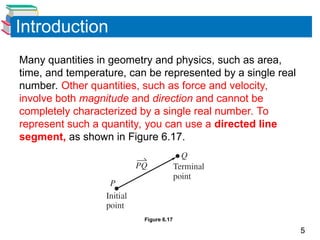
Many quantities in geometry and physics, such as area,
time, and temperature, can be represented by a single real
number. Other quantities, such as force and velocity,
involve both magnitude and direction and cannot be
completely characterized by a single real number. To
represent such a quantity, you can use a directed line
segment, as shown in Figure 6.17.
Figure 6.17
6
Introduction
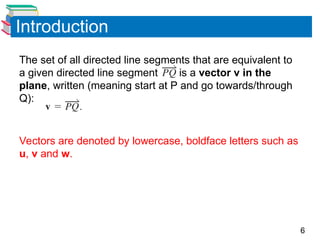
The set of all directed line segments that are equivalent to
a given directed line segment is a vector v in the
plane, written (meaning start at P and go towards/through
Q):
Vectors are denoted by lowercase, boldface letters such as
u, v and w.
7
Example 1 – Equivalent Directed Line Segments
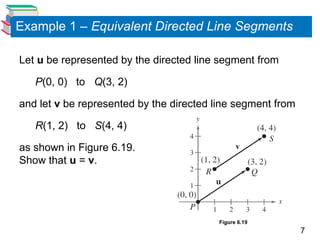
Let u be represented by the directed line segment from
P(0, 0) to Q(3, 2)
and let v be represented by the directed line segment from
R(1, 2) to S(4, 4)
as shown in Figure 6.19.
Show that u = v.
Figure 6.19
8
Example 1 – Solution
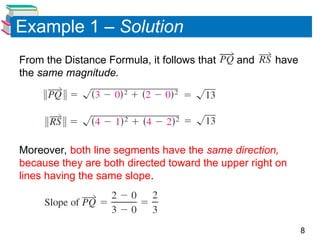
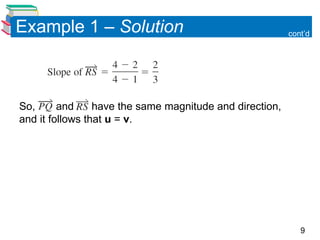
From the Distance Formula, it follows that and have
the same magnitude.
Moreover, both line segments have the same direction,
because they are both directed toward the upper right on
lines having the same slope.
9
Example 1 – Solution
So, and have the same magnitude and direction,
and it follows that u = v.
cont’d
10
Component Form of a Vector
11
Component Form of a Vector
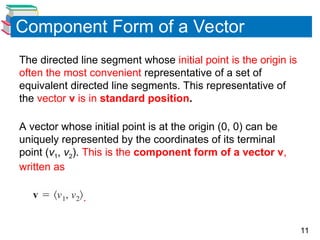
The directed line segment whose initial point is the origin is
often the most convenient representative of a set of
equivalent directed line segments. This representative of
the vector v is in standard position.
A vector whose initial point is at the origin (0, 0) can be
uniquely represented by the coordinates of its terminal
point (v1, v2). This is the component form of a vector v,
written as
.
12
Component Form of a Vector
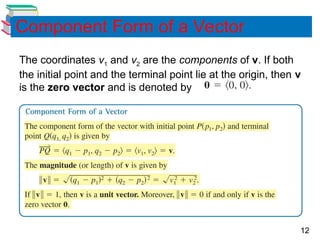
The coordinates v1 and v2 are the components of v. If both
the initial point and the terminal point lie at the origin, then v
is the zero vector and is denoted by
13
Component Form of a Vector
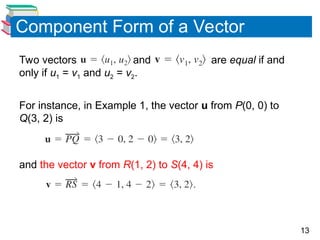
Two vectors and are equal if and
only if u1 = v1 and u2 = v2.
For instance, in Example 1, the vector u from P(0, 0) to
Q(3, 2) is
and the vector v from R(1, 2) to S(4, 4) is
14
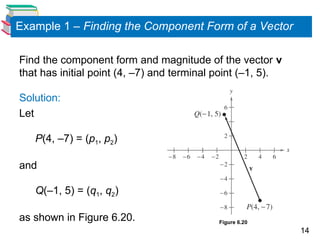
Example 1 – Finding the Component Form of a Vector
Find the component form and magnitude of the vector v
that has initial point (4, –7) and terminal point (–1, 5).
Solution:
Let
P(4, –7) = (p1, p2)
and
Q(–1, 5) = (q1, q2)
as shown in Figure 6.20. Figure 6.20
15
Example 1 – Solution
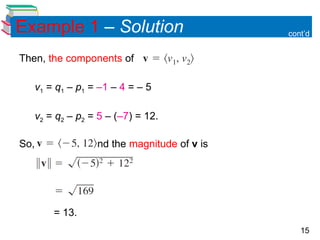
Then, the components of are
v1 = q1 – p1 = –1 – 4 = – 5
v2 = q2 – p2 = 5 – (–7) = 12.
So, and the magnitude of v is
= 13.
cont’d
16
Vector Operations
17
Vector Operations
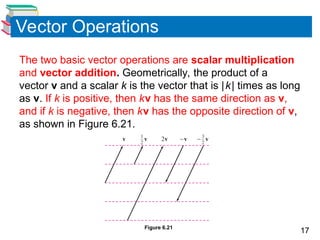
The two basic vector operations are scalar multiplication
and vector addition. Geometrically, the product of a
vector v and a scalar k is the vector that is |k| times as long
as v. If k is positive, then kv has the same direction as v,
and if k is negative, then kv has the opposite direction of v,
as shown in Figure 6.21.
Figure 6.21
18
Vector Operations
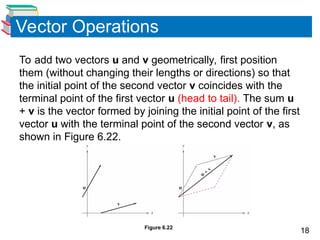
To add two vectors u and v geometrically, first position
them (without changing their lengths or directions) so that
the initial point of the second vector v coincides with the
terminal point of the first vector u (head to tail). The sum u
+ v is the vector formed by joining the initial point of the first
vector u with the terminal point of the second vector v, as
shown in Figure 6.22.
Figure 6.22
19
Vector Operations
The vector u + v is often called the resultant of vector
addition
20
Vector Operations
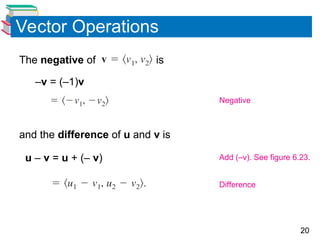
The negative of is
–v = (–1)v
and the difference of u and v is
u – v = u + (– v)
Negative
Add (–v). See figure 6.23.
Difference
21
Example 3 – Vector Operations
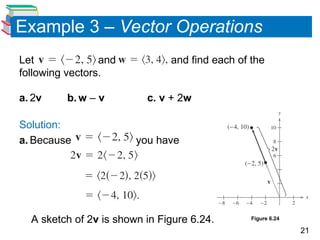
Let and and find each of the
following vectors.
a. 2v b. w – v c. v + 2w
Solution:
a. Because you have
A sketch of 2v is shown in Figure 6.24. Figure 6.24
22
Example 3(b) – Solution
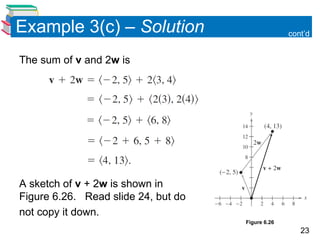
The difference of w and v is
A sketch of w – v is shown in
Figure 6.25. Note that the figure
shows the vector difference
w – v as the sum w + (– v).
Figure 6.25
cont’d
23
Example 3(c) – Solution
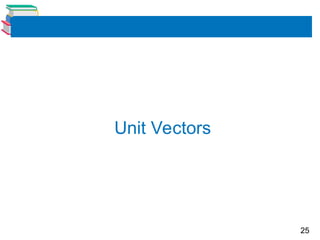
The sum of v and 2w is
A sketch of v + 2w is shown in
Figure 6.26. Read slide 24, but do
not copy it down.
Figure 6.26
cont’d
24
Vector Operations
25
Unit Vectors
26
Unit Vectors
In many applications of vectors, it is useful to find a unit
vector that has the same direction as a given nonzero
vector v. To do this, you can divide v by its length to obtain
Note that u is a scalar multiple of v. The vector u has a
magnitude of 1 and the same direction as v. The vector u is
called a unit vector in the direction of v.
Unit vector in direction of v
27
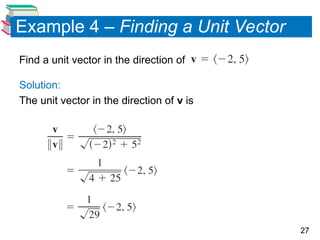
Example 4 – Finding a Unit Vector
Find a unit vector in the direction of .
Solution:
The unit vector in the direction of v is
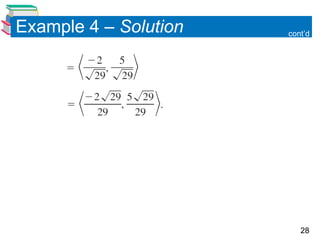
28
Example 4 – Solution cont’d
29
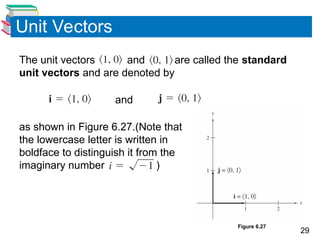
Unit Vectors
The unit vectors and are called the standard
unit vectors and are denoted by
and
as shown in Figure 6.27.(Note that
the lowercase letter is written in
boldface to distinguish it from the
imaginary number )
Figure 6.27
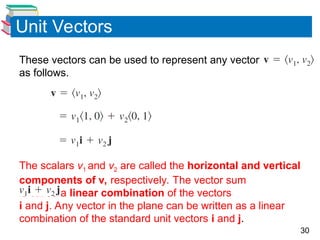
30
Unit Vectors
These vectors can be used to represent any vector
as follows.
The scalars v1 and v2 are called the horizontal and vertical
components of v, respectively. The vector sum
is called a linear combination of the vectors
i and j. Any vector in the plane can be written as a linear
combination of the standard unit vectors i and j.
31
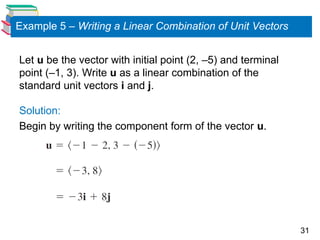
Example 5 – Writing a Linear Combination of Unit Vectors
Let u be the vector with initial point (2, –5) and terminal
point (–1, 3). Write u as a linear combination of the
standard unit vectors i and j.
Solution:
Begin by writing the component form of the vector u.
32
Direction Angles
33
Direction Angles
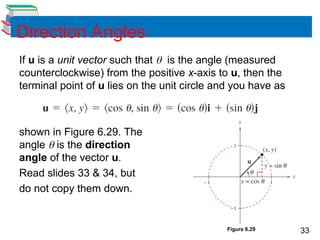
If u is a unit vector such that  is the angle (measured
counterclockwise) from the positive x-axis to u, then the
terminal point of u lies on the unit circle and you have as
shown in Figure 6.29. The
angle  is the direction
angle of the vector u.
Read slides 33 & 34, but
do not copy them down.
Figure 6.29
34
Direction Angles
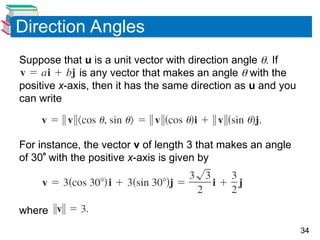
Suppose that u is a unit vector with direction angle . If
is any vector that makes an angle  with the
positive x-axis, then it has the same direction as u and you
can write
For instance, the vector v of length 3 that makes an angle
of 30 with the positive x-axis is given by
where
35
Direction Angles
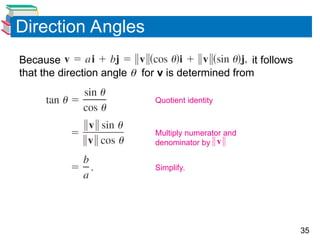
Because it follows
that the direction angle  for v is determined from
Quotient identity
Multiply numerator and
denominator by
Simplify.
36
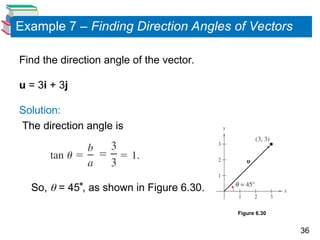
Example 7 – Finding Direction Angles of Vectors
Find the direction angle of the vector.
u = 3i + 3j
Solution:
The direction angle is
So,  = 45, as shown in Figure 6.30.
Figure 6.30

Section General Chemistry 1 Lesson PC.ppt

  • 1.
    Copyright © CengageLearning. All rights reserved. 6.3 Vectors in the Plane
  • 2.
    2 What You ShouldLearn • Represent vectors as directed line segments. • Write the component forms of vectors. • Perform basic vector operations and represent vectors graphically. • Write vectors as linear combinations of unit vectors.
  • 3.
    3 What You ShouldLearn • Find the direction angles of vectors. • Use vectors to model and solve real-life problems.
  • 4.
  • 5.
    5 Introduction Many quantities ingeometry and physics, such as area, time, and temperature, can be represented by a single real number. Other quantities, such as force and velocity, involve both magnitude and direction and cannot be completely characterized by a single real number. To represent such a quantity, you can use a directed line segment, as shown in Figure 6.17. Figure 6.17
  • 6.
    6 Introduction The set ofall directed line segments that are equivalent to a given directed line segment is a vector v in the plane, written (meaning start at P and go towards/through Q): Vectors are denoted by lowercase, boldface letters such as u, v and w.
  • 7.
    7 Example 1 –Equivalent Directed Line Segments Let u be represented by the directed line segment from P(0, 0) to Q(3, 2) and let v be represented by the directed line segment from R(1, 2) to S(4, 4) as shown in Figure 6.19. Show that u = v. Figure 6.19
  • 8.
    8 Example 1 –Solution From the Distance Formula, it follows that and have the same magnitude. Moreover, both line segments have the same direction, because they are both directed toward the upper right on lines having the same slope.
  • 9.
    9 Example 1 –Solution So, and have the same magnitude and direction, and it follows that u = v. cont’d
  • 10.
  • 11.
    11 Component Form ofa Vector The directed line segment whose initial point is the origin is often the most convenient representative of a set of equivalent directed line segments. This representative of the vector v is in standard position. A vector whose initial point is at the origin (0, 0) can be uniquely represented by the coordinates of its terminal point (v1, v2). This is the component form of a vector v, written as .
  • 12.
    12 Component Form ofa Vector The coordinates v1 and v2 are the components of v. If both the initial point and the terminal point lie at the origin, then v is the zero vector and is denoted by
  • 13.
    13 Component Form ofa Vector Two vectors and are equal if and only if u1 = v1 and u2 = v2. For instance, in Example 1, the vector u from P(0, 0) to Q(3, 2) is and the vector v from R(1, 2) to S(4, 4) is
  • 14.
    14 Example 1 –Finding the Component Form of a Vector Find the component form and magnitude of the vector v that has initial point (4, –7) and terminal point (–1, 5). Solution: Let P(4, –7) = (p1, p2) and Q(–1, 5) = (q1, q2) as shown in Figure 6.20. Figure 6.20
  • 15.
    15 Example 1 –Solution Then, the components of are v1 = q1 – p1 = –1 – 4 = – 5 v2 = q2 – p2 = 5 – (–7) = 12. So, and the magnitude of v is = 13. cont’d
  • 16.
  • 17.
    17 Vector Operations The twobasic vector operations are scalar multiplication and vector addition. Geometrically, the product of a vector v and a scalar k is the vector that is |k| times as long as v. If k is positive, then kv has the same direction as v, and if k is negative, then kv has the opposite direction of v, as shown in Figure 6.21. Figure 6.21
  • 18.
    18 Vector Operations To addtwo vectors u and v geometrically, first position them (without changing their lengths or directions) so that the initial point of the second vector v coincides with the terminal point of the first vector u (head to tail). The sum u + v is the vector formed by joining the initial point of the first vector u with the terminal point of the second vector v, as shown in Figure 6.22. Figure 6.22
  • 19.
    19 Vector Operations The vectoru + v is often called the resultant of vector addition
  • 20.
    20 Vector Operations The negativeof is –v = (–1)v and the difference of u and v is u – v = u + (– v) Negative Add (–v). See figure 6.23. Difference
  • 21.
    21 Example 3 –Vector Operations Let and and find each of the following vectors. a. 2v b. w – v c. v + 2w Solution: a. Because you have A sketch of 2v is shown in Figure 6.24. Figure 6.24
  • 22.
    22 Example 3(b) –Solution The difference of w and v is A sketch of w – v is shown in Figure 6.25. Note that the figure shows the vector difference w – v as the sum w + (– v). Figure 6.25 cont’d
  • 23.
    23 Example 3(c) –Solution The sum of v and 2w is A sketch of v + 2w is shown in Figure 6.26. Read slide 24, but do not copy it down. Figure 6.26 cont’d
  • 24.
  • 25.
  • 26.
    26 Unit Vectors In manyapplications of vectors, it is useful to find a unit vector that has the same direction as a given nonzero vector v. To do this, you can divide v by its length to obtain Note that u is a scalar multiple of v. The vector u has a magnitude of 1 and the same direction as v. The vector u is called a unit vector in the direction of v. Unit vector in direction of v
  • 27.
    27 Example 4 –Finding a Unit Vector Find a unit vector in the direction of . Solution: The unit vector in the direction of v is
  • 28.
    28 Example 4 –Solution cont’d
  • 29.
    29 Unit Vectors The unitvectors and are called the standard unit vectors and are denoted by and as shown in Figure 6.27.(Note that the lowercase letter is written in boldface to distinguish it from the imaginary number ) Figure 6.27
  • 30.
    30 Unit Vectors These vectorscan be used to represent any vector as follows. The scalars v1 and v2 are called the horizontal and vertical components of v, respectively. The vector sum is called a linear combination of the vectors i and j. Any vector in the plane can be written as a linear combination of the standard unit vectors i and j.
  • 31.
    31 Example 5 –Writing a Linear Combination of Unit Vectors Let u be the vector with initial point (2, –5) and terminal point (–1, 3). Write u as a linear combination of the standard unit vectors i and j. Solution: Begin by writing the component form of the vector u.
  • 32.
  • 33.
    33 Direction Angles If uis a unit vector such that  is the angle (measured counterclockwise) from the positive x-axis to u, then the terminal point of u lies on the unit circle and you have as shown in Figure 6.29. The angle  is the direction angle of the vector u. Read slides 33 & 34, but do not copy them down. Figure 6.29
  • 34.
    34 Direction Angles Suppose thatu is a unit vector with direction angle . If is any vector that makes an angle  with the positive x-axis, then it has the same direction as u and you can write For instance, the vector v of length 3 that makes an angle of 30 with the positive x-axis is given by where
  • 35.
    35 Direction Angles Because itfollows that the direction angle  for v is determined from Quotient identity Multiply numerator and denominator by Simplify.
  • 36.
    36 Example 7 –Finding Direction Angles of Vectors Find the direction angle of the vector. u = 3i + 3j Solution: The direction angle is So,  = 45, as shown in Figure 6.30. Figure 6.30