Graded Readers
• Models in literature teaching
• Benefits in using graded readers
• Disadvantages in using graded
readers
• How to use graded readers in the
English lessons
Reasons for not using readers
• Students are lazy to read
• They will not understand the
• text
• They are not able to concentrate on a
text for too long
• There is no time for reading in the
lessons
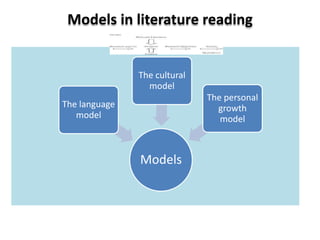
Models in literature reading
Models
The language
model
The cultural
model
The personal
growth
model
Process of reading
• People are reading when the words
understood become thoughts and ideas
• Comprehension is the capacity for
understanding those thoughts and ideas
• Readers relate the text they read to their
own personal experiences, they compare
and evaluate.
Questionnaire for teachers
• Do you use Graded readers in your lessons?
• Do you use any other reading material?
• How do you choose the material to be read?
• What goals do you set for reading activities?
• How do you motivate your students to read?
• Do you believe that a teacher can influence
the learner´s attitude to reading?
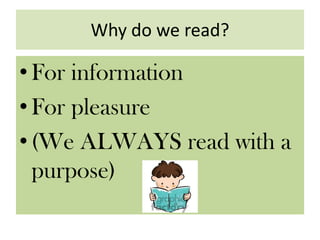
Why do we read?
•For information
•For pleasure
•(We ALWAYS read with a
purpose)
Definition of a graded reader
• A graded reader is one of a series of
books ranked by grade level, reader level
or another level of difficulty.
• Graded readers are used by learners at
specific stages of their foreign language
learning and whose purpose is to
practice reading and to gain reading
fluency.
• “The literary language which is unique to
the original is “translated” into
something else. It is claimed that by
transforming the literary work into a
simplified version, it loses the texture of
the original and the language shifts from
literary to non-literary” (Carter and Long)
Example
• Stand: the opposite of sit
• Stand: take a position (I ll stand by your
side)
• Mantain a certain position (Stand first in
class)
• Occupy a place (The house stands on a
hill)
• Remain valid (The order still stands)
Graded readers: a flexibe tool for
language teachers
Creating the basic motivational
conditions
• Appropriate teacher behaviour
• Pleasant and supportive
atmosphere in the classroom
• A cohesive learner group with
appropriate group norms.
Generating initial motivation
• The learners should be prepared for the task
• Learners have to know the teacher is ready to
help them
• It is essential to support the learner´s
cooperation.
• Learners should know the purpose of the
reading.
• The material should be relevant for the
learners
Maintaining and protecting motivation
• Presenting tasks in a motivating way
• Setting goals
• Protecting the learners´self esteem and
increasing their self-confidence
• Promoting cooperation among the learners
• Creating learner autonomy
• Selecting a book
• Presenting the work
• Maintaining momentum
• Deciding on activities and group
work
Organizing a literature lesson
Stages in the lesson
•Pre-reading activities
•While reading activities
•Post reading activities
Pre-reading activities
•Guess the story from the
cover
•Jumbled chapter titles
•Working with pictures
While reading
• Answering broad questions
• Comparing commentaries
• Making questions
• Listing main events
• Completing paragraphs
• Choosing vocabulary
• Horoscopes
After reading
• Comic strips
• Radio articles
• News Articles
• In the character´s shoes
• Book reviews
Pre-reading activities
(The Picture of Dorian Gray)
• In groups, plan two activities
you´d give a group of
eleven/ twelve- year-old
students before reading the
story.
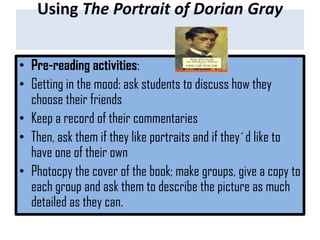
Using The Portrait of Dorian Gray
• Pre-reading activities:
• Getting in the mood: ask students to discuss how they
choose their friends
• Keep a record of their commentaries
• Then, ask them if they like portraits and if they´d like to
have one of their own
• Photocpy the cover of the book; make groups, give a copy to
each group and ask them to describe the picture as much
detailed as they can.
While reading activities
• Worksheets:
• Say whether some sentences are true or
false
• Put events in the right order
• Make an oral presentation defending/
opposing Dorian´s decision of not
showing the portrait.
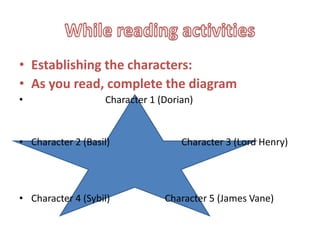
• Establishing the characters:
• As you read, complete the diagram
• Character 1 (Dorian)
• Character 2 (Basil) Character 3 (Lord Henry)
• Character 4 (Sybil) Character 5 (James Vane)
After reading activities
(to be done in groups)
• Using the imagination:
• A- Imagine you are one of Dorian´s servants and tell your
mates what you have seen in his house.
• B- Imagine you spent a day as one of the characters in
the story.Describe the events that happened to you.
• Describe a situation you found frightening.
• Describe the character you found more interesting in the
book.
• Write a report after Dorian´s death as if you were Lord
Henry.
• Write a commentary making clear whether you feel pity/
sad/anger for Dorian.
Worksheet for chapter two
• Dorian never saw Lord Henry again. He devoted his
time to have pleasure; he went to parties, to expensive
restaurants and to the theatre. One day, Dorian met a
very beautiful girl; she was Sybil Vane, she was the
leading actress in the play Dorian had decided to
watch. She was not a very good actress but she was the
most beautiful woman Dorian had ever seen.
• Sybil fell in love with Dorian, she did not know if he
was rich or poor, she only knew she loved him with all
her heart. Sybil´s mom was not happy with this love,
she said Sybil was too young and that she´d be alone as
her son, Sybil´s brother, was going to Africa.
Helping students with activities:
• Students can work with the following link in
order to have more information on the literary
work:
•
• http://cregocristina.edu.glogster.com/the-
portrait-of-dorian-grey
Expanding the story
We can ask students to watch the
video at:
http://www.youtube.com/watch?v=x4
Umh-intCQ
Favourite scenes
• Work in a small group. Make a list of all the
scenes in the film that people in your group
liked. Each person should suggest one or two
of their favourite scenes.
• Number these scenes in order of most to least
preferred by the whole group.
• Report back to the whole class
Watching one scene
 Watch one scene (maybe chosen by the
teacher) and write notes on the topic below:
 Setting
 Film
 Book
 Character
 Film
 Book
Comparing
• Problem:
• What is the main problem the story deals
with?
• How is it presented in the film?
• Climax:
• What happens to bring about the ending?
• How does the film show the climax?

Graded readers

  • 1.
    Graded Readers • Modelsin literature teaching • Benefits in using graded readers • Disadvantages in using graded readers • How to use graded readers in the English lessons
  • 2.
    Reasons for notusing readers • Students are lazy to read • They will not understand the • text • They are not able to concentrate on a text for too long • There is no time for reading in the lessons
  • 3.
    Models in literaturereading Models The language model The cultural model The personal growth model
  • 4.
    Process of reading •People are reading when the words understood become thoughts and ideas • Comprehension is the capacity for understanding those thoughts and ideas • Readers relate the text they read to their own personal experiences, they compare and evaluate.
  • 5.
    Questionnaire for teachers •Do you use Graded readers in your lessons? • Do you use any other reading material? • How do you choose the material to be read? • What goals do you set for reading activities? • How do you motivate your students to read? • Do you believe that a teacher can influence the learner´s attitude to reading?
  • 6.
    Why do weread? •For information •For pleasure •(We ALWAYS read with a purpose)
  • 7.
    Definition of agraded reader • A graded reader is one of a series of books ranked by grade level, reader level or another level of difficulty. • Graded readers are used by learners at specific stages of their foreign language learning and whose purpose is to practice reading and to gain reading fluency.
  • 8.
    • “The literarylanguage which is unique to the original is “translated” into something else. It is claimed that by transforming the literary work into a simplified version, it loses the texture of the original and the language shifts from literary to non-literary” (Carter and Long)
  • 9.
    Example • Stand: theopposite of sit • Stand: take a position (I ll stand by your side) • Mantain a certain position (Stand first in class) • Occupy a place (The house stands on a hill) • Remain valid (The order still stands)
  • 10.
    Graded readers: aflexibe tool for language teachers
  • 11.
    Creating the basicmotivational conditions • Appropriate teacher behaviour • Pleasant and supportive atmosphere in the classroom • A cohesive learner group with appropriate group norms.
  • 12.
    Generating initial motivation •The learners should be prepared for the task • Learners have to know the teacher is ready to help them • It is essential to support the learner´s cooperation. • Learners should know the purpose of the reading. • The material should be relevant for the learners
  • 13.
    Maintaining and protectingmotivation • Presenting tasks in a motivating way • Setting goals • Protecting the learners´self esteem and increasing their self-confidence • Promoting cooperation among the learners • Creating learner autonomy
  • 14.
    • Selecting abook • Presenting the work • Maintaining momentum • Deciding on activities and group work Organizing a literature lesson
  • 15.
    Stages in thelesson •Pre-reading activities •While reading activities •Post reading activities
  • 16.
    Pre-reading activities •Guess thestory from the cover •Jumbled chapter titles •Working with pictures
  • 17.
    While reading • Answeringbroad questions • Comparing commentaries • Making questions • Listing main events • Completing paragraphs • Choosing vocabulary • Horoscopes
  • 18.
    After reading • Comicstrips • Radio articles • News Articles • In the character´s shoes • Book reviews
  • 19.
    Pre-reading activities (The Pictureof Dorian Gray) • In groups, plan two activities you´d give a group of eleven/ twelve- year-old students before reading the story.
  • 20.
    Using The Portraitof Dorian Gray • Pre-reading activities: • Getting in the mood: ask students to discuss how they choose their friends • Keep a record of their commentaries • Then, ask them if they like portraits and if they´d like to have one of their own • Photocpy the cover of the book; make groups, give a copy to each group and ask them to describe the picture as much detailed as they can.
  • 21.
    While reading activities •Worksheets: • Say whether some sentences are true or false • Put events in the right order • Make an oral presentation defending/ opposing Dorian´s decision of not showing the portrait.
  • 22.
    • Establishing thecharacters: • As you read, complete the diagram • Character 1 (Dorian) • Character 2 (Basil) Character 3 (Lord Henry) • Character 4 (Sybil) Character 5 (James Vane)
  • 23.
    After reading activities (tobe done in groups) • Using the imagination: • A- Imagine you are one of Dorian´s servants and tell your mates what you have seen in his house. • B- Imagine you spent a day as one of the characters in the story.Describe the events that happened to you. • Describe a situation you found frightening. • Describe the character you found more interesting in the book. • Write a report after Dorian´s death as if you were Lord Henry. • Write a commentary making clear whether you feel pity/ sad/anger for Dorian.
  • 24.
    Worksheet for chaptertwo • Dorian never saw Lord Henry again. He devoted his time to have pleasure; he went to parties, to expensive restaurants and to the theatre. One day, Dorian met a very beautiful girl; she was Sybil Vane, she was the leading actress in the play Dorian had decided to watch. She was not a very good actress but she was the most beautiful woman Dorian had ever seen. • Sybil fell in love with Dorian, she did not know if he was rich or poor, she only knew she loved him with all her heart. Sybil´s mom was not happy with this love, she said Sybil was too young and that she´d be alone as her son, Sybil´s brother, was going to Africa.
  • 25.
    Helping students withactivities: • Students can work with the following link in order to have more information on the literary work: • • http://cregocristina.edu.glogster.com/the- portrait-of-dorian-grey
  • 26.
    Expanding the story Wecan ask students to watch the video at: http://www.youtube.com/watch?v=x4 Umh-intCQ
  • 27.
    Favourite scenes • Workin a small group. Make a list of all the scenes in the film that people in your group liked. Each person should suggest one or two of their favourite scenes. • Number these scenes in order of most to least preferred by the whole group. • Report back to the whole class
  • 28.
    Watching one scene Watch one scene (maybe chosen by the teacher) and write notes on the topic below:  Setting  Film  Book  Character  Film  Book
  • 29.
    Comparing • Problem: • Whatis the main problem the story deals with? • How is it presented in the film? • Climax: • What happens to bring about the ending? • How does the film show the climax?