The Beginnings
VIDYA PATIL
Assistant Professor in English
Government First Grade College, Humnabad.
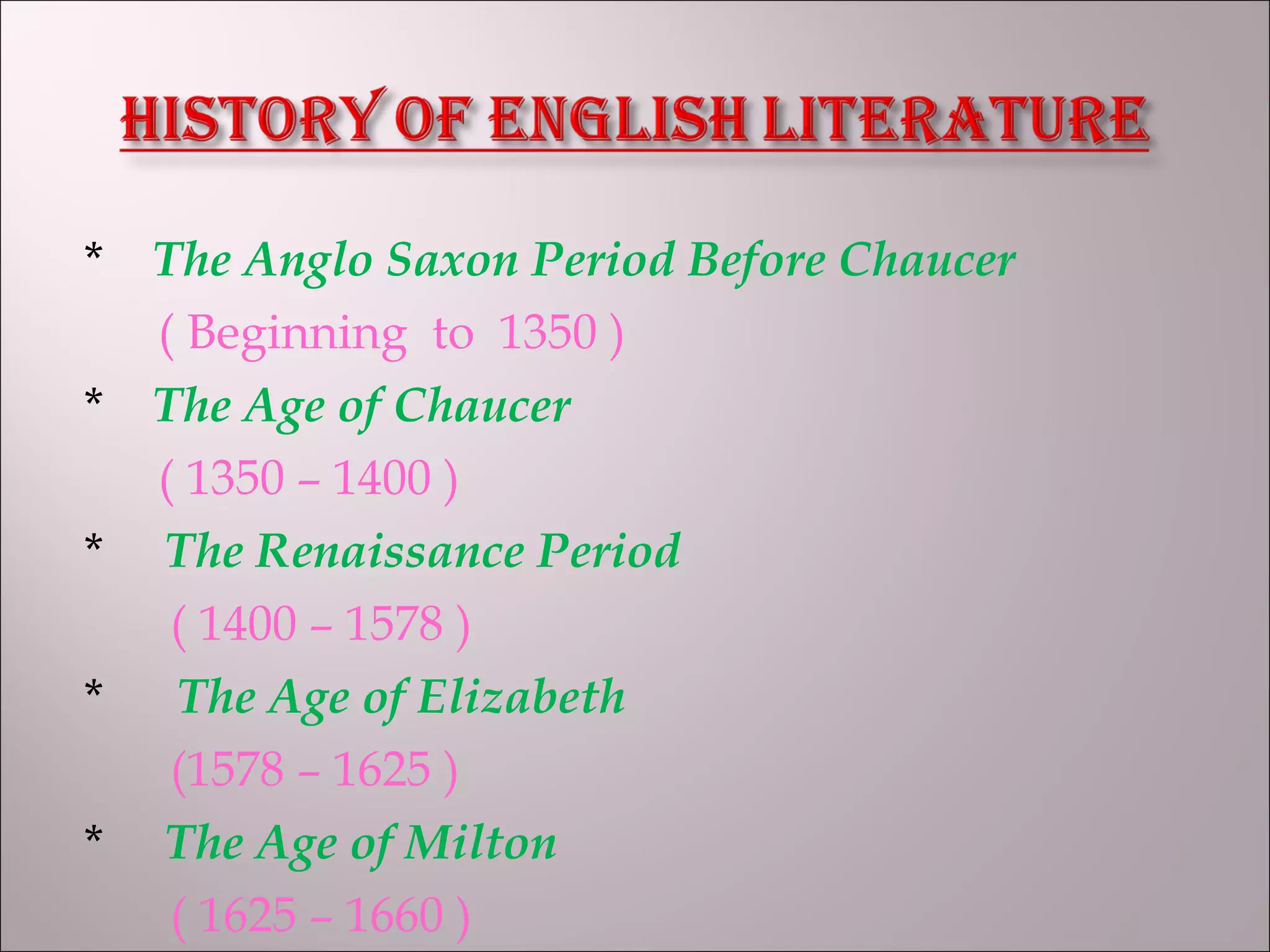
* The Anglo Saxon Period Before Chaucer
( Beginning to 1350 )
* The Age of Chaucer
( 1350 – 1400 )
* The Renaissance Period
( 1400 – 1578 )
* The Age of Elizabeth
(1578 – 1625 )
* The Age of Milton
( 1625 – 1660 )
* The Restoration Period
( 1660 – 1700 )
* The Age of Pope
( 1700 – 1740 )
* The Age of Johnson
( 1740 – 1798 )
* The Age of Romanticism
( 1798 – 1830 )
* The Victorian Age
( 1830 -1890 )
* Early Twentieth Century Literature
( 1890 – 1930 )
* Twentieth Century Literature Since 1930
( 1930 – 1960 )
INTRODUCTION
English literature traces its origin to
the beginning of the history of English
people.
The English are a composite race,
Because various racial elements have
entered into their making :
Celts, Anglo-Saxons, Danes, Normans.
. The Celts were the earliest inhabitants of
England.
• The Romans conquered Britain in 43A.D.
• The Angles, Saxons and Jutes came to
settle in England in the latter part of the
fifth century A.D. and eventually gave
the country it’s name and it’s language.
• The Angles being the most numerous
gave their name to the whole country :–
Angle- land or England.
• The first step that put the Anglo-Saxons
on the path of civilisation was their
conversion to Christianity.
. Oral literature was popular and mainly
secular and religious in nature.
• Written English literature was said to
have been appeared between 450-1050
which is known as Old English Period in
the history of English language.
449 :- Landing of tribes in England.
547 :- Settling of Angles.
635-665 :- Coming of St. Aidan.
700 :- Conversion of Northumbria.
Beowulf the poem was made.
867 :- Danes conquer Northumbria.
871 :- Alfred, King of Wessex.
901 :- Death of Alfred.
1000 :- Beowulf was written down.
1189 :- Richard I – Third Crusade.
1215 :- Magna Carta.
1300-1400 :- York and Wakefield Miracle Plays.
1338 :- Beginning of Hundred Years War with
France.
1340 :- Birth of Chaucer.
1350 :- Sir Gawain, The Pearl.
Beowulf
It is the first written literary creation
in English.
It is the earliest and greatest epic in
Anglo Saxon.
It is a poem of more than 3000 lines
celebrating the heroic deeds of the
warrior who gives his name to the
poem.
He saved the king from terrible
monster Grendal and his mother.
Later he becomes the King of Geatas.
In the end he kills a firedrake but
dies of the dragon’s fiery breath.
The story was in oral form in
England. It was later written by an
eighth century poet in the form of an
epic.
Beowulf was followed by other
poetical works like Widsith, Waldera
and the Exetor Book. The authorship
of these poetical works is not known.
Life in all these poems is sorrowful
and the speakers are fatalistic, though
at the same time courageous and
determined.
The English passion for the sea and
the adventurous life is well
illustrated by the Sea farer, a lyrical
poem of great power with a similar
mood of the hardship, the
fascination, the melancholy of the
sea .
RELIGIOUS THEMES
* Two names are connected with
Christian poetry, Caedmon and Cynewulf.
* Caedmon’s work was historical while
Cynewulf’s work was mythical.
* Three outstanding poems on biblical
themes are Genesis B, The Dream of the
Road and the story of Tudith.
* The language used is rough. It’s words are hard and
metallic . Accordingly the poetry is also crude and
rough.
* Monotonous and artificial versification due to
excessive use of alliteration.
* Cheerless gloom and temper of the poems as most
of them dealt with Fate making short work of Man
and his achievements.
* Poetry is marred by verbosity – high sounding
words and long-winded explanations and
elaborations.
* The earliest prose writers is Aldhelm (709),
Bishop of Sherborne, who wrote praises of
virginity in an ornate Latin.
* The greatest figure is Bede who wrote
about history, astronomy, saints’ lives and
the lives of martyrs. Foremost among his
works is his great Ecclesiastical History of
the English Race.
* Alfred was not only a great king, he was also a
great literary figure. He is usually regarded as the
founder of the English prose. His translations are :
(1) The History and Geography of Orosius,
(2) The Ecclesiastical History of Bede,
(3) The Consolations of Philosophy of Boethius.
* In addition to these, under his aegis the famous
Anglo-Saxon Chronicle began to be written. It is
the most important work of Anglo-Saxon prose,
which records the history of England from the
time of the Roman occupation to the middle of the
twelfth century. Alfred died in 899, but additions
continued to be made even after his death.
 IMPERSONALITY : Most of the writings were
anonymous. The reproduction of the books by
hand tended to give them a communal
character as texts were exposed both to
unconscious alteration and conscious change.
Originality was not a major requirement of
medieval authors. There is less personal quality
in medieval than in modern literature.
PRESENCE OF WOMEN : We can notice a
change that takes place in the narrative poetry
as it passes from heroic to courtly in nature.
RELIGIOUS IN NATURE : Religious writings were
a large and significant part of medieval literature.
PROMOTED VIRTUE : In medieval literature the
will to delight is often partner with the will to
teach.
VERSE FORM : Much of the literature in the
medieval period was meant to be listened to
rather than read. As a result, verse is the normal
medium for most forms of literature.
SIMPLICITY and IMMATURITY : Medieval writing
lacks the immediate appeal of the contemporary
literature. But beauty cannot be denied on the
grounds of immaturity and simplicity.
THANK
YOU
Mrs Vidya Patil
Assistant Professor in English
Government First Grade College,
Humnabad.

grade 9 english 1.pdf

  • 1.
    The Beginnings VIDYA PATIL AssistantProfessor in English Government First Grade College, Humnabad.
  • 3.
    * The AngloSaxon Period Before Chaucer ( Beginning to 1350 ) * The Age of Chaucer ( 1350 – 1400 ) * The Renaissance Period ( 1400 – 1578 ) * The Age of Elizabeth (1578 – 1625 ) * The Age of Milton ( 1625 – 1660 )
  • 4.
    * The RestorationPeriod ( 1660 – 1700 ) * The Age of Pope ( 1700 – 1740 ) * The Age of Johnson ( 1740 – 1798 ) * The Age of Romanticism ( 1798 – 1830 ) * The Victorian Age ( 1830 -1890 ) * Early Twentieth Century Literature ( 1890 – 1930 ) * Twentieth Century Literature Since 1930 ( 1930 – 1960 )
  • 5.
    INTRODUCTION English literature tracesits origin to the beginning of the history of English people. The English are a composite race, Because various racial elements have entered into their making : Celts, Anglo-Saxons, Danes, Normans.
  • 6.
    . The Celtswere the earliest inhabitants of England. • The Romans conquered Britain in 43A.D. • The Angles, Saxons and Jutes came to settle in England in the latter part of the fifth century A.D. and eventually gave the country it’s name and it’s language. • The Angles being the most numerous gave their name to the whole country :– Angle- land or England.
  • 11.
    • The firststep that put the Anglo-Saxons on the path of civilisation was their conversion to Christianity. . Oral literature was popular and mainly secular and religious in nature. • Written English literature was said to have been appeared between 450-1050 which is known as Old English Period in the history of English language.
  • 12.
    449 :- Landingof tribes in England. 547 :- Settling of Angles. 635-665 :- Coming of St. Aidan. 700 :- Conversion of Northumbria. Beowulf the poem was made. 867 :- Danes conquer Northumbria. 871 :- Alfred, King of Wessex.
  • 13.
    901 :- Deathof Alfred. 1000 :- Beowulf was written down. 1189 :- Richard I – Third Crusade. 1215 :- Magna Carta. 1300-1400 :- York and Wakefield Miracle Plays. 1338 :- Beginning of Hundred Years War with France. 1340 :- Birth of Chaucer. 1350 :- Sir Gawain, The Pearl.
  • 14.
    Beowulf It is thefirst written literary creation in English. It is the earliest and greatest epic in Anglo Saxon. It is a poem of more than 3000 lines celebrating the heroic deeds of the warrior who gives his name to the poem.
  • 16.
    He saved theking from terrible monster Grendal and his mother. Later he becomes the King of Geatas. In the end he kills a firedrake but dies of the dragon’s fiery breath. The story was in oral form in England. It was later written by an eighth century poet in the form of an epic.
  • 17.
    Beowulf was followedby other poetical works like Widsith, Waldera and the Exetor Book. The authorship of these poetical works is not known. Life in all these poems is sorrowful and the speakers are fatalistic, though at the same time courageous and determined.
  • 18.
    The English passionfor the sea and the adventurous life is well illustrated by the Sea farer, a lyrical poem of great power with a similar mood of the hardship, the fascination, the melancholy of the sea .
  • 19.
    RELIGIOUS THEMES * Twonames are connected with Christian poetry, Caedmon and Cynewulf. * Caedmon’s work was historical while Cynewulf’s work was mythical. * Three outstanding poems on biblical themes are Genesis B, The Dream of the Road and the story of Tudith.
  • 20.
    * The languageused is rough. It’s words are hard and metallic . Accordingly the poetry is also crude and rough. * Monotonous and artificial versification due to excessive use of alliteration. * Cheerless gloom and temper of the poems as most of them dealt with Fate making short work of Man and his achievements. * Poetry is marred by verbosity – high sounding words and long-winded explanations and elaborations.
  • 21.
    * The earliestprose writers is Aldhelm (709), Bishop of Sherborne, who wrote praises of virginity in an ornate Latin. * The greatest figure is Bede who wrote about history, astronomy, saints’ lives and the lives of martyrs. Foremost among his works is his great Ecclesiastical History of the English Race.
  • 22.
    * Alfred wasnot only a great king, he was also a great literary figure. He is usually regarded as the founder of the English prose. His translations are : (1) The History and Geography of Orosius, (2) The Ecclesiastical History of Bede, (3) The Consolations of Philosophy of Boethius. * In addition to these, under his aegis the famous Anglo-Saxon Chronicle began to be written. It is the most important work of Anglo-Saxon prose, which records the history of England from the time of the Roman occupation to the middle of the twelfth century. Alfred died in 899, but additions continued to be made even after his death.
  • 23.
     IMPERSONALITY :Most of the writings were anonymous. The reproduction of the books by hand tended to give them a communal character as texts were exposed both to unconscious alteration and conscious change. Originality was not a major requirement of medieval authors. There is less personal quality in medieval than in modern literature. PRESENCE OF WOMEN : We can notice a change that takes place in the narrative poetry as it passes from heroic to courtly in nature.
  • 24.
    RELIGIOUS IN NATURE: Religious writings were a large and significant part of medieval literature. PROMOTED VIRTUE : In medieval literature the will to delight is often partner with the will to teach. VERSE FORM : Much of the literature in the medieval period was meant to be listened to rather than read. As a result, verse is the normal medium for most forms of literature. SIMPLICITY and IMMATURITY : Medieval writing lacks the immediate appeal of the contemporary literature. But beauty cannot be denied on the grounds of immaturity and simplicity.
  • 25.
  • 26.
    Mrs Vidya Patil AssistantProfessor in English Government First Grade College, Humnabad.