Almighty God, youare the source of life.
We thank you for all the blessings you have
given to us. Thank you for giving us another
day to learn something new. Clear our mind
and help us focus. Guide us and our
teacher as we study and create new
learning experiences. We pray in Jesus
Christ, amen.
3.
Science 6
Planets inthe Solar
System
Demonstrated by:
Virginia M. Bautista
Science 6
Planets in the Solar
System
Demonstrated by:
Virginia M. Bautista
4.
Directions: Decide whethereach of
the statements shown is describing
revolution or rotation. Raise the red
flaglet if the statement describes
revolution, yellow if the statement
describes rotation.
5.
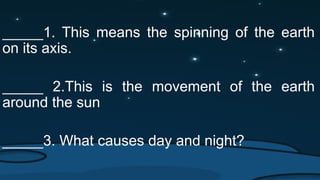
_____1. This meansthe spinning of the earth
on its axis.
_____ 2.This is the movement of the earth
around the sun
_____3. What causes day and night?
6.
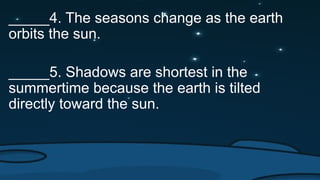
_____4. The seasonschange as the earth
orbits the sun.
_____5. Shadows are shortest in the
summertime because the earth is tilted
directly toward the sun.
7.
Direction: Arrange thejumbled letters to
answer the ff.
1.
-it is a heavenly body that revolves around the sun
2.
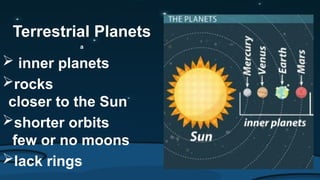
- these are also called the inner planets which are made
up of rocks.
3.
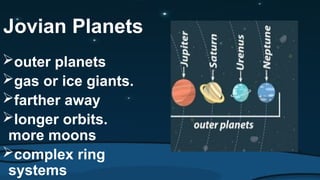
• - these are the outer planets and they are also called
gas giants
netpla
trialterres netspla
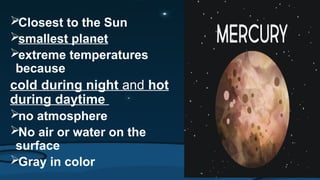
Closest to theSun
smallest planet
extreme temperatures
because
cold during night and hot
during daytime
no atmosphere
No air or water on the
surface
Gray in color
15.
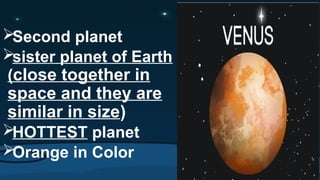
Second planet
sister planetof Earth
(close together in
space and they are
similar in size)
HOTTEST planet
Orange in Color
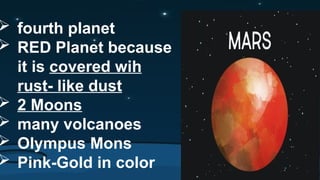
fourth planet
RED Planet because
it is covered wih
rust- like dust
2 Moons
many volcanoes
Olympus Mons
Pink-Gold in color
18.
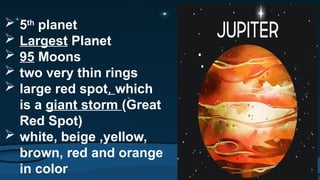
5th
planet
LargestPlanet
95 Moons
two very thin rings
large red spot, which
is a giant storm (Great
Red Spot)
white, beige ,yellow,
brown, red and orange
in color
19.
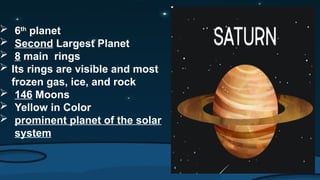
6th
planet
SecondLargest Planet
8 main rings
Its rings are visible and most
frozen gas, ice, and rock
146 Moons
Yellow in Color
prominent planet of the solar
system
20.
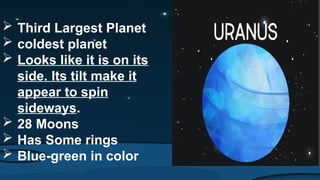
Third LargestPlanet
coldest planet
Looks like it is on its
side. Its tilt make it
appear to spin
sideways.
28 Moons
Has Some rings
Blue-green in color
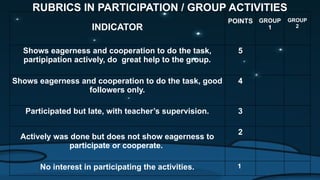
INDICATOR
POINTS GROUP
1
GROUP
2
Shows eagernessand cooperation to do the task,
partipipation actively, do great help to the group.
5
Shows eagerness and cooperation to do the task, good
followers only.
4
Participated but late, with teacher’s supervision. 3
Actively was done but does not show eagerness to
participate or cooperate.
2
No interest in participating the activities. 1
RUBRICS IN PARTICIPATION / GROUP ACTIVITIES
25.
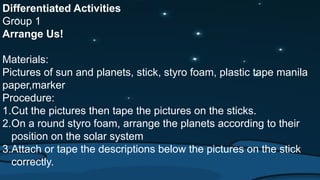
Differentiated Activities
Group 1
ArrangeUs!
Materials:
Pictures of sun and planets, stick, styro foam, plastic tape manila
paper,marker
Procedure:
1.Cut the pictures then tape the pictures on the sticks.
2.On a round styro foam, arrange the planets according to their
position on the solar system
3.Attach or tape the descriptions below the pictures on the stick
correctly.
26.
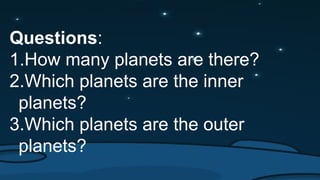
Questions:
1.How many planetsare there?
2.Which planets are the inner
planets?
3.Which planets are the outer
planets?
27.
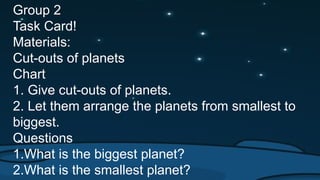
Group 2
Task Card!
Materials:
Cut-outsof planets
Chart
1. Give cut-outs of planets.
2. Let them arrange the planets from smallest to
biggest.
Questions
1.What is the biggest planet?
2.What is the smallest planet?
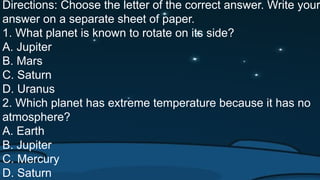
Directions: Choose theletter of the correct answer. Write your
answer on a separate sheet of paper.
1. What planet is known to rotate on its side?
A. Jupiter
B. Mars
C. Saturn
D. Uranus
2. Which planet has extreme temperature because it has no
atmosphere?
A. Earth
B. Jupiter
C. Mercury
D. Saturn
31.
3. Which descriptionabout the planets
is false?
A. Mars is the red planet.
B. Earth is the blue planet.
C. Venus is Earth’s twin planet.
D. Mercury is the hottest planet.
32.
4. Which groupingof planets is correct?
A. Jupiter, Saturn, Neptune, Venus
B. Mercury, Venus, Earth, Saturn
C. Jupiter, Saturn, Earth, Venus
D. Mercury, Venus, Earth, Mars
5. Which is a common characteristic of all the planets in
the Solar System?
A. All of them have rings.
B. All of them can sustain life.
C. All of them have atmosphere.
D. All of them revolve around the Sun
33.
Directions: Choose theletter of the correct answer. Write your answers
on a separate sheet of paper.
1. Which planet has a big red spot on its surface?
A. Jupiter
B. Mars
C. Neptune
D. Uranus
2. Which list of the planets is in correct order starting from the sun?
A. Mercury, Venus, Earth, Mars, Jupiter, Saturn, Uranus, Neptune
B. Mars, Venus, Earth, Mercury, Jupiter, Saturn, Uranus, Neptune
C. Mercury, Venus, Earth, Mars, Jupiter, Saturn, Neptune, Uranus
D. Mercury, Venus, Earth, Mars, Saturn, Jupiter, Uranus, Neptune
34.
3. What isa common characteristic of the inner planets?
A. They are large.
B. They have rings.
C. They are gaseous.
D. They have rocky surfaces.
4. Which planet has iron in the soil that gives it a red color?
A. Jupiter
B. Mars
C. Saturn
D. Uranus
35.
5. Which isthe biggest planet in the solar system?
A. Neptune
B. Venus
C. Jupiter
D. Earth
6. Which is the smallest planet in the solar system?
A. Mercury
B. Earth
C. Uranus
D. Mars
36.
7. Which planethas almost the same size with the earth
A. Jupiter
B. Saturn
C. Venus
D. Uranus
8. What planet is known to rotate on its side?
A. Jupiter
B. Mars
C. Saturn
D. Uranus
37.
9. Which groupingof planets is correct?
A. Jupiter, Saturn, Neptune, Venus
B. Mercury, Venus, Earth, Saturn
C. Jupiter, Saturn, Earth, Venus
D. Mercury, Venus, Earth, Mars
10. Why do we need to study about the solar system?
A. So we can find aliens
B. So we can learn about other planets
C. So we can evacuate to Mars
D. So we can make space travel cheaper
38.
Assignment
Directions: Using recyclablematerials
available at home. Make a mobile craft that
will show visual representation of the
position of the different planets in the Solar
System and demonstrate the idea that the
planets revolve around the Sun.
39.
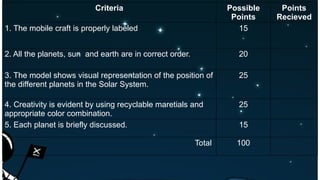
Criteria Possible
Points
Points
Recieved
1. Themobile craft is properly labeled 15
2. All the planets, sun and earth are in correct order. 20
3. The model shows visual representation of the position of
the different planets in the Solar System.
25
4. Creativity is evident by using recyclable maretials and
appropriate color combination.
25
5. Each planet is briefly discussed. 15
Total 100
#1 What are the rules you must follow when we are having our lesson?
1. Be ready to learn
2. Listen and follow directions
3. Raise your hand to speak
4. Be kind and repectful
5. Cooperate with others.
#2 What are the rules you must follow when we are having our lesson?
1. Be ready to learn
2. Listen and follow directions
3. Raise your hand to speak
4. Be kind and repectful
5. Cooperate with others.
#3 Before we proceed let’s review our past lesson in the form of a game.
Let me see if you can recall it by answering the following.
Here are the directions.
#7 These words have something to do with our lesson for today.
What do you think are we going to learn today?
Answer: We are going to learn about the planets of the solar system
#8 Do you want to explore the outer space?
Let’s explore and compare the planets of the solar system.
Let’s watch the music video. But before that, what will you do while watching the video?
#9 Did you like the music video?
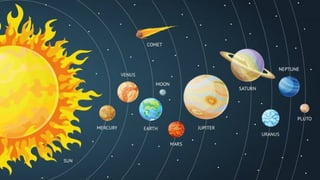
There are eight planets in our solar system that revolve around the sun. Can you remember their names and sequence?
The sentence will help you remember the sequence of the planets.
#10 Planets do not produce their own light and heat.
They shine because they reflect the sunlight that falls on them.
They moved around the sun in an elliptical pathway called an orbit.
As they revolve around the sun, they also spin and rotate.
Each planet has an orbit of different length around the sun.
The further the planet from the sun, the longer its orbit.
#13 Im going to give you activity cards about the planets of the solar system .
Read and answer the following questions .
You are given 1 minute to read and answer each card.
you will know that the time is up when you hear the bell.
Time starts now! are you ready! Time up
#14 Extreme temperature
-Cold on half of the planet during night –{-180 degrees Celsius)
-Hot on half facing the sun during daytime (400 degrees Celsius.)
What is the smallest planet?
_____________________________________________________________
Why does it have extreme temperatures?
_____________________________________________________________
#15 sister planet of Earth because they are close together in space and they are similar in size
3. What is the hottest planet?
Sino na ang nakakain ng litson?
litson- 71 degrees celcius para makapaglitson-6x hotter
4. Why is Venus the sister planet to earth?
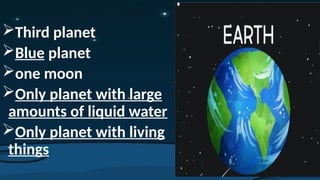
#16 5. What is the blue planet?
6.What makes the earth different from the rest of the planets?
7. Since the Earth is the only planet with living things, how will you care for our planet?
#17 it is here where the largest volcano –
Olympus mons - in the Solar System is found.
8.Why is Mars called the Red Planet?
9. How many moons does Mars have?
#18 10. What is the largest planet in the Solar System?
11. How many moons does it have?
12. What is the Great Red Spot of Jupiter?
#19 13. What is the second largest planet?
14. How many moons does it have?
15. Why is Saturn called the ringed planet?
#20 16. What is different about Uranus when it spins?
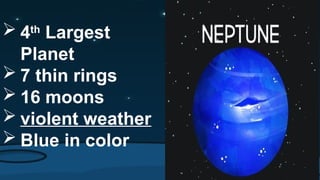
#21 17. Compared to other planets, what distinct characteristic does Neptune have?