INNER PLANETS
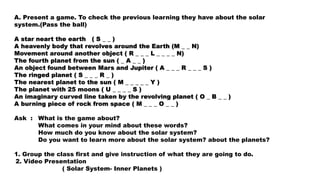
A. Present a game. To check the previous learning they have about the solar
system.(Pass the ball)
A star neart the earth ( S _ _ )
A heavenly body that revolves around the Earth (M _ _ N)
Movement around another object ( R _ _ _ L _ _ _ _ N)
The fourth planet from the sun ( _ A _ _ )
An object found between Mars and Jupiter ( A _ _ _ R _ _ _ S )
The ringed planet ( S _ _ _ R _ )
The nearest planet to the sun ( M _ _ _ _ _ Y )
The planet with 25 moons ( U _ _ _ _ S )
An imaginary curved line taken by the revolving planet ( O _ B _ _ )
A burning piece of rock from space ( M _ _ _ O _ _ )
A. Present a game. To check the previous learning they have about the solar
system.(Pass the ball)
A star neart the earth ( S _ _ )
A heavenly body that revolves around the Earth (M _ _ N)
Movement around another object ( R _ _ _ L _ _ _ _ N)
The fourth planet from the sun ( _ A _ _ )
An object found between Mars and Jupiter ( A _ _ _ R _ _ _ S )
The ringed planet ( S _ _ _ R _ )
The nearest planet to the sun ( M _ _ _ _ _ Y )
The planet with 25 moons ( U _ _ _ _ S )
An imaginary curved line taken by the revolving planet ( O _ B _ _ )
A burning piece of rock from space ( M _ _ _ O _ _ )
Ask : What is the game about?
What comes in your mind about these words?
How much do you know about the solar system?
Do you want to learn more about the solar system? about the planets?
1. Group the class first and give instruction of what they are going to do.
2. Video Presentation
( Solar System- Inner Planets )
Inner Planets
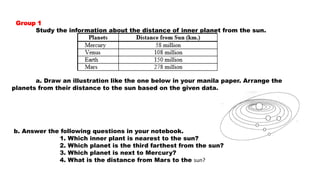
Group 1
Study the information about the distance of inner planet from the sun.
a. Draw an illustration like the one below in your manila paper. Arrange the
planets from their distance to the sun based on the given data.
b. Answer the following questions in your notebook.
1. Which inner plant is nearest to the sun?
2. Which planet is the third farthest from the sun?
3. Which planet is next to Mercury?
4. What is the distance from Mars to the sun?
Group 2 : Study the information about inner planets and answer the information that
follows.
Which are true about the inner planets? Copy these in your manila paper.
Refer to the information given to check whether your answers are correct.
1. Mercury is the fastest planet.
2. The earth has two moons.
3. If you live in Venus you can celebrate your birthday every after 225 days.
4. Venus is the most beautiful planet.
6. The nearer the planet to the sun, the fastest it moves around the sun.
7. Looking into the temperature of Mercury, life can exist there.
8. The presence of atmosphere can make life possible on Earth.
9. Mars has 2 moons.
10. The 4 inner planets move around the sun.
11. Planets have different distances from the sun.
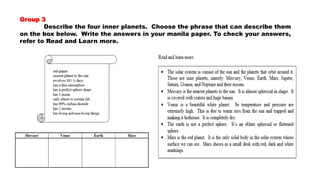
Group 3
Describe the four inner planets. Choose the phrase that can describe them
on the box below. Write the answers in your manila paper. To check your answers,
refer to Read and Learn more.
C. Group presentation of output.
Acknowledge the effort of the pupil.
( Give different clappings to the reporter)
D. Check the outputs of each group.
1. Give further explanation about the report of the group. (Power point
Presentation)
2. Ask:
What is the center of the solar system?
What do you call the heavenly bodies that orbit around the sun?
What are the inner planets?
What is the largest volcano in the solar system? Where it is found?
E. Generalization:
Ask:
What are the terrestrial planets?
Among the four planets, what planet has life? Why?
What makes Venus the strangest planet in the solar system?
What is the difference between Earth and Mars?
MERCURY
 Mercury is the nearest planets to
the sun. It is almost spherical in
shape. It is covered with craters
and huge basins.
 It can be seen in the sky at
sunrise and sunset. Only one side
of Mercury is facing the sun. This
part is very hot.
 The name comes from a Roman
God of Commerce, travel and
thievery
 The slowest planet and only 5%
of Earth’s size
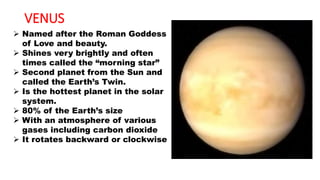
VENUS
 Named after the Roman Goddess
of Love and beauty.
 Shines very brightly and often
times called the “morning star”
 Second planet from the Sun and
called the Earth’s Twin.
 Is the hottest planet in the solar
system.
 80% of the Earth’s size
 With an atmosphere of various
gases including carbon dioxide
 It rotates backward or clockwise
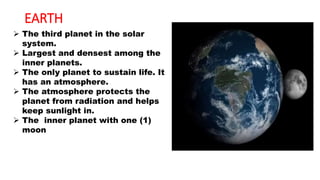
EARTH
 The third planet in the solar
system.
 Largest and densest among the
inner planets.
 The only planet to sustain life. It
has an atmosphere.
 The atmosphere protects the
planet from radiation and helps
keep sunlight in.
 The inner planet with one (1)
moon
MARZ
 The fourth in the solar system
and named after the Roman God
of War
 Known as the red planet
 10% of Earth’s mass.
 It has two (2) moons which is
believed to be asteroids
 It has huge volcano known as
Olympus Mons
 It is reddish in color.
 It is cold in Mars.
 It has white caps on its poles
which is ice.
GENERLIZATION
Name the inner planets we’ had learned.
What are their characteristics?
Among the four planets, what planet has life? Why?
Value: Do you enjoy living on Earth? How will you protect/ care
the planet Earth?
Choose the letter of the correct answer about the inner planets.
1. Mercury is the _____________ planet in the Solar System.
a. second b. first c. fourth
2. Earth is the _____________ planet from the sun.
a. second b. first c. third
3. Venus was named after the Roman goddess of ___.
a. grace and peace b. love and beauty c. Hope and eternity
4. There are ____ moons in Mars.
a. 0 b. 2 c. 1
5. The largest volcano in the solar system is found in _____.
a. Earth b. Venus c. Mars
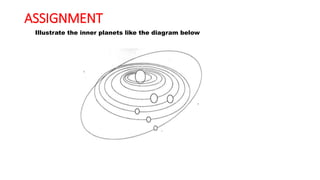
ASSIGNMENT
Illustrate the inner planets like the diagram below
Enter title
Enter your text here, or paste your text here.
Enter title
Click here to add content of the
text,and briefly explain your point
of view
Enter title
Click here to add content of the
text,and briefly explain your point
of view
Enter title
Click here to add content of the
text,and briefly explain your point
of view

SOLAR SYSTEM- INNER PLANETS.pptx

  • 1.
  • 2.
    A. Present agame. To check the previous learning they have about the solar system.(Pass the ball) A star neart the earth ( S _ _ ) A heavenly body that revolves around the Earth (M _ _ N) Movement around another object ( R _ _ _ L _ _ _ _ N) The fourth planet from the sun ( _ A _ _ ) An object found between Mars and Jupiter ( A _ _ _ R _ _ _ S ) The ringed planet ( S _ _ _ R _ ) The nearest planet to the sun ( M _ _ _ _ _ Y ) The planet with 25 moons ( U _ _ _ _ S ) An imaginary curved line taken by the revolving planet ( O _ B _ _ ) A burning piece of rock from space ( M _ _ _ O _ _ ) A. Present a game. To check the previous learning they have about the solar system.(Pass the ball) A star neart the earth ( S _ _ ) A heavenly body that revolves around the Earth (M _ _ N) Movement around another object ( R _ _ _ L _ _ _ _ N) The fourth planet from the sun ( _ A _ _ ) An object found between Mars and Jupiter ( A _ _ _ R _ _ _ S ) The ringed planet ( S _ _ _ R _ ) The nearest planet to the sun ( M _ _ _ _ _ Y ) The planet with 25 moons ( U _ _ _ _ S ) An imaginary curved line taken by the revolving planet ( O _ B _ _ ) A burning piece of rock from space ( M _ _ _ O _ _ ) Ask : What is the game about? What comes in your mind about these words? How much do you know about the solar system? Do you want to learn more about the solar system? about the planets? 1. Group the class first and give instruction of what they are going to do. 2. Video Presentation ( Solar System- Inner Planets )
  • 3.
  • 4.
    Group 1 Study theinformation about the distance of inner planet from the sun. a. Draw an illustration like the one below in your manila paper. Arrange the planets from their distance to the sun based on the given data. b. Answer the following questions in your notebook. 1. Which inner plant is nearest to the sun? 2. Which planet is the third farthest from the sun? 3. Which planet is next to Mercury? 4. What is the distance from Mars to the sun?
  • 5.
    Group 2 :Study the information about inner planets and answer the information that follows. Which are true about the inner planets? Copy these in your manila paper. Refer to the information given to check whether your answers are correct. 1. Mercury is the fastest planet. 2. The earth has two moons. 3. If you live in Venus you can celebrate your birthday every after 225 days. 4. Venus is the most beautiful planet. 6. The nearer the planet to the sun, the fastest it moves around the sun. 7. Looking into the temperature of Mercury, life can exist there. 8. The presence of atmosphere can make life possible on Earth. 9. Mars has 2 moons. 10. The 4 inner planets move around the sun. 11. Planets have different distances from the sun.
  • 6.
    Group 3 Describe thefour inner planets. Choose the phrase that can describe them on the box below. Write the answers in your manila paper. To check your answers, refer to Read and Learn more.
  • 7.
    C. Group presentationof output. Acknowledge the effort of the pupil. ( Give different clappings to the reporter) D. Check the outputs of each group. 1. Give further explanation about the report of the group. (Power point Presentation) 2. Ask: What is the center of the solar system? What do you call the heavenly bodies that orbit around the sun? What are the inner planets? What is the largest volcano in the solar system? Where it is found? E. Generalization: Ask: What are the terrestrial planets? Among the four planets, what planet has life? Why? What makes Venus the strangest planet in the solar system? What is the difference between Earth and Mars?
  • 8.
    MERCURY  Mercury isthe nearest planets to the sun. It is almost spherical in shape. It is covered with craters and huge basins.  It can be seen in the sky at sunrise and sunset. Only one side of Mercury is facing the sun. This part is very hot.  The name comes from a Roman God of Commerce, travel and thievery  The slowest planet and only 5% of Earth’s size
  • 9.
    VENUS  Named afterthe Roman Goddess of Love and beauty.  Shines very brightly and often times called the “morning star”  Second planet from the Sun and called the Earth’s Twin.  Is the hottest planet in the solar system.  80% of the Earth’s size  With an atmosphere of various gases including carbon dioxide  It rotates backward or clockwise
  • 10.
    EARTH  The thirdplanet in the solar system.  Largest and densest among the inner planets.  The only planet to sustain life. It has an atmosphere.  The atmosphere protects the planet from radiation and helps keep sunlight in.  The inner planet with one (1) moon
  • 11.
    MARZ  The fourthin the solar system and named after the Roman God of War  Known as the red planet  10% of Earth’s mass.  It has two (2) moons which is believed to be asteroids  It has huge volcano known as Olympus Mons  It is reddish in color.  It is cold in Mars.  It has white caps on its poles which is ice.
  • 12.
    GENERLIZATION Name the innerplanets we’ had learned. What are their characteristics? Among the four planets, what planet has life? Why? Value: Do you enjoy living on Earth? How will you protect/ care the planet Earth?
  • 13.
    Choose the letterof the correct answer about the inner planets. 1. Mercury is the _____________ planet in the Solar System. a. second b. first c. fourth 2. Earth is the _____________ planet from the sun. a. second b. first c. third 3. Venus was named after the Roman goddess of ___. a. grace and peace b. love and beauty c. Hope and eternity 4. There are ____ moons in Mars. a. 0 b. 2 c. 1 5. The largest volcano in the solar system is found in _____. a. Earth b. Venus c. Mars
  • 14.
    ASSIGNMENT Illustrate the innerplanets like the diagram below
  • 15.
    Enter title Enter yourtext here, or paste your text here. Enter title Click here to add content of the text,and briefly explain your point of view Enter title Click here to add content of the text,and briefly explain your point of view Enter title Click here to add content of the text,and briefly explain your point of view