GRA Implementations using Open Source
                          Technologies
                        Mark Perbix and Yogesh Chawla
                                              SEARCH
Goals

   Quick review of Global Standards and
   Initiatives

   Describe projects that have adopted and
   successfully implemented various Global
   Standards

   Discuss advantages of using                                                             Open
   Source software


SEARCH, The National Consortium for Justice Information and Statistics | www.search.org           2
Global Standards and Initiatives

   Global Reference Architecture (GRA)


   Global Federated Identity and Privilege
   Management (GFIPM)


   Global Technical Privacy Framework


SEARCH, The National Consortium for Justice Information and Statistics | www.search.org   3
Global Standards and Initiatives

   Global Reference Architecture (GRA)
    National Information Exchange Model (NIEM)
    Governance – Policy and Technical Standards


   Global Federated Identity and Privilege
   Management (GFIPM)
    Single Sign On
    Access Control


   Global Technical Privacy Framework
    Privacy Policy Rules Enforcement
SEARCH, The National Consortium for Justice Information and Statistics | www.search.org   4
Focus

   Global Reference Architecture (GRA)
    National Information Exchange Model (NIEM)
    Governance – Policy and Technical Standards


   Global Federated Identity and Privilege
   Management (GFIPM)
    Single Sign On
    Access Control


SEARCH, The National Consortium for Justice Information and Statistics | www.search.org           5
GIST - Where does it all fit in?

                        Data       Messaging                   Architecture              Access Control              Authentication       Federation


                       < Data >       Data                   Structural Design
                                                                                         Data Disclosure        User Identification        Security

                       Payload      Transport                & IS Enablement
                                                                                           & Auditing                & Credentialing     Management

    Underlying                        WS*                                                                              AD & LDAP

                                                               BPEL/XSLT
    Technology           XML         TCIP/IP                                              XACML/SAML                     Crypto        Trust Federation
                                                                  ebXML
     Standard                     HTTP & HTTP/S                                                                       Trust Model


                                                    GRA                                                                  GFIPM
Global Adaptation of
                        NIEM
     Standard
                                                                                Global Technical Privacy Framework


                                                                                         GFIPM Metadata         GFIPM Trust Model
  Enablement of                                                                                                                        Federation & FMO
                        IEPDs         SSPs                        SIPs
  Interoperability                                                                                                                        Definition
                                                                                                 Communication Profiles


                                                  Services
  Manifestation in
                                                                                                                                        Participation in
       Your             IEPs                                                               SP Services                IdP Services
                                   Adapters &                Intermediary &                                                               Federation
  Implementation
                                   Connectors                Service Registry
                                                                                                                                                           6
GRA - Technical Components


SEARCH, The National Consortium for Justice Information and Statistics | www.search.org   7
GRA Implementation Projects
  Notification Service
   Interstate Compact for Adult Offender
    Supervision (ICAOS)
   Maine State Police Incident Reporting


  Subscription Notification
    Hawaii Integrated Justice Information System
     (HIJIS)

  Federated Query/Response with GFIPM
    Vermont Integrated Justice Information
     System Portal
SEARCH, The National Consortium for Justice Information and Statistics | www.search.org   8
ICAOS

   Business Requirements
    Notify fusion centers (and potentially other
     law enforcement agencies) when a probation
     or parole offender relocates to another state.

   Outcome
    Send notification through existing fusion
     center network infrastructure
    Notifications sent from outside the fusion
     center environment meeting security
     requirements

SEARCH, The National Consortium for Justice Information and Statistics | www.search.org           9
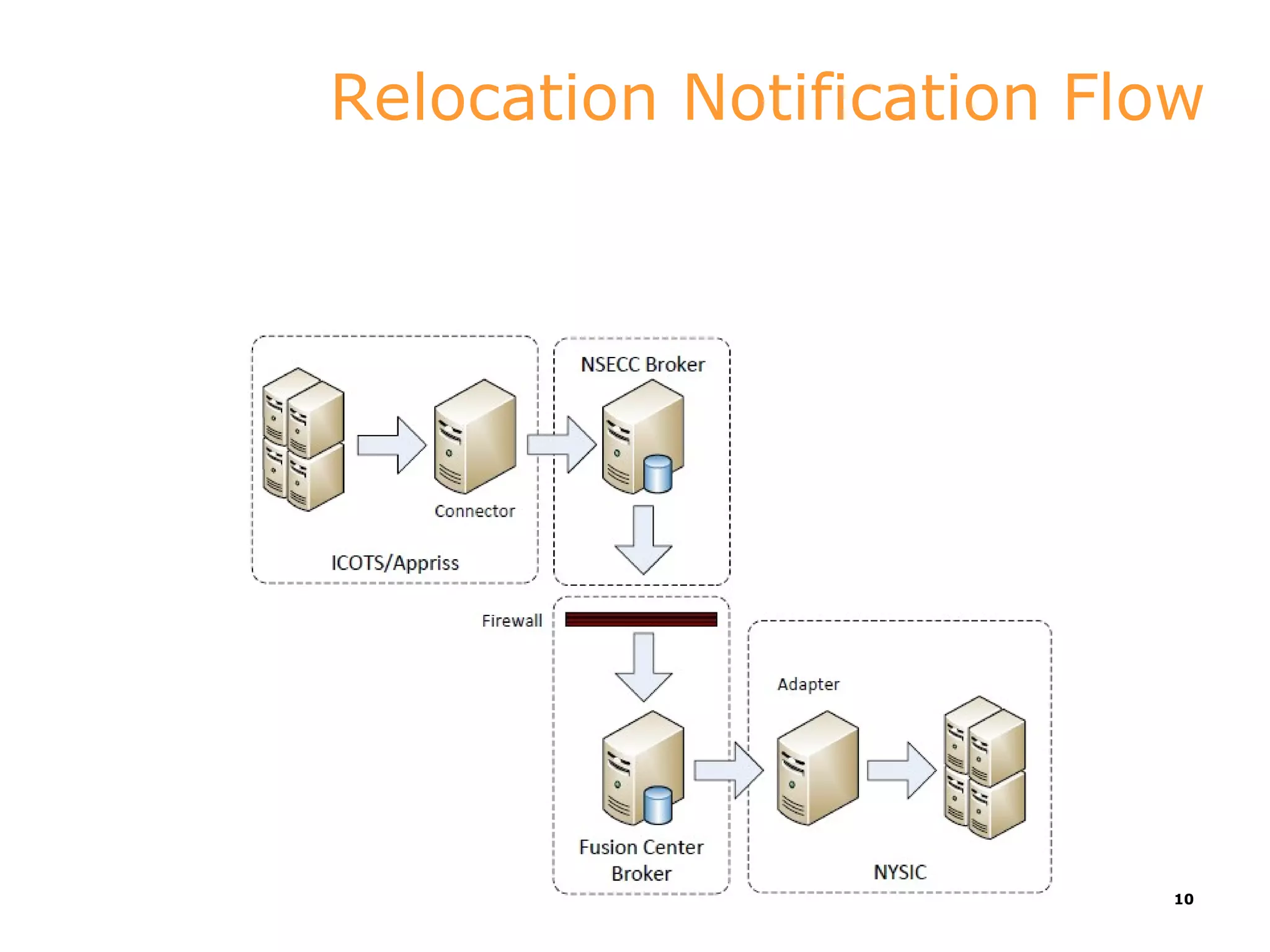
Relocation Notification Flow


                          10
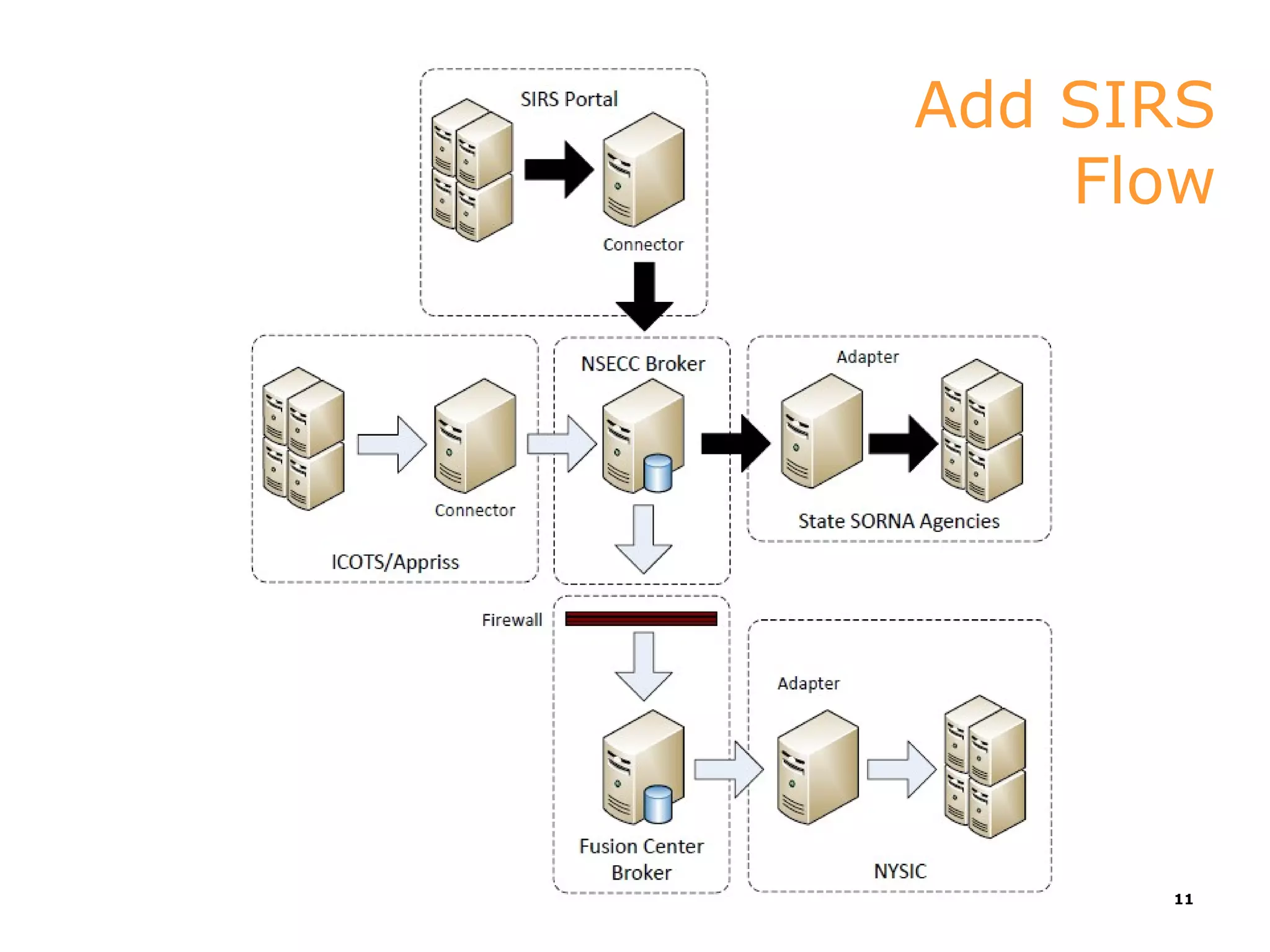
Add SIRS
    Flow


      11
Maine State Police Incident
                                       Reporting
   Business Requirements
    Incident Reports sent to N-DEx
    Case Referrals sent to Prosecutor


   Outcomes
    Single Incident Record sent by police
     agencies to FBI and/or Prosecutor


SEARCH, The National Consortium for Justice Information and Statistics | www.search.org   12
Maine State Police


                 13
HIJIS Notification of Re-arrest

   Business Requirement
    Notify probation and parole officers when
     an offender is arrested for a new offense

   Outcome
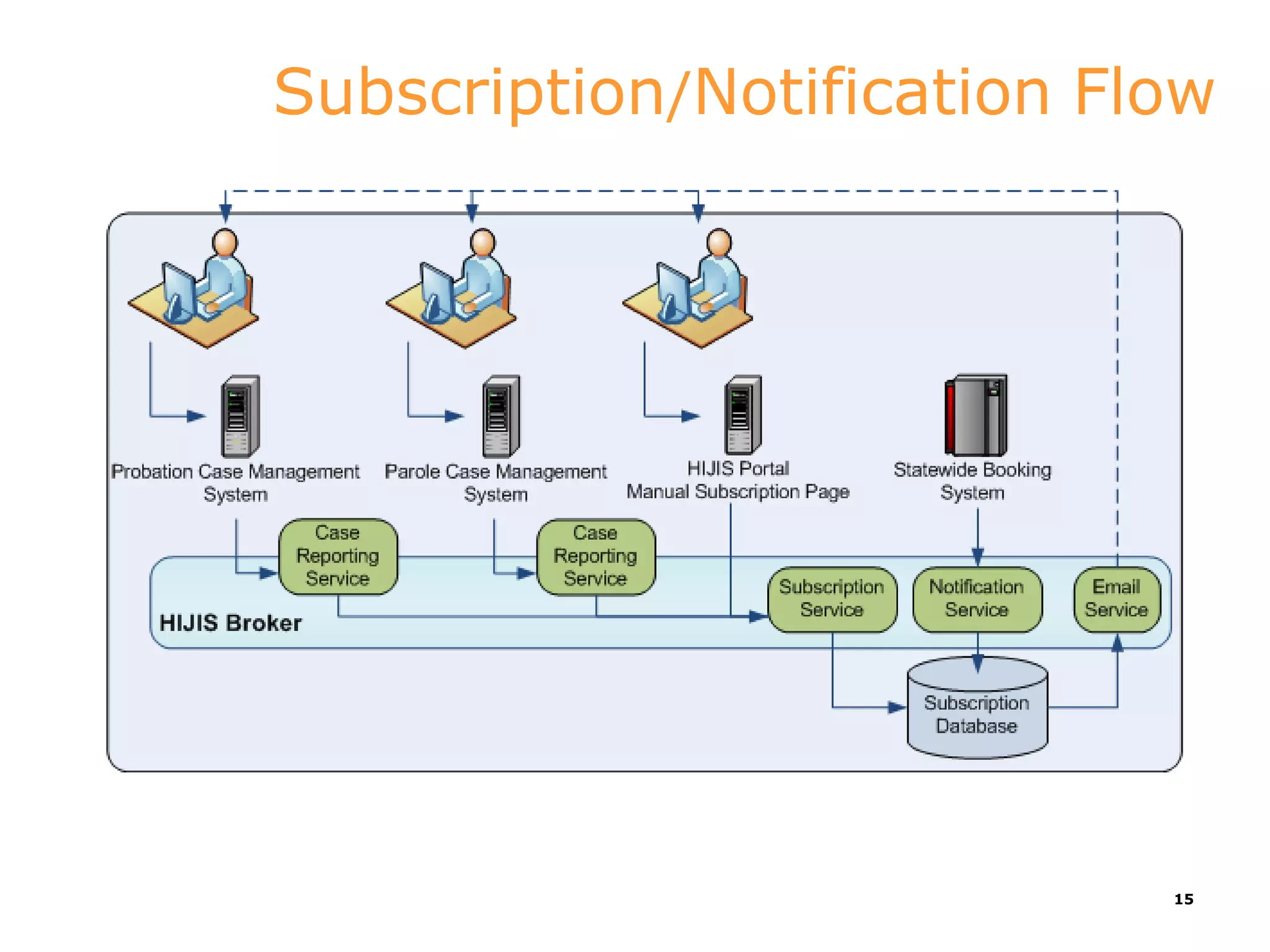
    Monitor statewide booking process and send
     a notification to parole and probation
     officers
    Subscriptions are automatically loaded from
     Parole and Probations systems


SEARCH, The National Consortium for Justice Information and Statistics | www.search.org   14
Subscription/Notification Flow


                            15
Vermont Federated Query

   Business Requirement
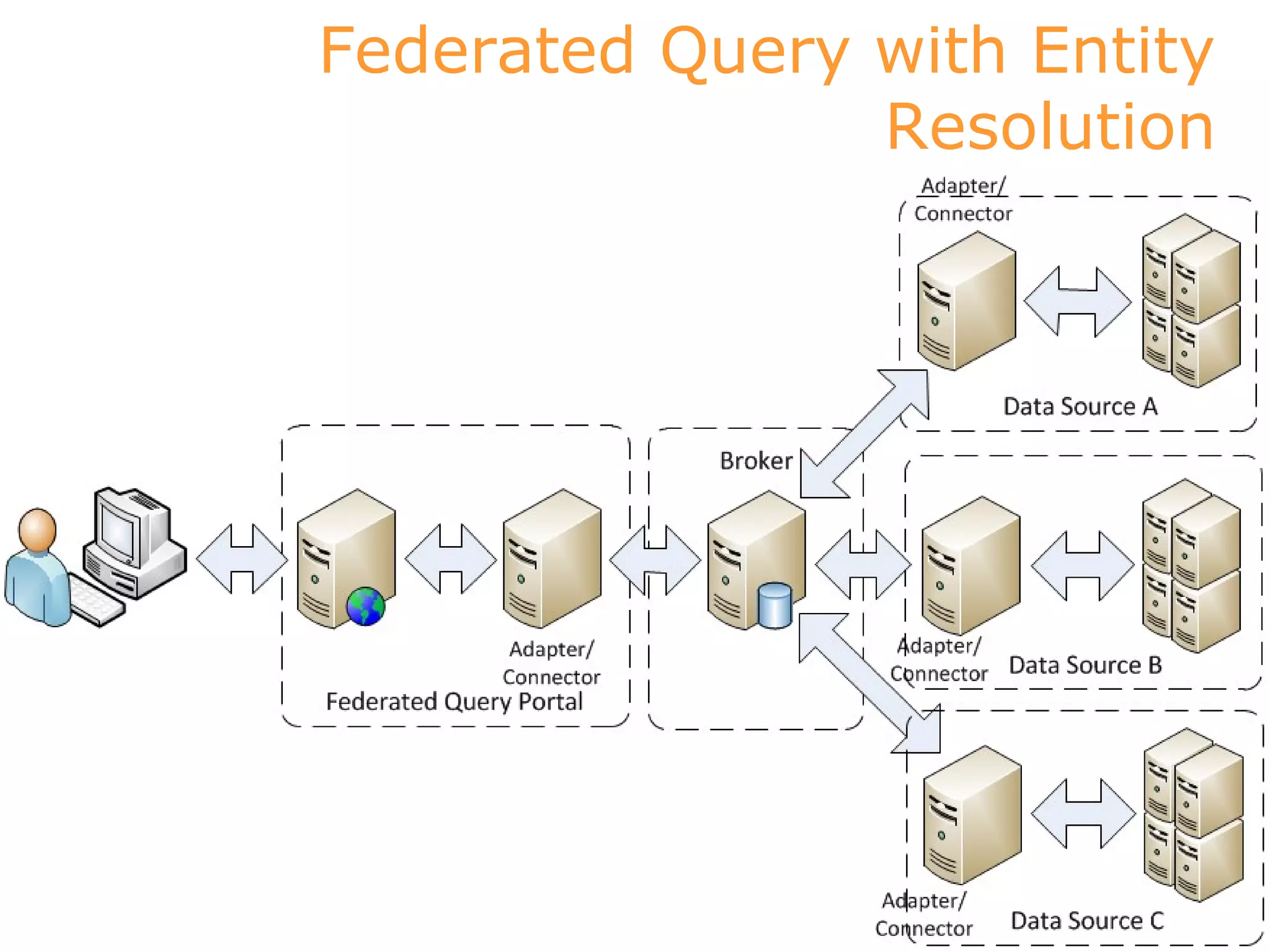
    Provide access to incident records from all
     law enforcement agencies
    Support Single Sign-On access


   Outcomes
    Enable users to access records in other
     agency RMSs using native credentials
    Implement Entity Resolution capabilities to
     merge persons or vehicles that do not have
     unique identifiers

SEARCH, The National Consortium for Justice Information and Statistics | www.search.org   16
Federated Query with Entity
                Resolution


                          17
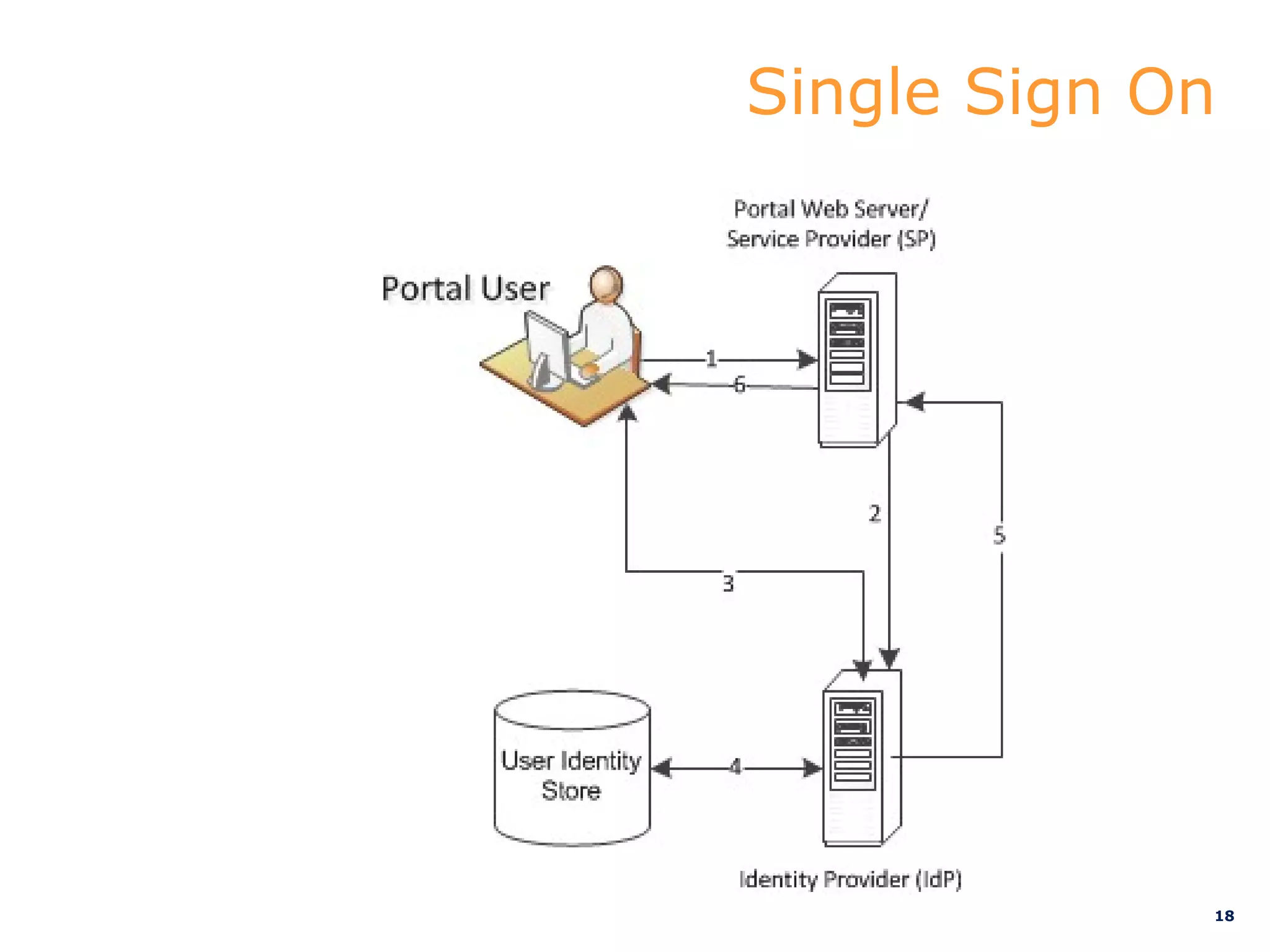
Single Sign On


             18
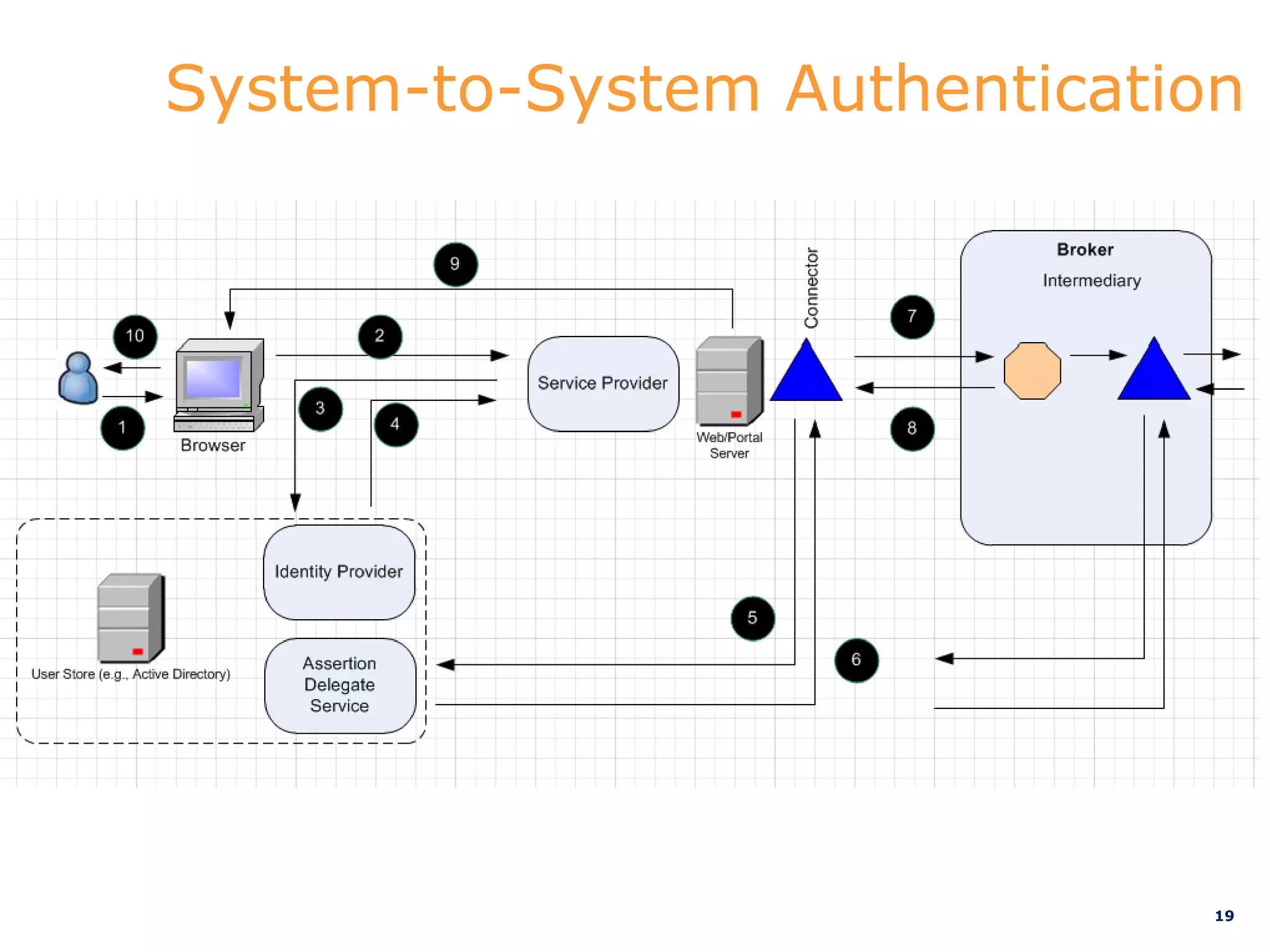
System-to-System Authentication


                              19
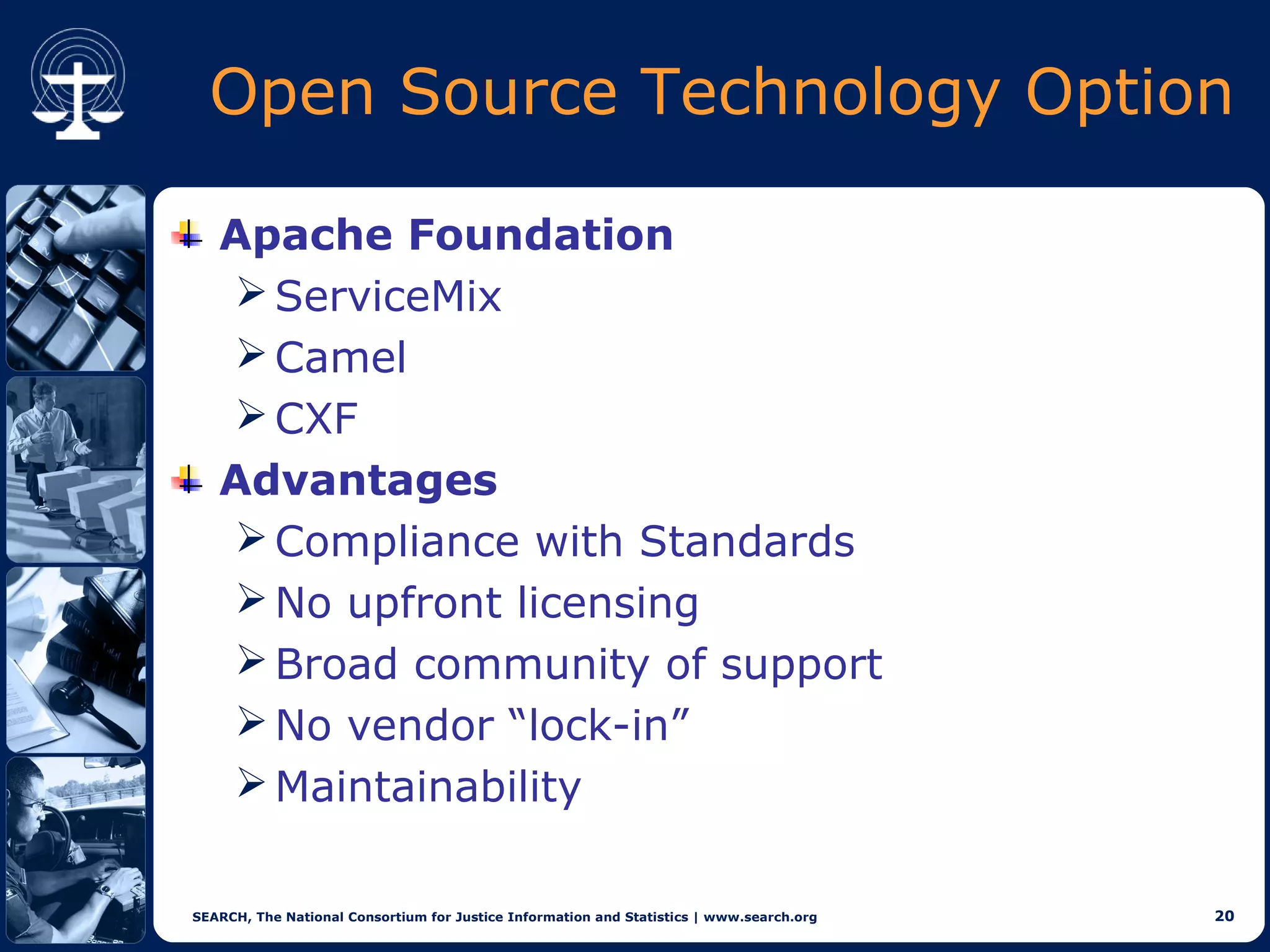
Open Source Technology Option

   Apache Foundation
    ServiceMix
    Camel
    CXF
   Advantages
    Compliance with Standards
    No upfront licensing
    Broad community of support
    No vendor “lock-in”
    Maintainability

SEARCH, The National Consortium for Justice Information and Statistics | www.search.org   20
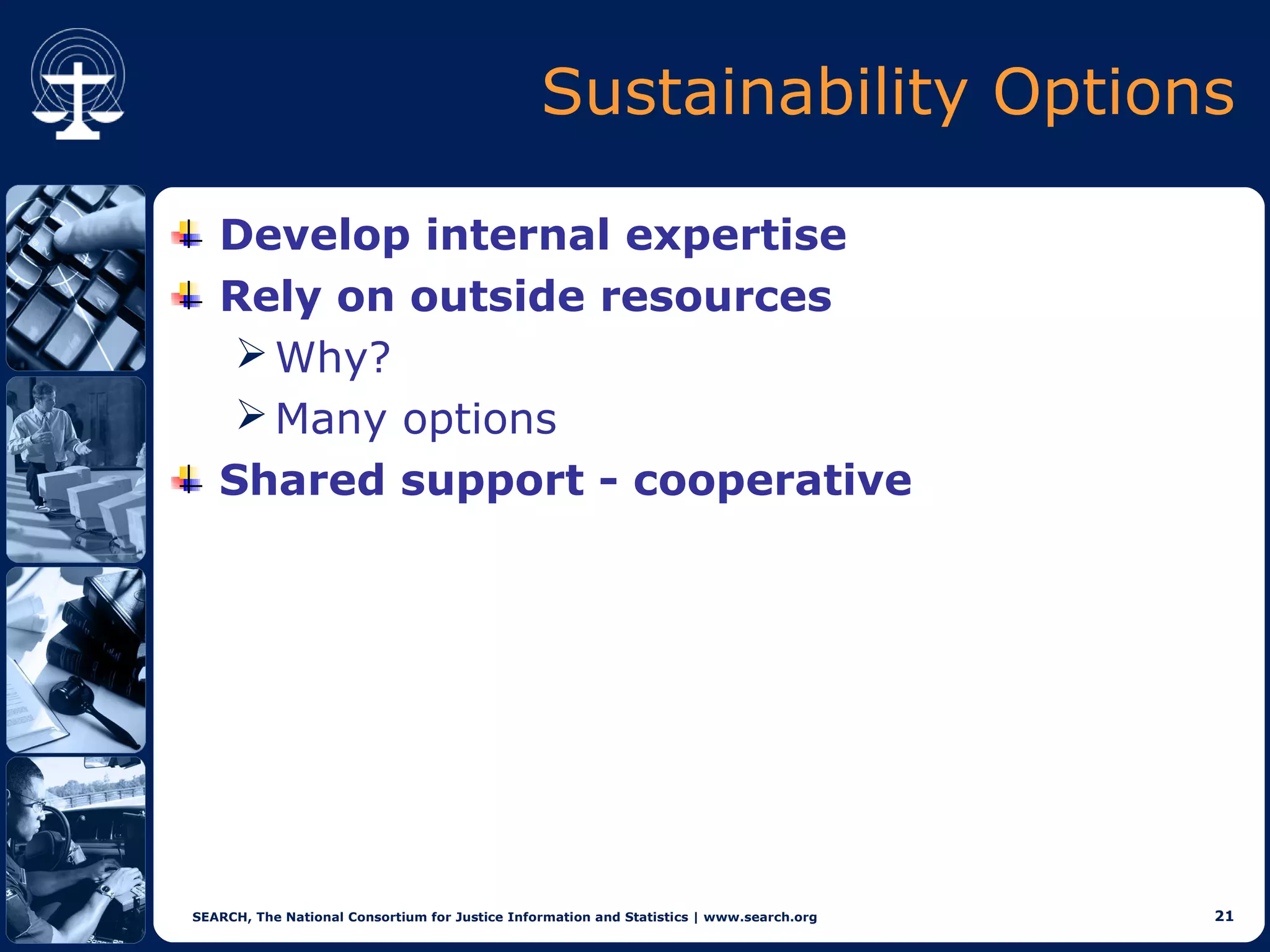
Sustainability Options

   Develop internal expertise
   Rely on outside resources
     Why?
     Many options
   Shared support - cooperative


SEARCH, The National Consortium for Justice Information and Statistics | www.search.org   21
What is the OJBC?

   Non-profit consortium of state and
   local jurisdictions to support reuse
   and sharing of technology
   States of Hawaii, Vermont and
   Maine are the initial members
   Goals of the consortium:
      Integrate contributions from member states
       into a single, reusable platform
      Provide shared expert staff resources
      Enable use of low-cost, open source
       technology
SEARCH, The National Consortium for Justice Information and Statistics | www.search.org
Benefits of the OJBC

   Commonality across states creates
   significant opportunity for reuse
      Don’t reinvent the wheel
      Learn from one another
      Save time and money
   National standards create the basis
   for a common technology platform
   Technology is powerful, but
   complex and costly to own and
   operate in isolation
   Continues a long tradition of
   collaboration among jurisdictions
SEARCH, The National Consortium for Justice Information and Statistics | www.search.org
Questions?

          “The only one thing you can always count
            on is that everything will always change”
                                                                                              - Unknown
           Contact Information

           Mark Perbix
           Director, Information Sharing Programs
           mark.perbix@search.org
           916-712-5918

           Yogesh Chawla
           Information Sharing Architecture Specialist
           Yogesh.chawla@search.org
           608-438-5965


SEARCH, The National Consortium for Justice Information and Statistics | www.search.org                   24

Gra implementations perbix_search

  • 1.
    GRA Implementations usingOpen Source Technologies Mark Perbix and Yogesh Chawla SEARCH
  • 2.
    Goals Quick review of Global Standards and Initiatives Describe projects that have adopted and successfully implemented various Global Standards Discuss advantages of using Open Source software SEARCH, The National Consortium for Justice Information and Statistics | www.search.org 2
  • 3.
    Global Standards andInitiatives Global Reference Architecture (GRA) Global Federated Identity and Privilege Management (GFIPM) Global Technical Privacy Framework SEARCH, The National Consortium for Justice Information and Statistics | www.search.org 3
  • 4.
    Global Standards andInitiatives Global Reference Architecture (GRA)  National Information Exchange Model (NIEM)  Governance – Policy and Technical Standards Global Federated Identity and Privilege Management (GFIPM)  Single Sign On  Access Control Global Technical Privacy Framework  Privacy Policy Rules Enforcement SEARCH, The National Consortium for Justice Information and Statistics | www.search.org 4
  • 5.
    Focus Global Reference Architecture (GRA)  National Information Exchange Model (NIEM)  Governance – Policy and Technical Standards Global Federated Identity and Privilege Management (GFIPM)  Single Sign On  Access Control SEARCH, The National Consortium for Justice Information and Statistics | www.search.org 5
  • 6.
    GIST - Wheredoes it all fit in? Data Messaging Architecture Access Control Authentication Federation < Data > Data Structural Design Data Disclosure User Identification Security Payload Transport & IS Enablement & Auditing & Credentialing Management Underlying WS* AD & LDAP BPEL/XSLT Technology XML TCIP/IP XACML/SAML Crypto Trust Federation ebXML Standard HTTP & HTTP/S Trust Model GRA GFIPM Global Adaptation of NIEM Standard Global Technical Privacy Framework GFIPM Metadata GFIPM Trust Model Enablement of Federation & FMO IEPDs SSPs SIPs Interoperability Definition Communication Profiles Services Manifestation in Participation in Your IEPs SP Services IdP Services Adapters & Intermediary & Federation Implementation Connectors Service Registry 6
  • 7.
    GRA - TechnicalComponents SEARCH, The National Consortium for Justice Information and Statistics | www.search.org 7
  • 8.
    GRA Implementation Projects Notification Service  Interstate Compact for Adult Offender Supervision (ICAOS)  Maine State Police Incident Reporting Subscription Notification  Hawaii Integrated Justice Information System (HIJIS) Federated Query/Response with GFIPM  Vermont Integrated Justice Information System Portal SEARCH, The National Consortium for Justice Information and Statistics | www.search.org 8
  • 9.
    ICAOS Business Requirements  Notify fusion centers (and potentially other law enforcement agencies) when a probation or parole offender relocates to another state. Outcome  Send notification through existing fusion center network infrastructure  Notifications sent from outside the fusion center environment meeting security requirements SEARCH, The National Consortium for Justice Information and Statistics | www.search.org 9
  • 10.
  • 11.
    Add SIRS Flow 11
  • 12.
    Maine State PoliceIncident Reporting Business Requirements  Incident Reports sent to N-DEx  Case Referrals sent to Prosecutor Outcomes  Single Incident Record sent by police agencies to FBI and/or Prosecutor SEARCH, The National Consortium for Justice Information and Statistics | www.search.org 12
  • 13.
  • 14.
    HIJIS Notification ofRe-arrest Business Requirement  Notify probation and parole officers when an offender is arrested for a new offense Outcome  Monitor statewide booking process and send a notification to parole and probation officers  Subscriptions are automatically loaded from Parole and Probations systems SEARCH, The National Consortium for Justice Information and Statistics | www.search.org 14
  • 15.
  • 16.
    Vermont Federated Query Business Requirement  Provide access to incident records from all law enforcement agencies  Support Single Sign-On access Outcomes  Enable users to access records in other agency RMSs using native credentials  Implement Entity Resolution capabilities to merge persons or vehicles that do not have unique identifiers SEARCH, The National Consortium for Justice Information and Statistics | www.search.org 16
  • 17.
    Federated Query withEntity Resolution 17
  • 18.
  • 19.
  • 20.
    Open Source TechnologyOption Apache Foundation  ServiceMix  Camel  CXF Advantages  Compliance with Standards  No upfront licensing  Broad community of support  No vendor “lock-in”  Maintainability SEARCH, The National Consortium for Justice Information and Statistics | www.search.org 20
  • 21.
    Sustainability Options Develop internal expertise Rely on outside resources  Why?  Many options Shared support - cooperative SEARCH, The National Consortium for Justice Information and Statistics | www.search.org 21
  • 22.
    What is theOJBC? Non-profit consortium of state and local jurisdictions to support reuse and sharing of technology States of Hawaii, Vermont and Maine are the initial members Goals of the consortium:  Integrate contributions from member states into a single, reusable platform  Provide shared expert staff resources  Enable use of low-cost, open source technology SEARCH, The National Consortium for Justice Information and Statistics | www.search.org
  • 23.
    Benefits of theOJBC Commonality across states creates significant opportunity for reuse  Don’t reinvent the wheel  Learn from one another  Save time and money National standards create the basis for a common technology platform Technology is powerful, but complex and costly to own and operate in isolation Continues a long tradition of collaboration among jurisdictions SEARCH, The National Consortium for Justice Information and Statistics | www.search.org
  • 24.
    Questions? “The only one thing you can always count on is that everything will always change” - Unknown Contact Information Mark Perbix Director, Information Sharing Programs mark.perbix@search.org 916-712-5918 Yogesh Chawla Information Sharing Architecture Specialist Yogesh.chawla@search.org 608-438-5965 SEARCH, The National Consortium for Justice Information and Statistics | www.search.org 24

Editor's Notes

  • #7 We all understand why we need to share, but what is the best way to approach it? Flexible/strong/agile vs brittle/weak/clumsy, which to choose?
  • #8 The Global Reference Architecture (GRA) identifies a small but significant set of infrastructure components that are core to any GRA implementation. These components include:   Adapters: Components that implement the “provider” side of a service interaction, typically by receiving messages and interacting with a service provider agency’s internal systems or business processes. Connectors: Components that implement the “consumer” side of a service interaction, typically by observing data changes or “triggers” in a consumer agency’s internal systems or business processes, and initiating a message transmission to a service provider. Intermediaries: Special adapters that “mediate” information exchanges between participating organizations, performing such operations as transformations, routing, validation, and message aggregation; intermediaries reside on a broker, which exists in a “common space” between the partner organizations.   The communication between these components must adhere to the GRA Service Interaction Profiles (SIPs), which in practice means that interactions must be via standards-conformant Web Services protocols.
  • #20 1. User requests access to web application, hosted on the “Web Portal Server”, via a web browser. 2. Web browser redirects the user’s HTTP request to the Service Provider for the Web Portal Server. 3. If the Service Provider does not have a session for the user, it redirects the user’s web browser to the user’s Identity Provider, which prompts the user to authenticate. Note that the Identity Provider is the sole place in the HIJIS environment where the user’s credentials are maintained; this will generally be at the user’s home agency. 4. Following authentication, the Identity Provider forms an assertion for the user and redirects the user’s web browser back to the Service Provider. The redirected HTTP request contains the assertion in an HTTP header. The Service Provider forms a session for the user, and redirects the user’s web browser back to the originally requested web application page. 5. The web application, which contains a Connector, forms a WS-Trust Request Security Token Request (RSTR) and sends the request to a GFIPM Assertion Delegate Service (ADS). An ADS is a special-purpose WS-Trust Security Token Service (STS), defined by GFIPM. The RSTR contains the original assertion obtained at the IdP in step 3. 6. The ADS forms a new SAML assertion and sends it back to the Connector. 7. The Connector includes the new SAML assertion in its web service message to the Intermediary. 8. The intermediary services the web service request and returns a response. 9. The web application returns the web page to the user’s web browser 10. The user’s web browser displays the web page to the user
  • #22 Why? Limited amount of work needed to support GRA components Many options – open source software is supported by many vendors and service providers – avoids vendor lock-in.