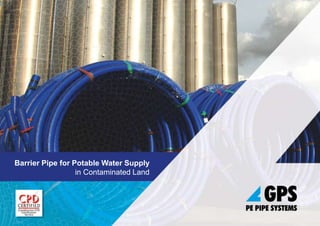
Barrier Pipe for Potable Water Supply
in Contaminated Land
The presentation should provideThe aim of this CPD is to
An introduction to Barrier Pipes
The presentation aims to deliver
informand educate
designers, specifiers, users and installers
on the features and benefits of
BARRIER PIPES.
a number of learning objectives
supported by case studies and concluding
with a very brief insight into GPS.
options
What is Barrier Pipe? Types Testing Usage Considerations Pipe Selection Why should Barrier Pipe be used?
to the owner, users and installer when designing and
specifying pipe systems for contaminated land.
 Further information
In this presentation we will cover…
 What is Barrier Pipe
 Types of Barrier Pipe
 When should Barrier Pipe be used?
 Why should Barrier Pipe be used?
 Jointing Methods
 Barrier Pipe Characteristics
 Standards & Approvals
 Applications & Case studies
 Barrier Pipe System
What is Barrier Pipe? Types Testing Usage Considerations Pipe Selection Why should Barrier Pipe be used?
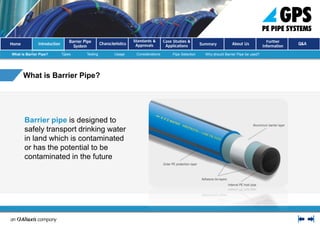
What is Barrier Pipe?
Barrier pipe is designed to
safely transport drinking water
in land which is contaminated
or has the potential to be
contaminated in the future
What is Barrier Pipe? Types Testing Usage Considerations Pipe Selection Why should Barrier Pipe be used?
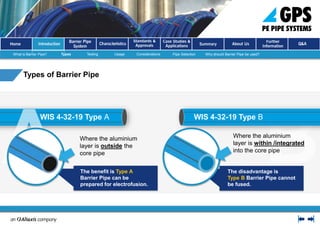
Types of Barrier Pipe
WIS 4-32-19 Type A WIS 4-32-19 Type B
Where the aluminium
layer is outside the
core pipe
Where the aluminium
layer is within /integrated
into the core pipe
The disadvantage is
Type B Barrier Pipe cannot
be fused.
The benefit is Type A
Barrier Pipe can be
prepared for electrofusion.
What is Barrier Pipe? Types Testing Usage Considerations Pipe Selection Why should Barrier Pipe be used?
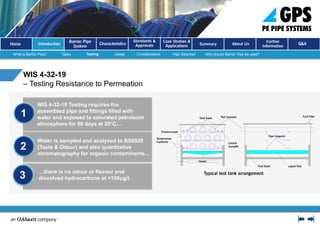
WIS 4-32-19 Testing requires the
assembled pipe and fittings filled with
water and exposed to saturated petroleum
atmosphere for 60 days at 20°C…
Water is sampled and analysed to BS6920
(Taste & Odour) and also quantitative
chromatography for organic contaminants…
…there is no odour or flavour and
dissolved hydrocarbons at <100μg/l.
WIS 4-32-19
– Testing Resistance to Permeation
1
2
3
What is Barrier Pipe? Types Testing Usage Considerations Pipe Selection Why should Barrier Pipe be used?
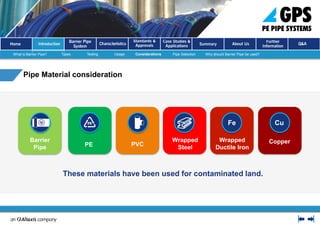
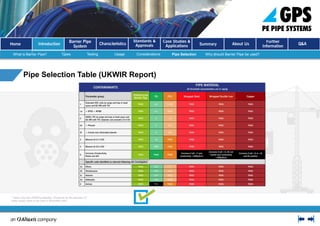
Pipe Material consideration
Barrier
Pipe
These materials have been used for contaminated land.
PE Copper
Cu
Wrapped
Ductile Iron
Fe
PVC
Wrapped
Steel
What is Barrier Pipe? Types Testing Usage Considerations Pipe Selection Why should Barrier Pipe be used?
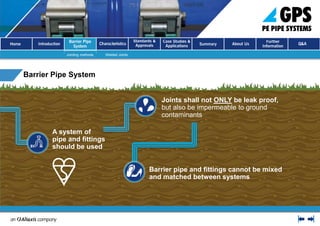
Barrier Pipe System
Barrier pipe and fittings cannot be mixed
and matched between systems
A system of
pipe and fittings
should be used
Joints shall not ONLY be leak proof,
but also be impermeable to ground
contaminants
Jointing methods Welded Joints
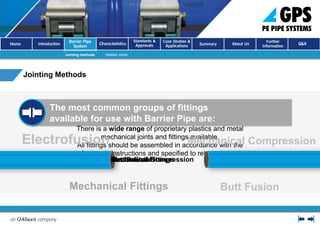
Electrofusion Butt Fusion
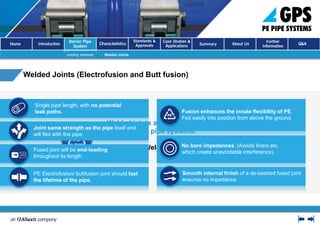
Welded Joints (Electrofusion and Butt Fusion)
Jointing methods Welded Joints
Characteristics
Tough and strong: Based upon the service
performance of PE100 pipe since its introduction in
the UK, a service life in excess of 100 years may
confidently be expected. Full end loading: thrust backs and
anchorages NOT necessary
Lightweight: easier to manage on
through the project lifecycle
Flexible: inherent flexibility decreases
failure rates and increases versatility
Complete barrier protection: PE-AL pipes
are suitable for using under all conditions.
Resistance to corrosion: PE pipes don’t RUST,
ROT, PIT, CORRODE or lose wall thickness
Prevention from future contamination:
Negates the risk of future contamination
Case Studies & Applications
Customers can trust our Barrier Pipe
Systems to help them achieve the required
water supply service targets for water quality,
continuity of supply and leakage rate.
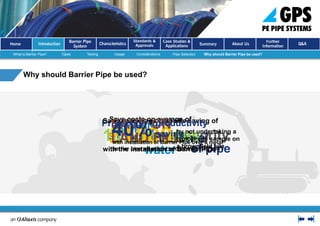
 Superior Barrier Performance
 Ease of installation
 Fully Kitemarked system
 Reduced overall costs
 Lifetime of service
Ensures water
quality and
structural
integrity of
pipes
Make savings by
not undertaking site
investigation and
replacing or
repairing pipework
Protection
against all
contaminants
With an
expected lifetime
of 100 years
Lightweight and
flexible
– requires only a
narrow trench for
rapid installation
Summary
Who we are – GPS locally
35,000
Tonne Capacity
16mm - 1200mm
Diameter
Turnover of
£65 million
Operating for over
50 years
Market Share
(approx of PE Pipe Systems)
Extrusion lines
17
Part of the Aliaxis Group
Overall
43%
Water
56%
Gas
41%

GPS Protecta Line 2016_cpd

  • 1.
    Barrier Pipe forPotable Water Supply in Contaminated Land
  • 2.
    The presentation shouldprovideThe aim of this CPD is to An introduction to Barrier Pipes The presentation aims to deliver informand educate designers, specifiers, users and installers on the features and benefits of BARRIER PIPES. a number of learning objectives supported by case studies and concluding with a very brief insight into GPS. options What is Barrier Pipe? Types Testing Usage Considerations Pipe Selection Why should Barrier Pipe be used? to the owner, users and installer when designing and specifying pipe systems for contaminated land.
  • 3.
     Further information Inthis presentation we will cover…  What is Barrier Pipe  Types of Barrier Pipe  When should Barrier Pipe be used?  Why should Barrier Pipe be used?  Jointing Methods  Barrier Pipe Characteristics  Standards & Approvals  Applications & Case studies  Barrier Pipe System What is Barrier Pipe? Types Testing Usage Considerations Pipe Selection Why should Barrier Pipe be used?
  • 4.
    What is BarrierPipe? Barrier pipe is designed to safely transport drinking water in land which is contaminated or has the potential to be contaminated in the future What is Barrier Pipe? Types Testing Usage Considerations Pipe Selection Why should Barrier Pipe be used?
  • 5.
    Types of BarrierPipe WIS 4-32-19 Type A WIS 4-32-19 Type B Where the aluminium layer is outside the core pipe Where the aluminium layer is within /integrated into the core pipe The disadvantage is Type B Barrier Pipe cannot be fused. The benefit is Type A Barrier Pipe can be prepared for electrofusion. What is Barrier Pipe? Types Testing Usage Considerations Pipe Selection Why should Barrier Pipe be used?
  • 6.
    WIS 4-32-19 Testingrequires the assembled pipe and fittings filled with water and exposed to saturated petroleum atmosphere for 60 days at 20°C… Water is sampled and analysed to BS6920 (Taste & Odour) and also quantitative chromatography for organic contaminants… …there is no odour or flavour and dissolved hydrocarbons at <100μg/l. WIS 4-32-19 – Testing Resistance to Permeation 1 2 3 What is Barrier Pipe? Types Testing Usage Considerations Pipe Selection Why should Barrier Pipe be used?
  • 7.
    Pipe Material consideration Barrier Pipe Thesematerials have been used for contaminated land. PE Copper Cu Wrapped Ductile Iron Fe PVC Wrapped Steel What is Barrier Pipe? Types Testing Usage Considerations Pipe Selection Why should Barrier Pipe be used?
  • 8.
    Barrier Pipe System Barrierpipe and fittings cannot be mixed and matched between systems A system of pipe and fittings should be used Joints shall not ONLY be leak proof, but also be impermeable to ground contaminants Jointing methods Welded Joints
  • 9.
    Electrofusion Butt Fusion WeldedJoints (Electrofusion and Butt Fusion) Jointing methods Welded Joints
  • 10.
    Characteristics Tough and strong:Based upon the service performance of PE100 pipe since its introduction in the UK, a service life in excess of 100 years may confidently be expected. Full end loading: thrust backs and anchorages NOT necessary Lightweight: easier to manage on through the project lifecycle Flexible: inherent flexibility decreases failure rates and increases versatility Complete barrier protection: PE-AL pipes are suitable for using under all conditions. Resistance to corrosion: PE pipes don’t RUST, ROT, PIT, CORRODE or lose wall thickness Prevention from future contamination: Negates the risk of future contamination
  • 11.
    Case Studies &Applications Customers can trust our Barrier Pipe Systems to help them achieve the required water supply service targets for water quality, continuity of supply and leakage rate.
  • 12.
     Superior BarrierPerformance  Ease of installation  Fully Kitemarked system  Reduced overall costs  Lifetime of service Ensures water quality and structural integrity of pipes Make savings by not undertaking site investigation and replacing or repairing pipework Protection against all contaminants With an expected lifetime of 100 years Lightweight and flexible – requires only a narrow trench for rapid installation Summary
  • 13.
    Who we are– GPS locally 35,000 Tonne Capacity 16mm - 1200mm Diameter Turnover of £65 million Operating for over 50 years Market Share (approx of PE Pipe Systems) Extrusion lines 17 Part of the Aliaxis Group Overall 43% Water 56% Gas 41%