CTE 216
INTERNET TECHNOLOGY
Mr. ABDULHAMEED, I.A.
Course Content
 LECTURE 1: Internet history
 LECTURE 2: ARPANET
 LECTURE 3: NSFNET
 LECTURE 4: MILNET and DATA COMMUNICATION
 LECTURE 5: INTRANET, INTERNET, EXTRANET
 LECTURE 6: INTERNET SERVICES – FTP, EMAIL, Bulletin Board System and so on
 LECTURE 7: DATA TRANSSMISISON
 LECTURE 8: GUIDED MEDIA and network topologies
 LECTURE 9: UNGUIDED MEDIA and ISP
 LECTURE 10: LOCAL AREA NETWORK
 LECTURE 11: WIRED AREA NETWORK
 LECTURE 12: METROPOLITAN AREA NETWORK
 LECTURE 13: TOKEN RING, PEER-TO-PEER NETWORK
 LECTURE 14: NETWORK TOPOLOGIES
 LECTURE 15: CHALLENGES AFFECTING INTERNET GROWTH IN NIGERIA
Course Outcome
At the end of this course, you will be able to:
 Understand concepts of internet history, the BBN, ARPANET.
NSFNET, USENET.
 understand LAN,WAN, MAN
 Know the challenges facing internet in Nigeria
 Identify an ISP (Internet Service Provider)
 Know data transmission media
 Understand the network topologies
Internet History?
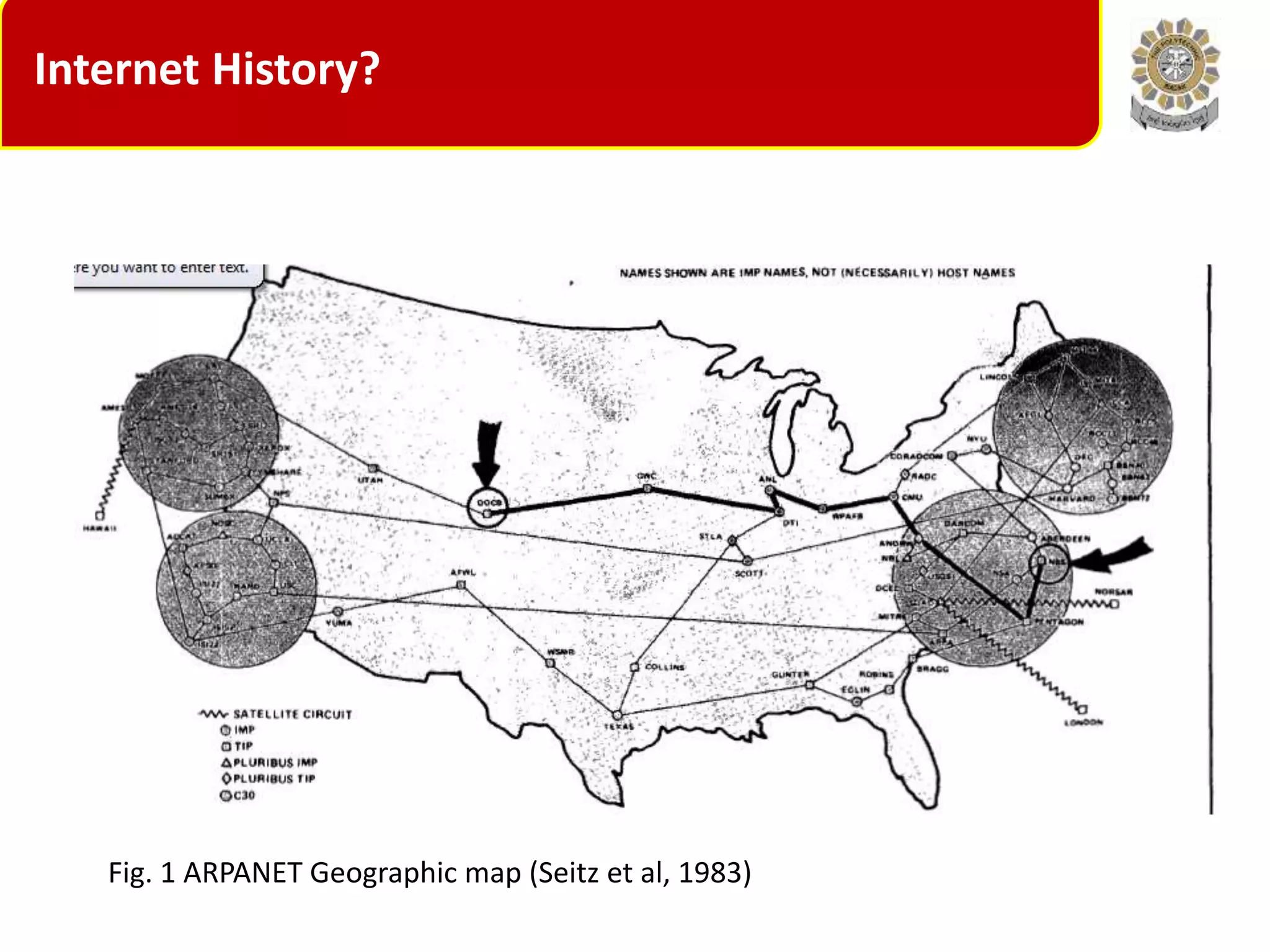
Fig. 1 ARPANET Geographic map (Seitz et al, 1983)
• The first scientific revolution was that of Nicolaus
Copernicus (1473–1543)
• He was the first astronomer to formulate a
scientifically-based heliocentric cosmology that
displaced the Earth and hence humanity from the
center of the universe.
• The second was Charles Darwin (1809–1882),
who showed that all species of life have evolved
over time from common ancestors through
natural selection
• On October 4, 1957, the Soviet Union
launched the first space satellite, Sputnik.
• The Sputnik success necessitated American
reaction.
• The US Department of Defense responded by
establishing the Advanced Research Projects
Agency (ARPA, 2004) cited by Raphael (2011)
Internet History cnt’d
• Dr. L.G. Roberts of the Advanced Research
Projects Agency (ARPA) proposed the
development of a new experimental computer
network
• The purpose of the network was to
interconnect the computers resources at
various research centres (Seitz et al, 1983)
THE ARPANET
 It is conceptually divided into two parts:
 The subnetwork
 The hosts
• The history of the Internet started in the United
States in the early 1960s.
• This was the Cold War period, when the world
was bi-polar: The United States and the Soviet
Union were competing in expanding their
influence in the world, viewing each other with
great caution and suspicion (Raphael, 2011)
• BBN: Bolt Beranek and Newman, a company who
played a major role in creating the Internet, which was
founded in 1948 as consulting company. Richard Bolt
and Leo Beranek were acousticians from MIT who did
private consulting on buildings around the country. To
read more, visit
http://www.securenet.net/members/shartley/history/
bbn_the_beginning.htm
NSFNET
• The National Science Foundation Network was
a program of coordinated, evolving projects
sponsored by the National Science Foundation
from 1985 to 1995 to promote advanced
research and education networking in the
United States.
• The program created several nationwide
backbone computer networks in support of
these initiatives (Wikipedia, 2020)
USENET
• A worldwide distributed discussion system
available on computers.
• It was developed from the general-purpose Unix-
to-Unix Copy dial-up network architecture. Tom
Truscott and Jim Ellis conceived the idea in 1979,
and it was established in 1980.
• Users read and post messages to one or more
categories, known as newsgroups. Usenet
resembles a bulletin board system in many
respects and is the precursor to Internet forums
that are widely used today.
MILNET
• MILNET (Military Network) was the name given
to the part of the ARPANET internetwork
designated for unclassified United States
Department of Defense traffic.
• It was physically separated from the ARPANET in
1983.
• The ARPANET remained in service for the
academic research community, but direct
connectivity between the networks was severed
for security reasons (Wikipedia, 2020)
Review Questions
1. Explain the role of Dr. L.G. Roberts on the
Internet
2. What do you understand by ARPANET?
3. What role did BBN, USENET,NSFNET and
MILNET play on the net?
4. Differentiate between, internet, intranet
and extranet
ANY QUESTION?
Internet
technology
END OF
NOTE

Cte216 slides

  • 1.
  • 2.
    Course Content  LECTURE1: Internet history  LECTURE 2: ARPANET  LECTURE 3: NSFNET  LECTURE 4: MILNET and DATA COMMUNICATION  LECTURE 5: INTRANET, INTERNET, EXTRANET  LECTURE 6: INTERNET SERVICES – FTP, EMAIL, Bulletin Board System and so on  LECTURE 7: DATA TRANSSMISISON  LECTURE 8: GUIDED MEDIA and network topologies  LECTURE 9: UNGUIDED MEDIA and ISP  LECTURE 10: LOCAL AREA NETWORK  LECTURE 11: WIRED AREA NETWORK  LECTURE 12: METROPOLITAN AREA NETWORK  LECTURE 13: TOKEN RING, PEER-TO-PEER NETWORK  LECTURE 14: NETWORK TOPOLOGIES  LECTURE 15: CHALLENGES AFFECTING INTERNET GROWTH IN NIGERIA
  • 3.
    Course Outcome At theend of this course, you will be able to:  Understand concepts of internet history, the BBN, ARPANET. NSFNET, USENET.  understand LAN,WAN, MAN  Know the challenges facing internet in Nigeria  Identify an ISP (Internet Service Provider)  Know data transmission media  Understand the network topologies
  • 4.
    Internet History? Fig. 1ARPANET Geographic map (Seitz et al, 1983)
  • 5.
    • The firstscientific revolution was that of Nicolaus Copernicus (1473–1543) • He was the first astronomer to formulate a scientifically-based heliocentric cosmology that displaced the Earth and hence humanity from the center of the universe. • The second was Charles Darwin (1809–1882), who showed that all species of life have evolved over time from common ancestors through natural selection
  • 6.
    • On October4, 1957, the Soviet Union launched the first space satellite, Sputnik. • The Sputnik success necessitated American reaction. • The US Department of Defense responded by establishing the Advanced Research Projects Agency (ARPA, 2004) cited by Raphael (2011)
  • 7.
    Internet History cnt’d •Dr. L.G. Roberts of the Advanced Research Projects Agency (ARPA) proposed the development of a new experimental computer network • The purpose of the network was to interconnect the computers resources at various research centres (Seitz et al, 1983)
  • 8.
    THE ARPANET  Itis conceptually divided into two parts:  The subnetwork  The hosts
  • 9.
    • The historyof the Internet started in the United States in the early 1960s. • This was the Cold War period, when the world was bi-polar: The United States and the Soviet Union were competing in expanding their influence in the world, viewing each other with great caution and suspicion (Raphael, 2011)
  • 10.
    • BBN: BoltBeranek and Newman, a company who played a major role in creating the Internet, which was founded in 1948 as consulting company. Richard Bolt and Leo Beranek were acousticians from MIT who did private consulting on buildings around the country. To read more, visit http://www.securenet.net/members/shartley/history/ bbn_the_beginning.htm
  • 11.
    NSFNET • The NationalScience Foundation Network was a program of coordinated, evolving projects sponsored by the National Science Foundation from 1985 to 1995 to promote advanced research and education networking in the United States. • The program created several nationwide backbone computer networks in support of these initiatives (Wikipedia, 2020)
  • 12.
    USENET • A worldwidedistributed discussion system available on computers. • It was developed from the general-purpose Unix- to-Unix Copy dial-up network architecture. Tom Truscott and Jim Ellis conceived the idea in 1979, and it was established in 1980. • Users read and post messages to one or more categories, known as newsgroups. Usenet resembles a bulletin board system in many respects and is the precursor to Internet forums that are widely used today.
  • 13.
    MILNET • MILNET (MilitaryNetwork) was the name given to the part of the ARPANET internetwork designated for unclassified United States Department of Defense traffic. • It was physically separated from the ARPANET in 1983. • The ARPANET remained in service for the academic research community, but direct connectivity between the networks was severed for security reasons (Wikipedia, 2020)
  • 14.
    Review Questions 1. Explainthe role of Dr. L.G. Roberts on the Internet 2. What do you understand by ARPANET? 3. What role did BBN, USENET,NSFNET and MILNET play on the net? 4. Differentiate between, internet, intranet and extranet ANY QUESTION?
  • 15.

Editor's Notes

  • #3 Recommended textbooks:
  • #5 Seitz, N.B., Wortendyke, D.R. and Spies, K.P. (1983) User-Oriented Performance Measurements, IEEE Communications Magazine
  • #7 ARPA (DARPA). (2004). Velocity guide. Retrieved from http://www.velocityguide.com/internet-history/ arpa-darpa.html Raphael, C-A. (2011) Internet History, International Journal of Technoethics, 2(2), 45-64, April-June 2011
  • #11 Kirsty, H. (2019) What Is A Database? COMPUTERS AND <CODING>, KidHaven PUBLISHING, USA
  • #12 Nsfnet (2020) NSFNET, retrieved from https://en.wikipedia.org/wiki/National_Science_Foundation_Network
  • #13 Wikipedia (2020) USENET, retrieved from https://en.wikipedia.org/wiki/Usenet on 22nd April 2020
  • #14 Wikipedia (2020) What is MILNET? Retrieved from https://en.wikipedia.org/wiki/MILNET on April 22 2020