Accounting for
Local
Government
Units
CJVM21
Basic Features and Policy
1. Accrual Accounting
2. One Fund Concept
3. Special Accounts in the General Fund
4. Chart of Accounts and Accounts Code
5. Books of Accounts
• Journals
1. Cash Receipt Journal
2. Cash Disbursement Journal
3. Check Disbursement Journal
4. General JournalCJVM21
Ledgers
1. General Ledgers
2. Subsidiary ledgers
• Cash
• Receivables
• Inventories
• Investment
• Property plant and equipment
• Liabilities
• Income
• Expenses
Additional Book
1. Cash Book – Cash in Treasury
2. Cash Book- Cash in Bank
3. Cash Book – Cash Advances
CJVM21
6. Financial Statements
7. Appropriations, Allotments and Obligations
8. Financial Expenses
9. Perpetual Inventory and Supplies
10. Valuation of Inventory
11. Maintenance of Supplies and Property Plant
and Equipment Ledger Cards
12. Construction of Assets
13. Public Infrastructures
CJVM21
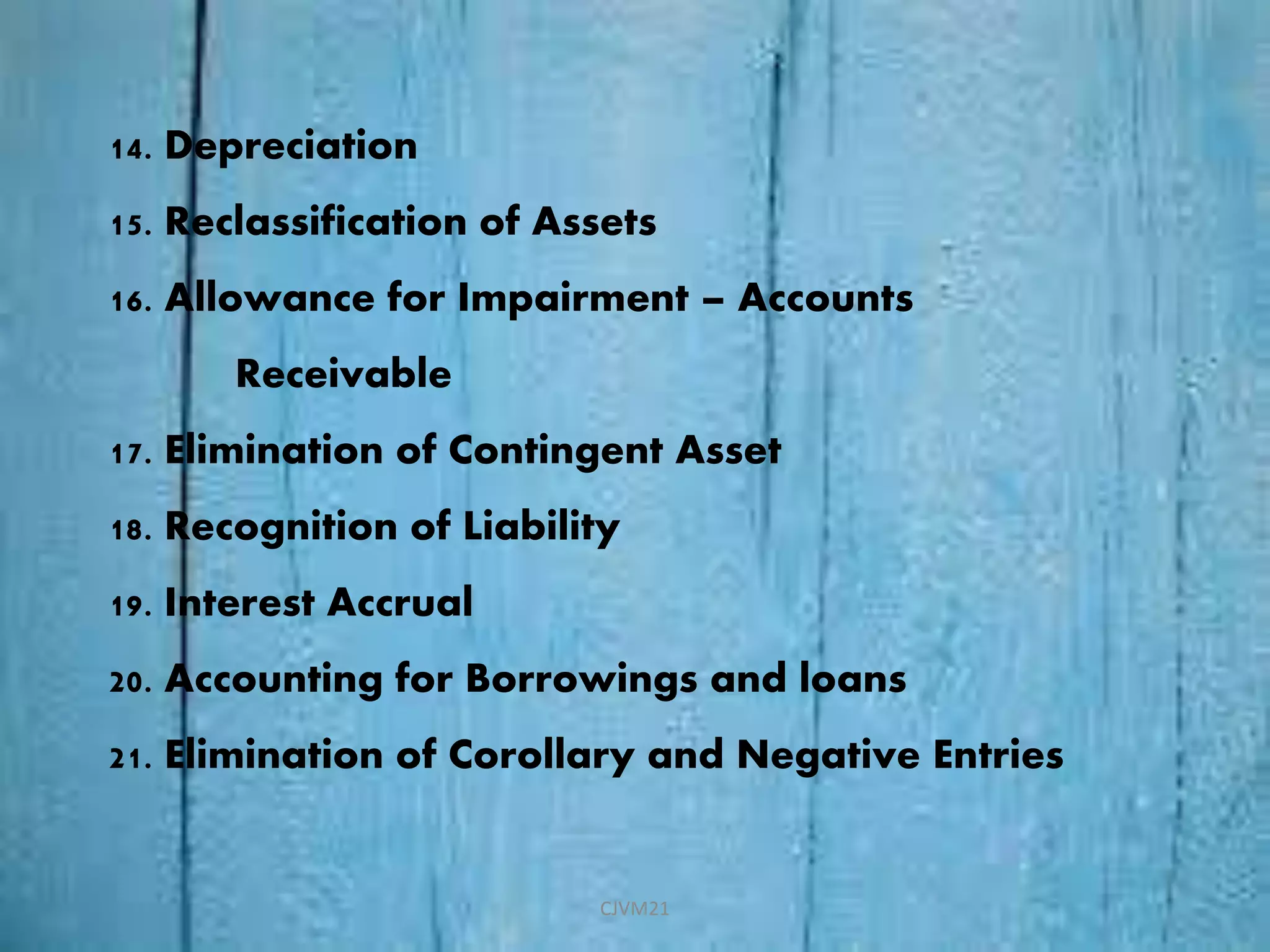
14. Depreciation
15. Reclassification of Assets
16. Allowance for Impairment – Accounts
Receivable
17. Elimination of Contingent Asset
18. Recognition of Liability
19. Interest Accrual
20. Accounting for Borrowings and loans
21. Elimination of Corollary and Negative Entries
CJVM21
FORMS AND CONTENT OF BUDGET
The local government budget primarily consist of
two parts namely:
1. The estimates of Income certified collectible by the
treasurer; and
2. The total appropriation covering the current
operating expenditures and capital outlays.
CJVM21
THE BUDGET PROCESS
1. Preparation
2. Legislative authorization
3. Execution and Accountability
CJVM21
Changes in Annual Budget
-may be made within the fiscal year by way of
supplemental budget
Failure to Enact an Annual Budget
-whenever the local legislative fails to pass an
annual budget or when an enacted budget is declared
unenforceable, the annual appropriations are deemed re
–enacted.
Budgetary Accounting
-similar to the national government, the
budgetary accounting of the local government units are
composed of the following:
- Appropriations
- Allotments
- Obligations
CJVM21
SOURCES OF INCOME
- the main sources of income of local government units are
as follows:
• Tax Revenues, fees and charges
• Share from Internal Revenue Collection
• Share from National Wealth
GENERAL INCOME ACCOUNTS
1. Subsidy from other local government units
2. Subsidy from other funds
3. Subsidy from special account
4. Sales revenue
5. Dividend revenue
6. Interest income
7. Gain on sale on securities
8. Gain on sale on assets
9. Sale of confiscated goods and properties
CJVM21
10. Foreign Exchange Gains
11. Miscellaneous operating and
service income
12. Fines and penalties- government
service and business operations
13. Income from grants and
donations
SPECIAL INCOME ACCOUNTS
1. Property taxes
2. Taxes on goods and services
3. Other taxes
4. Other specific income
CJVM21
METHODS OF ACCOUNTING FOR INCOME
1. Accrual method
Illustration 1
- Received notice of Funding check issued from
the Department of Budget and Management, together with
credit memo from the bank for the share from internal
revenue collections in amount of P100,000
Cash in Bank 100000
Internal Revenue Allotment 100000
CJVM21
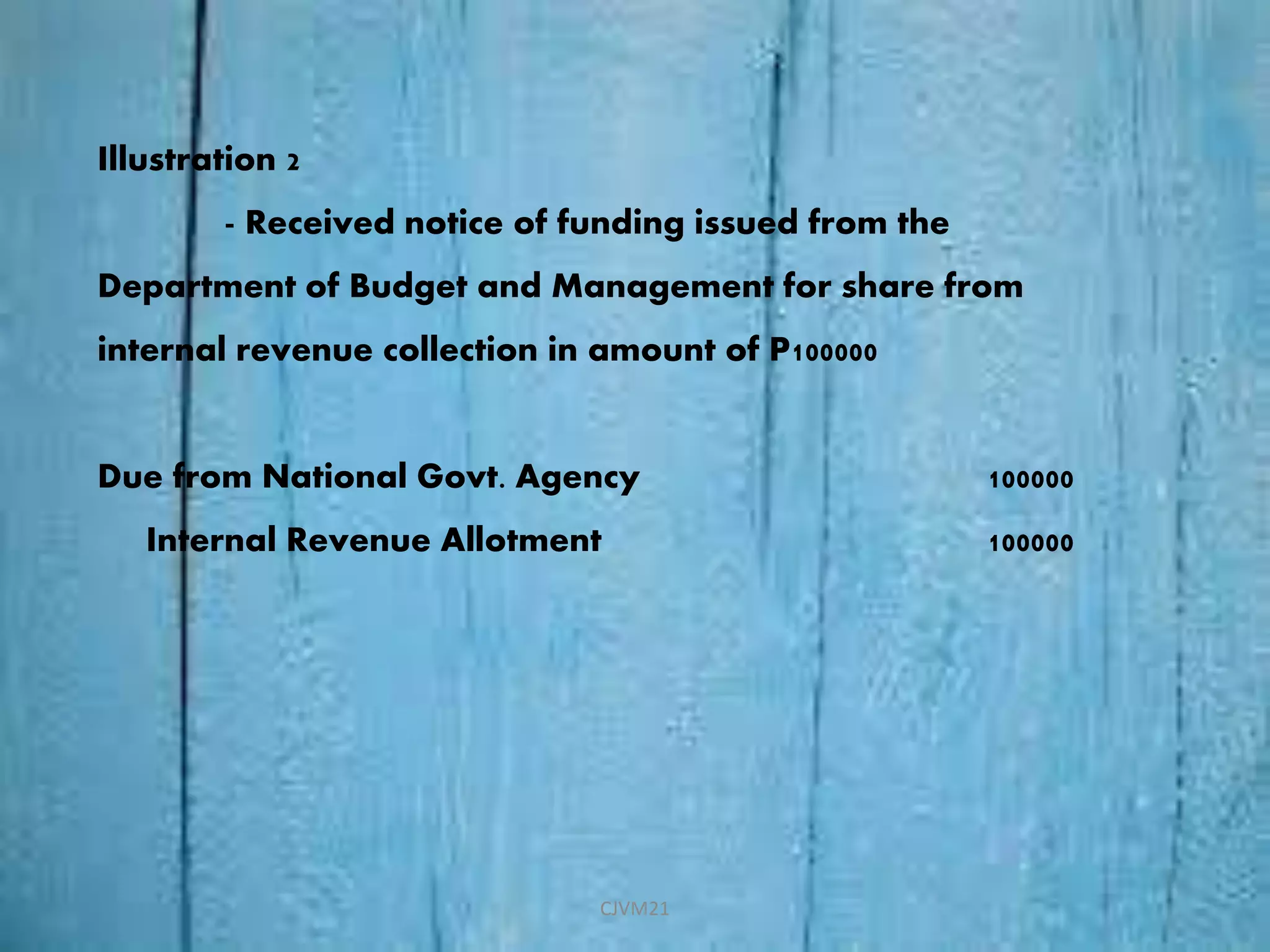
Illustration 2
- Received notice of funding issued from the
Department of Budget and Management for share from
internal revenue collection in amount of P100000
Due from National Govt. Agency 100000
Internal Revenue Allotment 100000
CJVM21
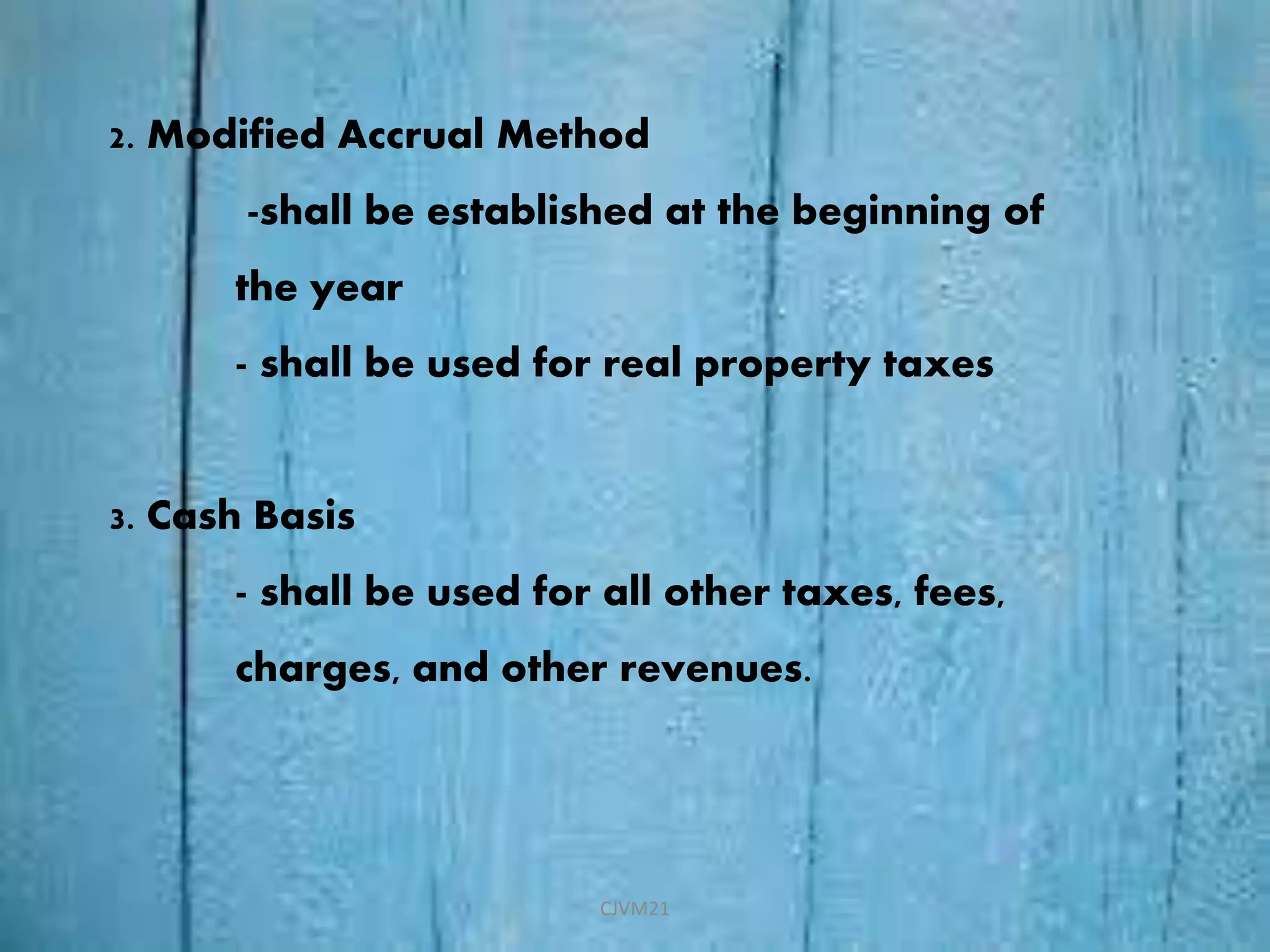
2. Modified Accrual Method
-shall be established at the beginning of
the year
- shall be used for real property taxes
3. Cash Basis
- shall be used for all other taxes, fees,
charges, and other revenues.
CJVM21
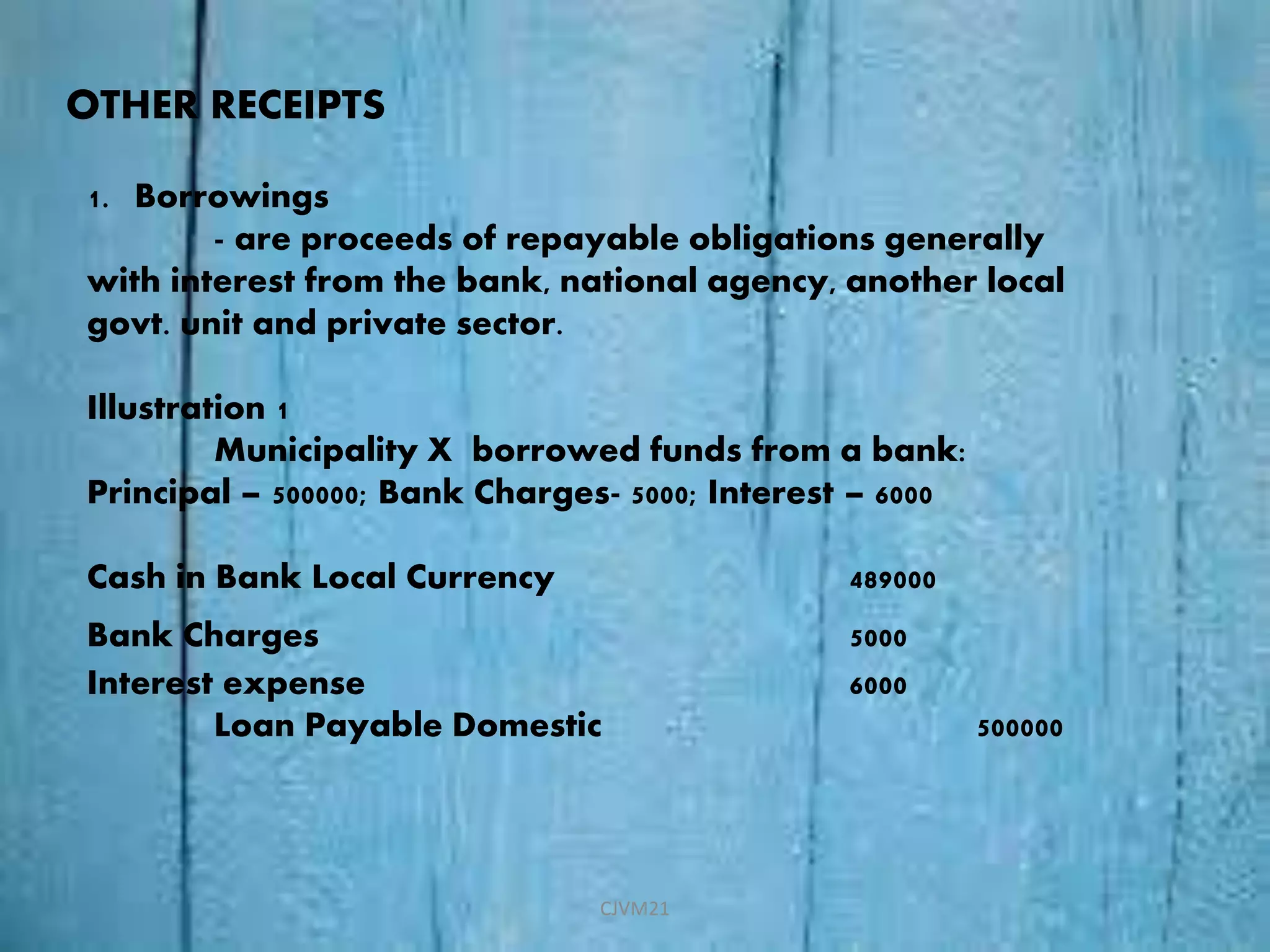
OTHER RECEIPTS
1. Borrowings
- are proceeds of repayable obligations generally
with interest from the bank, national agency, another local
govt. unit and private sector.
Illustration 1
Municipality X borrowed funds from a bank:
Principal – 500000; Bank Charges- 5000; Interest – 6000
Cash in Bank Local Currency 489000
Bank Charges 5000
Interest expense 6000
Loan Payable Domestic 500000
CJVM21
2. Sale of Property, Plant and Equipment
- refer to the proceeds from the sale of fixed assets,
such as land, building, equipment, furniture and fixtures, etc.
3. Refund of Cash Advances
-cash advances for official travel shall be recorded as
receivable from the concerned official of employee as
“Advances to Officers and Employees”. Refunds made shall be
credited to the receivable account previously recorded.
4. Receipt of Performance/Bidders Bonds
- performance bond in cash or certified check shall be
acknowledge through the issuance of official receipt and
recorded in the books by the accountant using a Journal Entry
Voucher.
CJVM21
Accounting for Collections and Deposit
Disbursements
• Personnel services
• Maintenance and Other Operating Expense
• Capital Outlay
• Financial Expense
Payments by Check
Payments by Cash
Payments out of Petty Cash Fund
Purchase or Construction of Property, Plant and Equipment
Purchase of Supplies
CJVM21
Miscellaneous Transactions
1. Loss of Cash and Property Accountability
Illustration 1
- The auditor of Municipality X discovered a loss of
fund by its disbursing officer in the amount of P5000. the
disbursing officer alleged that said amount was lost due to
theft and filed a request for relief from the accountability.
When the innocence of the accountable officer was
proven, the request for relief from accountability was
granted.
To record the loss:
Due from Officers and Employees 5000
Cash – Disbursing Officer 5000CJVM21
To record relief for accountability:
Loss of assets 5000
Due from Officers and Employees 5000
In case of denial of request for relief from accountability,
cash settlement is required;
Cash in Vault 5000
Due from Officers and Employees 5000
CJVM21
2. Cash Overage
- the cash overage shall be recorded as a credit to Other
Specific Income of LGU and debited to Cash in Treasury.
3. Dishonored Checks
Illustration 1
A check issued by a taxpayer for real property
tax in current year in the amount of P10000 was dishonored by a
bank upon presentation for payment. Accordingly, the official
receipt was cancelled. Upon notifications of the cancellation, the
taxpayer settled the obligation.
To record the receipt of advice of dishonored check
Real Property Tax Receivable 10000
Deferred Real Property Tax Income 10000CJVM21
To record cancellation of official receipt
Due to LGU – Real Property Tax Income 6000
Real Property Tax Income 4000
Cash in Bank Local Currency 10000
To record settlement
Cash in Vault 10000
Real Property Tax Receivable 10000
CJVM21
4. Cancellation of Lost Check Issued
- A check is considered lost when it is misplaced,
waylaid or left behind inadvertently/ negligently by the
payee or holder I due course or when it is lost due to
fortuitous event, theft or robbery.
To record the cancellation of check:
Cash in Bank – Local Currency Acct. 50000
Accounts Payable 50000
To record the repalcement
Accounts Payable 50000
Cash in Bank – Local Currency Acct. 50000
CJVM21
5. Spoiled and Stale Checks
- A check is considered spoil when it is torn,
mutilated, defaced or with erasures or errors affecting
the genuineness of any material information
contained therein.
- It is a stale, if it has been outstanding for over
six month from the date of issue or as prescribed by
the depository bank.
CJVM21
6. Suspensions, Disallowances and
Charges
Illustration:
During the examination conducted by the resident
auditor of the municipality of AB, it was discovered that
payment for office supplies delivered by a supplier was
overpaid by P10000. Accordingly, the auditor disallowed the
overpayment and required accountable officer to settle the
overpaid amount.
To record the disallowance:
Receivables – Disallowance charges 10000
Office Supplies Expense 10000
To record the settlement:
Cash in Vault 10000
Receivables – Disallowance charges 10000
CJVM21
TRIAL BALANCE AND FINANCIAL STATEMENTS
- trial balance is a list of all the general ledger accounts and
their balances at a given time. The accounts are listed in the order in
which they appear in the ledger, with the debit balances in the left
column and credit balance in the right column.
ADJUSTING JOURNAL ENTRIES
- are accounting journal entries made in order to ensure
that revenues and expense are recorded in the period when
earned or incurred following the revenue recognition and
matching principle.
There are two types of adjusting journal entries, namely:
1. Prepayments
2. Accruals CJVM21
Pre – Closing Trial Balance
- is the one prepared from the general ledger accounts after
the adjusting entries have been journalized and posted. This is also
called adjusted trial balance.
Closing Journal Entries
- are the accounting entries prepared to reduce all the balances
of the nominal accounts to zero at the end of the accounting period in
order to prepare the accounts for the next accounting period.
Post – Closing Trial Balance
- is the trial balance prepared at the end of the year after the
closing entries are journalized and posted in the general ledgers
- it shall be submitted not later than the fourteenth day of
February after the end of the calendar year with the following
schedules:
1. Status of Appropriations, Allotments and Obligations
2. Subsidiary Schedule of General Ledger account balances
3. Summary of Public Infrastructures
CJVM21
INTERIM REPORTS
- are financial statement required to be prepared at any
given period or at a financial reporting period shorter than a full
financial year, without closing the book of accounts.
The following interim financial statements and the Notes to Financial
Statements shall be prepared and submitted on quarterly basis;
1. Balance Sheet
2. Statement of Income and Expenses
3. Statement of Cash Flows
STATEMENT OF MANAGEMENT RESPONSIBILITY FOR
FINANCIAL STATEMENTS
- shows the local govt. agencies responsibility for the
preparation and presentation of its financial statements. It shall be
signed by the Chief Accountant and the Head of the Agency or his
authorized representative.
CJVM21
YEAR END FINANCIAL STATEMENTS
1. Balance Sheet
2. Statement of Income and Expenses
3. Statement of Cash Flows
4. Notes to Financial Statements
GENERAL FUND
- consists of monies and resources not accruing to
any other fund and shall be available for payment of
expenditures, obligations or purposes not specifically
declared by law.
CJVM21
SPECIAL EDUCATION FUND
- consists of the respective shares of provinces, cities and
municipalities in the proceeds of the additional one percent tax on
the assessed value of real property for education purposes under
the Real Property Tax Code.
Proceeds for special education Fund shall be divided
between provincial and municipal school boards for the following
purposes:
1. Operation and maintenance in the public schools
2. Construction and repair of school buildings, facilities and
equipment
3. Education research
4. Purchase of book and periodicals
5. Sports development CJVM21
BASIS OF RECORDING SPECIAL EDUCATION FUND
-based on Real Property Tax Account Register/Taxpayers
Index Card, the Special Education Tax Receivables shall be
established at the beginning of the year
- the Chief Accountant shall record the Special Education Tax
Receivables using the Journal Entry Voucher.
ACCOUNTING FOR SPECIAL EDUCATION FUND
- the treasurer or accountable officers shall maintain separate
cashbook for the special education fund
- the chief accountant shall maintain separate registries for
appropriation, allotment and obligations and books of accounts.
CJVM21
TRUST FUND
- Consists of private and public monies received, by local
government official as trustee, agent or administrator, as guaranty
for the fulfillment of some obligations.
- A trust fund shall only be used for the specific purpose for
which it was intended.
ACCOUNTING FOR TRUST FUND
- Cash collections for the trust fund shall be acknowledged by
issuance of official receipt.
- The treasurer or concerned accountable officer shall
maintain separate cashbooks for the trust fund. The accountant on
the other hand, shall maintain separate books of accounts for trust
fund, prepare separate financial reports such as trial balance,
balance sheet, statement of cash flow and supporting schedules, to
be submitted on time.
- Disbursements from trust fund shall be in accordance with
the specific purpose stated in the trust agreement/approved budget
between the trustor and the trustee (LGU) as certified by the chief
accountant as to existence of funds held in trust
CJVM21
THE NEW CODING STRUCTURE
- one of the key elements of the Unified Account
Code Structure under Joint Circular No. 2013-1 dated
August 6,2013, is the Location Code, which is a nine digit
code to reflect the
Region/Province/Municipality/Barangay following the
Philippine Standard Geographic Code prescribed by the
National Statistical Coordination Board.
CJVM21
REGION
- it is a sub national administrative unit composed of
several provinces having more or less homogenous
characteristics such as ethnic region of inhabitants, dialect spoken,
agricultural produce etc.
- it is a two digit code that identifies a specific region
PROVINCE
- it is a political corporate unit of government which consists
of a cluster of municipalities and component cities.
- the province code is a two digit code that identifies the
province.
CJVM21
CITY/MUNICIPALITY
- is a political corporate unit of government which consists
of a more urbanized and developed groups of barangays.
- the municipality code is a two digit code that generally
defines the relative alphabetical
BARANGAY
- it is the basic political unit of the government, it serves as
a primary planning and implementing unit of government
policies, plans, programs, projects and activities.
- it is a three digit code which generally defines the
relative alphabetical sequence of barangays within the
municipalities.
CJVM21
SPECIAL ACCOUNTS IN THE GENERAL FUND
- local government units shall maintain special accounts,
through the use of complete subsidiary ledgers for each number of
the same economic enterprise, if any, in the General Fund for the
following:
1. Public utilities and other economic enterprise
2. Loans, interest, bind issues and other contributions for specific
purposes
3. Development projects funded from the share of the local
government concerned from the Internal Revenue Collections
4. Other special accounts which may be created by law or
ordinance
CJVM21
ACCOUNTING FOR SPECIAL ACCOUNTS
- accounting procedures for the operations of the special
accounts are adopted for the following purposes:
1. To determine whether the income generated by the public
utilities or economic enterprises are sufficient to meet their
respective operating costs.
2. To provide adequate information as to the assets,
liabilities, and equity of each special account.
CJVM21
ACCOUNTING FOR PROFIT FROM OPERATIONS
- profits or income derived from the operation of public utilities
and other economic enterprises shall be first be applied for the return
of the advances or loans made therefor . Any excess shall be from
part of the general fund of the local government unit concerned.
ACCOUNTING FOR SUPPLIES OR PROPERTY
- purchase of supplies and materials for stock, regardless of
whether or not they are consumed within the accounting period, shall
be recorded as inventory following the perpetual inventory method.
- the moving average method shall be used for costing
inventories
- items with serviceable life of more than one year but small
enough to be considered as property, plant and equipment shall be
recorded as inventories upon the acquisition and expense upon
issuance.
CJVM21
CLASSIFICATION OF SUPPLIES OR PROPERTY
a. Expendable Supplies or Property
b. Non Expendable Supplies or Property
c. Non Personal Services
PROCEDURES FOR REQUISITION, DELIVERIES, AND
ISSUANCES OF SUPPLIES OR PROPERTY
Requisition shall be accomplished using the following forms:
1. Requisition Issue Slip (RIS) – for supplies carried in stock
2. Purchase Request (PR) – for supplies not carried in stock
CJVM21
REVISED RATES OF REPRESENTATION AND
TRANSPORTATION ALLOWANCE
- Local Budget Circular No. 2009-91 dated March 27, 2009 is
issued to implement the revised RATA rates authorized under
Section 44, General Provisions of R.A. No. 9524, the General
Appropriation Act, for local government officials and
employees and to prescribe the funding source thereof. The
grant of RATA at the revised rates is subject to the 45%/55% limit
on personnel service expenditures mandated under Section
325(a) R.A. No. 7160, Local Government Code of 1991.
CJVM21
The following officials and employees of provincial, city and
municipal governments are equated to national government
officials and employees entitled to RATA under the General
Appropriations Act:
1. Local Chief Executives (provincial governors, city mayors and municipal
mayors
2. Local Vice Chief Executives (Provincial Vice Governor, City Vice Mayors and
Municipal Vice Mayors
3. Sanggunian Members ( Sangguniang Panglalawigan Members, Sanggunian
Panglungsod Members, Sanggunian Bayan Members
4. Department Heads ( Provincial Government Department Heads, City
Government Department Heads, and Municipal Government Department
Heads
5. Assistant Department Heads ( Provincial Government Assistant Department
Heads, City Government Assistant Department Heads, and Municipal
Government Assistant Department Heads
6. Chief of Hospitals CJVM21

Govt acct chapter 9 for LGUs

  • 1.
  • 2.
    Basic Features andPolicy 1. Accrual Accounting 2. One Fund Concept 3. Special Accounts in the General Fund 4. Chart of Accounts and Accounts Code 5. Books of Accounts • Journals 1. Cash Receipt Journal 2. Cash Disbursement Journal 3. Check Disbursement Journal 4. General JournalCJVM21
  • 3.
    Ledgers 1. General Ledgers 2.Subsidiary ledgers • Cash • Receivables • Inventories • Investment • Property plant and equipment • Liabilities • Income • Expenses Additional Book 1. Cash Book – Cash in Treasury 2. Cash Book- Cash in Bank 3. Cash Book – Cash Advances CJVM21
  • 4.
    6. Financial Statements 7.Appropriations, Allotments and Obligations 8. Financial Expenses 9. Perpetual Inventory and Supplies 10. Valuation of Inventory 11. Maintenance of Supplies and Property Plant and Equipment Ledger Cards 12. Construction of Assets 13. Public Infrastructures CJVM21
  • 5.
    14. Depreciation 15. Reclassificationof Assets 16. Allowance for Impairment – Accounts Receivable 17. Elimination of Contingent Asset 18. Recognition of Liability 19. Interest Accrual 20. Accounting for Borrowings and loans 21. Elimination of Corollary and Negative Entries CJVM21
  • 6.
    FORMS AND CONTENTOF BUDGET The local government budget primarily consist of two parts namely: 1. The estimates of Income certified collectible by the treasurer; and 2. The total appropriation covering the current operating expenditures and capital outlays. CJVM21
  • 7.
    THE BUDGET PROCESS 1.Preparation 2. Legislative authorization 3. Execution and Accountability CJVM21
  • 8.
    Changes in AnnualBudget -may be made within the fiscal year by way of supplemental budget Failure to Enact an Annual Budget -whenever the local legislative fails to pass an annual budget or when an enacted budget is declared unenforceable, the annual appropriations are deemed re –enacted. Budgetary Accounting -similar to the national government, the budgetary accounting of the local government units are composed of the following: - Appropriations - Allotments - Obligations CJVM21
  • 9.
    SOURCES OF INCOME -the main sources of income of local government units are as follows: • Tax Revenues, fees and charges • Share from Internal Revenue Collection • Share from National Wealth GENERAL INCOME ACCOUNTS 1. Subsidy from other local government units 2. Subsidy from other funds 3. Subsidy from special account 4. Sales revenue 5. Dividend revenue 6. Interest income 7. Gain on sale on securities 8. Gain on sale on assets 9. Sale of confiscated goods and properties CJVM21
  • 10.
    10. Foreign ExchangeGains 11. Miscellaneous operating and service income 12. Fines and penalties- government service and business operations 13. Income from grants and donations SPECIAL INCOME ACCOUNTS 1. Property taxes 2. Taxes on goods and services 3. Other taxes 4. Other specific income CJVM21
  • 11.
    METHODS OF ACCOUNTINGFOR INCOME 1. Accrual method Illustration 1 - Received notice of Funding check issued from the Department of Budget and Management, together with credit memo from the bank for the share from internal revenue collections in amount of P100,000 Cash in Bank 100000 Internal Revenue Allotment 100000 CJVM21
  • 12.
    Illustration 2 - Receivednotice of funding issued from the Department of Budget and Management for share from internal revenue collection in amount of P100000 Due from National Govt. Agency 100000 Internal Revenue Allotment 100000 CJVM21
  • 13.
    2. Modified AccrualMethod -shall be established at the beginning of the year - shall be used for real property taxes 3. Cash Basis - shall be used for all other taxes, fees, charges, and other revenues. CJVM21
  • 14.
    OTHER RECEIPTS 1. Borrowings -are proceeds of repayable obligations generally with interest from the bank, national agency, another local govt. unit and private sector. Illustration 1 Municipality X borrowed funds from a bank: Principal – 500000; Bank Charges- 5000; Interest – 6000 Cash in Bank Local Currency 489000 Bank Charges 5000 Interest expense 6000 Loan Payable Domestic 500000 CJVM21
  • 15.
    2. Sale ofProperty, Plant and Equipment - refer to the proceeds from the sale of fixed assets, such as land, building, equipment, furniture and fixtures, etc. 3. Refund of Cash Advances -cash advances for official travel shall be recorded as receivable from the concerned official of employee as “Advances to Officers and Employees”. Refunds made shall be credited to the receivable account previously recorded. 4. Receipt of Performance/Bidders Bonds - performance bond in cash or certified check shall be acknowledge through the issuance of official receipt and recorded in the books by the accountant using a Journal Entry Voucher. CJVM21
  • 16.
    Accounting for Collectionsand Deposit Disbursements • Personnel services • Maintenance and Other Operating Expense • Capital Outlay • Financial Expense Payments by Check Payments by Cash Payments out of Petty Cash Fund Purchase or Construction of Property, Plant and Equipment Purchase of Supplies CJVM21
  • 17.
    Miscellaneous Transactions 1. Lossof Cash and Property Accountability Illustration 1 - The auditor of Municipality X discovered a loss of fund by its disbursing officer in the amount of P5000. the disbursing officer alleged that said amount was lost due to theft and filed a request for relief from the accountability. When the innocence of the accountable officer was proven, the request for relief from accountability was granted. To record the loss: Due from Officers and Employees 5000 Cash – Disbursing Officer 5000CJVM21
  • 18.
    To record relieffor accountability: Loss of assets 5000 Due from Officers and Employees 5000 In case of denial of request for relief from accountability, cash settlement is required; Cash in Vault 5000 Due from Officers and Employees 5000 CJVM21
  • 19.
    2. Cash Overage -the cash overage shall be recorded as a credit to Other Specific Income of LGU and debited to Cash in Treasury. 3. Dishonored Checks Illustration 1 A check issued by a taxpayer for real property tax in current year in the amount of P10000 was dishonored by a bank upon presentation for payment. Accordingly, the official receipt was cancelled. Upon notifications of the cancellation, the taxpayer settled the obligation. To record the receipt of advice of dishonored check Real Property Tax Receivable 10000 Deferred Real Property Tax Income 10000CJVM21
  • 20.
    To record cancellationof official receipt Due to LGU – Real Property Tax Income 6000 Real Property Tax Income 4000 Cash in Bank Local Currency 10000 To record settlement Cash in Vault 10000 Real Property Tax Receivable 10000 CJVM21
  • 21.
    4. Cancellation ofLost Check Issued - A check is considered lost when it is misplaced, waylaid or left behind inadvertently/ negligently by the payee or holder I due course or when it is lost due to fortuitous event, theft or robbery. To record the cancellation of check: Cash in Bank – Local Currency Acct. 50000 Accounts Payable 50000 To record the repalcement Accounts Payable 50000 Cash in Bank – Local Currency Acct. 50000 CJVM21
  • 22.
    5. Spoiled andStale Checks - A check is considered spoil when it is torn, mutilated, defaced or with erasures or errors affecting the genuineness of any material information contained therein. - It is a stale, if it has been outstanding for over six month from the date of issue or as prescribed by the depository bank. CJVM21
  • 23.
    6. Suspensions, Disallowancesand Charges Illustration: During the examination conducted by the resident auditor of the municipality of AB, it was discovered that payment for office supplies delivered by a supplier was overpaid by P10000. Accordingly, the auditor disallowed the overpayment and required accountable officer to settle the overpaid amount. To record the disallowance: Receivables – Disallowance charges 10000 Office Supplies Expense 10000 To record the settlement: Cash in Vault 10000 Receivables – Disallowance charges 10000 CJVM21
  • 24.
    TRIAL BALANCE ANDFINANCIAL STATEMENTS - trial balance is a list of all the general ledger accounts and their balances at a given time. The accounts are listed in the order in which they appear in the ledger, with the debit balances in the left column and credit balance in the right column. ADJUSTING JOURNAL ENTRIES - are accounting journal entries made in order to ensure that revenues and expense are recorded in the period when earned or incurred following the revenue recognition and matching principle. There are two types of adjusting journal entries, namely: 1. Prepayments 2. Accruals CJVM21
  • 25.
    Pre – ClosingTrial Balance - is the one prepared from the general ledger accounts after the adjusting entries have been journalized and posted. This is also called adjusted trial balance. Closing Journal Entries - are the accounting entries prepared to reduce all the balances of the nominal accounts to zero at the end of the accounting period in order to prepare the accounts for the next accounting period. Post – Closing Trial Balance - is the trial balance prepared at the end of the year after the closing entries are journalized and posted in the general ledgers - it shall be submitted not later than the fourteenth day of February after the end of the calendar year with the following schedules: 1. Status of Appropriations, Allotments and Obligations 2. Subsidiary Schedule of General Ledger account balances 3. Summary of Public Infrastructures CJVM21
  • 26.
    INTERIM REPORTS - arefinancial statement required to be prepared at any given period or at a financial reporting period shorter than a full financial year, without closing the book of accounts. The following interim financial statements and the Notes to Financial Statements shall be prepared and submitted on quarterly basis; 1. Balance Sheet 2. Statement of Income and Expenses 3. Statement of Cash Flows STATEMENT OF MANAGEMENT RESPONSIBILITY FOR FINANCIAL STATEMENTS - shows the local govt. agencies responsibility for the preparation and presentation of its financial statements. It shall be signed by the Chief Accountant and the Head of the Agency or his authorized representative. CJVM21
  • 27.
    YEAR END FINANCIALSTATEMENTS 1. Balance Sheet 2. Statement of Income and Expenses 3. Statement of Cash Flows 4. Notes to Financial Statements GENERAL FUND - consists of monies and resources not accruing to any other fund and shall be available for payment of expenditures, obligations or purposes not specifically declared by law. CJVM21
  • 28.
    SPECIAL EDUCATION FUND -consists of the respective shares of provinces, cities and municipalities in the proceeds of the additional one percent tax on the assessed value of real property for education purposes under the Real Property Tax Code. Proceeds for special education Fund shall be divided between provincial and municipal school boards for the following purposes: 1. Operation and maintenance in the public schools 2. Construction and repair of school buildings, facilities and equipment 3. Education research 4. Purchase of book and periodicals 5. Sports development CJVM21
  • 29.
    BASIS OF RECORDINGSPECIAL EDUCATION FUND -based on Real Property Tax Account Register/Taxpayers Index Card, the Special Education Tax Receivables shall be established at the beginning of the year - the Chief Accountant shall record the Special Education Tax Receivables using the Journal Entry Voucher. ACCOUNTING FOR SPECIAL EDUCATION FUND - the treasurer or accountable officers shall maintain separate cashbook for the special education fund - the chief accountant shall maintain separate registries for appropriation, allotment and obligations and books of accounts. CJVM21
  • 30.
    TRUST FUND - Consistsof private and public monies received, by local government official as trustee, agent or administrator, as guaranty for the fulfillment of some obligations. - A trust fund shall only be used for the specific purpose for which it was intended. ACCOUNTING FOR TRUST FUND - Cash collections for the trust fund shall be acknowledged by issuance of official receipt. - The treasurer or concerned accountable officer shall maintain separate cashbooks for the trust fund. The accountant on the other hand, shall maintain separate books of accounts for trust fund, prepare separate financial reports such as trial balance, balance sheet, statement of cash flow and supporting schedules, to be submitted on time. - Disbursements from trust fund shall be in accordance with the specific purpose stated in the trust agreement/approved budget between the trustor and the trustee (LGU) as certified by the chief accountant as to existence of funds held in trust CJVM21
  • 31.
    THE NEW CODINGSTRUCTURE - one of the key elements of the Unified Account Code Structure under Joint Circular No. 2013-1 dated August 6,2013, is the Location Code, which is a nine digit code to reflect the Region/Province/Municipality/Barangay following the Philippine Standard Geographic Code prescribed by the National Statistical Coordination Board. CJVM21
  • 32.
    REGION - it isa sub national administrative unit composed of several provinces having more or less homogenous characteristics such as ethnic region of inhabitants, dialect spoken, agricultural produce etc. - it is a two digit code that identifies a specific region PROVINCE - it is a political corporate unit of government which consists of a cluster of municipalities and component cities. - the province code is a two digit code that identifies the province. CJVM21
  • 33.
    CITY/MUNICIPALITY - is apolitical corporate unit of government which consists of a more urbanized and developed groups of barangays. - the municipality code is a two digit code that generally defines the relative alphabetical BARANGAY - it is the basic political unit of the government, it serves as a primary planning and implementing unit of government policies, plans, programs, projects and activities. - it is a three digit code which generally defines the relative alphabetical sequence of barangays within the municipalities. CJVM21
  • 34.
    SPECIAL ACCOUNTS INTHE GENERAL FUND - local government units shall maintain special accounts, through the use of complete subsidiary ledgers for each number of the same economic enterprise, if any, in the General Fund for the following: 1. Public utilities and other economic enterprise 2. Loans, interest, bind issues and other contributions for specific purposes 3. Development projects funded from the share of the local government concerned from the Internal Revenue Collections 4. Other special accounts which may be created by law or ordinance CJVM21
  • 35.
    ACCOUNTING FOR SPECIALACCOUNTS - accounting procedures for the operations of the special accounts are adopted for the following purposes: 1. To determine whether the income generated by the public utilities or economic enterprises are sufficient to meet their respective operating costs. 2. To provide adequate information as to the assets, liabilities, and equity of each special account. CJVM21
  • 36.
    ACCOUNTING FOR PROFITFROM OPERATIONS - profits or income derived from the operation of public utilities and other economic enterprises shall be first be applied for the return of the advances or loans made therefor . Any excess shall be from part of the general fund of the local government unit concerned. ACCOUNTING FOR SUPPLIES OR PROPERTY - purchase of supplies and materials for stock, regardless of whether or not they are consumed within the accounting period, shall be recorded as inventory following the perpetual inventory method. - the moving average method shall be used for costing inventories - items with serviceable life of more than one year but small enough to be considered as property, plant and equipment shall be recorded as inventories upon the acquisition and expense upon issuance. CJVM21
  • 37.
    CLASSIFICATION OF SUPPLIESOR PROPERTY a. Expendable Supplies or Property b. Non Expendable Supplies or Property c. Non Personal Services PROCEDURES FOR REQUISITION, DELIVERIES, AND ISSUANCES OF SUPPLIES OR PROPERTY Requisition shall be accomplished using the following forms: 1. Requisition Issue Slip (RIS) – for supplies carried in stock 2. Purchase Request (PR) – for supplies not carried in stock CJVM21
  • 38.
    REVISED RATES OFREPRESENTATION AND TRANSPORTATION ALLOWANCE - Local Budget Circular No. 2009-91 dated March 27, 2009 is issued to implement the revised RATA rates authorized under Section 44, General Provisions of R.A. No. 9524, the General Appropriation Act, for local government officials and employees and to prescribe the funding source thereof. The grant of RATA at the revised rates is subject to the 45%/55% limit on personnel service expenditures mandated under Section 325(a) R.A. No. 7160, Local Government Code of 1991. CJVM21
  • 39.
    The following officialsand employees of provincial, city and municipal governments are equated to national government officials and employees entitled to RATA under the General Appropriations Act: 1. Local Chief Executives (provincial governors, city mayors and municipal mayors 2. Local Vice Chief Executives (Provincial Vice Governor, City Vice Mayors and Municipal Vice Mayors 3. Sanggunian Members ( Sangguniang Panglalawigan Members, Sanggunian Panglungsod Members, Sanggunian Bayan Members 4. Department Heads ( Provincial Government Department Heads, City Government Department Heads, and Municipal Government Department Heads 5. Assistant Department Heads ( Provincial Government Assistant Department Heads, City Government Assistant Department Heads, and Municipal Government Assistant Department Heads 6. Chief of Hospitals CJVM21