Government 2.0: Utilization Model,
Implementation Scenarios, &
Relationships
Authors
Gohar Feroz Khan (Korea University of Technology & Education, South Korea)
Bobby Swar (SolBridge International School of Business, South Korea)
Pre-ECIS workshop: E-Government 2.0: Case studies and experience reports
June 4, Utrecht, the Netherlands.
Table of Contents
 What is social media?
 Social media defined
 Social media-based government
 Government 2.0 vs. e-govt.
 How is Social Media Used in Public Sector?
 Method
 Results

The big picture

Govt. 2.0 Utilization model

Govt. 2.0 implementation scenarios

Govt. 2.0 Relationships
 Conclusion
What is Social Media?
 Social media consists of a variety of tools and
technologies that includes:
 Collaborative projects (e.g., Wikipedia and wikispaces),
 Blogs (e.g., WordPress) and microblogs (e.g., Twitter),
 Content communities (e.g., YouTube),
 Social networking sites (e.g., Facebook),
 Virtual game worlds (e.g., World of Warcraft),
 Virtual social worlds (e.g., Second Life), and
 All other Web 2.0 platforms that facilitate the creation &
exchange of UGC.
Social Media Defined
 “A Web 2.0 based technologies/tools— that allows the
creation and exchange of user-generated contents while
letting users establish one or more of these:
 Identity
 Conversations
 Connectivity (i.e., presence)
 Relationships
 Reputation
 Groups, and
 Share contents.” (Khan, 2013, p.2)
What is Government 2.0?
 Is driven by social media/Web 2.0
 Also known as:
 Collaborative Government (McGuire, 2006),
 Do-it-yourself Government (Dunleavy & Margetts,
2010),
 Government as a Platform (O'Reilly, 2010),
 Social Government (Khan, et al., 2012), or
 We-Government (Linders, 2012), among others.
Government 2.0 VS., E-Government
Table 1 e-Government VS., Government 2.0
e-Government Government 2.0
Technology Static enterprise and
domain specific
technologies;
Web 1.0 phenomenon;
Consumer and commoditised
technologies;
Web 2.0 & Social Media;
Strategy Inside-Out Outside-In
Service Focus Citizens as Receivers Citizens as Active Participants
Research Question
 How is Social Media Used in Public
Sector?
How is Social Media Used in
Public Sector?
 Method (Inductive Approach)
 A Web survey of 200 govt. websites from 40 countries (20
Developed and 20 Developing), to look for:

1) SNS

2) multimedia sharing services

3) discussion forums ,

4) blogging ,

5) wikis ,

6) rich site summery , and

7) social tagging services,
 Coded either as “yes” or “no”.
How is Social Media Used in
Public Sector?
 Method (Inductive Approach)
 Also, reviewed 45 Web 2.0 initiatives from around the
world.

Each initiative was assessed based on a coding
scheme covering four dimensions:
 1) citizens’ engagement,
 2) mass collaboration,
 3) social transaction, and
 4) Web 2.0 complexity

The variables were coded as: 1) low, 2) medium,
and 3) high to access the four dimensions
Results
 The Big Picture: Social Media in Public
Sector
 Govt. 2.0 Utilization Model
 Govt. 2.0 Implementation Scenarios
 Govt. 2.0 Relationships
The Big Picture: Social Media
in Public Sector
 This is what we found it is
Posts, Likes, Tweets, & SharesPosts, Likes, Tweets, & Shares
Mass collaborations, citizen sourcing,
co-creation, etc.
Mass collaborations, citizen sourcing,
co-creation, etc.
Social transactionSocial transaction
-SM use is mostly informational and limitedly collaboration and transactional.
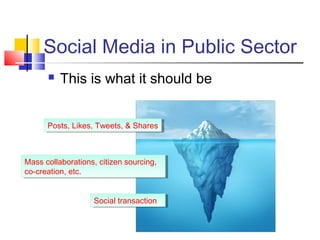
Social Media in Public Sector
 This is what it should be
Posts, Likes, Tweets, & SharesPosts, Likes, Tweets, & Shares
Mass collaborations, citizen sourcing,
co-creation, etc.
Mass collaborations, citizen sourcing,
co-creation, etc.
Social transactionSocial transaction
The Big Picture
 The social media pipe (i.e., social
media tools/technologies) connects
producer and consumer or
prosumers (i.e., government
agencies, citizens, and
businesses) where the government
services are co-produced that
flows in both directions making
government and citizen partners in
the delivery of public services.
Figure 1. Conceptual Model of Social Media Use in Public Sector
Govt. 2.0 Utilization Model
Figure 2: Government 2.0 Utilization Model
1. Information Socialization (IS)
 At this stage, public sector leverage social
media as an informational and participatory
channel to increase citizen’s awareness and
enable them to monitor and participate in
government activities.
Socialization of information
is achieved in two ways:
 Simple Information Socialization, and
 Complex Information Socialization
Simple Information
Socialization
 Simple information socialization is
achieved through merely incorporating
social media tools in the existing
government websites e.g.,
 through incorporating comments
and discussions features, and/or
 through establishing dedicated
social media pages/accounts (e.g.,
Facebook fan page or Twitter
account) to delivery day-to-day
information/news to the citizens.
Complex Information
Socialization
 Complex information socialization
requires establishing advance
social media/web 2.0 based
informational government portals
for informational and participatory
purposes, such as:
 http://maplight.org/
 http://www.data.gov/about, and
 http://blogs.justice.gov/main/.
Note
 An important use of the socialization of information
is in situation where the immediate delivery of
information/news is crucial, such as:
 disseminating news and information about public safety
and in crisis management situations such as,

weather,

traffic,

diseases, and

nature or man-made disasters.
2. Mass Collaboration
 At this stage, public sector leverage
social media tools to poster mass social
collaboration between government and
citizens and cross agency collaboration.
 Mass collaboration was instrumental in
 regulation, crowd sourcing, and law
enforcement.
 Mostly observed in Developed
countries
Example 1-Regulation
 For example, the Peer-To-
Patent (www.peertopatent.com)
initiative by the Patent and
Trademark Office (USPTO) of
the United States is a good
example of mass government
and citizen social collaboration
in reinforcing regulations.
Example 2-Law Enforcement
 Another example is the Korean
government’s smart phone apps
developed to enable mass collaboration in
reporting illegal car parking, waste
disposal, energy misuse, and reporting
other inappropriate behaviour.
Example 3-Croud Sourcing
 Similarly, a good example
of croudsourcing is the
“apps for democracy”
initiative:
http://www.appsfordemoc
racy.org/application-
directory/.
 A U.S. government
initiative to engage the
public in developing new
applications for
democracy.
3. Social Transaction
 Public sector use (limitedly though) social
media tools to establish tangible online
transactions with the citizens.
Example 1
 Another example of using
social media for service
delivery is the “Fixmystreet”
initiative:
http://www.fixmystreet.com/)
 Where citizens using an
interactive portal report a
problem related to their locality
(e.g., fly tipping, broken paving
slabs, or street lighting) which
is then forwarded to the council
to fix the problem.
Example 2
 For example, the U.K.
government use a Web
2.0 based website
(www.gov.uk) to provide
simple, one-stop access
to government services
online where citizens
can access to public
services such as:
 tax, driving test, passport,
births, deaths, marriages,
and health care.
Example-3
 The Korea NTS is
operating online
"Year-end Tax
Settlement Service“
at:
www.yesone.go.kr
 to enable taxpayers
to gather all sorts of
the receipts for
income deduction
online.
Govt. 2.0 Implementation
Scenarios
 Mainly three implementation scenarios
were observed:
 Standalone
 Nested, and
 Hybrid Govt. 2.0
Standalone Govt. 2.0
 In the standalone implementation scenarios,
informational Government 2.0 (i.e., stage 1)
can be implement directly under traditional
government settings (i.e., paper based
government).
 Mostly, observed in developing countries (e.g.,
Zimbabwe, Rwanda, and Fiji) where e-
Government is not yet fully implemented
Paper-Based
Web 2.0 & Social
Media Based
Standalone Govt. 2.0
Figure 3: standalone Government 2.0
Nested Govt. 2.0
 Under this scenario, governments
funnel existing e-Government
infrastructure and capabilities to
leverage social media tools in the day-
to-day governance.
 Scenario 2 is the most likely scenario
where Government 2.0 is realized under
the umbrella of e-government
Paper-Based
Static ICTs & Web
1.0 Based
Web 2.0 & Social
Media Based
Nested Govt. 2.0
Figure 2: Nested Government 2.0
Nested Govt. 2.0
 Observed in the developing and transitional
economies, such as:
 Estonia
 India
 Pakistan
 Kazakhstan
 Lithuania
 Poland
 South Africa, and
 Thailand
Hybrid govt. 2.0
 Hybrid Government 2.0, from a conceptual point
of view, can be defined as,
 a flavor (or subset) of ICT based government
(e.g., e-Government & m-Government) that
harness social media tool/technologies to
establish an open, transparent, and
participative government (see Figure 4).
Hybrid Govt.
Figure 4. Hybrid Government
Hybrid govt. 2.0
 This type of government is observed in
advanced economies, such as:
 Denmark
 New Zealand
 South Korea
 the Netherlands
 the United Kingdom, and
 the United States
 who have already made significant
achievement in the e-Government
Govt. 2.0 Relationships
 C2G Informational Relationship
 e.g., inform of feedback and exert opinion, or reporting
crimes and natural disasters using social media tools.
 C2G Service Relationship
 the “Apps for America 2”: A U.S. government
initiative where citizens are invited to developed
apps for the government
 Other possible relationships
 B2G informational relationship
 B2G service relationship
Conclusion
 Social media in public sector is more than just “likes”,
“tweets”, and “shares”
 Social media tools and channels useful to
disseminate information, foster mass collaboration,
enforce laws, and execute regulation.
 SM use is mostly informational and limited
transactional.
 SM has great potential for DCs
Conclusion
 Limitations
 we only focused on the use of and opportunities
related to social media

studies are needed to access the risk and
reward of social media in public sector
systematically

Stages based risks
 Skills and capabilities needed to implement social
media are not discussed
Thank You
 In case you are interested
 SSCR special issue on
 Best Practices in Social Media at Non-
profit, Public, Education, and Healthcare
Organizations
 CFP:
http://laton.wikispaces.com/SSCOR+Speci
al+Issue+on+Social+Media
References
 Eggers, W. D. (2005). Government 2.0: Using Technology to Improve Education, Cut Red Tape, Reduce
Gridlock, and Enhance Democracy. Lanhma, MD: Rowman & Littlefield Publishers.
 McGuire, M. (2006). Collaborative public management: Assessing what we know and how we know it.
Public Administration Review, 66, 33-43.
 Dunleavy, P., & Margetts, H. Z. (2010). The second wave of digital era governance. APSA 2010 Annual
Meeting Papers.
 Khan, G. F., Yoon, H. Y., & Park, H. W. (2012). Social Media Use in Public Sector: A
comparitive study of the Korean & US Government Paper presented at the ATHS panel
during the 8th International Conference on Webometrics, Informatics and Scientometrics &
13th COLLNET Meeting, 23-26 October 2012, Seoul, Korea.
 O'Reilly, T. (2010). Government as a Platform (Chap 2). In D. Lathrop & L. Ruma (Eds.), Open
government: Collaboration, transparency, and participation in practice: O'Reilly Media.
 Linders, D. (2012). From e-government to we-government: Defining a typology for citizen
coproduction in the age of social media. Government Information Quarterly, 29(4), 446-454.
doi: 10.1016/j.giq.2012.06.003
 Patrice, M. (2010). Building open government. Government Information Quarterly, 27(4),
401-413. doi: 10.1016/j.giq.2010.07.002
 Is the Social Media and SNS
same things?
Is the Social Media and
SNS same things?
 No
 All SNS (social networking site) are
social media, but not all social media
are SNS.
Or
 All SNS are based on Web 2.0, but not
all Web 2.0 concepts are SNS

Example
Based on Social Media/Web
2.0
Based on Social Media/Web
2.0
Facebook is an SNS (i.e., facilitate
online social networking)
Wikipedia is not an SNS (i.e., does
not facilitate online social
networking)
An application/example of social
media/web 2.0 to facilitate online
social networking
An example/application of social
media/web 2.0 to facilitate online
collaborative content creation
VS.
,

Government 2.0 Explained

  • 1.
    Government 2.0: UtilizationModel, Implementation Scenarios, & Relationships Authors Gohar Feroz Khan (Korea University of Technology & Education, South Korea) Bobby Swar (SolBridge International School of Business, South Korea) Pre-ECIS workshop: E-Government 2.0: Case studies and experience reports June 4, Utrecht, the Netherlands.
  • 2.
    Table of Contents What is social media?  Social media defined  Social media-based government  Government 2.0 vs. e-govt.  How is Social Media Used in Public Sector?  Method  Results  The big picture  Govt. 2.0 Utilization model  Govt. 2.0 implementation scenarios  Govt. 2.0 Relationships  Conclusion
  • 3.
    What is SocialMedia?  Social media consists of a variety of tools and technologies that includes:  Collaborative projects (e.g., Wikipedia and wikispaces),  Blogs (e.g., WordPress) and microblogs (e.g., Twitter),  Content communities (e.g., YouTube),  Social networking sites (e.g., Facebook),  Virtual game worlds (e.g., World of Warcraft),  Virtual social worlds (e.g., Second Life), and  All other Web 2.0 platforms that facilitate the creation & exchange of UGC.
  • 4.
    Social Media Defined “A Web 2.0 based technologies/tools— that allows the creation and exchange of user-generated contents while letting users establish one or more of these:  Identity  Conversations  Connectivity (i.e., presence)  Relationships  Reputation  Groups, and  Share contents.” (Khan, 2013, p.2)
  • 5.
    What is Government2.0?  Is driven by social media/Web 2.0  Also known as:  Collaborative Government (McGuire, 2006),  Do-it-yourself Government (Dunleavy & Margetts, 2010),  Government as a Platform (O'Reilly, 2010),  Social Government (Khan, et al., 2012), or  We-Government (Linders, 2012), among others.
  • 6.
    Government 2.0 VS.,E-Government Table 1 e-Government VS., Government 2.0 e-Government Government 2.0 Technology Static enterprise and domain specific technologies; Web 1.0 phenomenon; Consumer and commoditised technologies; Web 2.0 & Social Media; Strategy Inside-Out Outside-In Service Focus Citizens as Receivers Citizens as Active Participants
  • 7.
    Research Question  Howis Social Media Used in Public Sector?
  • 8.
    How is SocialMedia Used in Public Sector?  Method (Inductive Approach)  A Web survey of 200 govt. websites from 40 countries (20 Developed and 20 Developing), to look for:  1) SNS  2) multimedia sharing services  3) discussion forums ,  4) blogging ,  5) wikis ,  6) rich site summery , and  7) social tagging services,  Coded either as “yes” or “no”.
  • 9.
    How is SocialMedia Used in Public Sector?  Method (Inductive Approach)  Also, reviewed 45 Web 2.0 initiatives from around the world.  Each initiative was assessed based on a coding scheme covering four dimensions:  1) citizens’ engagement,  2) mass collaboration,  3) social transaction, and  4) Web 2.0 complexity  The variables were coded as: 1) low, 2) medium, and 3) high to access the four dimensions
  • 10.
    Results  The BigPicture: Social Media in Public Sector  Govt. 2.0 Utilization Model  Govt. 2.0 Implementation Scenarios  Govt. 2.0 Relationships
  • 11.
    The Big Picture:Social Media in Public Sector  This is what we found it is Posts, Likes, Tweets, & SharesPosts, Likes, Tweets, & Shares Mass collaborations, citizen sourcing, co-creation, etc. Mass collaborations, citizen sourcing, co-creation, etc. Social transactionSocial transaction -SM use is mostly informational and limitedly collaboration and transactional.
  • 12.
    Social Media inPublic Sector  This is what it should be Posts, Likes, Tweets, & SharesPosts, Likes, Tweets, & Shares Mass collaborations, citizen sourcing, co-creation, etc. Mass collaborations, citizen sourcing, co-creation, etc. Social transactionSocial transaction
  • 13.
    The Big Picture The social media pipe (i.e., social media tools/technologies) connects producer and consumer or prosumers (i.e., government agencies, citizens, and businesses) where the government services are co-produced that flows in both directions making government and citizen partners in the delivery of public services. Figure 1. Conceptual Model of Social Media Use in Public Sector
  • 14.
    Govt. 2.0 UtilizationModel Figure 2: Government 2.0 Utilization Model
  • 15.
    1. Information Socialization(IS)  At this stage, public sector leverage social media as an informational and participatory channel to increase citizen’s awareness and enable them to monitor and participate in government activities.
  • 16.
    Socialization of information isachieved in two ways:  Simple Information Socialization, and  Complex Information Socialization
  • 17.
    Simple Information Socialization  Simpleinformation socialization is achieved through merely incorporating social media tools in the existing government websites e.g.,  through incorporating comments and discussions features, and/or  through establishing dedicated social media pages/accounts (e.g., Facebook fan page or Twitter account) to delivery day-to-day information/news to the citizens.
  • 18.
    Complex Information Socialization  Complexinformation socialization requires establishing advance social media/web 2.0 based informational government portals for informational and participatory purposes, such as:  http://maplight.org/  http://www.data.gov/about, and  http://blogs.justice.gov/main/.
  • 19.
    Note  An importantuse of the socialization of information is in situation where the immediate delivery of information/news is crucial, such as:  disseminating news and information about public safety and in crisis management situations such as,  weather,  traffic,  diseases, and  nature or man-made disasters.
  • 20.
    2. Mass Collaboration At this stage, public sector leverage social media tools to poster mass social collaboration between government and citizens and cross agency collaboration.  Mass collaboration was instrumental in  regulation, crowd sourcing, and law enforcement.  Mostly observed in Developed countries
  • 21.
    Example 1-Regulation  Forexample, the Peer-To- Patent (www.peertopatent.com) initiative by the Patent and Trademark Office (USPTO) of the United States is a good example of mass government and citizen social collaboration in reinforcing regulations.
  • 22.
    Example 2-Law Enforcement Another example is the Korean government’s smart phone apps developed to enable mass collaboration in reporting illegal car parking, waste disposal, energy misuse, and reporting other inappropriate behaviour.
  • 23.
    Example 3-Croud Sourcing Similarly, a good example of croudsourcing is the “apps for democracy” initiative: http://www.appsfordemoc racy.org/application- directory/.  A U.S. government initiative to engage the public in developing new applications for democracy.
  • 24.
    3. Social Transaction Public sector use (limitedly though) social media tools to establish tangible online transactions with the citizens.
  • 25.
    Example 1  Anotherexample of using social media for service delivery is the “Fixmystreet” initiative: http://www.fixmystreet.com/)  Where citizens using an interactive portal report a problem related to their locality (e.g., fly tipping, broken paving slabs, or street lighting) which is then forwarded to the council to fix the problem.
  • 26.
    Example 2  Forexample, the U.K. government use a Web 2.0 based website (www.gov.uk) to provide simple, one-stop access to government services online where citizens can access to public services such as:  tax, driving test, passport, births, deaths, marriages, and health care.
  • 27.
    Example-3  The KoreaNTS is operating online "Year-end Tax Settlement Service“ at: www.yesone.go.kr  to enable taxpayers to gather all sorts of the receipts for income deduction online.
  • 28.
    Govt. 2.0 Implementation Scenarios Mainly three implementation scenarios were observed:  Standalone  Nested, and  Hybrid Govt. 2.0
  • 29.
    Standalone Govt. 2.0 In the standalone implementation scenarios, informational Government 2.0 (i.e., stage 1) can be implement directly under traditional government settings (i.e., paper based government).  Mostly, observed in developing countries (e.g., Zimbabwe, Rwanda, and Fiji) where e- Government is not yet fully implemented
  • 30.
    Paper-Based Web 2.0 &Social Media Based Standalone Govt. 2.0 Figure 3: standalone Government 2.0
  • 31.
    Nested Govt. 2.0 Under this scenario, governments funnel existing e-Government infrastructure and capabilities to leverage social media tools in the day- to-day governance.  Scenario 2 is the most likely scenario where Government 2.0 is realized under the umbrella of e-government
  • 32.
    Paper-Based Static ICTs &Web 1.0 Based Web 2.0 & Social Media Based Nested Govt. 2.0 Figure 2: Nested Government 2.0
  • 33.
    Nested Govt. 2.0 Observed in the developing and transitional economies, such as:  Estonia  India  Pakistan  Kazakhstan  Lithuania  Poland  South Africa, and  Thailand
  • 34.
    Hybrid govt. 2.0 Hybrid Government 2.0, from a conceptual point of view, can be defined as,  a flavor (or subset) of ICT based government (e.g., e-Government & m-Government) that harness social media tool/technologies to establish an open, transparent, and participative government (see Figure 4).
  • 35.
    Hybrid Govt. Figure 4.Hybrid Government
  • 36.
    Hybrid govt. 2.0 This type of government is observed in advanced economies, such as:  Denmark  New Zealand  South Korea  the Netherlands  the United Kingdom, and  the United States  who have already made significant achievement in the e-Government
  • 37.
    Govt. 2.0 Relationships C2G Informational Relationship  e.g., inform of feedback and exert opinion, or reporting crimes and natural disasters using social media tools.  C2G Service Relationship  the “Apps for America 2”: A U.S. government initiative where citizens are invited to developed apps for the government  Other possible relationships  B2G informational relationship  B2G service relationship
  • 38.
    Conclusion  Social mediain public sector is more than just “likes”, “tweets”, and “shares”  Social media tools and channels useful to disseminate information, foster mass collaboration, enforce laws, and execute regulation.  SM use is mostly informational and limited transactional.  SM has great potential for DCs
  • 39.
    Conclusion  Limitations  weonly focused on the use of and opportunities related to social media  studies are needed to access the risk and reward of social media in public sector systematically  Stages based risks  Skills and capabilities needed to implement social media are not discussed
  • 40.
    Thank You  Incase you are interested  SSCR special issue on  Best Practices in Social Media at Non- profit, Public, Education, and Healthcare Organizations  CFP: http://laton.wikispaces.com/SSCOR+Speci al+Issue+on+Social+Media
  • 41.
    References  Eggers, W.D. (2005). Government 2.0: Using Technology to Improve Education, Cut Red Tape, Reduce Gridlock, and Enhance Democracy. Lanhma, MD: Rowman & Littlefield Publishers.  McGuire, M. (2006). Collaborative public management: Assessing what we know and how we know it. Public Administration Review, 66, 33-43.  Dunleavy, P., & Margetts, H. Z. (2010). The second wave of digital era governance. APSA 2010 Annual Meeting Papers.  Khan, G. F., Yoon, H. Y., & Park, H. W. (2012). Social Media Use in Public Sector: A comparitive study of the Korean & US Government Paper presented at the ATHS panel during the 8th International Conference on Webometrics, Informatics and Scientometrics & 13th COLLNET Meeting, 23-26 October 2012, Seoul, Korea.  O'Reilly, T. (2010). Government as a Platform (Chap 2). In D. Lathrop & L. Ruma (Eds.), Open government: Collaboration, transparency, and participation in practice: O'Reilly Media.  Linders, D. (2012). From e-government to we-government: Defining a typology for citizen coproduction in the age of social media. Government Information Quarterly, 29(4), 446-454. doi: 10.1016/j.giq.2012.06.003  Patrice, M. (2010). Building open government. Government Information Quarterly, 27(4), 401-413. doi: 10.1016/j.giq.2010.07.002
  • 42.
     Is theSocial Media and SNS same things?
  • 43.
    Is the SocialMedia and SNS same things?  No  All SNS (social networking site) are social media, but not all social media are SNS. Or  All SNS are based on Web 2.0, but not all Web 2.0 concepts are SNS 
  • 44.
    Example Based on SocialMedia/Web 2.0 Based on Social Media/Web 2.0 Facebook is an SNS (i.e., facilitate online social networking) Wikipedia is not an SNS (i.e., does not facilitate online social networking) An application/example of social media/web 2.0 to facilitate online social networking An example/application of social media/web 2.0 to facilitate online collaborative content creation VS. ,