3 ways to engage citizens
      using social media


Gohar Feroz Khan
Research: http://laton.wikispaces.com/Brief+Vita
Twitter: @gfkhan
                                            Copyright 2013 Gohar Feroz Khan
What is Social Media?
   Social media consists of a variety of tools and
    technologies that includes:

       Collaborative projects (e.g., Wikipedia),
       Blogs (e.g., WordPress) and microblogs (e.g.,
        Twitter),
       Content communities (e.g., YouTube),
       Social networking sites (e.g., Facebook), virtual
        game worlds (e.g., World of Warcraft), and
       Virtual social worlds (e.g. Second Life).
How may governments engage
citizens using social media?
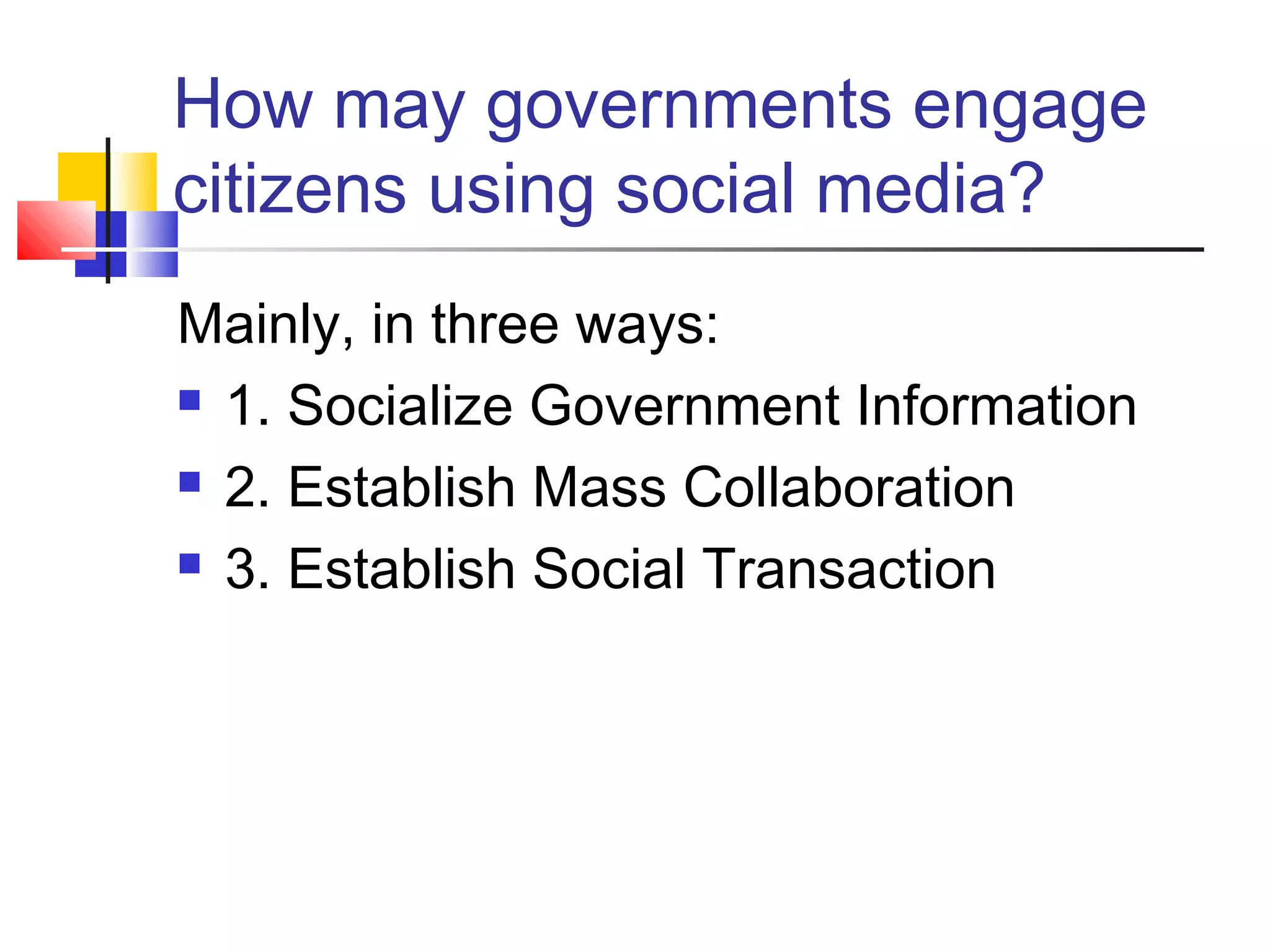
Mainly, in three ways:
 1. Socialize Government Information

 2. Establish Mass Collaboration

 3. Establish Social Transaction
1. Socialize Government
    Information
   First, public sector can leverage social
    media as an informational and
    participatory channel to increase
    citizen’s awareness and enable them to
    monitor and participate in government
    activities.
Socialization of information
can be achieved in two ways:

   Simple information socialization, and
   Complex information socialization.
Simple information
socialization
   Simple information socialization can be
    achieved through merely incorporating
    social media tools in the existing
    government websites.
       e.g. through incorporating comments and
        discussions features and through
        establishing dedicated social media
        pages/accounts (e.g. Facebook fan page
        or Twitter account) to delivery day-to-day
        information/news to the citizens.
Complex information
socialization
   Complex information socialization
    requires establishing advance social
    media or web 2.0 based informational
    government portals for informational
    and participatory purposes, such as:
   http://maplight.org/
   http://www.data.gov/about, and
   http://blogs.justice.gov/main/.
2. Establish Mass
   Collaboration
   Second, public sector can leverage
    social media tools to poster mass social
    collaboration between government and
    citizens and cross agency collaboration.
   Mass collaboration can be instrumental
    in crowd sourcing, regulation, and law
    enforcement.
Example 1
   For example, the Peer-To-Patent
    (www.peertopatent.com) initiative by the
    Patent and Trademark Office (USPTO)
    of the United States is a good example
    of mass government and citizen social
    collaboration in reinforcing regulations.
Example 2
   Another example is the Korean
    government’s smart phone apps
    developed to enable mass collaboration
    in reporting illegal car parking, waste
    disposal, energy misuse, and reporting
    other inappropriate behaviour.

   Note: the author personally used some of the apps.
Example 3
   Similarly, another good example of
    mass collaboration is the “apps for
    democracy” initiative:
    http://www.appsfordemocracy.org/appli
    cation-directory/.
   A U.S. government initiative to engage
    the public in developing new
    applications for democracy.
3. Establish Social
   Transaction
   Third, public sector can use social
    media tools to establish tangible online
    transactions with the citizens.
Example 1
   For example, the U.K. government use
    a Web 2.0 based website (www.gov.uk)
    to provide simple, one-stop access to
    government services online where
    citizens can access to public services
    such as:
       tax, driving test, passport, births, deaths,
        marriages, and health care.
Example 2
   Another example of using social media for
    service delivery is the “Fixmystreet” initiative:
    http://www.fixmystreet.com/)

   Where citizens using an interactive portal
    report a problem related to their locality (e.g.
    fly tipping, broken paving slabs, or street
    lighting) which is then forwarded to the
    council to fix the problem.
Final note
   An important use of the socialization of
    information is in situation where the
    immediate delivery of information/news is
    crucial, such as:
       disseminating news and information about public
        safety and in crisis management situations such
        as, weather, traffic, diseases, and nature or man-
        made disasters.
About the Author
   Gohar Feroz Khan is an Assistant Professor
    at Korea University of Technology &
    Education. His research interest includes, IT
    adoption, social information systems, and
    Social media.

   Note: the 3 steps presented here are based
    on our empirical study currently under review.

3 ways to engage citizens using social media

  • 1.
    3 ways toengage citizens using social media Gohar Feroz Khan Research: http://laton.wikispaces.com/Brief+Vita Twitter: @gfkhan Copyright 2013 Gohar Feroz Khan
  • 2.
    What is SocialMedia?  Social media consists of a variety of tools and technologies that includes:  Collaborative projects (e.g., Wikipedia),  Blogs (e.g., WordPress) and microblogs (e.g., Twitter),  Content communities (e.g., YouTube),  Social networking sites (e.g., Facebook), virtual game worlds (e.g., World of Warcraft), and  Virtual social worlds (e.g. Second Life).
  • 3.
    How may governmentsengage citizens using social media? Mainly, in three ways:  1. Socialize Government Information  2. Establish Mass Collaboration  3. Establish Social Transaction
  • 4.
    1. Socialize Government Information  First, public sector can leverage social media as an informational and participatory channel to increase citizen’s awareness and enable them to monitor and participate in government activities.
  • 5.
    Socialization of information canbe achieved in two ways:  Simple information socialization, and  Complex information socialization.
  • 6.
    Simple information socialization  Simple information socialization can be achieved through merely incorporating social media tools in the existing government websites.  e.g. through incorporating comments and discussions features and through establishing dedicated social media pages/accounts (e.g. Facebook fan page or Twitter account) to delivery day-to-day information/news to the citizens.
  • 7.
    Complex information socialization  Complex information socialization requires establishing advance social media or web 2.0 based informational government portals for informational and participatory purposes, such as:  http://maplight.org/  http://www.data.gov/about, and  http://blogs.justice.gov/main/.
  • 8.
    2. Establish Mass Collaboration  Second, public sector can leverage social media tools to poster mass social collaboration between government and citizens and cross agency collaboration.  Mass collaboration can be instrumental in crowd sourcing, regulation, and law enforcement.
  • 9.
    Example 1  For example, the Peer-To-Patent (www.peertopatent.com) initiative by the Patent and Trademark Office (USPTO) of the United States is a good example of mass government and citizen social collaboration in reinforcing regulations.
  • 10.
    Example 2  Another example is the Korean government’s smart phone apps developed to enable mass collaboration in reporting illegal car parking, waste disposal, energy misuse, and reporting other inappropriate behaviour.  Note: the author personally used some of the apps.
  • 11.
    Example 3  Similarly, another good example of mass collaboration is the “apps for democracy” initiative: http://www.appsfordemocracy.org/appli cation-directory/.  A U.S. government initiative to engage the public in developing new applications for democracy.
  • 12.
    3. Establish Social Transaction  Third, public sector can use social media tools to establish tangible online transactions with the citizens.
  • 13.
    Example 1  For example, the U.K. government use a Web 2.0 based website (www.gov.uk) to provide simple, one-stop access to government services online where citizens can access to public services such as:  tax, driving test, passport, births, deaths, marriages, and health care.
  • 14.
    Example 2  Another example of using social media for service delivery is the “Fixmystreet” initiative: http://www.fixmystreet.com/)  Where citizens using an interactive portal report a problem related to their locality (e.g. fly tipping, broken paving slabs, or street lighting) which is then forwarded to the council to fix the problem.
  • 15.
    Final note  An important use of the socialization of information is in situation where the immediate delivery of information/news is crucial, such as:  disseminating news and information about public safety and in crisis management situations such as, weather, traffic, diseases, and nature or man- made disasters.
  • 16.
    About the Author  Gohar Feroz Khan is an Assistant Professor at Korea University of Technology & Education. His research interest includes, IT adoption, social information systems, and Social media.  Note: the 3 steps presented here are based on our empirical study currently under review.