Should there be governance for e-commerce?
By
Mr. Suhaan Mukerji
Privileged & Confidential
June 22, 2013
Privileged & Confidential | Client Logo
Potential for e-commerce in IndiaPotential for e-commerce in India
Privileged & Confidential | 3
India: Facts and figures (“Opportunity”)India: Facts and figures (“Opportunity”)
Number of young
internet users– 110
million (indicates
propensity to buy
online)
Total internet users
in India - 150 million
(only 13 % of the
population)
3,311 e-commerce
hubs; 1,267 rural
hubs
Privileged & Confidential | 4
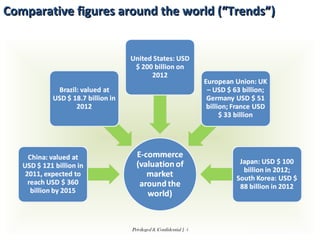
Comparative figures around the world (“Trends”)Comparative figures around the world (“Trends”)
Privileged & Confidential | 5
Top e-commerce companies (“Players”)Top e-commerce companies (“Players”)
Privileged & Confidential | 6
Types of e-commerce models (“Options”)Types of e-commerce models (“Options”)
Business to
Business (B2B)
Buyers and sellers are both business entities, comparable to a manufacturer
supplying goods to the retailer or wholesaler. E.g. The Steel Exchange
Business to
consumer (B2C)
Online businesses selling to individual consumers.
Consumer to
consumer (C2C):
Online auction sites are an excellent example, e.g., E-bay,
Quikr etc.
M-commerce
Utility model where personal transactions (banking, bill payments,
insurance, tax returns) done electronically/telecommunication.
Other Models
Other types: Other variations such as business to employee (B2E),
Government to business (G2B) and Government to citizen (G2C), which in
essence is similar to the above mentioned types.
Privileged & Confidential | 7
What works for e-commerce in India (“Drivers”)What works for e-commerce in India (“Drivers”)
Demographic
dividend
More than 75 % of internet users in India less than 30 years indicating a
greater propensity to shop online
Access to social media promotes better communication (promotions,
advertising, influence on ‘brands'), key to driving e-commerce growth
E-commerce platforms require considerably less physical infrastructure
putting less demand on the increasingly cramped public spaces
Institutionalized banking laws facilitate safe, secure and convenient
payment transactions , increased use of e-money, greater spending
power
No shortage of human resource to establish supply chains critical to
delivery and customer satisfaction
Social media
Puts less demand
on infrastructure
Robust financial
system
Human resource
for supply chain
Privileged & Confidential | 8
Existing regulatory framework: Is it adequate?
Privileged & Confidential | 9
Current regulatory framework: IT ActCurrent regulatory framework: IT Act
Privileged & Confidential | 10
Contract Act and Sale of Goods ActContract Act and Sale of Goods Act
Privileged & Confidential | 11
Consumer ProtectionConsumer Protection
Privileged & Confidential | 12
Data privacyData privacy
Privileged & Confidential | 13
Payment systems, courier services
Payment and
Settlement
Systems Act
 Authorisation to payment system operators to facilitate
e-payment.
 Provides duties and liabilities of the system provider
operating the payment system (obligation to disclose
terms/charges of payment system, maintain
confidentiality).
Courier Imports and Exports (Electronic Declaration and
Processing) Regulations, 2010
Enables electronic filing and processing of customs
declarations with regard to import/export by courier
companies.
For domestic couriers, the regulatory ecosystem is
ambiguous with each state having separate requirements for
declarations, forms, sales tax (inbound and outbound), entry
tax etc.
Regulation of
courier services
Privileged & Confidential | 14
Taxation
Neutrality
of taxation
Residence
based
taxation
Permanent
establishment
Domestic e-
commerce
Represents a fast growing base, and falls within the
direct tax net
International e-
commerce
International
e-commerce
‘Place of effective management’ as determining factor in
ascertaining tax liability
No single rule to determine place of effective management
Provisions of the Income Tax Act and the DTAs do not
require any revision.
 A server at the disposal of an enterprise and hosting could
constitute PE, if it is kept at a fixed place for a sufficient
period of time
 High Powered committee (Ministry of Finance) on e-
commerce recommended moving beyond PE as does not
ensure certainty of tax burden and maintenance of the
existing equilibrium in sharing of tax revenues
Privileged & Confidential | 15
FDI in e-commerce
Privileged & Confidential |
Comparative review of e-commerce legislations
Privileged & Confidential | 17
Review of e-commerce legislations
UNCITRAL
Model Law
European
Union
 Prior disclosure by service providers (name, location, nature etc.)
 Positive obligation to enforce electronic contracts on member states
 Exclusion of liability of service providers on the principle of ‘mere conduit’
 No liability for service providers for ‘caching’ and ‘hosting’ of information
 Obligation to frame code of conduct (trade associations) to ensure compliance
 Member states obliged to facilitate out of court dispute settlement in case of
dispute between service provider and the recipient of the service
 Emphasises on providing legal recognition to e-contracts, electronic
signatures
 Rules on attribution, acknowledgement, receipt , time of dispatch of
electronic communications
 Legal admissibility and evidential weight of data messages
 IT Act 2000 substantially incorporates UNCITRAL Model Law
Privileged & Confidential | 18
Review of e-commerce legislations
Korea
Framework Act on Electronic Trade (“FAET”) and the Electronic Signature
Act
Legal recognition to online contracts
Disclosure of name, address, contact by service provider
Security and reliability is the obligation of service provider
Also regulates website content to prevent unfair competition and trade
UK
 UK E-commerce Regulations 2002 transpose the main requirements of the EC
Directive
 Emphasis on by breaking jurisdictional barriers & boosting consumer confidence
• Regulations apply to persons who advertise goods/services online, sell goods/
services online or transmit or store electronic content or provide access to a
communication network
• Obligations in respect of information an online service provider must give a
consumer
• Limitations on service providers’ liability for unlawful information they unwittingly
carry or store (mere conduit, caching, hosting etc.)
Privileged & Confidential | 19 Client Logo
Enhanced coverage of a new legislation
Privileged & Confidential | 20 Client Logo
New law on e-commerceNew law on e-commerce
E-
commerce
Platform for
emerging
technologies
Effective
communication
with the end user
Protection from
liability: web
hosting, caching Recognition of e-
commerce as a
business sector
Limitation of
liability for 3rd
party goods
Recognition of
click wrap
agreements
Mandatory
disclosure of
identity, place of
business, contact of
the seller
Determining place
of jurisdiction for
consumer
protection
Recognition of all
forms of commercial
communication
Harmonisation of
laws regulating
logistical services
Privileged & Confidential | 21 Client Logo
Thank you

Governance framework for e commerce

  • 1.
    Should there begovernance for e-commerce? By Mr. Suhaan Mukerji Privileged & Confidential June 22, 2013
  • 2.
    Privileged & Confidential| Client Logo Potential for e-commerce in IndiaPotential for e-commerce in India
  • 3.
    Privileged & Confidential| 3 India: Facts and figures (“Opportunity”)India: Facts and figures (“Opportunity”) Number of young internet users– 110 million (indicates propensity to buy online) Total internet users in India - 150 million (only 13 % of the population) 3,311 e-commerce hubs; 1,267 rural hubs
  • 4.
    Privileged & Confidential| 4 Comparative figures around the world (“Trends”)Comparative figures around the world (“Trends”)
  • 5.
    Privileged & Confidential| 5 Top e-commerce companies (“Players”)Top e-commerce companies (“Players”)
  • 6.
    Privileged & Confidential| 6 Types of e-commerce models (“Options”)Types of e-commerce models (“Options”) Business to Business (B2B) Buyers and sellers are both business entities, comparable to a manufacturer supplying goods to the retailer or wholesaler. E.g. The Steel Exchange Business to consumer (B2C) Online businesses selling to individual consumers. Consumer to consumer (C2C): Online auction sites are an excellent example, e.g., E-bay, Quikr etc. M-commerce Utility model where personal transactions (banking, bill payments, insurance, tax returns) done electronically/telecommunication. Other Models Other types: Other variations such as business to employee (B2E), Government to business (G2B) and Government to citizen (G2C), which in essence is similar to the above mentioned types.
  • 7.
    Privileged & Confidential| 7 What works for e-commerce in India (“Drivers”)What works for e-commerce in India (“Drivers”) Demographic dividend More than 75 % of internet users in India less than 30 years indicating a greater propensity to shop online Access to social media promotes better communication (promotions, advertising, influence on ‘brands'), key to driving e-commerce growth E-commerce platforms require considerably less physical infrastructure putting less demand on the increasingly cramped public spaces Institutionalized banking laws facilitate safe, secure and convenient payment transactions , increased use of e-money, greater spending power No shortage of human resource to establish supply chains critical to delivery and customer satisfaction Social media Puts less demand on infrastructure Robust financial system Human resource for supply chain
  • 8.
    Privileged & Confidential| 8 Existing regulatory framework: Is it adequate?
  • 9.
    Privileged & Confidential| 9 Current regulatory framework: IT ActCurrent regulatory framework: IT Act
  • 10.
    Privileged & Confidential| 10 Contract Act and Sale of Goods ActContract Act and Sale of Goods Act
  • 11.
    Privileged & Confidential| 11 Consumer ProtectionConsumer Protection
  • 12.
    Privileged & Confidential| 12 Data privacyData privacy
  • 13.
    Privileged & Confidential| 13 Payment systems, courier services Payment and Settlement Systems Act  Authorisation to payment system operators to facilitate e-payment.  Provides duties and liabilities of the system provider operating the payment system (obligation to disclose terms/charges of payment system, maintain confidentiality). Courier Imports and Exports (Electronic Declaration and Processing) Regulations, 2010 Enables electronic filing and processing of customs declarations with regard to import/export by courier companies. For domestic couriers, the regulatory ecosystem is ambiguous with each state having separate requirements for declarations, forms, sales tax (inbound and outbound), entry tax etc. Regulation of courier services
  • 14.
    Privileged & Confidential| 14 Taxation Neutrality of taxation Residence based taxation Permanent establishment Domestic e- commerce Represents a fast growing base, and falls within the direct tax net International e- commerce International e-commerce ‘Place of effective management’ as determining factor in ascertaining tax liability No single rule to determine place of effective management Provisions of the Income Tax Act and the DTAs do not require any revision.  A server at the disposal of an enterprise and hosting could constitute PE, if it is kept at a fixed place for a sufficient period of time  High Powered committee (Ministry of Finance) on e- commerce recommended moving beyond PE as does not ensure certainty of tax burden and maintenance of the existing equilibrium in sharing of tax revenues
  • 15.
    Privileged & Confidential| 15 FDI in e-commerce
  • 16.
    Privileged & Confidential| Comparative review of e-commerce legislations
  • 17.
    Privileged & Confidential| 17 Review of e-commerce legislations UNCITRAL Model Law European Union  Prior disclosure by service providers (name, location, nature etc.)  Positive obligation to enforce electronic contracts on member states  Exclusion of liability of service providers on the principle of ‘mere conduit’  No liability for service providers for ‘caching’ and ‘hosting’ of information  Obligation to frame code of conduct (trade associations) to ensure compliance  Member states obliged to facilitate out of court dispute settlement in case of dispute between service provider and the recipient of the service  Emphasises on providing legal recognition to e-contracts, electronic signatures  Rules on attribution, acknowledgement, receipt , time of dispatch of electronic communications  Legal admissibility and evidential weight of data messages  IT Act 2000 substantially incorporates UNCITRAL Model Law
  • 18.
    Privileged & Confidential| 18 Review of e-commerce legislations Korea Framework Act on Electronic Trade (“FAET”) and the Electronic Signature Act Legal recognition to online contracts Disclosure of name, address, contact by service provider Security and reliability is the obligation of service provider Also regulates website content to prevent unfair competition and trade UK  UK E-commerce Regulations 2002 transpose the main requirements of the EC Directive  Emphasis on by breaking jurisdictional barriers & boosting consumer confidence • Regulations apply to persons who advertise goods/services online, sell goods/ services online or transmit or store electronic content or provide access to a communication network • Obligations in respect of information an online service provider must give a consumer • Limitations on service providers’ liability for unlawful information they unwittingly carry or store (mere conduit, caching, hosting etc.)
  • 19.
    Privileged & Confidential| 19 Client Logo Enhanced coverage of a new legislation
  • 20.
    Privileged & Confidential| 20 Client Logo New law on e-commerceNew law on e-commerce E- commerce Platform for emerging technologies Effective communication with the end user Protection from liability: web hosting, caching Recognition of e- commerce as a business sector Limitation of liability for 3rd party goods Recognition of click wrap agreements Mandatory disclosure of identity, place of business, contact of the seller Determining place of jurisdiction for consumer protection Recognition of all forms of commercial communication Harmonisation of laws regulating logistical services
  • 21.
    Privileged & Confidential| 21 Client Logo Thank you