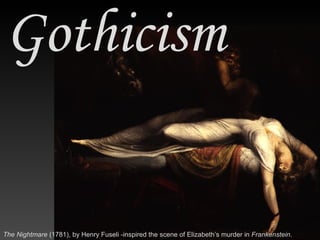
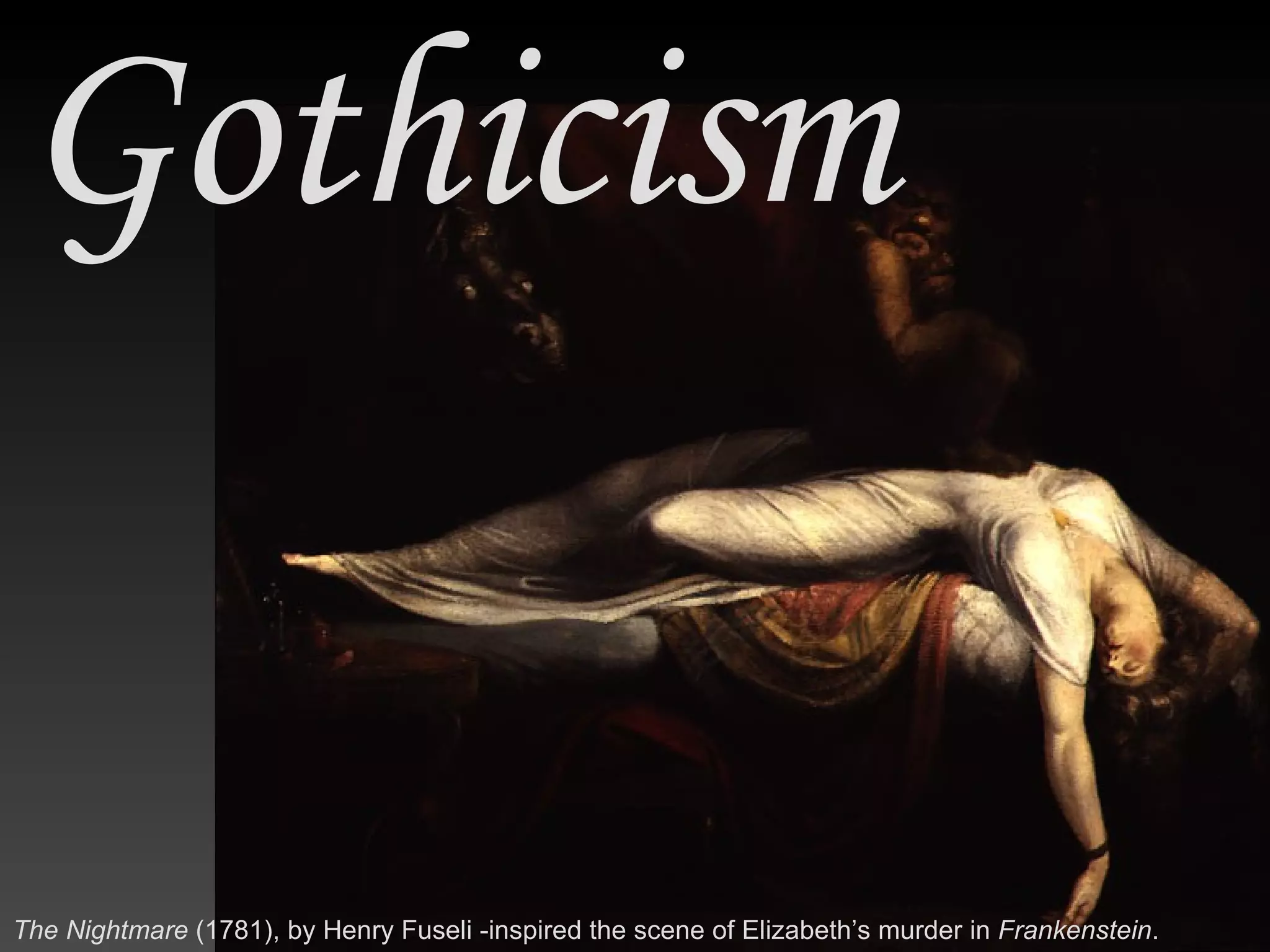
Gothicism The Nightmare  (1781), by  Henry Fuseli -inspired the scene of Elizabeth’s murder in  Frankenstein .
Definitions “ The word “ Gothic ” originally implied “ medieval ,”  but in the later 18 th  cent. its meaning altered until its emphasis lay on the macabre , and the original medieval element was sometimes wholly forgotten.” Gothic Novel: “ Tales of the  macabre, fantastic, and supernatural , usually set amid haunted castles, graveyards, ruins, and wild picturesque landscapes.” -From  The Oxford Companion to English Literature , Fifth Edition Gothic Revival: A revival of the Gothic style of architecture which began in the late 18 th  cent. with a new romantic interest in the medieval […], followed in the 19 th  cent.  by a more scholarly study of Gothic [poetry & prose].
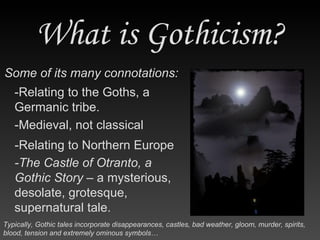
What is Gothicism? Some of its many connotations: Typically, Gothic tales incorporate disappearances, castles, bad weather, gloom, murder, spirits, blood, tension and extremely ominous symbols… -Relating to the Goths, a Germanic tribe. -Medieval, not classical -Relating to Northern Europe -The Castle of Otranto, a Gothic Story  – a mysterious, desolate, grotesque, supernatural tale.
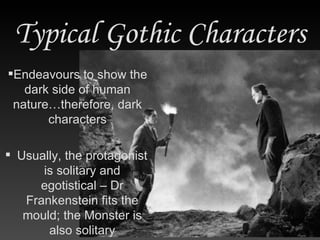
Usually, the protagonist is solitary and egotistical – Dr Frankenstein fits the mould; the Monster is also solitary Typical Gothic Characters Endeavours to show the dark side of human nature…therefore, dark characters
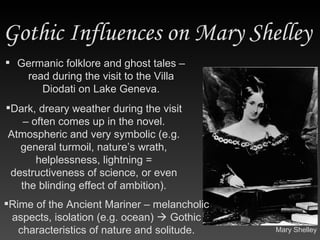
Gothic Influences on Mary Shelley  Germanic folklore and ghost tales – read during the visit to the Villa Diodati on Lake Geneva. Rime of the Ancient Mariner – melancholic aspects, isolation (e.g. ocean)    Gothic characteristics of nature and solitude. Dark, dreary weather during the visit – often comes up in the novel. Atmospheric and very symbolic (e.g. general turmoil, nature’s wrath, helplessness, lightning = destructiveness of science, or even the blinding effect of ambition). Mary Shelley
Gothicism and the Romantics In the late 18 th  cent. it connoted terrifying experiences in ancient castles [subterranean dungeons, secret passageways, flickering lamps, screams, bloody hands, ghosts, graveyards and etc.] Samuel Taylor Coleridge, Romantic poet, author of the  Rime of the Ancient Mariner For British Romantics, literary Gothicism was a type of “imitation medievalism.” By extension, it came to designate the macabre, mysterious, fantastic, and supernatural.
The History of Gothicism In 1764, Walpole produced the first “true” Gothic novel:  The Castle of Otranto: A Gothic Story . In the 1740s the writer Horace Walpole bought Strawberry Hill, an estate on the Thames near London, which was remodelled with turrets to look “Gothick.” This sparked off a fashion for Gothic housing which spread across England and can still be seen today. Its popularity peaked in the 1790s and early 19th century. Otranto’s  Gothic elements: Otranto  was so popular it made the Gothic novel [or the Gothic romance] the most common type of fiction for half a century. -Supernatural happenings: -Haunted castle -Moaning ancestral portrait -Mysterious deaths -A male villain: -Egotistical -Tyrannical -Maniacal -A fair damsel in distress -“Terror, anguish and love.”
Other early Gothic classics - Vathek , by William Beckford (1786) -by Ann Radcliffe: - The Romance of the Forest  (1791) - The Mysteries of Udolpho  (1794) - The Italian  (1797) - The Monk , by Matthew Gregory Lewis (1796) Shared Gothic elements: -Medieval settings [though  Vathek  was in fact rather Oriental] -Blends  terror, cruelty and eroticism -In  The Monk  and Mrs. Radcliffe’s works: -Seduction -Incest/Rape -Matricide/Murder -Diabolism -by C. R. Maturin: -The Fatal Revenge  (1807) - Melmoth the Wanderer  (1820) Jane Austen’s  Northanger Abbey  (1818) and Thomas Love Peacock’s  Nightmare Abbey  (also of 1818) both mock the established form of Gothic romance, and in particular Mrs. Radcliffe’s popular work  The Mysteries of Udolpho.
Many Victorian writers were influenced by Gothic literature.  American writers influenced by Gothic literature are most notably Charles Brocken Brown (early period) [ Wieland ,  Ormund ,  Edgar Huntly ] and Edgar Allen Poe [ The Raven ,  The Pit and the Pendulum ,  William Wilson , and many many morbid more]. Those that followed… Renowned examples are: -The work of the Bront ë  sisters [eg: the scene in Charlotte Bront ë ’s  Jane Eyre  where the old chestnut tree is struck in half by lightening] -That of Charles Dickens [eg: all the events, imagery and symbolism of Miss Havisham in  Great Expectations ]. Modern “Gothic” works: -Mervyn Peake’s  Titus Groan  (1946) and  Gormenghast  (1950) -There are Gothic elements in the work of William Faulkner, McCullers and John Gardner Plath, to name just a few. Note:  Women writers did  fantastically  in this period: Best-selling author: Ann Radcliffe, “Queen of Terror” Most enduring novel: Mary Shelley’s  Frankenstein Most effective parody: Jane Austen’s  Northanger Abbey -compiled by Celia Zhang, Emily Lieu and Ushashi Dasgupta

Gothicism[1]

  • 1.
    Gothicism The Nightmare (1781), by Henry Fuseli -inspired the scene of Elizabeth’s murder in Frankenstein .
  • 2.
    Definitions “ Theword “ Gothic ” originally implied “ medieval ,” but in the later 18 th cent. its meaning altered until its emphasis lay on the macabre , and the original medieval element was sometimes wholly forgotten.” Gothic Novel: “ Tales of the macabre, fantastic, and supernatural , usually set amid haunted castles, graveyards, ruins, and wild picturesque landscapes.” -From The Oxford Companion to English Literature , Fifth Edition Gothic Revival: A revival of the Gothic style of architecture which began in the late 18 th cent. with a new romantic interest in the medieval […], followed in the 19 th cent. by a more scholarly study of Gothic [poetry & prose].
  • 3.
    What is Gothicism?Some of its many connotations: Typically, Gothic tales incorporate disappearances, castles, bad weather, gloom, murder, spirits, blood, tension and extremely ominous symbols… -Relating to the Goths, a Germanic tribe. -Medieval, not classical -Relating to Northern Europe -The Castle of Otranto, a Gothic Story – a mysterious, desolate, grotesque, supernatural tale.
  • 4.
    Usually, the protagonistis solitary and egotistical – Dr Frankenstein fits the mould; the Monster is also solitary Typical Gothic Characters Endeavours to show the dark side of human nature…therefore, dark characters
  • 5.
    Gothic Influences onMary Shelley Germanic folklore and ghost tales – read during the visit to the Villa Diodati on Lake Geneva. Rime of the Ancient Mariner – melancholic aspects, isolation (e.g. ocean)  Gothic characteristics of nature and solitude. Dark, dreary weather during the visit – often comes up in the novel. Atmospheric and very symbolic (e.g. general turmoil, nature’s wrath, helplessness, lightning = destructiveness of science, or even the blinding effect of ambition). Mary Shelley
  • 6.
    Gothicism and theRomantics In the late 18 th cent. it connoted terrifying experiences in ancient castles [subterranean dungeons, secret passageways, flickering lamps, screams, bloody hands, ghosts, graveyards and etc.] Samuel Taylor Coleridge, Romantic poet, author of the Rime of the Ancient Mariner For British Romantics, literary Gothicism was a type of “imitation medievalism.” By extension, it came to designate the macabre, mysterious, fantastic, and supernatural.
  • 7.
    The History ofGothicism In 1764, Walpole produced the first “true” Gothic novel: The Castle of Otranto: A Gothic Story . In the 1740s the writer Horace Walpole bought Strawberry Hill, an estate on the Thames near London, which was remodelled with turrets to look “Gothick.” This sparked off a fashion for Gothic housing which spread across England and can still be seen today. Its popularity peaked in the 1790s and early 19th century. Otranto’s Gothic elements: Otranto was so popular it made the Gothic novel [or the Gothic romance] the most common type of fiction for half a century. -Supernatural happenings: -Haunted castle -Moaning ancestral portrait -Mysterious deaths -A male villain: -Egotistical -Tyrannical -Maniacal -A fair damsel in distress -“Terror, anguish and love.”
  • 8.
    Other early Gothicclassics - Vathek , by William Beckford (1786) -by Ann Radcliffe: - The Romance of the Forest (1791) - The Mysteries of Udolpho (1794) - The Italian (1797) - The Monk , by Matthew Gregory Lewis (1796) Shared Gothic elements: -Medieval settings [though Vathek was in fact rather Oriental] -Blends terror, cruelty and eroticism -In The Monk and Mrs. Radcliffe’s works: -Seduction -Incest/Rape -Matricide/Murder -Diabolism -by C. R. Maturin: -The Fatal Revenge (1807) - Melmoth the Wanderer (1820) Jane Austen’s Northanger Abbey (1818) and Thomas Love Peacock’s Nightmare Abbey (also of 1818) both mock the established form of Gothic romance, and in particular Mrs. Radcliffe’s popular work The Mysteries of Udolpho.
  • 9.
    Many Victorian writerswere influenced by Gothic literature. American writers influenced by Gothic literature are most notably Charles Brocken Brown (early period) [ Wieland , Ormund , Edgar Huntly ] and Edgar Allen Poe [ The Raven , The Pit and the Pendulum , William Wilson , and many many morbid more]. Those that followed… Renowned examples are: -The work of the Bront ë sisters [eg: the scene in Charlotte Bront ë ’s Jane Eyre where the old chestnut tree is struck in half by lightening] -That of Charles Dickens [eg: all the events, imagery and symbolism of Miss Havisham in Great Expectations ]. Modern “Gothic” works: -Mervyn Peake’s Titus Groan (1946) and Gormenghast (1950) -There are Gothic elements in the work of William Faulkner, McCullers and John Gardner Plath, to name just a few. Note: Women writers did fantastically in this period: Best-selling author: Ann Radcliffe, “Queen of Terror” Most enduring novel: Mary Shelley’s Frankenstein Most effective parody: Jane Austen’s Northanger Abbey -compiled by Celia Zhang, Emily Lieu and Ushashi Dasgupta