What’s Your Favorite Scary Movie
 Think about a scary movie you enjoy…
 What happens—plot?
 Where does it take place—the setting?
 Why do people like to be scared?
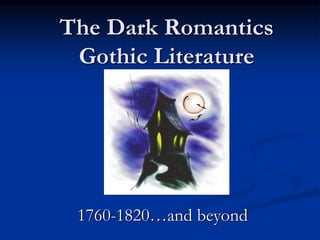
The Dark Romantics
Gothic Literature
1760-1820…and beyond
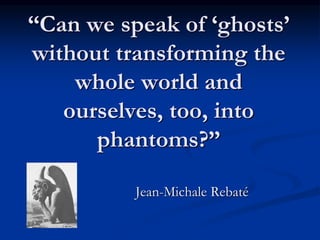
“Can we speak of ‘ghosts’
without transforming the
whole world and
ourselves, too, into
phantoms?”
Jean-Michale Rebaté
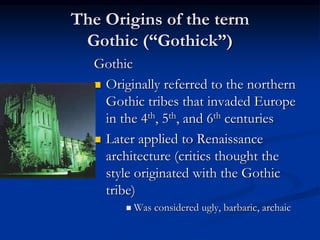
The Origins of the term
Gothic (“Gothick”)
Gothic
 Originally referred to the northern
Gothic tribes that invaded Europe
in the 4th, 5th, and 6th centuries
 Later applied to Renaissance
architecture (critics thought the
style originated with the Gothic
tribe)
 Was considered ugly, barbaric, archaic
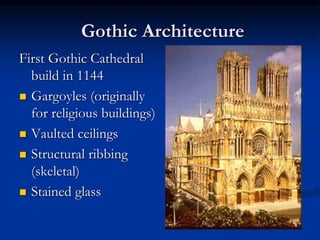
Gothic Architecture
First Gothic Cathedral
build in 1144
 Gargoyles (originally
for religious buildings)
 Vaulted ceilings
 Structural ribbing
(skeletal)
 Stained glass
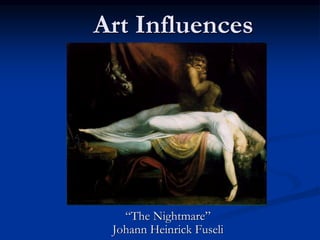
Art Influences
“The Nightmare”
Johann Heinrick Fuseli
The Beginning
 1764- Horace Walpole publishes The Castle of
Otranto: A Gothic Story anonymously
 Contains essentially all the elements associated
with the genre
 Best-seller
 Had remodeled his home in “Gothick” style
 Said that the inspiration of his story was a dream
that was so haunting, he had to write it down
Elements of Gothic Literature
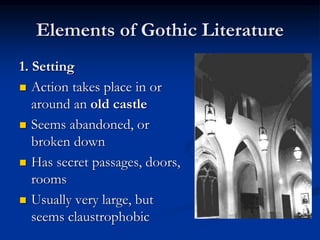
1. Setting
 Action takes place in or
around an old castle
 Seems abandoned, or
broken down
 Has secret passages, doors,
rooms
 Usually very large, but
seems claustrophobic
Elements of Gothic Literature
2. An atmosphere of mystery or suspense
 Feeling of being threatened or fearful
 Plot is built around a mystery (such as unknown
parentage, a disappearance, or some other
inexplicable event)
 This is achieved by the next three elements…
Elements of Gothic Literature
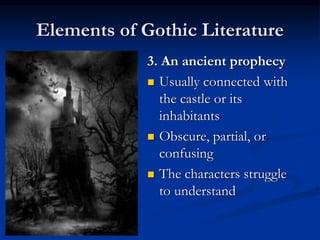
3. An ancient prophecy
 Usually connected with
the castle or its
inhabitants
 Obscure, partial, or
confusing
 The characters struggle
to understand
Elements of Gothic Literature
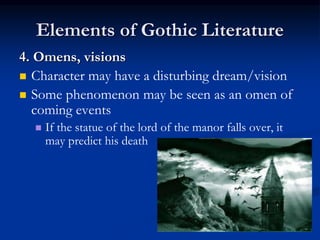
4. Omens, visions
 Character may have a disturbing dream/vision
 Some phenomenon may be seen as an omen of
coming events
 If the statue of the lord of the manor falls over, it
may predict his death
Elements of Gothic Literature
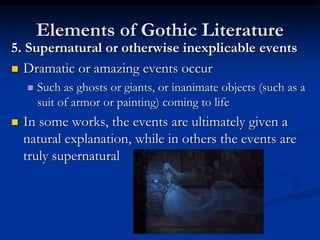
5. Supernatural or otherwise inexplicable events
 Dramatic or amazing events occur
 Such as ghosts or giants, or inanimate objects (such as a
suit of armor or painting) coming to life
 In some works, the events are ultimately given a
natural explanation, while in others the events are
truly supernatural
Elements of Gothic Literature
6. High, overwrought emotion
 Narration may be highly sentimental
 Characters are often overcome by anger,
sorrow, surprise, and especially, terror.
 Suffer from raw nerves and a feelings of
impending doom
 Crying and emotional speeches are frequent
 Breathlessness and panic are common
Elements of Gothic Literature
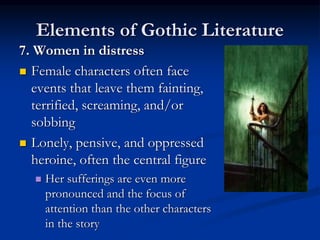
7. Women in distress
 Female characters often face
events that leave them fainting,
terrified, screaming, and/or
sobbing
 Lonely, pensive, and oppressed
heroine, often the central figure
 Her sufferings are even more
pronounced and the focus of
attention than the other characters
in the story
Elements of Gothic Literature
8. Women threatened by a
powerful, tyrannical male
 A male character (king, lord of
the manor, father) has the
power to demand the female
character/s do something
intolerable
 May be commanded to marry
someone she does not love , or
commit a crime, keeps her
locked away
Elements of Gothic Literature
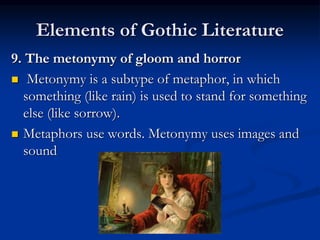
9. The metonymy of gloom and horror
 Metonymy is a subtype of metaphor, in which
something (like rain) is used to stand for something
else (like sorrow).
 Metaphors use words. Metonymy uses images and
sound
Elements of Gothic Literature
 Wind, especially howling
 Doors grating on rusty
hinges
 Footsteps approaching
 Gusts of wind blowing out
lights
 Characters trapped in a
room
 Baying of dogs (or wolves)
 Thunder and/or lightning
 Rain
 Sighs, moans, howls
 Clanking chains
 Lights in abandoned rooms
 Doors suddenly slamming
shut
 Crazed laughter
 Children
Elements of Gothic Literature
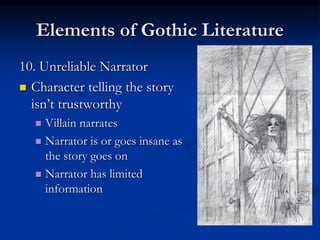
10. Unreliable Narrator
 Character telling the story
isn’t trustworthy
 Villain narrates
 Narrator is or goes insane as
the story goes on
 Narrator has limited
information
Is your movie Gothic?
 Setting
 Mystery
 Ancient prophecy
 Omen/Vision
 Supernatural
 High emotion
 Women in distress
 Women being threatened by man
 Metonymy
 Unreliable narrator
Examples
 The Ring Trailer:
https://www.youtube.com/watch?v=_6HaoRF
gSUw
 GEICO ad:
 https://www.youtube.com/watch?v=AWv-
dIUP9oc
Criticism
Gothic tradition has not been very highly regarded
 Attracted many “big” writers: Keats, Melville,
Faulkner
 but it is usually not these works that are highlighted
 Women also wrote in this genre
 Jane Austin (Northanger Abbey), Mary Wollstonecraft
Shelley (Frankenstein)
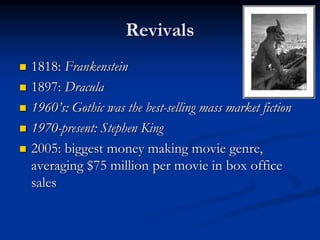
Revivals
 1818: Frankenstein
 1897: Dracula
 1960’s: Gothic was the best-selling mass market fiction
 1970-present: Stephen King
 2005: biggest money making movie genre,
averaging $75 million per movie in box office
sales
The Master: Poe
 Edgar Allan Poe is the master
of gothic literature
 He is famous for this use of
personal tragedies, especially
with women, in his work
 Poe is most popular because
of his mastery of fear,
suspense, and death
Poe’s biography
 As most authors do, Poe used his personal life
as motivation to write
Poe
 With the exception of “The Raven,” not famous in
his own time
 His literary criticism made him more enemies
 He didn’t make much money on his writing
 Died of unknown causes, destitute and alone
 Shortly after his death, rival author/frenemy
Rufus Griswold set out to ruin Poe's reputation
with a lurid biography that painted him as a drug
user and madman. The scheme backfired when
Poe's sales skyrocketed and a legend was born.
Works Used
 Bayer-Berenbaum, Linda. “Elements of a Gothic.” Horror. Ed. Michael Stuprich. San Diego:
Greenhaven Press, 2001. 72-83.
 “Door: Metal: Squeaky Metal Restroom Door in Building: Close: Slow Creak.” Sound Ideas. 2007.
Unitedstreaming. 17 April 2007. http://www.unitedstreaming.com/>.
 The Gothic Imagination. Ruthford: Associated University Press, Ltd., 1982.
 “Gothic Architecture.” Wikipedia Online. 2005. 6 March 2005
http://en.wikipedia.org/wiki/Gothic_architecture.
 Harris, Robert. “Elements of the Gothic Novel.” VirtualSalt. 2005. 6 March 2005.
http://www.virtualsalt.com/gothic.htm.
 Williams, Anne. “The Gothic Novel.” Horror. Ed. Michael Stuprich. San Diego:
Greenhaven Press, 2001. 62-71.
 Wolfreys, Julian. Victoria Haunting: Spectrality, Gothic, the Uncanny and Literature.
Houndsmills: Palgrave, 2001.

358195046-gothic-presentation.ppt

  • 1.
    What’s Your FavoriteScary Movie  Think about a scary movie you enjoy…  What happens—plot?  Where does it take place—the setting?  Why do people like to be scared?
  • 2.
    The Dark Romantics GothicLiterature 1760-1820…and beyond
  • 3.
    “Can we speakof ‘ghosts’ without transforming the whole world and ourselves, too, into phantoms?” Jean-Michale Rebaté
  • 4.
    The Origins ofthe term Gothic (“Gothick”) Gothic  Originally referred to the northern Gothic tribes that invaded Europe in the 4th, 5th, and 6th centuries  Later applied to Renaissance architecture (critics thought the style originated with the Gothic tribe)  Was considered ugly, barbaric, archaic
  • 5.
    Gothic Architecture First GothicCathedral build in 1144  Gargoyles (originally for religious buildings)  Vaulted ceilings  Structural ribbing (skeletal)  Stained glass
  • 6.
  • 7.
    The Beginning  1764-Horace Walpole publishes The Castle of Otranto: A Gothic Story anonymously  Contains essentially all the elements associated with the genre  Best-seller  Had remodeled his home in “Gothick” style  Said that the inspiration of his story was a dream that was so haunting, he had to write it down
  • 8.
    Elements of GothicLiterature 1. Setting  Action takes place in or around an old castle  Seems abandoned, or broken down  Has secret passages, doors, rooms  Usually very large, but seems claustrophobic
  • 9.
    Elements of GothicLiterature 2. An atmosphere of mystery or suspense  Feeling of being threatened or fearful  Plot is built around a mystery (such as unknown parentage, a disappearance, or some other inexplicable event)  This is achieved by the next three elements…
  • 10.
    Elements of GothicLiterature 3. An ancient prophecy  Usually connected with the castle or its inhabitants  Obscure, partial, or confusing  The characters struggle to understand
  • 11.
    Elements of GothicLiterature 4. Omens, visions  Character may have a disturbing dream/vision  Some phenomenon may be seen as an omen of coming events  If the statue of the lord of the manor falls over, it may predict his death
  • 12.
    Elements of GothicLiterature 5. Supernatural or otherwise inexplicable events  Dramatic or amazing events occur  Such as ghosts or giants, or inanimate objects (such as a suit of armor or painting) coming to life  In some works, the events are ultimately given a natural explanation, while in others the events are truly supernatural
  • 13.
    Elements of GothicLiterature 6. High, overwrought emotion  Narration may be highly sentimental  Characters are often overcome by anger, sorrow, surprise, and especially, terror.  Suffer from raw nerves and a feelings of impending doom  Crying and emotional speeches are frequent  Breathlessness and panic are common
  • 14.
    Elements of GothicLiterature 7. Women in distress  Female characters often face events that leave them fainting, terrified, screaming, and/or sobbing  Lonely, pensive, and oppressed heroine, often the central figure  Her sufferings are even more pronounced and the focus of attention than the other characters in the story
  • 15.
    Elements of GothicLiterature 8. Women threatened by a powerful, tyrannical male  A male character (king, lord of the manor, father) has the power to demand the female character/s do something intolerable  May be commanded to marry someone she does not love , or commit a crime, keeps her locked away
  • 16.
    Elements of GothicLiterature 9. The metonymy of gloom and horror  Metonymy is a subtype of metaphor, in which something (like rain) is used to stand for something else (like sorrow).  Metaphors use words. Metonymy uses images and sound
  • 17.
    Elements of GothicLiterature  Wind, especially howling  Doors grating on rusty hinges  Footsteps approaching  Gusts of wind blowing out lights  Characters trapped in a room  Baying of dogs (or wolves)  Thunder and/or lightning  Rain  Sighs, moans, howls  Clanking chains  Lights in abandoned rooms  Doors suddenly slamming shut  Crazed laughter  Children
  • 18.
    Elements of GothicLiterature 10. Unreliable Narrator  Character telling the story isn’t trustworthy  Villain narrates  Narrator is or goes insane as the story goes on  Narrator has limited information
  • 19.
    Is your movieGothic?  Setting  Mystery  Ancient prophecy  Omen/Vision  Supernatural  High emotion  Women in distress  Women being threatened by man  Metonymy  Unreliable narrator
  • 20.
    Examples  The RingTrailer: https://www.youtube.com/watch?v=_6HaoRF gSUw  GEICO ad:  https://www.youtube.com/watch?v=AWv- dIUP9oc
  • 21.
    Criticism Gothic tradition hasnot been very highly regarded  Attracted many “big” writers: Keats, Melville, Faulkner  but it is usually not these works that are highlighted  Women also wrote in this genre  Jane Austin (Northanger Abbey), Mary Wollstonecraft Shelley (Frankenstein)
  • 22.
    Revivals  1818: Frankenstein 1897: Dracula  1960’s: Gothic was the best-selling mass market fiction  1970-present: Stephen King  2005: biggest money making movie genre, averaging $75 million per movie in box office sales
  • 23.
    The Master: Poe Edgar Allan Poe is the master of gothic literature  He is famous for this use of personal tragedies, especially with women, in his work  Poe is most popular because of his mastery of fear, suspense, and death
  • 25.
    Poe’s biography  Asmost authors do, Poe used his personal life as motivation to write
  • 27.
    Poe  With theexception of “The Raven,” not famous in his own time  His literary criticism made him more enemies  He didn’t make much money on his writing  Died of unknown causes, destitute and alone  Shortly after his death, rival author/frenemy Rufus Griswold set out to ruin Poe's reputation with a lurid biography that painted him as a drug user and madman. The scheme backfired when Poe's sales skyrocketed and a legend was born.
  • 28.
    Works Used  Bayer-Berenbaum,Linda. “Elements of a Gothic.” Horror. Ed. Michael Stuprich. San Diego: Greenhaven Press, 2001. 72-83.  “Door: Metal: Squeaky Metal Restroom Door in Building: Close: Slow Creak.” Sound Ideas. 2007. Unitedstreaming. 17 April 2007. http://www.unitedstreaming.com/>.  The Gothic Imagination. Ruthford: Associated University Press, Ltd., 1982.  “Gothic Architecture.” Wikipedia Online. 2005. 6 March 2005 http://en.wikipedia.org/wiki/Gothic_architecture.  Harris, Robert. “Elements of the Gothic Novel.” VirtualSalt. 2005. 6 March 2005. http://www.virtualsalt.com/gothic.htm.  Williams, Anne. “The Gothic Novel.” Horror. Ed. Michael Stuprich. San Diego: Greenhaven Press, 2001. 62-71.  Wolfreys, Julian. Victoria Haunting: Spectrality, Gothic, the Uncanny and Literature. Houndsmills: Palgrave, 2001.