Gore returns with a vengeance
“gore-nography” or “torture porn”
in the 2000s
A little bit of history
Torture
“It’s the moral antithesis of what we want to
stand for as a country”.
– Sgt Erik Saar, US Army translator, Guantanamo Bay
“The act of torture represents the ultimate
corruption of power; the torturer has absolute
dominance over their victim, they control pain,
which is often of far more consequence than
death”.
–horrorfilmhistory.com
A little bit of history
“David Edelstein coined the term torture porn in
the January 2006 New Yorker, suggesting that
we engage with these kind of movies on a purely
visceral level, all considerations of story and
character aside”.
-horrorfilmhistory.com
Visceral = base/coarse (of the gut/stomach)
A little bit of history
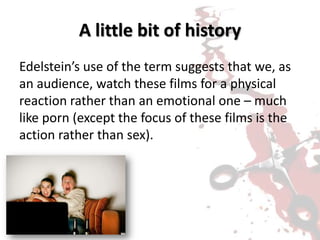
Edelstein’s use of the term suggests that we, as
an audience, watch these films for a physical
reaction rather than an emotional one – much
like porn (except the focus of these films is the
action rather than sex).
Torture
During the mid 2000s, many films were released
that contained “startlingly graphic
representations of torture: Hostel, Wolf Creek,
The Devil’s Rejects, Saw I-V”.
Using torture as a premise or theme in horror is
not new (damsels tied to railway tracks etc.) but
the way it is portrayed is. It suddenly became
very ‘real’.
Torture
In 2004 reports surfaced in which the US Army
was accused of torturing prisoners. Shortly
after, the treatment of detainees at
Guantanamo Bay was target of an FBI
investigation and the findings concluded that
prisoners were “subject to […] food
deprivation, heat/cold exposure, water
immersion, enforced immobilisation and forced
feeding”.
Suddenly torture was very real and very topical.
Realism
Although the themes and characters of previous
films are identifiable in the no holds barred
nastiness of the 2000s, there is one particular
element that sets them apart; the realistic
settings and locations.
In the cinema you may feel safe watching these
horrific scenes happening to someone else but
when you leave, the settings are recognisable
and the locations familiar.
Realism
The nasty, violent and gory horror films of the
‘naughties’ are striving for aesthetic realism;
when a limb is hacked from someone’s body or
if a character is impaled on some object, the
blood and gore is not comic or over-the-top, it
has been designed to look ‘real’.
“Little is left to the imagination; the sequences
[…] are all about the details”.
-horrorfilmhistory.com
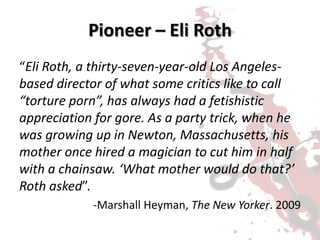
Pioneer – Eli Roth
“Eli Roth, a thirty-seven-year-old Los Angeles-
based director of what some critics like to call
“torture porn”, has always had a fetishistic
appreciation for gore. As a party trick, when he
was growing up in Newton, Massachusetts, his
mother once hired a magician to cut him in half
with a chainsaw. ‘What mother would do that?’
Roth asked”.
-Marshall Heyman, The New Yorker. 2009
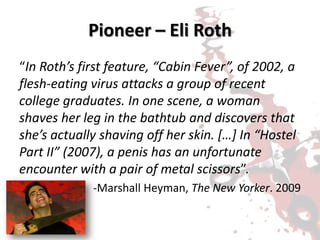
Pioneer – Eli Roth
“In Roth’s first feature, “Cabin Fever”, of 2002, a
flesh-eating virus attacks a group of recent
college graduates. In one scene, a woman
shaves her leg in the bathtub and discovers that
she’s actually shaving off her skin. *…+ In “Hostel
Part II” (2007), a penis has an unfortunate
encounter with a pair of metal scissors”.
-Marshall Heyman, The New Yorker. 2009
Crossing the line – the end?
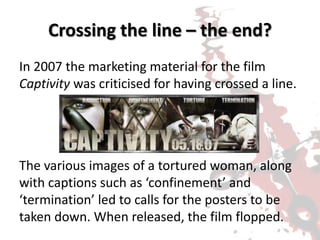
In 2007 the marketing material for the film
Captivity was criticised for having crossed a line.
The various images of a tortured woman, along
with captions such as ‘confinement’ and
‘termination’ led to calls for the posters to be
taken down. When released, the film flopped.
The end of gore-nography?
Although torture made it into several other big
budget movies and popular TV shows in the
2000s, such as Casino Royale and 24, the
demand for it might be viewed as having fizzled
out by the end of the decade. Hostel II made
$50 million less than it’s predecessor (although
the heavy piracy also played a big part) and the
highest grossing film of 2007 was 1408, a
supernatural tale with a notable lack of torture.
Key ‘gorno’ texts
Saw (Wan, 2004)
Hostel (Roth, 2005)
Saw II (Bousman, 2005)
Wolf Creek (McLean, 2005)
Hostel II (Roth, 2007)
Captivity (Joffe, 2007)
Saw V (Hacki, 2008)
Hostel III (Spiegel, video release 2011)

Gorenography

  • 1.
    Gore returns witha vengeance “gore-nography” or “torture porn” in the 2000s
  • 2.
    A little bitof history Torture “It’s the moral antithesis of what we want to stand for as a country”. – Sgt Erik Saar, US Army translator, Guantanamo Bay “The act of torture represents the ultimate corruption of power; the torturer has absolute dominance over their victim, they control pain, which is often of far more consequence than death”. –horrorfilmhistory.com
  • 3.
    A little bitof history “David Edelstein coined the term torture porn in the January 2006 New Yorker, suggesting that we engage with these kind of movies on a purely visceral level, all considerations of story and character aside”. -horrorfilmhistory.com Visceral = base/coarse (of the gut/stomach)
  • 4.
    A little bitof history Edelstein’s use of the term suggests that we, as an audience, watch these films for a physical reaction rather than an emotional one – much like porn (except the focus of these films is the action rather than sex).
  • 5.
    Torture During the mid2000s, many films were released that contained “startlingly graphic representations of torture: Hostel, Wolf Creek, The Devil’s Rejects, Saw I-V”. Using torture as a premise or theme in horror is not new (damsels tied to railway tracks etc.) but the way it is portrayed is. It suddenly became very ‘real’.
  • 6.
    Torture In 2004 reportssurfaced in which the US Army was accused of torturing prisoners. Shortly after, the treatment of detainees at Guantanamo Bay was target of an FBI investigation and the findings concluded that prisoners were “subject to […] food deprivation, heat/cold exposure, water immersion, enforced immobilisation and forced feeding”. Suddenly torture was very real and very topical.
  • 7.
    Realism Although the themesand characters of previous films are identifiable in the no holds barred nastiness of the 2000s, there is one particular element that sets them apart; the realistic settings and locations. In the cinema you may feel safe watching these horrific scenes happening to someone else but when you leave, the settings are recognisable and the locations familiar.
  • 8.
    Realism The nasty, violentand gory horror films of the ‘naughties’ are striving for aesthetic realism; when a limb is hacked from someone’s body or if a character is impaled on some object, the blood and gore is not comic or over-the-top, it has been designed to look ‘real’. “Little is left to the imagination; the sequences […] are all about the details”. -horrorfilmhistory.com
  • 9.
    Pioneer – EliRoth “Eli Roth, a thirty-seven-year-old Los Angeles- based director of what some critics like to call “torture porn”, has always had a fetishistic appreciation for gore. As a party trick, when he was growing up in Newton, Massachusetts, his mother once hired a magician to cut him in half with a chainsaw. ‘What mother would do that?’ Roth asked”. -Marshall Heyman, The New Yorker. 2009
  • 10.
    Pioneer – EliRoth “In Roth’s first feature, “Cabin Fever”, of 2002, a flesh-eating virus attacks a group of recent college graduates. In one scene, a woman shaves her leg in the bathtub and discovers that she’s actually shaving off her skin. *…+ In “Hostel Part II” (2007), a penis has an unfortunate encounter with a pair of metal scissors”. -Marshall Heyman, The New Yorker. 2009
  • 11.
    Crossing the line– the end? In 2007 the marketing material for the film Captivity was criticised for having crossed a line. The various images of a tortured woman, along with captions such as ‘confinement’ and ‘termination’ led to calls for the posters to be taken down. When released, the film flopped.
  • 12.
    The end ofgore-nography? Although torture made it into several other big budget movies and popular TV shows in the 2000s, such as Casino Royale and 24, the demand for it might be viewed as having fizzled out by the end of the decade. Hostel II made $50 million less than it’s predecessor (although the heavy piracy also played a big part) and the highest grossing film of 2007 was 1408, a supernatural tale with a notable lack of torture.
  • 13.
    Key ‘gorno’ texts Saw(Wan, 2004) Hostel (Roth, 2005) Saw II (Bousman, 2005) Wolf Creek (McLean, 2005) Hostel II (Roth, 2007) Captivity (Joffe, 2007) Saw V (Hacki, 2008) Hostel III (Spiegel, video release 2011)