1930’S
History of horror
SOUND
 Horror movies were reborn in the 1930s. The advent of sound, as well as
changing the whole nature of cinema forever, had a huge impact on the horror
genre. The dreamlike imagery of the 1920s was replaced by monsters. Sound adds
an extra dimension to terror, whether it be music used to build suspense or signal
the presence of a threat, or magnified footsteps echoing down a corridor. This was
also despite the struggle that many of the major players - such as director Tod
Browning - had to adapt to the new medium. Making talking pictures was a very
different process to producing silent movies and, watching today, some of the early
efforts seem very awkward.
1930 HORROR CONTENT
 The horror films of the 1930s are exotic fairy tales, invariably set in some far-
off land peopled by characters in period costume speaking in strange accents.
Horror was still essentially looking backwards, drawing upon the literary classics of
the 19th century for their source material. Audiences seemed even more enthusiastic
about the horror genre than in the 1920s, and flocked into cinemas to be scared by
largely supernatural monsters wreaking havoc, events far removed from the
everyday realities of Depression and approaching war. 80 million people attended
the cinema on a weekly basis in 1930, some 65% of the total US population.
1930 HORROR
 During the early period of talking pictures, the American Movie studio Universal
Pictures began a successful Gothic horror film series. Tod Browning's Dracula
(1931), with Bela Lugosi, also James Whale's Frankenstein (also 1931). Some of these
films blended science fiction with Gothic horror, such as Whale's The Invisible Man
(1933) and, mirroring the earlier German films, featured a mad scientist. These
films, while designed to thrill, also incorporated more serious elements. Make-up artist
Jack Pierce was responsible for the iconic image of the monster, and others in the series.
Universal's horror cycle continued into the 1940s as B-pictures including The Wolf Man
(1941). With the progression of the genre, actors were beginning to build entire careers in
such films, most especially Boris Karloff and Bela Lugosi.
FRANKENSTEIN
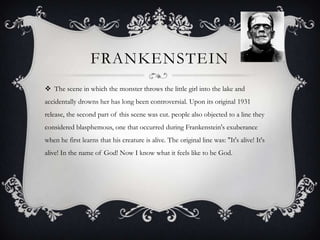
 The scene in which the monster throws the little girl into the lake and
accidentally drowns her has long been controversial. Upon its original 1931
release, the second part of this scene was cut. people also objected to a line they
considered blasphemous, one that occurred during Frankenstein's exuberance
when he first learns that his creature is alive. The original line was: "It's alive! It's
alive! In the name of God! Now I know what it feels like to be God.
FRANKENSTEIN
 As with many Pre-Code films that were reissued after strict enforcement of the
Production Code in 1934, Universal made cuts from the master negative. They cut:
 Frankenstein's line, "Now I know what it feels like to be God!“.
 Some footage of Frankenstein's assistant Fritz scaring the monster by waving a
lit torch near him while the monster is shackled in chains.
 Close up of needle injection was removed.
 In the scene of the monster and the little girl tossing flowers into the lake, the
second part of the scene was cut, beginning at the moment he extends his hands to
pick her up.
HORROR TRAILERS
 http://www.youtube.com/watch?v=BN8K-4osNb0
 http://www.youtube.com/watch?v=Skyuybdkb4w

1930’s horror

  • 1.
  • 2.
    SOUND  Horror movieswere reborn in the 1930s. The advent of sound, as well as changing the whole nature of cinema forever, had a huge impact on the horror genre. The dreamlike imagery of the 1920s was replaced by monsters. Sound adds an extra dimension to terror, whether it be music used to build suspense or signal the presence of a threat, or magnified footsteps echoing down a corridor. This was also despite the struggle that many of the major players - such as director Tod Browning - had to adapt to the new medium. Making talking pictures was a very different process to producing silent movies and, watching today, some of the early efforts seem very awkward.
  • 3.
    1930 HORROR CONTENT The horror films of the 1930s are exotic fairy tales, invariably set in some far- off land peopled by characters in period costume speaking in strange accents. Horror was still essentially looking backwards, drawing upon the literary classics of the 19th century for their source material. Audiences seemed even more enthusiastic about the horror genre than in the 1920s, and flocked into cinemas to be scared by largely supernatural monsters wreaking havoc, events far removed from the everyday realities of Depression and approaching war. 80 million people attended the cinema on a weekly basis in 1930, some 65% of the total US population.
  • 4.
    1930 HORROR  Duringthe early period of talking pictures, the American Movie studio Universal Pictures began a successful Gothic horror film series. Tod Browning's Dracula (1931), with Bela Lugosi, also James Whale's Frankenstein (also 1931). Some of these films blended science fiction with Gothic horror, such as Whale's The Invisible Man (1933) and, mirroring the earlier German films, featured a mad scientist. These films, while designed to thrill, also incorporated more serious elements. Make-up artist Jack Pierce was responsible for the iconic image of the monster, and others in the series. Universal's horror cycle continued into the 1940s as B-pictures including The Wolf Man (1941). With the progression of the genre, actors were beginning to build entire careers in such films, most especially Boris Karloff and Bela Lugosi.
  • 5.
    FRANKENSTEIN  The scenein which the monster throws the little girl into the lake and accidentally drowns her has long been controversial. Upon its original 1931 release, the second part of this scene was cut. people also objected to a line they considered blasphemous, one that occurred during Frankenstein's exuberance when he first learns that his creature is alive. The original line was: "It's alive! It's alive! In the name of God! Now I know what it feels like to be God.
  • 6.
    FRANKENSTEIN  As withmany Pre-Code films that were reissued after strict enforcement of the Production Code in 1934, Universal made cuts from the master negative. They cut:  Frankenstein's line, "Now I know what it feels like to be God!“.  Some footage of Frankenstein's assistant Fritz scaring the monster by waving a lit torch near him while the monster is shackled in chains.  Close up of needle injection was removed.  In the scene of the monster and the little girl tossing flowers into the lake, the second part of the scene was cut, beginning at the moment he extends his hands to pick her up.
  • 7.