
By,
Aparna.N.K
Roll.No:1
S3 MCA
 Introduction
 Components
 Operating System
 How Google Glass work?
 What makes it work?
 Applications
 Advantages
 Disadvantages
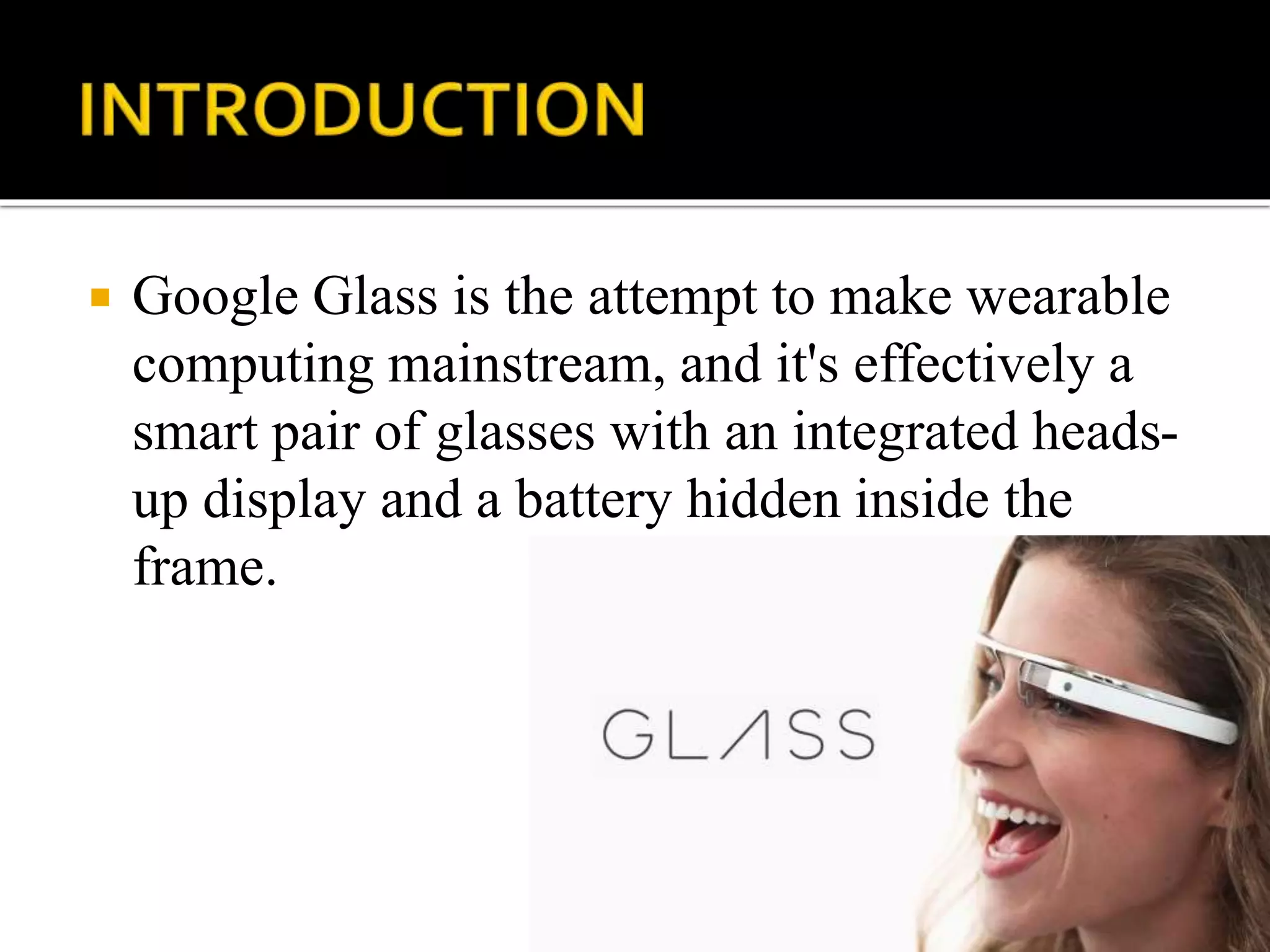
 Google Glass is the attempt to make wearable
computing mainstream, and it's effectively a
smart pair of glasses with an integrated heads-
up display and a battery hidden inside the
frame.
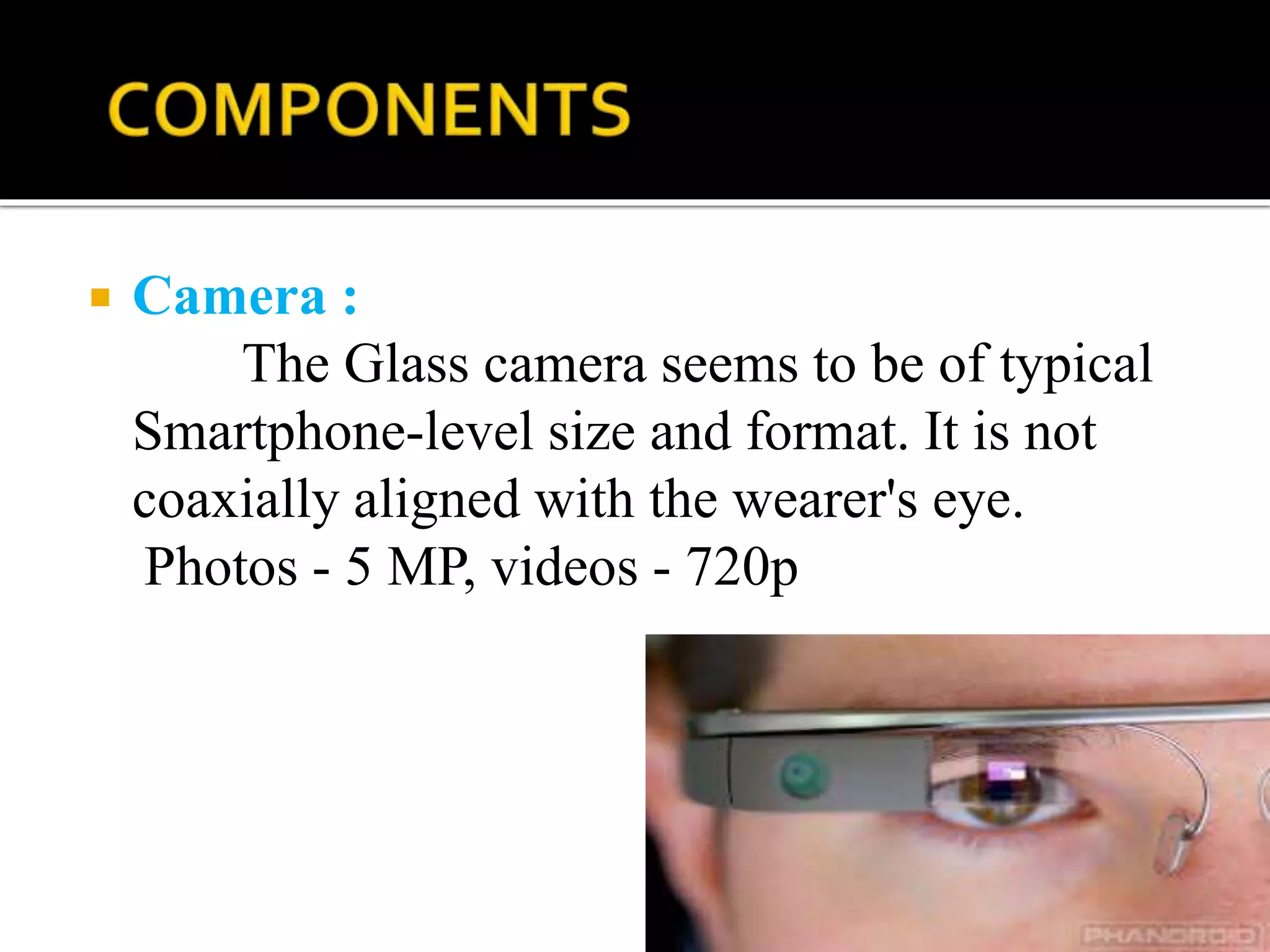
 Camera :
The Glass camera seems to be of typical
Smartphone-level size and format. It is not
coaxially aligned with the wearer's eye.
Photos - 5 MP, videos - 720p
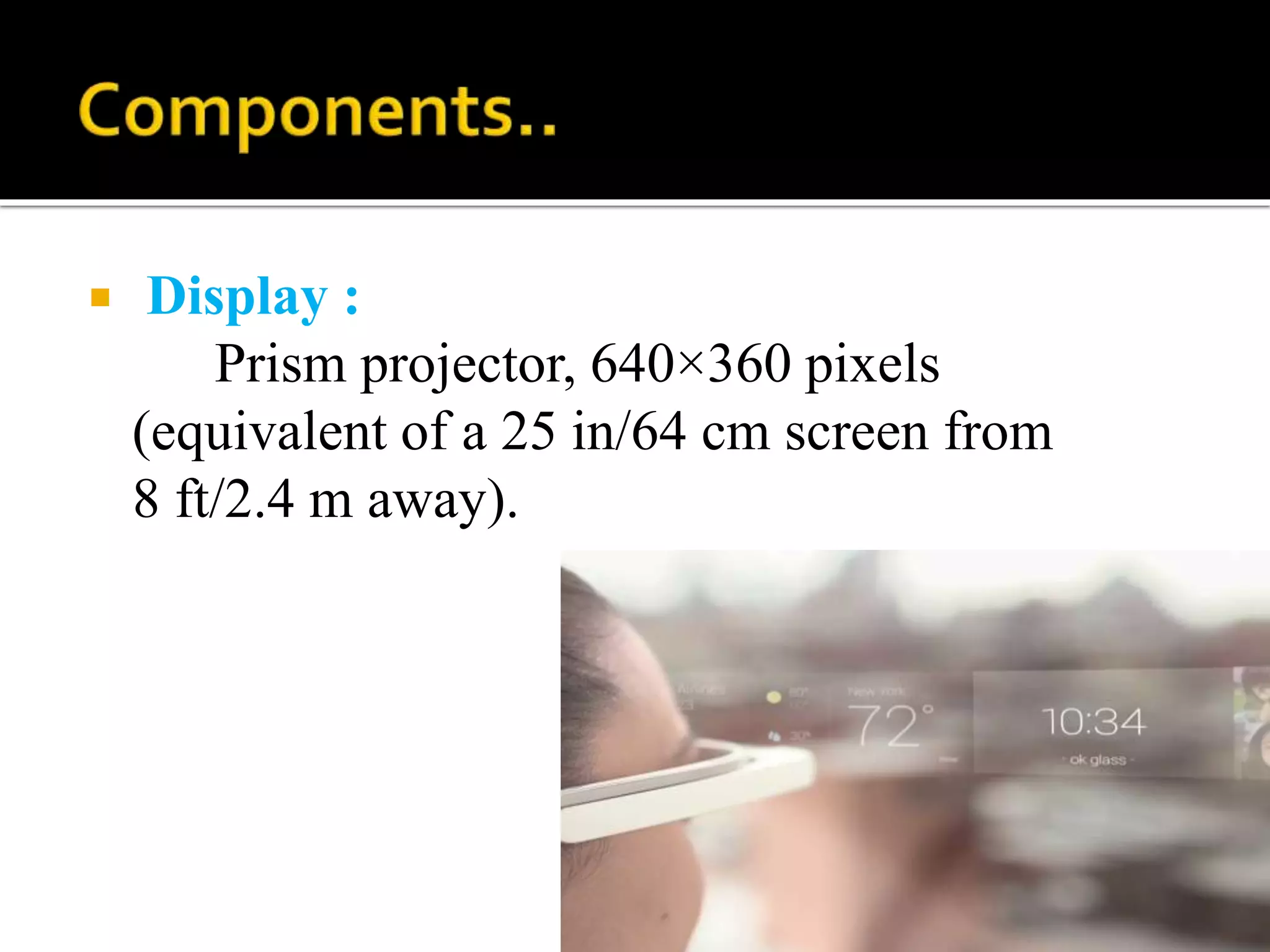
 Display :
Prism projector, 640×360 pixels
(equivalent of a 25 in/64 cm screen from
8 ft/2.4 m away).
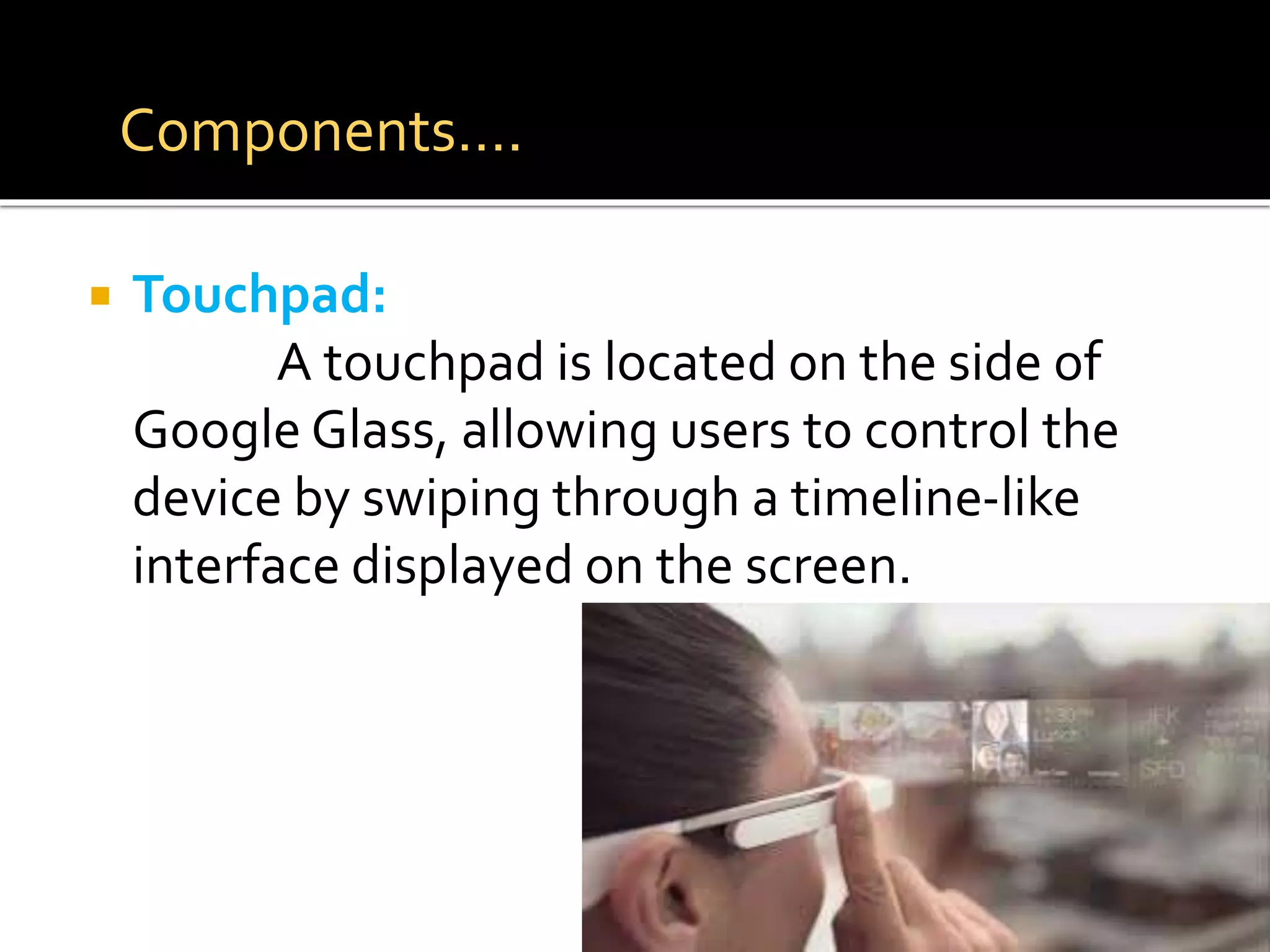
 Touchpad:
A touchpad is located on the side of
Google Glass, allowing users to control the
device by swiping through a timeline-like
interface displayed on the screen.
Components….
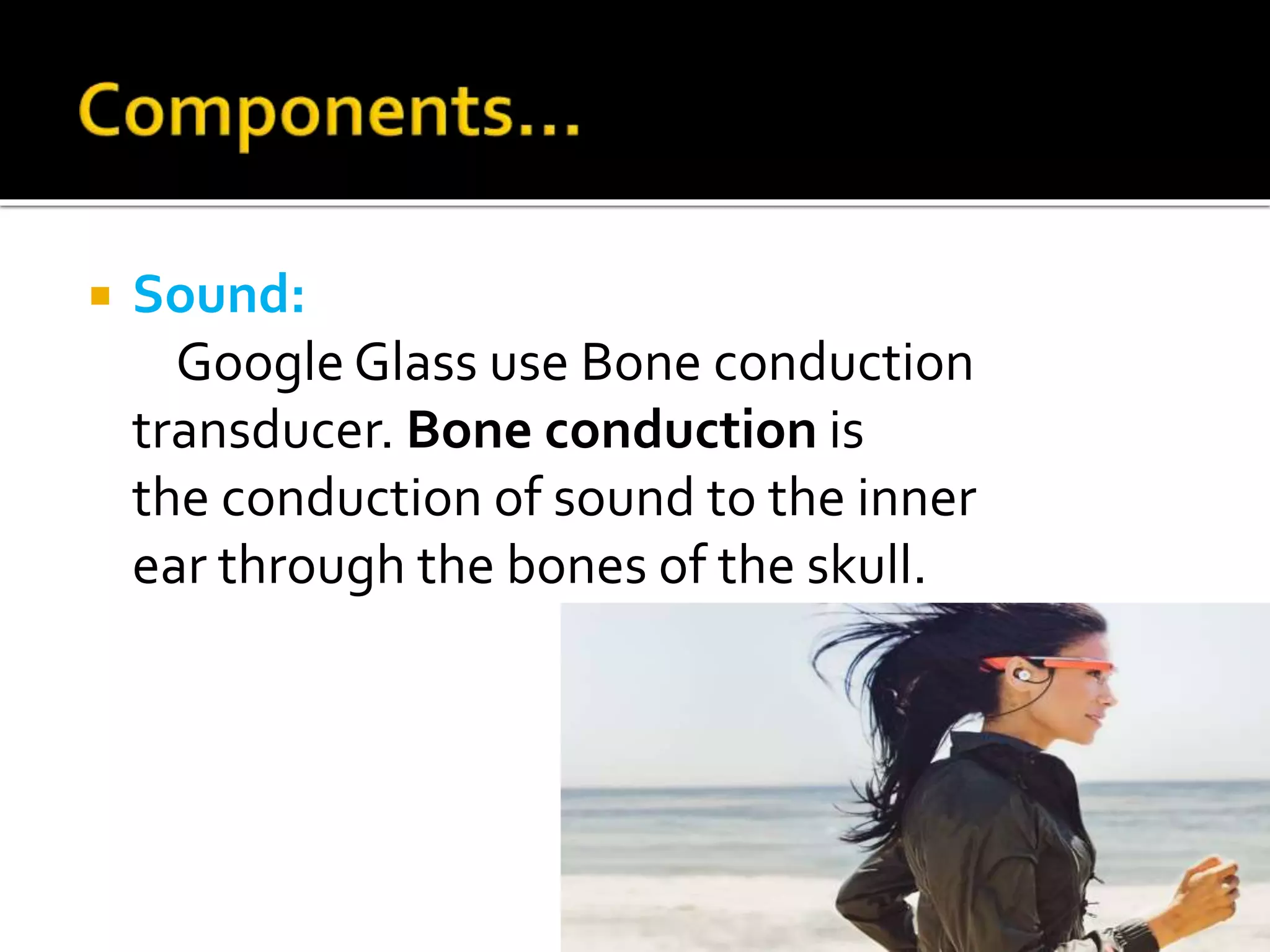
 Sound:
Google Glass use Bone conduction
transducer. Bone conduction is
the conduction of sound to the inner
ear through the bones of the skull.
 Input:
Other than touchpad Google Glass use Voice
command through microphone,
accelerometer, gyroscope, magnetometer,
ambient light sensor, proximity sensor… as input.
Components…
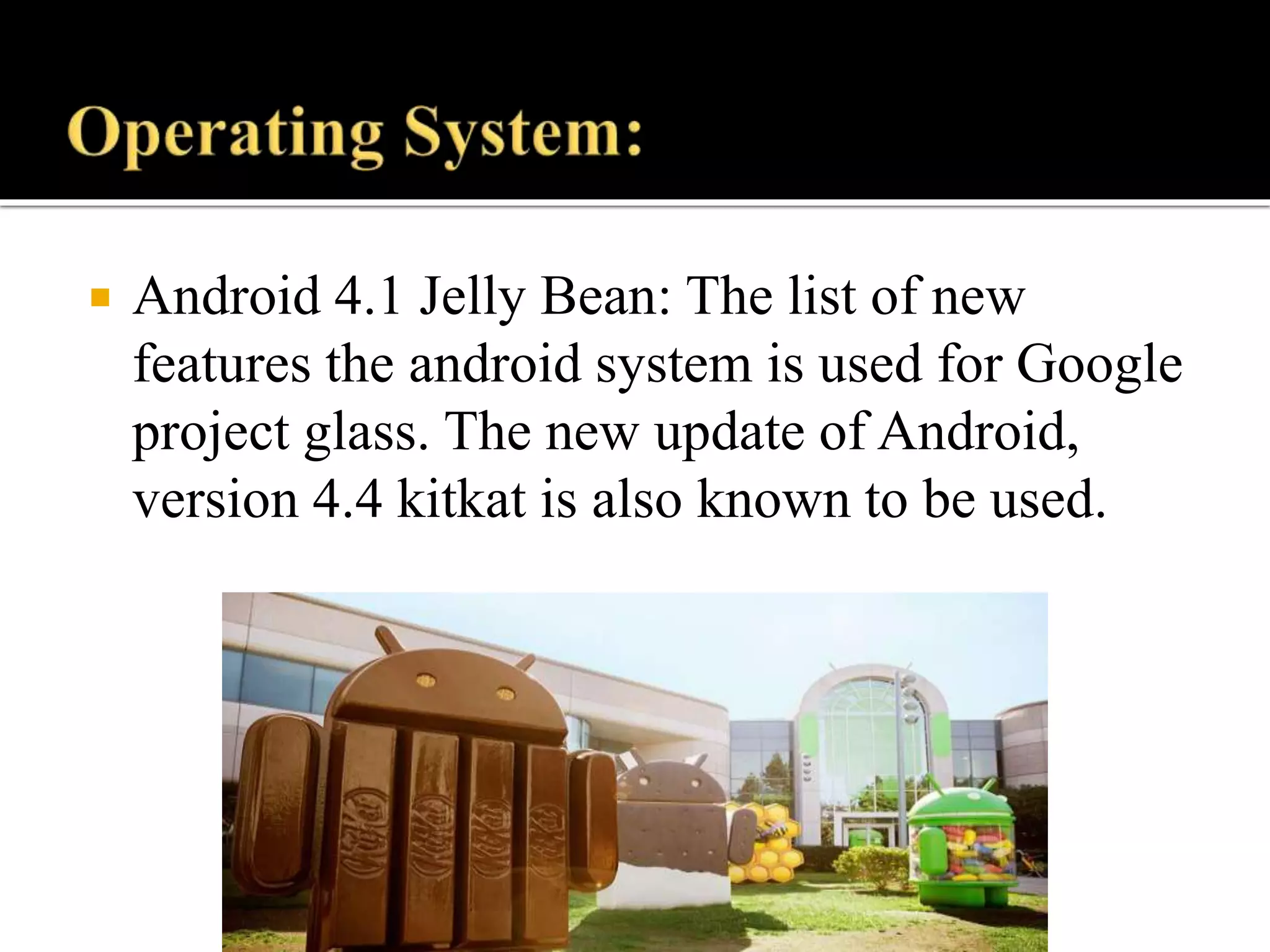
 Android 4.1 Jelly Bean: The list of new
features the android system is used for Google
project glass. The new update of Android,
version 4.4 kitkat is also known to be used.
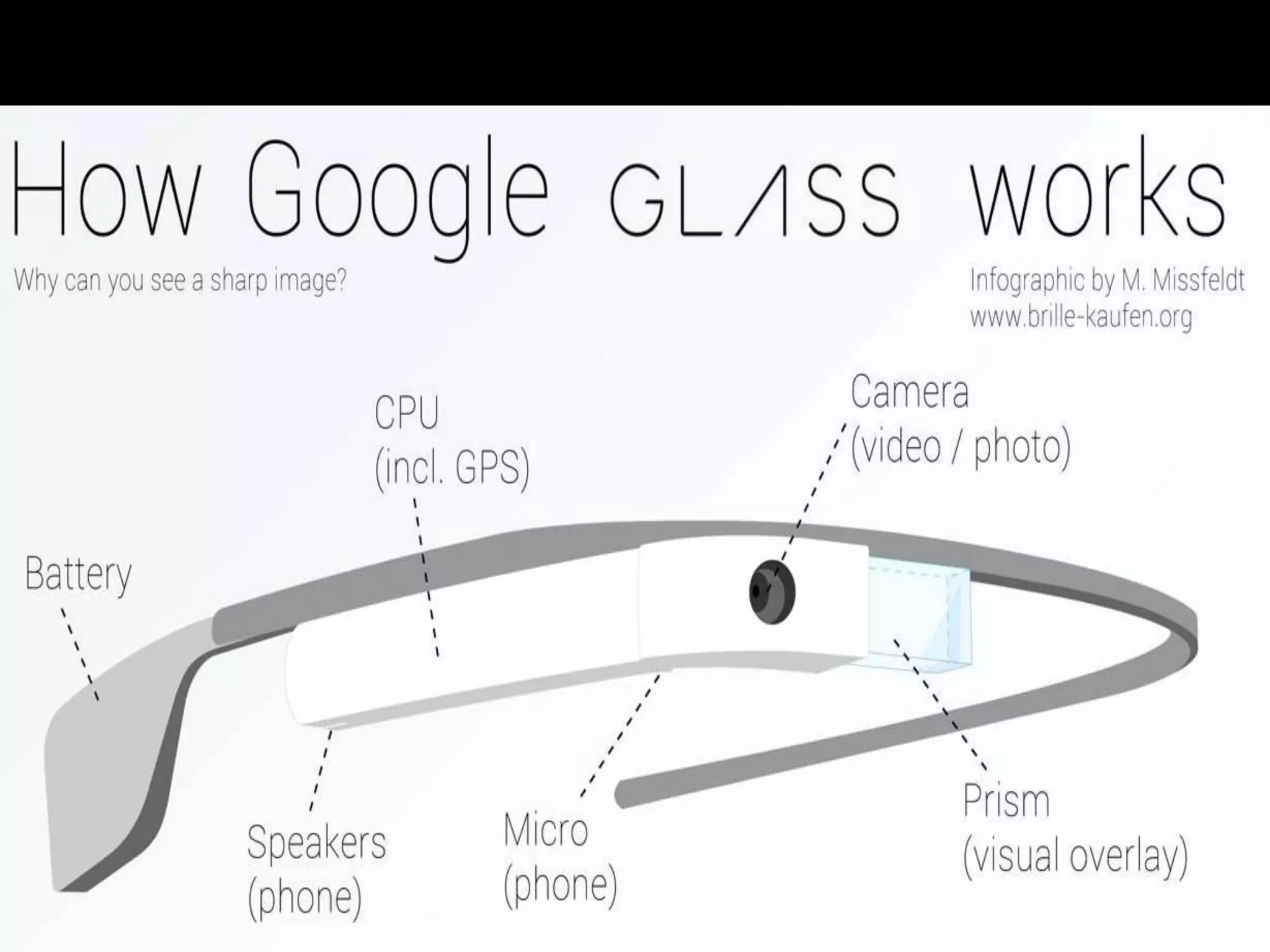
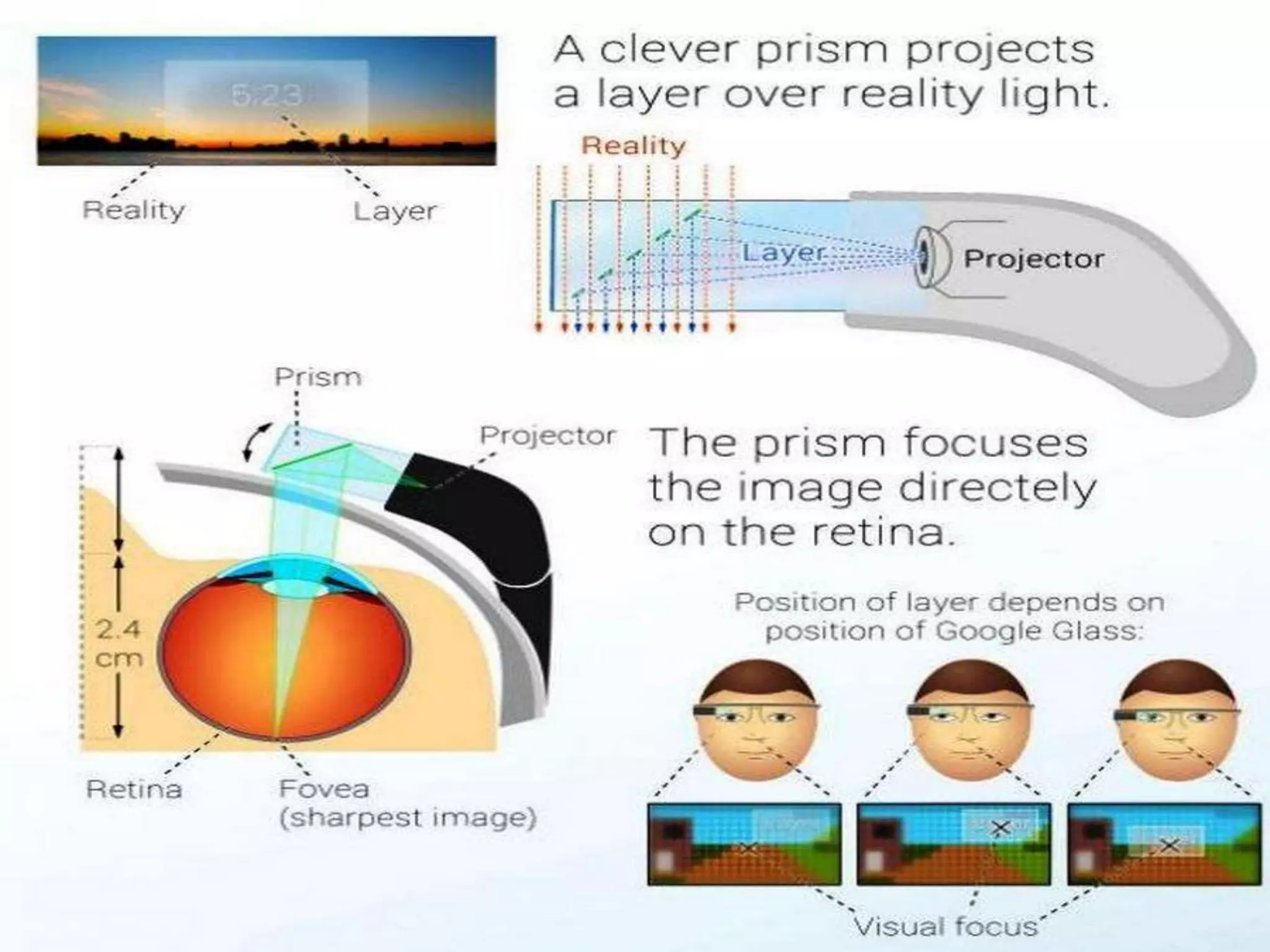
Google Glass contains the fundamental
bits of any computer, including a CPU,
sensors such as GPS, speakers, microphone
and battery, to which are added a tiny
projector and a prism that redirects the light
onto your retina.
Generally it uses voice recognition
technology to access the menu.
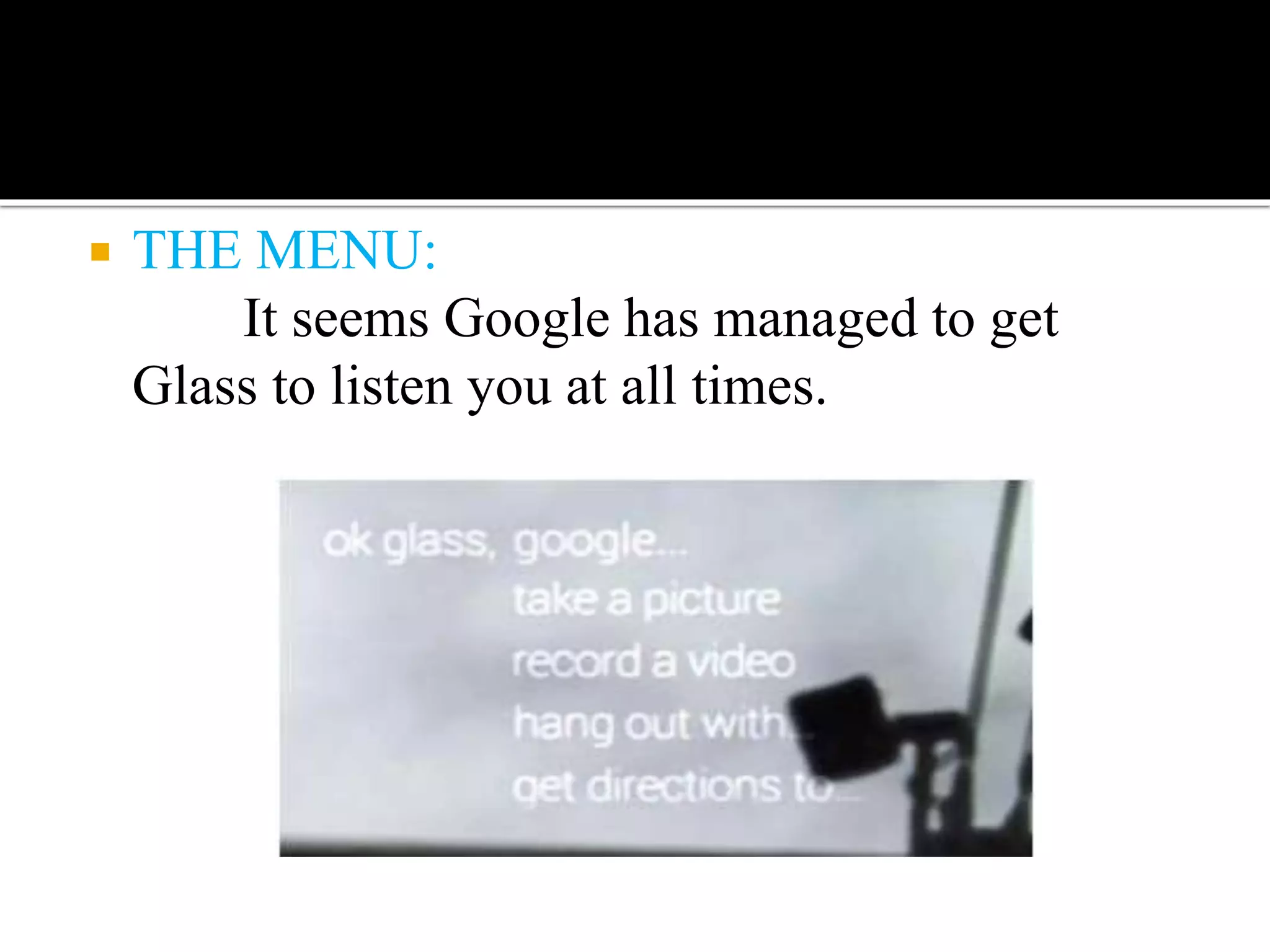
 THE MENU:
It seems Google has managed to get
Glass to listen you at all times.
 Google Glass menu overview:
1. Google...
2. take a picture
3. record a video
4. get directions to...
1.Google…
Google is the first and most diverse voice
command. The ellipses (...) after the command
indicate that you can follow it up with sub-
commands..
2. Take a picture:
Snapping images with Glass should be an
extremely rewarding and spontaneous experience
– after all you can snap images everywhere
almost instantly.
3. Record a video
Recording a video is another great examples
where the hands-free nature of Google Glass
shines. What makes Glass different from most
head-mounted cameras though is its cellular
connectivity and ability to instantly share the
captured footage.
4. Get directions to...
With Google Maps in the corner of your
eye at all times you can easily navigate
yourself while driving, cycling, walking.
Again, having your display head-mounted and
your hands free is the greatest advantage to
Glass.
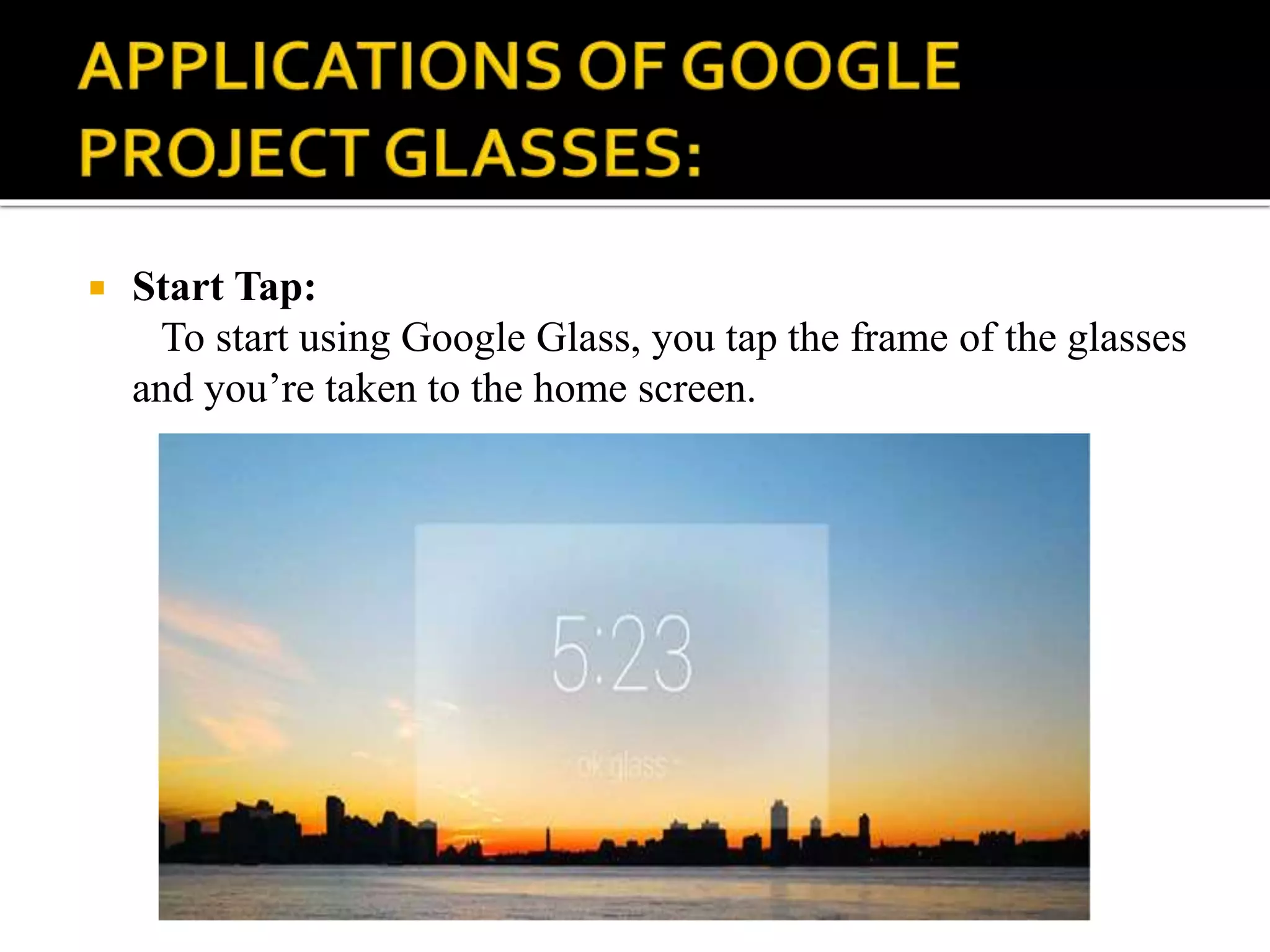
 Start Tap:
To start using Google Glass, you tap the frame of the glasses
and you’re taken to the home screen.
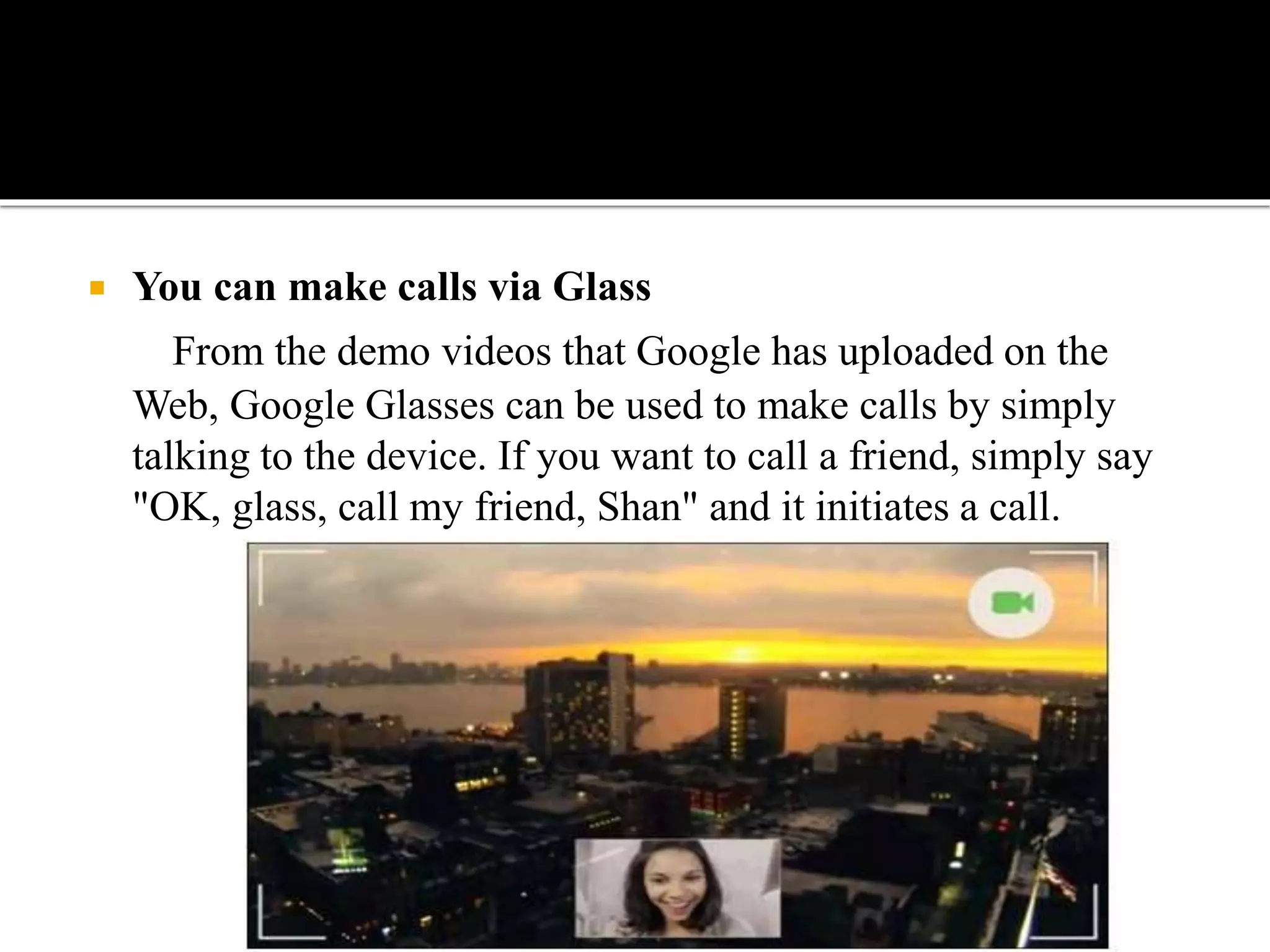
 You can make calls via Glass
From the demo videos that Google has uploaded on the
Web, Google Glasses can be used to make calls by simply
talking to the device. If you want to call a friend, simply say
"OK, glass, call my friend, Shan" and it initiates a call.
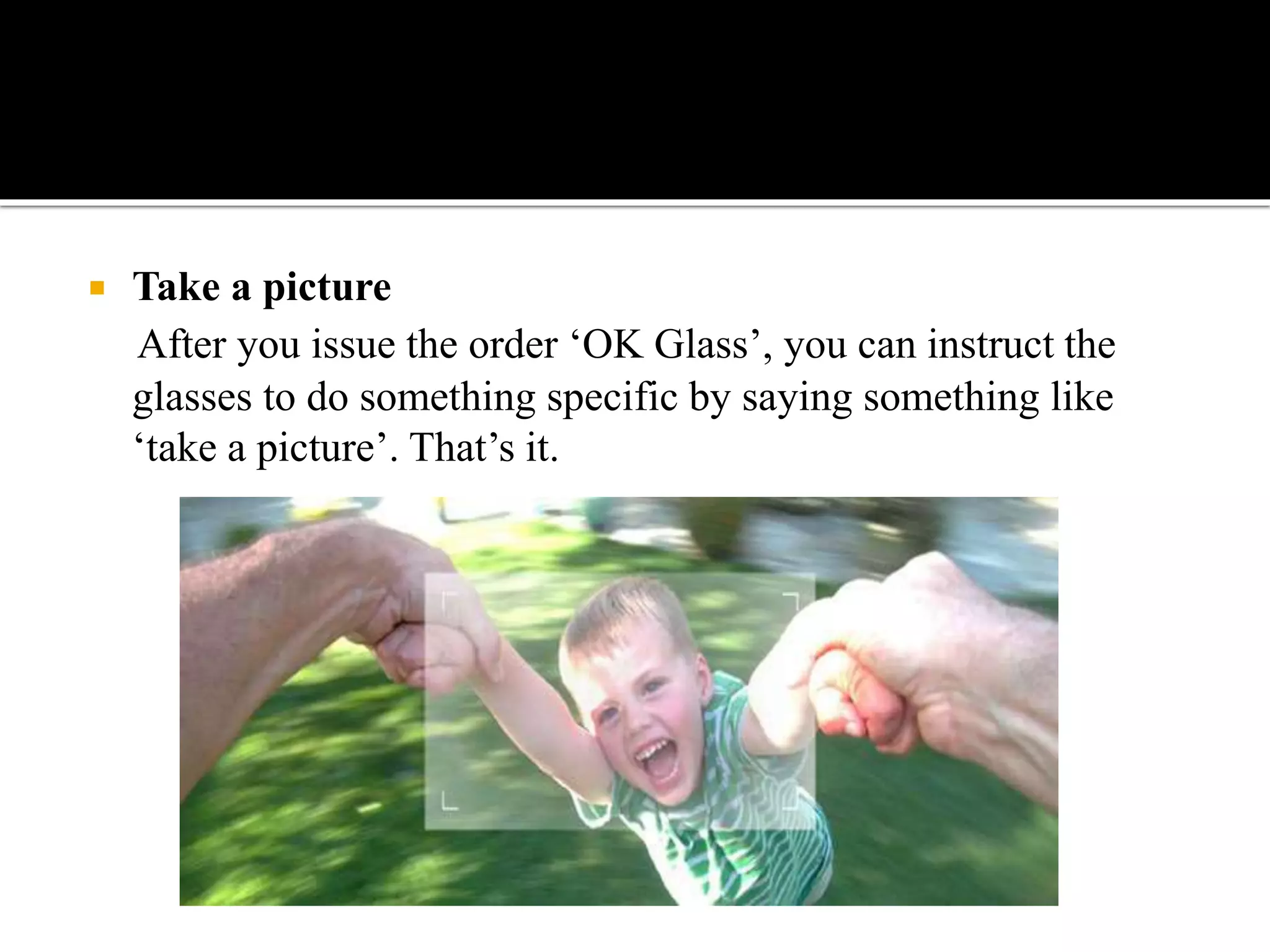
 Take a picture
After you issue the order ‘OK Glass’, you can instruct the
glasses to do something specific by saying something like
‘take a picture’. That’s it.
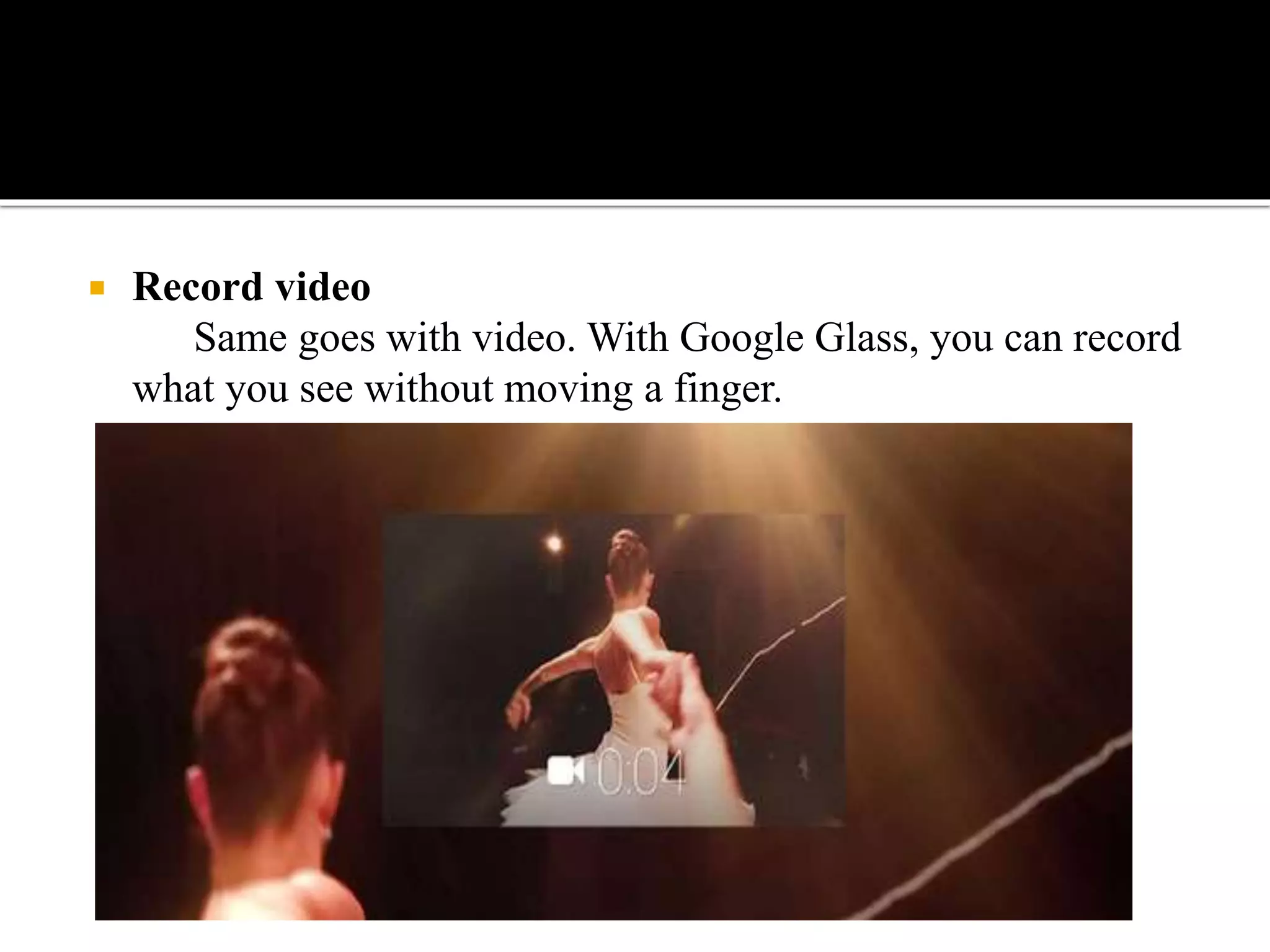
 Record video
Same goes with video. With Google Glass, you can record
what you see without moving a finger.
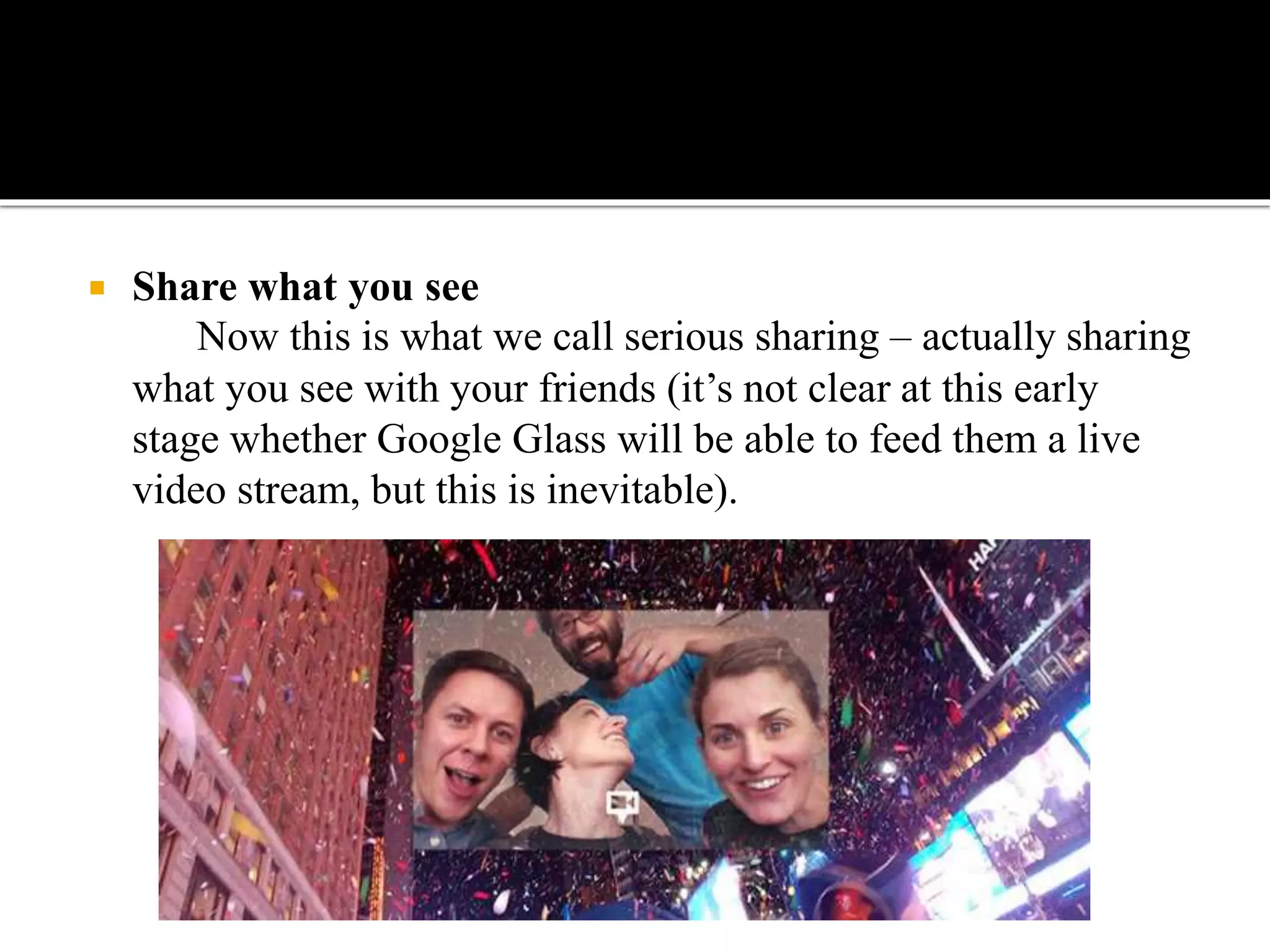
 Share what you see
Now this is what we call serious sharing – actually sharing
what you see with your friends (it’s not clear at this early
stage whether Google Glass will be able to feed them a live
video stream, but this is inevitable).
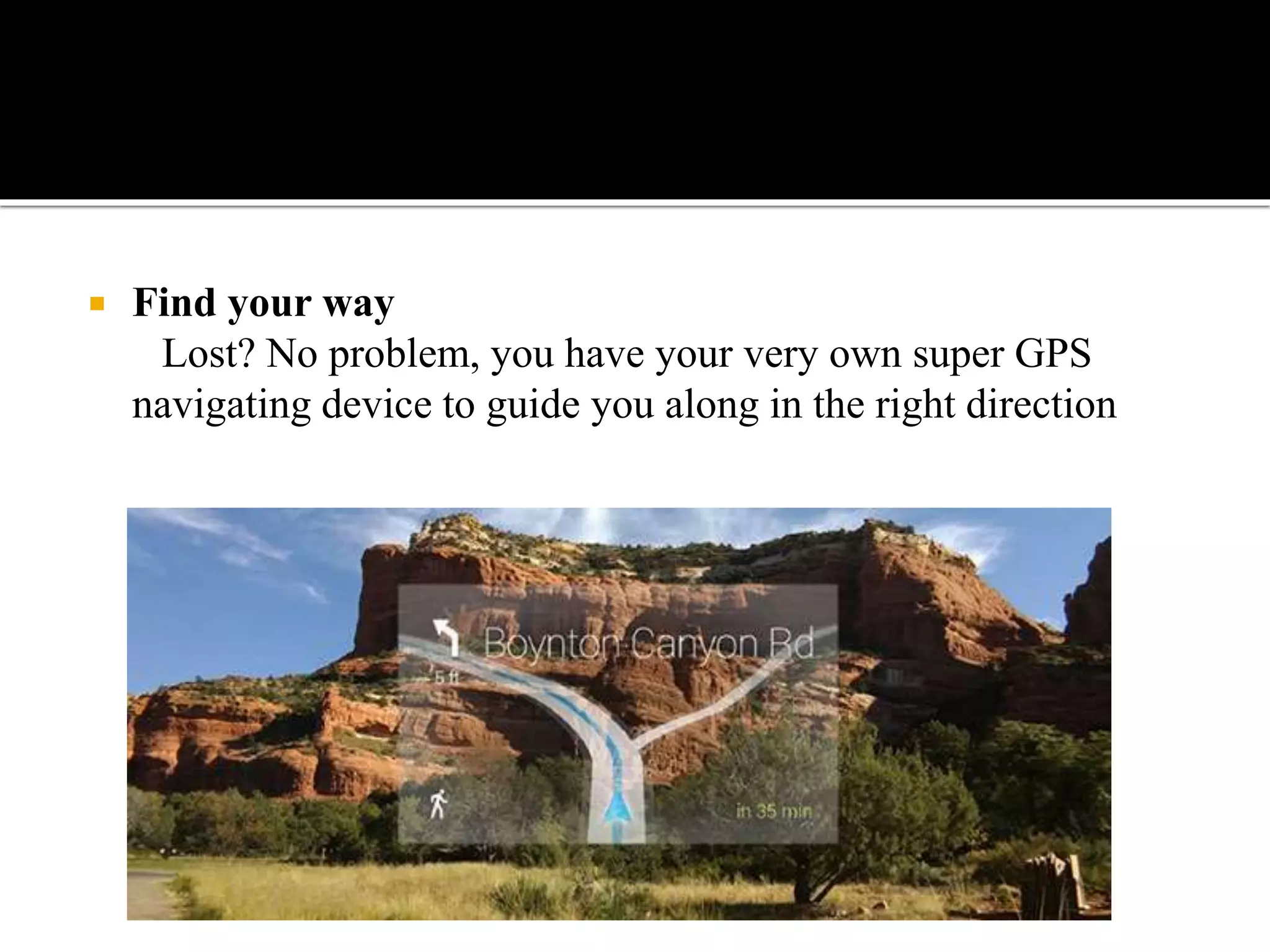
 Find your way
Lost? No problem, you have your very own super GPS
navigating device to guide you along in the right direction
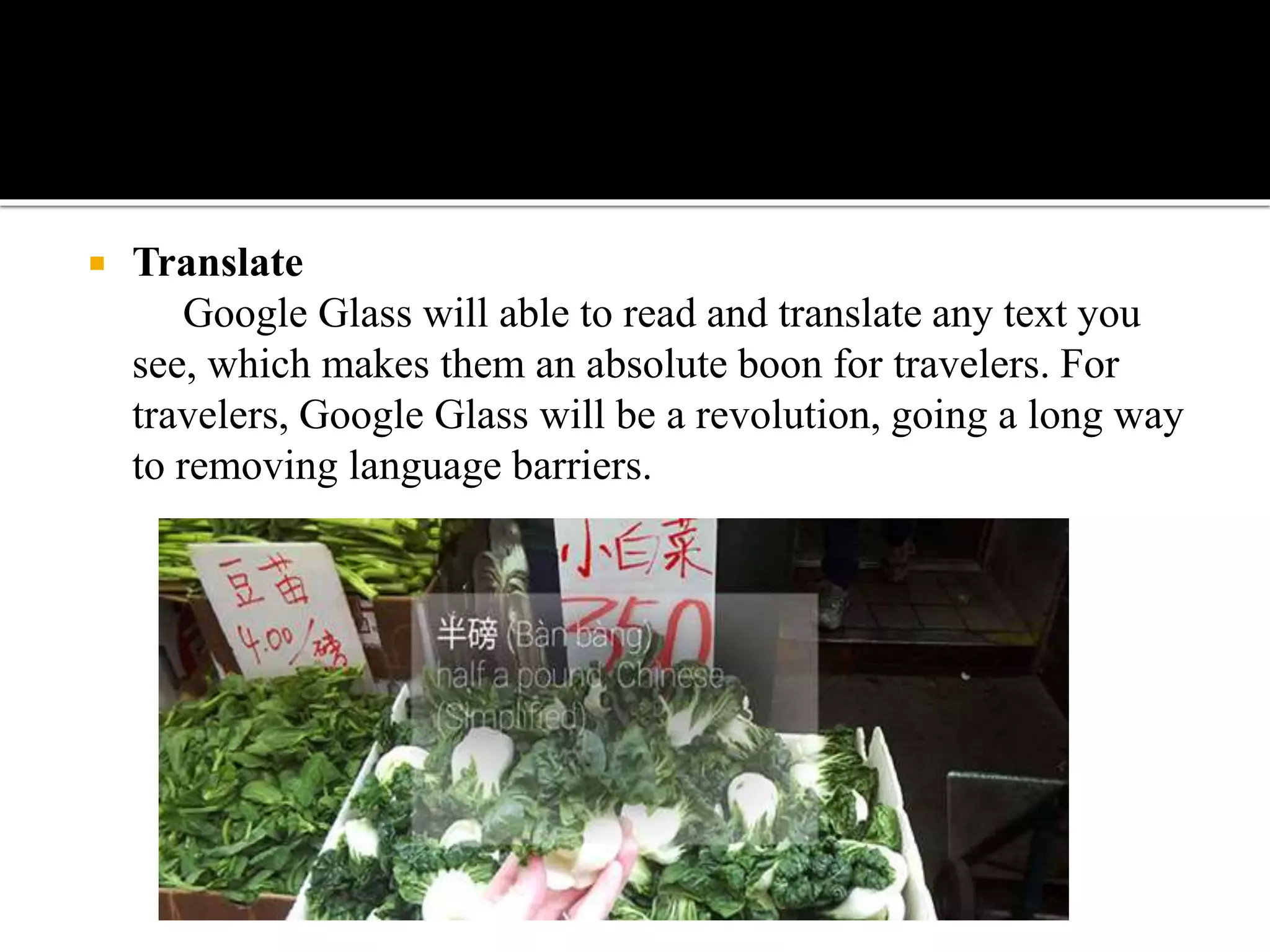
 Translate
Google Glass will able to read and translate any text you
see, which makes them an absolute boon for travelers. For
travelers, Google Glass will be a revolution, going a long way
to removing language barriers.
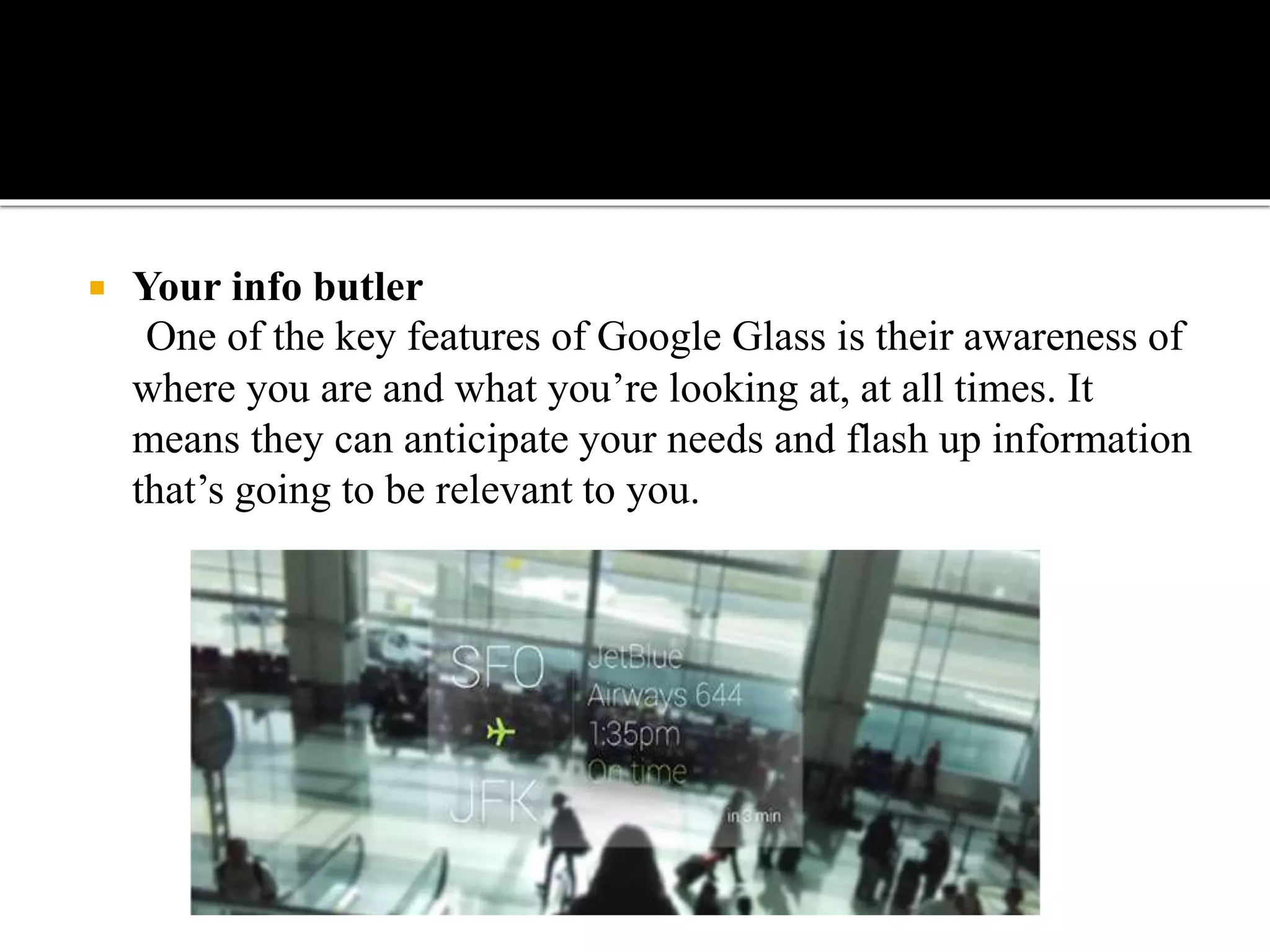
 Your info butler
One of the key features of Google Glass is their awareness of
where you are and what you’re looking at, at all times. It
means they can anticipate your needs and flash up information
that’s going to be relevant to you.
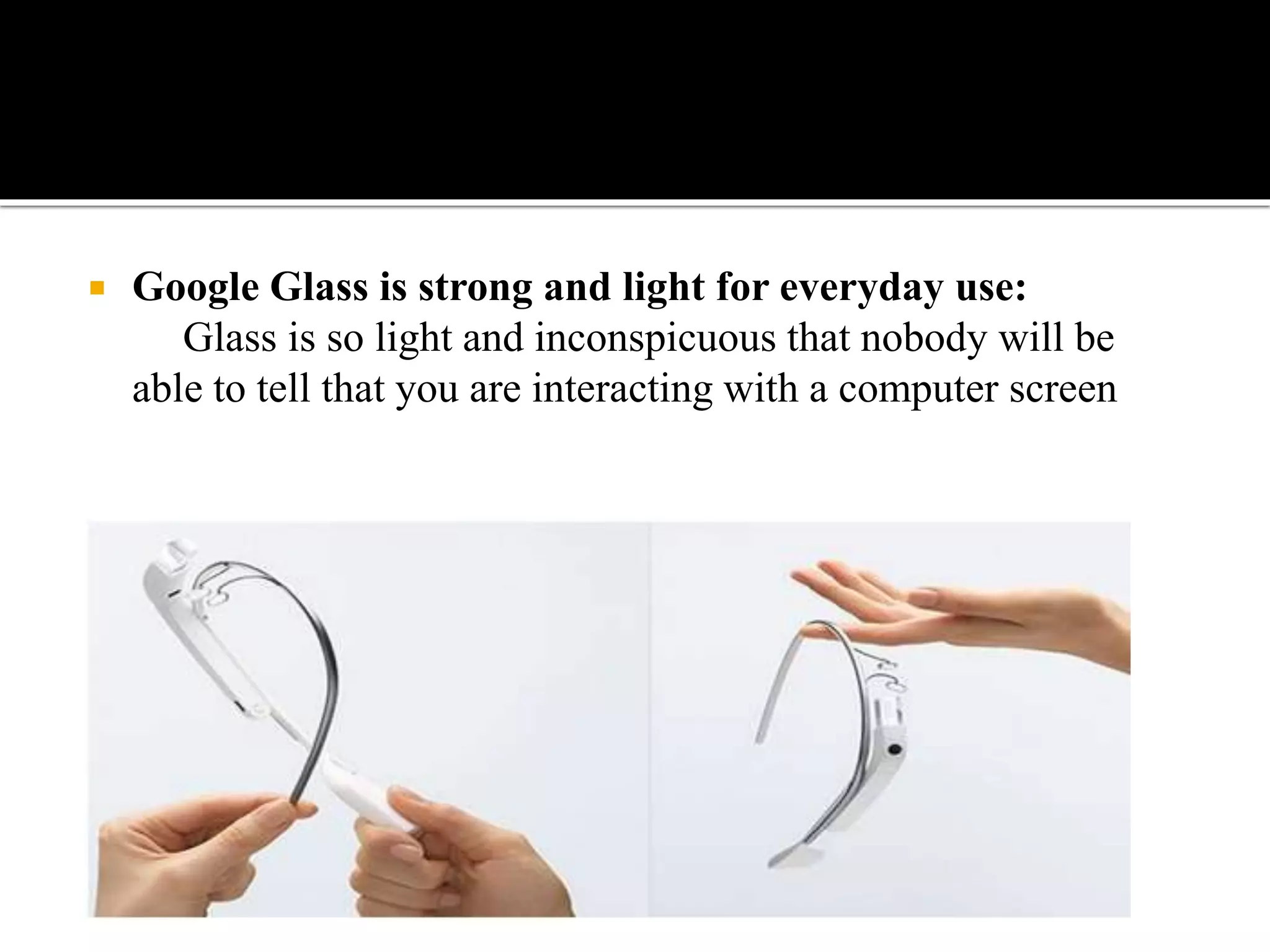
 Google Glass is strong and light for everyday use:
Glass is so light and inconspicuous that nobody will be
able to tell that you are interacting with a computer screen
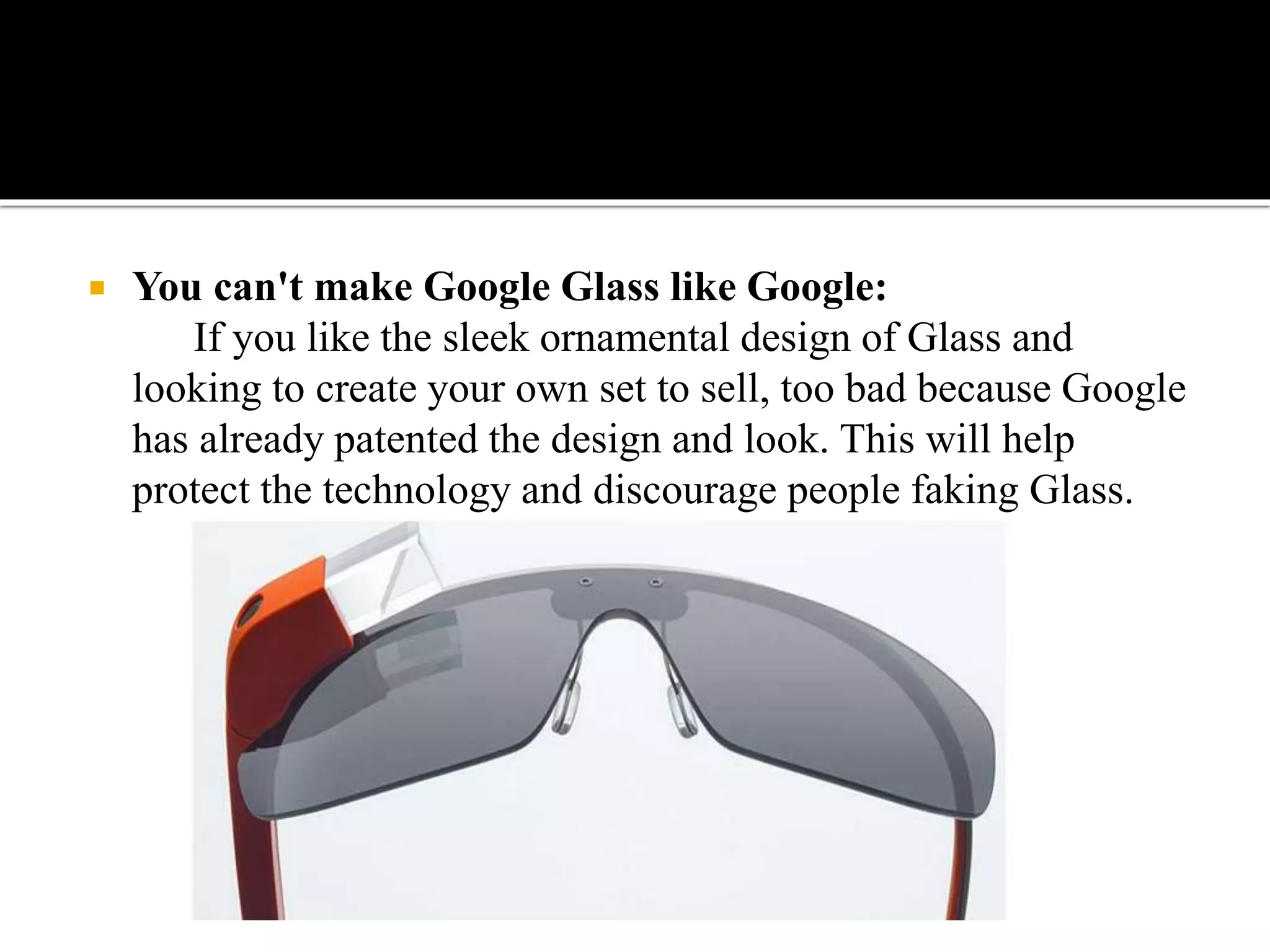
 You can't make Google Glass like Google:
If you like the sleek ornamental design of Glass and
looking to create your own set to sell, too bad because Google
has already patented the design and look. This will help
protect the technology and discourage people faking Glass.
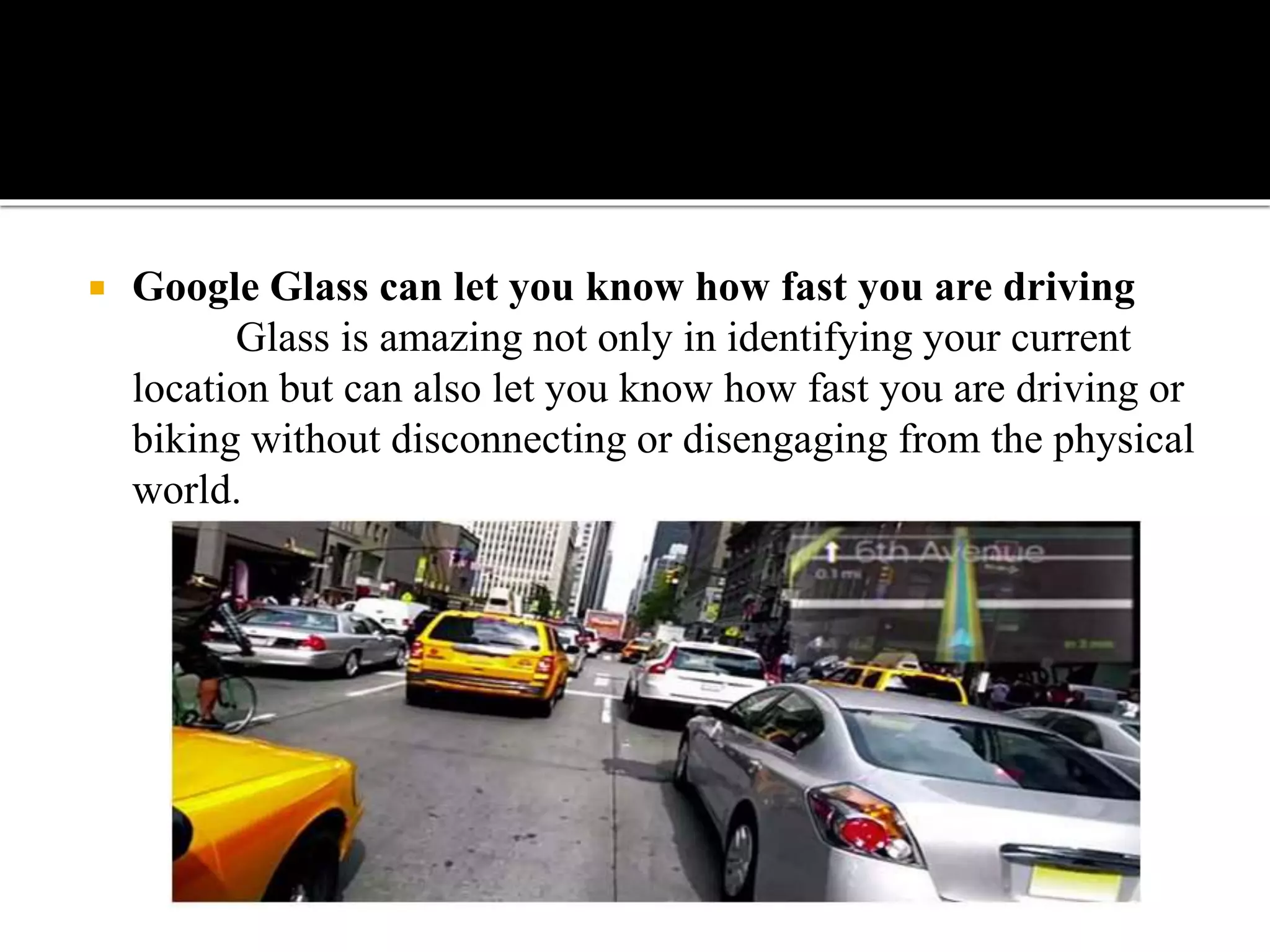
 Google Glass can let you know how fast you are driving
Glass is amazing not only in identifying your current
location but can also let you know how fast you are driving or
biking without disconnecting or disengaging from the physical
world.
 its really useful
 a better option for a smart phone
 you can use it while doing day to day
activities
 capturing video or image is more effective
 sharing is easy
 can use internet and social networking easily
 there may be obstacle while watching something
 Due to pop up adds and notification regular obstacle
during day to day life
 As display is too near to the eyeball it may cause
serious damage to eyeball .
Thus we have overlook a new upcoming
device which is going to be released in market by the
end of 2014 and which will be revolutionary device
called as a Google project glass. This device will
change the meaning of a technology, this device will
change the medium of communication and will be
popular within a few years.
… ???

Google glass seminar presentation

  • 1.
  • 2.
     Introduction  Components Operating System  How Google Glass work?  What makes it work?  Applications  Advantages  Disadvantages
  • 3.
     Google Glassis the attempt to make wearable computing mainstream, and it's effectively a smart pair of glasses with an integrated heads- up display and a battery hidden inside the frame.
  • 4.
     Camera : TheGlass camera seems to be of typical Smartphone-level size and format. It is not coaxially aligned with the wearer's eye. Photos - 5 MP, videos - 720p
  • 5.
     Display : Prismprojector, 640×360 pixels (equivalent of a 25 in/64 cm screen from 8 ft/2.4 m away).
  • 6.
     Touchpad: A touchpadis located on the side of Google Glass, allowing users to control the device by swiping through a timeline-like interface displayed on the screen. Components….
  • 7.
     Sound: Google Glassuse Bone conduction transducer. Bone conduction is the conduction of sound to the inner ear through the bones of the skull.
  • 8.
     Input: Other thantouchpad Google Glass use Voice command through microphone, accelerometer, gyroscope, magnetometer, ambient light sensor, proximity sensor… as input. Components…
  • 9.
     Android 4.1Jelly Bean: The list of new features the android system is used for Google project glass. The new update of Android, version 4.4 kitkat is also known to be used.
  • 12.
    Google Glass containsthe fundamental bits of any computer, including a CPU, sensors such as GPS, speakers, microphone and battery, to which are added a tiny projector and a prism that redirects the light onto your retina. Generally it uses voice recognition technology to access the menu.
  • 13.
     THE MENU: Itseems Google has managed to get Glass to listen you at all times.
  • 14.
     Google Glassmenu overview: 1. Google... 2. take a picture 3. record a video 4. get directions to...
  • 15.
    1.Google… Google is thefirst and most diverse voice command. The ellipses (...) after the command indicate that you can follow it up with sub- commands.. 2. Take a picture: Snapping images with Glass should be an extremely rewarding and spontaneous experience – after all you can snap images everywhere almost instantly.
  • 16.
    3. Record avideo Recording a video is another great examples where the hands-free nature of Google Glass shines. What makes Glass different from most head-mounted cameras though is its cellular connectivity and ability to instantly share the captured footage.
  • 17.
    4. Get directionsto... With Google Maps in the corner of your eye at all times you can easily navigate yourself while driving, cycling, walking. Again, having your display head-mounted and your hands free is the greatest advantage to Glass.
  • 18.
     Start Tap: Tostart using Google Glass, you tap the frame of the glasses and you’re taken to the home screen.
  • 19.
     You canmake calls via Glass From the demo videos that Google has uploaded on the Web, Google Glasses can be used to make calls by simply talking to the device. If you want to call a friend, simply say "OK, glass, call my friend, Shan" and it initiates a call.
  • 20.
     Take apicture After you issue the order ‘OK Glass’, you can instruct the glasses to do something specific by saying something like ‘take a picture’. That’s it.
  • 21.
     Record video Samegoes with video. With Google Glass, you can record what you see without moving a finger.
  • 22.
     Share whatyou see Now this is what we call serious sharing – actually sharing what you see with your friends (it’s not clear at this early stage whether Google Glass will be able to feed them a live video stream, but this is inevitable).
  • 23.
     Find yourway Lost? No problem, you have your very own super GPS navigating device to guide you along in the right direction
  • 24.
     Translate Google Glasswill able to read and translate any text you see, which makes them an absolute boon for travelers. For travelers, Google Glass will be a revolution, going a long way to removing language barriers.
  • 25.
     Your infobutler One of the key features of Google Glass is their awareness of where you are and what you’re looking at, at all times. It means they can anticipate your needs and flash up information that’s going to be relevant to you.
  • 26.
     Google Glassis strong and light for everyday use: Glass is so light and inconspicuous that nobody will be able to tell that you are interacting with a computer screen
  • 27.
     You can'tmake Google Glass like Google: If you like the sleek ornamental design of Glass and looking to create your own set to sell, too bad because Google has already patented the design and look. This will help protect the technology and discourage people faking Glass.
  • 28.
     Google Glasscan let you know how fast you are driving Glass is amazing not only in identifying your current location but can also let you know how fast you are driving or biking without disconnecting or disengaging from the physical world.
  • 29.
     its reallyuseful  a better option for a smart phone  you can use it while doing day to day activities  capturing video or image is more effective  sharing is easy  can use internet and social networking easily
  • 30.
     there maybe obstacle while watching something  Due to pop up adds and notification regular obstacle during day to day life  As display is too near to the eyeball it may cause serious damage to eyeball .
  • 31.
    Thus we haveoverlook a new upcoming device which is going to be released in market by the end of 2014 and which will be revolutionary device called as a Google project glass. This device will change the meaning of a technology, this device will change the medium of communication and will be popular within a few years.
  • 32.