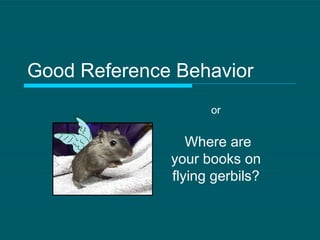
Good Reference Behavior Where are your books on flying gerbils? or
Our Mission  Harris County Public Library provides information and resources to enrich lives and strengthen communities through innovative services within and beyond our walls.
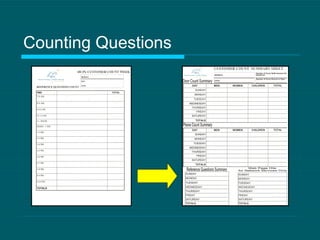
Counting Questions
Reference Transaction An information contact that involves the use, recommendation, interpretation, or instruction in the use of one or more information sources, or knowledge of such sources, by a member of the reference or information staff. American National Standard for Library and Information Statistics  (ANSI Z39-1983)
How do you answer a question?  Courteously.
How do you answer a question? Accurately.
How do you answer a question? Completely.
How do you answer a question? Quickly.
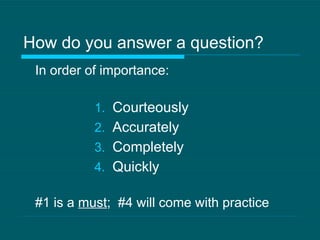
How do you answer a question? In order of importance: Courteously Accurately Completely Quickly #1 is a  must ;  #4 will come with practice
Guidelines for Behavioral Performance of Reference and Information Service Providers 1.0 Approachability 2.0 Interest 3.0 Listening/Inquiring 4.0 Searching 5.0 Follow-up
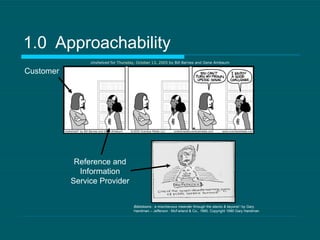
1.0 Approachability Unshelved  for  Thursday, October 13, 2005  by Bill Barnes and Gene Ambaum Customer Reference and Information Service Provider Bibliotoons : a mischievous meander through the stacks & beyond  / by Gary Handman.– Jefferson : McFarland & Co., 1990. Copyright 1990 Gary Handman or
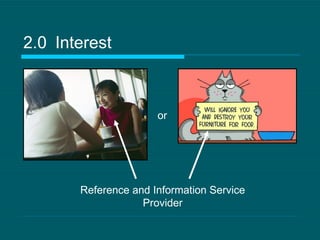
2.0 Interest or Reference and Information Service Provider
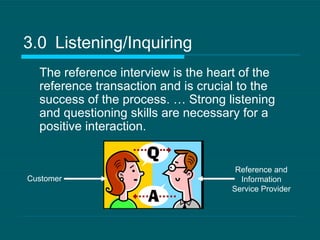
3.0 Listening/Inquiring The reference interview is the heart of the reference transaction and is crucial to the success of the process. … Strong listening and questioning skills are necessary for a positive interaction.  Reference and Information Service Provider Customer
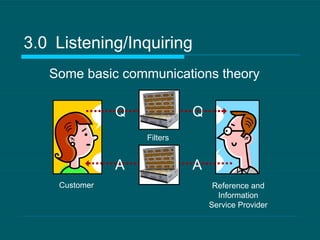
Some basic communications theory Reference and Information Service Provider Customer Filters A Q Q A 3.0 Listening/Inquiring
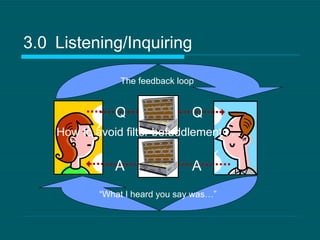
How to avoid filter befuddlement . . .  3.0 Listening/Inquiring A Q Q A The feedback loop “ What I heard you say was…”
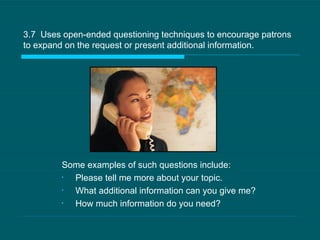
3.7  Uses open-ended questioning techniques to encourage patrons to expand on the request or present additional information.  Some examples of such questions include: Please tell me more about your topic.  What additional information can you give me?  How much information do you need?
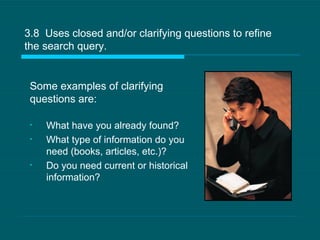
3.8  Uses closed and/or clarifying questions to refine the search query.  What have you already found?  What type of information do you need (books, articles, etc.)? Do you need current or historical information? Some examples of clarifying questions are:
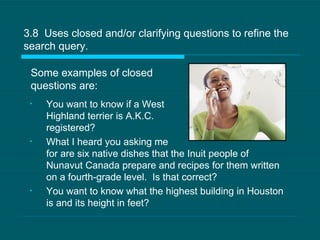
3.8  Uses closed and/or clarifying questions to refine the search query.  Some examples of closed questions are: You want to know if a West  Highland terrier is A.K.C.  registered? What I heard you asking me  for are six native dishes that the Inuit people of Nunavut Canada prepare and recipes for them written on a fourth-grade level.  Is that correct? You want to know what the highest building in Houston is and its height in feet?
Role Playing Take turns playing Customer or Reference Information Service Provider
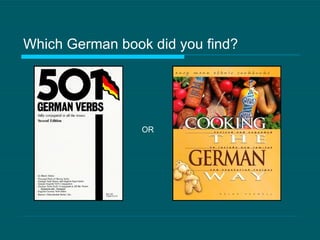
Which German book did you find? OR
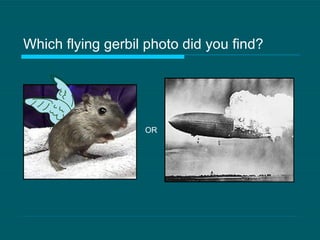
Which flying gerbil photo did you find? OR
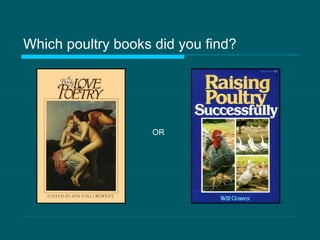
Which poultry books did you find? OR
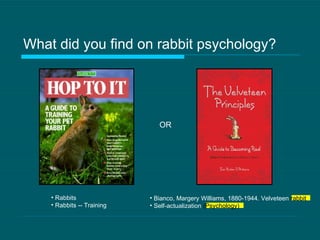
What did you find on rabbit psychology? OR Rabbits Rabbits -- Training Bianco, Margery Williams, 1880-1944. Velveteen  rabbit Self-actualization  (Psychology)
An effective searcher: 4.1  Finds out what patrons have already tried, and encourages patrons to contribute ideas. 4.2  Constructs a competent and complete search strategy.  This involves: Selecting search terms that are most related to the  information desired.   Verifying spelling and other possible factual errors in the original query.  Identifying sources appropriate to the patron's need that have the highest probability of containing information relevant to the patron's query.  4.0  Searching Now that you know the question, how do you find the answer?
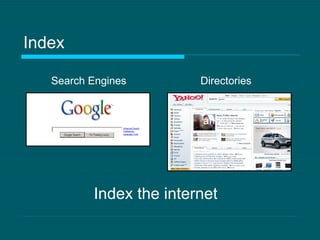
Index Directories Index the internet Search Engines and
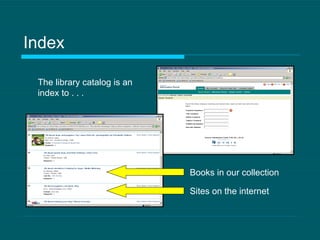
Index The library catalog is an index to . . .  Books in our collection Sites on the internet
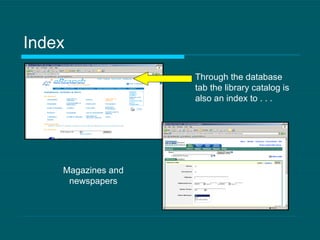
Index Magazines and newspapers Through the database tab the library catalog is also an index to . . .
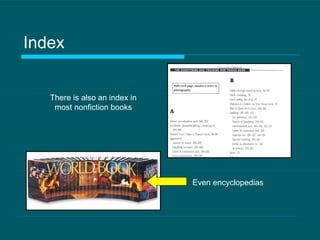
Index There is also an index in most nonfiction books Even encyclopedias
4.0  Searching An effective searcher: 4.3  Explains the search strategy and sequence to the patrons, as well as the sources to be used. 4.4  Attempts  to conduct the search within the patrons’ allotted time   frame. 4.5  Explains how to use sources when appropriate. 4.6  Works with the patrons  to narrow or broaden the topic  when too little or too much information is identified. 4.7  Asks the patrons if additional information is needed  after an initial result is found. 4.8  Recognizes  when to refer patrons  to a more appropriate guide, database, library, librarian, or other resource. 4.9  Offers pointers, detailed search paths (including complete URLs), and names of resources used to find the answer, so that patrons can learn to answer similar questions on their own.
5.0  Follow-up 5.1 Asks patrons if their questions have been completely answered. 5.2 Encourages the patrons to return if they have  further questions by making a statement such as, “If you don’t find what you are looking for, please come back and we’ll try something else.” 5.3 Roving (see 1.7) is an excellent technique for follow-up. The reference transaction does not end when the librarian leaves the patrons.  For successful follow-up, the librarian:
The reference transaction does not end when the librarian leaves the patrons. For successful follow-up, the librarian asks patrons if their questions have been completely answered. “ Does this completely answer your question?” 5.0  Follow-up
5.0  Follow-up “Does this completely answer your question?”
5.0   Follow-up "Does this completely answer your question?"

Good Reference Behavior

  • 1.
    Good Reference BehaviorWhere are your books on flying gerbils? or
  • 2.
    Our Mission Harris County Public Library provides information and resources to enrich lives and strengthen communities through innovative services within and beyond our walls.
  • 3.
  • 4.
    Reference Transaction Aninformation contact that involves the use, recommendation, interpretation, or instruction in the use of one or more information sources, or knowledge of such sources, by a member of the reference or information staff. American National Standard for Library and Information Statistics (ANSI Z39-1983)
  • 5.
    How do youanswer a question? Courteously.
  • 6.
    How do youanswer a question? Accurately.
  • 7.
    How do youanswer a question? Completely.
  • 8.
    How do youanswer a question? Quickly.
  • 9.
    How do youanswer a question? In order of importance: Courteously Accurately Completely Quickly #1 is a must ; #4 will come with practice
  • 10.
    Guidelines for BehavioralPerformance of Reference and Information Service Providers 1.0 Approachability 2.0 Interest 3.0 Listening/Inquiring 4.0 Searching 5.0 Follow-up
  • 11.
    1.0 Approachability Unshelved for Thursday, October 13, 2005 by Bill Barnes and Gene Ambaum Customer Reference and Information Service Provider Bibliotoons : a mischievous meander through the stacks & beyond / by Gary Handman.– Jefferson : McFarland & Co., 1990. Copyright 1990 Gary Handman or
  • 12.
    2.0 Interest orReference and Information Service Provider
  • 13.
    3.0 Listening/Inquiring Thereference interview is the heart of the reference transaction and is crucial to the success of the process. … Strong listening and questioning skills are necessary for a positive interaction. Reference and Information Service Provider Customer
  • 14.
    Some basic communicationstheory Reference and Information Service Provider Customer Filters A Q Q A 3.0 Listening/Inquiring
  • 15.
    How to avoidfilter befuddlement . . . 3.0 Listening/Inquiring A Q Q A The feedback loop “ What I heard you say was…”
  • 16.
    3.7 Usesopen-ended questioning techniques to encourage patrons to expand on the request or present additional information. Some examples of such questions include: Please tell me more about your topic. What additional information can you give me? How much information do you need?
  • 17.
    3.8 Usesclosed and/or clarifying questions to refine the search query. What have you already found? What type of information do you need (books, articles, etc.)? Do you need current or historical information? Some examples of clarifying questions are:
  • 18.
    3.8 Usesclosed and/or clarifying questions to refine the search query. Some examples of closed questions are: You want to know if a West Highland terrier is A.K.C. registered? What I heard you asking me for are six native dishes that the Inuit people of Nunavut Canada prepare and recipes for them written on a fourth-grade level. Is that correct? You want to know what the highest building in Houston is and its height in feet?
  • 19.
    Role Playing Taketurns playing Customer or Reference Information Service Provider
  • 20.
    Which German bookdid you find? OR
  • 21.
    Which flying gerbilphoto did you find? OR
  • 22.
    Which poultry booksdid you find? OR
  • 23.
    What did youfind on rabbit psychology? OR Rabbits Rabbits -- Training Bianco, Margery Williams, 1880-1944. Velveteen rabbit Self-actualization (Psychology)
  • 24.
    An effective searcher:4.1 Finds out what patrons have already tried, and encourages patrons to contribute ideas. 4.2 Constructs a competent and complete search strategy. This involves: Selecting search terms that are most related to the information desired. Verifying spelling and other possible factual errors in the original query. Identifying sources appropriate to the patron's need that have the highest probability of containing information relevant to the patron's query. 4.0 Searching Now that you know the question, how do you find the answer?
  • 25.
    Index Directories Indexthe internet Search Engines and
  • 26.
    Index The librarycatalog is an index to . . . Books in our collection Sites on the internet
  • 27.
    Index Magazines andnewspapers Through the database tab the library catalog is also an index to . . .
  • 28.
    Index There isalso an index in most nonfiction books Even encyclopedias
  • 29.
    4.0 SearchingAn effective searcher: 4.3 Explains the search strategy and sequence to the patrons, as well as the sources to be used. 4.4 Attempts to conduct the search within the patrons’ allotted time frame. 4.5 Explains how to use sources when appropriate. 4.6 Works with the patrons to narrow or broaden the topic when too little or too much information is identified. 4.7 Asks the patrons if additional information is needed after an initial result is found. 4.8 Recognizes when to refer patrons to a more appropriate guide, database, library, librarian, or other resource. 4.9 Offers pointers, detailed search paths (including complete URLs), and names of resources used to find the answer, so that patrons can learn to answer similar questions on their own.
  • 30.
    5.0 Follow-up5.1 Asks patrons if their questions have been completely answered. 5.2 Encourages the patrons to return if they have further questions by making a statement such as, “If you don’t find what you are looking for, please come back and we’ll try something else.” 5.3 Roving (see 1.7) is an excellent technique for follow-up. The reference transaction does not end when the librarian leaves the patrons. For successful follow-up, the librarian:
  • 31.
    The reference transactiondoes not end when the librarian leaves the patrons. For successful follow-up, the librarian asks patrons if their questions have been completely answered. “ Does this completely answer your question?” 5.0 Follow-up
  • 32.
    5.0 Follow-up“Does this completely answer your question?”
  • 33.
    5.0 Follow-up "Does this completely answer your question?"