12P08
Electromagnetic Waves
Learning Objectives
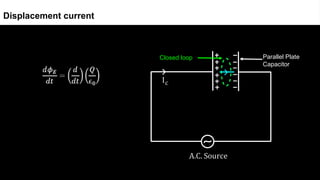
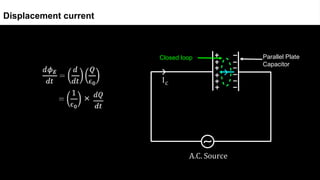
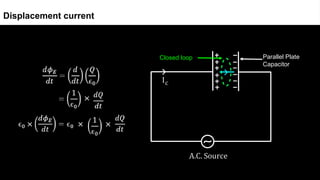
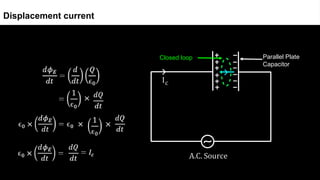
Displacement current
Electromagnetic waves
Electromagnetic spectrum
12P08-Electromagnetic Waves
12P08.1
Displacement current
Learning Objectives
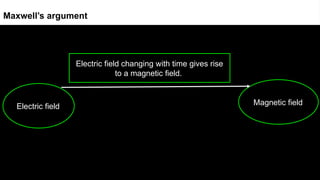
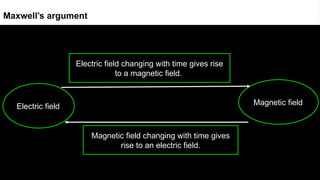
Maxwell’s argument
Maxwell’s experiment
Maxwell’s equation
12P08.1 Displacement current
12P08.1
CV1
Maxwell’s arguments
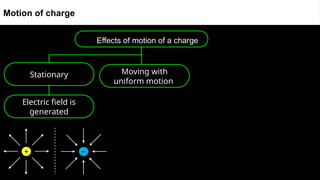
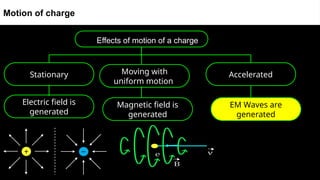
Effects of motion of a charge
Motion of charge
Effects of motion of a charge
Motion of charge
Stationary
Effects of motion of a charge
Motion of charge
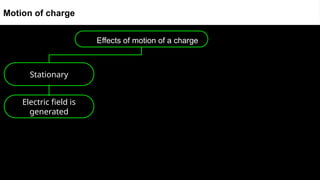
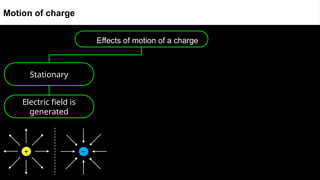
Stationary
Electric field is
generated
Effects of motion of a charge
Motion of charge
Stationary
Electric field is
generated
Effects of motion of a charge
Motion of charge
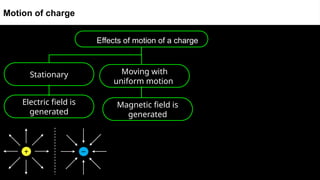
Stationary Moving with
uniform motion
Electric field is
generated
Effects of motion of a charge
Motion of charge
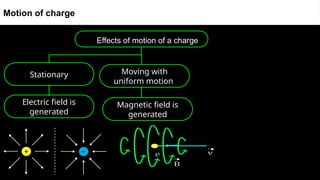
Stationary Moving with
uniform motion
Magnetic field is
generated
Electric field is
generated
Effects of motion of a charge
Motion of charge
Stationary Moving with
uniform motion
Magnetic field is
generated
Electric field is
generated
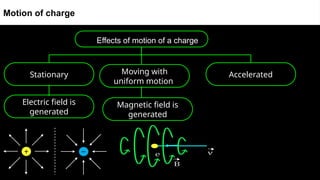
Effects of motion of a charge
Motion of charge
Stationary Moving with
uniform motion
Accelerated
Magnetic field is
generated
Electric field is
generated
Effects of motion of a charge
EM Waves are
generated
Motion of charge
Stationary Moving with
uniform motion
Accelerated
Magnetic field is
generated
Electric field is
generated
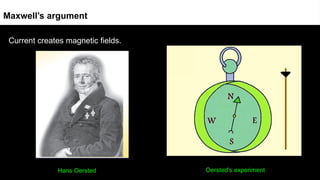
Current creates magnetic fields.
Maxwell’s argument
Hans Oersted
Current creates magnetic fields.
Maxwell’s argument
Oersted's experiment
Hans Oersted
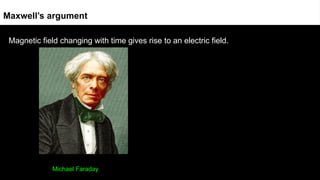
Magnetic field changing with time gives rise to an electric field.
Maxwell’s argument
Michael Faraday
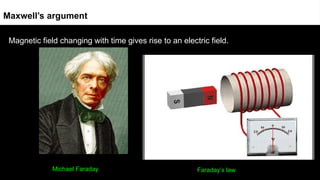
Magnetic field changing with time gives rise to an electric field.
Maxwell’s argument
Faraday’s law
Michael Faraday
Maxwell’s argument
Is the converse also true?
Maxwell’s argument
Is the converse also true?
J.C. Maxwell
Maxwell’s argument
Does the change in electric field create magnetic field?
J.C. Maxwell
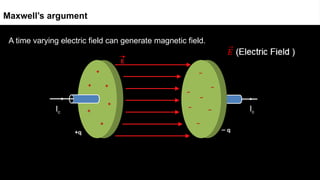
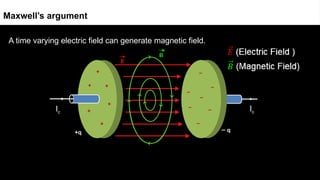
A time varying electric field can generate magnetic field.
Maxwell’s argument
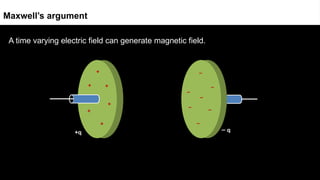
A time varying electric field can generate magnetic field.
Maxwell’s argument
A time varying electric field can generate magnetic field.
Maxwell’s argument
Ic Ic
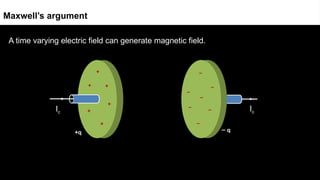
A time varying electric field can generate magnetic field.
Maxwell’s argument
Ic Ic
A time varying electric field can generate magnetic field.
Maxwell’s argument
Ic Ic
Electric field
Maxwell’s argument
Electric field
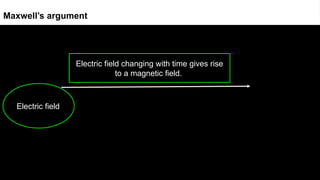
Electric field changing with time gives rise
to a magnetic field.
Maxwell’s argument
Electric field Magnetic field
Electric field changing with time gives rise
to a magnetic field.
Maxwell’s argument
Electric field Magnetic field
Electric field changing with time gives rise
to a magnetic field.
Maxwell’s argument
Magnetic field changing with time gives
rise to an electric field.
12P08.1
CV2
Maxwell’s Experiment
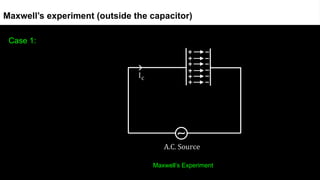
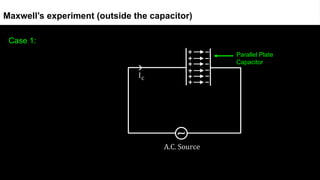
Case 1:
Maxwell’s Experiment
Maxwell’s experiment (outside the capacitor)
Case 1:
Maxwell’s experiment (outside the capacitor)
Parallel Plate
Capacitor
Case 1:
Maxwell’s experiment (outside the capacitor)
Parallel Plate
Capacitor
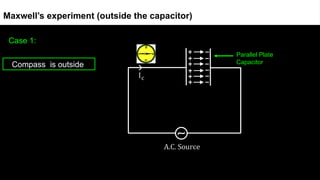
Compass is outside
Case 1:
Maxwell’s experiment (outside the capacitor)
Parallel Plate
Capacitor
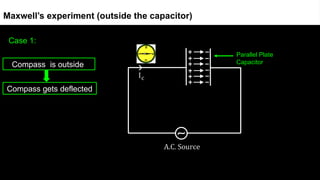
Compass is outside
Compass gets deflected
Case 1:
Maxwell’s experiment (outside the capacitor)
Parallel Plate
Capacitor
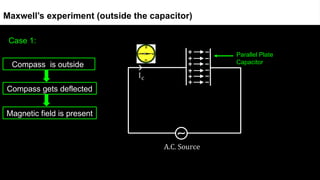
Compass is outside
Compass gets deflected
Magnetic field is present
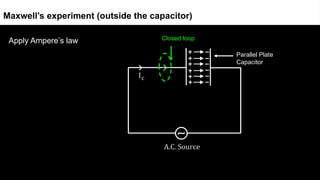
Apply Ampere’s law
Maxwell’s experiment (outside the capacitor)
Closed loop
Parallel Plate
Capacitor
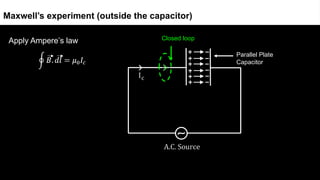
Apply Ampere’s law
Maxwell’s experiment (outside the capacitor)
Closed loop
Parallel Plate
Capacitor
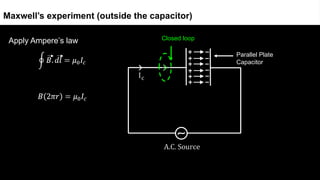
Apply Ampere’s law
Maxwell’s experiment (outside the capacitor)
Closed loop
Parallel Plate
Capacitor
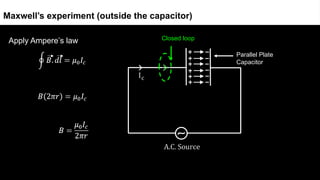
Apply Ampere’s law
Maxwell’s experiment (outside the capacitor)
Closed loop
Parallel Plate
Capacitor
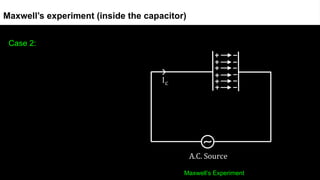
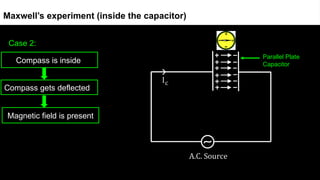
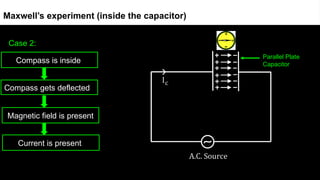
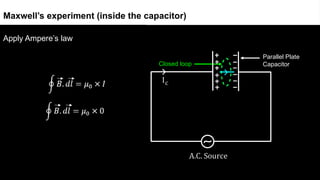
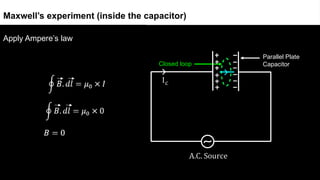
Maxwell’s experiment (inside the capacitor)
Maxwell’s Experiment
Case 2:
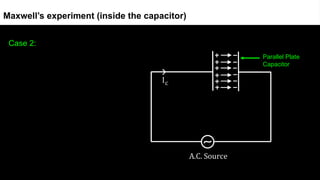
Maxwell’s experiment (inside the capacitor)
Parallel Plate
Capacitor
Case 2:
Case 2:
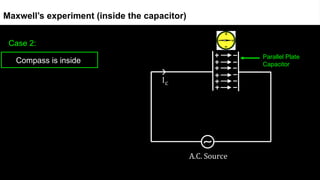
Maxwell’s experiment (inside the capacitor)
Parallel Plate
Capacitor
Compass is inside
Case 2:
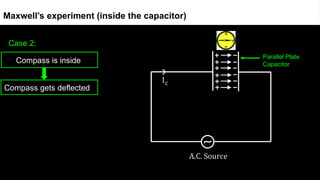
Maxwell’s experiment (inside the capacitor)
Parallel Plate
Capacitor
Compass is inside
Compass gets deflected
Case 2:
Maxwell’s experiment (inside the capacitor)
Parallel Plate
Capacitor
Compass is inside
Compass gets deflected
Magnetic field is present
Case 2:
Maxwell’s experiment (inside the capacitor)
Parallel Plate
Capacitor
Compass is inside
Compass gets deflected
Magnetic field is present
Current is present
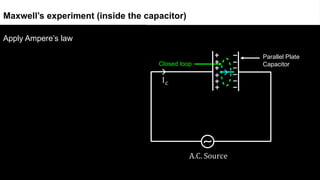
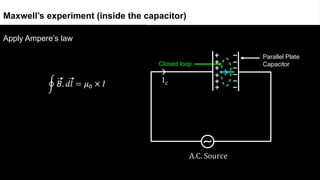
Closed loop
Maxwell’s experiment (inside the capacitor)
4.31
Parallel Plate
Capacitor
Apply Ampere’s law
Closed loop
Maxwell’s experiment (inside the capacitor)
4.31
Apply Ampere’s law
Parallel Plate
Capacitor
Closed loop
Maxwell’s experiment (inside the capacitor)
Parallel Plate
Capacitor
Apply Ampere’s law
Closed loop
Maxwell’s experiment (inside the capacitor)
Apply Ampere’s law
Parallel Plate
Capacitor
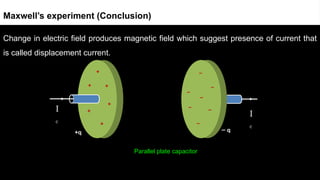
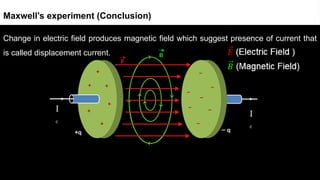
Change in electric field produces magnetic field which suggest presence of current that
is called displacement current.
Maxwell’s experiment (Conclusion)
I
c
I
c
Parallel plate capacitor
Change in electric field produces magnetic field which suggest presence of current that
is called displacement current.
Maxwell’s experiment (Conclusion)
I
c
I
c
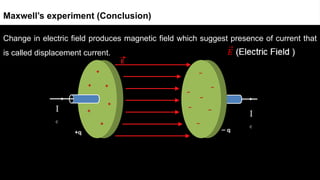
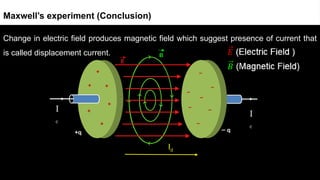
Change in electric field produces magnetic field which suggest presence of current that
is called displacement current.
Maxwell’s experiment (Conclusion)
I
c
I
c
Change in electric field produces magnetic field which suggest presence of current that
is called displacement current.
Maxwell’s experiment (Conclusion)
Id
I
c
I
c
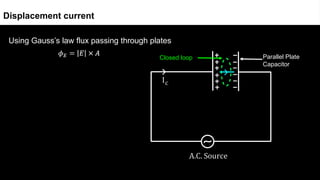
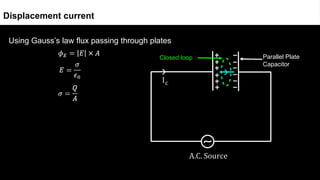
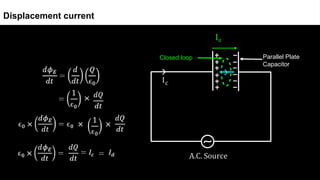
Using Gauss’s law flux passing through plates
Displacement current
Parallel Plate
Capacitor
Closed loop
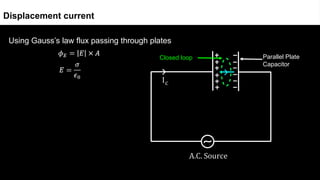
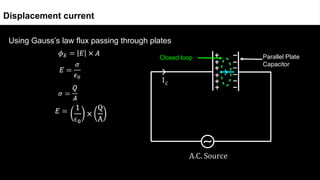
Using Gauss’s law flux passing through plates
Displacement current
Parallel Plate
Capacitor
Closed loop
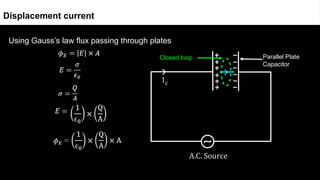
Using Gauss’s law flux passing through plates
Displacement current
Parallel Plate
Capacitor
Closed loop
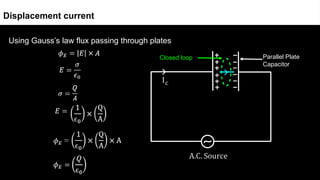
Using Gauss’s law flux passing through plates
Displacement current
Parallel Plate
Capacitor
Closed loop
Using Gauss’s law flux passing through plates
Displacement current
Parallel Plate
Capacitor
Closed loop
Using Gauss’s law flux passing through plates
Displacement current
Parallel Plate
Capacitor
Closed loop
Displacement current
Parallel Plate
Capacitor
Closed loop
Displacement current
Parallel Plate
Capacitor
Closed loop
Displacement current
Parallel Plate
Capacitor
Closed loop
Displacement current
Parallel Plate
Capacitor
Closed loop
Displacement current
Parallel Plate
Capacitor
Closed loop
Id
Displacement current
Parallel Plate
Capacitor
Closed loop
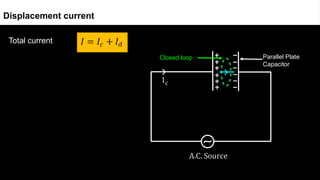
Total current
Displacement current
Parallel Plate
Capacitor
Closed loop
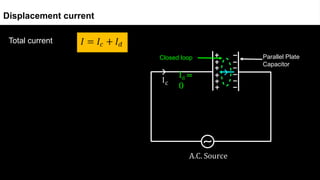
Total current
Id =
0
Displacement current
Parallel Plate
Capacitor
Closed loop
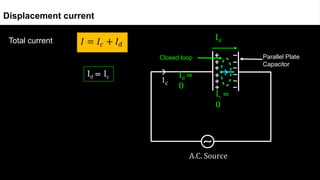
Total current
Id =
0
Ic =
0
Id = Ic
Id
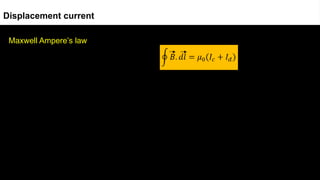
Maxwell Ampere’s law
Displacement current
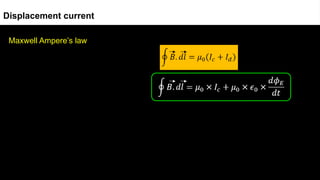
Maxwell Ampere’s law
Displacement current
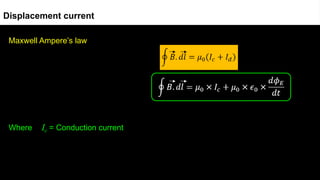
Maxwell Ampere’s law
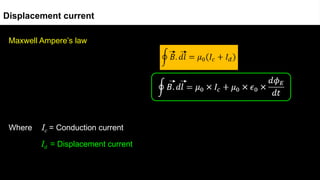
Where Ic = Conduction current
Displacement current
Maxwell Ampere’s law
Where Ic = Conduction current
Id = Displacement current
Displacement current
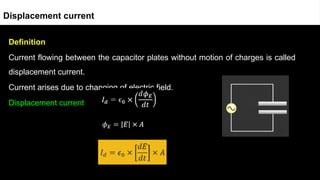
Definition
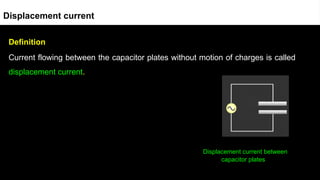
Current flowing between the capacitor plates without motion of charges is called
displacement current.
Displacement current between
capacitor plates
Displacement current
Definition
Current flowing between the capacitor plates without motion of charges is called
displacement current.
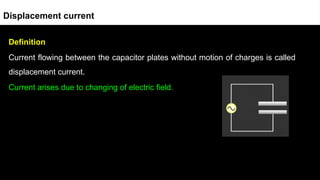
Current arises due to changing of electric field.
Displacement current
Definition
Current flowing between the capacitor plates without motion of charges is called
displacement current.
Current arises due to changing of electric field.
Displacement current
Definition
Current flowing between the capacitor plates without motion of charges is called
displacement current.
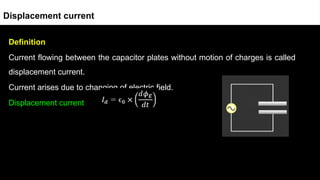
Current arises due to changing of electric field.
Displacement current
Definition
Current flowing between the capacitor plates without motion of charges is called
displacement current.
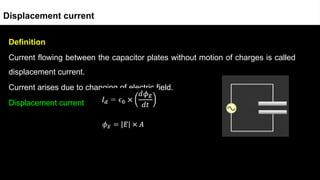
Current arises due to changing of electric field.
Displacement current
ConcepTest
Ready for challenge
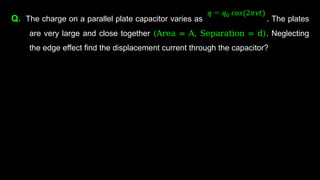
Q. The charge on a parallel plate capacitor varies as . The plates
are very large and close together (Area = A, Separation = d). Neglecting
the edge effect find the displacement current through the capacitor?
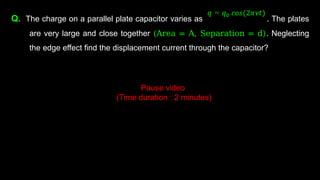
Q. The charge on a parallel plate capacitor varies as . The plates
are very large and close together (Area = A, Separation = d). Neglecting
the edge effect find the displacement current through the capacitor?
Pause video
(Time duration : 2 minutes)
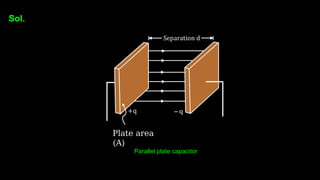
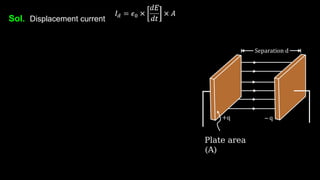
Sol.
Parallel plate capacitor
Plate area
(A)
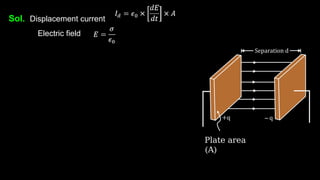
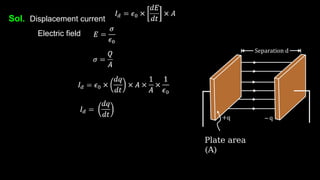
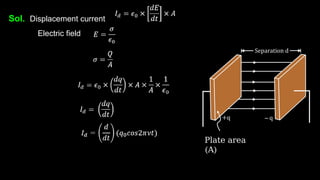
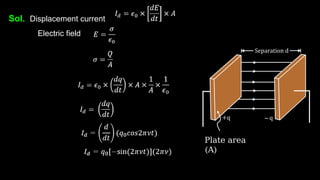
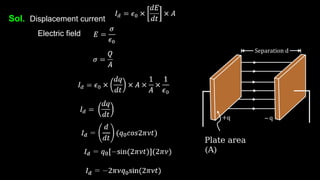
Sol. Displacement current
Plate area
(A)
Sol. Displacement current
Electric field
Plate area
(A)
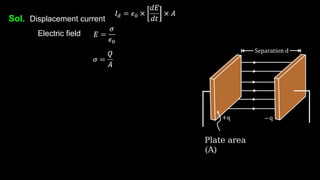
Sol. Displacement current
Electric field
Plate area
(A)
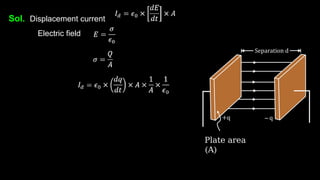
Sol. Displacement current
Electric field
Plate area
(A)
Sol. Displacement current
Electric field
Plate area
(A)
Sol. Displacement current
Electric field
Plate area
(A)
Sol. Displacement current
Electric field
Plate area
(A)
Sol. Displacement current
Electric field
Plate area
(A)
12P08.1
CV3
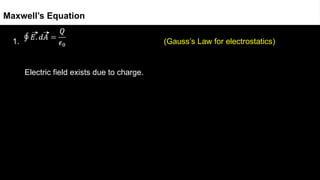
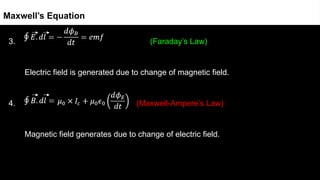
Maxwell’s Equation
1. (Gauss’s Law for electrostatics)
Electric field exists due to charge.
Maxwell’s Equation
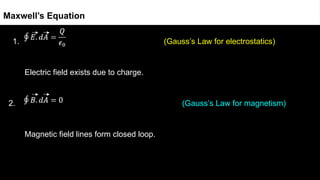
1. (Gauss’s Law for electrostatics)
Electric field exists due to charge.
2. (Gauss’s Law for magnetism)
Magnetic field lines form closed loop.
Maxwell’s Equation
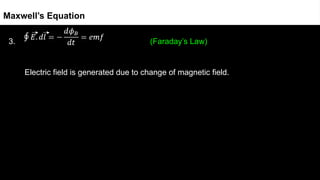
3. (Faraday’s Law)
Electric field is generated due to change of magnetic field.
Maxwell’s Equation
3. (Faraday’s Law)
Electric field is generated due to change of magnetic field.
4. (Maxwell-Ampere’s Law)
Magnetic field generates due to change of electric field.
Maxwell’s Equation
Reference Questions
NCERT : Ex 8.1
12P08.1
PSV 1
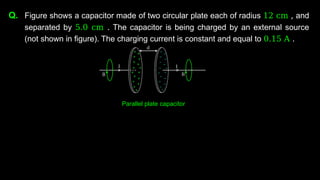
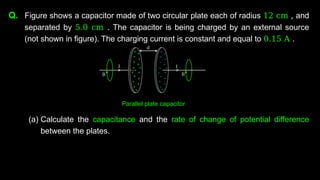
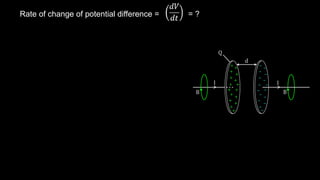
Q. Figure shows a capacitor made of two circular plate each of radius 12 cm , and
separated by 5.0 cm . The capacitor is being charged by an external source
(not shown in figure). The charging current is constant and equal to 0.15 A .
Parallel plate capacitor
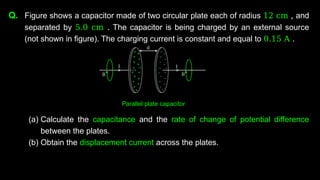
Q. Figure shows a capacitor made of two circular plate each of radius 12 cm , and
separated by 5.0 cm . The capacitor is being charged by an external source
(not shown in figure). The charging current is constant and equal to 0.15 A .
(a) Calculate the capacitance and the rate of change of potential difference
between the plates.
Parallel plate capacitor
Q. Figure shows a capacitor made of two circular plate each of radius 12 cm , and
separated by 5.0 cm . The capacitor is being charged by an external source
(not shown in figure). The charging current is constant and equal to 0.15 A .
(a) Calculate the capacitance and the rate of change of potential difference
between the plates.
(b) Obtain the displacement current across the plates.
Parallel plate capacitor
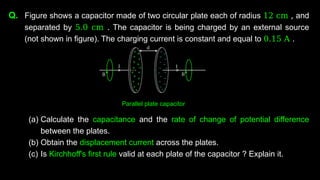
Q. Figure shows a capacitor made of two circular plate each of radius 12 cm , and
separated by 5.0 cm . The capacitor is being charged by an external source
(not shown in figure). The charging current is constant and equal to 0.15 A .
(a) Calculate the capacitance and the rate of change of potential difference
between the plates.
(b) Obtain the displacement current across the plates.
(c) Is Kirchhoff's first rule valid at each plate of the capacitor ? Explain it.
Parallel plate capacitor
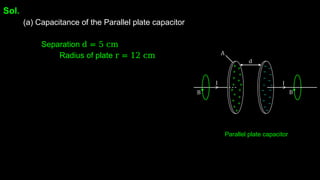
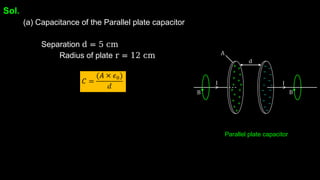
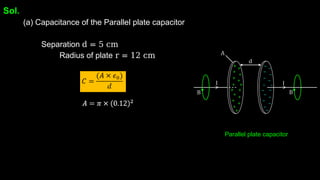
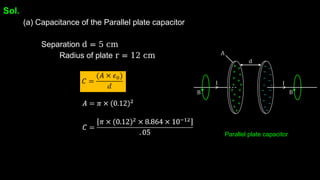
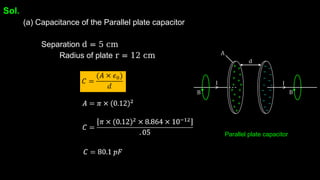
Sol.
(a) Capacitance of the Parallel plate capacitor
Separation d = 5 cm
Radius of plate r = 12 cm
Parallel plate capacitor
Sol.
(a) Capacitance of the Parallel plate capacitor
Separation d = 5 cm
Radius of plate r = 12 cm
Parallel plate capacitor
Sol.
(a) Capacitance of the Parallel plate capacitor
Separation d = 5 cm
Radius of plate r = 12 cm
Parallel plate capacitor
Sol.
(a) Capacitance of the Parallel plate capacitor
Separation d = 5 cm
Radius of plate r = 12 cm
Parallel plate capacitor
Sol.
(a) Capacitance of the Parallel plate capacitor
Separation d = 5 cm
Radius of plate r = 12 cm
Parallel plate capacitor
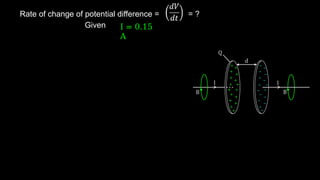
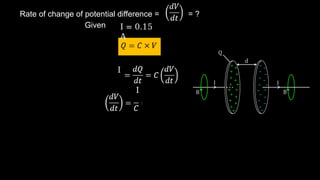
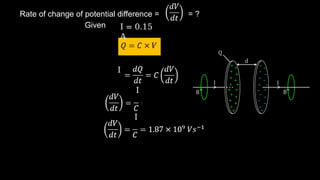
Rate of change of potential difference = = ?
Given I = 0.15
A
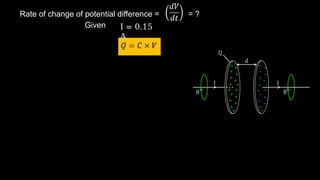
Rate of change of potential difference = = ?
Given I = 0.15
A
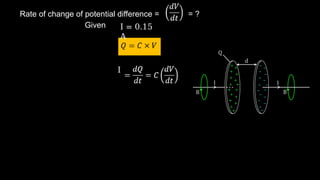
Rate of change of potential difference = = ?
Given
I
I = 0.15
A
Rate of change of potential difference = = ?
Given
I
I
I = 0.15
A
Rate of change of potential difference = = ?
Given
I
I
I
I = 0.15
A
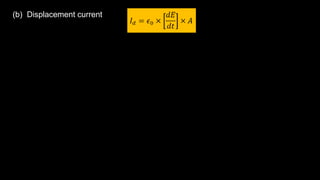
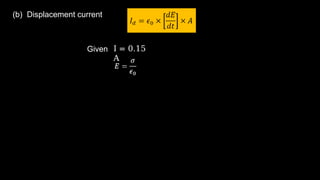
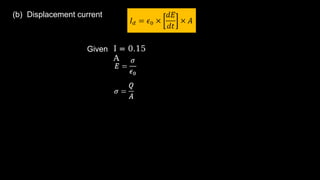
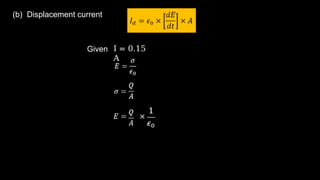
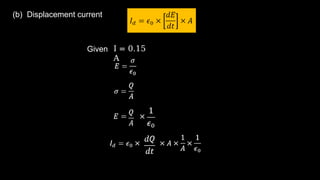
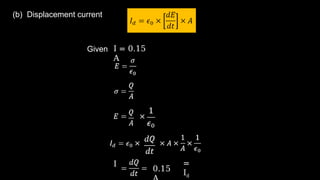
(b) Displacement current
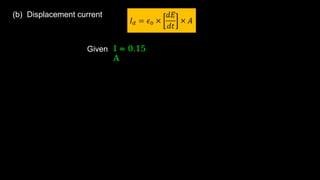
Given I = 0.15
A
(b) Displacement current
Given I = 0.15
A
(b) Displacement current
Given I = 0.15
A
(b) Displacement current
Given I = 0.15
A
(b) Displacement current
Given I = 0.15
A
(b) Displacement current
Given
I =
Id
0.15
I = 0.15
A
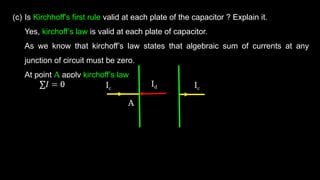
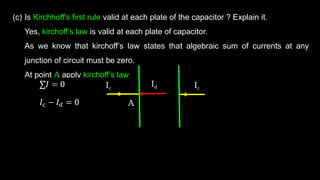
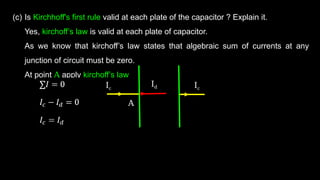
(c) Is Kirchhoff's first rule valid at each plate of the capacitor ? Explain it.
Yes, kirchoff’s law is valid at each plate of capacitor.
(c) Is Kirchhoff's first rule valid at each plate of the capacitor ? Explain it.
Yes, kirchoff’s law is valid at each plate of capacitor.
As we know that kirchoff’s law states that algebraic sum of currents at any
junction of circuit must be zero.
(c) Is Kirchhoff's first rule valid at each plate of the capacitor ? Explain it.
Yes, kirchoff’s law is valid at each plate of capacitor.
As we know that kirchoff’s law states that algebraic sum of currents at any
junction of circuit must be zero.
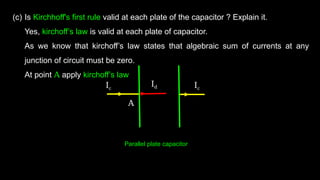
At point A apply kirchoff’s law
Ic Ic
Id
A
Parallel plate capacitor
(c) Is Kirchhoff's first rule valid at each plate of the capacitor ? Explain it.
Yes, kirchoff’s law is valid at each plate of capacitor.
As we know that kirchoff’s law states that algebraic sum of currents at any
junction of circuit must be zero.
At point A apply kirchoff’s law
Ic Ic
Id
A
(c) Is Kirchhoff's first rule valid at each plate of the capacitor ? Explain it.
Yes, kirchoff’s law is valid at each plate of capacitor.
As we know that kirchoff’s law states that algebraic sum of currents at any
junction of circuit must be zero.
At point A apply kirchoff’s law
Ic Ic
Id
A
(c) Is Kirchhoff's first rule valid at each plate of the capacitor ? Explain it.
Yes, kirchoff’s law is valid at each plate of capacitor.
As we know that kirchoff’s law states that algebraic sum of currents at any
junction of circuit must be zero.
At point A apply kirchoff’s law
Ic Ic
Id
A
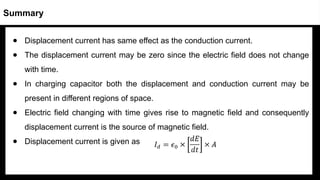
● Displacement current has same effect as the conduction current.
● The displacement current may be zero since the electric field does not change
with time.
● In charging capacitor both the displacement and conduction current may be
present in different regions of space.
● Electric field changing with time gives rise to magnetic field and consequently
displacement current is the source of magnetic field.
● Displacement current is given as
Summary
12P08.2
Electromagnetic Waves
Learning Objectives
What is EM Waves
Source and Nature of EM Waves
Properties of EM Waves
12P08.2 Electromagnetic waves
12P08.2
CV1
What is EM Waves
What is EM Waves
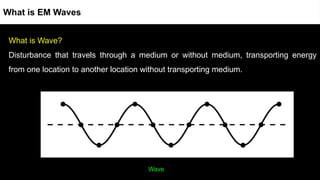
What is Wave?
Disturbance that travels through a medium or without medium, transporting energy
from one location to another location without transporting medium.
Wave
Types of waves
(i) Longitudinal Waves:- Particle of waves are displaced along the direction of
propagation of wave.
130
What is EM Waves
Types of waves
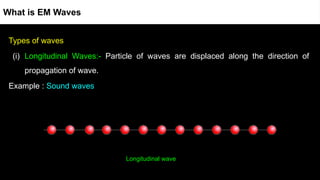
(i) Longitudinal Waves:- Particle of waves are displaced along the direction of
propagation of wave.
Example : Sound waves
131
What is EM Waves
Longitudinal wave
(ii) Transverse Waves:- Particles of waves are displaced perpendicular to the
direction of propagation.
What is EM Waves
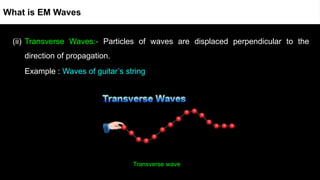
(ii) Transverse Waves:- Particles of waves are displaced perpendicular to the
direction of propagation.
Example : Waves of guitar’s string
What is EM Waves
Transverse wave
Definition of Electromagnetic waves
What is EM Waves
What is EM Waves
Definition of Electromagnetic waves
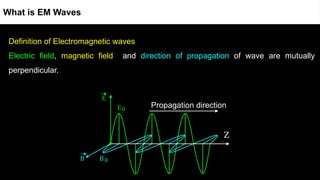
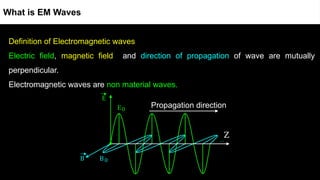
Electric field, magnetic field and direction of propagation of wave are mutually
perpendicular.
Propagation direction
Z
What is EM Waves
Definition of Electromagnetic waves
Electric field, magnetic field and direction of propagation of wave are mutually
perpendicular.
Electromagnetic waves are non material waves.
Propagation direction
Z
What is EM Waves
Definition of Electromagnetic waves
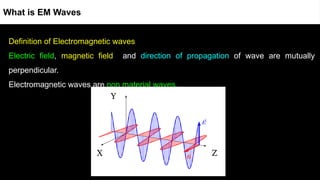
Electric field, magnetic field and direction of propagation of wave are mutually
perpendicular.
Electromagnetic waves are non material waves.
Z
Y
X
Z
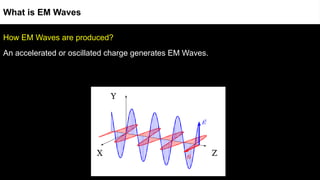
How EM Waves are produced?
An accelerated or oscillated charge generates EM Waves.
138
ret
What is EM Waves
Y
X Z
Z
http://www.mysearch.org.uk/website1/images/animations/472.emwave.gif
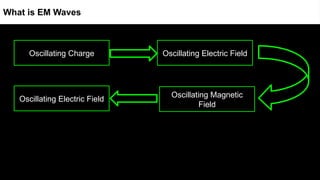
Oscillating Charge
What is EM Waves
http://www.mysearch.org.uk/website1/images/animations/472.emwave.gif
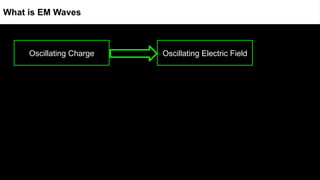
Oscillating Charge Oscillating Electric Field
What is EM Waves
http://www.mysearch.org.uk/website1/images/animations/472.emwave.gif
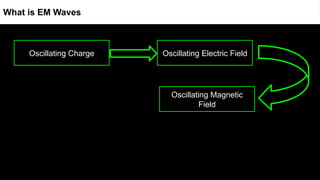
Oscillating Charge
Oscillating Magnetic
Field
Oscillating Electric Field
What is EM Waves
http://www.mysearch.org.uk/website1/images/animations/472.emwave.gif
Oscillating Charge
Oscillating Electric Field
Oscillating Magnetic
Field
Oscillating Electric Field
What is EM Waves
Oscillating Electric Field
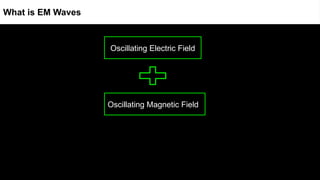
What is EM Waves
Oscillating Magnetic Field
Oscillating Electric Field
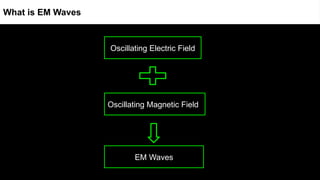
What is EM Waves
Oscillating magnetic field
Oscillating electric field
EM Waves
What is EM Waves
Oscillating Magnetic Field
Oscillating Electric Field
ConcepTest
Ready for challenge
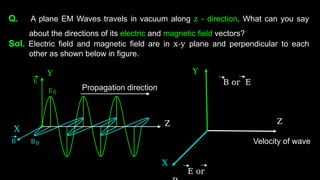
Q. A plane EM Waves travels in vacuum along z - direction. What can you say
about the directions of its electric and magnetic field vectors?
Q. A plane EM Waves travels in vacuum along z - direction. What can you say
about the directions of its electric and magnetic field vectors?
Pause video
(Time duration : 2 minutes)
Q. A plane EM Waves travels in vacuum along z - direction. What can you say
about the directions of its electric and magnetic field vectors?
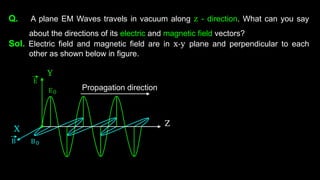
Sol. Electric field and magnetic field are in x-y plane and perpendicular to each
other as shown below in figure.
Q. A plane EM Waves travels in vacuum along z - direction. What can you say
about the directions of its electric and magnetic field vectors?
Sol. Electric field and magnetic field are in x-y plane and perpendicular to each
other as shown below in figure.
Z
X
Y
Propagation direction
Q. A plane EM Waves travels in vacuum along z - direction. What can you say
about the directions of its electric and magnetic field vectors?
Sol. Electric field and magnetic field are in x-y plane and perpendicular to each
other as shown below in figure.
E or
B or E
Velocity of wave
Z
X
Y
X
Y
Z
Propagation direction
12P08.2
CV2
Source and Nature of EM Waves
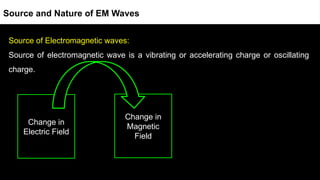
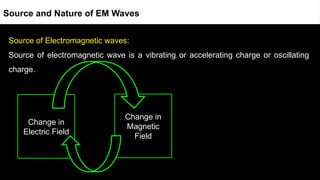
Source of Electromagnetic waves:
Source of electromagnetic wave is a vibrating or accelerating charge or oscillating
charge.
Source and Nature of EM Waves
Source of Electromagnetic waves:
Source of electromagnetic wave is a vibrating or accelerating charge or oscillating
charge.
Source and Nature of EM Waves
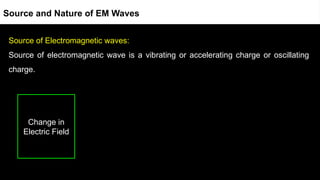
Change in
Electric Field
Source of Electromagnetic waves:
Source of electromagnetic wave is a vibrating or accelerating charge or oscillating
charge.
Source and Nature of EM Waves
Change in
Electric Field
Change in
Magnetic
Field
Source of Electromagnetic waves:
Source of electromagnetic wave is a vibrating or accelerating charge or oscillating
charge.
Source and Nature of EM Waves
Change in
Electric Field
Change in
Magnetic
Field
Nature of EM Waves
EM Waves are transverse and non material waves .
Source and Nature of EM Waves
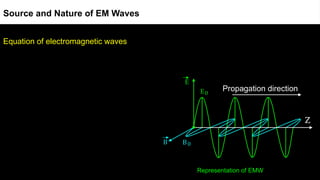
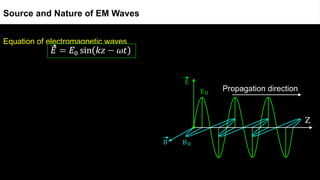
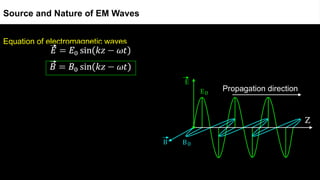
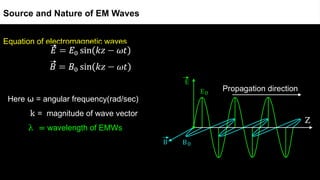
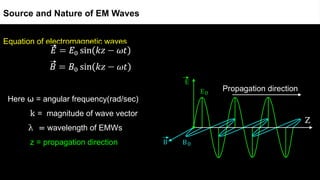
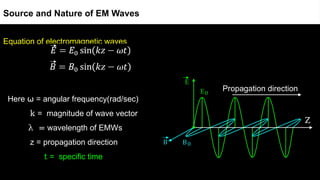
Equation of electromagnetic waves
Source and Nature of EM Waves
Representation of EMW
Z
Propagation direction
Equation of electromagnetic waves
Source and Nature of EM Waves
Z
Propagation direction
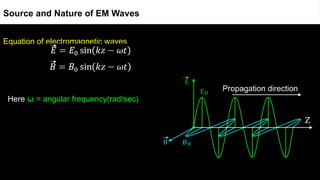
Equation of electromagnetic waves
Source and Nature of EM Waves
Z
Propagation direction
Equation of electromagnetic waves
Here = angular frequency(rad/sec)
⍵
Source and Nature of EM Waves
Z
Propagation direction
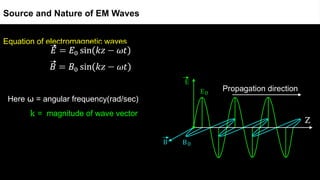
Equation of electromagnetic waves
Here = angular frequency(rad/sec)
⍵
k = magnitude of wave vector
Source and Nature of EM Waves
Z
Propagation direction
Equation of electromagnetic waves
Here = angular frequency(rad/sec)
⍵
k = magnitude of wave vector
λ = wavelength of EMWs
Source and Nature of EM Waves
Z
Propagation direction
Equation of electromagnetic waves
Here = angular frequency(rad/sec)
⍵
k = magnitude of wave vector
λ = wavelength of EMWs
z = propagation direction
Source and Nature of EM Waves
Z
Propagation direction
Equation of electromagnetic waves
Here = angular frequency(rad/sec)
⍵
k = magnitude of wave vector
λ = wavelength of EMWs
z = propagation direction
t = specific time
Source and Nature of EM Waves
Z
Propagation direction
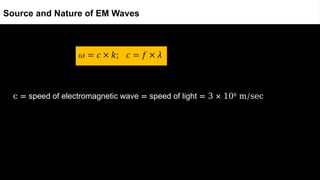
c = speed of electromagnetic wave = speed of light = 3 × 10⁸
m/sec
Source and Nature of EM Waves
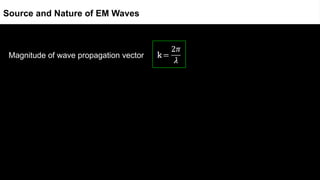
Magnitude of wave propagation vector
Source and Nature of EM Waves
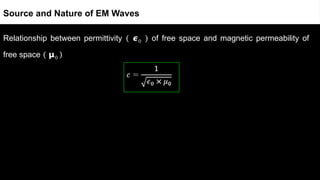
Relationship between permittivity ( 𝟄0 ) of free space and magnetic permeability of
free space ( 𝝻0 )
Source and Nature of EM Waves
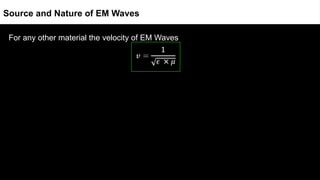
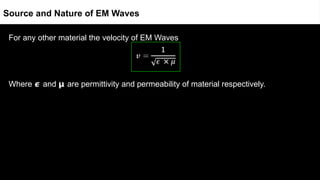
For any other material the velocity of EM Waves
Source and Nature of EM Waves
For any other material the velocity of EM Waves
Source and Nature of EM Waves
For any other material the velocity of EM Waves
Where 𝟄 and 𝝻 are permittivity and permeability of material respectively.
Source and Nature of EM Waves
ConcepTest
Ready for challenge
Q. The source of EM Waves can be a charge
(a) Moving with a constant velocity
(b) Moving in a circular orbit
(c) At rest
(d) Falling in an electric field
Q. The source of EM Waves can be a charge
(a) Moving with a constant velocity
(b) Moving in a circular orbit
(c) At rest
(d) Falling in an electric field
Pause video
(Time duration : 2 minutes)
Q. The source of EM Waves can be a charge
(a) Moving with a constant velocity
(b) Moving in a circular orbit
(c) At rest
(d) Falling in an electric field
Sol.
(b) Moving in a circular orbital ( In circular motion a particle is having centripetal
acceleration so it can be a source of EM Waves )
(d) Falling in an electric field (In electric field a charge particle is experienced
force so that it gets accelerated, so it can be a source EM Waves)
ConcepTest
Ready for challenge
Q. Which physical quantity is same for X- rays of wavelength 10 -10
m , red light
of wavelength 6800 Å and radio waves of wavelength 500 m ?
(a) Velocity
(b) Frequency
(c) Amplitude
(d) acceleration
Q. Which physical quantity is same for X- rays of wavelength 10 -10
m , red light
of wavelength 6800 Å and radio waves of wavelength 500 m ?
(a) Velocity
(b) Frequency
(c) Amplitude
(d) acceleration
Pause video
(Time duration : 2 minutes)
Q. Which physical quantity is same for X- rays of wavelength 10 -10
m , red light
of wavelength 6800 Å and radio waves of wavelength 500 m ?
Sol.
(a) Velocity
ConcepTest
Ready for challenge
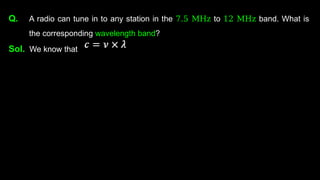
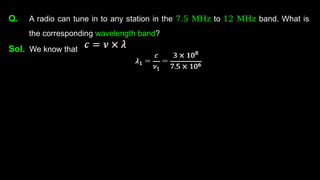
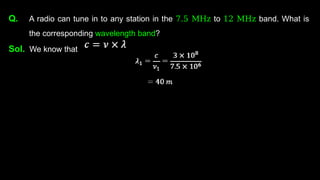
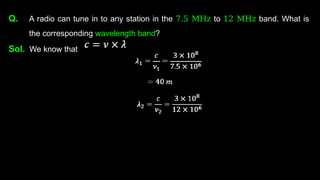
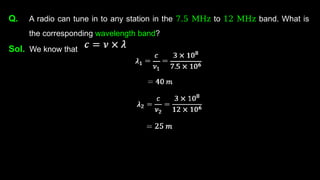
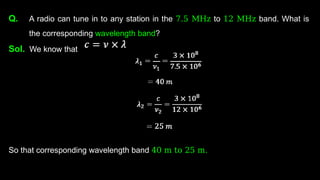
Q. A radio can tune in to any station in the 7.5 MHz to 12 MHz band. What is
the corresponding wavelength band?
Q. A radio can tune in to any station in the 7.5 MHz to 12 MHz band. What is
the corresponding wavelength band?
Pause video
(Time duration : 2 minutes)
Q. A radio can tune in to any station in the 7.5 MHz to 12 MHz band. What is
the corresponding wavelength band?
Sol. We know that
Q. A radio can tune in to any station in the 7.5 MHz to 12 MHz band. What is
the corresponding wavelength band?
Sol. We know that
Q. A radio can tune in to any station in the 7.5 MHz to 12 MHz band. What is
the corresponding wavelength band?
Sol. We know that
Q. A radio can tune in to any station in the 7.5 MHz to 12 MHz band. What is
the corresponding wavelength band?
Sol. We know that
Q. A radio can tune in to any station in the 7.5 MHz to 12 MHz band. What is
the corresponding wavelength band?
Sol. We know that
Q. A radio can tune in to any station in the 7.5 MHz to 12 MHz band. What is
the corresponding wavelength band?
Sol. We know that
So that corresponding wavelength band 40 m to 25 m.
ConcepTest
Ready for challenge
Q. A charged particle oscillates about its mean equilibrium position with a
frequency of 109
Hz. what is the frequency of the electromagnetic waves
produced by the oscillator?
Q. A charged particle oscillates about its mean equilibrium position with a
frequency of 109
Hz. what is the frequency of the electromagnetic waves
produced by the oscillator?
Pause video
(Time duration : 2 minutes)
Q. A charged particle oscillates about its mean equilibrium position with a
frequency of 109
Hz. what is the frequency of the electromagnetic waves
produced by the oscillator?
Sol. Frequency of Electromagnetic wave must be equal to the frequency of
oscillation of charged particle.
So frequency of EM Waves is 10 9
Hz.
12P08.2
CV3
Properties of EM Waves
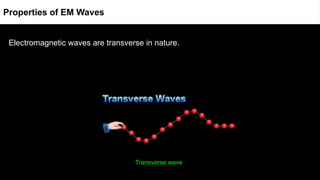
Electromagnetic waves are transverse in nature.Properties of EMWs
Transverse wave
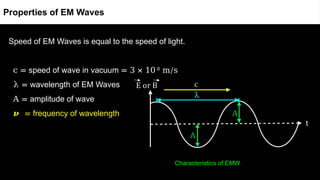
Speed of EM Waves is equal to the speed of light.
Properties of EM Waves
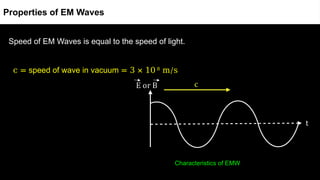
Speed of EM Waves is equal to the speed of light.
c = speed of wave in vacuum = 3 × 10 8
m/s
Characteristics of EMW
Properties of EM Waves
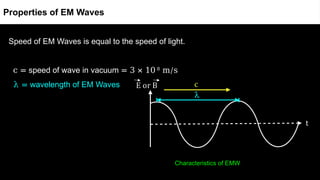
Speed of EM Waves is equal to the speed of light.
c = speed of wave in vacuum = 3 × 10 8
m/s
λ = wavelength of EM Waves
Characteristics of EMW
Properties of EM Waves
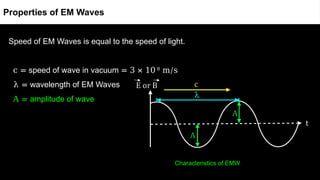
Speed of EM Waves is equal to the speed of light.
c = speed of wave in vacuum = 3 × 10 8
m/s
λ = wavelength of EM Waves
A = amplitude of wave
Characteristics of EMW
Properties of EM Waves
Speed of EM Waves is equal to the speed of light.
c = speed of wave in vacuum = 3 × 10 8
m/s
λ = wavelength of EM Waves
A = amplitude of wave
𝝂 = frequency of wavelength
Characteristics of EMW
Properties of EM Waves
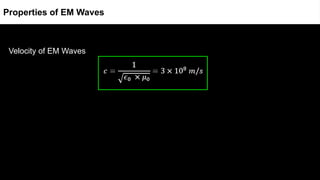
Velocity of EM Waves
Properties of EM Waves
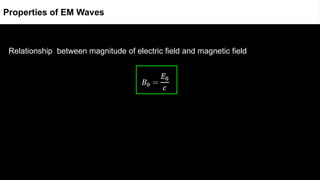
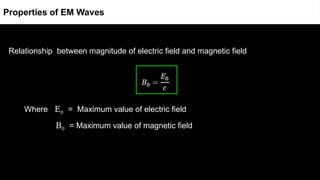
Relationship between magnitude of electric field and magnetic field
Properties of EM Waves
Relationship between magnitude of electric field and magnetic field
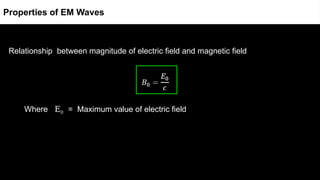
Where E0 = Maximum value of electric field
Properties of EM Waves
Relationship between magnitude of electric field and magnetic field
Where E0 = Maximum value of electric field
B0 = Maximum value of magnetic field
Properties of EM Waves
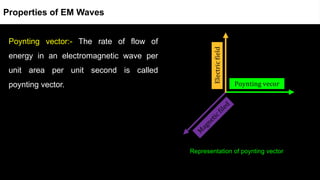
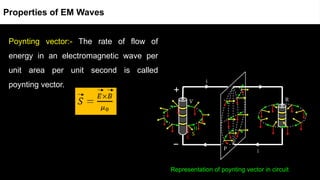
Poynting vector:- The rate of flow of
energy in an electromagnetic wave per
unit area per unit second is called
poynting vector.
Properties of EM Waves
Poynting vector:- The rate of flow of
energy in an electromagnetic wave per
unit area per unit second is called
poynting vector.
Representation of poynting vector
Properties of EM Waves
Poynting vector:- The rate of flow of
energy in an electromagnetic wave per
unit area per unit second is called
poynting vector.
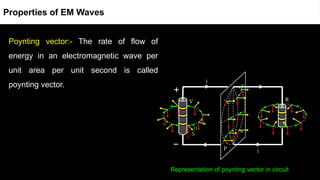
Representation of poynting vector in circuit
Properties of EM Waves
Poynting vector:- The rate of flow of
energy in an electromagnetic wave per
unit area per unit second is called
poynting vector.
Representation of poynting vector in circuit
Properties of EM Waves
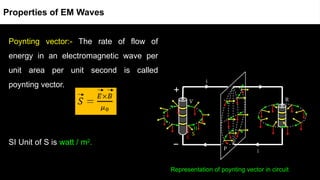
Poynting vector:- The rate of flow of
energy in an electromagnetic wave per
unit area per unit second is called
poynting vector.
SI Unit of S is watt / m2
.
Representation of poynting vector in circuit
Properties of EM Waves
The electric vector is responsible for optical effect of electromagnetic waves.
Properties of EM Waves
The electric vector is responsible for optical effect of electromagnetic waves.
Because moving particle oscillates primarily due to the electric field.
Properties of EM Waves
The energy in an electromagnetic wave is equally divided in electric vector and
magnetic vector.
Properties of EM Waves
The energy in an electromagnetic wave is equally divided in electric vector and
magnetic vector.
Energy distribution in EMWs
Properties of EM Waves
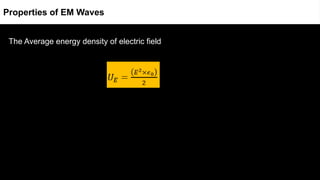
The Average energy density of electric field
Properties of EM Waves
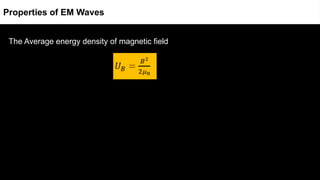
The Average energy density of magnetic field
Properties of EM Waves
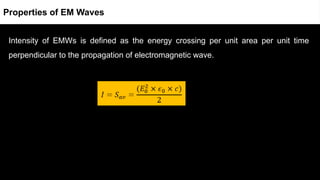
Intensity of EM Waves is defined as the energy crossing per unit area per unit time
perpendicular to the propagation of electromagnetic wave.
Properties of EM Waves
Intensity of EMWs is defined as the energy crossing per unit area per unit time
perpendicular to the propagation of electromagnetic wave.
Properties of EM Waves
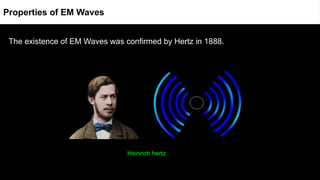
The existence of EM Waves was confirmed by Hertz in 1888.
Heinrich hertz
Properties of EM Waves
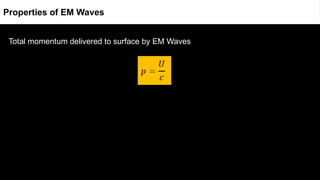
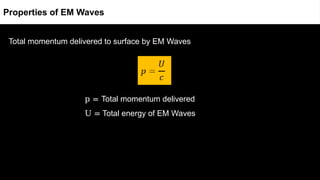
Total momentum delivered to surface by EM Waves
Properties of EM Waves
Total momentum delivered to surface by EM Waves
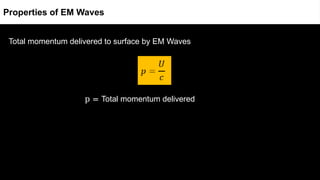
p = Total momentum delivered
Properties of EM Waves
Total momentum delivered to surface by EM Waves
p = Total momentum delivered
U = Total energy of EM Waves
Properties of EM Waves
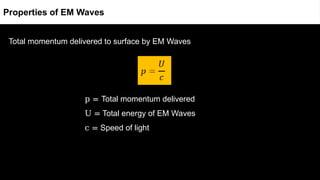
Total momentum delivered to surface by EM Waves
p = Total momentum delivered
U = Total energy of EM Waves
c = Speed of light
Properties of EM Waves
ConcepTest
Ready for challenge
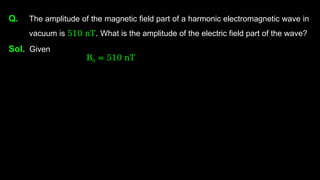
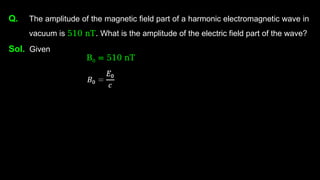
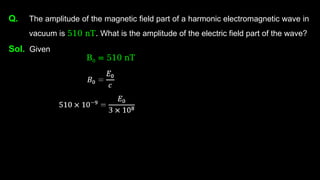
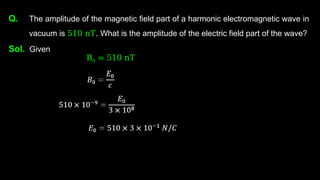
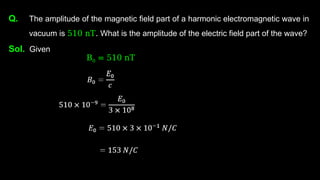
Q. The amplitude of the magnetic field part of a harmonic electromagnetic wave in
vacuum is 510 nT. What is the amplitude of the electric field part of the wave?
Q. The amplitude of the magnetic field part of a harmonic electromagnetic wave in
vacuum is 510 nT. What is the amplitude of the electric field part of the wave?
Pause video
(Time duration : 2 minutes)
Q. The amplitude of the magnetic field part of a harmonic electromagnetic wave in
vacuum is 510 nT. What is the amplitude of the electric field part of the wave?
Sol. Given
B0 = 510 nT
Q. The amplitude of the magnetic field part of a harmonic electromagnetic wave in
vacuum is 510 nT. What is the amplitude of the electric field part of the wave?
Sol. Given
B0 = 510 nT
Q. The amplitude of the magnetic field part of a harmonic electromagnetic wave in
vacuum is 510 nT. What is the amplitude of the electric field part of the wave?
Sol. Given
B0 = 510 nT
Q. The amplitude of the magnetic field part of a harmonic electromagnetic wave in
vacuum is 510 nT. What is the amplitude of the electric field part of the wave?
Sol. Given
B0 = 510 nT
Q. The amplitude of the magnetic field part of a harmonic electromagnetic wave in
vacuum is 510 nT. What is the amplitude of the electric field part of the wave?
Sol. Given
B0 = 510 nT
Reference Questions
NCERT : Example 8.2, 8.3, 8.4, 8.5
12P08.2
PSV 2
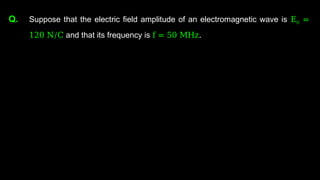
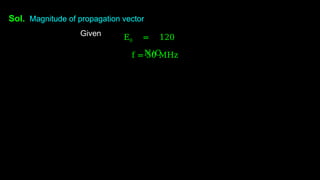
Q. Suppose that the electric field amplitude of an electromagnetic wave is E0 =
120 N/C and that its frequency is f = 50 MHz.
Q. Suppose that the electric field amplitude of an electromagnetic wave is E0 =
120 N/C and that its frequency is f = 50 MHz.
(a) Determine B0, 𝟂, k and λ.
Q. Suppose that the electric field amplitude of an electromagnetic wave is E0 =
120 N/C and that its frequency is f = 50 MHz.
(a) Determine B0, 𝟂, k and λ.
(b) Find expression for E and B.
Q. Suppose that the electric field amplitude of an electromagnetic wave is E0 =
120 N/C and that its frequency is f = 50 MHz.
(a) Determine B0, 𝟂, k and λ.
(b) Find expression for E and B.
Pause video
(Time duration : 2 minutes)
Sol.
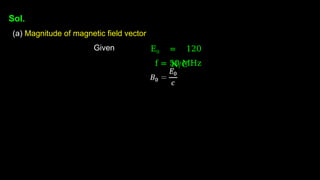
(a) Magnitude of magnetic field vector
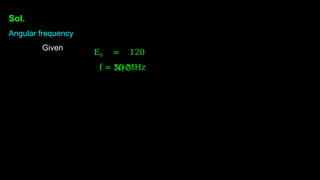
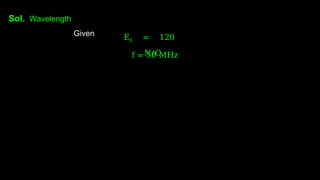
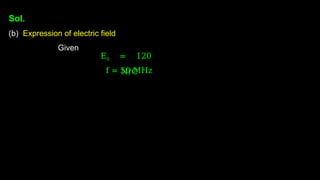
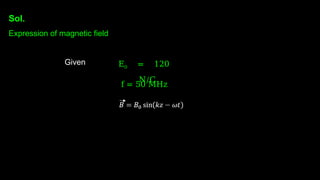
Given E0 = 120
N/C
f = 50 MHz
Sol.
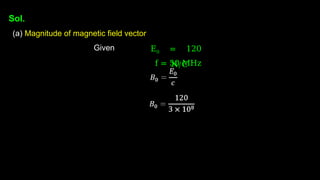
(a) Magnitude of magnetic field vector
Given E0 = 120
N/C
f = 50 MHz
Sol.
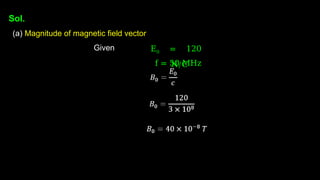
(a) Magnitude of magnetic field vector
Given E0 = 120
N/C
f = 50 MHz
Sol.
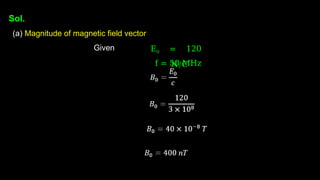
(a) Magnitude of magnetic field vector
Given E0 = 120
N/C
f = 50 MHz
Sol.
(a) Magnitude of magnetic field vector
Given E0 = 120
N/C
f = 50 MHz
Sol.
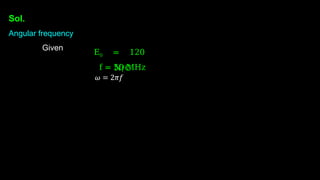
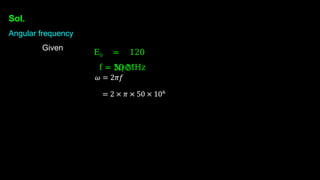
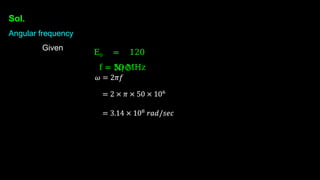
Angular frequency
Given
E0 = 120
N/C
f = 50 MHz
Sol.
Angular frequency
Given
E0 = 120
N/C
f = 50 MHz
Sol.
Angular frequency
Given
E0 = 120
N/C
f = 50 MHz
Sol.
Angular frequency
Given
E0 = 120
N/C
f = 50 MHz
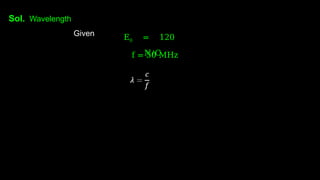
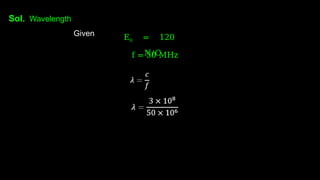
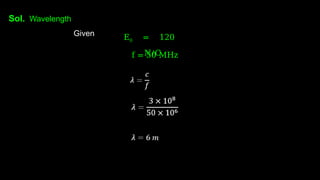
Sol. Wavelength
Given E0 = 120
N/C
f = 50 MHz
Sol. Wavelength
Given E0 = 120
N/C
f = 50 MHz
Sol. Wavelength
Given E0 = 120
N/C
f = 50 MHz
Sol. Wavelength
Given E0 = 120
N/C
f = 50 MHz
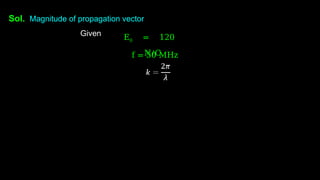
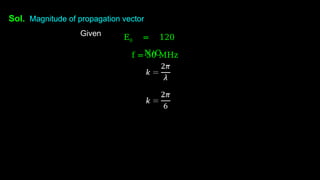
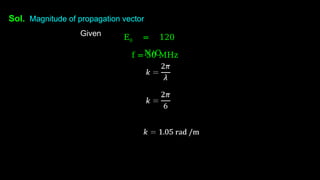
Sol. Magnitude of propagation vector
Given E0 = 120
N/C
f = 50 MHz
Sol. Magnitude of propagation vector
Given E0 = 120
N/C
f = 50 MHz
Sol. Magnitude of propagation vector
Given E0 = 120
N/C
f = 50 MHz
Sol. Magnitude of propagation vector
Given E0 = 120
N/C
f = 50 MHz
E0 = 120
N/C
f = 50 MHz
Sol.
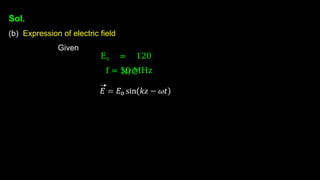
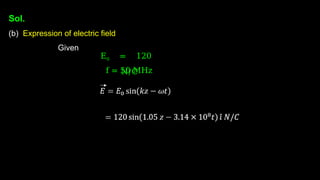
(b) Expression of electric field
Given
Sol.
(b) Expression of electric field
Given
E0 = 120
N/C
f = 50 MHz
Sol.
(b) Expression of electric field
Given
E0 = 120
N/C
f = 50 MHz
Sol.
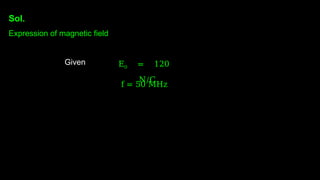
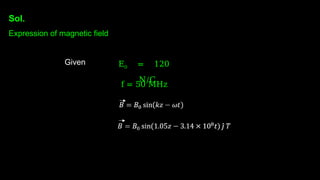
Expression of magnetic field
Given E0 = 120
N/C
f = 50 MHz
Sol.
Expression of magnetic field
Given E0 = 120
N/C
f = 50 MHz
Sol.
Expression of magnetic field
Given E0 = 120
N/C
f = 50 MHz
12P08.2
PSV 3
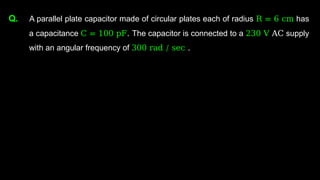
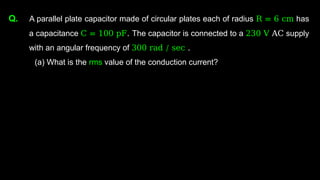
Q. A parallel plate capacitor made of circular plates each of radius R = 6 cm has
a capacitance C = 100 pF. The capacitor is connected to a 230 V AC supply
with an angular frequency of 300 rad / sec .
Q. A parallel plate capacitor made of circular plates each of radius R = 6 cm has
a capacitance C = 100 pF. The capacitor is connected to a 230 V AC supply
with an angular frequency of 300 rad / sec .
(a) What is the rms value of the conduction current?
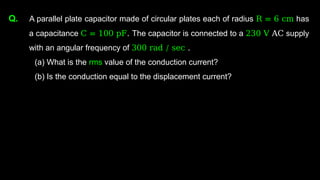
Q. A parallel plate capacitor made of circular plates each of radius R = 6 cm has
a capacitance C = 100 pF. The capacitor is connected to a 230 V AC supply
with an angular frequency of 300 rad / sec .
(a) What is the rms value of the conduction current?
(b) Is the conduction equal to the displacement current?
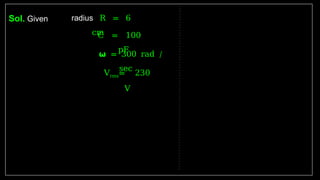
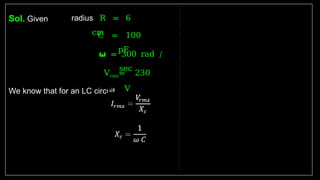
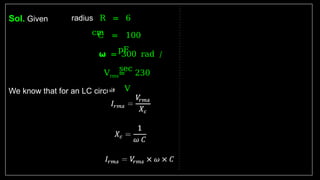
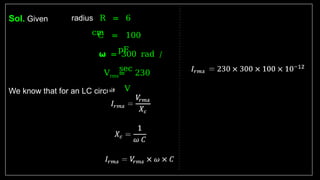
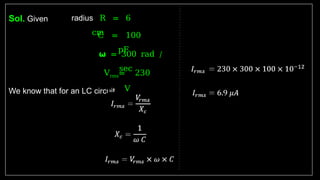
Sol. Given radius R = 6
cm
C = 100
pF
𝞈 = 300 rad /
sec
Vrms= 230
V
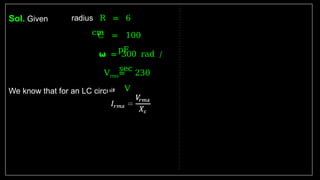
Sol. Given
We know that for an LC circuit
radius R = 6
cm
C = 100
pF
𝞈 = 300 rad /
sec
Vrms= 230
V
Sol. Given
We know that for an LC circuit
radius R = 6
cm
C = 100
pF
𝞈 = 300 rad /
sec
Vrms= 230
V
Sol. Given
We know that for an LC circuit
radius R = 6
cm
C = 100
pF
𝞈 = 300 rad /
sec
Vrms= 230
V
Sol. Given
We know that for an LC circuit
radius R = 6
cm
C = 100
pF
𝞈 = 300 rad /
sec
Vrms= 230
V
Sol. Given
We know that for an LC circuit
radius R = 6
cm
C = 100
pF
𝞈 = 300 rad /
sec
Vrms= 230
V
(b) Is the conduction equal to the displacement current?
Sol.
(b) Yes, because from the formula of displacement current, we can get
conduction current without changing the dimension.
12P08.2
PSV 4
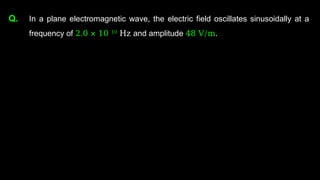
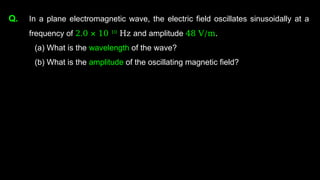
Q. In a plane electromagnetic wave, the electric field oscillates sinusoidally at a
frequency of 2.0 × 10 10
Hz and amplitude 48 V/m.
Q. In a plane electromagnetic wave, the electric field oscillates sinusoidally at a
frequency of 2.0 × 10 10
Hz and amplitude 48 V/m.
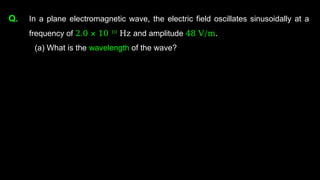
(a) What is the wavelength of the wave?
Q. In a plane electromagnetic wave, the electric field oscillates sinusoidally at a
frequency of 2.0 × 10 10
Hz and amplitude 48 V/m.
(a) What is the wavelength of the wave?
(b) What is the amplitude of the oscillating magnetic field?
Q. In a plane electromagnetic wave, the electric field oscillates sinusoidally at a
frequency of 2.0 × 10 10
Hz and amplitude 48 V/m.
(a) What is the wavelength of the wave?
(b) What is the amplitude of the oscillating magnetic field?
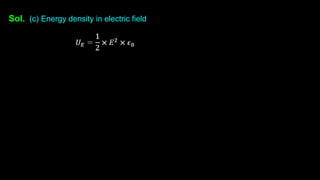
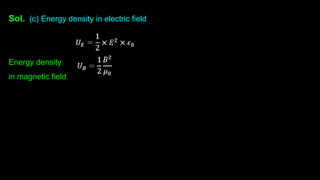
(c) Show that the average energy density of the E field equals the average
energy density of the B field. [c = 3 × 10 8
m s-1
]
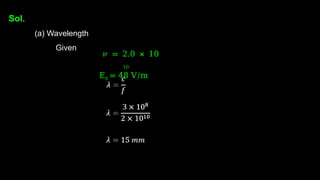
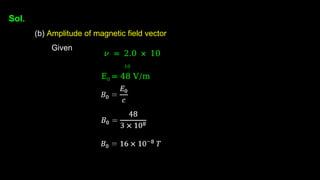
Sol.
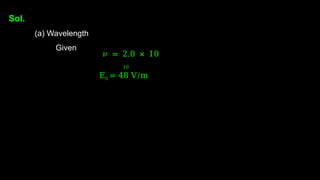
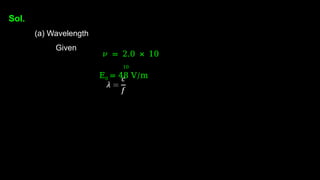
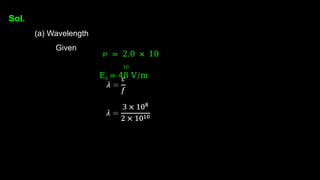
(a) Wavelength
Given
𝜈 = 2.0 × 10
10
E0 = 48 V/m
Sol.
(a) Wavelength
Given
𝜈 = 2.0 × 10
10
E0 = 48 V/m
Sol.
(a) Wavelength
Given
𝜈 = 2.0 × 10
10
E0 = 48 V/m
Sol.
(a) Wavelength
Given
𝜈 = 2.0 × 10
10
E0 = 48 V/m
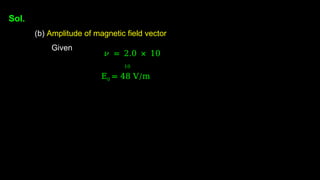
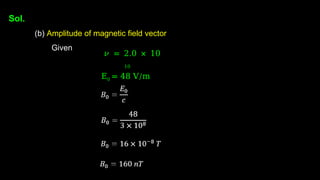
Sol.
(b) Amplitude of magnetic field vector
Given
𝜈 = 2.0 × 10
10
E0 = 48 V/m
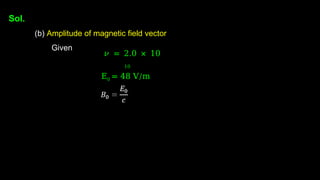
Sol.
(b) Amplitude of magnetic field vector
Given
𝜈 = 2.0 × 10
10
E0 = 48 V/m
Sol.
(b) Amplitude of magnetic field vector
Given
𝜈 = 2.0 × 10
10
E0 = 48 V/m
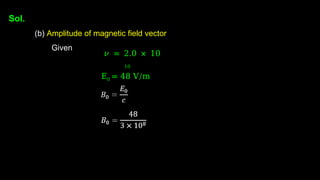
Sol.
(b) Amplitude of magnetic field vector
Given
𝜈 = 2.0 × 10
10
E0 = 48 V/m
Sol.
(b) Amplitude of magnetic field vector
Given
𝜈 = 2.0 × 10
10
E0 = 48 V/m
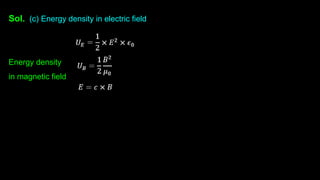
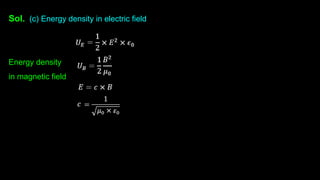
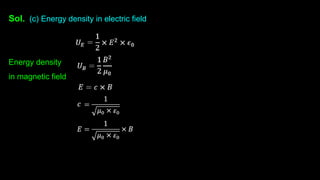
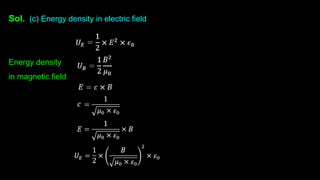
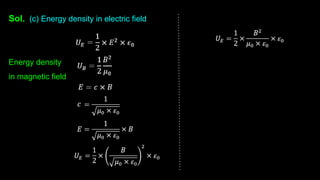
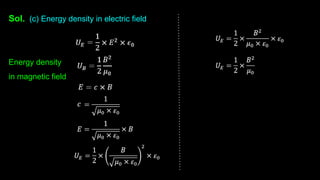
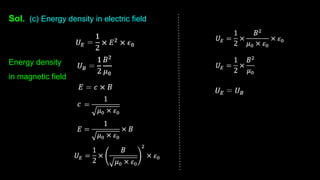
Sol. (c) Energy density in electric field
Energy density
in magnetic field
Sol. (c) Energy density in electric field
Energy density
in magnetic field
Sol. (c) Energy density in electric field
Energy density
in magnetic field
Sol. (c) Energy density in electric field
Energy density
in magnetic field
Sol. (c) Energy density in electric field
Energy density
in magnetic field
Sol. (c) Energy density in electric field
Energy density
in magnetic field
Sol. (c) Energy density in electric field
Energy density
in magnetic field
Sol. (c) Energy density in electric field
Energy density
in magnetic field
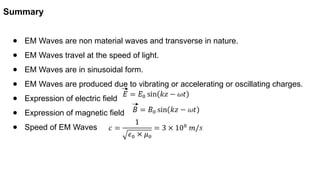
● EM Waves are non material waves and transverse in nature.
● EM Waves travel at the speed of light.
● EM Waves are in sinusoidal form.
● EM Waves are produced due to vibrating or accelerating or oscillating charges.
● Expression of electric field
● Expression of magnetic field
● Speed of EM Waves
Summary
12P08.3
Electromagnetic Spectrum
Learning objectives
What is EM Spectrum?
Classification of EM Waves
12P08.3 Electromagnetic Spectrum
12P08.3
CV1
What is EM Spectrum
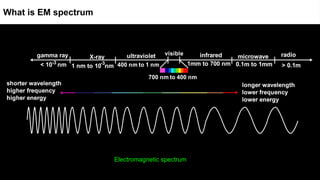
The arrange array of electromagnetic radiation in the sequence of their wavelength
or frequency is called Electromagnetic spectrum.
What is EM spectrum
The arrange array of electromagnetic radiation in the sequence of their wavelength
or frequency is called Electromagnetic spectrum.
This consists electromagnetic energy ranging from Gamma Rays to Radio waves.
What is EM spectrum
What is EM spectrum
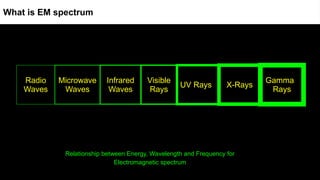
Electromagnetic spectrum
Radio
Waves
Microwave
Waves
Infrared
Waves
Visible
Rays
UV Rays X-Rays
Gamma
Rays
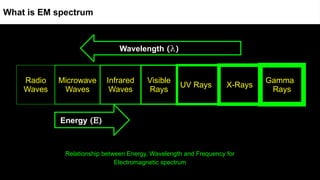
What is EM spectrum
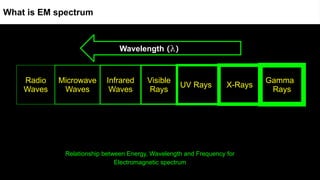
Relationship between Energy, Wavelength and Frequency for
Electromagnetic spectrum
Radio
Waves
Microwave
Waves
Infrared
Waves
Visible
Rays
UV Rays X-Rays
Gamma
Rays
Wavelength (λ)
What is EM spectrum
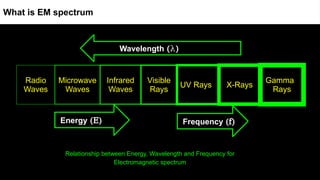
Relationship between Energy, Wavelength and Frequency for
Electromagnetic spectrum
Radio
Waves
Microwave
Waves
Infrared
Waves
Visible
Rays
UV Rays X-Rays
Gamma
Rays
Wavelength (λ)
Energy (E)
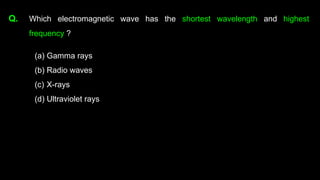
What is EM spectrum
Relationship between Energy, Wavelength and Frequency for
Electromagnetic spectrum
Wavelength (λ)
Radio
Waves
Microwave
Waves
Infrared
Waves
Visible
Rays
UV Rays X-Rays
Gamma
Rays
Wavelength (λ)
Energy (E) Frequency (f)
What is EM spectrum
Relationship between Energy, Wavelength and Frequency for
Electromagnetic spectrum
Wavelength (λ)
Memory based question
Ready for challenge
Q. Which electromagnetic wave has the shortest wavelength and highest
frequency ?
(a) Gamma rays
(b) Radio waves
(c) X-rays
(d) Ultraviolet rays
Q. Which electromagnetic wave has the shortest wavelength and highest
frequency ?
(a) Gamma rays
(b) Radio waves
(c) X-rays
(d) Ultraviolet rays
Pause video
(Time duration : 2 minutes)
Q. Which electromagnetic wave has the shortest wavelength and highest
frequency ?
(a) Gamma rays
(b) Radio waves
(c) X-rays
(d) Ultraviolet rays
Sol.
(e) Gamma rays
Memory based question
Ready for challenge
Q. Electromagnetic waves that you can see are called
(a) Infrared rays
(b) Microwaves
(c) X-rays
(d) Visible light
Q. Electromagnetic waves that you can see are called
(a) Infrared rays
(b) Microwaves
(c) X-rays
(d) Visible light
Pause video
(Time duration : 2 minutes)
Q. Electromagnetic waves that you can see are called
(a) Infrared rays
(b) Microwaves
(c) X-rays
(d) Visible light
Sol.
(d) Visible light
Memory based question
Ready for challenge
Q. Longest wavelength of spectrum
(a) Radio waves
(b) Ultraviolet rays
(c) Visible light
(d) Microwaves
Q. Longest wavelength of spectrum
(a) Radio waves
(b) Ultraviolet rays
(c) Visible light
(d) Microwaves
Pause video
(Time duration : 2 minutes)
Q. Longest wavelength of spectrum
(a) Radio waves
(b) Ultraviolet rays
(c) Visible light
(d) Microwaves
Sol.
(e) Radio waves
Memory based question
Ready for challenge
Q. Which colour has the shortest wavelength in visible light?
(a) Red
(b) Violet
(c) Blue
(d) Green
Q. Which colour has the shortest wavelength in visible light?
(a) Red
(b) Violet
(c) Blue
(d) Green
Pause video
(Time duration : 2 minutes)
Q. Which colour has the shortest wavelength in visible light?
(a) Red
(b) Violet
(c) Blue
(d) Green
Sol.
(b) Violet
12P08.3
CV2
Classification of EM Spectrum
1. Radio waves
Classification of EM Waves
1. Radio waves
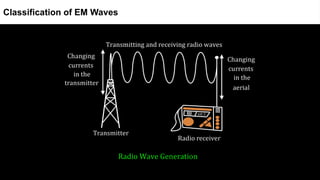
Production - Due to accelerated charge in wire or antena
Classification of EM Waves
1. Radio waves
Production - Due to accelerated charge in wire or antena
Wavelength range - Greater than 0.1 m
Classification of EM Waves
1. Radio waves
Production - Due to accelerated charge in wire or antena
Wavelength range - Greater than 0.1 m
Detection- Receiver’s Aerial
Classification of EM Waves
Application of Radio waves
Radio waves are used in radio and television communication systems.
Classification of EM Waves
Application of Radio waves
Radio waves are used in radio and television communication systems.
Radio waves are used in Cellular phones to transmit voice communication in the
ultrahigh frequency band.
Classification of EM Waves
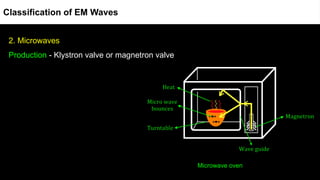
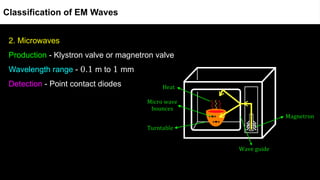
2. Microwaves
Classification of EM Waves
2. Microwaves
Production - Klystron valve or magnetron valve
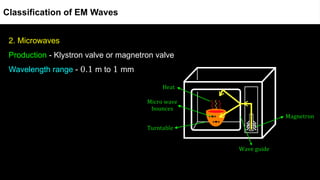
Microwave oven
Classification of EM Waves
2. Microwaves
Production - Klystron valve or magnetron valve
Wavelength range - 0.1 m to 1 mm
Classification of EM Waves
2. Microwaves
Production - Klystron valve or magnetron valve
Wavelength range - 0.1 m to 1 mm
Detection - Point contact diodes
Classification of EM Waves
Application of microwaves
They are suitable for the radar systems used in aircraft navigation.
Classification of EM Waves
Application of microwaves
They are suitable for the radar systems used in aircraft navigation.
Microwave oven is an interesting domestic application of these waves.
Classification of EM Waves
3. Infrared rays
Classification of EM Waves
3. Infrared rays
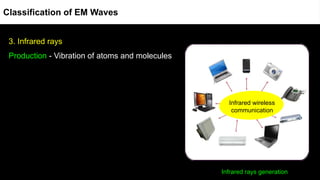
Production - Vibration of atoms and molecules
Infrared wireless
communication
Infrared rays generation
Classification of EM Waves
3. Infrared rays
Production - Vibration of atoms and molecules
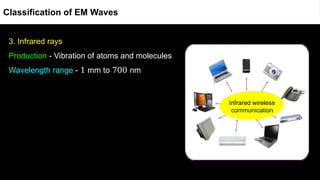
Wavelength range - 1 mm to 700 nm
Infrared wireless
communication
Classification of EM Waves
3. Infrared rays
Production - Vibration of atoms and molecules
Wavelength range - 1 mm to 700 nm
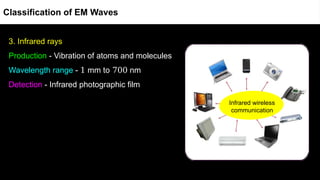
Detection - Infrared photographic film
Infrared wireless
communication
Classification of EM Waves
Application of Infrared rays
Infrared lamps are used in physical therapy.
Classification of EM Waves
Application of Infrared rays
Infrared lamps are used in physical therapy.
Infrared rays maintain the earth’s temperature.
Classification of EM Waves
Application of Infrared rays
Infrared lamps are used in physical therapy.
Infrared rays maintain the earth’s temperature.
Infrared detectors are used in earth satellites, both for military purpose and to
observe the growth of crops.
Classification of EM Waves
Application of Infrared rays
Infrared lamps are used in physical therapy.
Infrared rays maintain the earth’s temperature.
Infrared detectors are used in earth satellites, both for military purpose and to
observe the growth of crops.
Electronic devices also emit infrared rays and widely used in the remote switches of
household electronic systems such as TV sets, video recorders, and wi-fi systems.
Classification of EM Waves
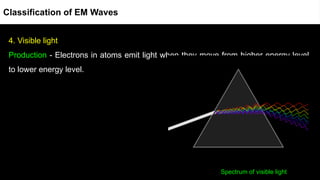
4. Visible light
Classification of EM Waves
4. Visible light
Production - Electrons in atoms emit light when they move from higher energy level
to lower energy level.
Spectrum of visible light
Classification of EM Waves
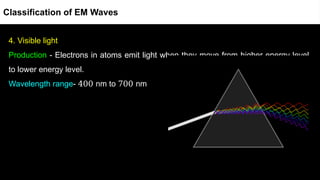
4. Visible light
Production - Electrons in atoms emit light when they move from higher energy level
to lower energy level.
Wavelength range- 400 nm to 700 nm
Classification of EM Waves
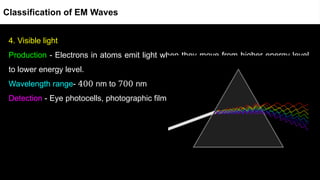
4. Visible light
Production - Electrons in atoms emit light when they move from higher energy level
to lower energy level.
Wavelength range- 400 nm to 700 nm
Detection - Eye photocells, photographic film
Classification of EM Waves
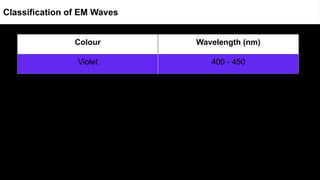
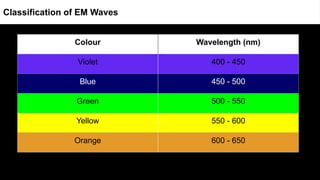
Colour Wavelength (nm)
Classification of EM Waves
Colour Wavelength (nm)
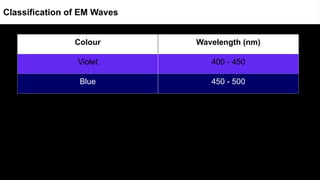
Violet 400 - 450
Classification of EM Waves
Colour Wavelength (nm)
Violet 400 - 450
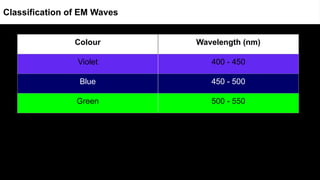
Blue 450 - 500
Classification of EM Waves
Colour Wavelength (nm)
Violet 400 - 450
Blue 450 - 500
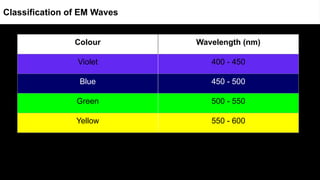
Green 500 - 550
Classification of EM Waves
Colour Wavelength (nm)
Violet 400 - 450
Blue 450 - 500
Green 500 - 550
Yellow 550 - 600
Classification of EM Waves
Colour Wavelength (nm)
Violet 400 - 450
Blue 450 - 500
Green 500 - 550
Yellow 550 - 600
Orange 600 - 650
Classification of EM Waves
Colour Wavelength (nm)
Violet 400 - 450
Blue 450 - 500
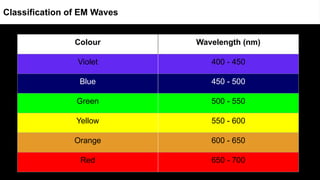
Green 500 - 550
Yellow 550 - 600
Orange 600 - 650
Red 650 - 700
Classification of EM Waves
Application of visible light
Visible light emitted or reflected from objects around us provides us information
about the world.
Classification of EM Waves
5. Ultraviolet rays
Classification of EM Waves
5. Ultraviolet rays
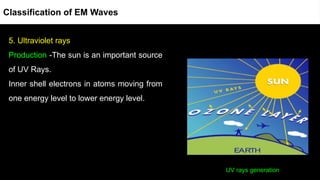
Production -The sun is an important source
of UV Rays.
Inner shell electrons in atoms moving from
one energy level to lower energy level.
UV rays generation
Classification of EM Waves
5. Ultraviolet rays
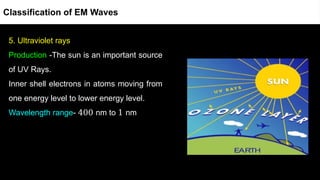
Production -The sun is an important source
of UV Rays.
Inner shell electrons in atoms moving from
one energy level to lower energy level.
Wavelength range- 400 nm to 1 nm
Classification of EM Waves
5. Ultraviolet rays
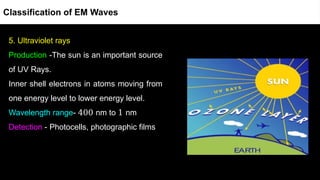
Production -The sun is an important source
of UV Rays.
Inner shell electrons in atoms moving from
one energy level to lower energy level.
Wavelength range- 400 nm to 1 nm
Detection - Photocells, photographic films
Classification of EM Waves
Application of Ultraviolet rays
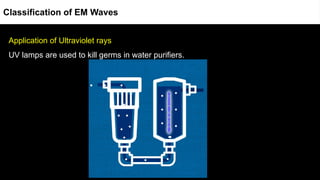
UV lamps are used to kill germs in water purifiers.
Classification of EM Waves
Application of Ultraviolet rays
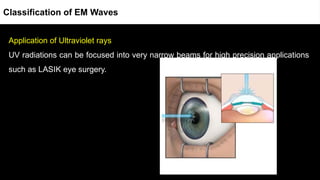
UV radiations can be focused into very narrow beams for high precision applications
such as LASIK eye surgery.
Classification of EM Waves
Application of Ultraviolet rays
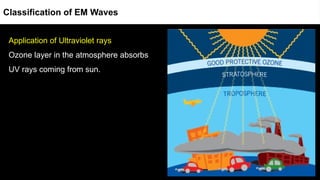
Ozone layer in the atmosphere absorbs
UV rays coming from sun.
Classification of EM Waves
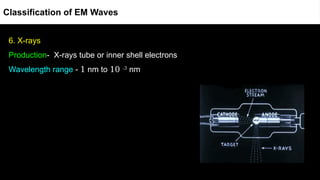
6. X-rays
Classification of EM Waves
6. X-rays
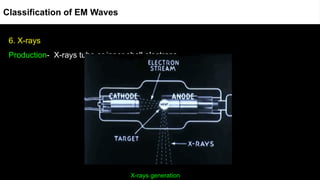
Production- X-rays tube or inner shell electrons
X-rays generation
Classification of EM Waves
6. X-rays
Production- X-rays tube or inner shell electrons
Wavelength range - 1 nm to 10 -3
nm
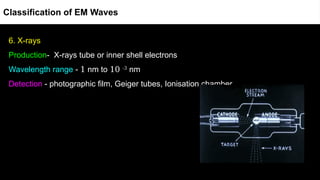
Classification of EM Waves
6. X-rays
Production- X-rays tube or inner shell electrons
Wavelength range - 1 nm to 10 -3
nm
Detection - photographic film, Geiger tubes, Ionisation chamber
Classification of EM Waves
Application of X-rays
X-rays are used as a diagnostic tool in medicine.
X-rays of body
Classification of EM Waves
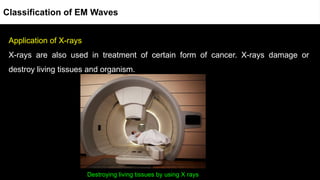
Application of X-rays
X-rays are also used in treatment of certain form of cancer. X-rays damage or
destroy living tissues and organism.
Destroying living tissues by using X rays
Classification of EM Waves
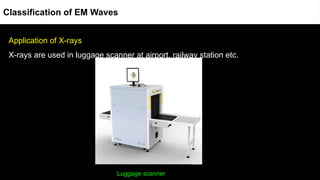
Application of X-rays
X-rays are used in luggage scanner at airport, railway station etc.
Luggage scanner
Classification of EM Waves
7. Gamma rays
Classification of EM Waves
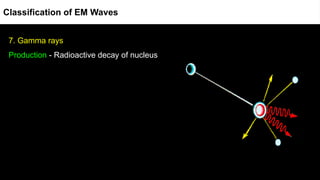
7. Gamma rays
Production - Radioactive decay of nucleus
Classification of EM Waves
7. Gamma rays
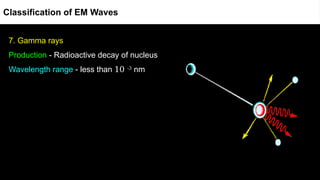
Production - Radioactive decay of nucleus
Wavelength range - less than 10 -3
nm
Classification of EM Waves
7. Gamma rays
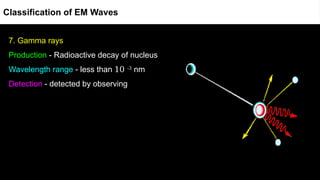
Production - Radioactive decay of nucleus
Wavelength range - less than 10 -3
nm
Detection - detected by observing
Classification of EM Waves
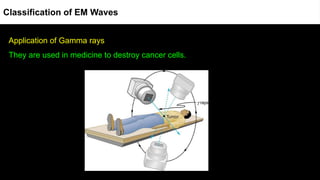
Application of Gamma rays
They are used in medicine to destroy cancer cells.
Classification of EM Waves
Application of Gamma rays
They are used in medicine to destroy cancer cells.
They are used to treat malignant tumours in radiotherapy.
Classification of EM Waves
Memory based question
Ready for challenge
Q. What type of waves are used to transmit cellular telephone messages?
(a) Gamma rays
(b) Microwaves
(c) Radio waves
(d) Visible light
Q. What type of waves are used to transmit cellular telephone messages?
(a) Gamma rays
(b) Microwaves
(c) Radio waves
(d) Visible light
Pause video
(Time duration : 2 minutes)
Q. What type of waves are used to transmit cellular telephone messages?
(a) Gamma rays
(b) Microwaves
(c) Radio waves
(d) Visible light
Sol.
(c) Radio waves
Memory based question
Ready for challenge
Q. Which of the following is correct in order of lowest to highest frequency?
(a) X-rays, visible light, microwaves
(b) Ultraviolet rays, visible light, gamma rays
(c) Microwaves,visible light, gamma rays
(d) Gamma rays, visible light, x rays
Q. Which of the following is correct in order of lowest to highest frequency?
(a) X-rays, visible light, microwaves
(b) Ultraviolet rays, visible light, gamma rays
(c) Microwaves,visible light, gamma rays
(d) Gamma rays, visible light, x rays
Pause video
(Time duration : 2 minutes)
Q. Which of the following is correct in order of lowest to highest frequency?
(a) X-rays, visible light, microwaves
(b) Ultraviolet rays, visible light, gamma rays
(c) Microwaves,visible light, gamma rays
(d) Gamma rays, visible light, x rays
Sol.
(c) Microwaves, visible light, gamma rays
Memory based question
Ready for challenge
Q. Why are radio waves used extensively for communication?
(a) Short wavelength
(b) High frequency
(c) High energy
(d) Long wavelength
Q. Why are radio waves used extensively for communication?
(a) Short wavelength
(b) High frequency
(c) High energy
(d) Long wavelength
Pause video
(Time duration : 2 minutes)
Q. Why are radio waves used extensively for communication?
(a) Short wavelength
(b) High frequency
(c) High energy
(d) Long wavelength
Sol.
(d) Long wavelength
Memory based question
Ready for challenge
Q. The energy of the EM Waves is of the order of 15 kev. Which part of the
spectrum does it belong
(a) X-rays
(b) Infrared rays
(c) Ultraviolet rays
(d) Gamma rays
Q. The energy of the EM Waves is of the order of 15 kev. Which part of the
spectrum does it belong
(a) X-rays
(b) Infrared rays
(c) Ultraviolet rays
(d) Gamma rays
Pause video
(Time duration : 2 minutes)
Q. The energy of the EM Waves is of the order of 15 kev. Which part of the
spectrum does it belong
(a) X-rays
(b) Infrared rays
(c) Ultraviolet rays
(d) Gamma rays
Sol.
(e) X-rays
Memory based question
Ready for challenge
Q. The condition under which a microwave oven heats up food containing water
molecules most efficiently is
(a) The frequency of the microwave must match the resonant frequency of
water molecules
(b) The frequency of the microwave has no relation with natural frequency of
water molecules
(c) Microwaves are heat waves , so always produce heat
(d) Infrared waves produce heating in a microwave oven
Q. The condition under which a microwave oven heats up food containing water
molecules most efficiently is
(a) The frequency of the microwave must match the resonant frequency of
water molecules
(b) The frequency of the microwave has no relation with natural frequency of
water molecules
(c) Microwaves are heat waves , so always produce heat
(d) Infrared waves produce heating in a microwave oven
Pause video
(Time duration : 2 minutes)
Q. The condition under which a microwave oven heats up food containing water
molecules most efficiently is
(a) The frequency of the microwave must match the resonant frequency of
water molecules
(b) The frequency of the microwave has no relation with natural frequency of
water molecules
(c) Microwaves are heat waves , so always produce heat
(d) Infrared waves produce heating in a microwave oven
Sol.
(e) The frequency of the microwave must match the resonant frequency of
water molecules
Memory based question
Ready for challenge
Q. The decreasing order of wavelength of infrared, microwave, ultraviolet rays and
Gamma rays is
(a) Gamma rays, Ultraviolet rays, Infrared rays, Microwaves
(b) Microwaves, Gamma rays, Ultraviolet rays, Infrared rays
(c) Infrared rays, Microwaves, Gamma rays, Ultraviolet rays
(d) Microwaves, Infrared rays, Ultraviolet rays, Gamma rays
Q. The decreasing order of wavelength of infrared, microwave, ultraviolet rays and
Gamma rays is
(a) Gamma rays, Ultraviolet rays, Infrared rays, Microwaves
(b) Microwaves, Gamma rays, Ultraviolet rays, Infrared rays
(c) Infrared rays, Microwaves, Gamma rays, Ultraviolet rays
(d) Microwaves, Infrared rays, Ultraviolet rays, Gamma rays
Pause video
(Time duration : 2 minutes)
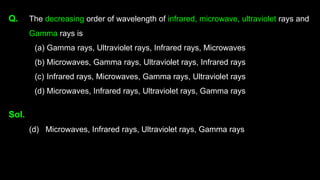
Q. The decreasing order of wavelength of infrared, microwave, ultraviolet rays and
Gamma rays is
(a) Gamma rays, Ultraviolet rays, Infrared rays, Microwaves
(b) Microwaves, Gamma rays, Ultraviolet rays, Infrared rays
(c) Infrared rays, Microwaves, Gamma rays, Ultraviolet rays
(d) Microwaves, Infrared rays, Ultraviolet rays, Gamma rays
Sol.
(d) Microwaves, Infrared rays, Ultraviolet rays, Gamma rays
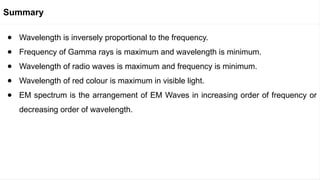
● Wavelength is inversely proportional to the frequency.
● Frequency of Gamma rays is maximum and wavelength is minimum.
● Wavelength of radio waves is maximum and frequency is minimum.
● Wavelength of red colour is maximum in visible light.
● EM spectrum is the arrangement of EM Waves in increasing order of frequency or
decreasing order of wavelength.
Summary

12P08electromagnetismadfgasdfsdfsdfsdfs.pptx

  • 1.
  • 2.
    Learning Objectives Displacement current Electromagneticwaves Electromagnetic spectrum 12P08-Electromagnetic Waves
  • 3.
  • 4.
    Learning Objectives Maxwell’s argument Maxwell’sexperiment Maxwell’s equation 12P08.1 Displacement current
  • 5.
  • 6.
    Effects of motionof a charge Motion of charge
  • 7.
    Effects of motionof a charge Motion of charge Stationary
  • 8.
    Effects of motionof a charge Motion of charge Stationary Electric field is generated
  • 9.
    Effects of motionof a charge Motion of charge Stationary Electric field is generated
  • 10.
    Effects of motionof a charge Motion of charge Stationary Moving with uniform motion Electric field is generated
  • 11.
    Effects of motionof a charge Motion of charge Stationary Moving with uniform motion Magnetic field is generated Electric field is generated
  • 12.
    Effects of motionof a charge Motion of charge Stationary Moving with uniform motion Magnetic field is generated Electric field is generated
  • 13.
    Effects of motionof a charge Motion of charge Stationary Moving with uniform motion Accelerated Magnetic field is generated Electric field is generated
  • 14.
    Effects of motionof a charge EM Waves are generated Motion of charge Stationary Moving with uniform motion Accelerated Magnetic field is generated Electric field is generated
  • 15.
    Current creates magneticfields. Maxwell’s argument Hans Oersted
  • 16.
    Current creates magneticfields. Maxwell’s argument Oersted's experiment Hans Oersted
  • 17.
    Magnetic field changingwith time gives rise to an electric field. Maxwell’s argument Michael Faraday
  • 18.
    Magnetic field changingwith time gives rise to an electric field. Maxwell’s argument Faraday’s law Michael Faraday
  • 19.
    Maxwell’s argument Is theconverse also true?
  • 20.
    Maxwell’s argument Is theconverse also true? J.C. Maxwell
  • 21.
    Maxwell’s argument Does thechange in electric field create magnetic field? J.C. Maxwell
  • 22.
    A time varyingelectric field can generate magnetic field. Maxwell’s argument
  • 23.
    A time varyingelectric field can generate magnetic field. Maxwell’s argument
  • 24.
    A time varyingelectric field can generate magnetic field. Maxwell’s argument Ic Ic
  • 25.
    A time varyingelectric field can generate magnetic field. Maxwell’s argument Ic Ic
  • 26.
    A time varyingelectric field can generate magnetic field. Maxwell’s argument Ic Ic
  • 27.
  • 28.
    Electric field Electric fieldchanging with time gives rise to a magnetic field. Maxwell’s argument
  • 29.
    Electric field Magneticfield Electric field changing with time gives rise to a magnetic field. Maxwell’s argument
  • 30.
    Electric field Magneticfield Electric field changing with time gives rise to a magnetic field. Maxwell’s argument Magnetic field changing with time gives rise to an electric field.
  • 31.
  • 32.
    Case 1: Maxwell’s Experiment Maxwell’sexperiment (outside the capacitor)
  • 33.
    Case 1: Maxwell’s experiment(outside the capacitor) Parallel Plate Capacitor
  • 34.
    Case 1: Maxwell’s experiment(outside the capacitor) Parallel Plate Capacitor Compass is outside
  • 35.
    Case 1: Maxwell’s experiment(outside the capacitor) Parallel Plate Capacitor Compass is outside Compass gets deflected
  • 36.
    Case 1: Maxwell’s experiment(outside the capacitor) Parallel Plate Capacitor Compass is outside Compass gets deflected Magnetic field is present
  • 37.
    Apply Ampere’s law Maxwell’sexperiment (outside the capacitor) Closed loop Parallel Plate Capacitor
  • 38.
    Apply Ampere’s law Maxwell’sexperiment (outside the capacitor) Closed loop Parallel Plate Capacitor
  • 39.
    Apply Ampere’s law Maxwell’sexperiment (outside the capacitor) Closed loop Parallel Plate Capacitor
  • 40.
    Apply Ampere’s law Maxwell’sexperiment (outside the capacitor) Closed loop Parallel Plate Capacitor
  • 41.
    Maxwell’s experiment (insidethe capacitor) Maxwell’s Experiment Case 2:
  • 42.
    Maxwell’s experiment (insidethe capacitor) Parallel Plate Capacitor Case 2:
  • 43.
    Case 2: Maxwell’s experiment(inside the capacitor) Parallel Plate Capacitor Compass is inside
  • 44.
    Case 2: Maxwell’s experiment(inside the capacitor) Parallel Plate Capacitor Compass is inside Compass gets deflected
  • 45.
    Case 2: Maxwell’s experiment(inside the capacitor) Parallel Plate Capacitor Compass is inside Compass gets deflected Magnetic field is present
  • 46.
    Case 2: Maxwell’s experiment(inside the capacitor) Parallel Plate Capacitor Compass is inside Compass gets deflected Magnetic field is present Current is present
  • 47.
    Closed loop Maxwell’s experiment(inside the capacitor) 4.31 Parallel Plate Capacitor Apply Ampere’s law
  • 48.
    Closed loop Maxwell’s experiment(inside the capacitor) 4.31 Apply Ampere’s law Parallel Plate Capacitor
  • 49.
    Closed loop Maxwell’s experiment(inside the capacitor) Parallel Plate Capacitor Apply Ampere’s law
  • 50.
    Closed loop Maxwell’s experiment(inside the capacitor) Apply Ampere’s law Parallel Plate Capacitor
  • 51.
    Change in electricfield produces magnetic field which suggest presence of current that is called displacement current. Maxwell’s experiment (Conclusion) I c I c Parallel plate capacitor
  • 52.
    Change in electricfield produces magnetic field which suggest presence of current that is called displacement current. Maxwell’s experiment (Conclusion) I c I c
  • 53.
    Change in electricfield produces magnetic field which suggest presence of current that is called displacement current. Maxwell’s experiment (Conclusion) I c I c
  • 54.
    Change in electricfield produces magnetic field which suggest presence of current that is called displacement current. Maxwell’s experiment (Conclusion) Id I c I c
  • 55.
    Using Gauss’s lawflux passing through plates Displacement current Parallel Plate Capacitor Closed loop
  • 56.
    Using Gauss’s lawflux passing through plates Displacement current Parallel Plate Capacitor Closed loop
  • 57.
    Using Gauss’s lawflux passing through plates Displacement current Parallel Plate Capacitor Closed loop
  • 58.
    Using Gauss’s lawflux passing through plates Displacement current Parallel Plate Capacitor Closed loop
  • 59.
    Using Gauss’s lawflux passing through plates Displacement current Parallel Plate Capacitor Closed loop
  • 60.
    Using Gauss’s lawflux passing through plates Displacement current Parallel Plate Capacitor Closed loop
  • 61.
  • 62.
  • 63.
  • 64.
  • 65.
  • 66.
  • 67.
  • 68.
    Displacement current Parallel Plate Capacitor Closedloop Total current Id = 0 Ic = 0 Id = Ic Id
  • 69.
  • 70.
  • 71.
    Maxwell Ampere’s law WhereIc = Conduction current Displacement current
  • 72.
    Maxwell Ampere’s law WhereIc = Conduction current Id = Displacement current Displacement current
  • 73.
    Definition Current flowing betweenthe capacitor plates without motion of charges is called displacement current. Displacement current between capacitor plates Displacement current
  • 74.
    Definition Current flowing betweenthe capacitor plates without motion of charges is called displacement current. Current arises due to changing of electric field. Displacement current
  • 75.
    Definition Current flowing betweenthe capacitor plates without motion of charges is called displacement current. Current arises due to changing of electric field. Displacement current Displacement current
  • 76.
    Definition Current flowing betweenthe capacitor plates without motion of charges is called displacement current. Current arises due to changing of electric field. Displacement current Displacement current
  • 77.
    Definition Current flowing betweenthe capacitor plates without motion of charges is called displacement current. Current arises due to changing of electric field. Displacement current Displacement current
  • 78.
  • 79.
    Q. The chargeon a parallel plate capacitor varies as . The plates are very large and close together (Area = A, Separation = d). Neglecting the edge effect find the displacement current through the capacitor?
  • 80.
    Q. The chargeon a parallel plate capacitor varies as . The plates are very large and close together (Area = A, Separation = d). Neglecting the edge effect find the displacement current through the capacitor? Pause video (Time duration : 2 minutes)
  • 81.
  • 82.
  • 83.
  • 84.
  • 85.
  • 86.
  • 87.
  • 88.
  • 89.
  • 90.
  • 91.
    1. (Gauss’s Lawfor electrostatics) Electric field exists due to charge. Maxwell’s Equation
  • 92.
    1. (Gauss’s Lawfor electrostatics) Electric field exists due to charge. 2. (Gauss’s Law for magnetism) Magnetic field lines form closed loop. Maxwell’s Equation
  • 93.
    3. (Faraday’s Law) Electricfield is generated due to change of magnetic field. Maxwell’s Equation
  • 94.
    3. (Faraday’s Law) Electricfield is generated due to change of magnetic field. 4. (Maxwell-Ampere’s Law) Magnetic field generates due to change of electric field. Maxwell’s Equation
  • 95.
  • 96.
  • 97.
    Q. Figure showsa capacitor made of two circular plate each of radius 12 cm , and separated by 5.0 cm . The capacitor is being charged by an external source (not shown in figure). The charging current is constant and equal to 0.15 A . Parallel plate capacitor
  • 98.
    Q. Figure showsa capacitor made of two circular plate each of radius 12 cm , and separated by 5.0 cm . The capacitor is being charged by an external source (not shown in figure). The charging current is constant and equal to 0.15 A . (a) Calculate the capacitance and the rate of change of potential difference between the plates. Parallel plate capacitor
  • 99.
    Q. Figure showsa capacitor made of two circular plate each of radius 12 cm , and separated by 5.0 cm . The capacitor is being charged by an external source (not shown in figure). The charging current is constant and equal to 0.15 A . (a) Calculate the capacitance and the rate of change of potential difference between the plates. (b) Obtain the displacement current across the plates. Parallel plate capacitor
  • 100.
    Q. Figure showsa capacitor made of two circular plate each of radius 12 cm , and separated by 5.0 cm . The capacitor is being charged by an external source (not shown in figure). The charging current is constant and equal to 0.15 A . (a) Calculate the capacitance and the rate of change of potential difference between the plates. (b) Obtain the displacement current across the plates. (c) Is Kirchhoff's first rule valid at each plate of the capacitor ? Explain it. Parallel plate capacitor
  • 101.
    Sol. (a) Capacitance ofthe Parallel plate capacitor Separation d = 5 cm Radius of plate r = 12 cm Parallel plate capacitor
  • 102.
    Sol. (a) Capacitance ofthe Parallel plate capacitor Separation d = 5 cm Radius of plate r = 12 cm Parallel plate capacitor
  • 103.
    Sol. (a) Capacitance ofthe Parallel plate capacitor Separation d = 5 cm Radius of plate r = 12 cm Parallel plate capacitor
  • 104.
    Sol. (a) Capacitance ofthe Parallel plate capacitor Separation d = 5 cm Radius of plate r = 12 cm Parallel plate capacitor
  • 105.
    Sol. (a) Capacitance ofthe Parallel plate capacitor Separation d = 5 cm Radius of plate r = 12 cm Parallel plate capacitor
  • 106.
    Rate of changeof potential difference = = ?
  • 107.
    Rate of changeof potential difference = = ? Given I = 0.15 A
  • 108.
    Rate of changeof potential difference = = ? Given I = 0.15 A
  • 109.
    Rate of changeof potential difference = = ? Given I I = 0.15 A
  • 110.
    Rate of changeof potential difference = = ? Given I I I = 0.15 A
  • 111.
    Rate of changeof potential difference = = ? Given I I I I = 0.15 A
  • 112.
  • 113.
  • 114.
  • 115.
  • 116.
  • 117.
  • 118.
  • 119.
    (c) Is Kirchhoff'sfirst rule valid at each plate of the capacitor ? Explain it. Yes, kirchoff’s law is valid at each plate of capacitor.
  • 120.
    (c) Is Kirchhoff'sfirst rule valid at each plate of the capacitor ? Explain it. Yes, kirchoff’s law is valid at each plate of capacitor. As we know that kirchoff’s law states that algebraic sum of currents at any junction of circuit must be zero.
  • 121.
    (c) Is Kirchhoff'sfirst rule valid at each plate of the capacitor ? Explain it. Yes, kirchoff’s law is valid at each plate of capacitor. As we know that kirchoff’s law states that algebraic sum of currents at any junction of circuit must be zero. At point A apply kirchoff’s law Ic Ic Id A Parallel plate capacitor
  • 122.
    (c) Is Kirchhoff'sfirst rule valid at each plate of the capacitor ? Explain it. Yes, kirchoff’s law is valid at each plate of capacitor. As we know that kirchoff’s law states that algebraic sum of currents at any junction of circuit must be zero. At point A apply kirchoff’s law Ic Ic Id A
  • 123.
    (c) Is Kirchhoff'sfirst rule valid at each plate of the capacitor ? Explain it. Yes, kirchoff’s law is valid at each plate of capacitor. As we know that kirchoff’s law states that algebraic sum of currents at any junction of circuit must be zero. At point A apply kirchoff’s law Ic Ic Id A
  • 124.
    (c) Is Kirchhoff'sfirst rule valid at each plate of the capacitor ? Explain it. Yes, kirchoff’s law is valid at each plate of capacitor. As we know that kirchoff’s law states that algebraic sum of currents at any junction of circuit must be zero. At point A apply kirchoff’s law Ic Ic Id A
  • 125.
    ● Displacement currenthas same effect as the conduction current. ● The displacement current may be zero since the electric field does not change with time. ● In charging capacitor both the displacement and conduction current may be present in different regions of space. ● Electric field changing with time gives rise to magnetic field and consequently displacement current is the source of magnetic field. ● Displacement current is given as Summary
  • 126.
  • 127.
    Learning Objectives What isEM Waves Source and Nature of EM Waves Properties of EM Waves 12P08.2 Electromagnetic waves
  • 128.
  • 129.
    What is EMWaves What is Wave? Disturbance that travels through a medium or without medium, transporting energy from one location to another location without transporting medium. Wave
  • 130.
    Types of waves (i)Longitudinal Waves:- Particle of waves are displaced along the direction of propagation of wave. 130 What is EM Waves
  • 131.
    Types of waves (i)Longitudinal Waves:- Particle of waves are displaced along the direction of propagation of wave. Example : Sound waves 131 What is EM Waves Longitudinal wave
  • 132.
    (ii) Transverse Waves:-Particles of waves are displaced perpendicular to the direction of propagation. What is EM Waves
  • 133.
    (ii) Transverse Waves:-Particles of waves are displaced perpendicular to the direction of propagation. Example : Waves of guitar’s string What is EM Waves Transverse wave
  • 134.
    Definition of Electromagneticwaves What is EM Waves
  • 135.
    What is EMWaves Definition of Electromagnetic waves Electric field, magnetic field and direction of propagation of wave are mutually perpendicular. Propagation direction Z
  • 136.
    What is EMWaves Definition of Electromagnetic waves Electric field, magnetic field and direction of propagation of wave are mutually perpendicular. Electromagnetic waves are non material waves. Propagation direction Z
  • 137.
    What is EMWaves Definition of Electromagnetic waves Electric field, magnetic field and direction of propagation of wave are mutually perpendicular. Electromagnetic waves are non material waves. Z Y X Z
  • 138.
    How EM Wavesare produced? An accelerated or oscillated charge generates EM Waves. 138 ret What is EM Waves Y X Z Z
  • 139.
  • 140.
  • 141.
  • 142.
    http://www.mysearch.org.uk/website1/images/animations/472.emwave.gif Oscillating Charge Oscillating ElectricField Oscillating Magnetic Field Oscillating Electric Field What is EM Waves
  • 143.
  • 144.
    Oscillating Magnetic Field OscillatingElectric Field What is EM Waves
  • 145.
    Oscillating magnetic field Oscillatingelectric field EM Waves What is EM Waves Oscillating Magnetic Field Oscillating Electric Field
  • 146.
  • 147.
    Q. A planeEM Waves travels in vacuum along z - direction. What can you say about the directions of its electric and magnetic field vectors?
  • 148.
    Q. A planeEM Waves travels in vacuum along z - direction. What can you say about the directions of its electric and magnetic field vectors? Pause video (Time duration : 2 minutes)
  • 149.
    Q. A planeEM Waves travels in vacuum along z - direction. What can you say about the directions of its electric and magnetic field vectors? Sol. Electric field and magnetic field are in x-y plane and perpendicular to each other as shown below in figure.
  • 150.
    Q. A planeEM Waves travels in vacuum along z - direction. What can you say about the directions of its electric and magnetic field vectors? Sol. Electric field and magnetic field are in x-y plane and perpendicular to each other as shown below in figure. Z X Y Propagation direction
  • 151.
    Q. A planeEM Waves travels in vacuum along z - direction. What can you say about the directions of its electric and magnetic field vectors? Sol. Electric field and magnetic field are in x-y plane and perpendicular to each other as shown below in figure. E or B or E Velocity of wave Z X Y X Y Z Propagation direction
  • 152.
  • 153.
    Source of Electromagneticwaves: Source of electromagnetic wave is a vibrating or accelerating charge or oscillating charge. Source and Nature of EM Waves
  • 154.
    Source of Electromagneticwaves: Source of electromagnetic wave is a vibrating or accelerating charge or oscillating charge. Source and Nature of EM Waves Change in Electric Field
  • 155.
    Source of Electromagneticwaves: Source of electromagnetic wave is a vibrating or accelerating charge or oscillating charge. Source and Nature of EM Waves Change in Electric Field Change in Magnetic Field
  • 156.
    Source of Electromagneticwaves: Source of electromagnetic wave is a vibrating or accelerating charge or oscillating charge. Source and Nature of EM Waves Change in Electric Field Change in Magnetic Field
  • 157.
    Nature of EMWaves EM Waves are transverse and non material waves . Source and Nature of EM Waves
  • 158.
    Equation of electromagneticwaves Source and Nature of EM Waves Representation of EMW Z Propagation direction
  • 159.
    Equation of electromagneticwaves Source and Nature of EM Waves Z Propagation direction
  • 160.
    Equation of electromagneticwaves Source and Nature of EM Waves Z Propagation direction
  • 161.
    Equation of electromagneticwaves Here = angular frequency(rad/sec) ⍵ Source and Nature of EM Waves Z Propagation direction
  • 162.
    Equation of electromagneticwaves Here = angular frequency(rad/sec) ⍵ k = magnitude of wave vector Source and Nature of EM Waves Z Propagation direction
  • 163.
    Equation of electromagneticwaves Here = angular frequency(rad/sec) ⍵ k = magnitude of wave vector λ = wavelength of EMWs Source and Nature of EM Waves Z Propagation direction
  • 164.
    Equation of electromagneticwaves Here = angular frequency(rad/sec) ⍵ k = magnitude of wave vector λ = wavelength of EMWs z = propagation direction Source and Nature of EM Waves Z Propagation direction
  • 165.
    Equation of electromagneticwaves Here = angular frequency(rad/sec) ⍵ k = magnitude of wave vector λ = wavelength of EMWs z = propagation direction t = specific time Source and Nature of EM Waves Z Propagation direction
  • 166.
    c = speedof electromagnetic wave = speed of light = 3 × 10⁸ m/sec Source and Nature of EM Waves
  • 167.
    Magnitude of wavepropagation vector Source and Nature of EM Waves
  • 168.
    Relationship between permittivity( 𝟄0 ) of free space and magnetic permeability of free space ( 𝝻0 ) Source and Nature of EM Waves
  • 169.
    For any othermaterial the velocity of EM Waves Source and Nature of EM Waves
  • 170.
    For any othermaterial the velocity of EM Waves Source and Nature of EM Waves
  • 171.
    For any othermaterial the velocity of EM Waves Where 𝟄 and 𝝻 are permittivity and permeability of material respectively. Source and Nature of EM Waves
  • 172.
  • 173.
    Q. The sourceof EM Waves can be a charge (a) Moving with a constant velocity (b) Moving in a circular orbit (c) At rest (d) Falling in an electric field
  • 174.
    Q. The sourceof EM Waves can be a charge (a) Moving with a constant velocity (b) Moving in a circular orbit (c) At rest (d) Falling in an electric field Pause video (Time duration : 2 minutes)
  • 175.
    Q. The sourceof EM Waves can be a charge (a) Moving with a constant velocity (b) Moving in a circular orbit (c) At rest (d) Falling in an electric field Sol. (b) Moving in a circular orbital ( In circular motion a particle is having centripetal acceleration so it can be a source of EM Waves ) (d) Falling in an electric field (In electric field a charge particle is experienced force so that it gets accelerated, so it can be a source EM Waves)
  • 176.
  • 177.
    Q. Which physicalquantity is same for X- rays of wavelength 10 -10 m , red light of wavelength 6800 Å and radio waves of wavelength 500 m ? (a) Velocity (b) Frequency (c) Amplitude (d) acceleration
  • 178.
    Q. Which physicalquantity is same for X- rays of wavelength 10 -10 m , red light of wavelength 6800 Å and radio waves of wavelength 500 m ? (a) Velocity (b) Frequency (c) Amplitude (d) acceleration Pause video (Time duration : 2 minutes)
  • 179.
    Q. Which physicalquantity is same for X- rays of wavelength 10 -10 m , red light of wavelength 6800 Å and radio waves of wavelength 500 m ? Sol. (a) Velocity
  • 180.
  • 181.
    Q. A radiocan tune in to any station in the 7.5 MHz to 12 MHz band. What is the corresponding wavelength band?
  • 182.
    Q. A radiocan tune in to any station in the 7.5 MHz to 12 MHz band. What is the corresponding wavelength band? Pause video (Time duration : 2 minutes)
  • 183.
    Q. A radiocan tune in to any station in the 7.5 MHz to 12 MHz band. What is the corresponding wavelength band? Sol. We know that
  • 184.
    Q. A radiocan tune in to any station in the 7.5 MHz to 12 MHz band. What is the corresponding wavelength band? Sol. We know that
  • 185.
    Q. A radiocan tune in to any station in the 7.5 MHz to 12 MHz band. What is the corresponding wavelength band? Sol. We know that
  • 186.
    Q. A radiocan tune in to any station in the 7.5 MHz to 12 MHz band. What is the corresponding wavelength band? Sol. We know that
  • 187.
    Q. A radiocan tune in to any station in the 7.5 MHz to 12 MHz band. What is the corresponding wavelength band? Sol. We know that
  • 188.
    Q. A radiocan tune in to any station in the 7.5 MHz to 12 MHz band. What is the corresponding wavelength band? Sol. We know that So that corresponding wavelength band 40 m to 25 m.
  • 189.
  • 190.
    Q. A chargedparticle oscillates about its mean equilibrium position with a frequency of 109 Hz. what is the frequency of the electromagnetic waves produced by the oscillator?
  • 191.
    Q. A chargedparticle oscillates about its mean equilibrium position with a frequency of 109 Hz. what is the frequency of the electromagnetic waves produced by the oscillator? Pause video (Time duration : 2 minutes)
  • 192.
    Q. A chargedparticle oscillates about its mean equilibrium position with a frequency of 109 Hz. what is the frequency of the electromagnetic waves produced by the oscillator? Sol. Frequency of Electromagnetic wave must be equal to the frequency of oscillation of charged particle. So frequency of EM Waves is 10 9 Hz.
  • 193.
  • 194.
    Properties of EMWaves Electromagnetic waves are transverse in nature.Properties of EMWs Transverse wave
  • 195.
    Speed of EMWaves is equal to the speed of light. Properties of EM Waves
  • 196.
    Speed of EMWaves is equal to the speed of light. c = speed of wave in vacuum = 3 × 10 8 m/s Characteristics of EMW Properties of EM Waves
  • 197.
    Speed of EMWaves is equal to the speed of light. c = speed of wave in vacuum = 3 × 10 8 m/s λ = wavelength of EM Waves Characteristics of EMW Properties of EM Waves
  • 198.
    Speed of EMWaves is equal to the speed of light. c = speed of wave in vacuum = 3 × 10 8 m/s λ = wavelength of EM Waves A = amplitude of wave Characteristics of EMW Properties of EM Waves
  • 199.
    Speed of EMWaves is equal to the speed of light. c = speed of wave in vacuum = 3 × 10 8 m/s λ = wavelength of EM Waves A = amplitude of wave 𝝂 = frequency of wavelength Characteristics of EMW Properties of EM Waves
  • 200.
    Velocity of EMWaves Properties of EM Waves
  • 201.
    Relationship between magnitudeof electric field and magnetic field Properties of EM Waves
  • 202.
    Relationship between magnitudeof electric field and magnetic field Where E0 = Maximum value of electric field Properties of EM Waves
  • 203.
    Relationship between magnitudeof electric field and magnetic field Where E0 = Maximum value of electric field B0 = Maximum value of magnetic field Properties of EM Waves
  • 204.
    Poynting vector:- Therate of flow of energy in an electromagnetic wave per unit area per unit second is called poynting vector. Properties of EM Waves
  • 205.
    Poynting vector:- Therate of flow of energy in an electromagnetic wave per unit area per unit second is called poynting vector. Representation of poynting vector Properties of EM Waves
  • 206.
    Poynting vector:- Therate of flow of energy in an electromagnetic wave per unit area per unit second is called poynting vector. Representation of poynting vector in circuit Properties of EM Waves
  • 207.
    Poynting vector:- Therate of flow of energy in an electromagnetic wave per unit area per unit second is called poynting vector. Representation of poynting vector in circuit Properties of EM Waves
  • 208.
    Poynting vector:- Therate of flow of energy in an electromagnetic wave per unit area per unit second is called poynting vector. SI Unit of S is watt / m2 . Representation of poynting vector in circuit Properties of EM Waves
  • 209.
    The electric vectoris responsible for optical effect of electromagnetic waves. Properties of EM Waves
  • 210.
    The electric vectoris responsible for optical effect of electromagnetic waves. Because moving particle oscillates primarily due to the electric field. Properties of EM Waves
  • 211.
    The energy inan electromagnetic wave is equally divided in electric vector and magnetic vector. Properties of EM Waves
  • 212.
    The energy inan electromagnetic wave is equally divided in electric vector and magnetic vector. Energy distribution in EMWs Properties of EM Waves
  • 213.
    The Average energydensity of electric field Properties of EM Waves
  • 214.
    The Average energydensity of magnetic field Properties of EM Waves
  • 215.
    Intensity of EMWaves is defined as the energy crossing per unit area per unit time perpendicular to the propagation of electromagnetic wave. Properties of EM Waves
  • 216.
    Intensity of EMWsis defined as the energy crossing per unit area per unit time perpendicular to the propagation of electromagnetic wave. Properties of EM Waves
  • 217.
    The existence ofEM Waves was confirmed by Hertz in 1888. Heinrich hertz Properties of EM Waves
  • 218.
    Total momentum deliveredto surface by EM Waves Properties of EM Waves
  • 219.
    Total momentum deliveredto surface by EM Waves p = Total momentum delivered Properties of EM Waves
  • 220.
    Total momentum deliveredto surface by EM Waves p = Total momentum delivered U = Total energy of EM Waves Properties of EM Waves
  • 221.
    Total momentum deliveredto surface by EM Waves p = Total momentum delivered U = Total energy of EM Waves c = Speed of light Properties of EM Waves
  • 222.
  • 223.
    Q. The amplitudeof the magnetic field part of a harmonic electromagnetic wave in vacuum is 510 nT. What is the amplitude of the electric field part of the wave?
  • 224.
    Q. The amplitudeof the magnetic field part of a harmonic electromagnetic wave in vacuum is 510 nT. What is the amplitude of the electric field part of the wave? Pause video (Time duration : 2 minutes)
  • 225.
    Q. The amplitudeof the magnetic field part of a harmonic electromagnetic wave in vacuum is 510 nT. What is the amplitude of the electric field part of the wave? Sol. Given B0 = 510 nT
  • 226.
    Q. The amplitudeof the magnetic field part of a harmonic electromagnetic wave in vacuum is 510 nT. What is the amplitude of the electric field part of the wave? Sol. Given B0 = 510 nT
  • 227.
    Q. The amplitudeof the magnetic field part of a harmonic electromagnetic wave in vacuum is 510 nT. What is the amplitude of the electric field part of the wave? Sol. Given B0 = 510 nT
  • 228.
    Q. The amplitudeof the magnetic field part of a harmonic electromagnetic wave in vacuum is 510 nT. What is the amplitude of the electric field part of the wave? Sol. Given B0 = 510 nT
  • 229.
    Q. The amplitudeof the magnetic field part of a harmonic electromagnetic wave in vacuum is 510 nT. What is the amplitude of the electric field part of the wave? Sol. Given B0 = 510 nT
  • 230.
    Reference Questions NCERT :Example 8.2, 8.3, 8.4, 8.5
  • 231.
  • 232.
    Q. Suppose thatthe electric field amplitude of an electromagnetic wave is E0 = 120 N/C and that its frequency is f = 50 MHz.
  • 233.
    Q. Suppose thatthe electric field amplitude of an electromagnetic wave is E0 = 120 N/C and that its frequency is f = 50 MHz. (a) Determine B0, 𝟂, k and λ.
  • 234.
    Q. Suppose thatthe electric field amplitude of an electromagnetic wave is E0 = 120 N/C and that its frequency is f = 50 MHz. (a) Determine B0, 𝟂, k and λ. (b) Find expression for E and B.
  • 235.
    Q. Suppose thatthe electric field amplitude of an electromagnetic wave is E0 = 120 N/C and that its frequency is f = 50 MHz. (a) Determine B0, 𝟂, k and λ. (b) Find expression for E and B. Pause video (Time duration : 2 minutes)
  • 236.
    Sol. (a) Magnitude ofmagnetic field vector Given E0 = 120 N/C f = 50 MHz
  • 237.
    Sol. (a) Magnitude ofmagnetic field vector Given E0 = 120 N/C f = 50 MHz
  • 238.
    Sol. (a) Magnitude ofmagnetic field vector Given E0 = 120 N/C f = 50 MHz
  • 239.
    Sol. (a) Magnitude ofmagnetic field vector Given E0 = 120 N/C f = 50 MHz
  • 240.
    Sol. (a) Magnitude ofmagnetic field vector Given E0 = 120 N/C f = 50 MHz
  • 241.
  • 242.
  • 243.
  • 244.
  • 245.
    Sol. Wavelength Given E0= 120 N/C f = 50 MHz
  • 246.
    Sol. Wavelength Given E0= 120 N/C f = 50 MHz
  • 247.
    Sol. Wavelength Given E0= 120 N/C f = 50 MHz
  • 248.
    Sol. Wavelength Given E0= 120 N/C f = 50 MHz
  • 249.
    Sol. Magnitude ofpropagation vector Given E0 = 120 N/C f = 50 MHz
  • 250.
    Sol. Magnitude ofpropagation vector Given E0 = 120 N/C f = 50 MHz
  • 251.
    Sol. Magnitude ofpropagation vector Given E0 = 120 N/C f = 50 MHz
  • 252.
    Sol. Magnitude ofpropagation vector Given E0 = 120 N/C f = 50 MHz
  • 253.
    E0 = 120 N/C f= 50 MHz Sol. (b) Expression of electric field Given
  • 254.
    Sol. (b) Expression ofelectric field Given E0 = 120 N/C f = 50 MHz
  • 255.
    Sol. (b) Expression ofelectric field Given E0 = 120 N/C f = 50 MHz
  • 256.
    Sol. Expression of magneticfield Given E0 = 120 N/C f = 50 MHz
  • 257.
    Sol. Expression of magneticfield Given E0 = 120 N/C f = 50 MHz
  • 258.
    Sol. Expression of magneticfield Given E0 = 120 N/C f = 50 MHz
  • 259.
  • 260.
    Q. A parallelplate capacitor made of circular plates each of radius R = 6 cm has a capacitance C = 100 pF. The capacitor is connected to a 230 V AC supply with an angular frequency of 300 rad / sec .
  • 261.
    Q. A parallelplate capacitor made of circular plates each of radius R = 6 cm has a capacitance C = 100 pF. The capacitor is connected to a 230 V AC supply with an angular frequency of 300 rad / sec . (a) What is the rms value of the conduction current?
  • 262.
    Q. A parallelplate capacitor made of circular plates each of radius R = 6 cm has a capacitance C = 100 pF. The capacitor is connected to a 230 V AC supply with an angular frequency of 300 rad / sec . (a) What is the rms value of the conduction current? (b) Is the conduction equal to the displacement current?
  • 263.
    Sol. Given radiusR = 6 cm C = 100 pF 𝞈 = 300 rad / sec Vrms= 230 V
  • 264.
    Sol. Given We knowthat for an LC circuit radius R = 6 cm C = 100 pF 𝞈 = 300 rad / sec Vrms= 230 V
  • 265.
    Sol. Given We knowthat for an LC circuit radius R = 6 cm C = 100 pF 𝞈 = 300 rad / sec Vrms= 230 V
  • 266.
    Sol. Given We knowthat for an LC circuit radius R = 6 cm C = 100 pF 𝞈 = 300 rad / sec Vrms= 230 V
  • 267.
    Sol. Given We knowthat for an LC circuit radius R = 6 cm C = 100 pF 𝞈 = 300 rad / sec Vrms= 230 V
  • 268.
    Sol. Given We knowthat for an LC circuit radius R = 6 cm C = 100 pF 𝞈 = 300 rad / sec Vrms= 230 V
  • 269.
    (b) Is theconduction equal to the displacement current? Sol. (b) Yes, because from the formula of displacement current, we can get conduction current without changing the dimension.
  • 270.
  • 271.
    Q. In aplane electromagnetic wave, the electric field oscillates sinusoidally at a frequency of 2.0 × 10 10 Hz and amplitude 48 V/m.
  • 272.
    Q. In aplane electromagnetic wave, the electric field oscillates sinusoidally at a frequency of 2.0 × 10 10 Hz and amplitude 48 V/m. (a) What is the wavelength of the wave?
  • 273.
    Q. In aplane electromagnetic wave, the electric field oscillates sinusoidally at a frequency of 2.0 × 10 10 Hz and amplitude 48 V/m. (a) What is the wavelength of the wave? (b) What is the amplitude of the oscillating magnetic field?
  • 274.
    Q. In aplane electromagnetic wave, the electric field oscillates sinusoidally at a frequency of 2.0 × 10 10 Hz and amplitude 48 V/m. (a) What is the wavelength of the wave? (b) What is the amplitude of the oscillating magnetic field? (c) Show that the average energy density of the E field equals the average energy density of the B field. [c = 3 × 10 8 m s-1 ]
  • 275.
    Sol. (a) Wavelength Given 𝜈 =2.0 × 10 10 E0 = 48 V/m
  • 276.
    Sol. (a) Wavelength Given 𝜈 =2.0 × 10 10 E0 = 48 V/m
  • 277.
    Sol. (a) Wavelength Given 𝜈 =2.0 × 10 10 E0 = 48 V/m
  • 278.
    Sol. (a) Wavelength Given 𝜈 =2.0 × 10 10 E0 = 48 V/m
  • 279.
    Sol. (b) Amplitude ofmagnetic field vector Given 𝜈 = 2.0 × 10 10 E0 = 48 V/m
  • 280.
    Sol. (b) Amplitude ofmagnetic field vector Given 𝜈 = 2.0 × 10 10 E0 = 48 V/m
  • 281.
    Sol. (b) Amplitude ofmagnetic field vector Given 𝜈 = 2.0 × 10 10 E0 = 48 V/m
  • 282.
    Sol. (b) Amplitude ofmagnetic field vector Given 𝜈 = 2.0 × 10 10 E0 = 48 V/m
  • 283.
    Sol. (b) Amplitude ofmagnetic field vector Given 𝜈 = 2.0 × 10 10 E0 = 48 V/m
  • 284.
    Sol. (c) Energydensity in electric field
  • 285.
    Sol. (c) Energydensity in electric field Energy density in magnetic field
  • 286.
    Sol. (c) Energydensity in electric field Energy density in magnetic field
  • 287.
    Sol. (c) Energydensity in electric field Energy density in magnetic field
  • 288.
    Sol. (c) Energydensity in electric field Energy density in magnetic field
  • 289.
    Sol. (c) Energydensity in electric field Energy density in magnetic field
  • 290.
    Sol. (c) Energydensity in electric field Energy density in magnetic field
  • 291.
    Sol. (c) Energydensity in electric field Energy density in magnetic field
  • 292.
    Sol. (c) Energydensity in electric field Energy density in magnetic field
  • 293.
    ● EM Wavesare non material waves and transverse in nature. ● EM Waves travel at the speed of light. ● EM Waves are in sinusoidal form. ● EM Waves are produced due to vibrating or accelerating or oscillating charges. ● Expression of electric field ● Expression of magnetic field ● Speed of EM Waves Summary
  • 294.
  • 295.
    Learning objectives What isEM Spectrum? Classification of EM Waves 12P08.3 Electromagnetic Spectrum
  • 296.
  • 297.
    The arrange arrayof electromagnetic radiation in the sequence of their wavelength or frequency is called Electromagnetic spectrum. What is EM spectrum
  • 298.
    The arrange arrayof electromagnetic radiation in the sequence of their wavelength or frequency is called Electromagnetic spectrum. This consists electromagnetic energy ranging from Gamma Rays to Radio waves. What is EM spectrum
  • 299.
    What is EMspectrum Electromagnetic spectrum
  • 300.
    Radio Waves Microwave Waves Infrared Waves Visible Rays UV Rays X-Rays Gamma Rays Whatis EM spectrum Relationship between Energy, Wavelength and Frequency for Electromagnetic spectrum
  • 301.
    Radio Waves Microwave Waves Infrared Waves Visible Rays UV Rays X-Rays Gamma Rays Wavelength(λ) What is EM spectrum Relationship between Energy, Wavelength and Frequency for Electromagnetic spectrum
  • 302.
    Radio Waves Microwave Waves Infrared Waves Visible Rays UV Rays X-Rays Gamma Rays Wavelength(λ) Energy (E) What is EM spectrum Relationship between Energy, Wavelength and Frequency for Electromagnetic spectrum Wavelength (λ)
  • 303.
    Radio Waves Microwave Waves Infrared Waves Visible Rays UV Rays X-Rays Gamma Rays Wavelength(λ) Energy (E) Frequency (f) What is EM spectrum Relationship between Energy, Wavelength and Frequency for Electromagnetic spectrum Wavelength (λ)
  • 304.
  • 305.
    Q. Which electromagneticwave has the shortest wavelength and highest frequency ? (a) Gamma rays (b) Radio waves (c) X-rays (d) Ultraviolet rays
  • 306.
    Q. Which electromagneticwave has the shortest wavelength and highest frequency ? (a) Gamma rays (b) Radio waves (c) X-rays (d) Ultraviolet rays Pause video (Time duration : 2 minutes)
  • 307.
    Q. Which electromagneticwave has the shortest wavelength and highest frequency ? (a) Gamma rays (b) Radio waves (c) X-rays (d) Ultraviolet rays Sol. (e) Gamma rays
  • 308.
  • 309.
    Q. Electromagnetic wavesthat you can see are called (a) Infrared rays (b) Microwaves (c) X-rays (d) Visible light
  • 310.
    Q. Electromagnetic wavesthat you can see are called (a) Infrared rays (b) Microwaves (c) X-rays (d) Visible light Pause video (Time duration : 2 minutes)
  • 311.
    Q. Electromagnetic wavesthat you can see are called (a) Infrared rays (b) Microwaves (c) X-rays (d) Visible light Sol. (d) Visible light
  • 312.
  • 313.
    Q. Longest wavelengthof spectrum (a) Radio waves (b) Ultraviolet rays (c) Visible light (d) Microwaves
  • 314.
    Q. Longest wavelengthof spectrum (a) Radio waves (b) Ultraviolet rays (c) Visible light (d) Microwaves Pause video (Time duration : 2 minutes)
  • 315.
    Q. Longest wavelengthof spectrum (a) Radio waves (b) Ultraviolet rays (c) Visible light (d) Microwaves Sol. (e) Radio waves
  • 316.
  • 317.
    Q. Which colourhas the shortest wavelength in visible light? (a) Red (b) Violet (c) Blue (d) Green
  • 318.
    Q. Which colourhas the shortest wavelength in visible light? (a) Red (b) Violet (c) Blue (d) Green Pause video (Time duration : 2 minutes)
  • 319.
    Q. Which colourhas the shortest wavelength in visible light? (a) Red (b) Violet (c) Blue (d) Green Sol. (b) Violet
  • 320.
  • 321.
  • 322.
    1. Radio waves Production- Due to accelerated charge in wire or antena Classification of EM Waves
  • 323.
    1. Radio waves Production- Due to accelerated charge in wire or antena Wavelength range - Greater than 0.1 m Classification of EM Waves
  • 324.
    1. Radio waves Production- Due to accelerated charge in wire or antena Wavelength range - Greater than 0.1 m Detection- Receiver’s Aerial Classification of EM Waves
  • 325.
  • 326.
    Application of Radiowaves Radio waves are used in radio and television communication systems. Classification of EM Waves
  • 327.
    Application of Radiowaves Radio waves are used in radio and television communication systems. Radio waves are used in Cellular phones to transmit voice communication in the ultrahigh frequency band. Classification of EM Waves
  • 328.
  • 329.
    2. Microwaves Production -Klystron valve or magnetron valve Microwave oven Classification of EM Waves
  • 330.
    2. Microwaves Production -Klystron valve or magnetron valve Wavelength range - 0.1 m to 1 mm Classification of EM Waves
  • 331.
    2. Microwaves Production -Klystron valve or magnetron valve Wavelength range - 0.1 m to 1 mm Detection - Point contact diodes Classification of EM Waves
  • 332.
    Application of microwaves Theyare suitable for the radar systems used in aircraft navigation. Classification of EM Waves
  • 333.
    Application of microwaves Theyare suitable for the radar systems used in aircraft navigation. Microwave oven is an interesting domestic application of these waves. Classification of EM Waves
  • 334.
  • 335.
    3. Infrared rays Production- Vibration of atoms and molecules Infrared wireless communication Infrared rays generation Classification of EM Waves
  • 336.
    3. Infrared rays Production- Vibration of atoms and molecules Wavelength range - 1 mm to 700 nm Infrared wireless communication Classification of EM Waves
  • 337.
    3. Infrared rays Production- Vibration of atoms and molecules Wavelength range - 1 mm to 700 nm Detection - Infrared photographic film Infrared wireless communication Classification of EM Waves
  • 338.
    Application of Infraredrays Infrared lamps are used in physical therapy. Classification of EM Waves
  • 339.
    Application of Infraredrays Infrared lamps are used in physical therapy. Infrared rays maintain the earth’s temperature. Classification of EM Waves
  • 340.
    Application of Infraredrays Infrared lamps are used in physical therapy. Infrared rays maintain the earth’s temperature. Infrared detectors are used in earth satellites, both for military purpose and to observe the growth of crops. Classification of EM Waves
  • 341.
    Application of Infraredrays Infrared lamps are used in physical therapy. Infrared rays maintain the earth’s temperature. Infrared detectors are used in earth satellites, both for military purpose and to observe the growth of crops. Electronic devices also emit infrared rays and widely used in the remote switches of household electronic systems such as TV sets, video recorders, and wi-fi systems. Classification of EM Waves
  • 342.
  • 343.
    4. Visible light Production- Electrons in atoms emit light when they move from higher energy level to lower energy level. Spectrum of visible light Classification of EM Waves
  • 344.
    4. Visible light Production- Electrons in atoms emit light when they move from higher energy level to lower energy level. Wavelength range- 400 nm to 700 nm Classification of EM Waves
  • 345.
    4. Visible light Production- Electrons in atoms emit light when they move from higher energy level to lower energy level. Wavelength range- 400 nm to 700 nm Detection - Eye photocells, photographic film Classification of EM Waves
  • 346.
  • 347.
    Colour Wavelength (nm) Violet400 - 450 Classification of EM Waves
  • 348.
    Colour Wavelength (nm) Violet400 - 450 Blue 450 - 500 Classification of EM Waves
  • 349.
    Colour Wavelength (nm) Violet400 - 450 Blue 450 - 500 Green 500 - 550 Classification of EM Waves
  • 350.
    Colour Wavelength (nm) Violet400 - 450 Blue 450 - 500 Green 500 - 550 Yellow 550 - 600 Classification of EM Waves
  • 351.
    Colour Wavelength (nm) Violet400 - 450 Blue 450 - 500 Green 500 - 550 Yellow 550 - 600 Orange 600 - 650 Classification of EM Waves
  • 352.
    Colour Wavelength (nm) Violet400 - 450 Blue 450 - 500 Green 500 - 550 Yellow 550 - 600 Orange 600 - 650 Red 650 - 700 Classification of EM Waves
  • 353.
    Application of visiblelight Visible light emitted or reflected from objects around us provides us information about the world. Classification of EM Waves
  • 354.
  • 355.
    5. Ultraviolet rays Production-The sun is an important source of UV Rays. Inner shell electrons in atoms moving from one energy level to lower energy level. UV rays generation Classification of EM Waves
  • 356.
    5. Ultraviolet rays Production-The sun is an important source of UV Rays. Inner shell electrons in atoms moving from one energy level to lower energy level. Wavelength range- 400 nm to 1 nm Classification of EM Waves
  • 357.
    5. Ultraviolet rays Production-The sun is an important source of UV Rays. Inner shell electrons in atoms moving from one energy level to lower energy level. Wavelength range- 400 nm to 1 nm Detection - Photocells, photographic films Classification of EM Waves
  • 358.
    Application of Ultravioletrays UV lamps are used to kill germs in water purifiers. Classification of EM Waves
  • 359.
    Application of Ultravioletrays UV radiations can be focused into very narrow beams for high precision applications such as LASIK eye surgery. Classification of EM Waves
  • 360.
    Application of Ultravioletrays Ozone layer in the atmosphere absorbs UV rays coming from sun. Classification of EM Waves
  • 361.
  • 362.
    6. X-rays Production- X-raystube or inner shell electrons X-rays generation Classification of EM Waves
  • 363.
    6. X-rays Production- X-raystube or inner shell electrons Wavelength range - 1 nm to 10 -3 nm Classification of EM Waves
  • 364.
    6. X-rays Production- X-raystube or inner shell electrons Wavelength range - 1 nm to 10 -3 nm Detection - photographic film, Geiger tubes, Ionisation chamber Classification of EM Waves
  • 365.
    Application of X-rays X-raysare used as a diagnostic tool in medicine. X-rays of body Classification of EM Waves
  • 366.
    Application of X-rays X-raysare also used in treatment of certain form of cancer. X-rays damage or destroy living tissues and organism. Destroying living tissues by using X rays Classification of EM Waves
  • 367.
    Application of X-rays X-raysare used in luggage scanner at airport, railway station etc. Luggage scanner Classification of EM Waves
  • 368.
  • 369.
    7. Gamma rays Production- Radioactive decay of nucleus Classification of EM Waves
  • 370.
    7. Gamma rays Production- Radioactive decay of nucleus Wavelength range - less than 10 -3 nm Classification of EM Waves
  • 371.
    7. Gamma rays Production- Radioactive decay of nucleus Wavelength range - less than 10 -3 nm Detection - detected by observing Classification of EM Waves
  • 372.
    Application of Gammarays They are used in medicine to destroy cancer cells. Classification of EM Waves
  • 373.
    Application of Gammarays They are used in medicine to destroy cancer cells. They are used to treat malignant tumours in radiotherapy. Classification of EM Waves
  • 374.
  • 375.
    Q. What typeof waves are used to transmit cellular telephone messages? (a) Gamma rays (b) Microwaves (c) Radio waves (d) Visible light
  • 376.
    Q. What typeof waves are used to transmit cellular telephone messages? (a) Gamma rays (b) Microwaves (c) Radio waves (d) Visible light Pause video (Time duration : 2 minutes)
  • 377.
    Q. What typeof waves are used to transmit cellular telephone messages? (a) Gamma rays (b) Microwaves (c) Radio waves (d) Visible light Sol. (c) Radio waves
  • 378.
  • 379.
    Q. Which ofthe following is correct in order of lowest to highest frequency? (a) X-rays, visible light, microwaves (b) Ultraviolet rays, visible light, gamma rays (c) Microwaves,visible light, gamma rays (d) Gamma rays, visible light, x rays
  • 380.
    Q. Which ofthe following is correct in order of lowest to highest frequency? (a) X-rays, visible light, microwaves (b) Ultraviolet rays, visible light, gamma rays (c) Microwaves,visible light, gamma rays (d) Gamma rays, visible light, x rays Pause video (Time duration : 2 minutes)
  • 381.
    Q. Which ofthe following is correct in order of lowest to highest frequency? (a) X-rays, visible light, microwaves (b) Ultraviolet rays, visible light, gamma rays (c) Microwaves,visible light, gamma rays (d) Gamma rays, visible light, x rays Sol. (c) Microwaves, visible light, gamma rays
  • 382.
  • 383.
    Q. Why areradio waves used extensively for communication? (a) Short wavelength (b) High frequency (c) High energy (d) Long wavelength
  • 384.
    Q. Why areradio waves used extensively for communication? (a) Short wavelength (b) High frequency (c) High energy (d) Long wavelength Pause video (Time duration : 2 minutes)
  • 385.
    Q. Why areradio waves used extensively for communication? (a) Short wavelength (b) High frequency (c) High energy (d) Long wavelength Sol. (d) Long wavelength
  • 386.
  • 387.
    Q. The energyof the EM Waves is of the order of 15 kev. Which part of the spectrum does it belong (a) X-rays (b) Infrared rays (c) Ultraviolet rays (d) Gamma rays
  • 388.
    Q. The energyof the EM Waves is of the order of 15 kev. Which part of the spectrum does it belong (a) X-rays (b) Infrared rays (c) Ultraviolet rays (d) Gamma rays Pause video (Time duration : 2 minutes)
  • 389.
    Q. The energyof the EM Waves is of the order of 15 kev. Which part of the spectrum does it belong (a) X-rays (b) Infrared rays (c) Ultraviolet rays (d) Gamma rays Sol. (e) X-rays
  • 390.
  • 391.
    Q. The conditionunder which a microwave oven heats up food containing water molecules most efficiently is (a) The frequency of the microwave must match the resonant frequency of water molecules (b) The frequency of the microwave has no relation with natural frequency of water molecules (c) Microwaves are heat waves , so always produce heat (d) Infrared waves produce heating in a microwave oven
  • 392.
    Q. The conditionunder which a microwave oven heats up food containing water molecules most efficiently is (a) The frequency of the microwave must match the resonant frequency of water molecules (b) The frequency of the microwave has no relation with natural frequency of water molecules (c) Microwaves are heat waves , so always produce heat (d) Infrared waves produce heating in a microwave oven Pause video (Time duration : 2 minutes)
  • 393.
    Q. The conditionunder which a microwave oven heats up food containing water molecules most efficiently is (a) The frequency of the microwave must match the resonant frequency of water molecules (b) The frequency of the microwave has no relation with natural frequency of water molecules (c) Microwaves are heat waves , so always produce heat (d) Infrared waves produce heating in a microwave oven Sol. (e) The frequency of the microwave must match the resonant frequency of water molecules
  • 394.
  • 395.
    Q. The decreasingorder of wavelength of infrared, microwave, ultraviolet rays and Gamma rays is (a) Gamma rays, Ultraviolet rays, Infrared rays, Microwaves (b) Microwaves, Gamma rays, Ultraviolet rays, Infrared rays (c) Infrared rays, Microwaves, Gamma rays, Ultraviolet rays (d) Microwaves, Infrared rays, Ultraviolet rays, Gamma rays
  • 396.
    Q. The decreasingorder of wavelength of infrared, microwave, ultraviolet rays and Gamma rays is (a) Gamma rays, Ultraviolet rays, Infrared rays, Microwaves (b) Microwaves, Gamma rays, Ultraviolet rays, Infrared rays (c) Infrared rays, Microwaves, Gamma rays, Ultraviolet rays (d) Microwaves, Infrared rays, Ultraviolet rays, Gamma rays Pause video (Time duration : 2 minutes)
  • 397.
    Q. The decreasingorder of wavelength of infrared, microwave, ultraviolet rays and Gamma rays is (a) Gamma rays, Ultraviolet rays, Infrared rays, Microwaves (b) Microwaves, Gamma rays, Ultraviolet rays, Infrared rays (c) Infrared rays, Microwaves, Gamma rays, Ultraviolet rays (d) Microwaves, Infrared rays, Ultraviolet rays, Gamma rays Sol. (d) Microwaves, Infrared rays, Ultraviolet rays, Gamma rays
  • 398.
    ● Wavelength isinversely proportional to the frequency. ● Frequency of Gamma rays is maximum and wavelength is minimum. ● Wavelength of radio waves is maximum and frequency is minimum. ● Wavelength of red colour is maximum in visible light. ● EM spectrum is the arrangement of EM Waves in increasing order of frequency or decreasing order of wavelength. Summary

Editor's Notes

  • #19 Maxwell argued that not only an electric current but also a time varying electric field can generate magnetic field.
  • #20 Maxwell argued that not only an electric current but also a time varying electric field can generate magnetic field.
  • #21 Maxwell argued that not only an electric current but also a time varying electric field can generate magnetic field.
  • #22 Maxwell argued that not only an electric current but also a time varying electric field can generate magnetic field.
  • #23 Maxwell argued that not only an electric current but also a time varying electric field can generate magnetic field.
  • #24 Maxwell argued that not only an electric current but also a time varying electric field can generate magnetic field.
  • #25 Maxwell argued that not only an electric current but also a time varying electric field can generate magnetic field.
  • #26 Maxwell argued that not only an electric current but also a time varying electric field can generate magnetic field.
  • #27 Maxwell argued that not only an electric current but also a time varying electric field can generate magnetic field.
  • #28 Maxwell argued that not only an electric current but also a time varying electric field can generate magnetic field.
  • #29 Maxwell argued that not only an electric current but also a time varying electric field can generate magnetic field.
  • #30 Maxwell argued that not only an electric current but also a time varying electric field can generate magnetic field.