Going to College
  & Staying Connected
  Communication Between College
    Freshmen and Their Parents


Madeline Smith, Mary Nguyen, Charles Lai,
       Gilly Leshed, & Eric Baumer
    CSCW 2012 – February 14, 2012
Common Life Changes


    • New job or school

    • Residential move

    • Relationship change


                            Image: Change by Rickydavid on flickr
Transitions Are Stressful


    • Transitions disrupt daily life


    • Many are associated with illness onset
      [Holmes &Rahe, 1967]


    • Such as loneliness & depression
      [Paykel et al., 1969]


                              Image: Depressed by Sander van der Wel on flickr
Social Support Can Help


    • People use coping measures
     [Billings & Moos, 1981]


    • Social support can buffer stress
     [Cohen & Wills, 1985]


    • Moving disrupts support networks
     [Shklovski et al., 2008]


                                Image: hug a mom (5 pts) by miguelavila on flickr
Going to College is a Big Change


    • Major turning point in students’ lives
      [Flanagan et al., 1993] [LaValle et al., 2011]


    • Friendships are changing
      [Cummings et al., 2006] [Ellison et al, 2007]


    • Relationships with parents can help
      [Wintre&Yaffe, 2000]


                                             Image: Dorm Life by borman818 on flickr
Families Communicate Online


    • Families are online and communicating
     [Check & Katz, 2009] [Yardi&Bruckman, 2011]


    • Students & parents are getting closer
     [Sax &Wartman, 2010] [Hofer, 2008]


    • Using tech to keep in touch after move
     [Gentzler et al., 2011]


                                Image: Facebook Demo by schramroyal on flickr
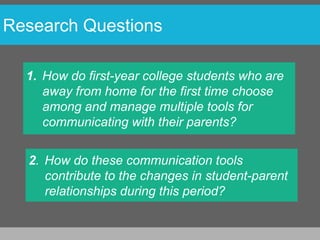
Research Questions

  1. How do first-year college students who are
     away from home for the first time choose
     among and manage multiple tools for
     communicating with their parents?

  2. How do these communication tools
     contribute to the changes in student-parent
     relationships during this period?
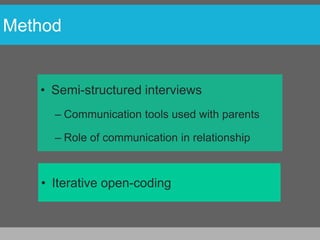
Method


   • Semi-structured interviews
     – Communication tools used with parents

     – Role of communication in relationship


   • Iterative open-coding
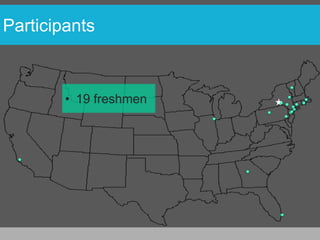
Participants


        • 19 freshmen
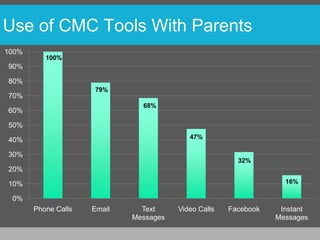
Use of CMC Tools With Parents
100%
          100%
90%

80%
                     79%
70%
                               68%
60%

50%

40%                                        47%

30%
                                                        32%
20%

10%                                                                16%

 0%
       Phone Calls   Email     Text     Video Calls   Facebook    Instant
                             Messages                            Messages
Research Questions

  1. How do first-year college students who are
     away from home for the first time choose
     among and manage multiple tools for
     communicating with their parents?
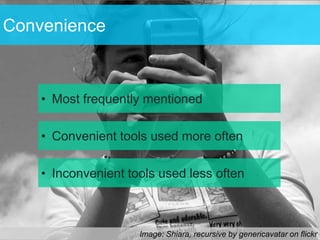
Convenience


    • Most frequently mentioned

    • Convenient tools used more often

    • Inconvenient tools used less often


                     Image: Shiara, recursive by genericavatar on flickr
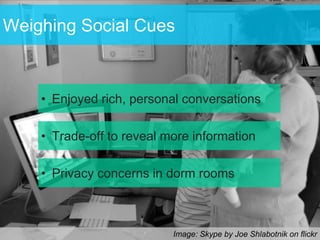
Weighing Social Cues


    • Enjoyed rich, personal conversations

    • Trade-off to reveal more information

    • Privacy concerns in dorm rooms


                           Image: Skype by Joe Shlabotnik on flickr
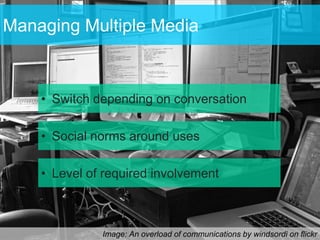
Managing Multiple Media


    • Switch depending on conversation

    • Social norms around uses

    • Level of required involvement


              Image: An overload of communications by windsordi on flickr
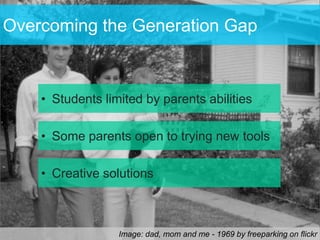
Overcoming the Generation Gap


    • Students limited by parents abilities

    • Some parents open to trying new tools

    • Creative solutions


                  Image: dad, mom and me - 1969 by freeparking on flickr
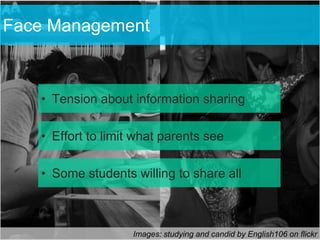
Face Management


   • Tension about information sharing

   • Effort to limit what parents see

   • Some students willing to share all


                    Images: studying and candid by English106 on flickr
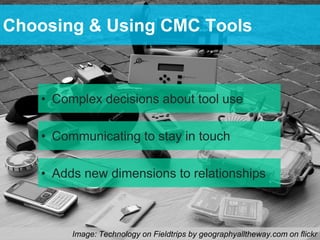
Choosing & Using CMC Tools


   • Complex decisions about tool use

   • Communicating to stay in touch

   • Adds new dimensions to relationships


        Image: Technology on Fieldtrips by geographyalltheway.com on flickr
Research Questions


  2. How do these communication tools
     contribute to the changes in student-parent
     relationships during this period?
Distance Changes Relationships


    • Student-parent dynamics changing

    • A few students felt nature unchanged

    • Some relationships improved


                        Image: Long Distance by Joe Thorn on flickr
“Normal” Relationships


    • Amount of communication

    • Compared to peers

    • Technology changes expectations


                   Image: Call Your Mom by Divine Madness on flickr
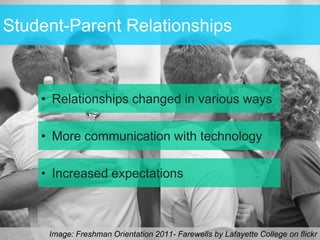
Student-Parent Relationships


    • Relationships changed in various ways

    • More communication with technology

    • Increased expectations


     Image: Freshman Orientation 2011- Farewells by Lafayette College on flickr
Summary


   • Tools used by students and parents

   • Student’s considerations for tools

   • Impact on relationships with parents


                         Image: DSC01116 by brent.holden on flickr
Implications


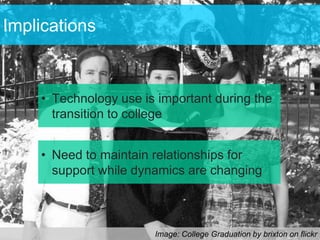
    • Technology use is important during the
      transition to college


    • Need to maintain relationships for
      support while dynamics are changing


                       Image: College Graduation by brixton on flickr
Moving Forward


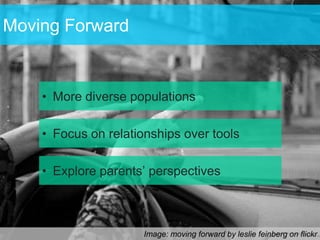
    • More diverse populations

    • Focus on relationships over tools

    • Explore parents’ perspectives


                      Image: moving forward by leslie feinberg on flickr
Thank you!


 Madeline E. Smith
mes369@cornell.edu

CSCW 2012: Going to College & Staying Connected

  • 1.
    Going to College & Staying Connected Communication Between College Freshmen and Their Parents Madeline Smith, Mary Nguyen, Charles Lai, Gilly Leshed, & Eric Baumer CSCW 2012 – February 14, 2012
  • 2.
    Common Life Changes • New job or school • Residential move • Relationship change Image: Change by Rickydavid on flickr
  • 3.
    Transitions Are Stressful • Transitions disrupt daily life • Many are associated with illness onset [Holmes &Rahe, 1967] • Such as loneliness & depression [Paykel et al., 1969] Image: Depressed by Sander van der Wel on flickr
  • 4.
    Social Support CanHelp • People use coping measures [Billings & Moos, 1981] • Social support can buffer stress [Cohen & Wills, 1985] • Moving disrupts support networks [Shklovski et al., 2008] Image: hug a mom (5 pts) by miguelavila on flickr
  • 5.
    Going to Collegeis a Big Change • Major turning point in students’ lives [Flanagan et al., 1993] [LaValle et al., 2011] • Friendships are changing [Cummings et al., 2006] [Ellison et al, 2007] • Relationships with parents can help [Wintre&Yaffe, 2000] Image: Dorm Life by borman818 on flickr
  • 6.
    Families Communicate Online • Families are online and communicating [Check & Katz, 2009] [Yardi&Bruckman, 2011] • Students & parents are getting closer [Sax &Wartman, 2010] [Hofer, 2008] • Using tech to keep in touch after move [Gentzler et al., 2011] Image: Facebook Demo by schramroyal on flickr
  • 7.
    Research Questions 1. How do first-year college students who are away from home for the first time choose among and manage multiple tools for communicating with their parents? 2. How do these communication tools contribute to the changes in student-parent relationships during this period?
  • 8.
    Method • Semi-structured interviews – Communication tools used with parents – Role of communication in relationship • Iterative open-coding
  • 9.
    Participants • 19 freshmen
  • 10.
    Use of CMCTools With Parents 100% 100% 90% 80% 79% 70% 68% 60% 50% 40% 47% 30% 32% 20% 10% 16% 0% Phone Calls Email Text Video Calls Facebook Instant Messages Messages
  • 11.
    Research Questions 1. How do first-year college students who are away from home for the first time choose among and manage multiple tools for communicating with their parents?
  • 12.
    Convenience • Most frequently mentioned • Convenient tools used more often • Inconvenient tools used less often Image: Shiara, recursive by genericavatar on flickr
  • 13.
    Weighing Social Cues • Enjoyed rich, personal conversations • Trade-off to reveal more information • Privacy concerns in dorm rooms Image: Skype by Joe Shlabotnik on flickr
  • 14.
    Managing Multiple Media • Switch depending on conversation • Social norms around uses • Level of required involvement Image: An overload of communications by windsordi on flickr
  • 15.
    Overcoming the GenerationGap • Students limited by parents abilities • Some parents open to trying new tools • Creative solutions Image: dad, mom and me - 1969 by freeparking on flickr
  • 16.
    Face Management • Tension about information sharing • Effort to limit what parents see • Some students willing to share all Images: studying and candid by English106 on flickr
  • 17.
    Choosing & UsingCMC Tools • Complex decisions about tool use • Communicating to stay in touch • Adds new dimensions to relationships Image: Technology on Fieldtrips by geographyalltheway.com on flickr
  • 18.
    Research Questions 2. How do these communication tools contribute to the changes in student-parent relationships during this period?
  • 19.
    Distance Changes Relationships • Student-parent dynamics changing • A few students felt nature unchanged • Some relationships improved Image: Long Distance by Joe Thorn on flickr
  • 20.
    “Normal” Relationships • Amount of communication • Compared to peers • Technology changes expectations Image: Call Your Mom by Divine Madness on flickr
  • 21.
    Student-Parent Relationships • Relationships changed in various ways • More communication with technology • Increased expectations Image: Freshman Orientation 2011- Farewells by Lafayette College on flickr
  • 22.
    Summary • Tools used by students and parents • Student’s considerations for tools • Impact on relationships with parents Image: DSC01116 by brent.holden on flickr
  • 23.
    Implications • Technology use is important during the transition to college • Need to maintain relationships for support while dynamics are changing Image: College Graduation by brixton on flickr
  • 24.
    Moving Forward • More diverse populations • Focus on relationships over tools • Explore parents’ perspectives Image: moving forward by leslie feinberg on flickr
  • 25.
    Thank you! MadelineE. Smith mes369@cornell.edu

Editor's Notes

  • #3 Changing jobs or schoolsMoving to a new citystarting or ending a romantic relationshipDeath of a loved oneAnd more!
  • #6  - major turning point in young people’s lives - friendships change - good relationships with parents can help ease the transition [Wintre & Yaffe] - technology makes maintaining relationships from a distance easier
  • #8 Our goals: exploratory study of student perspectives
  • #9 Semi-structured interviews - up to one hour with one researcher - took place in April 2011 (about 8months into college) - general questions about students, families, relationships - focus on comm tools used - also ask about role of comm tools in relationshipsAnalysis - audio recorded, partially transcribed - open-coded iteratively to identify themes presented
  • #10 19 participants (pseudonyms used here and in paper) - 16 female, 3 male - from US, moved to school (50->2000miles) - 11 parents married, 8 divorced
  • #11 Phone100%19Email79%15Text68%13VidCall47%9SNS32%6IM16%3also asked about: blogs, shared calendars, location-based, others
  • #12 We identified five themes related to this question: - convenience - social cues - generation gap - multiple media - face management
  • #13  - the most common consideration mentioned - cell phones considered convenient (chris talk while walking) - texting more than calling because of asynchronicity (maria ask questions) - used video calling less frequently because it required planning ahead
  • #14  - considered depth of tool and conversation needs - thought phone calls were more personal (matt – phone with benefits) - trade-off with richness and shared info (steph – tone on phone) - privacy in dorms was also an issue
  • #15  - frequently switched between multiple media - depending on conversation needs (Chris – faster answer via texting) - social norms around tool (email as formal or for sharing links) - level of involvement (kayla multitasking on skype)
  • #16  - students somewhat limited in choosing tools their parents could use - even tech-savvy pprents like allie’s programmer mom w/ webcam - parents also learned new tools to make it easier for students (chris) - other creative solutions (matt texting brother to ask mom a question)
  • #17  - tension between personal connections and privacy - awareness of daily activities good, if filtered - matt told friends to be careful what they post on his Facebook - leah not worried because her mom is “pretty chill” - kayla’s mom saw her gchat status and told her to go to bed
  • #18 we found that convenience, often correlated with mobility and accessibility, was a prominent factor in choosing which tool to use when contacting their parents. However, our findings highlight a number of additional factors, such as social cues afforded by the tools, the generation gap, and face management, all of which contributed to complex decisions and sets of practices in which each student uniquely engaged.Our results therefore emphasize the importance of communicating through technology not only for staying in touch with parents, but also adding new dimensions to the relationship and signifying willingness to adjust to the other sides’ abilities and needs.
  • #19 We identified two themes related to this question: - distance changes relationships - maintaining “normal” relationships
  • #20  - moving away helps some to connect (megan missed mom) - many were still figuring out the new relationship dynamics (hard for chris’s parents, julia wants more advice) - some felt relationship hadn’t changed (sarah, different but not all that much) - eight felt relationships improved (emily not being suffocated)
  • #21  - all thought more communication was better than less - how much varied widely (leah, multiple times per day, to steph, every few weeks) - often compared to friends, roommates and siblings (Erica friends more open) - felt they were expected to communicate more because of tech (matt)
  • #23 Contributions: - identified tools used by some students in this population - student’s considerations and preferences for choosing tools - impact of tools on relationships with parents
  • #24 Implications: - tech use important for transitioning to college (and likely other major life events) - need to consider kinds of support needed to maintain relationships while growing independence - ambivalence of communication during transition (good for support, possibly limiting growth)
  • #25 Limitations: - small sample size - homogeneous sample (all cornell students, all form US, 16 female) - one-sidedNext Steps - parent’s side of the story - more diverse students (international, male, community colleges, etc.) - focus on relationships -